IMPROVED SCHEME OF E-MAIL SPAM CLASSIFICATION USING META-HEURISTICS FEATURE SELECTION AND SUPPORT VECTOR
MACHINE
NADIR OMER FADL ELSSIED HAMED
A thesis submitted in fulfilment of the requirements for the award of the degree of
Doctor of Philosophy (Computer Science)
Faculty of Computing
Universiti Teknologi Malaysia
ACKNOWLEDGEMENT
“Praise be to Allah, the cherisher and the sustainer of the world”, “praise be
to him he who taught by the pen, taught man, that which he did not know”
First and foremost, my sincere thanks to God, who endowed me to complete this PhD thesis. I would like to thank my supervisor, Associate Professor Dr. Othman Ibrahim, for all your guidance, support, brilliant ideas, numerous hours of discussions, patience, and the opportunities you have presented me. Your managerial skills and uncompromising quest for excellence always motivated me to present the best of what I can. I wish to thank Associate Professor Dr. Ahmad Kamil bin Mahood and Professor Dr. Siti Mariyam binti Shamsuddin for accepting to review and examine my PhD thesis.
ABSTRACT
ABSTRAK
TABLE OF CONTENTS
CHAPTER TITLE PAGE
DECLARATION ii
DEDICATION iii
ACKNOWLEDGEMENT iv
ABSTRACT v
ABSTRAK vi
TABLE OF CONTENTS vii
LIST OF TABLES xii
LIST OF FIGURES xv
LIST OF ABBREVIATION xvii
LIST OF APPENDIX xix
1 INTRODUCTION 1
1.1 Introduction 1
1.2 Problem Background 3
1.3 Problem Statement 8
1.4 Research Questions 8
1.5 The Aim of the Study 9
1.6 Objectives of the Study 10
1.7 Scope of the Study 10
1.8 Significance of the Study 11 1.9 Research Contributions 12
2 LITERATURE REVIEW 16
2.1 Introduction 16
2.2 Reviewing of the E-mail 17 2 3 E-mail Spam and E-mail Spam Classification 19
2.3.1 E-mail Spam 19
2.3.2 E-mail Spam Classification 21
2.4 Feature Selection 28
2.5 Soft Computing (SC) 35
2.5.1 Evolutionary Computations (ECs) 37 2.5.1.1 Evolutionary Algorithm (EAs) 39 2.5.1.1.1 Differential Evolution (DE) 42 2.5.1.2 Swarm Intelligence (SI) 48 2.5.1.2.1 Particle Swarm Optimization 49 2.5.2 Hybrid Approaches of DE and PSO 52 2.5.3 Machine Learning for ECs 53 2.5.3.1 Opposition-Based Learning (OBL) 54 2.5.3.2 Adaptive OBL in ECs Algorithms 56 2.5.3.3 Implementing OBL in DE algorithm 57 2.5.3.4 Implementing OBL in PSO algorithm 57 2.6 Classification Algorithms for E-mail Spam 59 2.6.1 Support Vector Machine (SVM) 59 2.6.2 Naïve Bayes Algorithm 65 2.7 Preprocessing Method for E-mail classification 68 2.7.1 Term Frequency Inverse Document Frequency 68 2.7.2 Entropy Weighting Method 69 2.8 Significant Statistical Methods for E-mail Spam 70 2.8.1 T-test for Significance 71 2.8.2 Correlation Coefficient 73
2.9 General Discussion 74
3 METHODOLOGY 77
3.1 Introduction 77
3.2 An Overview of Research Design 78 3.3 Problem Situation and Solution Concept 78
3.4 Conceptual Framework 80
3.5 Experiment Dataset 82
3.5.1 Pre-processing Step 84 3.5.2 General Information about the Features 87 3.5.3 Normalization of the Dataset 88
3.6 Research Design 89
3.7 Performance Measures for E-mail Spam Classification 99 3.7. 1 Percentage of the Classification 99 3.7. 2 The Formula for Performance Measurement 101 3.7. 3 Error Percentage 102 3.7. 4 F-measure (F-score): 103
3.8 Evaluation Framework 103
3.9 Summary 104
4 FEATURE SELECTION BASED ON ONE-WAY
ANOVA F-TEST 106
4.1 Introduction 106
4.2 Proposed Feature Selection Scheme for E-mail Spam 106 4.2.1 P-Value Based on the F Statistic 107
4.2.2. Feature Subset Selection Based on Statistic 108 4.3 Result and Discussions 110
4.3.1 Experimental Results and Analysis 111 4.3.2 Validation of the proposed scheme 117 4.3.3 The Difference Between our Proposed scheme
and and other 118
4.4 Correlation Coefficient for significance test 119
5 FEATURE SELECTION BASED BINARY
DIFFERENTIAL EVOLUTION ALGORITHM 123
5.1 Introduction 123
5.2 Control Parameters and Objection Function 124 5.2.1 Control Parameters 124 5.2.2 Fitness Function 128 5.3 Binary Differential Evolution (BDE) 129 5.3.1 Feature Selection Procedure Based on BDE 132 5.4 Results and Discussions 134 5.4.1 Experimental Results and Analysis 135 5.4.2 Comparison with Others Methods 143 5.5 Statistical Testing using correlation coefficient 145
5.7 Summary 146
6 OPPOSITION DE AND OPPOSITION PSO
ALGORITHM BASED FEATURE SELECTION 149
6.1 Introduction 149
6.2 ML for E-mail Spam Classification 150 6.3 The Population and Swarm Status Initialization 152 6.4 The OBL for DE and PSO 153
6.5 The Material Used 158
6.5.1 Controls Parameters for DE and PSO 158 6.5.2 Binary Opposition PSO 159 6.5.3 Objective Function 161 6.5.4 The Modulator 162 6.5.5 The Selected Features 163 6.6 Results and Discussion 164 6.6.1 Experimental Results and Analysis 164 6.6.2 Comparison with Others Methods 175 6.7 Correlation coefficient as statistical testing 178
7 HYBRID PSO AND DE BINARY AS FEATURE
SELECTION 182
7.1 Introduction 182
7.2 Control Parameters and Fitness Function for DE 184 7.2.1 Control Parameters 185 7.2.2 The Proposed Methods 186 7.2.3 Fitness Function 187
7.3 Result and Discussion 188
7.3.1 Experimental Result and Analysis 188 7.3.2 Comparison with Others Methods 195 7.4 Correlation Coefficient for Statistical Testing 197
7.5 Summary 198
8 CONCLUSION AND FUTURE WORK 200
8.1 Introduction 200
8.2 Research Contributions 200
8.3 Future Work 202
References REFERENCES 203
Appendix A 220
LIST OF TABLES
TABLE NO. TITLE PAGE
2.1 Summary of the advantage and disadvantage of
collaborative-based and content-based classification. 24 2.2 Statistical Significant Testing Using t-test. 72 2.3 Statistical significant testing using correlation coefficient. 74 3.1 Summary of Problem Situations and Solution Concepts. 79 3.2 Show general information about spambase and spamassassin
datasets. 87
3.3 The truth table. 100
3.4 Evaluation schemes. 104
4.1 Part of the output from one way ANOVA as feature
selection. 110
4.2 Accuracy result based on SVM using full features. 112 4.3 Detailed of result based on SVM using full features. 112 4.4 Accuracy result after using SVM with reduced features. 114 4.5 Detailed of accuracy after using SVM with reduced features. 114 4.6 Summary of accuracy, false positive, false negative and
execution-time results. 115
4.7 Comparisons between different methods in term of accuracy. 117 4.8 Statistical significant testing using correlation coefficient. 120
5.1 DE Control Parameter Values. 128
5.2 The example result of the best values for 20 runs on
spambase dataset. 137
5.3 The example result of the best values for 20 runs on
5.4 Accuracy and execution time result based on BDE and SVM. 138 5.5 The result of classification after reducing the features. 139
5.6 The comparisons of improvement. 140
5.7 The comparisons of Accuracy among our proposed scheme
and others. 144
5.8 Statistical significant testing using correlation coefficient. 146 6.1 The control parameters values using in DE. 158 6.2 The control parameters values using in PSO. 159 6.3 The example result for ODE of the best values for 20 runs on
spambase dataset. 166
6.4 The example result for ODE of the best values for 20 runs on
spamassassin dataset. 166
6.5 The example result for OPSO of the best values for 20 runs
on spambase dataset. 168
6.6 The example result for OPSO of the best values for 20 runs
on spamassassin dataset. 168
6.7 The classification accuracy result after using BDE and ODE
with SVM as classifiers. 170
6.8 The classification accuracy result after using OPSO with
SVM as classifiers. 170
6.9 The comparisons of Accuracy, Recall, and F-measure using
different numbers of features based on SVM. 171 6.10 The comparisons of proposed Accuracy with other. 176 6.11 Statistical significant testing between SVM and ODE-SVM. 179 6.12 Statistical significant testing between SVM and OPSO-SVM. 179
7.1 Parameter setting used in DEPSO. 185
7.2 The example for PSODE of the best values for 20 runs on
spambase dataset. 190
7.3 The example result for PSODE of the best values for 20 runs
on spamassassin dataset. 190
7.4 The classification accuracy result after using DEPSO with
7.5 The Recall, precision, and F-measure result after using
DEPSO with SVM as classifiers. 193 7.6 The comparisons of Accuracy using different numbers of
features based on SVM. 193
7.7 The comparisons of Accuracy between our accuracy and
others. 195
7.8 Statistical significant testing between BDE-SVM and
LIST OF FIGURES
FIGURE NO. TITLE PAGE
1.1 Scenario leading to the problem. 6
2.1 The architecture of e-mail classification methods. 23
2.2 The spam classification methods. 25
2.3 Feature selection phase for classification. 26
2.4 The machine learning techniques. 27
2.5 Dimension reduction methods. 28
2.6 The roots and the different branches of soft computing. 37
2.7 General framework for EC. 39
2.8 The PSO phase. 51
2.9 T-Test statistics. 71
3.1 Conceptual research frameworks. 81
3.2 The spambase dataset. 83
3.3 The spamassassin dataset. 83
3.4 Process and procedure for one-way ANOVA F-test. 91 3.5 Process and procedure for BDE scheme. 93 3.6 General framework structure for ODE and OPSO. 96 3.7 General framework structure for DEPSO scheme. 98 4.1 Feature subset selection and SVM phase. 108 4.2 E-mail spam classifications with full spambase dataset
features. 111
4.3 E-mail spam classifications with reduced features. 113 4.4 Comparison between accuracy and execution-time. 116
4.5 The comparison of F-measure. 116
5.1 Process and procedure of our scheme. 131 5.2 Chromosome structure- feature positions. 133
5.3 Chromosome value modulation. 134
5.4 Training and testing result for SVM before improvement. 136 5.5 Training and testing result for SVM after using BDE. 139
5.6 Comparisons among our results. 141
5.7 Line comparisons among our results. 142 5.8 Comparisons among recall and F-measure with our results. 142 5.9 The comparisons among our results and others. 143 5.10 Comparisons among our result and others. 144 5.11 Line comparisons between our result and others. 145 6.1 The general process for the proposed schemes. 157 6.2 Training and testing result after using BDE. 165 6.3 Training and testing result for SVM after using ODE. 167 6.4 Training and testing result for SVM after using OPSO. 169 6.5 Comparisons among our proposed schemes. 172 6.6 Line comparisons among our results. 173 6.7 Comparisons among OPSO-SVM result and other. 174 6.8 Line to comparisons among OPSO-SVM results and other. 175 6.9 Comparisons among ODE-SVM result and other. 176 6.10 Line comparisons among ODE-SVM result and other. 177 6.11 Comparisons among our result and other. 177 6.12 Line comparisons between our result and other. 178 7.1 General process of our improve scheme. 183 7.2 Training and testing result for SVM after using DEPSO. 191 7.3 Training and testing result for SVM after using OPSO. 191
7.4 Comparisons among our results. 195
LIST OF ABBREVIATIONS
ACO - Ant Colony Optimization ACO - Ant Colony Optimization AI - Artificial Intelligence
BDE - Binary Differential Evolution CA - Collaborative Approach
CAI - Computational Artificial Intelligence CBA - Content-Based Approach
CBR - Case-Based Reasoning CC - Correlation Coefficient CV - Cross Validation DE - Differential Evolution DEPSO - DE and PSO
DF - Document Frequency DR - Dimension Reduction EAs - Evolutionary Algorithms ECs - Evolutionary Computations E-mail - Electronic Mail
EP - Evolutionary Programming ES - Evolutionary Strategies FN - False Negatives
FP - False Positive FS - Feature Selection FT - Feature Transformation GA - Genetic Algorithm IG - Information Gain
LDA - Linear Discriminant Analysis MI - Mutual Information
ML - Machine Learning MLP - Multi-Layer Perceptron NB - Naïve Bayes
OBL - Opposition-Based Learning ODE - Opposition Differential Evolution
OPSO - Opposition Particle Swarm Optimization PCA - principle Component Analysis
PSO - Particle Swarm Optimization RBF - Radial Basis Function
SA - Simulating Annealing SC - Soft Computing
SRDA - Spectral Regression Discriminant Analysis SVD - Singular Value Decomposition
SVM - Support Vector Machine TF - Term Frequency
TN - True Negative TP - True Positive TS - Term Strength
LIST OF APPENDIX
APPENDIX TITLE PAGE
INTRODUCTION
1.1 Introduction
improve their performance (Almeida et al., 2011; Yevseyeva et al., 2013). In addition, e-mail spam identification is a difficult task because spammers use tricks in order to avoid spam classifiers to ensure their delivery (Méndez et al., 2008; Sousa et al., 2013).
study is to evaluate how different feature subset selection schemes can affect the performance of learning algorithm such as SVM-based e-mail classification system via reducing the dimensionality of the feature space.
1.2 Problem Background
The increasing risk size of spam e-mail has become a serious issue and uncontrollable not only to the Internet, but also for users and for Internet Service Providers (ISPs) (Idris et al., 2014; Sathawane, 2013). Spam e-mail is an intrusion of privacy, with problematic content such as online fraud, phishing attacks or viruses (Méndez et al., 2008). Spam e-mail creates a serious threat to the security of networked systems and computer users everywhere (Islam and Yang, 2010). Furthermore, a large amount of space is occupied in user's mailbox, and there is no relation between spam message content and receivers (Alguliev et al., 2011; Pour et al., 2012). Further, users of e-mails are affected by spam e-mail due to time spent to distinguish between spam e-mail and non-spam e-mail (Guzella and Caminhas, 2009). The importance of safeguarding the Inbox mail against spam e-mail is an essential issue and e-mail spam classification plays an important role in ensuring a non-spam e-mail. Recently, the high increase of spam e-mail has become a challenge. The e-mail spam classification problem is growing because spammers will always find new ways to attack e-mail spam classifier due to the economic benefits of sending spam e-mail (Sathawane, 2013). Therefore, there is a need to develop spam e-mail classifiers that can effectively eliminate the increasing of spam e-mail automatically before the spam enters the user's mailbox (Chhabra et al., 2010). Among the approaches developed to combat spam e-mail, classification is an important and popular one (Zhang et al., 2014).
Content-Based Approach, (CBA) and some researchers have combined features from both of them to develop new approach (He et al., 2009b; Kuang et al., 2014; Sathawane, 2013; Sousa et al., 2010). The CA is based on sharing information about spam e-mails, while CBA uses a data mining classifier to analyze content (.e.g. word frequencies) (Cortez et al., 2012). The two approaches have their own drawbacks; CA often suffers from the sparsity of data although many techniques have been developed to improve this drawback. On the other hand, CBA behavior is dependent not only on the classifier learning capabilities, but also the type of FS method adopted (Sousa et al., 2013). In regards to e-mail spam classification, current research on CBA relies mainly on improving individual classifier performance via selecting the optimum subset features. The effectiveness of CBA e-mail spam classifier relies on the appropriate choice of the features (Méndez et al., 2006). The increasing importance of e-mail spam classification motivates various aspects of classification-related study that provide a new solution, which may not be achievable by conventional e-mail classification approaches. The main goal of e-mail spam classification is to pre-sort messages into two categories of spam e-mail and non-spam e-mail with a high accuracy rate and low execution time (Terri Oda, 2005). Although, there are many algorithms such as SVM that have been developed for e-mail spam classification problems, but the problem is still not being solved completely (Ashok and Shrivastav, 2014; Kumar et al., 2012).
classification, and some of them may be unimportant due to redundancy or may even be irrelevant. One of the fundamental motivations for feature selection is to overcome the problem of high dimensionality (Mendez et al., 2006). To overcome this problem, dimensionality reduction schemes have been proposed, which can reduce the number of irrelevant features in order to achieve higher classification accuracy (Wu et al., 2011b). Therefore, a wide variety of methods have been proposed in the literature in order to determine the most important features for classification (Aggarwal and Zhai, 2012). The correct Feature Selection (FS) approaches are a key challenge to improve the e-mail spam classification (Cortez et al., 2012). Also, the result of eliminating irrelevant and redundant features leads to an optimized classification process that is efficient and accurate (Yevseyeva et al., 2013). Nowadays the use of a finite subset of features to classify the e-mail as spam e-mail or non-spam e-mail is an important research topic (Kumar et al., 2012; Lai et al., 2009a; Yevseyeva et al., 2013).
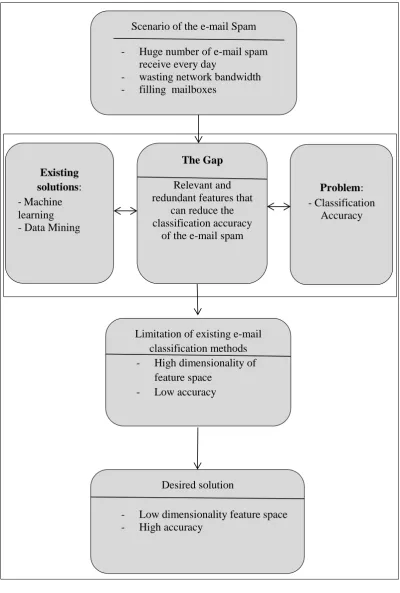
Desired solution
- Low dimensionality feature space
- High accuracy
Scenario of the e-mail Spam
- Huge number of e-mail spam receive every day
- wasting network bandwidth - filling mailboxes
The Gap
Relevant and redundant features that
can reduce the classification accuracy
of the e-mail spam
Limitation of existing e-mail classification methods - High dimensionality of
feature space
- Low accuracy
Figure 1.1 Scenario leading to the problem Existing
solutions: - Machine learning - Data Mining
Problem: - Classification
The problem of SVM with a high dimensional feature space and the large dataset classification still remains a challenge (Liu et al., 2013). Yet the problem of optimizing the SVM in terms of improving the classification accuracy is the subject of ongoing research (Zhang et al., 2012). The accuracy of SVM as a classifier was affected by the high dimensionality of features (number of variable) (Wang et al., 2005). For example Genetic Algorithm (GA) algorithm was adopted in the work of Wang et al (2005) to select the optimal subset feature. SVM algorithm has continuously received increasing attention from researchers in spam e-mail classification. Some research has been done in SVM with e-mail spam classification (Lai et al., 2009a; Lai and Wu, 2007). The conventional SVM algorithm is insufficient because it considers all e-mail features as equal in importance. All the e-mail features are used even if they have irrelevant or redundant features. There are different processes and methods used in order to enhance the accuracy and computational complexity of the learning algorithms such as SVM. Many researchers approach this problem of computational complexity and the classification accuracy via performance feature selection (Fagbola Temitayo, 2012; Maldonado and L’Huillier, 2013).
design and build better approaches by using ECs algorithm to select the optimal (near-optimal) subset features. Additionally, to differentiate between low and high features in terms of importance, researchers in this thesis consider the features that have emerged in order to obtain higher e-mail spam classification accuracy. Also, this study focuses on using feature subset selection schemes that help to select the subset features related to the performance of the e-mail classification system. The selection of the features is based upon some accuracy criteria, without significantly reducing the performance from the classifier system.
1.3 Problem Statement
Although several supervised algorithms have been widely used in e-mail spam classification, the problem of dealing with huge data and high dimensionality (many feature) is low accuracy as many researches are being carried out (Chhabra et al., 2010; Fagbola Temitayo, 2012; Morariu et al., 2006).
"A high dimensionality of the feature space based on a large number of irrelevant and redundant features can affect the classification accuracy of various supervised algorithms during run for e-mail spam classification".
1.4 Research Questions
This research is intended to deal with the problems related to e-mail spam classification. This research seeks to answer the following main question:
dimensionality of the feature space and increase the classification accuracy of e-mail spam classification?
In order to answer the main question raised above, the following sub-questions need to be addressed:
i. How can effectively eliminate the irrelevant and redundant features to reduce the high dimensionality of e-mail spam classification?
ii. What are the optimum features that could significantly improve the execution time for e-mail spam classification?
iii. How can OBL approach improve the DE and PSO algorithms in terms of enhancing the e-mail spam classification accuracy?
iv. How can the hybridization of PSO and DE as feature selections enhance the e-mail spam classification accuracy?
1.5 The Aim of the Study
1.6 Objectives of the Study
The main goal of this study is to proposed schemes to select an optimal feature and to improve the e-mail spam classification accuracy. The objectives of this study are:
i. To reduce the high dimensionality for e-mail spam classification based on one-way ANOVA F-test.
ii. To improve the execution time of e-mail spam classification based on BDE scheme as feature selection.
iii. To improve the accuracy of e-mail spam classification based on ODE and OPSO scheme.
iv. To improve hybrid scheme based on combination of PSO and DE for feature selection to enhance the accuracy of e-mail spam classification.
1.7 Scope of the Study
The scope of this study is to answer the research questions stated above in order to draw conclusions. Furthermore, the preceding section stated the objectives of this research which focus on how to produce an optimal (or near-optimal) e-mail spam classification schemes. The following aspects are the scope of the study for the stated objectives:
i. Binary e-mail spam classification (spam detection) due to the nature of e-mail datasets.
ii. Support Vector Machine (SVM) algorithm as classification algorithm due to popular algorithm that are used as classifiers for e-mail spam classification area.
iv. Binary Differential Evolution (BDE) algorithm to reduce the execution time for e-mail spam classification.
v. Improved Differential Evolution (DE) algorithm based on Opposition Based Learning (OBL) and Particle Swarm Optimization (PSO) algorithm to improve the accuracy of e-mail spam classification.
vi. Improved Particle Swarm Optimization (PSO) algorithm based on Opposition Based Learning (OBL) to improve the accuracy of e-mail spam classification. vii. Evaluation of the performance of the proposed schemes using two standards dataset: "spambase" and "spamassassin." These are obtained from the machine learning repository of the Center for Machine Learning and Intelligent.
viii. The accuracy, precision, F-measure, false positive, computational complexity (execution time) and recall were selected to measure and evaluate the systems generated.
ix. The statistical significant test (Pearson correlation coefficient) was used to measure the agreement level between the proposed and the other methods such as e-mail spam classification with SVM using all features.
1.8 Significance of the Study
August and averaged 75%, in addition to the Kaspersky Lab annual report the in which the total amount of spam in mail traffic was 78.5% (Bulletin, 2012; Wood, 2012).
1.9 Research Contributions
The contributions of this study are as follows:
i. An improved e-mail spam classification scheme using feature selection scheme based on one-way ANOVA and SVM as a classifier to remove the irrelevant and redundant features.
ii. An improved e-mail spam classification scheme using a significant feature selection based on binary DE and SVM as a classifier to reduce the high execution time.
iii. An improved e-mail spam classification scheme using OPSO and ODE to select the optimal (or near-optimal) features and SVM classifier to improve the accuracy of classification.
iv. An improved e-mail spam classification scheme using a feature selection based on hybrid (PSO and DE) and SVM classifier to improve the accuracy of classification.
1.10 Thesis Organization
Chapter 1: Introduction
The introductory chapter of this thesis provides a brief overview of some of the issues that are of concern to those working in the field of e-mail spam classification. This chapter will also look at the overview of the whole studies, the problem statements, research questions, aims, and the scope of this study as well as examining the contributions this research can make to the field of e-mail spam classification.
Chapter 2: Literature Review
This chapter provides background information and reviews of the related work in the area of e-mail spam classification. The chapter reviews recent surveys presented in the area. Since this study proposes ECs algorithm based solutions, the chapter also reviews, most especially, the feature selection schemes and classification research based on similar or other EAs. It reviews ML approaches that have been presented to improve the search performance of EAs. The chapter covers available datasets utilized in the methodology.
Chapter 3: Research Methodology
Chapter 4: A New Feature Selection Based on One-Way ANOVA F-test
This chapter provides a new feature subset selection based on one-way ANOVA f-test to remove the irrelevant and redundant features so these researchers are left with the most relevant features that increase or maintain accuracy of e-mail spam classification.
Chapter 5: Feature Selection Based Binary Differential Evolution (BDE)
Algorithm
This chapter demonstrates feature subset selection based on Binary Differential Evolution (BDE) scheme and uses correlation coefficient as fitness function to determine the most optimal subset features that could contribute to reduce the execution time and improve the e-mail spam classification accuracy.
Chapter 6: Feature Subset Selection Based ODE and OPSO
Chapter 7: Hybridization of PSO and DE as Feature Selection
These chapters present evolutionary feature selection based on the hybridization of DE and PSO. In this chapter, PSO operator such pbest and gbest were used instead of three random generations in mutation phase of DE to accelerate the convergence rate of DE algorithm, which indicates that researchers use the PSO before the mutation phase in DE. Then, the feature selection based on hybrid of DEPSO approach was applied to determine the most important features contributing to e-mail spam classification accuracy.
Chapter 8: Conclusion and Future Work
Abraham, A., Das, S., and Konar, A. (2006, 0-0 0). Document Clustering Using Differential Evolution. Paper presented at the IEEE Congress on Evolutionary Computation, 2006. CEC 2006. , 1784-1791.
Aggarwal, C. C., and Zhai, C. (2012). A survey of text classification algorithms. In Mining Text Data (pp. 163-222): Springer.
Ahandani, M. A., and Alavi-Rad, H. (2012). Opposition-based learning in the shuffled differential evolution algorithm. Soft computing, 16(8), 1303-1337. Al-Qunaieer, F. S., Tizhoosh, H. R., and Rahnamayan, S. (2010). Opposition based
computing—A survey. Paper presented at the The 2010 International Joint Conference on Neural Networks (IJCNN), , 1-7.
Alguliev, R. M., Aliguliyev, R. M., and Nazirova, S. A. (2011). Classification of textual E-mail spam using data mining techniques. Applied Computational Intelligence and Soft Computing, 2011, 10.
Alguliyev, R., and Nazirova, S. (2012). Two Approaches on Implementation of CBR and CRM Technologies to the Spam Filtering Problem. Journal of Information, 3.
Ali, M., Pant, M., and Abraham, A. (2009). Simplex differential evolution. Acta Polytechnica Hungarica, 6(5), 95-115.
Allias, N., Megat, M. N., Noor, M., and Ismail, M. N. (2014). A Hybrid Gini PSO-SVM Feature Selection Based on Taguchi Method: An Evaluation on Email Filtering.
Almeida, T. A., Almeida, J., and Yamakami, A. (2011). Spam filtering: how the dimensionality reduction affects the accuracy of Naive Bayes classifiers. Journal of Internet Services and Applications, 1(3), 183-200.
Alper Kursat Uysal, S. G. (2012). A novel probabilistic feature selection method for text classification. Knowledge-Based Systems.
Arani, S. H. S., and Mozaffari, S. (2013a). Genetic-based feature selection for spam detection. Paper presented at the Electrical Engineering (ICEE), 2013 21st Iranian Conference on, 1-6.
Arani, S. H. S., and Mozaffari, S. (2013b). Genetic-based feature selection for spam detection. Paper presented at the 21st Iranian Conference on Electrical Engineering (ICEE), 2013 1-6.
Arun Rajput , D. T. (2009). Adaptive Spam Filtering based on Bayesian Algorithm. International Journal on Advanced Computer Engineering and Communication Technology, Vol-1(1 : ISSN 2278 - 5140).
Ashok, A. R., and Shrivastav, G. (2014). A Spam Filtering Technique using SVM Light Tool.
Babaoglu, İ., Findik, O., and Ülker, E. (2010). A comparison of feature selection
models utilizing binary particle swarm optimization and genetic algorithm in determining coronary artery disease using support vector machine. Expert Systems with Applications, 37(4), 3177-3183.
Behjat, A. R., Mustapha, A., Nezamabadi-pour, H., Sulaiman, M., and Mustapha, N. (2012a). GA-based feature subset selection in a spam/non-spam detection system. Paper presented at the International Conference on Computer and Communication Engineering (ICCCE), 2012, 675-679.
Behjat, A. R., Mustapha, A., Nezamabadi-pour, H., Sulaiman, M. N., and Mustapha, N. (2013). A PSO-Based Feature Subset Selection for Application of Spam/Non-spam Detection. In Soft Computing Applications and Intelligent Systems (pp. 183-193): Springer.
Blum, C., and Roli, A. (2008). Hybrid metaheuristics: an introduction. In Hybrid Metaheuristics (pp. 1-30): Springer.
Bonissone, P. P. (1997). Soft computing: the convergence of emerging reasoning technologies. Soft computing, 1(1), 6-18.
Cervante, L., Xue, B., Zhang, M., and Shang, L. (2012). Binary particle swarm optimisation for feature selection: A filter based approach. Paper presented at the IEEE Congress on Evolutionary Computation (CEC), 2012 1-8.
Chakravarty, S. (2010). A survey on text classification techniques for e-mail filtering. Paper presented at the Second International Conference on Machine Learning and Computing (ICMLC), 2010 32-36.
Chen, J., Huang, H., Tian, S., and Qu, Y. (2009). Feature selection for text classification with Naïve Bayes. Expert Systems with Applications, 36(3, Part 1), 5432-5435.
Chhabra, P., Wadhvani, R., and Shukla, S. (2010). Spam Filtering using Support Vector Machine. International Conference [ACCTA-2010], Vol.1( 2).
Chuang, L.-Y., Hsiao, C.-J., and Yang, C.-H. (2009). An Improved Binary Particle Swarm Optimization with Complementary Distribution Strategy for Feature Selection. Paper presented at the International Conference on Machine Learning and Computing, 244-248.
Çıltık, A., and Güngör, T. (2008). Time-efficient spam e-mail filtering using n-gram
models. Pattern Recognition Letters, 29(1), 19-33.
Cormack, G. V. (2007). Email spam filtering: A systematic review. Foundations and Trends in Information Retrieval, 1(4), 335-455.
Cortez, P., Vaz, R. F. M., Rocha, M., Rio, M., and Sousa, P. (2012). Evolutionary symbiotic feature selection for email spam detection.
Cosme, R. d. C., and Krohling, R. A. (2011). Support Vector Machines applied to noisy data classification using differential evolution with local search.
Dancey, C., and Reidy, J. (2008). Statistics without Maths for Psychology, 408-413. Harlow: United States: Prentice Hall
Das, S., Abraham, A., and Konar, A. (2008). Automatic clustering using an improved differential evolution algorithm. Systems, Man and Cybernetics, Part A: Systems and Humans, IEEE Transactions on, 38(1), 218-237.
Das, S., and Suganthan, P. N. (2011). Differential evolution: A survey of the state-of-the-art. Evolutionary Computation, IEEE Transactions on, 15(1), 4-31.
Drucker, H., Wu, D., and Vapnik, V. N. (1999). Support vector machines for spam categorization. Neural Networks, IEEE Transactions on, 10(5), 1048-1054. Eiben, A. E., and Smith, J. E. (2010). Introduction to evolutionary computing (Vol.
El-Alfy, E.-S. M., and Abdel-Aal, R. E. (2011). Using GMDH-based networks for improved spam detection and email feature analysis. Applied Soft Computing, 11(1), 477-488.
Elloumi, M., Hayati, P., Iliopoulos, C., Mirza, J. A., Pissis, S. P., and Shah, A. (2013). Comparison for the detection of Virus and spam using pattern matching tools. Paper presented at the International Conference on Technological Advances in Electrical, Electronics and Computer Engineering (TAEECE), 2013 304-311.
Engelbrecht, A. P., and Pampara, G. (2007). Binary differential evolution strategies. Paper presented at the IEEE Congress on Evolutionary Computation, 2007. CEC 2007. , 1942-1947.
Fagbola Temitayo, O. S., digun Abimbola (2012). Hybrid GA-SVM for Efficient Feature Selection in E-mail Classification Computer Engineering and Intelligent Systems Vol 3, No.3, 2012(No.3,), 17-28.
Forman, G. (2003). An extensive empirical study of feature selection metrics for text classification. The Journal of Machine Learning Research, 3, 1289-1305. Forman, G. (2004). A pitfall and solution in multi-class feature selection for text
classification. Paper presented at the Proceedings of the twenty-first international conference on Machine learning, 38.
Fu, W., Johnston, M., and Zhang, M. (2011a). Hybrid particle swarm optimisation algorithms based on differential evolution and local search. In AI 2010: Advances in Artificial Intelligence (pp. 313-322): Springer.
Fu, W., Johnston, M., and Zhang, M. (2011b). A hybrid particle swarm optimisation with differential evolution approach to image segmentation. In Applications of Evolutionary Computation (pp. 173-182): Springer.
GA, D. K., and Okdem, S. (2004). A simple and global optimization algorithm for engineering problems: differential evolution algorithm. Turk J Elec Engin, 12(1).
Gawande, P. Y. P. a. S. H. (2012). A Comparative Study on Different Types of Approaches to Text Categorization. International Journal of Machine Learning and Computing, vol.2,no.4,pp.423-426.
Ghosh, A., Das, S., Chowdhury, A., and Giri, R. (2011). An improved differential evolution algorithm with fitness-based adaptation of the control parameters. Information Sciences, 181(18), 3749-3765.
Ghosh, A., Datta, A., and Ghosh, S. (2012). Self-adaptive differential evolution for feature selection in hyperspectral image data. Applied Soft Computing. Gomez, J. C., Boiy, E., and Moens, M.-F. (2012). Highly discriminative statistical
features for email classification. Knowledge and Information Systems, 31(1), 23-53.
Günal, S., Ergin, S., Gülmezoğlu, M., and Gerek, Ö. (2006). On feature extraction
for spam e-mail detection. Multimedia Content Representation, Classification and Security, 635-642.
Guzella, T. S., and Caminhas, W. M. (2009). A review of machine learning approaches to Spam filtering. Expert Systems with Applications, 36(7), 10206-10222.
Han, J., Kamber, M., and Pei, J. (2006). Data mining: concepts and techniques: Morgan kaufmann.
Han, L., and He, X. (2007). A novel opposition-based particle swarm optimization for noisy problems. Paper presented at the Third International Conference on Natural Computation, 2007. ICNC 2007. , 624-629.
He, X., Zhang, Q., Sun, N., and Dong, Y. (2009). Feature selection with discrete binary differential evolution. Paper presented at the Artificial Intelligence and Computational Intelligence, 2009. AICI'09. International Conference on, 327-330.
Hong, C. (2011). Improving classification in Bayesian networks using structural learning. World Academy of Science, Engineering and Technology, 75, 1407-1411.
Huang, J., Cai, Y., and Xu, X. (2007). A hybrid genetic algorithm for feature selection wrapper based on mutual information. Pattern Recognition Letters, 28(13), 1825-1844.
Idris, I. (2012). Model and Algorithm in Artificial Immune System for Spam Detection. International Journal, 3.
Idris, I., and Selamat, A. (2014). Improved email spam detection model with negative selection algorithm and particle swarm optimization. Applied Soft Computing, 22, 11-27.
Idris, I., Selamat, A., and Omatu, S. (2014). Hybrid email spam detection model with negative selection algorithm and differential evolution. Engineering Applications of Artificial Intelligence, 28, 97-110.
Imran, M., Hashim, R., and Khalid, N. E. A. (2012). Opposition based Particle Swarm Optimization with student T mutation (OSTPSO). Paper presented at the 4th Conference on Data Mining and Optimization (DMO), 2012 80-85. Islam, R., and Yang, X. (2010, 25-27 Aug. 2010). Email classification using data
reduction method. Paper presented at the 5th International ICST Conference on Communications and Networking in China (CHINACOM), 2010 1-5. Ismaila Idris, A. S. (2012). Optimized spam classification approach with negative
selection algorithm Journal of Theoretical and Applied Information Technology Vol. 39 (No.1 ), 22-31.
Jacob, E. (2013). A soft computing model for data clustering and application to gene grouping.
Jakkula, V. (2006). Tutorial on support vector machine (svm). School of EECS, Washington State University.
Ji, Z., and Dasgupata, D. (2004). Augmented negative selection algorithm with variable-coverage detectors, 1081-1088 Vol. 1081.
Jia, D., Duan, X., and Khan, M. K. (2013). An Efficient Binary Differential Evolution with Parameter Adaptation. International Journal of Computational Intelligence Systems, 6(2), 328-336.
Jin, Q., and Ming, M. (2011). A method to construct self set for IDS based on negative selection algorithm, 1051-1053.
Jun, Z., Zhi-Hui, Z., Ying, L., Ni, C., Yue-Jiao, G., Jing-hui, Z., et al. (2011). Evolutionary Computation Meets Machine Learning: A Survey. Computational Intelligence Magazine, IEEE, 6(4), 68-75.
Kamiya, A., Ovaska, S. J., Roy, R., and Kobayashi, S. (2005). Fusion of soft computing and hard computing for large-scale plants: a general model. Applied Soft Computing, 5(3), 265-279.
Kennedy, J. (2010). Particle swarm optimization. In Encyclopedia of Machine Learning (pp. 760-766): Springer.
Kennedy, J., and Eberhart, R. (1995). Particle swarm optimization. Paper presented at the IEEE International Conference on Neural Networks, 1995. Proceedings.,, 1942-1948.
Kennedy, J., and Eberhart, R. C. (1997). A discrete binary version of the particle swarm algorithm. Paper presented at the IEEE International Conference on Systems, Man, and Cybernetics, 1997. Computational Cybernetics and Simulation., 1997 4104-4108.
Kennedy, J. F., Kennedy, J., and Eberhart, R. C. (2001). Swarm intelligence: Morgan Kaufmann.
Kesharwani, Y., and Lade, S. (2013). Spam Mail Filtering Through Data Mining Approach–A Comparative Performance Analysis. International Journal of Engineering, 2(9).
Khare, A., and Rangnekar, S. (2012). Particle Swarm Optimization: A Review. Applied Soft Computing.
Khatri, S., and Emmanuel, M. (2013). Review on Classification Algorithms in Email Domain.
Khoshgoftaar, T. M., Fazelpour, A., Wang, H., and Wald, R. (2013a). A survey of stability analysis of feature subset selection techniques. Paper presented at the IEEE 14th International Conference on Information Reuse and Integration (IRI), 2013 424-431.
Khoshgoftaar, T. M., Fazelpour, A., Wang, H., and Wald, R. (2013b). A survey of stability analysis of feature subset selection techniques. Paper presented at the IEEE 14th International Conference on Information Reuse and Integration (IRI), 2013, 424-431.
Khushaba, R. N., Al-Ani, A., and Al-Jumaily, A. (2008). Differential evolution based feature subset selection. Paper presented at the 19th International Conference on Pattern Recognition, 2008. ICPR 2008. , 1-4.
Khushaba, R. N., Al-Ani, A., and Al-Jumaily, A. (2011). Feature subset selection using differential evolution and a statistical repair mechanism. Expert Systems with Applications, 38(9), 11515-11526.
Kim, H., and Chen, S.-S. (2009). Associative Naïve Bayes classifier: Automated linking of gene ontology to medline documents. Pattern Recognition, 42(9), 1777-1785.
Kokash, N. (2005). An introduction to heuristic algorithms. Department of Informatics and Telecommunications.
Kuang, B. Q., Lin, P. Y., Huang, P. J., Zhang, J. F., and Liang, G. Q. (2014). Spam Filter Based on Multiple Classifiers Combinational Model. Paper presented at the Proceedings of the 9th International Symposium on Linear Drives for Industry Applications, Volume 1, 689-698.
Kumar, R. K., Poonkuzhali, G., and Sudhakar, P. (2012). Comparative Study on Email Spam Classifier using Data Mining Techniques. Paper presented at the Proceedings of the International MultiConference of Engineers and Computer Scientists.
Lai, C.-C., Wu, C.-H., and Tsai, M.-C. (2009a). Feature selection using particle swarm optimization with application in spam filtering. Int J Innov Comput Inf Control, 5, 423-432.
Lai, C. C., and Wu, C. H. (2007). Particle swarm optimization-aided feature selection for spam email classification, 165-165.
Lai, G.-H., Chen, C.-M., Laih, C.-S., and Chen, T. (2009b). A collaborative anti-spam system. Expert Systems with Applications, 36(3), 6645-6653.
Langin, C., and Rahimi, S. (2010). Soft computing in intrusion detection: the state of the art. Journal of Ambient Intelligence and Humanized Computing, 1(2), 133-145.
Lee, C.-H., and Yang, H.-C. (2009). Construction of supervised and unsupervised learning systems for multilingual text categorization. Expert Systems with Applications, 36(2, Part 1), 2400-2410.
International Conference on Multimedia Information Networking and Security (MINES), 2012, 67-70.
Lim, K. S., Buyamin, S., and Ibrahim, Z. (2011). Convergence and Diversity Measurement for Vector Evaluated Particle Swarm Optimization Based on ZDT Test Problems. Paper presented at the Modelling Symposium (AMS), 2011 Fifth Asia, 32-36.
Lin, S.-W., Ying, K.-C., Chen, S.-C., and Lee, Z.-J. (2008). Particle swarm optimization for parameter determination and feature selection of support vector machines. Expert Systems with Applications, 35(4), 1817-1824.
Liu, D., Qian, H., Dai, G., and Zhang, Z. (2013). An iterative SVM approach to feature selection and classification in high-dimensional datasets. Pattern Recognition, 46(9), 2531-2537.
Long, X., Cleveland, W. L., and Yao, Y. L. (2011). Methods and systems for identifying and localizing objects based on features of the objects that are mapped to a vector: Google Patents.
Luo, L., and Li, L. (2014). Defining and Evaluating Classification Algorithm for High-Dimensional Data Based on Latent Topics. PloS one, 9(1), e82119. Maali, Y., and Al-Jumaily, A. (2013). Self-advising support vector machine.
Knowledge-Based Systems, 52(0), 214-222.
Madkour, A., Hefni, T., Hefny, A., and Refaat, K. S. (2008). Using semantic features to detect spamming in social bookmarking systems. Paper presented at the Proc. of ECML PKDD Discovery Challenge Workshop, 55-62.
Magdalena, L. (2010). What is soft computing? revisiting possible answers. International Journal of Computational Intelligence Systems, 3(2), 148-159. Maldonado, S., and L’Huillier, G. (2013). SVM-Based Feature Selection and
Classification for Email Filtering. In Pattern Recognition-Applications and Methods (pp. 135-148): Springer.
Manjusha, K., and Kumar, R. (2010). Spam Mail Classification Using Combined Approach of Bayesian and Neural Network, 145-149.
Mark-Hopkins, Erik-Reeber , George-Forman, and Jaap-Suermondt. (1999).SpambaseDataset.ftp://ftp.ics.uci.edu/pub/machinelearningdatabases/s
Marsono, M. N. (2007). Towards Improving E-mail Content Classification for Spam Control: Architecture, Abstraction, and Strategies. PhD Thesis -University of Victoria.
Méndez, J. R., Cid, I., Glez-Peña, D., Rocha, M., and Fdez-Riverola, F. (2008). A comparative impact study of attribute selection techniques on Naïve Bayes spam filters. In Advances in Data Mining. Medical Applications, E-Commerce, Marketing, and Theoretical Aspects (pp. 213-227): Springer. Mendez, J. R., Fdez-Riverola, F., Diaz, F., Iglesias, E. L., and Corchado, J. M.
(2006). A comparative performance study of feature selection methods for the anti-spam filtering domain. In Advances in Data Mining. Applications in Medicine, Web Mining, Marketing, Image and Signal Mining (pp. 106-120): Springer.
Mohammad, A. H., and Zitar, R. A. (2011). Application of genetic optimized artificial immune system and neural networks in spam detection. Applied Soft Computing, 11(4), 3827-3845.
Mohammed M Mazid, A. B. M. S. A., Kevin S Tickle (2010). Improved C4.5 Algorithm for Rule Based Classification RECENT ADVANCES in ARTIFICIAL INTELLIGENCE, KNOWLEDGE ENGINEERING and DATA BASES.
Morariu, D., Vintan, L., and Tresp, V. (2006). Evolutionary feature selection for text documents using the SVM, 215-221.
Naksomboon, S., Charnsripinyo, C., and Wattanapongsakorn, N. (2010, 11-13 May 2010). Considering behavior of sender in spam mail detection. Paper presented at the 6th International Conference on Networked Computing (INC), 2010 1-5.
Natarajan, A., Subramanian, S., and Premalatha, K. (2012). Optimized Bin Bloom Filter for Spam Filtering using Particle Swarm Optimization. European Journal of Scientific Research, 68(2), 199-213.
Nazirova, S. (2012). Anti-Spam Software for Detecting Information Attacks. International Journal of Intelligent Systems and Applications (IJISA), 4(10), 25.
Nwankwor, E., Nagar, A., and Reid, D. (2013). Hybrid differential evolution and particle swarm optimization for optimal well placement. Computational Geosciences, 1-20.
Oda, T., and White, T. (2003). Increasing the accuracy of a spam-detecting artificial immune system, 390-396 Vol. 391.
Omar, N., Jusoh, F., Ibrahim, R., and Othman, M. (2013). Review of Feature Selection for Solving Classification Problems. Journal of Information System Research and Innovation, 3.
Omran, M. G. (2009). Using opposition-based learning with particle swarm optimization and barebones differential evolution. Particle Swarm Optimization, InTech Education and Publishing.
Ovaska, S. J., Dote, Y., Furuhashi, T., Kamiya, A., and VanLandingham, H. F. (1999, 1999). Fusion of soft computing and hard computing techniques: a review of applications. Paper presented at the IEEE International Conference on Systems, Man, and Cybernetics, 1999. IEEE SMC '99 Conference Proceedings. 1999, 370-375 vol.371.
Parimala, R., and Nallaswamy, R. (2012). Feature Selection using a Novel Particle Swarm Optimization and It’s Variants. International Journal of Information
Technology and Computer Science (IJITCS), 4(5), 16.
Pearson, K. (1920). Notes on the history of correlation. Biometrika, 13(1), 25-45. Pour, A. N., Kholghi, R., and Roudsari, S. B. (2012). Minimizing the Time of Spam
Mail Detection by Relocating Filtering System to the Sender Mail Server. International Journal, 4.
Powers, D. (2011). Evaluation: From precision, recall and f-measure to roc., informedness, markedness & correlation. Journal of Machine Learning Technologies, 2(1), 37-63.
Qin, A., and Li, X. (2013). Differential evolution on the CEC-2013 single-objective continuous optimization testbed. Paper presented at the IEEE Congress on Evolutionary Computation (CEC), 2013, 1099-1106.
R.Deepa Lakshmi, N. R. (2010). Supervised Learning Approach for Spam Classification Analysis using Data Mining Tools (IJCSE) International Journal on Computer Science and Engineering Vol. 02, (No. 08), 2760-2766. Rahnamayan, S., Tizhoosh, H. R., and Salama, M. M. (2006). Opposition-based
differential evolution algorithms. Paper presented at the IEEE Congress on Evolutionary Computation, 2006. CEC 2006. , 2010-2017.
Rahnamayan, S., Tizhoosh, H. R., and Salama, M. M. (2007). Opposition-based differential evolution (ODE) with variable jumping rate. Paper presented at the IEEE Symposium on Foundations of Computational Intelligence, 2007. FOCI 2007. , 81-88.
Rahnamayan, S., Tizhoosh, H. R., and Salama, M. M. (2008). Opposition-based differential evolution. Evolutionary Computation, IEEE Transactions on, 12(1), 64-79.
Rakse, S. K., and Shukla, S. (2010). Spam Classification using new kernel function in Support Vector Machine. International Journal on Computer Science and Engineering, 2(5), 1819.
Saad, O., Darwish, A., and Faraj, R. (2012). A survey of machine learning techniques for Spam filtering. IJCSNS, 12(2), 66.
Saeys, Y., Inza, I., and Larrañaga, P. (2007). A review of feature selection techniques in bioinformatics. bioinformatics, 23(19), 2507-2517.
Salcedo-Campos, F., Díaz-Verdejo, J., and García-Teodoro, P. (2012). Segmental parameterisation and statistical modelling of e-mail headers for spam detection. Information Sciences, 195(0), 45-61.
Salehi, S., and Selamat, A. (2011). Hybrid simple artificial immune system (SAIS) and particle swarm optimization (PSO) for spam detection, 124-129.
Sanasam Ranbir Singh, H. A. M., Timothy A. Gonsalves. (2010). Feature Selection for Text Classification Based on Gini Coeffcient of Inequality. Journal of
Machine Learning Research, volume 10 , FSDM 2010 Proceedings(10), 76-85.
Sathawane, M. K. (2013). A Robust Spam Detection System using a collaborative approach with an E-Mail Abstraction Scheme and Spam Tree Data Structure. International Journal Of Computer Science And Applications, 6(2).
Selamat, A., and Omatu, S. (2004). Web page feature selection and classification using neural networks. Information Sciences, 158, 69-88.
Sevkli, M., Mamedsaidov, R., and Camci, F. (2012). A Novel Discrete Particle Swarm Optimization for P-Median Problem. Journal of King Saud University-Engineering Sciences.
Shahzad, F., Masood, S., and Khan, N. K. (2013). Probabilistic opposition-based particle swarm optimization with velocity clamping. Knowledge and Information Systems, 1-35.
Shang, C., Li, M., Feng, S., Jiang, Q., and Fan, J. (2013). Feature selection via maximizing global information gain for text classification. Knowledge-Based Systems, 54, 298-309.
Shang, W., Huang, H., Zhu, H., Lin, Y., Qu, Y., and Wang, Z. (2007). A novel feature selection algorithm for text categorization. Expert Systems with Applications, 33(1), 1-5.
Sheehan, K. B. (2001). E‐ mail survey response rates: A review. Journal of Computer‐ Mediated Communication, 6(2), 0-0.
Shi, W.-X., and Huang, Y.-L. (2010). A spam filtering technique based on feature fingerprint. Paper presented at the International Conference on Machine Learning and Cybernetics (ICMLC), 2010 1065-1070.
Soranamageswari, M., and Meena, C. (2010, 9-11 Feb. 2010). Statistical Feature Extraction for Classification of Image Spam Using Artificial Neural Networks. Paper presented at the Second International Conference on Machine Learning and Computing (ICMLC), 2010 101-105.
Sousa, P., Cortez, P., Vaz, R., Rocha, M., and Rio, M. (2013). Email spam detection: a symbiotic feature selection approach fostered by evolutionary computation. International Journal of Information Technology & Decision Making, 12(04), 863-884.
Sousa, P., Machado, A., Rocha, M., Cortez, P., and Rio, M. (2010). A Collaborative Approach for Spam Detection. Paper presented at the Second International Conference on Evolving Internet (INTERNET), 2010 92-97.
Suebsing, A., and Hiransakolwong, N. (2012). A Novel Technique for Feature Subset Selection Based on Cosine Similarity. Applied Mathematical Sciences, 6(133), 6627-6655.
Sun, J., Zheng, C., Li, X., and Zhou, Y. (2010). Analysis of the distance between two classes for tuning SVM hyperparameters. Neural Networks, IEEE Transactions on, 21(2), 305-318.
Talbi, H., and Batouche, M. (2004). Hybrid particle swarm with differential evolution for multimodal image registration. Paper presented at the IEEE International Conference on Industrial Technology, 2004. IEEE ICIT'04. 2004, 1567-1572.
Tang, G., Pei, J., and Luk, W.-S. (2013). Email mining: tasks, common techniques, and tools. Knowledge and Information Systems, 1-31.
Terri Oda, T. W. (2005). A Spam-Detecting Artificial Immune System. Master Thesis.
Tizhoosh, H. R. (2005). Opposition-based learning: a new scheme for machine intelligence. Paper presented at the international conference on Computational intelligence for modelling, control and automation, 2005 and international conference on intelligent agents, web technologies and internet commerce, , 695-701.
Tizhoosh, H. R. (2006). Opposition-Based Reinforcement Learning. JACIII, 10(4), 578-585.
Trivedi, S. K., and Dey, S. (2013). Effect of feature selection methods on machine learning classifiers for detecting email spams. Paper presented at the Proceedings of the 2013 Research in Adaptive and Convergent Systems, 35-40.
Tušar, T., and Filipič, B. (2007). Differential evolution versus genetic algorithms in
multiobjective optimization. Paper presented at the Evolutionary Multi-Criterion Optimization, 257-271.
Uğuz, H. (2011). A two-stage feature selection method for text categorization by
using information gain, principal component analysis and genetic algorithm. Knowledge-Based Systems, 24(7), 1024-1032.
Unler, A., Murat, A., and Chinnam, R. B. (2011b). mr2PSO: A maximum relevance minimum redundancy feature selection method based on swarm intelligence for support vector machine classification. Information Sciences, 181(20), 4625-4641.
Uysal, A. K., and Gunal, S. (2012). A novel probabilistic feature selection method for text classification. Knowledge-Based Systems.
Wang, G. (2008). A survey on training algorithms for support vector machine classifiers. Paper presented at the Fourth International Conference on Networked Computing and Advanced Information Management, 2008. NCM'08. , 123-128.
Wang, H., Li, H., Liu, Y., Li, C., and Zeng, S. (2007a). Opposition-based particle swarm algorithm with Cauchy mutation. Paper presented at the IEEE Congress on Evolutionary Computation, 2007. CEC 2007., 4750-4756. Wang, H., Wu, Z., Rahnamayan, S., Liu, Y., and Ventresca, M. (2011). Enhancing
particle swarm optimization using generalized opposition-based learning. Information Sciences, 181(20), 4699-4714.
Wang, J., Wu, X., and Zhang, C. (2005). Support vector machines based on K-means clustering for real-time business intelligence systems. International Journal of Business Intelligence and Data Mining, 1(1), 54-64.
Wang, X., and Cloete, I. (2005). Learning to classify email: a survey, 5716-5719 Vol. 5719.
Wang, X., Yang, J., Teng, X., Xia, W., and Jensen, R. (2007b). Feature selection based on rough sets and particle swarm optimization. Pattern Recognition Letters, 28(4), 459-471.
Wood, P. (2012). Symantec Intelligence Report: September 2012. (September 2012). Wu, H., Li, H.-z., Wang, G., Chen, H.-l., and Li, X.-k. (2011a). A Novel Spam
Filtering Framework Based on Fuzzy Adaptive Particle Swarm Optimization. Paper presented at the International Conference on Intelligent Computation Technology and Automation (ICICTA), 2011 38-41.
Xia, H., Fu, Y., Zhou, J., and Xia, Q. (2013). Intelligent spam filtering for massive short message stream. COMPEL: The International Journal for Computation and Mathematics in Electrical and Electronic Engineering, 32(2), 586-596. Xingshi, H., Qingqing, Z., Na, S., and Yan, D. (2009, 7-8 Nov. 2009). Feature
Selection with Discrete Binary Differential Evolution. Paper presented at the International Conference on Artificial Intelligence and Computational Intelligence, 2009. AICI '09. , 327-330.
Xu, C., Su, B., Cheng, Y., and Pan, W. (2013). An Adaptive Fusion Algorithm for Spam Detection.
Xu, Q., Wang, L., He, B., and Wang, N. (2011). Modified opposition-based differential evolution for function optimization. Journal of Computational Information Systems, 7(5), 1582-1591.
Xue, B., Zhang, M., and Browne, W. N. (2012). Multi-objective particle swarm optimisation (PSO) for feature selection. Paper presented at the Proceedings of the fourteenth international conference on Genetic and evolutionary computation conference, 81-88.
Yevseyeva, I., Basto-Fernandes, V., Ruano-Ordás, D., and Méndez, J. R. (2013). Optimising anti-spam filters with evolutionary algorithms. Expert Systems with Applications.
Youn, S., and McLeod, D. (2007a). A comparative study for email classification. Advances and Innovations in Systems, Computing Sciences and Software Engineering, 387-391.
Youn, S., and McLeod, D. (2007b). A comparative study for email classification. In Advances and Innovations in Systems, Computing Sciences and Software Engineering (pp. 387-391): Springer.
Yu, B., and Xu, Z.-b. (2008). A comparative study for content-based dynamic spam classification using four machine learning algorithms. Knowledge-Based Systems, 21(4), 355-362.
Yu, H., and Kim, S. (2009). SVM tutorial: Classification, regression, and ranking. Handbook of Natural Computing.
Zhang, H., and Li, D. (2007). Naïve Bayes Text Classifier, 708-708.
Zhang, Q., YANG, H., WANG, P., and MA, W. (2011b). Fuzzy Clustering based on Semantic Body and its Application in Chinese Spam Filtering. JDCTA: International Journal of Digital Content Technology and its Applications, 5(4), 1-11.
Zhang, W.-J., and Xie, X.-F. (2003). DEPSO: hybrid particle swarm with differential evolution operator. Paper presented at the IEEE International Conference on Systems, Man and Cybernetics, 2003. , 3816-3821.
Zhang, X., Zhou, J., Wang, C., Li, C., and Song, L. (2012). Multi-class support vector machine optimized by inter-cluster distance and self-adaptive deferential evolution. Applied Mathematics and Computation, 218(9), 4973-4987.