To the Source of Kindness Who Provided Me with Ambition,
My Parents “Assoc. Prof Dr. Ismael and Mrs. Asma”.
To My Beloved Wife “Amina”, for her Love and Support this Research
Would Have Never Been Completed.
To My Brother “Ibrahim” and My Sisters “Noor” and “Marwa” for
being patience, supportive, and understanding.
ACKNOWLEDGEMENT
Thanks to Allah SWT for everything I was able to achieve and for everything I tried but I was not able to achieve.
First of all, I would like to take this opportunity to gratefully acknowledge the wholehearted supervision of Professor Dr. Ghazali bin Sulong during this work. His dedication, skillful guidance, helpful suggestions and constant encouragement made it possible for me to deliver a dissertation of appreciable quality and standard.
I am forever indebted to my parents for their patience and understanding, alleviating my family responsibilities and encouraging me to concentrate on my study.
Finally, and most importantly, I would like to express special thanks to my brothers, sisters and friends for their support when it was most required. Without their help and encouragement, this study would not have been completed.
ABSTRACT
ABSTRAK
TABLE OF CONTENTS
CHAPTER TITLE PAGE
DECLARATION ii
DEDICATION iii
ACKNOWLEDGEMENT iv
ABSTRACT v
ABSTRAK vi
TABLE OF CONTENTS vii
LIST OF TABLES xii
LIST OF FIGURES xiv
LIST OF ABBREVIATIONS xxiv
LIST OF ALGORITHMS xxv
1 INTRODUCTION 1
1.1 Overview 1
1.2 Background of Research 3
1.2.1 Pixel-Based Approach 6
1.2.2 Format-Based Approach 6
1.2.3 Camera-Based Approach 7
1.2.4 Geometric-Based Approach 8
1.3 Problem Statements 9
1.4 Research Goal 11
1.5 Research Objectives 12
1.6 Research Scope 12
1.8 Thesis Outline 13
2 LITERATURE REVIEW 15
2.1 Introduction 15
2.2 Digital Video Forgery Detection 16
2.2.1 Source Identification 19
2.2.2 Splicing 22
2.2.3 Copy-Move Forgery 23
2.3 Framework Processing in Video Forgery
Detection 26
2.4 Tampering of Video Content in Passive
Approaches 28
2.4.1 Tampering in Spatial Domain 31 2.4.1.1 Block Level Attack 33 2.4.1.2 Pixel Level Attack 33 2.4.1.3 Object Removal Attack 35 2.4.1.4 Object Addition Attack 35 2.4.1.5 Object Modification Attack 36 2.4.2 Tampering in Temporal Domain 37 2.4.2.1 Frames Addition Attack 39 2.4.2.2 Frames Removal Attack 40 2.4.2.3 Frame Swapping Attack 40 2.4.3 Tampering in Spatial-Temporal Domain 42
2.5 Related Work 45
2.6 Video Compression 51
2.7 Summary 52
3 RESEARCH METHODOLOGY 55
3.1 Introduction 55
3.2 Research Framework 56
3.2.1 Phase A: Problem Formulation 58
3.2.2 Phase B: Design 58
3.2.4 Phase D: Implementation 59 3.2.5 Phase E: Validation of the Proposed
Methods 62
3.2.5.1 Qualitative Evaluation 63 3.2.5.2 Quantitative Evaluation
Approach 63
3.3 Benchmarking 66
3.4 Datasets in Video Forgery Detection 67
3.4.1 SULFA Dataset 67
3.4.1.1 Video Forgery Process 68 3.4.1.2 Manipulating Digital Video
Forgery 69
3.4.2 The Video Tampering Dataset (VTD) 72 3.4.2.1 Video Tampering Domain 72 3.4.2.2 Framework of Video Forgery
Process 78
3.4.2.3 Ground Truth 80
3.8 Summary 81
4 DETAILED PROPOSED METHODS OF VIDEO
COPY-MOVE FORGERY DETECTION 82
4.1 Introduction 82
4.2 Convert Videos into Image Frames 85
4.3 Computation of Optical Flow 87
4.3.1 Convert RGB Colour Frames to
Greyscale 91
4.3.2 Partition Frame into Non-Overlapping
Blocks 93
4.3.3 Diamond Search Algorithm 96
4.3.4 Slantlet Transform-based Matching
Function 100
4.3.5 Optical Flow Computation for Each
4.4 Optical Flow in Copy-Move Forgery Detection 118 4.4.1 Detection of Deleted Object in Video
Forgery 119
4.4.2 Cloning Object Detection 127
4.4.2.1 Extraction of Moving Object 132 4.4.2.2 Represent Moving Object 139 4.4.2.3 Compute Similarity Matching
and Forgery Detection 148
4.5 Summary 157
5 RESULTS AND DISCUSSION 158
5.1 Introduction 158
5.2 Performance Evaluation of Deleting Object
Detection 160
5.2.1 Qualitative Evaluation of Deleting
Object Detection 160
5.2.1.1 Experimental Results for
SULFA Dataset 161
5.2.1.2 Experimental Results for
VTD Dataset 167
5.2.2 Quantitative Evaluation of Deleting
Object Detection 178
5.2.2.1 Frame-based Detection
Evaluation 178
5.2.2.1 Block-based Detection
Evaluation 183
5.3 Performance Evaluation of Cloning Object
Detection 188
5.3.1 Qualitative Evaluation of Cloning
Object Detection 189
5.3.2 Quantitative Evaluation of Cloning
Object Detection 198
Evaluation
5.3.2.2 Block-based Cloning Object
Detection Evaluation 201
5.4 Benchmarking 204
5.5 Summary 205
6 CONCLUSIONS AND FURTHER OUTLOOK 206
6.1 Contributions 208
6.2 Further Works 212
LIST OF TABLES
TABLE NO. TITLE PAGE
2.1 Multi frequent happenings in spatio-temporal visual videos, where parameters are chosen to simulate the
real cases 45
2.2 Summary of video forgery detection method and classifier extracted features with dataset by previous
work 46
3.1 Summary of operational research design for Phase D 60
3.2 Performance Measures 62
3.3 The meaning of statistical measures, TP, TN, FN,
and FP 65
3.4 Current methods for benchmarking 66
4.1 The parameters of the function gi (n) with different
pixels numbers 104
4.2 The parameters of both filters fi(n)and hi(n)with
different number of pixels 106
4.3 Coefficients of fi(n) and hi(n) functionsusing the
Algorithm 4.7 with N=8 107
5.1 Frame-based deleting object detection using TP, TN,
FP, and FN. 179
5.2 Result of Frame-based deleting object detection 181 5.3 Jaccard and Dice scores for the deleting object
5.4 Evaluation result of cloning object detection using
SULFA Dataset 199
5.5 Jaccard and Dice scores for the cloning object
localisation 201
5.6 The proposed method versus the state-of-the-art
LIST OF FIGURES
FIGURE NO. TITLE PAGE
1.1 Text sub-images (blocks) Example of video Copy-Move forgery (a) Original video(b) Tampered video
from SULFA dataset 3
1.2 Sample of video copy-move forgery (a) Original
video (b) Tampering video from VTD dataset 4
1.3 Example of video copy-move forgery 10
2.1 Classification of video forgery detection approaches 18 2.2 Forged videos recorded realistic scenes (a)
Wrapped box on a bookshelf (b) Bicycle in front of
a building 21
2.3 Video copy-move tampering (a) Original video (b) Delete/add object (c) Delete/add sequence of frames
(d) Tampering both copy-move 23
2.4 Example of a forged video copy-move 24
2.5 Example of (a) Original and (b) Forged of video 25
2.6 General forgery detection 27
2.7 (a) Original video; (b) Spatially tampered video; (c) Temporally tampered video; and (d)
Spatio-temporal tampered video 29
2.8 Number of papers related to digital video passive
approaches 30
2.9 Slice and macro-blocks Structure 32
Swapping, and (c) Frame Copying where source is
the video sequence presented 37
2.11 An example of temporal domain: (a) Original frames; (b) Frame Copying; (c) Frame Drop; and
(d) Frame Swapping 41
2.12 Spatio temporal connotation in passive tampering
detection 44
2.13 Arrows show prediction dependencies between
frames 52
3.1 Block diagram of the research design 57
3.2 The Evaluation of localisation of the video forged block detection using Jaccard (J) coefficient and
Dice (D) coefficient 66
3.3 A block diagram of the general forgery process 69 3.4 Manipulating video; (a) actual Video, (b) Tampered
video and (c) Subtracted ground-truth frame of (a) 70
3.5 Structures of SULFA Datasets 71
3.6 (a) Original video; (b) Spatially tampered video; (c)Temporally tampered video; and (d)
Spatio-temporal tampered video. 73
3.7 The process of copy-move forgery 75
3.8 Splicing tampering in video frames 76
3.9 An example of temporal domain: (a) Original frames; (b) Frame Copying; (c) Frame Drop; and
(d) Frame Swapping 77
3.10 Swapping frames (drop and add) 78
3.11 Framework of the video tampering process 79 3.12 Deducted ground-truth frame of figures (a) and (b) 80
4.1 The proposed methodology framework 84
4.2 Example of conversion of video into frames of the video named: “Forgery camera_demo” of VTD
dataset 86
Frame#69 of “Forgery Dahua_HDCVI” video of
VTD dataset 89
4.4 Displacement velocity of a vector movement 90 4.5 Video frame conversion: Group of RGB video
frames and its converted greyscale of “Forgery
white car” video of VTD dataset 93
4.6 Video frame partitioning into non-overlapping blocks of 8×8 pixels of video 6_(Elephant) of
SULFA Dataset 95
4.7 Full Search algorithms within thirteen crosses show all possible checking-point positions within the
circle 97
4.8 Two search patterns are employed in the Diamond Search algorithm; (a) Large diamond search (LDS)
(b) Small diamond search (SDS) 98
4.9 Search window path examples of three cases of checking-point. (a) The corner point LDS LDS, (b) The edge point LDS LDS, and (c) The corner
point LDS SDS 99
4.10 Diamond Search for block movement estimation 100
4.11 The SLTBlock matrix operation 110
4.12 An example of a SLTBlock creation 112
4.13 Calculate movement vector of displacement in each
S2F 115
4.14 The 5 × 5 Gaussian smoothing filter 115
4.15 The optical flow in three temporally-consecutive frames using the proposed method from video
named: “Real man _street” of VTD dataset 117 4.16 X and Y elements values of the displacement
movement of blocks representing the Optical flow of human movement in a videonamed “Real man
_street” of VTD dataset 118
of video frames to hide a specific event, extracted
from video 11_(person) of SULFA Dataset 120 4.18 Example of (a) Original (b) forged optical flow
vector plot of video frames to hide a specific event, extracted from video 11_(person) of SULFA
Dataset 121
4.19 Minimum movements in video frames of SULFA
dataset 123
4.20 A flowchart for detection of deleted of object using
minimum movement in videos frames 125
4.21 Result of the Optical Flow matrix of the frame 138 extracted from 11_ forgery (person) video of
SULFA Dataset 126
4.22 The identical object movement in video named
“02_forgery (red ball)” of SULFA Dataset 129 4.23 Example of (a) Original and (b) Forged optical flow
vector plot of video frames to copy an identical object movement in video named “2_forgery (red
ball)” of SULFA Dataset 131
4.24 Maximum movements in videos frames of SULFA
dataset 134
4.25 The optical flow matrix of the frame 66 extracted
from “2_forgery (red ball)” video of SULFA dataset 136 4.26 Example of (a) Original and (b) Forged optical flow
vector plot of moving object detection from video
named “2_forgery (red ball)” of SULFA Dataset 138 4.27 8-connectivity to link and label all the movement
values 141
4.28 Example of(a) Forged frames 102 and 103, (b) Vector plot of optical flow and (c) movement extraction from video named “4_forgery (red ball)”
of SULFA Dataset 142
66 to 72 video named “2_forgery (red ball)” of
SULFA dataset 145
4.30 Example of displacement path of each object movement in video (a) Blue Object movement labeled 1from frame 62 to 94, (b) Black Object movement labeled 2 from frame 123 to 152 and (c) Red Object movement labeled 3 from frame 223 to 255 of connected moving objects from video named
“2_forgery (red ball)” SULFA Dataset 147 4.31 The difference between Euclidean and DTW
matching similarity measure: (a) Euclidean and (b) DTW frame 62 to 94 and frame 123 to 152 of connected object movement from video named
“2_forgery (red ball)” of SULFA Dataset 149
4.32 Initialization of the alignment matrix 151
4.33 (a) to (d) Filling of the alignment matrix 152 4.34 Trackback of the optimal complete alignment: (a)
Alignment matrix with the initial point and (b)
Alignment matrix with the optimal path 153 4.35 Overall process of computing the similarity of two
displacement paths using DTW matching 155 5.1 The general framework to achieving the proposed
objectives 159
5.2 Detection result of deleting object obtained from frame 153 of “11_forgery (person)” video (a) Original frame (b) Tampered frame (c) Ground-truth (d) Optical flow (e) The detection result with
forged area (red) 161
5.3 Detection result of deleting object obtained from frame 292 of “11_forgery (person)” video (a) Original frame (b) Tampered frame (c) Ground-truth (d) Optical flow (e) The detection result with
5.4 Detection result of deleting object obtained from frame 103 of “13_forgery (person walk)” video (a) Original frame (b) Tampered frame (c) Ground-truth (d) Optical flow (e) The detection result with
forged area (red) 163
5.5 Detection result of deleting object obtained from frame 131 of “13_forgery (person walk)” video (a) Original frame (b) Tampered frame (c) Ground-truth (d) Optical flow (e) The detection result with
forged area (red) 164
5.6 Detection result of deleting object obtained from frame 38 of “14_forgery (person walk)” video (a) Original frame (b) Tampered frame (c) Ground-truth (d) Optical flow (e) The detection result with
forged area (red) 165
5.7 Detection result of deleting object obtained from frame 175 of “14_forgery (person walk)” video (a) Original frame (b) Tampered frame (c) Ground-truth (d) Optical flow (e) The detection result with
forged area (red) 166
5.8 Detection result of deleting object obtained from frame 65 of “Camera_Demo” video (a) Original frame (b) Tampered frame (c) Ground-truth (d) Optical flow (e) The detection result with forged
area (red) 167
5.9 Detection result of deleting object obtained from frame 130 of “Camera_Demo” video (a) Original frame (b) Tampered frame (c) Ground-truth (d) Optical flow (e) The detection result with forged
area (red) 168
Ground-truth (d) Optical flow (e) The detection result with
forged area (red) 169
5.11 Detection result of deleting object obtained from frame 416 of “CCTV_London_Str” video (a) Original frame (b) Tampered frame (c) Ground-truth (d) Optical flow (e) The detection result with
forged area (red) 170
5.12 Detection result of deleting object obtained from frame 400 of “Clarity_Sample” video (a) Original frame (b) Tampered frame (c) Ground-truth (d) Optical flow (e) The detection result with forged
area (red) 171
5.13 Detection result of deleting object obtained from frame 430 of “Clarity_Sample” video (a) Original frame (b) Tampered frame (c) Ground-truth (d) Optical flow (e) The detection result with forged
area (red) 172
5.14 Detection result of deleting object obtained from frame 185 of “Dahua_HDCVI” video (a) Original frame (b) Tampered frame (c) Ground-truth (d) Optical flow (e) The detection result with forged
area (red) 173
5.15 Detection result of deleting object obtained from frame 1 of “man _street” video (a) Original frame (b) Tampered frame (c) Ground-truth (d) Optical
flow (e) The detection result with forged area (red) 174 5.16 Detection result of deleting object obtained from
frame 90 of “man _street” video (a) Original frame (b) Tampered frame (c) Ground-truth (d) Optical
flow (e) The detection result with forged area (red) 175 5.17 Detection result of deleting object obtained from
flow (e) The detection result with forged area (red)
176 5.18 Detection result of deleting object obtained from
frame 315 of “White Car” video (a) Original frame (b) Tampered frame (c) Ground-truth (d) Optical
flow (e) The detection result with forged area (red) 177 5.19 Performance measures of the proposed detection
method implemented on a series of videos from
both SULFA and VTD datasets 182
5.20 The deleting object blocks detection in video images using Jaccard coefficient and Dice
coefficient 183
5.21 The Jaccard and Dice coefficient detection for of
each video in SULFA and VTD datasets 186 5.22 Incomplete tampered region localization detected
by the proposed method on SULFA dataset, video named 11_forgery (person) (a) Detection result after using the proposed method (b) Ground-truth
(c) Incomplete detected the full frame247 187 5.23 Incomplete tampered region localization detected
by the proposed method on SULFA
dataset,13_forgery (person walk) (a) Detection result after using the proposed method (b)
Ground-truth (c) Incomplete detected full frame 116 187 5.24 Detection result of cloning object obtained from
“2_forgery” video (a) Frame 67 (b) Tampered frame 128 (c) Optical flow 67 (d) Optical flow tampered 128 (e) Ground-truth (f) The detection
result of processing by red colour 190 5.25 Detection result of cloning object obtained from
result of processing by red colour 191 5.26 Detection result of cloning object obtained from
“4_forgery (red ball)” (a) Frame108 (b) Tampered frame 74 (c) Optical flow 108 (d) Optical flow tampered 74 (e) Ground-truth (f) The detection
result of processing by red colour 192 5.27 Detection result of cloning object obtained from
“4_forgery (red ball)” (a) Frame 137 (b) Tampered frame 103 (c) Optical flow 137 (d) Optical flow tampered 103 (e) Ground-truth (f) The detection
result of processing by red colour 193 5.28 Detection result of cloning object obtained from
“6_forgery (red ball)” (a) Frame 24 (b) Tampered frame 226 (c) Optical flow 24 (d) Optical flow tampered 226 (e) Ground-truth (f) The detection
result of processing by red colour 194 5.29 Detection result of cloning object obtained from
“7_forgery (red ball)” (a) Frame 377 (b) Tampered frame 102 (c) Optical flow 377 (d) Optical flow tampered102 (e) Ground-truth (f) The detection
result of processing by red colour 195 5.30 Detection result of cloning object obtained from
“8_forgery (red ball)” (a) Frame 232 (b) Tampered frame 145 (c) Optical flow 232 (d) Optical flow tampered 145 (e) Ground-truth (f) The detection
result of processing by red colour 196 5.31 Detection result of cloning object obtained from
“9_forgery (red ball)” (a) Frame 535 (b) Tampered frame 340 (c) Optical flow 535 (d) Optical flow tampered 340 (e) Ground-truth (f) The detection
result of processing by red colour 197 5.32 Performance results obtained by the proposed
dataset 200 5.33 The Jaccard and Dice coefficients for each video of
SULFA dataset 202
5.34 Examples of incomplete tampered region
localization detected by the proposed method on SULFA dataset, 2_forgery (red ball) (a) Detected cloning object region (b) Ground-truth (c)
Incomplete detected frame 130 203
5.35 Examples of incomplete tampered region
localization detected by the proposed method on SULFA dataset, 7_forgery (red car) (a) Detected cloning object region (b) Ground-truth (c)
LIST OF ABBREVIATIONS
GOP - Group of Pictures
SULFA - Surrey University Library for Forensic Analysis VTD - Video Tampering Dataset
NLF - Noise Level Function CCN - Circular Correlation Norm HHT - Hilbert-Huang transform DCT - Discrete Cosine Transform
DS - Diamond Search
SLT - Slantlet Transform
DTW - Dynamic Time Warping
Th1 - Threshold
Th2 - Threshold
TP - True Positive
TN - True Negative
FN - False Negative
FP - False Positive
S2F - Two Successive Frame
Oflow - optical flow
LDS - Large Diamond Search
SDS - Small Diamond Search
MAD - Mean Absolute Difference
MAE - Mean Absolute Error
DWT - Discrete Wavelet Transform
LIST OF ALGORITHMS
ALGORITHM TITLE PAGE
4.1 Conversion of videos into image frames 86
4.2 Conversion of video frames to greyscale 92
4.3 Frames divided into non-overlapping blocks 95 4.4 Calculation of parameter of gi(n) function 104 4.5 Calculation of parameters of fi(n) and hi(n)
filters 106
4.6 Calculation of coefficients of fi (n)and
hi (n) functions 107
4.7 Creation of SLT filter matrix 108
4.8 Transposed operation of SLTfilter matrix 109
4.9 Calculation of SLT Block matrix 110
4.10 Proposed MAE Block Matching function 113
4.11 Minimum optical flow movement value in
each S2F 123
4.12 Detection of the motionless area in each S2F
using the Th1 127
4.13 Maximum optical flow movement value in
each frame 135
4.14 Detection of the moving object area in S2F
using the Th2 136
4.15 Extraction of connected moving object 141
4.16 Computing displacement path based on center
4.17 DTW matching alignment process 154 4.18 Similarity measure between two displacement
CHAPTER 1
INTRODUCTION
1.1 Overview
In the last of few years, with the advent of digital media such as video, images and audio through internet, the means and the incentive to create digital forgeries have also multiplied with it. As a matter of fact, powerful tamper media or editing software and tools allow the creation of perceptually persuasive digital forgeries techniques. Evolutions in visual digital video technologies such as digital transmission, compression, storage, and video-conferencing have supported society in many ways. Compared with digital image, the tampering of digital video is often more sophisticated and time-consuming (Richao et al., 2014) although it is becoming easier with the popularity of video editing tools, such as Video Editor and Adobe Photoshop.
modification, combination or create of new video contents. The aim behind video manipulation is to tamper, doctor or fake an authentic video. The real videos may be utilized as sources of their tampered counterparts, and such tampering can be conducted on a single video source or on many sources (Upadhyay and Singh, 2012).
Video forgeries mainly fall into two types of techniques that can be used for video tampering detection: active forgeries and passive forgeries. In active forgeries, (Di Martino and Sessa, 2012; Ram et al., 2009), the tampered region can be extracted using a pre-embedded information such as watermark and fingerprint. However, this scheme must have source files to embed the watermark first otherwise the detection process will fail (Ng et al., 2006).
In passive approaches, techniques can be divided into three categories (C.-S. Lin and Tsay, 2013) namely, source identification (sensor type of camera such as noise), splicing techniques (multiple video-based forgery), and copy-move detection techniques (single video-based forgery).
Source camera identification (C.-C. Hsu et al., 2008; Kang et al., 2012) is a crucial issue that focuses on many issues that are linked to camera that is concerned with identifying the source of a digital device; for example, mobile phones, camcorders, and cameras. On the other hand, in splicing techniques forgery (Wahab et al., 2014), two videos are combined to create one tampered video or a composite of two or more videos are combined to create a fake video. Furthermore, splicing tampering becomes difficult if the directions and lighting conditions are different during recording with a dynamic camera (He et al., 2012; Y.-F. Hsu and Chang, 2007).
main objective is to hide or incorporate an object from the same video scene to develop a new scene. This process has become widely used as a malicious way of hiding evidence (Qadir et al., 2012).
(a) (b)
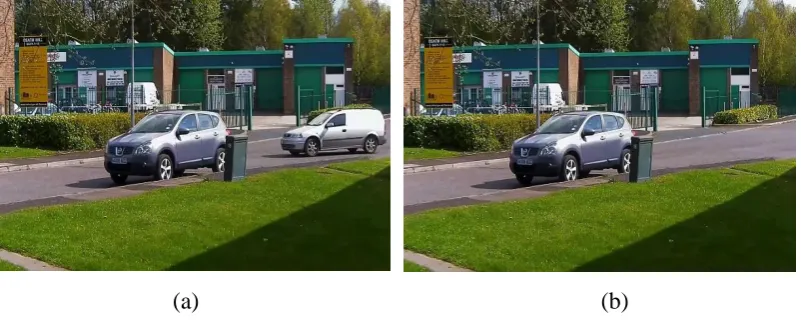
Figure 1.1 Example of video Copy-Move forgery (a) Original video (b) Tampered video from VTD dataset
Figure 1.1 illustrates an example of video copy-move forgery, where (a) the original video and (b) the tampered video. For example, the ducks are recorded in the video twice by taking part of the video (e.g., white car) and pasting it in another region within the same video. It is challenging to detect this type of video forgery if the copy-move procedure is carefully and actually carried out. Therefore, it is necessary to have reliable and efficient methods to detect copy-move forgery for applications in law enforcement, particularly forensics (Milani et al., 2012).
1.2 Background of Research
processing tools and algorithms, and low cost accessibility as well as easy to operate digital multimedia devices have led to the increased video tampering and the challenge of video authentication.
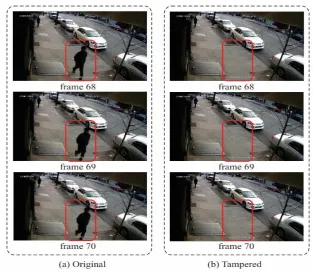
Video copy-move forgery has been identified as a vital form of forgery as it utilizes the same video frames sources and destination-apart from this, the video frame is copied and pasted on another part of the same video. In fact there are more subtle cases found in the standard dataset video copy-move forgery whereby copied frames are pasted on several places on the same video (many-to-many). Figure 1.2 illustrates the above cases.
Figure 1.2 Sample of video copy-move forgery (a) Original video (b) Tampering video from VTD dataset
Pioneering methods depend on intrinsic features such as pixel value and statistical features as well as video files characteristics. Among the many methods that are considered for video forgery detection are those that are based on the identification of acquisition device and detection of whether or not two video clips stem from the one source. In relation to this, (Kot and Cao, 2013) stated that owing to the statistical source features sensitive nature towards tampering and modifications, it is suitable to be used in addressing tampering.
A majority of the previous works (Pathak and Patil, 2014; D'Amiano, et al., 2015; Bestagini et al., 2013) have used Local Binary Patterns (LBP)-based features to identify duplicated image regions. Though LBP is effective against distortions, scaling, JPEG compression, blurring and noise adding, it however becomes ineffective when forged areas are small. This failure may lead to inadvertent errors in the subsequent important processes such as detection of moving objects and deleting objects. This is to emphasise that precise duplicated region detection is utmost important in video copy-move forgery detection. Failure which will result in low detection accuracy.
Beside the duplicated region, detection of moving objects, which traverse from frame to frame, is also important. Most of the previous works (Pathak and Patil, 2014; D'Amiano, et al., 2015; Bestagini et al., 2013) used LESH (Local Energy based Shape
Histogram) along with lexicographical sorting to determine objects’ trajectory similarity. The
method is similar to shape-based image retrieval approach. The method has a good efficiency
in detecting copy-move. However, the efficiency falls as the quality of the video frames
degrades. Video tampering refers to the generation of faked videos by adding, deleting or altering new video object. It usually consists of detection/tracking, video manipulation, video in-painting and video layer fusion (Kot and Cao, 2013).
1.2.1 Pixel-Based Approach
According to (Wang and Farid, 2007), pixel-based approaches make use of high correlation between authentic and forged areas in video frames for the detection of copy-paste forgery. The drawback lies in the fact that high correlation between frames is common in normal videos rendering the method useless if the copied regions are in use from other video frames. In (G.-S. Lin et al., 2011) proposed a video detection method known as a coarse-to-fine grained method that uses the variation in colour histograms of adjacent frames that are similar spatially and temporally – it makes use of the macro-block based correlation algorithm to identify duplication. However, their method is not able to determine region forgery.
In a similar study, (Zhang et al., 2009) brought forward a method that uses ghost shadow artefacts presented by the consistencies in painting in order to detect forged moving object region. Their approach differentiates static background from moving foreground through block matching that is sensitive to the noise property (illumination alterations), but due to its inaccuracy, the tampered region in each frame cannot be identified by their method.
1.2.2 Format-Based Approach
In this background, (Wang and Farid, 2006), proposed spatio-temporal domain artefacts of doubly compressed MPEG video frames in type of I-frame that is like a frame sequence of JPEG compressed image although there is considerable correlation among frames in GOP (Group of Pictures). In relation to this, the determination of predictive coded I-frame double compression is akin to double compression detection, and in the case of GOP, insertion or removal of frames will increase the error of motion estimation. Their method effectively works in detecting frame manipulation but not in locating tampered object regions. In (Luo et al., 2008) study, the authors brought forward a new method using the temporal blocking artefacts patterns to detect whether deletion or insertion has been done on MPEG video prior to recompression with different GOP structures. Their approaches are effective in frame-level forgery but not in region-level tampering and localization.
1.2.3 Camera-Based Approach
The main steps of this approach is extracting different types of fingerprints based on a set of videos then applying pattern recognition techniques in order to detect forgery. Some fingerprints recognition, which can be used in these techniques include noise patterns, lens distortion, and inconsistence-related artifacts (Kancherla and Mukkamala, 2012).
(Kobayashi et al., 2010) proposed photon approach shot noise to detect tampered level regions by using noise characteristics. Their method exploited the inconsistencies of photon shot noise caused by various video source cameras to detect between the original and forgery regions. But, their methods approach can merely detect forgery regions in static scene videos and not suspicious level regions in videos captured by a moving camera.
1.2.4 Geometric-Based Approach
Geometric-based approaches make use of measurements of objects in the video and their positions relative to the moving video camera. Based on (Conotter et al., 2011) study, a forgery technique approach to detect physically inconsistent implausible trajectory of objects in video frame sequences was employed. However, their technique can detect manipulation regions in a video sequence and limits the form of the video frame (i.e., de-interlaced or interlaced).
The research questions regarding automatic video copy-move forgery detection that are answered in this thesis are:
1. What different techniques for video forgery copy-move detection have been proposed to date and where does state-of-the-art methods stand today in terms of detection rates?
2. Which type of features can be extracted to characterizing the video frames?
4. How can the exact location of forged area in video forgery copy-move detection be located?
1.3 Problem Statement
Malicious manipulations and video tampering without any evidence being left behind has become very affordable and highly used, due to existence of extremely powerful editing tools such as Adobe Photoshop and video editing software. Therefore, there has been a swift augmentation of the digitally altered videos on the Internet and mainstream media. This tendency depicts grave vulnerabilities as well as minimizes the reliability of digital video. For such reasons, upcoming techniques in verification of the authenticity and integrity of digital video have been regarded as being significant, more so when putting into consideration the videos presented as news items, as evidence in forensic investigation, such as murder surveillance, or part of video forensics. From such a perspective, the principal goal in video forensics is to determine and detect video forgery forensics (Amerini et al., 2013).
(c) Forged video
(b) Target part of video
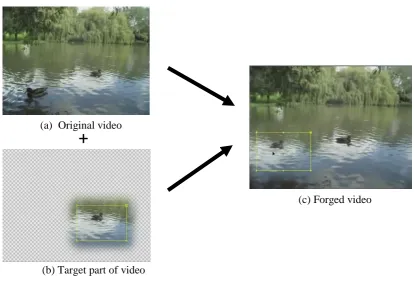
Figure 1.3 Example of video copy-move forgery (Qadir, et al., 2012)
Figure 1.3 shows an example of video copy-move forgery in which a region from one image is copied and pasted within the same video (Muhammad Ghulam et al., 2014). For instance, there has been a continuous problem in identifying copy-move areas that have been rotated and scaled from different angles (Lanjewar et al., 2014).
Against this backdrop, this research therefore concludes that existing video copy-move detection methods still suffer many drawbacks, which include, among others:
i. Their performance is mediocre when it comes to video compression, and in GOP, where addition or deletion of frame increases the estimation of motion error (Dong et al., 2012; Li and Huang, 2014; Shanableh, 2013). Their method’s effectiveness is confined to the detection of frame tampering and not localization of tampered regions.
+
ii. The presence of homogeneous regions in the tampering video further complicates the video copy-move forgery detection, which normally increases the false positive and the accuracy rate is far from satisfactory (Hyun et al., 2013; Su, et al., 2015; Subramanyam and Emmanuel, 2013).
iii. Notwithstanding the achievements realized by prior studies entailing high correlations between original and forged regions in copy-move forgery detection (e.g., Hsu et al., 2008; Thakur, 2013; Wang et al., 2014), high correlation is known to be common in natural videos and the methods proposed are not effective if the copied regions are within-frame object tampering calling for more enhancements.
Thus, the remaining issues and drawbacks of the previous works, which have been mentioned above, compel the author to pursue the research to seek a new approach to improve the detection rate of video copy-move forgery. With that in mind, a specific and focused research goal along with its objectives and scope are articulated and given in the following sub-sections.
1.4 Research Goal
1.5 Research Objectives
In order to achieve the goal, this study aims to fulfil the following main objectives:
i. To develop a new method to trace duplicated blocks from each pair of successive frames of a video using a two-tier approach comprising Diamond search and Slantlet transform.
ii. To propose a new method to detect and localise both deleted objects and moving objects using block displacements.
iii. To propose a new cloning object detection method based on displacement paths of moving objects using Dynamic Time Warping (DTW) matching algorithm.
1.6 Research Scope
The scope of this research is limited to the following:
i. Datasets: two sets of datasets namely, SULFA (Surrey University Library for Forensic Analysis) (Qadir, et al., 2012) and VTD (Video Tampering Dataset) are employed to evaluate the performance of the proposed scheme. The former is a standard dataset obtained from http://sulfa.cs.surrey.ac.uk/forged.php. On the other hand, the latter is a self -created dataset which can be found at:
ii. Performance evaluation: This study’s only concern is the accuracy rate, while the computational complexity is beyond its domain.
iii. Type of forgery: This study only focus on copy-move or copy-paste-move forgery, while other kinds are out of scope of this study.
1.7 Significance of the Study
It is strongly believed that several applications like video copy-move forgery detection investigations of digital video for forensic investigation such as in the case of video surveillance, and presenting video evidence in courts of law need more advanced detection and authentication techniques to prove the trustworthiness of digital video. In light of the above mentioned issues, the results of this research are expected to contribute to what is currently known about video copy-move forgery detection. Nonetheless, the significance of this study is not only limited to forgery detection, but also to the development of a new method that can be used in the future in many applications in the field of computer vision.
1.8 Thesis Outline
In Chapter 2, an in-depth review of the existing literature on authentication of video digital processing on the whole, as well as passive methods in attaining the study’s objective, specifically are presented. The currently employed approaches and criteria within the context of counterfeit digital video recognition are highly defined in this chapter. A review of a current study is conducted inclusive of recent techniques and methods employed in sensing video forgery tampering. This study area is moderately novel hence the meagre sources relative to the study topic. Therefore, the reviewed and availed approaches relate to extensive processing of digital videos, but only somewhat related to forgery detection in videos forensic. All the chapters are independent but a flow and coherency of ideas throughout the entire thesis are ensured.
Chapter 3, presents a clear roadmap of this study to guide the reader to achieve a quick grasp of the detailed research framework. The advantages of using the popular dataset in the newly developed methods are emphasised. The layout of the entire research framework, strategies, and procedures are highlighted. This is followed by Chapter 4, where a detailed design of the proposed method is provided along with the step-by-step processes and the proposed algorithms employed in it. The chapter also provides a discussion of the proposed methods entailing the proposed method’s implementation on video copy-move forgery detection.
Conotter, V., O'Brien, J. F. and Farid, H. (2012). Exposing digital forgeries in ballistic motion. Information Forensics and Security, IEEE Transactions on, 7(1), 283-296.
Dalal, N. and Triggs, B. (2005). Histograms of oriented gradients for human detection. Proceedings of the 2005 Computer Vision and Pattern Recognition, 2005. CVPR 2005. IEEE Computer Society Conference on, 886-893.
D'Amiano, L., Cozzolino, D., Poggi, G. and Verdoliva, L. (2015). Video forgery detection and localization based on 3D patchmatch. Proceedings of the 2015 Multimedia & Expo Workshops (ICMEW), 2015 IEEE International Conference on, 1-6.
Davarzani, R., Yaghmaie, K., Mozaffari, S. and Tapak, M. (2013). Copy-move forgery detection using multiresolution local binary patterns. Forensic science international, 231(1), 61-72.
Di Martino, F. and Sessa, S. (2012). Fragile watermarking tamper detection with images compressed by fuzzy transform. Information Sciences, 195, 62-90. Dice, L. R. (1945). Measures of the amount of ecologic association between species.
Ecology, 26(3), 297-302.
Dong, Q., Yang, G. and Zhu, N. (2012). A MCEA based passive forensics scheme for detecting frame-based video tampering. Digital Investigation, 9(2), 151-159. Elnagar, A. and Basu, A. (1995). Motion detection using background constraints.
Pattern Recognition, 28(10), 1537-1554.
Esmaeilani, R. (2014). Source identification of captured video using photo response non-uniformity noise pattern and svm classifiers. Master thesis, Universiti Teknologi Malaysia.
Fan, X. and Tjahjadi, T. (2015). A spatial-temporal framework based on histogram of gradients and optical flow for facial expression recognition in video sequences. Pattern Recognition, 48(11), 3407-3416.
Farid, H. (2003). A picture tells a thousand lies. New Scientist, (2411), 38-41.
Farid, H. (2009). Image forgery detection. Signal Processing Magazine, IEEE, 26(2), 16-25.
Fu, A. W.-C., Keogh, E., Lau, L. Y., Ratanamahatana, C. A. and Wong, R. C.-W. (2008). Scaling and time warping in time series querying. The VLDB Journal— The International Journal on Very Large Data Bases, 17(4), 899-921.
Garg, R., Varna, A. L. and Wu, M. (2011). Seeing ENF: natural time stamp for digital video via optical sensing and signal processing. Proceedings of the 2011 Proceedings of the 19th ACM international conference on Multimedia, 23-32. Ghanbari, M. (1990). The cross-search algorithm for motion estimation. IEEE
Transactions on Communications, 38(7), 950-953.
Ghanem, K. (2013). Towards more accurate clustering method by using dynamic time warping. International Journal of Data Mining & Knowledge Management Process (IJDKP), 3(2), 107-118.
Gironi, A., Fontani, M., Bianchi, T., Piva, A. and Barni, M. (2014). A video forensic technique for detecting frame deletion and insertion. Proceedings of the 2014 Acoustics, Speech and Signal Processing (ICASSP), 2014 IEEE International Conference on, 6226-6230.
Goldman, D. B., Gonterman, C., Curless, B., Salesin, D. and Seitz, S. M. (2008). Video object annotation, navigation, and composition. Proceedings of the 2008 Proceedings of the 21st annual ACM symposium on User interface software and technology, 3-12.
He, Z., Lu, W., Sun, W. and Huang, J. (2012). Digital image splicing detection based on Markov features in DCT and DWT domain. Pattern Recognition, 45(12), 4292-4299.
Hikmat N, A. and Safa'a AA, A. (2010). Implementation of 8-point Slantlet transform based polynomial cancellation coding-OFDM system using FPGA. Proceedings of the 2010 Systems Signals and Devices (SSD), 2010 7th International Multi-Conference on, 1-6.
Hsu, C.-C., Hung, T.-Y., Lin, C.-W. and Hsu, C.-T. (2008). Video forgery detection using correlation of noise residue. Proceedings of the 2008 Multimedia Signal Processing, 2008 IEEE 10th Workshop on, 170-174.
Hyun, D.-K., Lee, M.-J., Ryu, S.-J., Lee, H.-Y. and Lee, H.-K. (2013). Forgery detection for surveillance video. The Era of Interactive Media (pp. 25-36): Springer.
Ince, S. and Konrad, J. (2008). Occlusion-aware optical flow estimation. IEEE Transactions on Image Processing, 17(8), 1443-1451.
Jaccard, P. (1912). The distribution of the flora in the alpine zone. New phytologist, 11(2), 37-50.
Jaiswal, S. and Dhavale, S. (2013). Video Forensics in Temporal Domain using Machine Learning Techniques. International Journal of Computer Network and Information Security, 5(9), 58.
Jing, G., Rajan, D. and Siong, C. E. (2005). Motion detection with adaptive background and dynamic thresholds. Proceedings of the 2005 2005 5th International Conference on Information Communications & Signal Processing, 41-45.
Johnson, M. K. and Farid, H. (2006). Exposing digital forgeries through chromatic aberration. Proceedings of the 2006 Proceedings of the 8th workshop on Multimedia and security, 48-55.
Johnson, M. K. and Farid, H. (2007). Exposing digital forgeries through specular highlights on the eye. Proceedings of the 2007 Information Hiding, 311-325. Kancherla, K. and Mukkamala, S. (2012). Novel blind video forgery detection using
markov models on motion residue. Intelligent Information and Database Systems (pp. 308-315): Springer.
Kang, X., Li, Y., Qu, Z. and Huang, J. (2012). Enhancing source camera identification performance with a camera reference phase sensor pattern noise. Information Forensics and Security, IEEE Transactions on, 7(2), 393-402.
Kattoush, A. H. (2012). A radon slantlet transforms based OFDM system design and performance simulation under different channel conditions. ISRN Communications and Networking, 2012, 1-10.
Kitagawa, G. (1994). The two-filter formula for smoothing and an implementation of the Gaussian-sum smoother. Annals of the Institute of Statistical Mathematics, 46(4), 605-623.
Kobayashi, M., Okabe, T. and Sato, Y. (2009). Detecting video forgeries based on noise characteristics. Advances in Image and Video Technology (pp. 306-317): Springer.
Kobayashi, M., Okabe, T. and Sato, Y. (2010). Detecting forgery from static-scene video based on inconsistency in noise level functions. IEEE Transactions on, Information Forensics and Security, 5(4), 883-892.
Koga, T. (1981). Motion-compensated interframe coding for video conferencing. Proceedings of the 1981 Proc. NTC 81, (pp. C9-6).
Kopparapu, S. and Satish, M. (2014). Optimal Gaussian Filter for Effective Noise Filtering. Computer Science, 12(2), 1-7.
Kot, A. C. and Cao, H. (2013). Image and Video Source Class Identification. Digital Image Forensics (pp. 157-178): Springer.
Kroeger, T., Timofte, R., Dai, D. and Van Gool, L. (2016). Fast Optical Flow using Dense Inverse Search. Computer Vision and Pattern Recognition, 1(3), 1-25. Kurosawa, K., Kuroki, K. and Saitoh, N. (1999). CCD fingerprint
method-identification of a video camera from videotaped images. IEEE International Conference on Image Processing, vol.3, 537-540.
Lanjewar, S. B., P. A. Khaire, and R. Meshram, (2014). An approach towards image forgery detection. International Journal of Advanced Research in Computer Science. vol.5, no.8, 205-209.
Le Gall, D. (1991). MPEG: A video compression standard for multimedia applications. Communications of the ACM, 34(4), 46-58.
Li, F. and Huang, T. (2014). Video copy-move forgery detection and localization based on structural similarity. Proceedings of the 2014 Proceedings of the 3rd International Conference on Multimedia Technology (ICMT 2013), 63-76. Li, R., Yu, S. and Yang, X. (2007). Efficient spatio-temporal segmentation for
extracting moving objects in video sequences. IEEE Transactions on Consumer Electronics, 53(3), 1161-1167.
Information Security (ICITIS), 2010 IEEE International Conference on, 1127-1130.
Liao, S.-Y. and Huang, T.-Q. (2013). Video copy-move forgery detection and localization based on Tamura texture features. Proceedings of the 2013 Image and Signal Processing (CISP), 2013 6th International Congress on, 864-868. Lin, C.-S. and Tsay, J.-J. (2013). Passive approach for video forgery detection and
localization. Proceedings of the 2013 The Second International Conference on Cyber Security, Cyber Peacefare and Digital Forensic (CyberSec2013), 107-112.
Lin, C.-S. and Tsay, J.-J. (2014). A passive approach for effective detection and localization of region-level video forgery with spatio-temporal coherence analysis. Digital Investigation, 11(2), 120-140.
Lin, G.-S., Chang, J.-F. and Chuang, C.-H. (2011). Detecting frame duplication based on spatial and temporal analyses. Proceedings of the 2011 Computer Science & Education (ICCSE), 2011 6th International Conference on, 1396-1399.
Lucas, B. D. and Kanade, T. (1981). An iterative image registration technique with an application to stereo vision. Proceedings of the 1981 International Joint Conference on Artificial Intelligence, 674-679.
Luo, W., Wu, M. and Huang, J. (2008). MPEG recompression detection based on block artifacts. Proceedings of the 2008 Electronic Imaging 2008, 68190X-68190X-68112.
Mahajan, A., Sharma, K. and Kumar, D. (2014). Comparative Analysis of Pixel Based Motion Estimation with Block Based Motion Estimation. International Journal of Recent Research Aspects, 1(2), 78-83.
Malviya, A. V. and Ladhake, S. A. (2016). Pixel Based Image Forensic Technique for Copy-move Forgery Detection Using Auto Color Correlogram. Procedia Computer Science, 79, 383-390.
Manzanera, A. and Richefeu, J. C. (2007). A new motion detection algorithm based on Σ–Δ background estimation. Pattern Recognition Letters, 28(3), 320-328. Metkar, S. and Talbar, S. (2013). Performance Evaluation of Block Matching
Milani, S., Bestagini, P., Tagliasacchi, M. and Tubaro, S. (2012). Multiple compression detection for video sequences. Proceedings of the 2012 Multimedia Signal Processing (MMSP), 2012 IEEE 14th International Workshop on, 112-117.
Milani, S., Fontani, M., Bestagini, P., Barni, M., Piva, A., Tagliasacchi, M., et al. (2012). An overview on video forensics. APSIPA Transactions on Signal and Information Processing, 1, 1-18.
Mondaini, N., Caldelli, R., Piva, A., Barni, M. and Cappellini, V. (2007). Detection of malevolent changes in digital video for forensic applications. Proceedings of the 2007 Electronic Imaging 2007, 65050T-65050T-65012.
Muhammad, Ghulam, Munner H. Al-Hammadi, Muhammad Hussain, and George Bebis, (2014). Image Forgery Detection Using Steerable Pyramid Transform and Local Binary Pattern. Machine Vision and Applications. vol.25, no.4, pp.985-995.
Mutt, S. and Kumar, S. (2009). Secure image Steganography based on Slantlet transform. Proceedings of the 2009 Methods and Models in Computer Science, 2009. ICM2CS 2009. Proceeding of International Conference on, 1-7.
Ng, T.-T., Chang, S.-F., Lin, C.-Y. and Sun, Q. (2006). Passive-blind image forensics. Multimedia Security Technologies for Digital Rights, 15, 383-412.
Pathak, A. and Patil, D. (2014). Video Forgery Detection Based on Variance in Luminance and Signal to Noise Ratio using LESH Features and Bispectral Analysis. International Journal of Computer Science and Mobile Computing, 3(7), 318-327.
Peng, F., Nie, Y.-y. and Long, M. (2011). A complete passive blind image copy-move forensics scheme based on compound statistics features. Forensic science international, 212(1), e21-e25.
Podilchuk, C. I. and Zeng, W. (1998). Image-adaptive watermarking using visual models. Selected Areas in Communications, IEEE Journal on, 16(4), 525-539. Popescu, A. C. and Farid, H. (2004). Statistical tools for digital forensics. Proceedings
of the 2004 Information Hiding, 128-147.
Qadir, G., Yahaya, S. and Ho, A. T. (2012). Surrey university library for forensic analysis (SULFA) of video content. IET Conference on, Proceedings of the 2012 Image Processing (IPR 2012), 1-6.
Qin, Y.-l., Sun, G.-l., Wang, S.-z. and ZHANG, X.-p. (2010). Blind detection of video sequence montage based on GOP abnormality. Act Electronica Sinica, 38(7), 1597-1602.
Ram, S., Bischof, H. and Birchbauer, J. (2009). Active fingerprint ridge orientation models Advances in Biometrics (pp. 534-543): Springer.
Ratanamahatana, C. A. and Keogh, E. (2004). Everything you know about dynamic time warping is wrong. Proceedings of the 2004 Third Workshop on Mining Temporal and Sequential Data, 53-63.
Redi, J. A., Taktak, W. and Dugelay, J.-L. (2011). Digital image forensics: a booklet for beginners. Multimedia Tools and Applications, 51(1), 133-162.
Ren, Y., Chua, C.-S. and Ho, Y.-K. (2003). Motion detection with no stationary background. Machine Vision and Applications, 13(5-6), 332-343.
Richao, C., Gaobo, Y. and Ningbo, Z. (2014). Detection of object-based manipulation by the statistical features of object contour. Forensic science international, 236, 164-169.
Richardson, I. E. (2004). H. 264 and MPEG-4 video compression: video coding for next-generation multimedia: John Wiley & Sons.
Schneider, M. and Chang, S.-F. (1996). A robust content based digital signature for image authentication. Proceedings of the 1996 Image Processing, 1996. Proceedings., International Conference on, 227-230.
Selesnick, I. W. (1999). The slantlet transform. IEEE Transactions on Signal Processing, 47(5), 1304-1313.
Shaid, S. (2009). Estimating optimal block size of copy-move attack detection on highly textured image. Universiti Teknologi Malaysia.
Shanableh, T. (2013). Detection of frame deletion for digital video forensics. Digital Investigation, 10(4), 350-360.
Shih, T. K., Tang, N. C., Tsai, J. C. and Hwang, J.-N. (2011). Video motion interpolation for special effect applications. Systems, Man, and Cybernetics, Part C: Applications and Reviews, IEEE Transactions on, 41(5), 720-732. Shivakumar, B. and Baboo, L. D. S. S. (2010). Detecting copy-move forgery in digital
images: a survey and analysis of current methods. Global Journal of Computer Science and Technology, 10(7).
Sowmya, K. and Chennamma, H. (2015). A Survey on video forgery detection. International Journal of Computer Engineering and Applications, 9(2), 17-27. Srinivasan, R. and Rao, K. (1985). Predictive coding based on efficient motion
estimation. IEEE Transactions on Communications, 33(8), 888-896.
Su, L., Huang, T. and Yang, J. (2015). A video forgery detection algorithm based on compressive sensing. Multimedia Tools and Applications, 74(17), 6641-6656. Su, Y., Zhang, J. and Liu, J. (2009). Exposing digital video forgery by detecting
motion-compensated edge artifact. Proceedings of the 2009 Computational Intelligence and Software Engineering, 2009. CiSE 2009. International Conference on, 1-4.
Subramanyam, A. and Emmanuel, S. (2012). Video forgery detection using HOG features and compression properties. Proceedings of the 2012 Multimedia Signal Processing (MMSP), 2012 IEEE 14th International Workshop on, 89-94. Subramanyam, A. and Emmanuel, S. (2013). Pixel estimation based video forgery
detection. Proceedings of the 2013 Acoustics, Speech and Signal Processing (ICASSP), 2013 IEEE International Conference on, 3038-3042.
Sun, T., Wang, W. and Jiang, X. (2012). Exposing video forgeries by detecting MPEG double compression. Proceedings of the 2012 Acoustics, Speech and Signal Processing (ICASSP), 2012 IEEE International Conference on, 1389-1392. Thakur, M. K. (2013). Tampered videos: detection and quality assessment. PhD thesis,
Jaypee Institute of Information Technology.
Upadhyay, S. and Singh, S. K. (2011). Learning based video authentication using statistical local information. Proceedings of the 2011 Image Information Processing (ICIIP), 2011 International Conference on, 1-6.
Vazquez-Padin, D., Fontani, M., Bianchi, T., Comesaña, P., Piva, A. and Barni, M. (2012). Detection of video double encoding with GOP size estimation. 2012 IEEE International Workshop on, Proceedings of the Information Forensics and Security (WIFS), 151-156.
Wahab, A. W. A., Bagiwa, M. A., Idris, M. Y. I., Khan, S., Razak, Z. and Ariffin, M. R. K. (2014). Passive video forgery detection techniques: a survey. 10th International Conference on, Proceedings of the 2014 Information Assurance and Security (IAS), 29-34.
Wang, Q., Li, Z., Zhang, Z. and Ma, Q. (2014). Video inter-frame forgery identification based on consistency of correlation coefficients of gray values. Journal of Computer and Communications, 2(04), 51.
Wang, W. (2009). Digital video forensics. PhD thesis, Dartmouth College, Hanover, New Hampshire.
Wang, W. and Farid, H. (2006). Exposing digital forgeries in video by detecting double MPEG compression. Proceedings of the 2006 Proceedings of the 8th workshop on Multimedia and security, 37-47.
Wang, W. and Farid, H. (2007a). Exposing digital forgeries in interlaced and deinterlaced video. Information Forensics and Security, IEEE Transactions on, 2(3), 438-449.
Wang, W. and Farid, H. (2007b). Exposing digital forgeries in video by detecting duplication. Proceedings of the 2007b Proceedings of the 9th workshop on Multimedia & security, 35-42.
Wang, W. and Farid, H. (2009). Exposing digital forgeries in video by detecting double quantization. Proceedings of the 2009 Proceedings of the 11th ACM workshop on Multimedia and security, 39-48.
Wang, W., Jiang, X., Wang, S., Wan, M. and Sun, T. (2013). Identifying video forgery process using optical flow Digital-Forensics and Watermarking (pp. 244-257): Springer.
Wang, Z. (2006). Time series matching: a multi-filter approach. Courant Institute of Mathematical Sciences New York.
International Workshop on Video Processing and Quality Metrics for Consumer Electronics (VPQM-09).,
Wu, X., Li, J., Zhang, Y. and Tang, S. (2008). Spatio-temporal visual consistency for video copy detection. Proceedings of the 2008 Visual Information Engineering, 2008. VIE 2008. 5th International Conference on, 414-419.
Wu, Y., Jiang, X., Sun, T. and Wang, W. (2014). Exposing video inter-frame forgery based on velocity field consistency. Proceedings of the 2014 Acoustics, Speech and Signal Processing (ICASSP), 2014 IEEE International Conference on, 2674-2678.
Xiaoling, C. and Huimin, Z. (2012). A Novel Video Tamper Detection Algorithm Based on Semi-fragile Watermarking Advances in Information Technology and Industry Applications (pp. 489-497): Springer.
Yu, D., Yu, X., Hu, Q., Liu, J. and Wu, A. (2011). Dynamic time warping constraint learning for large margin nearest neighbor classification. Information Sciences, 181(13), 2787-2796.
Yu, J. and Srinath, M. D. (2001). An efficient method for scene cut detection. Pattern Recognition Letters, 22(13), 1379-1391.
Zeng, F.-z., LU, Y.-s. and ZHOU, Y. (2011). The video tamper detection algorithm based on semi-fragile watermark with compressive sensing [J]. Journal of Circuits and Systems, 4, 016.
Zhang, J., Su, Y. and Zhang, M. (2009). Exposing digital video forgery by ghost shadow artifact. Proceedings of the 2009 Proceedings of the First ACM workshop on Multimedia in forensics, 49-54.
Zheng, J., Li, B., Zhou, B. and Li, W. (2005). Fast motion detection based on accumulative optical flow and double background model. Proceedings of the 2005 International Conference on Computational and Information Science, 291-296.
Zhu, C., Lin, X., Chau, L.-P., Ang, H.-A. and Ong, C.-Y. (2004). Efficient inner search for faster diamond search. Signal processing, 84(3), 527-533.
Required Corrections Page
No. The Amendment Made
Page No.
Title Video Copy-Move Forgery Detection Scheme
Based On Displacement Paths
Abstract Amended
Chapter 1
Typographical errors including English language and UTM
Formatting
Checked and amended 2, 9 and
11
Background of Research 4 Added two paragraphs about motivation of
previous works 5
Problem statement 8 Added a paragraph about motivation of this
study 9
Figure 1.3 adding (a), (b)
and (c) 10
Added figure 1.3 the link motivation of this
study 10
Adding reference at
paragraph 1 line 2 10 Added (Muhammad Ghulam et al., 2014) 10 Adding paragraphs about
motivation of this study 10
Added two paragraph in page 10 to link a
motivation of Problem Statement 11
Chapter 2
Typographical errors including English language and UTM
Formatting
Checked and amended
16, 26, 37 and
51
Give critical analysis (short coming, advantage
of other works)
22 Critical analyses are given in four separate pages 24, 25, 32 and 50 Chapter 3 Typographical errors including English language and UTM
Formatting
Checked and amended 59 and
62
Research framework should be contributions
and link to objective
59 Research framework is amended to include the contributions and link to objectives
60 and 61
Adding words 78 Add “see in Figure 3.11” words 78
Chapter 4
Typographical errors including English language and UTM
Formatting
Checked and amended
Need to tie up with the
research problem 81
Added paragraph about the proposed method’s main components and link with
research problem and objectives
82
Insert small caption in
Fig. 4.1 83
Changed caption of Figure 4.1: “Proposed video
copy-move forgery detection scheme” 84
Chapter 5
Typographical errors including English language and UTM
Formatting
Checked and amended
160,193, 194, 195 and 196
Indicating the figure with a symbol in the relevant
figures and tables
180 Each video in Table 5.2 indicated to the name
of each video in both datasets SULA and VTD 181
Indicating the figure with a symbol in the relevant
figures and tables
184 Each video in Table 5.3 indicated to the name
of each video in both datasets SULA and VTD 185
Changing words in Figure
5.28 193
Changing words from “ (red ball) “ to
“(Elephant) “ words in Figure 5.28 194 Changing words in Figure
5.29 194
Changing words from “ (red ball) “ to “(red
car)“ words in Figure 5.29 195 Changing words in Figure
5.30 195
Changing words from “ (red ball) “ to “(white
ball) “ words in Figure 5.30 196 Changing words in Figure
5.31 196
Changing words from “ (red ball) “ to “(white
car)“ words in Figure 5.31 197
Indicating the figure with a symbol in the relevant
figures and tables
198 Each video in Table 5.4 indicated to the name
of each video in dataset SULA 199
Indicating the figure with a symbol in the relevant
figures and tables
200 Each video in Table 5.5 indicated to the name
of each video in dataset SULA 201
Chapter 6
Typographical errors including English language and UTM
Formatting
Checked
second paragraph is a revisit to problem background, objectives
205 A new paragraph (2
nd. Paragraph) is added to
address the issue 206
References
Reference has been
deleted form References 212
Al-Sanjary, O. I., Ahmed, A. A. and Sulong, G. (2016). Development of a video tampering dataset for forensic investigation. Forensic
Science International, 266, 565-572.