THE PRACTICE OF REFLECTION ON THE ISSUES OF TEACHING AND LEARNING PROCESS AMONG STEM EDUCATORS IN UTM
Siti Anisha Binti Samsudin*1 Nor Hasniza Binti Ibrahim2 Johari Bin Surif3 Halim Bin Abdullah4 Marlina Binti Ali5 1, 2 ,3,4,5
Departmentof Educational Sciences, Mathematics and Creative Multimedia,
Universiti Teknologi Malaysia, Johor Bahru, MALAYSIA.
(E-mail: [email protected], [email protected],
[email protected], [email protected], [email protected] )
Abstract
This article discusses the practice of reflection among STEM educators in Universiti Teknologi Malaysia. The practice of reflection refers to the issues that have been selected for reflection by STEM educators after the process of teaching and learning. This article used qualitative approach on 55 STEM educators in Universiti Teknologi Malaysia. Data were collected through open-ended questions where the STEM educators were given the opportunity to state their answers and opinions. The obtained data were analyzed by using the content analysis technique. Findings showed that majority of the STEM educators reflect on issues of teaching and learning processes such as time management, teaching contents, students’ difficulties, lecture management, evaluation techniques, as well as teaching methods. In conclusion, this article shows that STEM educators in UTM are able to reflect on issues related to the teaching and learning process. However, the conducted reflections are not at a critical level.
Introduction
According to Ramaley (2009), the era of Science, Technology, Engineering and Mathematics (STEM) education has prolonged the age of science, technology and society in the world economy. This is because experts that were created from STEM education are not only master in a specialized field such as science, but can even integrate science with technology, engineering, and mathematics. Moreover, STEM education also exposes the students to skills, especially in applying everything they have learned in everyday life to solve the problems in everyday life to meet the needs of the future job market that values skills. Levinson & Palmer (2005) for instance, found that half of the students in US, who have completed their studies and are only mastering knowledge, without the skills to apply their knowledge in life are difficult to find a job. Therefore, Malaysia has targeted 60 per cent of their students to take STEM course in order to meet the needs of experts in the required field of STEM. This goal can be achieved by improving the quality of education. STEM educators should focus on the implementation of the teaching and learning process.
Systematic implementation of teaching and learning process can ensure that the students have the ability to master the learning content. However, STEM education is a new challenge that must be faced by educators because the integration of knowledge that happened in education requires the educators to struggle for the improvement of the existing knowledge and skills in teaching and learning process. Weaknesses in handling the process of teaching and learning have reduced the students’ confident on such educators. There are several weaknesses that can be seen
in terms of diversifying teaching methods as well as misunderstands the teaching concept (Dori and Hameiri, 2003). Second, a too teacher-centered teaching process is another weakness (Kember, 1997; Prosser and Trigwell 1999; Prosser, Trigwell, and Taylor 1994; Samuelowicz and Bain, 2001) that cause the students to be less active and make no effort to solve the problems they faced on their own. Third, lack of collaboration among educators to discuss teaching-related issues they are facing (Van Petegem Donchan and 2005; Oosterheert, Vermunt and Denessen 2002; Wideen, Mayer-Smith and Moon 1998). Fourth, educators did not try to use the existing theory or model of teaching and learning to improve the teaching process (Korthagen 2001; Schulz and Mandzuk 2005). Thus, reflection helps educators to identify any shortcomings in the teaching and learning process and improve the teaching process.
Reflection is the key concept in the field of education (Korthagen & Vasalos, 2005; Loughran, 2006; Moon, 2004). This is because, through reflection, a variety of solutions related to teaching can be obtained and improved the educators’ quality of teaching effectively. According to Schon (1983), reflection is related to an action. The action aims to modify the teaching to improve the effectiveness of teaching and learning process of lectures under the context of professional development possessed by one educator (Mok, 2002).
four selected faculties: Faculty of Science, Faculty of Education, Faculty of Petroleum and Renewable Energy Engineering and Faculty of Computing. After that, the data which was analyzed by using content analysis technique is further explained in the methodology section.
Methodology
Research methodology is divided into several parts, which are research design, sample or population, and research instruments. Qualitative study was used to obtain data that are related to the selection of issues of reflection practices process conducted by STEM educators in UTM. In addition, Punch (2001) said that qualitative research requires a researcher to position himself in the empirical world that will connect research questions with the data to be obtained. Qualitative data in this study were collected by using open questionnaires containing some questions as guideline for respondents to elaborate on the issues of teaching and learning processes. The questions are as follows:
What is your view on the overall teaching and learning process that has been
implemented?
What are the advantages that can be felt in this PdP?
Are there any deficiencies in this PdP?
How is it possible?
What are the steps needed to improve the situation?
Table 1.2 Faculties and populations
Faculties No. of respondent(s)
Faculty of Science (FS) 9
Faculty of Education (FP) 15
Faculty of Petroleum and Renewable Energy Engineering (FPREE)
22
Faculty of Computing (FK) 9
Total 55
Data Analysis and Discussion
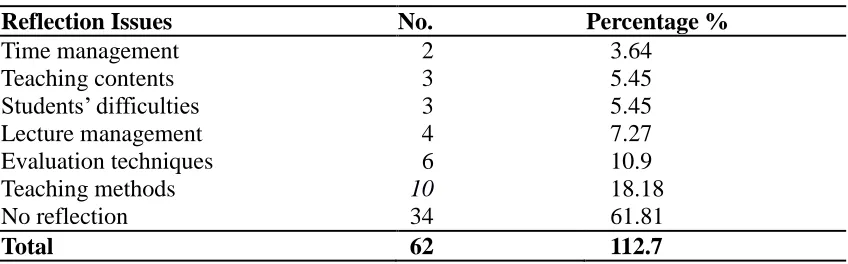
Based on the analysis conducted, some issues of reflections have been identified. Table 1.3 shows the number of respondents who agreed on the issue in the reflection and its percentage.
Table 1.3 Reflection issues by STEM educators
Reflection Issues No. Percentage %
Time management 2 3.64
Teaching contents 3 5.45
Students’ difficulties 3 5.45
Lecture management 4 7.27
Evaluation techniques 6 10.9
Teaching methods 10 18.18
No reflection 34 61.81
Total 62 112.7
3.1 Reflection Issues
There are seven issues been reflected by STEM educators: time management, teaching contents, students’ difficulties, lecture management, evaluation techniques, teaching methods, and no reflection.
3.1.1 Time Management
time consumed by the students in carrying out their assignments outdoor as well as their weaknesses in planning their time for activities in the lecture as follows:
Among the constraints faced students are the students’ hectic timetable that does not allow them to make an assignment visits after lecture period. (FS respondent)
It feels like time really flies. I did not realize that I am running out of time. This happens due to a lot of discussion in the class and the big number of students. (FP respondent)
Time management is important in the implementation of teaching and learning process. A good time management should be emphasized by educators and students. If the educators failed to practice a good time management, the students will imitate the same behavior. As an educator, the flexibility of time for students to carry out outdoor activities and limiting the number of planned activities are necessary to ensure that the issue of running out of time does not happen.
3.1.2 Teaching Content
Issue related to selected teaching content for reflection by 5.45% of the respondents is explaining the objectives of teaching and the application of the concepts of teaching content in everyday life. Here are some of the answers given by the respondents:
Understanding is the most important thing between a presenter and a receiver. Therefore, it is very crucial that students were given an overview of learning objectives for the short- and long term as well as the overall plan of the course work prior on the first week of lectures. (FPREE respondent)
The students are able to understand and apply a teaching concept to the actual situation in everyday life. (FP respondent)
After several times teaching this subject, I noticed few examples of industrial goods such as car components are so foreign to them and to understand the concept of sensitivity is also a problem for them. (FP respondent)
Teaching content is the learning content delivered by educators to students. According to Mohamad Nor (2009), the educators’ effort to present a good content of teaching cause the students to master the skills and knowledge besides the formation of attitudes. Therefore, it is essential for the educators to reflect the teaching content in identifying any existing weaknesses.
3.1.3 Students’ Difficulty
Students’ difficulty is due to the behavior of students in the lecture itself, which hinders the effectiveness of teaching and learning process of educators. The issue of students’ difficulty has the same percentage with the issue of teaching content which is 5.45%. Here are some issues of students’ difficulties described by the respondents:
I found that there are some students who fall asleep during learning sessions. This is probably because of my monotonous delivery approaches. (FPREE respondent)
Students failed to answer questions relating definitions, concepts and applications correctly. Almost all students can answer questions that need calculation. I expect that they just memorize formulas without being able to use the formula in the concept or application questions. (FS respondent)
related to the definition, concept and application is because students prefer to memorize rather than to understand what is being taught in college.
3.1.4 Lecture Management
A total of 7.27% of the respondents chose lecture management-related issues to be reflected. A good lecture management can create a systematic teaching and learning environment and makes it easier for students to grasp all knowledge taught by educators. Here are some of the issues discussed by the respondents:
Create a conducive and constructive lecture environment to implement a systematic and clear teaching and learning process. (FPREE respondent)
However, there are also respondents who gave negative impact on disorganized lecture management:
For me, the reason of my less successful PdP is caused by lack of effort to master any creative and effective way of PdP despite the bigger size of lecture, which accommodates many students and hinders me from focusing on weak students. (FPREE respondent)
Lecture management is a responsibility that should be prioritized by educators. This is because a good lecture management can determine the success of teaching and learning processes implemented. This point is supported by Rosmilawati (2006) who agrees that students’ convenience in the learning process is dependent on a good classroom preparation; in terms of atmosphere created by educators or even a complete facility.
3.1.5 Evaluation Technique
following are some examples of reflection written on issues of evaluation techniques in order to measure the students' understanding:
For me, the students’ understanding on a topic will be measured through a short period evaluation (such as pop quizzes) or through question and answer sessions with the students. Students’ understanding is essential before moving on to a new topic. (FPREE respondent)
I want the students to respond to all aspects in the exit-course survey at the end of the semester. (FPREE respondent)
Furthermore, there is some evaluation technique measured through the implementation of reflection practices that turns into an issue of reflection;
Reflection is important to continue and improve the overall success. We always do. Simply, improvement methods need experience or continuous reading. (FP respondent)
Reflections on the PdP need to be done every time PdP session ends. There are processes and skills in the PdP to be analyzed. Teaching quality is derived from the effective reflection. (FP respondent)
In summary, evaluation technique is a monitoring process to assess the ability of an educator to deliver effectively. This is also supported by Mohd Salleh (2006) who stated that educators’ teaching must be monitored either by the educators
themselves or superiors to facilitate a more effective strategy planning and to ensure that learning outcomes for subjects on that day are achieved.
3.1.6 Teaching Method
A total of 18.18% of the respondents gave issues on reflection that are related to teaching methods such as Program Based Learning (PBL), active learning, and case study. Here are some of the answers:
Teaching process is an active learning that uses investigation technique and classroom flip. This method can improve students' generic skills more systematically. (FK respondent)
One of the teaching processes is a case study to be done by students as assignment. Case study is based on the findings of a study visit to a particular place. (FS respondent)
Moreover, the importance of educators in remembering the students’ names and holding a break in the middle of teaching is also a teaching method answered by a respondent:
Lecturers need to know the names of each student so that they can interact with students by calling his or her name. Students will feel appreciated. This can encourage thems to focus. In addition, In addition, insert a motivational story between the lecture of so that students do not get bored. General guidelines, give a 2-minute break after 30 minutes of delivery. Lecturers can interact with students about any related issues—general/current (FK respondent)
There are also respondents who felt that two-way communication is essential in the teaching methods used;
Two-way communication between educators and students can enhance the effectiveness of PdP process. (FPREE respondent)
3.1.7 No Reflection
A total of 61.81% of the respondents did not specify any issues of reflection
for this study. This is because respondents might not perform reflection after the teaching and learning process or do not understand what is meant by reflection as required to be disclosed in the open questionnaire provided.
Conclusion
Overall, the findings obtained in the issues reflected by STEM educators are as follows:
There are several issues identified by STEM educators to be reflected.
The selected issues include time management, teaching content, students’ difficulty, lecture management, evaluation techniques, teaching methods and no reflection.
Most of the STEM educators, with 18.18% of the respondents, chose
the issue of teaching methods in the teaching and learning process to be reflected as an approach used by educators in facilitating the delivery of a topic and it will be understood by students.
However, the highest percentage of 61.81% belongs to the category of
REFERENCES
Hashim Fauzy Yaakob. (2000). Introduction to Human Communication. First Edition.
Skudai Universiti Teknologi Malaysia.
Levinson, E. M.,Palmer, E. J. (2005). Preparing students with disabilities for
school-to-work transitions and post-school life. Retrieved April 10, 2010
fromhttp://www.nasponline.org/resources/principals/Transition%20Planning%
20WEB.pdf
Loughran, J. (2006). Developing a Pedagogy of Teacher Education: Understanding
teaching and learning about teaching. London: Routledge Talyor &Francis
Group.
Korthagen, F., Vasalos, A. (2005) Levels in reflection: core reflection as a means to
enhance professional growth. Teachers and Teaching: theory and practice, 11
(1), 47-71.
Mohammad Nor, M. A. (2009). The Learning Style and Relationships Teaching in
Improving Students' Comprehension. Master 's thesis. Universiti TunHussein
Onn Malaysia.
Mohd Salleh Hj. Tahar. (2006). Leadership in Education Management Techniques
and Vocational Educatio . Johor: Kolej Universiti Teknologi Tun Hussein
Onn.
Mok Soon Sang (2002). Pedagogy 2 : Implementation of teaching 2 .Selangor:
Moon, J. (2004).A Handbook of reflective and experiential learning: Theory and
practice. London: Falmer Press.
Punch. (2001). Introduction to Social Research Quantitative and Qualitative
Approaches.
Ramaley, J. A. (2009). The National Perspective: Fostering the Enhancement of
STEM Undergraduate Education. Improving the Climate for Undergraduate
Teaching and Learning in Stem Fields.(117), 69-82.
Rosmilawati. (2006). Teaching Evaluation on Undergraduate Students Technical
Education and Vocational Training Program In Teaching Technical Secondary
School .Johor: Kolej Universiti Teknologi Tun Hussein Onn. Thesis
Education
Settlage, J. (2007). Demythologizing science teacher education: Conquering the false
ideal of open inquiry. Journal of Science Teacher Education,18, 461–467.
Zailah Zainudin. (2012). Didik Hibur. IPG Kampus Raja Melewar . Retrieved on
15 Mei2012 from http://kssr.bpk.my/berita/didik_hibur.