Recognition Assistance
Treating Errors in Texts Acquired from Various Recognition Processes
Gábor PRÓSZÉKY MorphoLogic Késmárki u. 8 1118 Budapest, Hungary [email protected]
Mátyás NASZÓDI MorphoLogic Késmárki u. 8 1118 Budapest, Hungary [email protected]
Balázs KIS MorphoLogic Késmárki u. 8 1118 Budapest, Hungary
Abstract
Texts acquired from recognition sources—conti-nuous speech/handwriting recognition and OCR—generally have three types of errors re-gardless of the characteristics of the source in particular. The output of the recognition process may be (1) poorly segmented or not segmented at all; (2) containing underspecified symbols (where the recognition process can only indicate that the symbol belongs to a specific group), e.g. shape codes; (3) containing incorrectly identified sym-bols. The project presented in this paper addresses these errors by developing of a unified linguistic
framework called the MorphoLogic Recognition
Assistant that provides feedback and corrections for various recognition processes. The framework uses customized morpho-syntactic and syntactic analysis where the lexicons and their alphabets correspond to the symbol set acquired from the recognition process. The successful framework must provide three services: (1) proper disambi-guated segmentation, (2) disambiguation for un-derspecified symbols, (3) correction for incorr-ectly recognized symbols. The paper outlines the methods of morpho-syntactic and syntactic post-processing currently in use.
Introduction
Recognition processes produce a sequence of dis-crete symbols that usually do not entirely corre-spond to characters of printed text. Further on, we refer to this sequence as an input sequence.1 A
1 This framework is actually a second tier of the data
flow. The user receives a black box providing linguis-tically sound and correctly recognized text. Inside the black box, the first tier performs the actual recognition, and the second tier carries out linguistic corrections and disambiguation.
unified linguistic framework must perform a trans-formation where (1) the symbols from the recogni-tion process are converted into characters of written text, and (2) the correlation between the original analog source and the result is the closest possible. A post-processing framework must not simply perform a symbol-to-symbol conversion. A direct conversion is either impossible (phonetic symbols of any kind do not directly correspond to printed characters) or insufficient (source symbols are un-derspecified or incorrectly recognized). Mor-pho-lexical and syntactic models can help this pro-cess as they recognize elements of the language, extracting meaningful passages from the input se-quence.
Lexical databases with fully inflected forms are fairly standard for speech recognition, mainly where a small closed vocabulary is used, and new, unknown or ad hoc word formations are not re-quired (Gibbon et al., 1997). This procedure is convenient in languages with very small inflection-al paradigms. An example of a language with few inflections is English, where, in general, three forms exist for nouns and four for verbs. English is therefore not a good example for illustrating in-flectional morphology.
In this paper, we describe the application of a new method based on morphology and partial parsing. This method uses a unified error model with flexible symbol mapping, facilitating the use of any linguistic module with traditional ortho-graphic lexicons—for any recognition process (OCR, handwriting, speech recognition), even for highly inflectional languages. The integrated sys-tem uses our existing morpho-syntactic modules and lexicons.
1 The error model
The linguistic correction framework must be a-ware of three classes of error sources occurring in the input sequence: (1) poor or nonexistent seg-mentation, (2) underspecified symbols, (3) in-correctly recognised symbols.
The input sequence does not appear in the form of written text. It comprises of complex symbol codes in a normalized format, where the codes closely correspond to the signals recognized by the particular recognition process. In the case of OCR or handwriting recognition, this can be a shape code such as <lower> indicating a group of char-acters. With speech recognition, this is rather a phoneme code such as <e:>. (Here we use the notation of the proposed framework.) Standard orthographic characters may also appear in the in-put sequence.
With all types of recognition processes, there exists no one-to-one mapping between the sym-bols of the input sequence (the input alphabet) and the orthographic alphabet of the written text. The number of identified phonemes/phoneme comp-lexes or characters/character compcomp-lexes does not provide information about the number of charac-ters to be used in the output text.2 Unlike in
two-level-morphology, the framework must pro-vide n-to-m character (symbol) mapping, where n
≠ m. Mapping between speech and text chunks of
different length makes the system able to offer, for example, consonant sequences instead of affricates usually represented by single characters:
me{ts,ts˘} metsz, metssz
(’engraves,slits,cuts’ in affirmative and imperative)
2 An example: in OCR outputs, the letter ‘m’ often
oc-curs in place of the ‘rn’ sequence. The correction mo-dule must be able to transform single ‘m’-s into ‘rn’.
With continuous speech recognition (and, though less frequently, continuous handwriting recogni-tion) it is even possible that a written segment boundary—such as the end of a word or a sentence—occurs within a symbol. The framework must be aware of these schemes as well.
The following sections present each error class with Hungarian examples to show the complexity of the linguistic model required by some languages.
2 The basics: symbol mapping
Atomic segments of input sequences are assumed to consist of (underspecified) symbols (phone-mes/phoneme complexes, characters/character complexes). The correction framework must have a database of complex symbols—either phoneme codes or shape codes representing the classes of underspecified characters. An obvious approach to acquire a database of phonetic description of stems and suffixes (for morphological processing) is converting the existing (orthographical) lexicon. However, this conversion is very complicated and may result in an extremely large database. With speech recognition, for example, all orthographic representations must be converted into as many phonetic allomorphs as possible, on the basis of a grapheme-sequence-to-phoneme-sequence conver-sion. This set contains every allomorph where the first or the last phoneme of which is subject to contextual change. E.g. két (‘two’) is converted to
{ke˘t, ke˘ty}, because of palatalization before
cer-tain words, like nyu˘l (‘rabbit’).
ke˘tynyu˘l két nyúl (‘two rabbits’)
<ccs> ((<t>|((c|)c<s>)|)(c(<s>|)c<s>|ts))
This is a phoneme conversion entry. On the left side, a phonetic code is listed in the unified inter-nal representation of the framework. (Note that this input symbol is the result of a mapping from the output of the recognition module.) On the right side, there is a directed acyclic graph (more or less a regular expression) describing all possible or-thographic representations of the single phonetic entity.
This is the core idea of the framework: the se-parate conversion process provides for an open architecture where the framework can be attached to any recognition process, and even the linguistic modules are replaceable.
3 Morpho-lexical segmentation
For the simplest example, let us assume that the input sequence consists of phonetic symbols with no segmentation: however, pauses are indicated by the recognition process. The input sequence is processed symbol by symbol, and when the seg-menter encounters a potential segment boundary, registers it and checks if the phonetic processor saw any pause, stress or other sign of segmentation at that particular position in the original speech signal. This might require some interaction with
speech recognizer, but for the sake of simplicity, now we describe the operation of the linguistic subsystem only.
The original architecture design devises the framework as a feedback service, one requesting further information from the recognition source. In the current implementation, however, the correction framework can be separated from the recognition process, and provide corrected and disambiguated text without feedback to the recognition module.
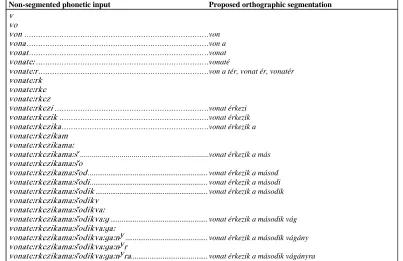
In the analysis process of the unsegmented sig-nal (see Figure 1), for example, the input slice vonate˘rhas three morpho-lexically equally likely segmentations: von a tér, vonat ér, vonatér. Either the acoustic signal contains information confirming or rejecting any of them; or all of them will be temporarily kept, and the segmentation process itself will filter them out later on. In Figure 1, after reading some further symbols from the input, it becomes clear that the only orthographically correct word boundary is between vonat and érkezik .
4 Underspecified forms
It is quite common that the recognition process cannot perfectly identify segments in the original
signal source. These are the cases of
underspeci-fication. Let us assume that a speech recognition
Non-segmented phonetic input Proposed orthographic segmentation
v vo
von ...von
vona ...von a
vonat...vonat
vonate˘ ...vonaté
vonate˘r ...von a tér, vonat ér, vonatér
vonate˘rk vonate˘rke vonate˘rkez
vonate˘rkezi ...vonat érkezi
vonate˘rkezik ...vonat érkezik
vonate˘rkezika...vonat érkezik a
vonate˘rkezikam vonate˘rkezikama˘
vonate˘rkezikama˘s‡‡ ...vonat érkezik a más
vonate˘rkezikama˘s‡‡o
vonate˘rkezikama˘s‡‡od... vonat érkezik a másod
vonate˘rkezikama˘s‡‡odi... vonat érkezik a másodi
vonate˘rkezikama˘s‡‡odik... vonat érkezik a második
vonate˘rkezikama˘s‡‡odikv vonate˘rkezikama˘s‡‡odikva˘
vonate˘rkezikama˘s‡‡odikva˘g... vonat érkezik a második vág
vonate˘rkezikama˘s‡‡odikva˘ga˘
vonate˘rkezikama˘s‡‡odikva˘ga˘ny... vonat érkezik a második vágány
vonate˘rkezikama˘s‡‡odikva˘ga˘nyr
vonate˘rkezikama˘s‡‡odikva˘ga˘nyra... vonat érkezik a második vágányra
process is unable to identify the value of the binary
feature VOICED. In these cases, the linguistic
subsystem attempts to find orthographically well-formed morpho-lexical constructions for both voiced and voiceless variants of the phoneme in question. In fact, underspecified forms of the input signal are represented either by lists of possible characters—like set representations in two-level morphology (Koskenniemi, 1983):
vona{t,d}e˘rkezikama˘s‡‡odi{g,k}{v,f}a˘ga˘nyra
(‘train is arriving to the second platform’) or by underspecified feature complexes:
vonaDe˘rkezikama˘s‡‡odiGVa˘ga˘nyra
where D, G and V are d, g and v, respectively, but not specified as voiced or voiceless.
5 Using higher-level linguistic processes
The linguistic correction framework operates ra-ther inefficiently if it uses morpho-lexical proces-sing only. This results in extreme ambiguity: nu-merous overgenerated orthographic patterns ap-pear with grammatically incorrect segmentation. Thus the process must be improved by adding higher level linguistic analysis. Currently, the framework uses partial syntax similar to the me-chanism applied in the Hungarian grammar che-cker module. This partial syntax describes parti-cular syntactic phenomena in order to identify in-correct grammar beyond the word boundaries.
A more efficient post-processing filter is being
developed by applying the HumorESK parser
mo-dule (Prószéky, 1996). Figure 2 shows the possible
segmentations of the morphology-only system. In this figure, an asterisk marks syntactically non-mo-tivated word sequences filtered out by the partial syntax or the full parser—operating as a higher-le-vel segmenter.
In the first 10 segmentations, the personal pro-noun ti (2nd person, pl.) does not agree with either the verb ír (3rd person, sing.) or the verb írok (1st person, sing.). Syntactically the last two segmentations can be accepted (but semantically and according to topic-focus articulation, Nr. 11 is bizarre). In most cases it is true that the segmentation containing the longest matches in the input sequence is the best orthographical candidate.
6 Further development
Morpho-lexical and syntactic segmentation and correction can be very useful in improving the quality of ‘traditional’ recognition sources. How-ever, it is important to emphasize that the proposed framework would only support existing recognition methods (e.g. likelihood-based mechanisms in speech recognition) rather than replacing them. The current breakdown of the framework makes no as-sumptions on the operation of the underlying re-cognition process, and does not prefer any methods to any other. In terms of architecture, the correction framework’s operation is separated from the rec-ognition module.
One of the aims of this project is, however, a better interaction between the linguistic and the re-cognition subsystem. As the first step, it requires a standard feedback interface (yet to be developed).
Because the current implementation of the
Mor-phoLogic Recognition Assistant framework does not make assumptions of the recognition subsys-tem, it cannot influence its operation. A standard feedback interface consists of a formalism for de-scribing the interaction between a recognition source and the correction framework, regardless of the characteristics of the recognition subsystem. Stub modules must be developed to communicate with existing recognition systems.
An example for the dialogue between a phonetic and linguistic subsystem: first, a superficial acous-tic-phonetic analysis offers some sequence of underspecified feature complexes, then the lin-guistic subsystem attempts to transform them into potential orthographically correct units with surface word boundaries. Finally, the phonetic system Input: nyelve˘setitsik˘eti˘rok
1. *nyel vész e ti cikket ír ok 2. *nyel vész e ti cikket írok 3. *nyel vésze ti cikket ír ok 4. *nyel vésze ti cikket írok 5. *nyelv ész e ti cikket ír ok 6. *nyelv ész e ti cikket írok 7. *nyelvész e ti cikket ír ok 8. *nyelvész e ti cikket ír ok 9. *nyelvésze ti cikket ír ok 10. *nyelvésze ti cikket írok 11. nyelvészeti cikket ír ok 12. nyelvészeti cikket írok
(‘I am writing a linguistic paper.’)
controls whether which of the offered segmen-tation points can be confirmed acoustically.
7 Implementation
The first version of the MorphoLogic Recognition Assistant framework has been implemented along with a demonstration interface. This application takes symbolic codes of different recognized symbols (phonemes, OCR-read characters etc.), and provides orthographical output. It has been programmed in C++ using MS Visual Studio 6.0, and runs on 32-bit Windows systems. As service
modules, the framework incorporates the Humor
(morphological analyser), the Helyesebb
(gram-matical validator), and the HumorESK (full parser) technologies. With a standard programming in-terface, it is ready to be integrated with existing recognition systems.
Conclusion
This paper has introduced a framework for treating common error classes occurring in the output of various recognition sources. We have shown that different types of recognition sources share the same error types: namely, (1) poor or nonexistent segmentation, (2) underspecified and (3) incor-rectly recognized symbols.
Our proposed solution is a post-processing phase performed on the output of the recognition source, where morpho-lexical and syntactic mod-els validate (either accept or reject) different orthographical candidates derived from a single recognized symbol sequence.
The system is language independent and com-pletely data-driven: by replacing the databases, the MorphoLogic Recognition Assistant is imme-diately ready to work with a different language. For the Humor system, descriptions exist for sev-eral languages (Hungarian, English, German, Spanish, Czech, Polish and Romanian). Syntax descriptions are under development for Hungarian and English (prototypes exist).
The proposed framework seems promising for continuous recognition systems. Its main advan-tage is the ease of application of any linguistic module, thanks to the separate symbol mapping process and the open architecture. However, we must emphasize again that the MorphoLogic Re-cognition Assistant supports existing recognition systems rather than replacing them.
Acknowledgements
This research was carries out within the framework of the IKTA-063/2000 Project supported by the Hungarian Ministry of Education.
References
Althoff, F., G. Drexel, H. Lüngen, M. Pampel & C. Schillo (1996). The treatment of compounds in a morphological component for speech recog-nition. In: D. Gibbon (ed.) Natural language processing and speech technology, 71-76, Mouton de Gruyter, Berlin, New York Gibbon, D., R. Moore, R. Winski, eds. (1997).
Handbook of Standards and Resources for Spoken Language Systems. Walter de Gruyter Publishers, Berlin & New York
Koskenniemi, K. (1983) Two-level morphology: A
general computational model for word-form recognition and production. University of sinki, Department of General Linguistics, Hel-sinki, Finland
Nakayama, T.(1994). Modeling Content
Identi-fication from Document Images. Proceedings of the 4th Applied Natural Language Processing Conference, 22-27, Stuttgart, Germany Prószéky, G. (1994). Industrial Applications of
Unification Morphology Proceedings of the 4th Conference on Applied Natural Language Processing, 157–159, Stuttgart, Germany Prószéky, G. (1996). Humor: a Morphological
System for Corpus Analysis First TELRI
Seminar on Language Resources and Language Technology, 149–158, Tihany, Hungary
Prószéky, G. (1996). Syntax As Meta-morphology
Proceedings of COLING-96, Vol.2, 1123–1126, Copenhagen, Denmark
Prószéky, G. & B. Kis (1999). Agglutinative and Other (Highly) Inflectional Languages. Pro-ceedings of the 37th Annual Meeting of the As-sociation for Computational Linguistics,
261–268. College Park, Maryland, USA Sibun, P. & Spitz, A. L. (1994). Language