Finding Problem Solving Threads in Online Forum
Zhonghua Qu and Yang Liu The University of Texas at Dallas
{qzh,yangl}@hlt.utdallas.edu
Abstract
Online forum is an important source that people use to find answers to questions. Most search engines simply retrieve “rele-vant” threads, but those are not necessarily good threads in terms of providing qual-ity answers. In this paper we propose a two-step approach to classify online forum threads according to their informativeness in terms of question answering. We use statistical models to first categorize posts inside a thread. Then, a variety of features including post level information and other meta-data information are used to classify the thread. We show promising results us-ing the online support forum data we have collected.
1 Introduction
Online forums often contain useful information, such as answers to questions. When people use search engines to search the forum for answers, the returned threads can be of very low quality in terms of providing informative answers. Some threads are either long conversations without any final conclusive answers or contain answers that do not work. This is especially the case in tech-nical forums. There has been some work on tracting information from online forums. For ex-ample, Cong et al. (Cong et al., 2008) used la-beled sequential patterns to detect question sen-tences in online forums. Ding et al. (Ding et al., 2008) used Conditional Random Fields to extract context of questions for answer detection. Huang et al. (Huang et al., 2007) used SVM to automati-cally extract and rank title-reply pairs from online discussion forums for chatbot knowledge. These previous studies provide a relatively good founda-tion for answer finding and extracfounda-tion. In online environments like mailing list or forums, question
answering is carried out in conversations. In this paper we take advantage of the structure of con-versation and language cues to answer a basic yet important question: Does the thread actually solve the problem?
We will make use of the conversation within the thread to determine how users think of the an-swers. To classify the usefulness of a thread, we propose a two-step approach using statistical mod-els. First we classify the posts inside a thread into different categories (e.g., problem description, so-lution, feedback). Different models using both content and contextual information are evaluated. Then, we develop features generated from the post categories together with forum meta-data to clas-sify a thread’s usefulness. In our collection of fo-rum threads, we show that our proposed methods achieve good results, significantly better than the rule-based baseline.
2 Data Collection and Annotation
We created our own data collection and annota-tion.1 We crawled 20,000 threads from an
ac-tive online forum (Oracle database support forum – general section). As an initial study, we se-lected 200 threads randomly and asked two anno-tators to label the threads and posts in them. The two annotators are computer science students with adequate knowledge to understand the content of those posts. For thread level annotation, we asked the annotators to label the thread based on whether they think it solves the problem and to what ex-tent. We did not give annotators detailed instruc-tions, but rather let them read the threads and make their own judgment. Each thread is given a score from 1 to 5, 1 being least helpful and 5 being most helpful. In the 200 threads we used, 50 have a use-fulness score of 1, 19 with 2, 7 with 3, 61 with 4, and 83 with a score of 5. The distribution has a U
1Please contact the authors for data sharing.
shape – many threads are annotated as absolutely solved the problem (usefulness of 5), or absolutely not helpful at all (usefulness of 1). This also shows that the confidence of annotators is very high.
Another annotation we performed is for the posts inside each thread. We defined four classes for the posts based on their main purpose. The cat-egories and brief explanation for them are shown in Table 1, along with the number of posts for each category. Note that sentences inside a post may have different purposes, however, we instructed the annotators to label it with its main purpose. The post classes are very imbalanced in the an-notated corpus. The feedback classes account for only about 10% of all the posts, while the majority classes are problems and solutions.
Post category Description number
Problem Ask a question or ask for answer clarification. 399 Solution Give answers/clarifications
to previous questions. 557 Good Feedback State that the problem is
solved. 78
Bad Feedback State that the answer did not
[image:2.595.72.291.292.391.2]solve the problem. 18
[image:2.595.341.491.468.546.2]Table 1: Annotated categories for posts inside threads.
Table 2 shows the Kappa statistics on thread and post annotation using 20 threads that we randomly selected and let both annotators label them. For the thread annotation agreement, we use binary la-bels – usefulness greater than 3 is considered as 1, and usefulness less than 3 is considered as 0. The Kappa scores are very reasonable, suggesting that humans do not have much trouble with this task definition.
Classes Kappa Coefficient
Thread Usefulness 0.93
Post - Problem 0.86
Post - Solution 0.70
Post - Good Feedback 0.93
Table 2: Kappa statistics between two annotators for thread and post category annotation.
3 Approaches
For the ultimate goal of classifying how likely a thread provides a good solution (its usefulness), we propose to use a two-step approach. First we determine the categories for the posts, then we
classify the threads using information from the first step along with other information.
3.1 Post Level Classification
We use the content of a post as well as its context for post classification. First we used Naive Bayes classifier with a bag-of-word model for post classi-fication. Naive Bayes classifiers have been proved to be robust and perform well in document classifi-cation. After performing tokenization using space, we use the top 600 words from the training set as the dictionary.2 Each post is thus represented by
a feature vector of tokens that appear in the dic-tionary. We use binary features for these words. This has been shown to perform better than using word frequency information for many classifica-tion tasks. We use the implementaclassifica-tion of multi-nomial Naive Bayes classifier provided by Weka (Hall et al., 2009).
We expect that posts in a thread, like turns in di-alogs, are very dependent on the context. For ex-ample, a “problem description” post is more likely to be followed by “solution” posts than a back” one. People are more likely to give “feed-back” after some “answers” are provided rather af-ter a “question” is asked. Hence we evaluate using an HMM for this post categorization task, in order to take advantage of context information. Figure 1 shows a first order HMM for this setup.
c2 d2
c3 d3
[image:2.595.95.269.572.624.2]c1 d1
Figure 1: Illustration of HMM for post categoriza-tion. An observation di is a post, and ci
corre-sponds to its category.
The generative process is as follows. The cat-egory of current post is generated according to a multinomial distributionP(ci|ci−1)conditioned
on its previous post category. Then, given the category of current post, words in the post are generated according to multinomial distribution
P(di|ci)based on the post’s category.
The problem can be formulated to find the most likely state sequenceC (post categories) given all 2We varied the dictionary size, but observed performance
the words in all the postsD. The posterior proba-bility ofCgivenDis:
P(C|D) =P(c1, .., cn|d1, .., dn) ∝P(d1, .., dn|c1, .., cn)×P(c1, .., cn)
=
n
Y
i=1
P(di|ci)×P(ci|ci−1) (1)
The last equation is due to the first order HMM assumption where a post document is only depen-dent on its category (in a generative process), and a post category is only dependent on its previous category. For parameters in this HMM, the tran-sition probabilities are estimated from the training set, similar to training a bigram language model (LM) for the post categories.
It is possible to use an n-gram language model to model the generation of text in posts given its category. However, since our data set is rather small, there is a data sparsity issue for these n-gram LMs. Hence, we only use a unin-gram-like model for a subset of the words (same as those in the Naive Bayes model), and each word is repre-sented in binary form: whether or not it appeared. In practice, when combining the state transition probabilities and emission probabilities, we use a weighting factorγ that is determined empirically.
This is needed because the two scores are in dif-ferent scales and contribute to the final hypothesis differently.
3.2 Thread Level Classification
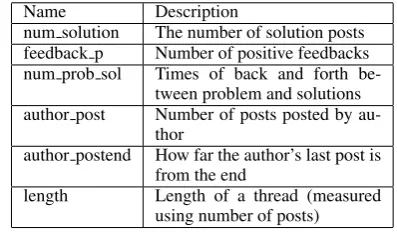
The second step in our system is thread level clas-sification, where the system determines whether a thread is useful or not. Using our annotated threads, we grouped them into binary classes: use-ful when the label is equal to or greater than 3; and not useful otherwise. We use a variety of features for thread level classification. Table 3 lists all the features we use for thread classification.
Since the post level classifier is optimized for the classification accuracy for that particular task, its hypotheses might not be optimal for subse-quent thread classification. For example, if a post “looks” like both a “good feedback” and a lem”, we may prefer “good feedback” to “prob-lem” since the former is more related to our final decision for the thread usefulness. To achieve this, we adjust the priors in the post classification pro-cess for different categories. We found that by increasing the prior for “good feedback” by 1.5 times, the final performance is improved – even
though the classification precision decreases, the improved recall seems to be helping.
Name Description
num solution The number of solution posts feedback p Number of positive feedbacks num prob sol Times of back and forth
be-tween problem and solutions author post Number of posts posted by
au-thor
author postend How far the author’s last post is from the end
[image:3.595.315.514.101.217.2]length Length of a thread (measured using number of posts)
Table 3: Features used for thread level classifica-tion. ‘Author’ means the user who first posted the problem and started the thread.
We use a maximum entropy model for thread classification. This classifier is chosen because of its good performance in many language process-ing tasks, as well as our own preliminary experi-ments when comparing to other classifiers includ-ing decision trees and SVMs.
4 Experiments
4.1 Post Level Classification Results
We performed leave-one-out-cross-validation (us-ing threads as the units) for post classification. Table 4 shows the results using different meth-ods. We developed a rule-based baseline system for this task. Posts containing typical question words like “what”,“where” are classified as “prob-lem” posts. Those containing cue words for pos-itive feedbacks, like “thanks”, “solved”, and hav-ing length of less than 50 words are classified as “positive feedback” posts. The rest are classified as solutions.
The results shown in the table include the F1
score for 3 individual post categories: problem (F-P), solution (F-S), and good feedback (F-F), as well as the micro averagedF1 score. Here we
ig-nored the classification results for “bad feedback” category since it is not very useful in later thread classification.
clas-Method Fmicro F1-P F1-S F1-F Baseline: rule 44.58 49.59 46.53 18.58
NB 77.57 76.81 85.52 28.57
[image:4.595.83.283.62.105.2]HMM 83.17 83.21 87.75 36.04
Table 4: Post classification results using different methods. Results are the F-measures for problem, solution, and good feedback categories, and the overall performance.
sifier. After using context information through HMM, post level classification performance in-creased substantially. There is consistent improve-ment for all the categories. In particular, there is a relatively larger gain for the “feedback” class, which we expect may have a great impact on sub-sequent thread level classification. This perfor-mance gain using HMM demonstrates that con-textual information is useful and HMM can well model such information (e.g., an ‘answer’ post is likely to follow a ‘problem’ one). We also in-creased HMM to higher order in order to model the transitions using more previous post cate-gories, but found there is no additional improve-ment. In fact, it is slightly worse than using the first order HMM. This can be explained by either that the long distance relationship is not very cru-cial for this task, or more likely that we do not have a large training set to learn high order transi-tion informatransi-tion reliably.
In general, we can see that the classifiers per-form relatively well for the majority categories, such as problems and solutions. However, for mi-nority classes, e.g., “feedback” (that is only 9.8% among all the posts), the classifiers are not able to learn well. We also observe that many “problem” types are classified as “solutions”. This may be explained by two reasons. First, problem descrip-tion posts use very similar vocabulary as soludescrip-tion posts. Second, there are more solution posts in the training data.
4.2 Thread Level Classification Results
For thread level classification, we use a binary setup, useful vs. not. We used leave-one-out-cross-validation for the 200 labeled threads. In-side each fold, first we use the training set to train the post level classifiers. Then we relabel all the posts in the training set as well as in the testing set with the classifier just trained to obtain the post category hypotheses. After the post level labeling, we extract features for thread classification as
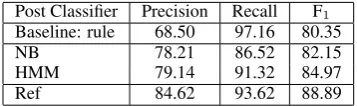
de-scribed in Section 3. We then train the maximum entropy classifier and test it for the final classi-fication of threads. We use the precision, recall, and F1score as the evaluation metrics. Results are
shown in Table 5. For a comparison, we also show the performance when using reference post labels for both training and test sets (last row). This is expected to give an upper bound performance re-garding the use of post level information for thread classification.
Post Classifier Precision Recall F1 Baseline: rule 68.50 97.16 80.35
NB 78.21 86.52 82.15
HMM 79.14 91.32 84.97
Ref 84.62 93.62 88.89
Table 5: Thread level binary classification results using features extracted from output of different post level classifiers.
We can see from Table 5 that in general thread classification results depend heavily on the perfor-mance of post level classification. HMM achieves the best performance. Using reference post cat-egory shows the upper bound of how post level classification could affect thread level classifica-tion. We also evaluated using the reference post tags in training the thread classifier, and automatic tags for testing, but that did not perform as well as using automatically obtained tags for both train-ing and testtrain-ing, suggesttrain-ing a matched traintrain-ing and testing condition is better. Overall we achieved very good performance – an F1 score of about
85% using HMM for post categorization. This is a promising result given that we have a quite small data set for training.
5 Conclusion
[image:4.595.327.506.207.260.2]References
Gao Cong, Long Wang, Chin-Yew Lin, Young-In Song, and Yueheng Sun. 2008. Finding question-answer pairs from online forums. InSIGIR, pages 467–474.
Shilin Ding, Gao Cong, Chin-Yew Lin, and Xiaoyan Zhu. 2008. Using conditional random fields to ex-tract contexts and answers of Questions from online forums. InACL.
Mark Hall, Eibe Frank, Geoffrey Holmes, Bernhard Pfahringer, Peter Reutemann, and Ian H. Witten. 2009. The weka data mining software: an update.
SIGKDD Explorations, 11(1):10–18.