Relational Lasso
—An Improved Method Using the Relations among Features—
Kotaro Kitagawa Kumiko Tanaka-Ishii
Graduate School of Information Science and Technology, The University of Tokyo
[email protected] [email protected]
Abstract
Relational lasso is a method that incor-porates feature relations within machine learning. By using automatically obtained noisy relations among features, relational lasso learns an additional penalty parame-ter per feature, which is then incorporated in terms of a regularizer within the target optimization function.
Relational lasso has been tested on three different tasks: text categorization, po-larity estimation, and parsing, where it was compared with conventional lasso and adaptive lasso (Zou, 2006) when using a multi-class logistic regression optimiza-tion method. Relational lasso outper-formed these other lasso methods in the tests.
1 Introduction
As machine learning methods scale up and now deal with millions of features, we ideally want to add all possible features without having to man-ually verify or consider the effectiveness of each feature with respect to the performance. In other words, we need an automatic way to exploit any usable information that can be obtained from fea-tures. However, with current machine learning methods, adding noisy features could lower per-formance, so the user still has to decide which fea-tures are worth adding.
Regularization methods have recently received greater interest because of this need. Regular-ization is expressed as a constraint term within an optimization function, where the term is given as a function regarding the importance weight of each feature. Regularization provides a means of importance control embedded within the target optimization problem. Among the various regu-larizers, lasso, proposed by (Tibshirani, 1996) is
the most widely used because of its mathematical comprehensiveness.
This paper describes a method, which we call relational lasso, that improves upon the conven-tional lasso method. We show that relational lasso improves the overall performance of classi-fication compared with that of other lasso meth-ods. This study was motivated through a limitation we observed in conventional lasso: that features could be inter-related, but such dependences are not incorporated within the current regularization. Therefore, the conventional method tends to favor correlated features, which can lead to the impor-tance of non-correlated features being neglected.
Relational lasso overcomes this limitation of conventional lasso by introducing an additional penalty parameter for each feature; this parame-ter is estimated automatically given the noisy re-lations among features, where the rere-lations are also automatically generated. While the proposed method does not add to the computational com-plexity of the conventional regularization method, it improves the quality of classification. We ex-plain the method and show empirical results from tests based on three different text classification and parsing tasks.
Regularization was originally proposed as a way to avoid over-fitting by favoring some small number of features. Our method presented in this article exploits this approach further and attempts to estimate the importance of each feature within the relations it has with other features. As ex-plained in more detail in the following section, attempts along the same line have been made to incorporate underlying relations among features, such as by fused lasso through the ordering among features (Tibshirani et al., 2005), or by group lasso through groups among features (Yuan and Lin, 2006). However, fused lasso assumes prob-lems with features that can be ordered in some meaningful way, and group lasso requires
lying group information to be configured before the method is applied. The closely related work to ours is adaptive lasso (Zou, 2006), which intro-duces an additional parameter per feature. How-ever, since adaptive lasso does not explicitly pro-cess relations among features, the estimation of this additional parameter is completely different from our method. Moreover, as will be empirically shown, our method outperforms adaptive lasso, which in fact performed worse than even the con-ventional method.
Related work on regularization techniques has shown the potential of regularization not only to prevent over-fitting, but also to serve as a kind of feature selection. Relational lasso provides an-other step along this line. Here, we show that our method outperforms other lasso methods in differ-ent classification tasks. Moreover, it works well even when noisy features are added, something that degrades the performance of other lasso meth-ods.
2 Related Work
As explained, feature selection is the key to our method’s effectiveness, and here we summarize the related work done along this line. A substantial number of studies have been done on feature selec-tion techniques, and these techniques can be clas-sified into three categories according to (Guyon and Elisseeff , 2003): wrapper methods, filter methods and embedded methods.
The wrapper is the most na¨ıve way of select-ing a subset of features through predictive accu-racy (Kohavi and John, 1997). The user searches the possible feature space greedily using an induc-tion algorithm and selects the best subset with the best predictive accuracy. Wrappers with greedy algorithms can be computationally expensive and the stepwise selection is often trapped into a lo-cal optimal solution. Since the possible number of subsets for a set is exponential to the number of features in the original set, in practice the user typically defines the subset arbitrarily depending on the category of features, as was tested by (Scott and Matwin , 1999). This makes impossible any fine adjustment as to which individual features to use.
Filter methods, on the other hand, select good features according to some criteria, thus provid-ing the means for selectprovid-ing individual features. These methods have been extensively studied, and
a good overview is available in (Manning, 1999). The representatives of the evaluation function for choosing good/bad features are chi-squares and mutual information, and features having higher scores for these functions are considered good fea-tures. While filtering methods are effective and therefore often used, these methods are indepen-dent of the learning method that they are used with. Moreover, the performance is not guaran-teed to improve even though feature selection is used.
The last category is embedded methods, where the feature selection is embedded within the over-all classification problem. The decision tree is an example of an embedded method, and machine learning techniques using pruning steps have been studied (Perkins et al., 2003). Lasso, an acronym for “least absolute shrinkage and selection oper-ator”, using the L1 norm (Tibshirani, 1996) is a
computationally efficient method for simultane-ously achieving the estimation and feature selec-tion.
Although lasso helps achieve an effective model, the L1 norm could cause biased
estima-tion among features (Knight and Fu, 2000) by not being able to distinguish between truly significant and noisy features.
To cope with this problem, (Zou and Hastie, 2005) proposed the elastic net method, which is expressed as the conjunct ofL1 andL2 norms of
the feature weights. They show that this method works when the number of features substantially exceeds the number of learning data, and also when there is strong correlation between some fea-tures. Another proposal is fused lasso, which in-corporates the order of features (as found in their numbers, such as found in the case when each image pixel value forms a feature) (Tibshirani et al., 2005). Here, the target application is protein mass spectroscopy and gene expression data, and the method is only applicable to a target where the order among features is explicit, as in the case of gene or image pixels. (Yuan and Lin, 2006) proposed grouped lasso, which incorporates un-derlying groups among features. The fused and grouped lasso methods require configuration of the structure among features.
Recently, a new approach called weighted lasso is proposed which calculates theL1 norm on
adaptive lasso. This paper proposes an alternative weighted lasso method, in which the estimation of the weights is processed differently from that of adaptive lasso. Although the procedure of adap-tive lasso is closest to relational lasso, the learning of adaptive lasso does not explicitly handle the re-lations among features.
All these methods are attempts to incorporate the relations, or structure, among features —such as dependence, ordering and groups— into ma-chine learning through the framework of regu-larization. Although such dependence is not al-ways given or tractable, we believe this informa-tion can be learned from some automatically gen-erated noisy relation among features.
3 L1-Regularization of Multi-Class Logistic Regression
Before going on to the main points of relational lasso, let us summarize the regularization frame-work that we adopt. Regularization is the general method used in classification. The target func-tion has two terms, one for fitting and another for regularization. This second term penalizes the weights acquired by each feature, typically by in-corporating the addition of their norms into a tar-get function for the classifier. This prevents the target function becoming too over-fitted by favor-ing some specific sets of features. In this sense, the regularization term can be considered as serv-ing for feature selection.
Of the various ways to define the target func-tion, in this paper we focus on the multi-class logistic regression model and L1-regularization; namely, the lasso method.
The fitting function adopted in this paper is a multi-class logistic regression model, denoted as LR in the following. LR is used to model the re-lationship between the input vectorsx= Rnand labels y ∈ Y. The conditional probability for a labelygivenxis defined as
p(y|x;w) = 1 Z(x)exp
(
wTϕ(x, y))
Z(x) = ∑
y′
exp(wTϕ(x, y′)),
where ϕ(x, y) ∈ Rm is the feature vector and w ∈ Rm is the weight vector. When the train-ing examples {(xi, yi)}(i = 1,· · · , l) are given,
minimization of the loss function
L(w) =−∑
i
logp(yi|xi;w),
is equivalent to the maximum likelihood estima-tion.
Regularization makes it possible to obtain a good model for LR, without restricting the number of features, by imposing appropriate restrictions on weightw. Of the different ways of regulariza-tion, in this paper we adopt (Tibshirani, 1996)’s method of imposing an L1 norm on parameters
because of its mathematical simplicity, especially when applied with LR. This method is called lasso and facilitates both estimation and automatic vari-able selection. When applying this lasso to logis-tic regression, the MAP estimation of weights for each feature is given by the following formula, the target function to be optimized:
w∗ = arg min
w
L(w) +λ∑
i
|wi|, (1)
where λ is the parameter defining the strength of the regularization term’s influence on the op-timization.
Although our proposal applies in general to var-ious types of target function, in this paper we ex-amine its effectiveness within this particular target function. This target function was chosen because the target function of LR-lasso is mathematically comprehensive, so multi-class logistic regression and lasso are widely applied. Further investiga-tion to determine whether our method works well for other target functions will be part of our future work.
4 Relational Lasso —The Proposed Method
for classification from a different aspect are more favored.
To express this, we adopt the weighted lasso ap-proach, so an additional penalizing parameter αi for each featureiis introduced in the second term of formula (1):
The solution found here, subject to theL1
regular-izer, is equivalent to the solution obtained from the constrained optimization problem:
The parameterγ corresponds to λof formula (2). Each parameterαi determines the penalty for wi and directly affects the importance of theith fea-ture.
Previous work on adaptive lasso (Zou, 2006) also introduces an additional parameter, such as
αi, in addition to the weight parameter. Adap-tive lasso focuses on the presence of oracle prop-erties1, and works in two stages of optimization. First weightwiis learned with conventional lasso. Second, L1 norm is re-weighted with the
param-eters αi as αi = 1/|wˆi|δ being set from initial lasso estimatorwˆusing a parameterδ, and the op-timization problem is processed using α. There-fore, their way of learning this additional parame-ter does not explicitly concern the exploitation of additional information different from the original weightwi. On the other hand, our αis estimated given a noisy relation among features, thus it plays a different role from w. In this sense, the way to handle this additional parameter for relational lasso is completely different from adaptive lasso. In other words, the originality of our method lies in usingαto express the relations between under-lying features.
The relations between features are denoted as
R, which is provided to the proposed algorithm and used to estimateα. R denotes a pairwise de-pendence relation between features. That is, if there are mfeatures in total, R ⊂ (1,· · ·, m)×
1Oracle property (Fan and Li , 2001) is satisfied if the
op-timization problem can correctly select the nonzero weights with probability converging to one and the estimators of the nonzero weights are asymptotically normal with the same means and covariance that they would have if the zero co-efficients were known in advance.
(1,· · ·, m). Unlike previous work such as fused (Tibshirani et al., 2005) and grouped lasso (Yuan and Lin, 2006),R in our work is a noisy relation which can be automatically obtained by scanning through features.
Although there are various possibilities for ob-taining R, one way is through the inclusion rela-tion among features. Given a pair of featurespand
q, the featureq includesp, if in every data of the learning data, when the value of featureq is non-zero, the value of feature p is always non-zero. For example, for the case of the adjective “eco-nomic” and its stem “econom”, the latter includes the former while also being a stem for other terms such as “economy” and “economist”. In the final classification, it is unknown which of “econom” and “economic” counts. For part-of-speech tag-ging, “econom” would not provide much infor-mation since it does not have a complete form, but for topic estimation, “econom” might provide sufficient information by representing the terms “economic”, “economy” and “economist”. In both cases, when the two words appear as features, they share a tight relation and when one is given high importance, the other will as well in conventional lasso. In relational lasso, if one representative is selected, then other similar features in the same group will acquire less importance by having a larger penalty.
The overall procedure is shown in Procedure 1. The procedure obtains three kinds of learning data input, a relation among features, and param-eter values. Before optimizing the target func-tion, denoted in the second line from the bot-tom, the procedure calculatesα depending on the given relationR among features. This procedure is expressed in terms of a while-structure, which enables the adjustment of penalty parameters for highly correlated features. The processed feature is held in setF to avoid any duplicate processing of features.
In the while-structure, features are selected one at a time in the order of larger values of ∂L∂(ww), withwbeing the zero vector2. The number of the selected feature is denoted ask∗. Then, for allks which are related tok∗in R, theαis enlarged by a
2
Procedure 1 Relational Lasso Input:
• (xi, yi)(i= 1,· · · , n)
• Parametersλ, a1, a2
• Relation amongmfeatures
R⊂(1,· · · , m)×(1,· · ·, m)
certain constanta1 anda2, depending on whether
the featurekis included ork∗ is included. When the while procedure ends,F includes all the fea-tures. Finally,wis estimated in terms of LR-lasso, where the second term is weighted further with the thus estimatedα. When some specificwk be-comes zero, this means that the weight is consid-ered as not selected for the classification task.
One further improvement that might be possi-ble for the above procedure is to repeat the while-structure and the estimation ofw, so thatαandw
perform co-training; this also remains for our fu-ture work. Moreover, the procedure presented here remains an ad hoc modification of conventional lasso based on our motivation. A more proper mathematical reformulation of this method will be part of our future work.
5 Evaluation
5.1 Experimental Settings
We will consider the following two feature sets.
• Standard features
• Standard and additional features
Here, an additional feature set is introduced so that it can be noisy with respect to the classification.
Therefore, the interest lies in whether the perfor-mance is better when we have the additional fea-tures than it is when we have only the standard features.
We consider three methods:
• Conventional lasso (Tibshirani, 1996)
• Adaptive lasso (Zou, 2006)
• Relational lasso (proposed method)
We are interested in whether relational lasso per-forms better than the other methods. In practice we can select the best λparameter used for lasso methods, using cross-validation, although we ex-amined multipleλs, which determine the strength of the regularizers’ influence as shown in formulas (1) and (2) of Sections 3 and 4.
The other parameters introduced in Section 4 are set as follows. Adaptive lasso has the param-eterδ = 1, which is set as the common choice in (Kr¨amer et al., 2009) and the parameterαi is de-fined from initial estimatorwˆas follows:
αi= max
For relational lasso, parametersa1anda2 were
each set to 1. For L1 regularized LR, a
coor-dinate descent method is implemented by mod-ifying LIBLINEAR3. Coordinate descent meth-ods have been widely applied elsewhere because of their suitability for application to higher-order problems (Yuam et al., 2010).
For each pair of a feature and a method, we con-sidered the following three problems of text clas-sification, polarity estimation, and statistical pars-ing. The next three sections explain the standard and additional feature sets, the relation among fea-turesR, and the evaluation scores.
Task 1: Text Classification
Twenty Newsgroups (20NG)4 were used as the dataset for text classification. This collection con-tains 18,846 English documents partitioned across 20 different news groups.
The data was sorted by date, with the first 60% used as a training set and the remaining 40% used as a test set. A simple bag of words was used
3
http://www.csie.ntu.edu.tw/∼cjlin/
liblinear/
4provided by Jason Rennie, http://people.
Table 1: Features used for dependency parsing
unigram forwinwi−1, wi, wj, wj+1, wj+2, wj+2 pos(w), lex(w)
forwinwi−1, wi, wj, pos(wlef t), lex(wlef t)
forwinwi−1, wi, pos(wiright), lex(wrighti ), pos(wheadi ),lex(wheadi )
bigram for(v, w)in(wi, wj),(wi−1, wj) pos(v)pos(w),pos(v)lex(w),lex(v)pos(w),lex(v)lex(w)
add bigram for(v, w)in(wi, wj+1),(wj, wj+1) pos(v)pos(w),pos(v)lex(w),lex(v)pos(w),lex(v)lex(w)
add preposition forwinwj+1, wj+2, wj+3 lex(wi)lex(wj)pos(w), pos(wi)lex(wj)lex(w)
(ifwjis a preposition)
as the standard feature sets, whereas all stems of all words were used as additional features. Rwas defined as the relation between each word and its stems.
A multi-class classification task is typically evaluated by macro and micro F1 values, so we also provided these values.
Task 2: Polarity Estimation
Polarity dataset v2.05was used as the second data set. The content of each data was a movie re-view in text, tagged with the sentiment of positive or negative. The data consisted of 1,000 positive and 1,000 negative reviews. Since the data set was small, the average accuracy was obtained through 10-fold cross validation.
Feature sets were basically the same as for Task 1, where the standard was a bag of words, the ad-ditional set consisted of word stems, and relation
Rwas the relation among words and their stems. The evaluation was based on the accuracy of the binary classification of positive/negative.
Task 3: Parsing
We also tested the methods on a parsing task, which was a task drastically different from tasks 1 and 2. We used CoNLL-X formatted sentences from the Wall Street Journal section of the Penn Tree-bank. Sections 2-21 were used as training data (39,832 sentences), and section 23 was used as test data (2,416 sentences).
The parsing algorithm we tested is the standard shift-reduce parsing proposed by (Nivre, 2003), where the parsing proceeds by successive determi-nation of the relation between two words (denoted as wi and wj). Such a determination is consid-ered a 4-class classification problem that is mod-eled and learned by LR, augmented by the three lasso methods being evaluated.
5provided by Bo Pang,http://www.cs.cornell.
edu/people/pabo/movie-review-data/
The standard features used are listed in Table 1. Here, pos(w) indicates the part of speech of the word w, where wi indicates the ith word of a given sentence, and wilef t indicates the already parsed dependent word ofwiplaced to its farthest left side. The additional feature set included all dependent words involvingwiandwj, and all bi-grams concerning words used as features in the standard set. In our dependency parsing task, we measured the word accuracy which was defined as the ratio of words assigned correct heads divided by the total of all words.
number of non−zero features
micro F−v
alue
0 20000 40000 60000 80000 100000 120000 140000
70%
75%
80%
85%
90%
95%
relational conventional adaptive
Figure 1: Task 1: Micro F1 values for the number of non-zero features
number of non−zero features
macro F−v
alue
0 20000 40000 60000 80000 100000 120000 140000
70%
75%
80%
85%
90%
95%
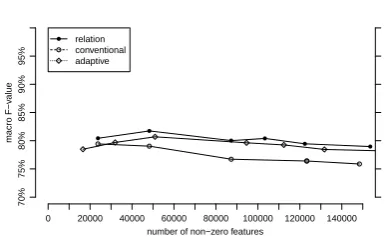
relation conventional adaptive
5.2 Results
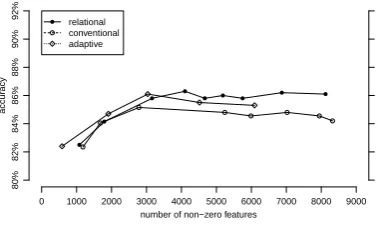
Figures 1 and 2 show the results for Task 1, Fig-ure 3 those for Task 2, and FigFig-ure 4 those for Task 3. Horizontal axes show the number of features and vertical axes show accuracy. Each graph has three lines, indicating the conventional, adaptive and relational lasso methods applied to the stan-dard and additional features all together. Each line has five points, each corresponding to a different value of λ. The horizontal coordinate was deter-mined by counting how many features remained non-zero for each value ofλ.
Overall, all figures, except for Figure 3 show that relational lasso outperformed the adaptive and conventional lasso methods. This was to be ex-pected, since relational lasso has the relationRas input, unlike the conventional lasso method. This confirms that information from the underlying R
does improve lasso performance. Curiously, the performance of adaptive lasso for some figures was lower than that of the conventional method. The reason for this will be given later in this sec-tion.
As Figure 3 and Figure 4 show, the performance was competitive among the three lasso methods, when the number of features were small. How-ever, with a large number of features, relational lasso generally outperforms the other lassos.
number of non−zero features
accur
acy
0 1000 2000 3000 4000 5000 6000 7000 8000 9000
80%
Figure 3: Task 2: Accuracy for the number of non-zero features
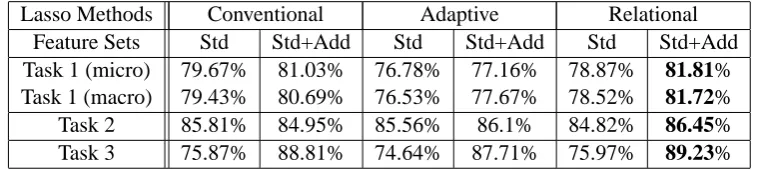
It is difficult to compare the performance since different λ values lead to different levels of per-formance, so the maximum performance obtained by changing the λ value is shown in Table 2. Columns are for different lasso methods with stan-dard and additional feature sets, whereas rows rep-resent different tasks. Note that the best values ofλdiffer depending on the pairs of methods and features.
number of non−zero features [10^6]
accur
Figure 4: Task 3: Word accuracy for the number of non-zero features
Overall, the last column presents the highest performance in each row, thus suggesting the ef-fectiveness of relational lasso.
For Task 2, when features of standard and ad-ditional sets were used, the performance of the conventional method decreased compared to that when only the standard set was used. This could happen if the additional feature set is noisy and the regularizer cannot exploit the useful information from the additional set of features. On the other hand, the performance of relational and adaptive lasso for the same task was improved by extract-ing the useful information; that is, the performance was higher than when using only the standard fea-tures. This shows that the use of underlying infor-mation among features enhances the overall per-formance.
For Tasks 1 and 3, adding features led to bet-ter performance than when using only the standard set. Note, though, that the performance increase was greatest for relational lasso. Thus, relational lasso is the best among the three lasso methods at exploiting information, and thus performs better in terms of accuracy.
In this table, too, we see that for Task 2, the performance of adaptive lasso is below that of the conventional lasso. We consider the reason for this to be as follows. Since the optimization for adap-tive lasso is done in two stages, some of the fea-tures are dropped within the first stage. In the sec-ond stage, these features will never re-acquire any importance. In other words, the feature selection must be done at the very end in order to preserve the possibility of some features to re-acqure the importance through learning.
Table 2: Maximum Performance among Various Values ofλfor Three Lasso Methods
Lasso Methods Conventional Adaptive Relational Feature Sets Std Std+Add Std Std+Add Std Std+Add Task 1 (micro) 79.67% 81.03% 76.78% 77.16% 78.87% 81.81%
Task 1 (macro) 79.43% 80.69% 76.53% 77.67% 78.52% 81.72%
Task 2 85.81% 84.95% 85.56% 86.1% 84.82% 86.45%
Task 3 75.87% 88.81% 74.64% 87.71% 75.97% 89.23%
The pre-processing to obtainαis very fast, since it only scans the number of features once. The bottleneck of the procedure lies in the estimation of w since this requires convergence through a repetitive procedure. Therefore, the computational complexity of relational lasso will not change even withαwithin the regularizer, and the overall speed of relational lasso is almost the same as that of the conventional method. In contrast, adaptive lasso requires twice as much time since the bottleneck part is done twice. In this sense, our method out-performs adaptive lasso in speed and is not signif-icantly slower than conventional, at least for the settings we have examined in this section.
6 Conclusion
Relational lasso utilizes relations among features to better exploit information through regulariza-tion, especially through lasso methods. The con-ventional lasso method is not designed to incorpo-rate relations among features, and this leads to bi-ased weighting of a group of features having sim-ilar behavior. Relational lasso controls such rela-tions underlying features by introducing a penalty parameter for each feature. The penalty increases when a feature is related to some other feature hav-ing less of a penalty. This parameter score is in-corporated as the regularization term of the target machine learning function for the optimization ob-jective.
We compared relational lasso to the conven-tional method and the adaptive lasso proposed by (Zou, 2006), which also uses an additional pa-rameter per feature. We evaluated the methods based on how well they performed three tasks of text categorization, polarity estimation, and pars-ing. Relational lasso outperformed the other lasso methods in these tasks. Moreover, the perfor-mance of the conventional lasso methods deterio-rated when noisy features were added, while rela-tional lasso successfully extracted useful informa-tion from these features and its performance
im-proved.
As part of our future work, we plan to inves-tigate whether our method works for other tasks such as tagging, and with other target functions. Moreover, there are many directions we can take to further improve the method, such as through co-training. Last, it will be interesting to see how our method can be mathematically reformulated.
References
Jianqing Fan, Runze Li. 2001. Variable selection via non-concave penalized likelihood and its oracle properties. Journal of the American Statistical Association, vol.96, pp.1348–1360.
Isabelle Guyon, Andr´e Elisseeff. 2003. An introduction to variable and feature selection. The Journal of Machine Learning Research, vol.3, pp.1157–1182.
G. V. Kass. 1980. An exploratory technique for investigating large quantities of categorical data. Journal of the Royal Statistical Society. Series C, vol.29, pp.119–127.
Keith Knight, Wenjiang Fu. 2000. Asymptotics for lasso-type estimators. The Annals of Statistics, vol.28, pp.1356– 1378.
Ron Kohavi, George H. John. 1997. Wrappers for feature subset selection, Artificial intelligence, vol.97, pp.273– 324.
Nicole Kr¨amer, Juliane Sch¨afer, Anne-Laure Boulesteix. 2009. Regularized estimation of large-scale gene asso-ciation networks using graphical Gaussian models. BMC Bioinformatics, vo.10.
Christopher Manning, Hinrich Schuetze. 1999. Foundations of Statistical Natural Language Processing. MIT Press.
Joakim Nivre. 2003. An efficient algorithm for projective dependency parsing. Proceedings of the 8th International Workshop on Parsing Technologies, pp. 149-160.
Simon Perkins, Kervin Lacker, and James Theiler. 2003. Grafting: Fast, Incremental Feature Selection by Gradi-ent DescGradi-ent in Function Space. The Journal of Machine Learning Research, vol.3, pp.1333–1356.
Yvan Saeys, I˜naki Inza, and Pedro Larra˜naga. 2007. A review of feature selection techniques in bioinformatics. Bioinformatics, vol.23, num.19, pp.2507–2517.
Robert Tibshirani. 1996. Regression shrinkage and selec-tion via the lasso. Journal of the Royal Statistical Society, Series B, vol.58, pp.267–288.
Robert Tibshirani, Michael Saunders, Saharon Rosset, Ji Zhu, and Keith Knight 2005. Sparsity and smoothness via the fused lasso. Journal of the Royal Statistical Society, Se-ries B, vol.67, pp.91–108.
Guo-Xun Yuan, Kai-Wei Chang, Cho-Jui Hsieh, Chih-Jen Lin. 2010. A comparison of optimization methods and software for large-scale l1-regularized linear classifica-tion. The Journal of Machine Learning Research, vol.11, pp.3183–3234.
Ming Yuan, Yi Lin. 2006. Model selection and estimation in regression with grouped variables. Journal of the Royal Statistical Society, Series B, vol.68, pp.49–67.
Ying Yang, Jan O. Pedersen. 1997. A comparative study on feature selection in text categorization. Proceedings of the Fourteenth International Conference on Machine Learn-ing, pp.412–420.
Hui Zou. 2006. The adaptive lasso and its oracle properties. Journal of the American Statistical Association, vol.101, pp.1418–1429.