An algorithm for efficiently generating summary paragraphs using
tree-adjoining grammar
Bruce Eddy, Diana Bental and Alison Cawsey
Department of Computing and Electrical Engineering Heriot-Watt University
Edinburgh EH14 4AS
UK
ceebde1,diana,alison @cee.hw.ac.uk
Abstract
We present an algorithm which im-proves the efficiency of a search for the optimally aggregated paragraph which summarises a flat structured input spec-ification. We model the space of possi-ble paraphrases of possipossi-ble paragraphs as the space of sequences of composi-tions of a set of tree-adjoining grammar (TAG) elementary trees. Our algorithm transforms this to a set with equivalent paraphrasing power but better compu-tational properties. Also, it identifies an explicit mapping between input propo-sitions and their possible surface reali-sations.
1 Introduction
Summarisation of simply structured data as short natural language paragraphs has recently been a focus of interest. Shaw (1998) and Bental et al. (1999) looked at generating text from database records. Robin and McKeown (1996) summarised quantitative data. Shaw’s examples were drawn from patient medical records; Bental et al’s from online resource cataloging informa-tion. A requirement common to all these studies has been to produce aggregated (Reape and Mel-lish, 1999) text.
Also in all these studies, the structure of the input data used was fairly flat. In particular, in (Shaw, 1998) and (Bental et al., 1999) each record
This work is supported by EPSRC grant GR/M23106.
is associated with a particular entity (e.g. a patient or an online resource) and is essentially a list of attribute-value pairs. We refer to pairs as fields, and to attributes as field names. The relationship between a value and the entity with which it is associated is specified by the field name. Most field names represent “is a” or “has a” relation-ships and hence most values represent facts about the entity. Slightly more complex structure may also be coerced into this form, but we will focus on this simple case.
For our application (summarising data about educational resources), we additionally assume that we are required to be able to summarise any subset of fields from a given record, and that our summary must include every member of that sub-set. The challenge from this sort of summarisa-tion is to devise a system which satisfies two po-tentially incompatible constraints. First, it must be flexible enough to model, for any combina-tion of fields, the optimally aggregated paragraph which expresses them. Second, despite the very large search space that such flexibility probably implies, it must be capable of finding that para-graph in a reasonable time.
identifies an explicit mapping from each field to its possible surface realisations, and hence allows a desirable surface form to be chosen for each field. Our partial implementation of these algo-rithms has produced some promising results.
The rest of the paper is organised as follows. In section 2 we discuss the problem, our approach to modelling it, and characteristics of the search space implied by our approach. In section 3 we present our algorithms for searching this space. In section 4 we summarise and discuss.
2 Searching for concise, coherent paragraphs
2.1 Aggregation is a global optimisation
problem
Our aim is to generate paragraphs which are well aggregated. This notion should be defined in terms of conciseness and coherence, which terms are not formally definable. However, some rea-sonable approximation to them can be achieved by specifying preferences for certain types of syn-tactic constructions over others (Robin and McK-eown, 1996), possibly by giving each generat-able construction a score which reflects its rela-tive preferability. We then define the best aggre-gated paragraph to be that which achieves the best sum of its constituent constructions’ preference scores.
Robin and McKeown’s (1996) system, STREAK, generates aggregated, fact-rich sen-tences. It adds facts in order of the preferability of their best possible realisation. It revises its syntactic choices every time an extra fact is aggregated. This is computationally expensive, and makes multi-sentence generation by the same means prohibitively slow. They do suggest how to deal with this when many of the facts occur in fixed positions, but this is not the case in our corpus.
CASPER (Shaw, 1998) delays syntactic choices until after it has decided where sentence boundaries should fall. It thereby gains computa-tional efficiency at the cost of its sentences being less optimal aggregations.
Our algorithms are an attempt to avoid these problems and to achieve greater efficiency by pre-compiling detailed syntactic decisions, the results
of which we store in the form of explicit map-pings from fields to surface forms. At generation time, we search for the optimal selection of reali-sations. This approach deviates from the pipeline architecture of NLG systems which, it has been observed, is not wholly suited to the generation of aggregated texts.
The first author to discuss this was Meteer (1992), who showed that the microplanning stage of the pipeline is constrained by surface realisa-tion in two ways. First, a microplan must be real-isable in the target language; second, a realreal-isable microplan must make best use of the capacities the target language for concise expression.
More generally, in order to generate aggregated text, constraints imposed by and opportunities af-forded by the surface form may be taken into ac-count at any stage in the pipeline. Reape and Mel-lish (1999) provided examples of different sys-tems each of which takes aggregation decisions at a different stage. It may not be easy to deter-mine what effect a decision taken at an early stage will have at the surface; and decisions taken at one stage may preclude at a later stage a choice which results in a more aggregated surface form. Simi-larly, it may not be easy to make a decision at an early stage which makes best use of the surface possibilities.
Consider the examples of figures 1 and 2. Both summarise the same set of fields; figure 2 sum-marises additionally the field “subject = science”. Both paragraphs summarise their fields in the most concise and coherent manner possible (al-though this is, of course, a subjective judgement). Note that they treat the fields they have in com-mon differently with respect to ordering and dis-tribution between the sentences.
“Constellations” is a 4-hour lesson plan pub-lished by online provider ProLog. Maureen Ryff wrote it for small group teaching.
Figure 1: A paragraph which summarises the set of fields of figure 3 in an aggregated manner.
“Constellations” is a science lesson plan which lasts 4 hours. Maureen Ryff wrote it for small group teaching and ProLog, an online provider, is its publisher.
Figure 2: A well aggregated paragraph which summarises the set of fields of figure 1, together with fieldsubject= “science”. Notice the non-linear effect the addition of a single extra propo-sition can have on the structure of the paragraph.
2.2 Modeling paragraphs with TAG
Our approach uses, as its primary representation, TAG formalism extended to include unification based feature structures (Vijay-Shanker and Joshi, 1991). Joshi (1986) describes the advantages TAG possesses as a syntactic formalism for NLG. In generation, the TAG model has usually been applied to generating clauses and sentences. Re-cently, Webber et al. (1999) outlined the benefits of modelling longer strings of text by the same means.
The most important characteristic of TAG for our purposes is the local definability of dependen-cies: constraints between the nodes of elemen-tary trees are preserved under adjoinings which increase the distances between them. For exam-ple, in the sentence fragment “Springer published ...”, which might be modelled by a single initial tree, the object is constrained to be some entity published by Springer. If an adjunction is made so that the fragment becomes “Springer, the largest publishing company in Europe, published ...”, this constraint is undisturbed.
Our approach presupposes the existence of a TAG whose string set is exactly those paragraphs which are comprehensible summaries of subsets of fields. We do not discuss the creation of such a TAG here. We have made progress with
design-ing one; we believe that it is the flatness of the input data which makes it possible.
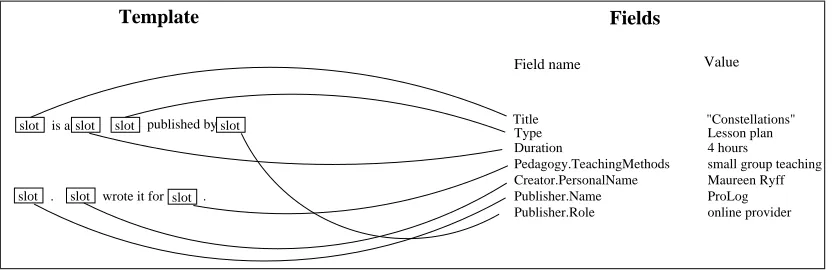
Let us restate the problem somewhat more for-mally. Suppose that we have a set of fields whose values we may be required to express. Suppose that for every there is a template which expresses . A template is a paragraph in which certain words are replaced by slots. A slot is a reference to a field-name. A template ex-presses a set of fields if the name of every ele-ment of is referenced by a slot, and every slot refers to an element of . We say that expresses
and that the resulting paragraph is the expres-sion of with respect to . See figure 3.
Let denote the template which “best” ex-presses some . Suppose also that we have a TAG with string set such that
! "#. The creation of is not discussed here. Every string in # is the yield of$ , some derived tree of .
Each of a TAG’s derived trees is represented by a unique derivation tree. Typically a deriva-tion tree represents several (differently ordered) sequences of compositions of (the same set of) elementary trees, all of which result in the same derived tree.
Hence, a derived tree $ of a TAG with el-ementary trees % is the result of some sequence of compositions of the elements of % which is equivalent to some derivation tree & . We write
$(')&*+%, or just$-'.&/ , Hence, our problem is, given and some( 0 , find some& such that&*12'.3 .
There are two parts to the problem of finding
. First we must recognise 3 , which we may do, as described in section 2.1, by defining
to be the paragraph which achieves the best sum of its constituent constructions’ preference scores. Second, since the search space of deriva-tion trees grows exponentially with the number of trees in the grammar, we must find its derivation in a reasonable amount of time.
slot is a slot slot published by slot
slot . slot wrote it for slot .
Lesson plan Type
Title "Constellations"
Template Fields
Field name Value
Duration 4 hours
small group teaching Maureen Ryff ProLog online provider Pedagogy.TeachingMethods
[image:4.595.92.508.64.199.2]Creator.PersonalName Publisher.Name Publisher.Role
Figure 3: A template which expresses a set of fields. The curves indicate the field name to which each slot refers. The fields’ expression with respect to the template is the paragraph in figure 1.
slot may be expressed are an implicit property of the grammar: it requires search to discover what they are, and then further search to find their op-timal configuration.
2.3 The search space
We model possible paraphrases with a TAG, the paraphrases being the elements of its string set. The nodes in the search space are TAG derivation trees, and an arc from4 to5 represents the com-position into the partial derivation corresponding to 4 , of an elementary tree, with result the par-tial derivation corresponding to 5 . The size of the search space may be reduced by collapsing certain paths in it, and by pruning certain arcs. These operations correspond to specific
lexicali-sation and the removal of redundant trees from
the grammar respectively.
A tree in the grammar is redundant if it cannot contribute to a paragraph which expresses the re-quired fields; or if it cannot contribute to a ‘best’ paragraph which expresses those fields. We will expand on redundancy removal after describing the specific lexicalisation algorithm. The spe-cific lexicalisation algorithm converts a TAG into a specific-lexicalised version of itself, in which certain paths in the search space, which it can be known will be used in any derivation, are col-lapsed.
3 The algorithms
3.1 Specific lexicalisation: creating a clausal
lexicon
We begin by introducing some notation, and defining some properties of TAGs and their
ele-mentary trees. Let 6+87:9<; denote , a TAG, and
9 , some set of elementary trees, not necessarily in . A leaf node of an elementary tree may be labelled as a slot, which is a special case of the lexical anchor.
An elementary tree is specific-lexicalised if at least one1 of its leaf nodes is a slot. An elemen-tary tree is= -lexicalised if it is specific-lexicalised or if it has no substitution nodes or foot nodes. A TAG is specific-lexicalised if all its elementary trees are= -lexicalised.
2
Given some 6>87:9?;, let @ be an element of
AB9 which is not specific-lexicalised. Let C be an elementary tree of . Suppose that there is some composition ofC into@ and that the resulting tree is specific-lexicalised. Then we say that @ is
single-step-lexicalisable in 687:9<;. We call any such resulting tree a single-step-lexicalisation at
of@ in 687:9<;, where is the node at which the composition occurred.
We now present the algorithm for our transformation Specific Lexicalisa-tion.
1: D'E is some TAG,9F'DGF')H .
2: repeat
3: Add 687:9?; toG .
4: for all@JIKBAL9 do
5: if@ is sinlge-step lexicalisable in6>M7:9<;
1
This is an important parameter. It specifies how many slots each elementary tree in the transformed TAG may have (and consequently how many times the “derivation tree” of each of these trees branches).
2
then
6: if@NIO then
7: Remove@ from .
8: Add@ to9 .
9: end if
10: For some node of @ , , add all the single-step-lexicalisations at of@ in
6>M7:9<;, to .
3
11: end if
12: end for
13: until 687:9<;NIPG
14: is a specific-lexicalisation
4 of
.
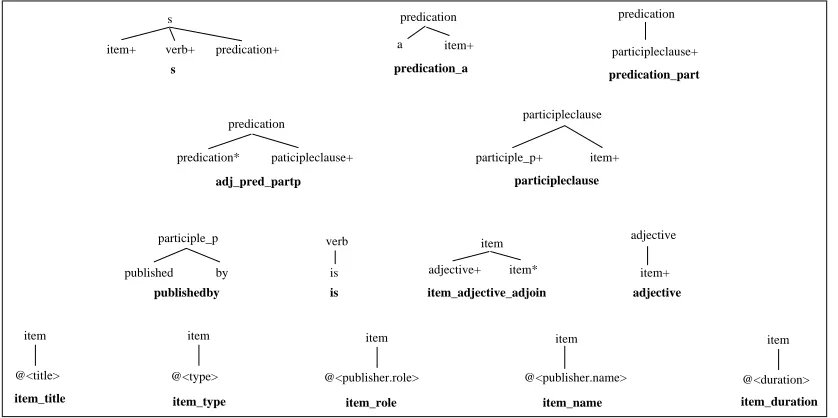
To illustrate this procedure, we have provided some figures. Consider the TAG Q , whose el-ementary trees are shown in figure 4. We have chosen, for reasons of space and simplicity, not to show the feature structures attached to each node of these trees. Their approximate form can per-haps be deduced by examination of the templates modelled byQ, shown in figure 6. A specific lex-icalised version of the TAG,R is shown in figure 5. We have named each elementary tree inR by concatenating the names of its constituents from
Q . The templates generated by Q (and hence R ) are shown in figure 6.
3.2 Redundancy removal
We can further remove redundancy in a specific-lexicalisation, , of some TAG. Let 687:9?; be a pair as in the previous section. The following three subsets of the elementary trees of are re-dundant. First, those trees @SID which are not rooted on the distinguished symbol and for which there is no CTI)0A?9 such that @ can be com-posed into C . Second, those@,IB which have a substitution node into which noCIKKAU9 can be substituted. Third, those @#IP such that for each tree V which is the result of the composition of someCUIOWAX9 into@ ,VYIZ[AX9 . Our program
3
Note that there is a choice at this step. Our implemen-tation of this algorithm chooses\ such that the number of single-step-lexicalisations at\ is maximised. But different choices result in a transformed grammar with different prop-erties.
4
We claim that a specific-lexicalisation of a TAG is in-deed specific-lexicalised. Note that there does not neces-sarily exist a specific-lexicalisation of a TAG. For certain pathological examples of TAGs, the algorithm does not ter-minate. Note also that if a specific-lexicalisation exists, it is not necessarily unique. Further work is required to discover the properties of the various specific-lexicalisations in these cases.
which implements the algorithm in fact removes these redundancies, not only after completion, but also after every iteration.
3.3 Finding the (approximately) global
optimum
Specific-lexicalisation causes the (previously im-plicit) grammatical constructions by which an el-ement of may be expressed to become explicit properties of the transformed grammar. Specifi-cally, each element of occurs as the anchor of each of a number of elementary trees. Let us refer to the set of elementary trees in the transformed grammar anchored by ]<I as ^+]_ .
5 Each of
these trees corresponds to a grammatical form in which the element may be realised. Hence, rather than performing an exhaustive search of the space of derivation trees `a R , specific-lexicalisation allows us to instead perform a best first search.
That is, we choose exactly one element of^ +]_ for each]/I< . Let]cbedgfh]cC* denote the set of all sets which contain exactly one element of^ +]_ for each]/I< . Recall that we may assign to each syntactic form in which an element of may be realised a preference score, and that each element of^+]c corresponds to some syntactic form. So, for each element of]cbid1fj]k1CY we may sum the preference scores of its elements. Hence, we may impose an order on the elements of ]kbidgfh]cC* according to their sum of preference scores. We may then refer to each element of]cbid1fj]k1CY as
l
Vm1n2o7pfq, where f is the element’s position in the order, withl
Vmn2o7_r being first.
We then search, in order, the spaces of possible compositions of the l
Vs1n2o7pfq s combined with some necessary supporting trees which are not an-chored by an element of . Call these spaces
l
Vm1nst_o7pfq . In terms of redundancy removal,
l
Vm1n t o7pfq is the specific-lexicalised TAG with those trees which might be redundant with respect to the search for removed. We begin the search withl
Vmnstco7_r . It is not guaranteed that is in this space. If it is not, we repeat the search using l
Vmnst_o7vum , and so on. At worst (if 3WI
l
Vs1nst_o7p where ]cbedgfh]c1CY has elements), this procedure exhaustively searches the space of compositions of the elements of R .
5
s
verb+
item+ predication+
s
predication item+ a
predication_a
predication
participleclause+
predication_part
predication
predication* paticipleclause+
adj_pred_partp
participleclause
participle_p+ item+
participleclause
adjective
item+
adjective
item adjective+ item*
item_adjective_adjoin
verb
is
is
participle_p
published by
publishedby
item
@<duration>
item_duration
item
@<publisher.name>
item_name
item
@<publisher.role>
item_role
item
@<type>
item_type
item
@<title>
[image:6.595.91.510.78.287.2]item_title
Figure 4: The elementary trees of a small TAG,Q . The trees’ names are in bold below them. Substi-tution nodes are indicated with a ‘+’; foot nodes are indicated with a ‘*’; the distinguished symbol is ‘s’. Slots are shown as ‘@<reference>’, where “reference” is the field to which the slot refers. Note that the feature structures which are associated with each node, which prohibit certain compositions, are not shown. Note also that this is not a lexicalised TAG (LTAG). This is somewhat unusual; we intend, as part of our ongoing work, to apply our techniques to an established LTAG, such as XTAG.
s
item verb+ predication+
@<title>
s:item_title
item
adjective item*
item
@<title>
item_adjective_adjoin:adjective:item_title
predication
participleclause
participle_p+ item
@<publisher.name>
adj_pred_partp:participleclause:item_name
predication*
predication
participleclause
item
@<publisher.name>
predication_part:participleclause:item_name
participle_p+
item
adjective item*
item
@<publisher.role>
item_adjective_adjoin:adjective:item_role
item
adjective item*
item
@<duration>
item_adjective_adjoin:adjective:item_duration
predication a item
@<type>
predication_a:item_type
verb
is
is
participle_p
published by
publishedby
[image:6.595.90.506.411.668.2]1:@<title>is a@<type>.
2:@<title>is a@<type>published by@<publisher.name>.
3:@<title>is a@<type>published by@<publisher.role> @<publisher.name>. 4:@<title>is a@<duration> @<type>.
5:@<title>is a@<duration> @<type>published by@<publisher.name>.
6:@<title>is a@<duration> @<type>published by@<publisher.role> @<publisher.name>. 7:@<title>is published by@<publisher.name>.
8:@<title>is published by@<publisher.role> @<publisher.name>.
Figure 6: The templates modelled by the TAGs of figures 4 and 5. Note that the expression of the fields in figure 3 with respect to template 6 is the first sentence of the paragraph of figure 1.
In fact, since the l
Vmnsto7p s do not partition `a R , in the worst cases this procedure is slower than an exhaustive search. However, 3 is de-fined in terms of maximal preference scores, so it is likely to be found inl
Vm1n2o7pfq for “low”f . For illustration, refer again to the specific-lexicalisation in figure 5. Notice that @< pub-lisher.name> occurs as the anchor of more than one tree.6 These trees, predication
part:-participleclause:item name and adj pred partp:-participleclause:item name which we will refer to as @xQ and @yR respectively, represent the forms in which that slot may be expressed. Hence,@< pub-lisher.name>may be realised as a predication in its own right using @xQ , as in templates 7 and 8 in figure 6, or as an adjunct to another predi-cation using the second, as in templates 2, 3, 5 and 6. Suppose that our preference scores rate@yR more highly than@xQ , and that we must include all four slots. Then the system would first search the space of compositions of the trees of R without
@vQ, and generate template 6. The second choice, R without@yR leads to the generation of the con-catenation of templates 4 and 8, which expresses the same fields but is less aggregated. This is as we would wish.
3.4 Redundancies in the search space
Specific-lexicalisation is a transformation which operates on a complete TAG Q and its result is another TAG R whose string set is the same as
Q ’s. Also, the feature structures on the nodes of the elementary trees of R contain fewer un-bound variables. Unbound variables represent
6
We are ignoring the tree item adjective adjoin:-adjective:item title, which is not usable due to its features, which are not shown.
dependencies between parts of the grammar. A search of the space of compositions of elemen-tary trees may make a long chain of compositions before discovering that the composed structure is forbidden by such a dependency. The forbidden chain of compositions is redundant, and specific-lexicalisation removes it from the search space.
Importantly, specific-lexicalisation may also take as a parameter , the set of fields to be ex-pressed. It then removes fromQ all elementary trees which are anchored on slots which do not refer to elements of and operates on this re-duced TAG, with resultR . And if3YJI<Qz then 3YBI{# R . Then, in effect, specific-lexicalisation, as well as removing general redun-dant dependencies, is specifically removing some of those parts of the grammar which are redun-dant with respect to the search for.
Redundancy occurs in a grammar for two rea-sons. First, it is written, by hand, with linguis-tic rather than computational efficiency concerns in mind. It is too complex for its writer to be able to spot redundancies arising from long chains of dependencies between its parts. So specific-lexicalisation may be regarded as automatic bug removal. Second, the grammar is written to be able to model all the templates which express some E . So for any particular , the gram-mar will contain information about how to ex-press items not in that set. Specific-lexicalisation highlights this redundancy.
showed a decrease in the generation time after lexicalisation of orders of magnitude, with the best observed reduction being a factor of about 3000.
The specific-lexicalisation of a TAG has the property of having the same string set (and possi-bly the same tree set) as the original, but a smaller space of possible compositions. We have not proved either clause of this statement, but on the basis of experimental evidence we believe both to be true. Also, the following argument supports the case for the second.
Recall that a feature structure attached to a non-terminal symbol in some rule (tree in the case of TAG) of a grammar is an abbreviation for several similar rules. For example, if a node has asso-ciated with it a feature structure containing three features each of which may be in one of two states and none of which are currently instantiated, then it abbreviates u}|W'~ nodes. So each tree in a TAG with feature structures is an abbreviation for
trees, where is the number of possible con-figurations of the feature structures on its nodes. Hence, when we search the space of possible compositions of some number of trees, we are in fact searching the space of compositions of^3 trees, where^ is some factor related to the number of possible configurations of the feature structures on the trees. Specific-lexicalisation identifies ex-actly which of the (non-featured) trees for which a tree with feature structures is an abbreviation are irrelevant to a search by instantiating unbound variables in its features.
4 Further work and discussion
The precise circumstances under which the tech-niques described are effective are still to be estab-lished. In particular, it is our intention to repeat our experiments with a standard LTAG; and with TAGs induced automatically from our corpus.
To summarise, we claim that the generation of an optimally aggregated summary paragraph re-quires the ability to move facts across sentence boundaries. A difficulty to achieving this is the exponential relationship between the number of possible paraphrases of a summary of a set of facts and the number of facts in that set. Our al-gorithm addresses this by transforming a TAG to better model the search space.
References
Diana S. Bental, Alison Cawsey, Sheila Rock, and Patrick McAndrew. 1999. The need for natural language generation techniques to produce resource descriptions in mirador. In Searching for
infor-mation: artificial intelligence and information re-trieval approaches, pages 15/1–15/3. Institution of
Electrical Engineers, London.
Aravind K. Joshi and Yves Schabes. 1991. Tree-adjoining grammars and lexicalized grammars. In Maurice Nivat and Andreas Podelski, editors,
De-finability and Recognizability of Sets of Trees.
Else-vier.
Aravind K. Joshi. 1986. The relevance of tree adjoin-ing grammar to generation. In Natural Language
Generation: New results in Artificial Intelligence, Psychology and Linguistics - NATO Advanced Re-search Workshop, pages 233–252, Nijmegen, The
Netherlands.
Marie Meteer. 1992. Expressibility and the Problem
of Efficient Text Planning. Pinter, London.
Mike Reape and Chris Mellish. 1999. Just what is aggregation anyway? In European Workshop on
Natural Language Generation, Toulouse, May 13–
14.
Jacques Robin and Kathleen McKeown. 1996. Em-pirically designing and evaluating a new revision-based model for summary generation. Artificial
In-telligence, 85(1-2), August.
James Shaw. 1998. Clause aggregation using linguis-tic knowledge. In Proceedings of the 9th
Interna-tional Workshop on Natural Language Generation,
pages 138–147.
Mathew Stone and Christine Doran. 1997. Sentence planning as description using tree-adjoining gram-mar. In Proceedings od the Assosciation for
Com-putational Linguistics, pages 198–205.
K. Vijay-Shanker and Aravind K. Joshi. 1991. Unification based tree adjoining grammars. In J. Wedekind, editor, Unification-based Grammars. MIT Press, Cambridge, Massachusetts.
Bonnie Webber, Aravind K. Joshi, Alistair Knott, and Matthew Stone. 1999. What are little texts made of? a structural presuppositional account using lex-icalised tag. In Proceedings of International
Work-shop on Levels of Representation in Discourse,
Ed-inburgh, July. LOIRD’99.