P R I N C I P A R - - A n
E f f i c i e n t , B r o a d - c o v e r a g e , P r i n c i p l e - b a s e d
P a r s e r
D e k a n g L i n
Department of Computer Science, University of Manitoba Winnipeg, Manitoba, Canada RaT 2N2, [email protected]
Abstract
We present an efI]cient, broad-coverage, principle-based parser for English. The parser has been implemented in C + + and runs on SUN Sparcstations with X-windows. It con- rains a lexicon with over 90,000 entries, con- structed automatically by applying a set of ex- traction and conversion rules to entries from machine readable dictionaries.
1. Introduction
Principle-based grammars, such as Govern- ment-Binding (GB) theory (Chomsky, 1981; Haegeman, 1991), offer many advantages over rule-based and unification-based grammars, such as the universality of principles and mod- ularity of components in the grammar. Prin- ciples are constraints over X-bar structures. Most previous principle-based parsers, e.g., (Dorr, 1991; Font, 1991; Johnson, 1991), es- sentially generate all possible X-bar structures of a sentence and then use the principles to fil- ter out the illicit ones. The drawback of this approach is the inefficiency due 1;o the large number of candidate structures to be. filtered out. The problem persists even when w~rions techniques such as optimal ordering of princi- ples (Fong, 1991), and corontining (Dorr, 1991; Johnson, 1991) are used. This problem may also account for the fact that these parsers are experimental and have limited coverage.
This paper describes an efficient, broad- coverage, principle-based parser, called PRIN- CIPAR. The main innovation in PRINCIPAR is that it applies principles to descriptions o17 X- bar structures rather than the structures them- selves. X-bar structures of a sentence are only
built when their descriptions have satisfied all the pri ncil)les.
O dynamic data [ ~ static
dala l)rocegsing module
data flow
Figure 1: '.Pile architecture of PRINCIPAR
Figure I shows the architecture of PRIN- CIPAR. Sentence analysis is divided into three steps. The lexical analyser first converts the in- put sentence into a set of texical items. Then, a message passing algorithm for OB-parsing is used to construct a shared parse forest. Fi- nally, a parse tree retriever is used to enumer- ate the parse trees.
The key idea of the parsing algorithm was presented in (tin, 199:1). This paper presents some implementation details and experimental results.
2. Parsing by Message Passing
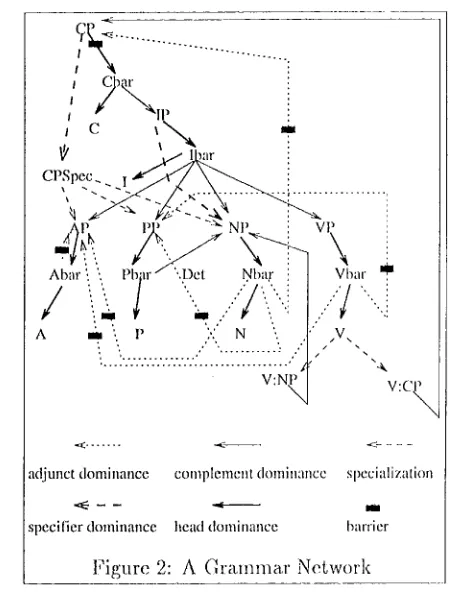
The parser in PIHNCIPAR is based on a message-passing framework proposed by ],in (1993) and l,in and Ooebel (1993), which uses a network to encode the grammar. The nodes in tile grammar network represent grammati- cal categories (e.g., NP, Nbar, N) or subcate- gories, such as V:NP (transitive verbs that take NPs as complements). The links in the net- work re.present relationships bel;ween the cat- egories. GB-principles are implemented as lo- cal c o n s t r a i n t s attached to the nodes and
[image:1.612.313.525.235.359.2]p e r c o l a t i o n c o r m t r a i n t s a t t a c h e d to links in t h e n e t w o r k . F i g u r e ' 2 d e p i c t s ~ port:ion C" tile g r ; u n m a r n e t w o r k for |Dnglish.
' 2 \
I t " "IPcpspe~.. , - / ~ / \ ~
i
AAI ~ I'P " NI i VI :
1 t . .
".,.... "...".. ...." ""....
A ul , P ,,
,. ' . . . ':
'....".v.v.v.v.v.v.v; ... .'"' "" ,~
V : N ~ V:(,~x '
adjullct dominance conlplement domln:lnce specialization
specifier doininailce head donlinanee barrier
F i g u r e 2: A Grtunma.r N e t w o r k
Th(;re ~u'e two types of links in 1,he network:
s u b s u m p t i o n l { n k s and d o m i n a n c e l i n k s .
• [l.'here is a SlXi)sttln[)tiOlX link ['rotn (v l;o
fl if a subsume.s ft. For exa,ini)le , since V s u b s u m e s V : N P a n d V : C P , l;here is a, s u l ) s m n p t i o n l i n k from V to ca.oh ()11o, of t h e m .
• There. is a donxhia.nce link frolil node (v i.o
/7 if/7 cfl, ll })e imme.dia.tely doininal~ed by
O& l.'~Ol ' C X i / d l l p l c , SillCC a.IX Nl)a.r lii&y iltl-
m e d i a £ c l y d o m i n a t e a. P P adjimct,, t;here is a d o m i n a n c e link f r o m N b a r to p p . A d o m i n a n c e link fi:om a to fl is a.ssoci~ted w i t h an integer id t h a t d e t e r m i i l e s tile linear o r d e r b e t w e e n fl and o t h e r cat;egories dolni- m~t(xl t)y a , a n d a, b i n a r y att;ril)ute to specify w h e t h e r fl is o p t i o n a l or oblig~l;ory. I
t ln order to simplify the diagrain, we did nol. label tile links with their ids in l"igure 2. [nstead, t h e prece- d e n c e between dominance links is ilMie~t>ed l)y their
I n p u t sentences a.rc p;u'sed by p a s s i n g me.s- sa.ges iu t,he g r a m m ; u ' n e t w o r k . 'l.'he nodes ill the nel, wor]( are compul, ing a g e n t s t;lxi~t c o m - nulnica.t.e wil;h e;~ch oilier 1)y sending messa,ges in tile rcv(HJso direcl, ion of t h e links ilx the. net-
work. I']acll node ha.s a. local n l e m o r y tlxa.t,
sDol'es a. set of it;ellx.~. Ail il;em is a t r i p l e t thai; represe.nts a. (possibly intern plei, e) X - b a , r strltc- i>ll I'(? [t:
< s t r , a r t , s r c > , w h e r e
~tr is an intx_'ger interva.l
[i,j]
denoi, ing t:ixe i'i~h Lo j'l, tl word ill I, he ill[)llt; still;el]eel a r t is the al;trilml,c vMues of the. reel; node o[ the X - b a r st;rtlCtAll:(':; ~Uid src is i'~ set o[ St)Ill'CO mess~.~ges Prom which this item is c o m b i n e d . T h e source i~lessa,ges r e p r e s e n t inlinedi~te constituctlLs o[the reel; node. li',a.ch node in l, he grannillu: net-
work has a. conll)letion I)redicate tllal, deter- tllillCS w h e t h e r a.n ilieln a.t l;lie node. is "coin- plete," ilx w i l M i ca.se the it;elXl is sent a.s a, ines- sltge 1;o el;tier ll()dOS ill 1~110 ]X}VOI'SC d i r e c t i o n of the links.
~Vilen a, node receives mi itcnl> il; adiLel31pts {o (:onll)ine the itenl w i t h il;ems ['rein other nodes 1,o forln Hew il;enis. 'l~wo it;ores
< [ i , , j l ] , A , , S , > a.nd < [ i 2 , j 2 ] , A,2, S~,>
can I)e combilxed if
• ' " a,(Ijacent to each
] l, heir Slll'[a.ce sl, riilgs Arc el, her: i 7 - :
jl-I-1.
2. tiieir a.tl, r i b u t e vMues At mid A~ a.re
t lHifli~ble..
{{. t i l e SOtlrc(~ l T x e s s a , ~ e s COTHe Vii/~ d i f f e . r e n t
Ii,,ks: li,,ks(,g,) r~ li,,ks(S,~) =-- (k, where links(,q) is a. I'illlC~iOlX {hal,> given i~ set o[ nlessa.ges, returlis the sel; of links via which the iiicssa.ges a, rrived.
{l'he result o[ I~ixe colnbinM;ion is a. [leW il;Oll;l:
<[il,.i~],
,mil'y(A,, A2), S, U S.~>. T h e new il;em represelxt:s a, la,rger N-ba, r sl;ruc- t,u re result;i ng f r o m t, hc c o m b i n a t i o n of the two snla.ller cues. 111 1;lie new it;era s<%isfles the lo- ca.l constraint, o[ I;he node it is considered valid a.nd sa.ved inl;o the local lnOIxlory. ()l:herwise, ig is disca.rded. A valid ito.nl si~t;isfying i;he c o m -sLarting poinl, s, e.g, (J precedes IP under Char since the link leading to (J is to I;he left, of t.he link leading
[image:2.612.75.301.124.420.2]pletion predicate of the node is sent further as messages to other nodes.
T h e input sentence is parsed in the follow-
ing steps.
S t e p 1: L e x i e a l L o o k - u p : Retrieve the lex-
ical entries for all the words in the sentence and create a lexical item for each word sense. A lexical item is a triple: <[i,j], av~lf, av ... p>, where [i,j] is an interval denoting the position of the word in the sentence; av~lf is the at- t r i b u t e values of the word sense; and av,:o,,,, is the a t t r i b u t e values of the complements of the word sense.
S t e p 2: M e s s a g e Passing: For each lexi-
eel item <[i,j], av~lf, av ... p>, create an initiM message <[i,j], av~r, 0> and send this message to the g r a m m a r network node that represents the category or subcategory of the word sense. When the node receives the initial message, it m a y forward the message to other nodes or it ma,y combine the message with other messages and send the resulting combination to other nodes. This initiates a message passing pro- cess which stops when there are no more mes- sages to be passed around. At that point, the initial message for the next lexical item is fed into the network.
S t e p 3: B u i l d a Shared Parse F o r e s t
W h e n all lexieal items have been processed, a shared parse forest for the input sentence can be built by tracing the origins of the messages at the highest node (CP or IP), whose s t r com- ponent is the whole sentence. T h e parse forest consists of the links of the g r a m m a r network that are traversed during the tracing process. T h e s t r u c t u r e of the parse forest is similar to (Billot and Long, 1989) and (Tomita, 1986), but extended to include a t t r i b u t e values.
T h e parse trees of the input sentence can be retrieved h'om the parse forest one by one. T h e next section explains how tile constraints attached to the nodes and links in the network ensure t h a t the parse trees satisfy all the prin- ciples.
3. I m p l e m e n t a t i o n o f P r i n c i p l e s
GB principles are implemented as local and percolation constraints on the items. Lo-
cal constraints are attached to nodes in the network. All items at a node must satisfy the node's local constraint, l?ercolation con- straints are attached to the links in the net- work. A message can be sent across a link only if the item satisfies the percolation constraint of the link.
We will only use two examples to give the reader a general idea about how GB principles are interpreted as loc, al and percolation con- straints. Interested reader is referred to Lin (1993) for more details.
3.1. B o u n d i n g r p h e o r y
T h e Bounding T h e o r y (Subjaneency) states that a movement can cross at most one bar- rier without leaving an intermedia~te trace. An a t t r i b u t e named ~hbarr±0r is used to imple- ment this l)rinciple. A message containing the a t t r i b u t e value -whbarrier iS used to rep- resent an X-bar structure contMnlng a posi- tion out ol7 which a wh-constituent has moved, but without yet crossing a barrier. T h e wdue +whbarrier means that the m o v e m e n t has M- ready crossed one barrier. Certain dominance links in the network are designated as bar- rier links. Bounding condition is implemented by tile percolation constraints attached to the barrier links, which block any message with +whbarrier and change -whbarrior to +whbarrier before the message is allowed to pass through.
3.2. C a s e T h e o r y
Case. T h e o r y reqlfires tha.t every lexicM NP be assigned an al)stl'act case. ']'he implementation of case theory in PI{,INCII~AII, is based on the following a t t r i b u t e vaJues: ca, govern, cm.
+ca the head is ,~ c~se assigner -ca the head is not a case assigner +govern the head is a governor
-govern the head is not a governor -cr~ an NP m - c o m m a n d e d by the
head needs case marking T h e case filter is implemented as follows: 1. LocM constraints attached to the nodes
assign +ca to items that represent X-bar structures whose heads are case assigners (P, actiw.' V, and tensed I).
.
.
.
-No&~. Local C<mstraint
- - l ) ] assign +ca to every item
[ assign +ca to items with
-passzve
assign +ca to items with t e n s e
attril)nte
]';very item at NI' node is assigned a n a.ttribute value -cm, which means that l;he NI' represented by l, he item needs 1,o
be case-marked. The -cm al;tril)ute then propagates with tile item as it is sent to el;her nodes. ']'his item is said t<) be the origin of the -cm attribute.
Barrier links do not Mlow any item with -cm l;o pass through, ])ceause, once the item goes beyond the 1)arri<:r, the origin
Of-era will not be governed, let alone case-
marked.
Since each node in X-1)ar strncture has at most one governor, if the governor is not a case assigner, the node will not l)e case-marked. Therei'ore, a case-filter vi- olation is detected if +govern -cm - c a co-
o c c u r in an item. On the other han<l,
if + g o v e r n + c a -cm co-ocetlr itl all item,
+,;lien t h e h e a d daughter of th<; it<,m g o v - e r n s a n d case:marks the origin o f - c m . 'l'he case-filter condition on the origin of -cm is met. ']'he -cm attril)ute is cleared. T h e local constraints attached to all the
nodes check for the ('.o-occurrences el ca, cm, a n d g o v e r n to ensure <:ase-filter is not
violated by any item.
4 . L e x i c o n
T h e lexicon in P R I N C I P A l { consists of two hash tables: a p r i m a r y one in m e m o r y and a secondary one on disk. Tile secondary hash ta.= ble contains over 90,000 entries, most of which
a r e constructed automatically by applying a set of e x t r a c t i o n and conw:rsion rules to etP tries in Oxford Adwmced ],eaner's l)ictionary
and Collins English I)ictionary.
W h e n a word is looked up, t;he F, rimary hashtable is searched first. If a,n entry for the word is found, the lexical search is done. Oth- erwise, the secondary hash table is searched.
The entry retrieved from the secondary LaI)Ie is inserted into the p r i m a r y one, so, tha,t when the word is encouutered again only i n - m e m o r y search will be necessary.
T h e p r i m a r y hash table is lc, aded from a file a.L l;he system start-up. T h e file also serves as a buffer for changes to the secondary hash tM)le. When a lexical entry is ad(led or ]nc, dified, it is saved in the file for the p r h n a r y hash table. The entry in the se<:(mdary hash tal)le remains unchanged. Since the i)rimary hash tM)le is a lw~ws consulted first, its entrios override the
(;orresponditlg entries in the seco[ldary La})]C.
The reason why the buffer in needed is that the secondary hash table is designed ill such a way that update speed is sacrificed for the sake of ef[icie.t retriewd. Therefore, updates to the secondary hash tal)le should I>e done in batch and relatively infrequently.
The tw(>tier organization of the lexicon is
transparent to the l)arser. T h a t is, as far as the. parser is concerned, the lexic<m is an o1> jec{, that, given a word or a phrase, returns its lexical entry or n i l if the e n t r y (lees not exist in the lexicon. I,cxical rctrievM is very el[icient, with over 90,000 entries, the average l;ime to
retrieve an entry is 0.002 secon<l.
4 . 1 . L e x i c a l E n t r i e s
All, hot@l the lexicon currently ttsed in I)I{IN -
C'II>AI{, contains only syl~.tactic information, it;
may also be used to hoM other types of ilffof
mation. Each lexical entry consists of ai1
eIltry
word or phrase and a, list of functions with a,r-
~tllllClltS:
(< en~;ry-~ord-or-phras e>
( < t u n e - n a m e > <arg> . . . < a r g > ) (<gunc-name> <arg> . . . < a r t > )
(<-June-name> < a r g > . . . < a r t > ) )
For exanq)le,
(acknowledge
(subcat ((cat v)) (((cat i) -bare inf)))
( s u b c a t ( ( c a t v ) ) ( ( ( c a t n) ( c a s e a c c ) ) ) ) ( s u b c a t ( ( c a t v ) ) ( ( ( c a t c ) ) ) )
itself. The second argument of the function is a list of a t t r i b u t e value vector for the comple- ments of the word. For example, the above en- try means t h a t acknowl edge is a verb that takes an IP, NP or CP as the complement. The lex- icon is extensible in that users can define new functions to suit their own needs. Current im- plementation of the lexicon also includes func- tions ref and phrase, which are explained in the next two subsections.
4.2. Reference E n t r i e s
The lexicon does not contain separate entries for regular variations of words. When a word is not found in the lexicon, the lexleal retriever strips the endings of the word to recow~'r pos- sible base forms of the word and look them up in the lexicon. For example, when the lc'xieal retriever fails to find an entry for "studies," it searches the lexicon for "studie," "studi" and "study." Only the last one of these has an en- try in the lexicon and its entry is returned.
Irregular variations of words are explicitly listed in the lexicon. For example, there is an entry for the word "began." IIowever, the snb- catgorization frames of "begin" are not listed again under "began." Instead, the entry con- tains a r e f fimction which returns a reference
to the entry for "begin."
(began
(ref ((cat v) (vform ed) -prog-perf-passive (tense past))) (begin (cat))))
The first argument of ref is the attribute val- ues of "began." The second argument contains the base form of the word and a set of at- tribute names. The lexical items for the word
"began" is obtained by unifying its attribute
values with the attribute wdues in the lexiea] entry for "begin." The advantage of making references to the base form is that when the base form is modified, one does not have to make changes to the entries for its variations.
4.a. Phrasal E n t r i e s
]'he lexicon also allows for phrases that consist of multiple words. One of the words in a phrase is designated as the head word. The head word should be a word in the phrase that can un- dergo morphological changes and is the most
in frequent. For example, in the phrase, "down payment," the head word is "payment." In d~e lexicon, a phrase "wl . . . wj . . . . w,,/' is stored as a s t r i n g
"'Wh
. . . 'tOn, 101 . . . 'U,~h_l."T h a t is, the first word in the string is always head word and the words Mter "," should ap- pear before the head word in texts. The rune-
don phrases converts il, s arguments into a list
of phrases where tile entry word is the head. l,'or example, the lexical entry for "paymenC' is as follows:
(payment
(subcat ((cat n) (nform norm)))
(phrases
(payment, down)
(payment, stop)
(payment, token) (payment, transfer)))
After retrieving the entry for a word, each phrase in the phrase list is compared with the surrounding words in the sentence. If the phrase is found in the sentence, the entry for the phrase is retrieved froin the lexicon.
5. Reducing Ambiguities
One of the problems with m a n y parsers is that they typically generate far more parses than humans normally do. I"or example, the average number of parses pet' word is 1.35 in (l]lack et al., 1992). T h a t means that their parser produces, on average, 8 parses for a 7-word sentence, 3d parses for a, l%word sentence, and ld4 l)a.rses for a 17-word seiRe.nce, rphe la.rge number of parse trees make tim l~roe(,ssing at later stages more dillicult and error l)ruTte.
PI{INCII)AI{ defines a weight for every parse tree. A weight is associated with every word sense and every link in the parse tree. [Pile weight of the parse tree is the total weight of the links and the word senses ~tt the leaf nodes of the tree.
The packed shared parse forest in PtUN- CIPAI{. is organized in such a way that the parse tree with minimum weight is retrieved first. I~IUNCIPAII, then uses the m i n i m u m weight and a predetermined number called BIGWEIGHT, which is currently arbitraryly de- fined to be 20, to prune the parse forest. Only
the parse trees whose weights are less than (minimum weiglit -F BIGWEIGHT/2) are spared
and output.
The weights of the links and word senses are determined as follows:
e 'I'he links fi'om Xbar to an ad,imlct YP have weight=nlGWEIglIW and all the~ other links have weight=l.0.
• The words in the lexicon ma,y have
an a t t r i b u t e rar% which takes wdues from {very, very-very}. If a word sense has the attribute value (rare very), its weight is BIGWEIGIIT. I f a word sense has the attribute value (rare very-very), its weight is 2×BIGWEIGIIT. Otherwise, the weight is 0,
Note that the att;ribute rare is used to indicate the relative frequency among different stmses of the same word.
/II~ /I L
bigwe!ght
L
',
John
John V
/~; NP'~/N
p
/~N~,
about
Kimread a/ ~b~r
read / N P .
a /)N bar N I~Ps t o r y / X
Nstory
about Kim
(a)
(b)
Figure 3: Adjunct links ha,re higher weights
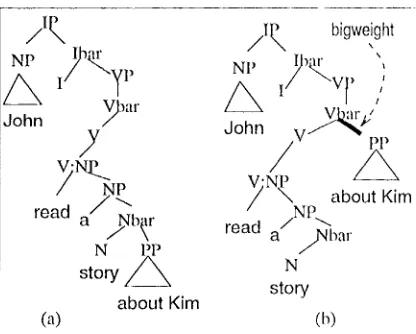
E x a m p l e 5.1. Comparing the two parses of the sentence "John read the story a,bout Kim" in Figure 3: in (a), lee about Kim] is the co,n- plement of "story"; in (b), it is the a.djunct of "read". Since the adjunct dominance link from Vbar to PP has much higher weight than the complement dominance link from Nba.r to PP, the total weight of (a) is much smaller them the weight of (b). Therefore, only (a) is output as the parse tree of the sentence.
E x a m p l e 5.2. The lexical entry for tlm word "do" is as follows:
7%
7%
"
.p v/,.
Who
Z_~ /bar
Who (traCe)V
Kim \~,
bigweight
\
/v%
did NP NP
love (trace)
A
A
(a)
(b)
Kim love
Figure 4: l,exical items have diffc,'ent weights
(do
(subcat ((cat i) -passive -per~ (auxform do) -prog (cgorm fin) (tense present))) (subcat ((cat v) (rare very))
(((cat n) (case acc) (nform norm)))) (subcat ((cat v) (rare very-very))
(((cat n) (case ace) (nform norm))
((cat
n)(case acc)
(nform norm))))']'ha.t is "do" (:a.n bc an auxiliary verb, a tran- sitive verb or a (li-trmlsitive verb. [,'igure el shows two parse trees for the sentence "Who did Kim love?" The parse l;ree (a) corrcsI)onds to the correct; understanding of the sentence. hi (b), "did" is analyzed as a bi-tra,nsitive w,'b as in "Who did Kim a fawn'?" llow- eww, since the latter sense of the word has an attribute value (rare very-very), tree (17) has much higher weight tha,n tt'ee (a) and only (a,) is otd.lmt, by the i)ai's(~l ..
6. I r n p l e m e n t a t i o n a n d E x p e r i m e n t a l Ftesult;s
PRINCII~AR lms been implemented in C-I--I ~. The graphica,1 user interface is developed with a toolkit called interViews. The program runs on SUN Spa.rcstatlons with X-windows. A ver- sion without; gral)hica, l user interface can also be run on most Unix machines with GNU g-f-t- compiler.
[image:6.612.311.532.73.221.2] [image:6.612.93.301.339.506.2]Table 1: Experimental Results Example sentences
Who do you think Bill saM Mary expected to see I asked which books he told me that I should read
The petition listed the mayor's occup~ttion as attorney and his age a,s 71 lie said evidence was obtained in violation o[' the legal rights of citizens Mr. Nixon, for his p a r t , wouhl oppose intervention ill Cllba without specific provocation
The ~Lssembly la.ngu~tge provides a means for w,'iting a progra.m and you are, not concerned with actual memory addresses "
Labels can be assigned to a particular instruction step in a source program that identify that step as an entry point for use in subsequent instructions
* time (in seconds) taken on a Sparcstation ];~LC.
- - . , I words [ tmte* p~trses
: 1 0 -
11 0.76
i3 0.60 t4
13 0.55 4
]3 0.51 6
19 O.80 2
26 4.13 32
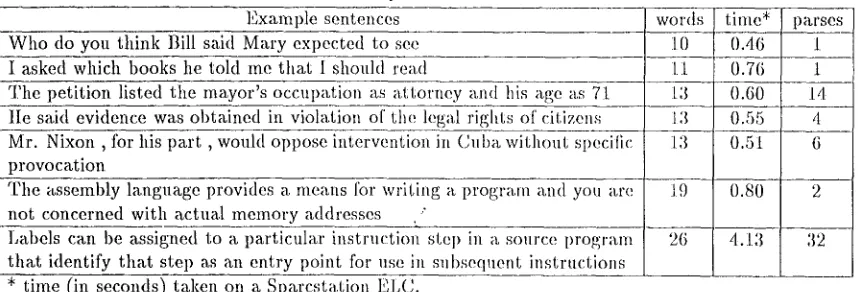
of the g r a m m a r (measure by the n u m b e r of the total length of the phrase structure rules). W h e n a t t r i b u t e values are used in messages, the c o m p l e x i t y of the Mgorithm is not yet known. Our experiments have shown that the parser is very fast. Table 1 lists the parsing time and the n u m b e r of parses for several ex- ample sentences. T h e correct parses for all the sentences in TM)le 1 are returned by the parser. Even though the lexicon is derived from ma- chine readable dictionaries and contains a ]a.rge n u m b e r of senses for m a n y words, the ratio be- tween the n u m b e r of parse trees and the sen- tence length here is well bellow the ratio re- p o r t e d in (Black et al., 1992).
A c k n o w l e d g e m e n t s
T h e a u t h o r wishes to thanl¢ Bonnie Dorr for c o m m e n t s a b o u t Sections 1, 2, and 3. This re'- search was supported by NaturM Sciences and Engineering Research Council of Canada grant OGP121338.
R e f e r e n c e s
Berwick, I1.. C., Abney, S. P., and Tenny, C., edi- tors (1991). Principle-Based Parsing: Com- putation and Psyeholinguislics. Kluwer Aca- demic Publishers.
Billot, S. and Lang, B. (1989). The structure of shared forests in ambiguous parsing. In Pro- ceedings of ACL-80, pages 143-151, Vancou- ver.
Black, E., L~dDrty, J., and Roukos, S. (:1992). l)evelopment and ewduation of a broad- coverage probM)ilistic grammar of english- language computer manua.ls. In Proceed- in:is of ACL-92, pages 1185-1192, Newark, l) alaware.
Chomsky, N. (:1981). Lectures on Government anti Binding. Foris Publications, Cinnaminson,
USA.
Dorr, B. J. (1991 ). Principle-based pa.rsing for nla,- chhm translation. In (Herwick et al., 1991), p~ges 15a <18,1.
Fong, S. (i 991). The computationM implementa- tion of principle-based parsers. In (Berwiek el, al., 1991), pages 05-82.
lla.egeman, L. (11997l). lnl,roductio'n to Government m,f Binding Theory. Basil ]~Ia.ckwell Ltd.
,]ohnson, M. (199l). 1)eductiw~ l>a.rsing: The use of knowledge o[' la.ngua.ge. In (l~erwiek el, al.,
Ig.Ol), pages 39 64.
l,in, 1). (199"{). Prhlciple-based parsing without ow'.rgeneration. In Proceedings of A 6'13-93, pages :112--120, Columbus, Ohio.
Lin, I). and Coebel, R. (1993). Context-free gram- m~r parsing by message passing. In Proceed- ings of l,he Fi'lwZ Cm@renee of the Pacific Association for Comw.tational Linguistics, pages 203-211, V~mcouver, British Columbia. Tomit',~, M. (1986). l'Jffieient Parsing for Nal,u- ral Language. Kluwer Ac~u[emic Publishers, Norwell, Massachusetts.
[image:7.612.97.526.97.243.2]