103
Authentication Using Palmprint
Madhavi A.Gulhane
1, Dr. G.R.Bamnote
2Scholar M.E Computer Science & Engineering PRMIT&R Badnera Amravati1, Professor Computer Science & Engineering at PRMIT&R Badnera Amravati2
[email protected] , [email protected]2
Abstract — Palmprint has proved to be a significant biometrics for personal authentication. Palmprint recognition is a challenging problem, mainly due to low quality of the pattern, large nonlinear distortion between different impression of the same palm and large image size, which makes features extraction and matching computationally demanding. The proposed system follows the typical steps used in detection and recognition of palmprint. Furthermost of the studies has been done in palmprint recognition due to its stability, reliability and exclusivity. This paper provides Multiscale Local Binary Pattern (MLBP) for efficient verification of palmprint. This paper elaborates about the detection of palmprint and palmprint recognition, the number of investigation works introduced to overcome the difficulties confronted in each stage of palm print verification. Our study on palm print recognition focuses on verifying the palm print in different types of schemes involved. We conducted a series of palmprint recognition using an established IIT Delhi database, and the result demonstrates that the proposed method is feasible and effective palmprint for recognition with high accuracy rate.
Index Terms- Biometrics, palmprint detection, palmprint recognition , multiscale local binary pattern.
1. INTRODUCTION
Biometric is the science of recognizing a person based on one or more intrinsic physical or behavioral characteristics [1]. Biometrics has been an emerging field of research in the recent years and is devoted to identification of individuals using physical traits, such as those based on iris or retinal scanning, face recognition, fingerprints, or voices [2].Palmprint is one the mostly used biometric nowdays for authentication purpose. Palmprint is the region between wrist and fingers and has features like principle lines, wrinkles, ridges, minutiae points, singular points and texture pattern in Fig.1 which can be considered as biometric characteristics.[3] Palmprint based biometric relies on a person’s principle lines, wrinkles, ridges on the surface of the palm [4], which remains unchanged in individual life span. Also from a study it has been stated that, no two palmprint taken from two different individuals are same. Therefore palmprint predicated recognition is considered more reliable, efficient and as well as the fairly accurate biometric system. In this paper, we propose a modified multiscale LBP algorithm for palmprint recognition. The LBPs for biggest radius is firstly extracted. Then, for those “non- uniform” patterns, the counterpart LBPs of smaller radius is extracted. Among the new LBPs, those “non-uniform” patterns is further proceeded to extract "uniform" patterns in even smaller radius. The procedure is iterated until the smallest radius is proceeded. The proposed scheme could fully utilize the information of “non-uniform” LBPs of bigger radius. Furthermore, this modified scheme is totally training free which are not sensitive to the training samples.
Fig.1: Features of Palm
2. LOCAL BINARY PATTERN
The original LBP operator labels the pixels of an image with decimal numbers, which are called LBPs or LBP codes that encode the local structure around each pixel. Each pixel is compared with its eight neighbors in a 3 × 3 neighborhood by subtracting the center pixel value; the resulting strictly negative values are encoded with 0, and the others with 1.
104 The derived binary numbers are referred to be the
LBPs or LBP codes [5].
Fig.2: Local Binary Pattern
One limitation of the basic LBP operator is that its small 3×3 neighborhood cannot capture dominant features with large-scale structures. To deal with the texture at different scales, the operator was later generalized to use neighborhoods of different sizes. A local neighborhood is defined as a set of sampling points evenly spaced on a circle, which is centered at the pixel to be labeled, and the sampling points that do not fall within the pixels are interpolated using bilinear interpolation, thus allowing for any radius and any number of sampling points in the neighborhood. Fig.3 shows some examples of the extended LBP (ELBP) operator [5], where the notation (P, R) denotes a neighborhood of P sampling points on a circle of radius of R.
Fig.3: ELBP with (8, 1), (16, 2) and (24, 3) neighborhoods
The basic LBP operator is invariant to monotonic gray-scale transformations, which preserve pixel intensity order in the local neighborhoods. The histogram of LBP labels calculated over a region can be exploited as a texture descriptor.
The obtained binary string is then concatenated add compared with the stored template.
3. MULTISCALE LOCAL BINARY PATTERN
Multiscale or multi-resolution could initiated more amount of image feature under different settings. The performance of ordinary LBP operator is limited. Traditionally, LBP features of various scales are extracted first, and then the histograms are concatenated into one long feature. Joint distribution could contain lot of information, but it affected from huge feature dimension.
A significant limitation of the original LBP operator is its small spatial support area. Features calculated in a local 3×3 neighborhood cannot capture large-scale structures that may be the dominant features of some textures. However, adjacent LBP codes are not totally independent of each other displays three adjacent four-bit LBP codes [6]. Assuming that the first bit in the leftmost code is zero, the third bit in the code to the right of it must be one. Similarly, the first bit in the code in the center and the third bit of the rightmost one must be either different or both equal to one. The right half of the figure shows an impossible combination of the codes. Each LBP code thus limits the set of possible codes adjacent to it, making the “effective area” of a single code actually slightly larger than 3× 3. Nevertheless, the operator is not very robust against local changes in the texture, caused, for example, by varying viewpoints or illumination directions.
An operator with a larger spatial support area is therefore often needed.A straightforward way of enlarging the spatial support area is to combine the information provided by N LBP operators with varying P and R values. This way, each pixel in an image gets N different LBP codes.
The most accurate information would be obtained by using the joint distribution of these codes. However, such a distribution would be overwhelmingly sparse with any reasonable image size. Fig.4 shows LBP and CS-LBP features for a neighborhood of 8 pixels. For example, the joint distribution of LBP8,1, LBPu2 16,3, and LBPu2 24,5 would contain256 ×243 ×555 ˜3.5 ×10⁷bins.
105 Fig.4: LBP and CS-LBP features for a
neighborhood of 8 pixels
The aggregate dissimilarity between a sample and a model can be calculated as a sum of the dissimilarities between the marginal distributions
Where Sn and Mn correspond to the sample and model distributions extracted by the nth operator [7]. Of course, the chi square distance or histogram intersection can also be used instead of the log-likelihood measure.
Even though the LBP codes at different radii are not statistically independent in the typical case, using multi-resolution analysis often enhances the discriminative power of the resulting features. With most applications, this straightforward way of building a multi-scale LBP operator has resulted in very good accuracy.
4. PROPOSED SYSTEM
The overall architecture is given in Fig.5. Input source is image database.
Palmprint image in database will take as standard database which will be taken in proper environment. For our system we have taken images of palm from PolyUdatabase [9].
Fig.5: Overall System Architecture
After image acquisition, palmprint image is preprocessed in Preprocessing stage. Palmprint preprocessing is done to extract the region-of interest (ROI) of the palm for feature extraction. The ROI is determined so that there is maximum variation among different users and minimum noise due to low picture quality. Accurate personal identification using palm print patterns will require accurate segmentation of ROI (region of interest) images. In case if the guiding pegs are not provided, then the process of authentication becomes difficult and hence rotation invariant processing technique is designed. Pre-processing is the first step of image processing technique. It is done to extract the required portion of palm from the entire hand image. It consists of main step process includes binaarization, filteration and segmentation of ROI to get the correct Palm Print Region.
Palmprint image enhancement techniques are applied to make palm lines more clear and visible. These techniques are also able to remove local noise and thin lines of the image.
After extracting region of interest(ROI) from a palm print image. Feature extraction is the main process to get forgery of Palm Print Image, so here we have used Multiscale local binary pattern (MLBP) has been used for feature extraction. Multiscale Local binary pattern (MLBP) is a nonparametric descriptor, which efficiently summarizes the local structures of images. In recent years, it has aroused increasing interest in many areas of image processing and computer vision and has shown its effectiveness in a number of applications, in particular for facial image analysis, including tasks as diverse as face detection, face recognition, facial expression analysis, and demographic classification. As a nonparametric method, MLBP summarizes local structures of images efficiently by comparing each pixel with its neighboring pixels. The most important properties of MLBP are its tolerance regarding monotonic illumination changes and its computational simplicity. LBP was originally proposed for texture analysis, and has proved a simple yet powerful approach to describe local structures.
Image from database
Pre-processing
Feature Extraction
Feature Matching
Recognize
Matcher
106 It has been extensively exploited in many applications,
for instance, face image analysis, image and video retrieval, environment modeling, visual inspection, motion analysis, biomedical and aerial image analysis and remote sensing. LBP-based facial image analysis has been one of the most popular and successful applications in recent years.
Feature Extraction is performed, Feature extraction is based upon the texture of enhanced palmprint image calculated using Local Binary Pattern.
Further in Feature Matching for every extracted Palm Print Image, feature has been extracted using feature extraction algorithm. So for detection of Forgery with respect to Input Test Palm Print Image, it will extract the feature from it and will match with Image database image and verification is done.
5. EXPERIMENTAL RESULTS
5.1 Palmprint Database
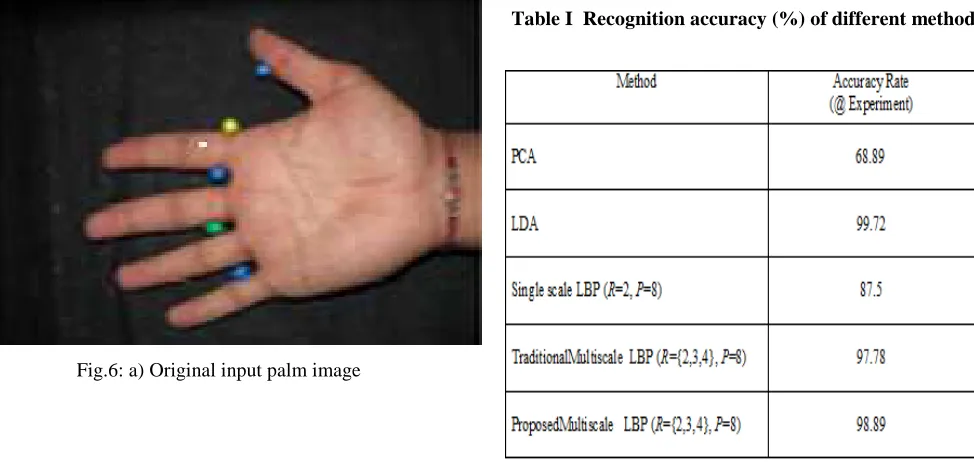
In this section, we verify the performance of the proposed method on a palmprint database, Indian Institute of Technology Delhi palmprint database [9]. In this database contains 8-bit (grey-scale) image from 6 persons. We have taken 8 images per person with different inclination of palm.
5.2 ROI Extraction
Some pre-processing jobs are required to correct the orientation of the palm images and extract the region of interest (ROI), so that the feature extraction process can be performed on a fixed size image. Moreover, in order to extract the central part of palmprint, the method described in [8] was employed.
Fig.6: a) Original input palm image
Fig.6: b) Extracted ROI of palm image
[image:4.595.290.521.95.235.2]Fig.7: Samples from database of extracted ROI
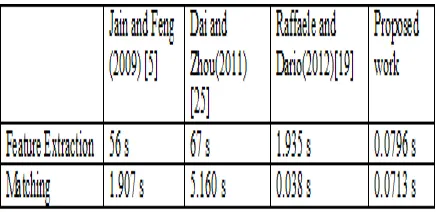
[image:4.595.295.516.290.464.2] [image:4.595.38.525.503.734.2]107 Table II Average Feature Extraction and Matching
Time
6. CONCLUSION
Palmprint recognition is a challenging problem, mainly due to low quality of the patterns, large nonlinear distortion, and computational complexity for the large image size of typical palmprints. This thesis explains detection and verification of palm image can be improved with proper feature extraction. Local Binary Pattern algorithms are widely used for feature extraction. The use of local binary pattern for palmprint verification based on texture is considered. In this paper, to fully extract useful feature from an image, a Modified mutliscale LBP (MLBP) is proposed. It could digout useful information from those “non-uniform” patterns. The main advantage of the proposed method could maintain the training free property during feature extraction, which is very important for some applications. Its effectiveness is shown in one palmprint. Compared with traditionally multiscale LBP, the proposed method could get more than 1% improvement. It could also get better result than those training based methods, when the training samples are not enough.
FUTURE SCOPE
The feature size of multiscale LBP (MLBP) is a little high. How to reduce the feature size but get good performance in recognition with high accuracy as well as improving template protection technology will be our future work.
REFERENCES
[1] A. K. Jain, R. Bolle, and S. Pankanti, Biometrics, Personal Identification in Networked Society.
Norwell, MA, USA: Kluwer, 2001.
[2] L. Fang, M.K.H. Leung, T. Shikhare, V. Chan, K. F. Choon, “Palmprint Classification” 1996. [3] D. Zhang,“Automated Biometrics Technologies
and Systems”, A.K. Jain (Ed.), Kluwer Academic,Boston, 2000.
[4] W. Shu and D. Zhang, “Automated personal identification by palmprint”, Optical Engineering, vol. 37, no. 8, pp. 2659-2362, 1998
[5] K.-A. Toh, H.-L. Eng, Y.-S. Choo, Y.-L. Cha, W.-Y. Yau, and K.-S. Low, “Identity verification through palm vein and crease texture,” Proc. ICB 2006, LNCS 3832, pp. 546-553, 2005.
[6] Maenpaa, T.,” The local binary pattern approach to texture analysis extensions and applications". PhD thesis, ActaUniversitatis Ouluensis C 187, University of Oulu (2003).
[7] Ojala, T., Pietikainen, M., Maenpaa, T.: Multire solution gray-scale and rotation invariant texture classification with local binary patterns. IEEE Trans. Pattern Anal. Mach. Intell. 24(7),971–987 (2002).
[8] K.O. Goh, C. Tee, B.J. Teoh, C.L. Ngo, “Automated hand geometry verification system based on salient points,” The 3rd InternationalSymposium on Communications and Information Technologies(ISCIT 2003) Songkhla, Thailand, September, 2003 pp. 720– 724.
[9]http://www4.comp.polyu.edu.hk/~csajaykr/IITD/Databas e_Palm.htm