R O B U S T T E X T P R O C E S S I N G I N A U T O M A T E D I N F O R M A T I O N R E T R I E V A L
T o m e k S t r z a l k o w s k i
C o u r a n t Institute o f M a t h e m a t i c a l Sciences N e w Y o r k U n i v e r s i t y
715 B r o a d w a y , rm. 7 0 4 N e w Y o r k , N Y 10003
t o m e k @ c s . n y u . e d u
ABSTRACT
This paper outlines a prototype text retrieval system which uses relatively advanced natural language pro- cessing techniques in order to enhance the effective- ness of statistical document retrieval. The backbone of our system is a traditional retrieval engine which builds inverted index files from pre-processed docu- ments, and then searches and ranks the documents in response to user queries. Natural language process- ing is used to (1) preprocess the documents in order to extract contents-carrying terms, (2) discover inter- term dependencies and build a conceptual hierarchy specific to the database domain, and (3) process user's natural language requests into effective search queries. The basic assumption of this design is that term-based representation of contents is in principle sufficient to build an effective if not optimal search query out of any user's request. This has been confirmed by an experiment that compared effective- ness of expert-user prepared queries with those derived automatically from an initial narrative infor- mation request. In this paper we show that large- scale natural language processing (hundreds of mil- lions of words and more) is not only required for a better retrieval, but it is also doable, given appropri- ate resources. We report on selected preliminary results of experiments with 500 MByte database of Wall Street Journal articles, as well as some earlier results with a smaller document collection.
INTRODUCTION
A typical information retrieval OR) task is to select documents from a d~!ahase in response to a user's query, and rank these documents according to relevance. This has been usually accomplished using statistical methods (often coupled with manual encoding) that (a) select terms (words, phrases, and other units) from documents that are deemed to best represent their contents, and (b) create an inverted index file (or files) that provide and easy access to documents containing these terms. An important issue here is that of finding an appropriate
combination of term weights which would reflect each term's relative contribution to the information contents of the document. Among many possible weighting schemes the inverted document frequency OdD has come to be recognized as universally appli- cable across variety of different text collections.
Once the index is created, the search process will attempt to match a preprocessed user query (or queries) against representations of documents in each case determining a degree of relevance between the two which depends upon the number and types of matching terms. Although many sophisticated search and matching methods are available, the crucial prob- lem remains to be that of an adequate representation of contents for both the documents and the queries.
The simplest word-based representations of contents are usually inadequate since single words are rarely specific enough for accurate discrimina- tion, and their grouping is often accidental. A better method is to identify groups of words that create meaningful phrases, especially if these phrases denote important concepts in database domain. For example, joint venture is an important term in Wall Street Journal (WSJ henceforth) database, while nei- ther joint nor venture are important by themselves. In the retrieval experiments with the WSJ database, we noticed that both joint and venture were dropped from the list of terms by the system because their idf weights were too low. In large databases, such as TIPSTEK/TREC, the use of phrasal terms is not just desirable, it becomes necessary.
automated natural language processing may not be suitable in IR. These difficulties included inefficiency, lack of robustness, and prohibitive cost of manual effort required to build lexicons and knowledge bases for each new text domain. On the other hand, while numerous experiments did not establish the usefulness of linguistic methods in IR, they cannot be considered conclusive because of their limited scale. ]
The rapid progress in Computational Linguis- tics over the last few years has changed this equation in various ways. First of all, large-scale resources became available: on-line lexicons, including Oxford Advanced Learner's Dictionary (OALD), Longman Dictionary of Contemporary English (LDOCE), Webster's Dictionary, Oxford English Dictionary, Collins Dictionary, and others, as well as large text corpora, many of which can now be obtained for research purposes. Robust text-oriented software tools have been built, including part of speech taggers (stochastic and otherwise), and fast parsers capable of processing text at speeds of 4200 words per minute or more (e.g., T I P parser developed by the author). While many of the fast parsers are not very accurate (they are usually partial analyzers by design), 2 some, like T I P , perform in fact no worse than standard full-analysis parsers which are many times slower and far less robust. 3
An accurate syntactic analysis is an essential prerequisite for term selection, but it is by no means sufficient. Syntactic parsing of the database contents is usually attempted in order to extract linguistically motivated phrases, which presumably are better indi- cators of contents than "statistical phrases" where words are grouped solely on the basis of physical proximity (e.g., "college junior" is not the same as "junior college'). However, creation of such com- pound terms makes term matching process more complex since in addition to the usual problems of synonymy and subsumption, one must deal with their structure (e.g., "college junior" is the same as "junior in college"). In order to deal with structure, parser's
t Standard IR benchmark collectiot~s are statistically t o o
small and the experiments can easily produce cotm~rinmitive results. For example, Cnmfield collection is only approx. 180,000 English words, while CACM-3204 collection is approx. 200.000 words.
2 Partial parsing is usually fast enough, but it also generates n o i s y data: a s n u m y a s 50% of all generated phrases cotild be in- correct (Lewis and Croft, 1990).
3 "I'rP has been shown to produce parse structures which sum
n o w o r s e m recall, precision and crossing rate than those generated by flill-setle lmguisuc parsers when compared to hand-coded Treebank parse tree,.
output needs to be "normalized" or "regularized" so that complex terms with the same or closely related meanings would indeed receive matching representa- tions. This goal has been achieved to a certain extent in the present work. As it will be discussed in more detail below, indexing terms were selected from among head-modifier pairs extracted from predicate- argument representations of sentences.
The next important task is to achieve normali- zation across diferent terms with close or related meaning. This can be accomplished by discovering various semantic relationships among words and phrases, such as synonymy and subsumption. For example, the term natural language can be con- sidered, in certain domains at least2 to subsume any term denoting a specific human language, such as English. Therefore, a query containing the former may be expected to retrieve documents containing the latter. The system presented here computes term associations from text on word and fixed phrase level and then uses these associations in query expansion. A fairly primitive filter is employed to separate synonymy and subsumption relationships from others including antonymy and complementation, some of which are strongly domain-dependent. This process has led to an increased retrieval precision in experi- ments with smaller and more cohesive collections (CACM-3204).
In the following sections we present an over- view of our system, with the emphasis on its text- processing components. We would like to point out here that the system is completely automated, i.e., all the processing steps, those performed by the statisti- cal core. and these performed by the natural language processing components, are done automatically, and no human intervention or manual encoding is required.
OVERALL DESIGN
Our information retrieval system consists of a traditional statistical backbone (NIST's PRISE sys- tem; Harman and Candela, 1989) augmented with various natural language processing components that assist the system in database processing (stemming, indexing, word and phrase clustering, selectional res- trictions), and translate a user's information request into an effective query. This design is a careful compromise between purely statistical non-linguistic approaches and those requiring rather accomplished (and expensive) semantic analysis of data~ often referred to as 'conceptual retrieval'.
trees and used as compound indexing terms in addi- tion to single-word terms. The extracted phrases are statistically analyzed as syntactic contexts in order to discover a variety of similarity links between smaller subphrases and words occurring in them. A further filtering process maps these similarity links onto semantic relations (generalization, specialization, synonymy, etc.) after which they are used to transform user's request into a search query.
The user's natural language request is also parsed, and all indexing terms occurring in them are identified. Certain highly ambiguous, usually single- word terms may be dropped, provided that they also occur as elements in some compound terms. At the same time, other terms may be added, namely those which are linked to some query term through admis- sible similarity relations. For example, "unlawful activity" is added to a query containing the com- pound term "illegal activity" via a synonymy link between "illegal" and "unlawful". After the final query is constructed, the database search follows, and a ranked list of documents is returned.
The purpose of this elaborate linguistic pro- cessing is to create a better representation of docu- ments and to generate best possible queries out of user's initial requests. Despite limitations of term- and-weight type representation (or boolean versions thereof), very good queries can be produced by human experts. In order to imitate an expert, the sys- tem must be able to learn about its database, in par- ticular about various correlations among index terms.
FAST PARSING W I T H T T P PARSER
"I'I'P (Tagged Text Parser) is based on the Linguistic String Grammar developed by Sager (1981). The parser currently encompasses some 400 grammar productions, but it is by no means complete. The parser's output is a regularized parse tree representation of each sentence, that is, a representa- tion that reflects the sentence's logical predicate- argument structure. For example, logical subject and logical object are identified in both passive and active sentences, and noun phrases are organized around their head elements. The significance of this representation will be discussed below. The parser is equipped with a powerful skip-and-fit recovery mechanism that allows it to operate effectively in the faze of ill-formed input or under a severe time pres- sure. In the runs with approximately 83 million words of TREC's Wall Street Journal texts~ the parser's 4 Approximately 0.5 GBytes of text. over 4 million sen- teilc¢~.
speed averaged between 0.3 and 0.5 seconds per sen- tence, or up to 4200 words per minute, on a Sun's SparcStation-2.
'I'I'P is a full grammar parser, and initially, it attempts to generate a complete analysis for each sentence. However, unlike an ordinary parser, it has a built-in timer which regulates the amount of time allowed for parsing any one sentence. If a parse is not returned before the allotted time elapses, the parser enters the skip-and-fit mode in which it will try to "fit" the parse. While in the skip-and-fit mode. the parser will attempt to forcibly reduce incomplete constituents, possibly skipping portions of input in order to restart processing at a next unattempted con- stituent. In other words, the parser will favor reduc- tion to backtracking while in the skip-and-fit mode. The result of this strategy is an approximate parse, partially fitted using top-down predictions. The frag- ments skipped in the first pass are not thrown out, instead they are analyzed by a simple phrasal parser that looks for noun phrases and relative clauses and then attaches the recovered material to the main parse structure. As an illustration, consider the following sentence taken from the CACM-3204 corpus:
The method is illustrated by the automatic con- struction of both reeursive and iterative pro- grams operating on natural numbers, lists, and trees, in order to construct a program satisfying certain specifications a theorem induced by those specifications is proved, and the destred program is extracted from the proof.
The italicized fragment is likely to cause additional complications in parsing this lengthy string, and the parser may be better off ignoring this fragment alto- gether. To do so successfully, the parser must close the currently open constituent (i.e., reduce a program satisfying certain specifications to NP), and possibly a few of its parent constituents, removing corresponding productions from further considera- tion, until an appropriate production is reactivated. In this case, T I P may force the following reductions: SI -~ to V N P , SA --~ SI; S -.~ N P V N P SA, until the production S ~ S and S is reached. Next, the parser skips input to find and, and resumes normal process- ing.
P A R T OF S P E E C H T A G G E R
One way of dealing with lexical ambiguity is to use a tagger to preprocess the input marking each word with a tag that indicates its syntactic categoriza- tion: a part of speech with selected morphological features such as number, tense, mode, case and degree. The following are tagged sentences from the CACM-32(M collection: 5
The/dt paper/nn presents/vbz aldt proposal/nn for~in structured/vbn representation/nn of/in muhiprogramming/vbg in~in a/dt high/jj level/nn language/nn ./per
The/dt notation/nn used/vbn explicitly/rb associates/vbz a/dt data/nns structure/nn shared/vbn by~in concurrent/jj p r o c e s s e s / n n s with~in operations/nns defined/vbn on~in it/pp ./per
The tags are understood as follows: dt - determiner, nn - singular noun, nns - plural noun, in - preposition, jj - adjective, vbz - verb in present tense third person singular, to - particle "to", vbg - present participle, vbn - past participle, vbd - past tense verb, vb - infinitive verb, cc - coordinate conjunction.
Tagging of the input text substantially reduces the search space of a top-down parser since it resolves most of the lexical level ambiguities. In the examples above, tagging of presents as "vbz" in the first sentence cuts off a potentially long and costly "garden path" with presents as a plural noun followed by a headless relative clause starting with (that) a proposal .... In the second sentence, tagging resolves ambiguity of used (vbn vs. vbd), and associates (vbz vs. nns). Perhaps more importantly, elimination of word-level lexical ambiguity allows the parser to make projection about the input which is yet to be parsed, using a simple lookahead; in particular, phrase boundaries can be determined with a degree of confidence (Church, 1988). This latter property is critical for implementing skip-and-fit recovery tech- nique outlined in the previous section.
Tagging of input also helps to reduce the number of parse structures that can be assigned to a sentence, decreases the demand for consulting of the dictionary, and simplifies dealing with unknown words. Since every item in the sentence is assigned a tag, so are the words for which we have no entry in the lexicon. Many of these words will be tagged as "rip" (proper noun), however, the surrounding tags may force other selections. In the following exam- ple, chinese, which does not appear in the dictionary, s Tagged using the 35-tag Penn Treebank Tagset created at the Univemty of Penn~Ivtnnt
is tagged as -jj,,:6
this~dr paper/nn dates/vbz back/rb the~dr genesis/nn of~in binary/jj conception/nn circa~in 5000/cd years/nns ago/rb ,~corn as/rb derived/vbn by~in the~dr chinese/jj ancients/nns
./per
W O R D SUFFIX T R I M M E R
Word stemming has been an effective way of improving document recall since it reduces words to their common morphological root, thus allowing more successful matches. On the other hand, stem- ming tends to decrease retrieval precision, if care is not taken to prevent situations where otherwise unre- lated words are reduced to the same stem. In our sys- tem we replaced a traditional morphological stemmer with a conservative dictionary-assisted suffix trim- mer. 7 The suffix trimmer performs essentially two tasks: (1) it reduces inflected word forms to their root forms as specified in the dictionary, and (2) it con- verts nominalized verb forms (e.g., "implementa- tion", "storage") to the root forms of corresponding verbs (i.e., "implement", "store"). This is accom- plished by removing a standard suffix, e.g.. "stor+age", replacing it with a standard root ending C+e"), and checking the newly created word against the dictionary, i.e., we check whether the new root ("store") is indeed a legal word, and whether the ori- ginal root ("storage") is defined using the new root ("store") or one of its standard inflectional forms (e.g., "storing"). For example, the following definitions are excerpted from the Oxford Advanced Learner's Dictionary (OALD):
storage n [13] (space used for, money paid for) the storing of goods ...
diversion n [U] diverting ...
procession n I t ] number of persons, vehicles, etc moving forward and following each other in an orderly way.
Therefore, we can reduce "diversion" to "divert" by removing the suffix "+sion" and adding root form suffix "+t". On the other hand, "process+ion" is not reduced to "process".
Earlier experiments with CACM-3204 collec- tion showed an improvement in retrieval precision by 6% to 8% over the base system equipped with a stan- dard morphological stemmer (the SMART stemmer).
6 We use the machine ~_d_~ie version o f the Oxford A d -
vanced Learner's Dictionary (OALD).
H E A D - M O D I F I E R S T R U C T U R E S
Syntactic phrases extracted from T I P parse trees are head-modifier pairs. The head in such a pair is a central element of a phrase (main verb, main noun, etc.), while the modifier is one of the adjunct arguments of the head. In the TREC experiments reported here we extracted head-modifier word and fixed-phrase pairs only. While TREC WSJ database is large enough to warrant generation of larger com- pounds, we were in no position to verify their effec- tiveness in indexing. This was largely because of the tight schedule, but also because of rapidly escalating complexity of the indexing process: even with 2- word phrases, compound terms accounted for nearly 96% of all index entries, in other words, including 2- word phrases has increased the index size 25 times!
Let us consider a specific example from WSJ database:
The former Soviet president has been a local hero ever since a Russian tank invaded Wiscon-
Silt.
The tagged sentence is given below, followed by the regularized parse structure generated by 'FI'P, given in Figure I.
The~dr former/j/' Soviet/jj president/nn has/vbz been/vbn aldt local/jj hero/nn ever/rb since~in eddt Russian/jj tanklnn invaded/vbd Wisconsin/rip ./per
It should be noted that the parser's output is a predicate-argument structure centered around main elements of various phrases. In Figure 1, BE is the main predicate (modified by HAVE) with 2 argu- ments (subject, object) and 2 adjuncts (adv, sub_oral). INVADE is the predicate in the subordinate clause with 2 arguments (subject. object). The subject of BE is a noun phrase with PRESIDENT as the head element, two modifiers (FORMER, SOVIET) and a determiner (THE). From this structure, we extract head-modifier pairs that become candidates for com- pound terms. The following types of pairs are con- sidered: (1) a head noun and its left adjective or noun adjunct, (2) a head noun and the head of its right adjunct, (3) the main verb of a clause and the head of its object phrase, and (4) the head of the subject phrase and the main verb. These types of pairs account for most of the syntactic variants for relating two words (or simple phrases) into pairs carrying compatible semantic content. For example, the pair retrieve+information will be extracted from any of the following fragments: information retrieval sys- tem; retrieval of information from databases;, and information that can be retrieved by a user- controlled interactive search process. In the example at hand, the following head-modifier pairs are
extracted (pairs containing low-contents elements,
]asserl
[ [ ~ [HAVE]] llverb [BE]]
[subject [np
In PRESIDENT] [tpos THE} [adj [FORMER]] ladj [SOVIET]Ill [object
Inp In HERO] It .pos A] ladj [LOCAL]Ill lady EVER} lsub_ord
[SINCE
Ilverb [INVADEII [subject
[np In TANK] [t_pos A]
ladj [RUSSIANII]I Iobjexl
]np
Iname [WISCONSIN]IIlIIIIII
Figure 1. Predicale-argum~at parse structure.
such as BE and FORMER, or names, such as WISCONSIN, will be later discarded):
[PRESIDENT,BE] [PRESIDENT,FORMER] [PRESIDENT,SOVIET] [BE,HEROI
[HERO,LOCAL]
[TANK.INVADE] flANK.RUSSIAN] [INVADE,WlSCONSlN]
We may note that the three-word phrase former Soviet president has been broken into two pairs former president and Soviet president, both of which denote things that are potentially quite different from what the original phrase refers to, and this fact may have potentially negative effect on retrieval preci- sion. This is one place where a longer phrase appears more appropriate. The representation of this sentence may therefore contain the following terms:
were performed on a relatively small collection (CACM-3204), and therefore we combined pairs obtained from different syntactic relations (e.g., verb-object, subject-verb, noun-adjunct, etc.) in order to increase frequencies of some associations. This became largely unnecessary in a large collection such as TIPSTER, but we had no means to test alternative options, and thus decided to stay with the original. It should not be difficult to see that this was a compromise solution, since many important distinc- tions were potentially lost, and strong associations could be produced where there weren't any. A way to improve things is to consider different syntactic rela- tions independently, perhaps as independent sources of evidence that could lend support (or not) to certain term similarity predictions. We have already started testing this option.
One difficulty in obtaining head-modifier pairs of highest accuracy is the notorious ambiguity of nominal compounds. For example, the phrase natural
language processing should generate
language+natural and processing+language, while
dynamic information processing is expected to yield
processing+dynamic and processing+information. A
still another case is executive vice president where the association president+executive may be stretch- ing things a bit too far. Since our parser has no knowledge about the text domain, and uses no semantic preferences, it does not attempt to guess any internal associations within such phrases. Instead, this task is passed to the pair extractor module which processes ambiguous parse smactures in two phases. In phase one, all and only unambiguous head- modifier pairs are extracted, and the frequencies of their occurrences are recorded. In phase two, fre- quency information about pairs generated in the first pass is used to form associations from ambiguous structures. For example, if language+natural has
occurred unambiguously a number times in contexts such as parser for natural language, while
processing+natural has occurred significantly fewer times or perhaps none at all, then we will prefer the former association as valid.
TERM CORRELATIONS FROM TEXT
Head-modifier pairs form compound terms used in database indexing. They also serve as occurrence contexts for smaller terms, including single-word terms. If two terms tend to be modified with a number of common modifiers and otherwise appear in few distinct contexts, we assign them a similarity coefficient, a real number between 0 and 1. The similarity is determined by comparing distribu- tion characteristics for both terms within the corpus: how much information contents do they carry, do
their information contribution over contexts vat3' greatly, are the common contexts in which these terms occur specific enough? In general we will credit high-contents terms appearing in identical con- texts, especially if these contexts are not too com- monplace, s The relative similarity between two words xi and x2 can be obtained using the following formula (ct is a large constant): 9
SIM (x l ,x2) = log (a ~ simy(x l ,x 2) )
Y
where
simy(x l ,x2) = MIN (IC (x l ,[x l,y ]),IC (x ~,[x 2, y ]))
* MIN(IC(y, [xl .y]),lC(y, [x2,y])) and IC is the Information Contribution measure indi- cating the strength of word pairings, and defined as
IC (x, [x,y ]) = -
-A,y
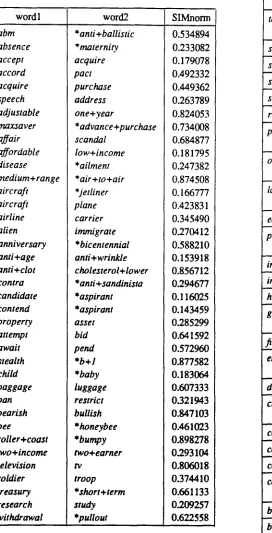
n~+d~-Iwhere f~,y is the absolute frequency of pair Ix,y] in the corpus, nx is the frequency of term x at the head position, and dx is a dispersion parameter understood as the number of distinct syntactic contexts in which term x is found. The similarity function is further normalized with respect to SIM (x i ,x I ). Example similarities are listed in Table 1.
We also considered a term clustering option which, unlike the shnilatity formula above, produces clusters of related words and phrases, but will not generate uniform term similarity ranking across clus- ters. We used a variant of weighted Tanimoto's measure described in (Grefenstette, 1992):
SIM (x I .x2) =
with
~j~4tN (W ([x,att ]),W ([y,att ])
all
~_~MAX (W
([x,att ]). W (D',att ])an
W ([x, y ]) = GW (x )* log (A.,)
GW (x) = 1 - n~
log (N)
s It would not be appropriate to predict similarity between language mad logar/thm on the basis of their co--occur~nee wlth
n a t u r a l .
Sample clusters obtained from approx. 100 MByte (17 million words) sample of WSJ are given in Table 2.
In order to generate better similarities and clus- ters, we require that words x] and x2 appear in at least
M distinct
common contexts, where a common context is a couple of pairs [x],y] and [x2,y], or [y,x l ] and [y,x 2 ] such that they each occurred at least twice. Thus,banana and Baltic
will not be con- sidered for similarity relation on the basis of their occurrences in the common context ofrepublic,
no matter how frequent, unless there is another such common context comparably frequent (there wasn't any in TREC WSJ database). For smaller or narrow domain databases M=2 is usually sufficient. For large databases covering rather diverse subject matter, like TIPSTER or even WSJ, we used M_>3) °It may be worth pointing out that the similari- ties are calculated using term co-occurrences in syn- tactic rather than in document-size contexts, the latter being the usual practice in non-linguistic clustering (e.g., Sparck Jones and Barber, 1971; Crouch, 1988; Lewis and Croft, 1990). Although the two methods of term clustering may be considered mutually comple- mentary in certain situations, we believe that more and stronger associations can be obtained through syntactic-context clustering, given sufficient amount of data and a reasonably accurate syntactic parser) ~
QUERY EXPANSION
Similarity relations are used to expand user queries with new terms, in an attempt to make the final search query more comprehensive (adding synonyms) and/or more pointed (adding specializa- tions)) 2 It follows that not all similarity relations will be equally useful in query expansion, for instance, complementary and antonymous relations like the
1o For example banana and Dominican were found to have two c o m m o n contexts: republic and plant, although this second oc- in appare, nfly different senses in Dominican plant and bana. na p/ant.
" Nun-syntactic contexts cross sentence boundaries with no fuss. which is helpful with short, succinct documents (such a s
CACM absuacts), but less so with longer texts; see also (Gnsimaan et al,, 1986).
:2 Query expansion (in the sense considered here, though not quite in the same way) has been used in information retrieval rescacch before (e.g., Sparc~ Jones and Tait. 1984; H a m u m , 1988). usually with nuxcd ~csults. An ahemanve is to use term clusters to create new teans, "meta~nns". a n d u s e them to index the database instead {e.g.. Crouch. 1988; lewis and Croft, 1990). W e found that the query expansion approach gives the system more flexibility, for instance, by making room for hypenext-style topic exploration via user feedback.
one between
Australian and Canadian,
oraccept and
reject
may actually harm system's performance, since we may end up retrieving many irrelevant documents. Similarly, the effectiveness of a query containingvitamin
is likely to diminish if we add a similar but far more general term such asacid.
On the other hand, database search is likely to miss relevant documents if we overlook the fact thatfor-
tran
is aprogramming language,
or thatinfant
is ababy and baby
is achild.
We noted that an average set of similarities generated from a text corpus con- tains about as many "good" relations (synonymy, specialization) as "bad" relations (antonymy. comple- mentation, generalization), as seen from the query expansion viewpoint. Therefore any attempt to separate these two classes and to increase the propor- tion of "good" relations should result in improved retrieval. This has indeed been confirmed in our experiments where a relatively crude filter has visibly increased retrieval precision.In order to create an appropriate filter, we dev- ised a global term specificity measure (GTS) which is calculated for each term across all contexts in which it occurs. The general philosophy here is that a more specific word/phrase would have a more limited use, i.e., a more specific term would appear in fewer
dis-
tinct
contexts. In this respect, GTS is similar to the standardinverted document frequency (idjO
measure except that term frequency is measured over syntactic units rather than document size units. 13 Terms with higher GTS values are generally considered more specific, but the specificity comparison is only mean- ingful for terms which are already known to be simi- lar. The new function is calculated according to the following formula:ICL(w)
ICR(w)
ifboth exist
GTS(w)=I~R(w)
otherwiseif°nlylCR(w)exists
where (with nw, d~ > 0):
~w
ICt(w) = IC ([w,_ ]) = a~(nw+d~-l)
n w
tCR(w)
= tc ([_,w]) =d,,(nw+a~- I)
For any two terms w~ and w 2, and a constant ~ > I. if G T S ( w 2) > 8 * G T S ( w ] ) then w 2 is considered m o r e specific than w]. In addition, if
SlM,,o,~(w i,w2) = o > O,
where 0 is an empirically established threshold, then w2 can be added to the query containing term w 1 with weight o. 14 For example, the following were obtained from TREC WSJ training database:
GTS (child) = 0.000001
GTS (baby) = 0.000013
GTS (infant) = 0.000055
with
SIM(child,infant) =0.131381
SIM (baby,child) = 0.183064
SIM (baby,infant) = 0.323121
Therefore both baby and infant can be used to spe- cialize child. With this filter, the relationship between
baby and infant had to be discarded, as we are unable to tell synonymous or near synonymous relationships from those which are primarily complementary, e.g.,
man and woman.
SUMMARY OF RESULTS
We have processed the total of 500 MBytes of articles from Wall Street Journal section of T R E C database. Retrieval experiments involved 50 user information requests (topics) (TREC topics 51-100) consisting of several fields that included both text and user supplied keywords. A typical topic is shown below:
<:top>
<head> Tipster Topic Description < h u m > Number:. 059
<dora> Domain: Environment <title> Topic: Weather Related Fatalities
<desc> Description:
Document will report a type of weather event which has directly caused at least one fatality in some location.
.~narr> Narrative:
A relevant document will include the number of people
killed and injured by the weather eveat, as well as reporting the type of w e . ~ e r event and the location of the event.
<con> Cmc~(s):
For C A C ' M - 3 2 0 4 colle~ion the filter was most effective at o = 0..5"7. For T R E C - I w e changed the similarity formula slightly in order to obtain ~ nonnahza~vns m all cases. This however lowered smailanty coefficients in general and a new threshold had to be selected. We used o = 0.1 m TREC-I rims, although it tamed om t o b c a p o o r choice. In all ¢ a u ~ S v a r i e d between 10and I00.
I. lightning, avalanche, tornado, typhoon, humcane. heat. heat wave. flood, snow. rain. downpour. blizzard, storm, freezing temperatures 2. dead. killed, fatal, death, fatality, victim
3. N O T man-made disasters, N O T war-induced famine 4. N O T earthquakes, N O T volcanic ernptions </top>
Note that this topic actually consists of two different statements of the same query: the natural language specification consisting of <desc> and <nan-> fields. and an expert-selected list of key terms which are often far more informative than the narrative part. Results obtained for queries using text fields only and those involving both text and keyword fields are reported separately. Further experiments have sug- gested that natural language processing impact is significant but may be severely limited by the expres- siveness of the term-based representation. Since the <con> field is considered the expert-user's rendering of the 'optimal" search query, our system is able to discover much of it from a less complete specification in the text section of the request via query expansion. In fact, we noted that the recall/precision gap between automatically generated queries and those supplied by the user was largely closed when NLP was used. Moreover, even with the keyword field included in the query along with other fields, NLP's impact on the system's performance is still noticeable.
Other results on the impact of different fields in TREC topics on the final recall/precision results were reported by Broglio and Croft (1993) at the ARPA HLT workshop, although text-only runs were not included. One of the most striking observations they
have made is that the narrative field is entirely
disposable, and moreover that its inclusion in the query actually hurts the system's performance. It has to be pointed out, however, that they do little language processing. 15
S u m m a r y statistics for these runs are shown in Table 4. These results are fairly tentative and should be regarded with some caution. For one, the column named txt reports performance of <dcsc> and <narr> fields which have been processed with our suffix- ~rimmer. This means some N I P has been done already (tagging + lexicon), and therefore what w e see there is not the performance of 'pure' statistical system. The same applies to con column. (For
word 1 word2 SIMnorm abm
absence accept accord acquire speech adjustable maxsaver affair affordable disease medium+range aircraft aircraft airline alien anniversary anti+age anti+clot contra candidate contend property attempt await stealth child baggage ban bearish bee
roller+coast two+income television soldier treasury research withdrawal
*anti+ballistic *maternity acquire pact purchase address one+year
*advance+purchase scandal
low+income *ailment *air+to+air *jetliner plane carrier immigrate *bicentennial anti+wrinkle cholesterol+lower *anti + sandinista *aspirant *aspirant asset bid pend
*b+l *baby luggage restrict bullish *honeybee *bumpy two+earner Iv
troop *short+term study *pullout
0.534894 0.233082 0.179078 0.492332 0.449362 0.263789 0.824053 0.734008 0.684877 0.181795 0.247382 0.874508 0.166777 0.423831 0.345490 0.270412 0.588210 0.153918 0.856712 0.294677 0.116025 0.143459 0.285299 0.641592 0.572960 0.877582 0.183064 0.607333 0.321943 0.847103 0.461023 0.898278 0.293104 0.8O6O18 0.374410 0.661133 0.209257 0.622558
Table 1. Selecte filtered word similarities (* indicates the more specific term).
word cluster
takeover merge, buy-out acquisition, bid
stock share, issue, bond, price staff personnel, employee, force share stock, issue,fund
sensitive crucial, difficult, critical rumor speculate
president director, executive chairman, manage outlook forecast, prospect
trend, picture law rule, legislate bill, regulate earnings revenue, income por(olio asset, invest, loan
property, hold inflate growth, earnings, rise industry business, company, market help additional, support, involve growth increase, rise, gain
decline, earnings, profit firm bank, concern, group, unit
environ climate, condition situation, trend debt loan, secure, bond custom( er ) client, investor
buyer, consume(r) counsel attorney
compute machine, software competitor rival, partner, buyer company business, firm, bank
market, industry, concern big large, major, huge base facile, source
reserve, support
asset property, loan,fund, invest share, stock, money
[image:9.612.329.513.77.677.2] [image:9.612.71.343.88.621.2]comparison, see Table 3 where runs with CACM- 3204 collection included 'pure' statistics run (base), and note the impact our suffix trimmer is having.) Nonetheless, one may notice that automated NLP can be very effective at discovering the right query from an imprecise narrative specification: as much as 82% of the effectiveness of the expert-generated query can be attained.
CONCLUSIONS
We presented in some detail a natural language information retrieval system consisting of an advanced NLP module and a 'pure' statistical core engine. While many problems remain to be resolved, including the question of adequacy of term-based representation of document contents, we attempted to demonstrate that the architecture described here is nonetheless viable. In particular, we demonstrated that natural language processing can now be done on a fairly large scale and that its speed and robustness can match those of traditional statistical programs such as key-word indexing or statistical phrase extraction. We suggest, with some caution until more experiments are run, that natural language processing can be very effective in creating appropriate search queries out of user's initial specifications which can be frequently imprecise or vague.
On the other hand, we must be aware of the limits of NLP technologies at our disposal. While part-of-speech tagging, lexicon-based stemming, and parsing can be done on large amounts of text (hun- dreds of millions of words and more), other, more advanced processing involving conceptual structur- ing, logical forms, etc., is still beyond reach, compu- rationally. It may be assumed that these super- advanced techniques will prove even more effective, since they address the problem of representation- level limits, however the experimental evidence is sparse and necessarily limited to rather small scale tests (e.g., Mauldin, 1991).
ACKNOWLEDGEMENTS
We would like to thank Donna Harman of NIST for making her PRISE system available to us. We would also like to thank Ralph Weischedel and Heidi Fox of BBN for providing and assisting in the use of the part of speech tagger. Jose Perez Carballo has contributed a number of valuable observations during the course of this work, and his assistance in processing the TREC data was critical. This paper is based upon work supported by the Defense Advanced Research Project Agency under Contract N00014-90-J-1851 from the Office of Naval
Research. under Contract N00600-88-D-3717 from PRC Inc., and the National Science Foundation under Grant IRI-89-02304. We also acknowledge support from Canadian Institute for Robotics and Intelligent Systems (IRIS).
REFERENCES
Broglio, John and W. Bruce Croft. 1993. "'Query Processing for Retrieval from Large Text Bases." Proceedings of ARPA HLT Workshop. March 21-24, Plainsboro, NJ.
Church, Kenneth Ward and Hanks, Patrick. 1990. "Word association norms, mutual information, and lexicography.'" Computational Linguistics, 16(1), MIT Press. pp. 22-29.
Crouch, Carolyn J. 1988. "A cluster-based approach to thesaurus construction." Proceedings of ACM SIGIR-88, pp. 309-320.
Grefenstette, Gregory. 1992. "Use of Syntactic Con- text To Produce Term Association Lists for Text Retrieval." Proceedings of SIGIR-92. Copenhagen, Denmark. pp. 89-97.
Grishman, Ralph. Lynette Hirschman, and Ngo T. Nhan. 1986. "Discovery procedures for sub- language selectional patterns: initial experi- ments". Computational Linguistics. 12(3), pp. 205-215.
Grishman, Ralph and Tomek Strzalkowski. 1991. "Information Retrieval and Natural Language Processing." Position paper at the workshop on Future Directions in Natural Language Processing in Information Retrieval, Chicago.
Harman, Donna. 1988. "Towards interactive query expansion." Proceedings of ACM SIGIR-88, pp. 321-331.
I-larman, Donna and Gerald Candela. 1989. "'Retrieving Records from a Gigabyte of text on a Minicomputer Using Statistical Ranldng.'" Jour- nal of the American Society for Information Sci- ence, 41(8), pp. 581-589.
I-lindle, Donald. 1990. "'Noun classification from predicate-argument structures." Proc. 28 Meet- ing of the ACL. Pittsburgh. PA, pp. 268-275. Lewis, David D. and W. Bruce Croft. 1990. "'Term
Clustering of Syntactic Phrases". Proceedings of ACM SIGIR-90, pp. 385-405.
Mauldin. Michael. 1991. "Retrieval Performance in Ferret: A Conceptual Information Retrieval Sys- tem." Proceedings of ACM SIGIR-91, pp. 347- 355.
Morgan-Kaufman, San Mateo, CA. pp. 331-336. Sager, Naomi. 1981. Natural Language Information
Processing. Addison-Wesley.
Sparck Jones, Karen. 1972. "'Statistical interpreta- tion of term specificity and its application in retrieval." Journal of Documentation, 28(1), pp. 11-20.
Sparck Jones, K. and E. O. Barber. 1971. "What makes automatic keyword classification effec- tive?" Journal of the American Society for Infor- mation Science, May-June, pp. 166-175.
Sparck Jones, K. and J. I. Tait. 1984. "Automatic search term variant generation." Journal of Documentation, 40(1), pp. 50-66.
Strzalkowski, Tomek and Barbara Vauthey. 1991. "Fast Text Processing for Information Retrieval." Proceedings of the 4th DARPA Speech and Natural Language Workshop, Morgan-Kaufman, pp. 346-351.
Strzalkowski, Tomek and Barbara Vauthey. 1992. "Information Retrieval Using Robust Natural Language Processing." Proc. of the 30th ACL Meeting, Newark, DE, June-July. pp. 104-111. Strzalkowski, Tomek. 1992. "TrP: A Fast and
Robust Parser for Natural Language." Proceed- ings of the 14th International Conference on Computational Linguistics (COLING), Nantes, France, July 1992. pp. 198-204.
Runs base surf.trim query exp. R ecall Precision Averages
0.00 0.10 0.20 0.30 0.40 0.50 0.60 0.70 0.80 0.90 1.00
3-pt Avg. %chg
0.764 0.674 0.547 0.449 0.387 0.329 0.273 0.198 0.146 0.093 0.079
0.328
0.775 0.793
0.688 0.700
0.547 0.573
0.479 0A86
0.421 0A21
0.356 0.372
0.280 0.304
0.222 0.226
0.170 0.174
O.112 0.I 14
0.087 0.090
0.356 0.371
+8.3 +13.1
Table 3. Run statistics for CACM-3204 da- tabase: with no NLP; with suffix trimmer, and with both phrases and similarities.
Ran txt txt+nlp l con
Queries 50 50 50
con+nip
50
Tot. number of docs over all queries
Ret Rel RelRet %chg
9980 ] 9980
6228 6228
1598 1835
+14.8
9788 6228 1927 +20.6
Recall Prec~ion Averages
0.00 0.10 0.20 0.30 0.40 0.50 0.60 0.70 0.80 0.90 1.00
0.6420 0.3727 0.2476 0.1543 0.1093 0.0611 0.0298 0.0160 0.0046 0.0000 0.0000
0.6917 0.4194 0.2959 0.2150 0.1513 0.0959 0.0396 0.0175 0.0047 0.0027 0.0000
0.7021 0.4476 0.3353 0.2202 0.1443 0.0851 0.0403 0.0187 0.0048 0.0000 0.0(K~
9975 6228 2062 +29.0
0.7539 0.4848 0.3641 0.2674 0.1735 0. I001 0.0665 0.0103 0.0024 0.0010 0.0010
Average Precisions
ll-pt 0.1489 0.1758 0.1817 0.2023
%chg +18.0 +22.0 +35.8
3-pt 0.1044 0.1322 I 0.1417 0.1555
%chg +26.6 [+35.7 +48.9
at 5 0.4360 0.5000 0.4680 0.4800
%chg +14.6 +7.3 +10.0
at 15 0.3453 0.3827 0.3880 0.4107
%chg +10.8 ~ +12.3 +18.9
i
at 100 0.2108 0.2384 0.2498 0.2712
%chg +13.0 +18.5 +28.6
Table 4. Ran statistics with TIPSTER WSJ database with top 200 documents considered per each query: (1) txt - with <narr> and <desc> fields only: (2) txt+nlp - with <hart> and <desc> only including syn- tactic phrase terms and similarities: (3) con - with
[image:11.612.312.560.77.526.2] [image:11.612.94.289.411.628.2]