Clustering Microtext Streams for Event Identification
Jie Yin
Computational Informatics CSIRO, Australia
Abstract
The popularity of microblogging systems has resulted in a new form of Web data – microtext – which is very different from conventional well-written text. Microtext often has the characteristics of informal-ity, brevinformal-ity, and varied grammar, which poses new challenges in applying tradi-tional clustering algorithms to analyze mi-crotext. In this paper, we propose a novel two-phase approach for clustering stream-ing microtext, in particular Twitter mes-sages, into event-based clusters. In the on-line phase, an incremental process is ap-plied to discover base clusters and main-tain detailed summary statistics. Upon de-mand for any user-specified time horizons, an offline phase is triggered to merge re-lated clusters together. We demonstrate that our proposed approach can achieve better clustering accuracy than state-of-the-art methods.
Introduction
Microtext is a newly emerging type of Web data which is generated in enormous volumes with the proliferation of online microblogging systems. These systems, such as Twitter and Facebook, pro-vide a light-weight, easy form of communication that enables individuals around the globe to share information and express their opinions in fluid and less formal ways. Microtext streams gener-ated from these sites offer a rich source of time information about a wide variety of real-world events, ranging from planned occurrences such as political campaigns or sports games, to unexpected incidents such as earthquakes or ter-rorist riots. To provide insight into user-generated content broadcast in microtext streams, clustering approaches have demonstrated great potential for
identifying what topics people are talking about and tracking how events unfold over time.
Clustering microtext streams poses a number of new challenges, due to short, noisy and informal nature of microtext [Ellen, 2011]. First, clustering techniques should be scalable to the sheer volume of data generated in microblogging systems. Twit-ter, for example, generates over 400 million tweets per day in early 2013. Thus, it is crucial to develop efficient clustering algorithms that can handle such massive amounts of streaming data. Second, mi-crotext often has the characteristic of informal-ity, brevinformal-ity, varied grammar, and free-style. De-pending on various personal style or background knowledge, people tend to use different words to convey the same or similar meanings, when writ-ing about a particular event. Therefore, it is highly desirable to design effective clustering algorithms that can discover event-based clusters over time.
To cope with the sparsity and brevity of micro-text, different methods have been proposed for mi-crotext clustering in recent years. The majority of previous work has primarily focused on cluster-ing a static collection of short documents [Rangrej et al., 2011, Tsur et al., 2012], or on using surface features to compute pairwise similarity between microtext [Reuter et al., 2011, Li et al., 2012]. However, the challenge of how to effectively clus-ter microtext in dynamic data streams has not been well addressed.
In this paper, we propose a novel framework for automatically grouping streaming microtext, in particular Twitter messages, into a set of event-based clusters; it intelligently divides the cluster-ing process into an online component which main-tains summary statistics, and an offline compo-nent which uses these compact statistics to dis-cover event-based clusters. In the online phase, an incremental process is applied to discover base clusters and maintain detailed summary statistics about the clusters. This process can be efficiently
performed for the purpose of online social me-dia monitoring. The generated base clusters serve as an intermediate statistical representation of the stream. Upon request, an offline phase is thereafter utilized to perform more computational analyses which merge similar clusters together in a bottom-up manner within a given time horizon. Experi-mental results show that our proposed clustering algorithm improve the clustering quality of other state-of-the-art approaches.
Related Work
This section reviews two primary related research areas: first, short text clustering which deals with very short and informal text; and second, studies that address event identification in social media.
Short Text Clustering
Although document clustering is well studied in the past decade, clustering very short, noisy and informal text has remained a challenging task. Rosa et al. [2010] studied the problem of clus-tering tweets into several pre-specified categories. They used hashtags as indicators of topics and ar-gued that the clusters produced by traditional un-supervised methods can often be incoherent from a topical perspective. Rangrej et al. [2011] com-pared the performance of three document clus-tering techniques on Twitter data, and found that graph-based approach using affinity propagation performs best in clustering tweets. To cope with the sparsity of tweets, Tsur et al. [2012] con-structed a virtual document by concatenating all micro-messages having the same hashtag, and then appliedk-means algorithm to cluster virtual documents. Existing research has primarily fo-cused on clustering a static collection of short text, while the challenge of continuously clustering mi-crotext streams has not been well addressed.
Event Identification in Social Media
In recent years, identifying events from social me-dia has attracted much attention. Petrovi´c et al. [2012] applied a k-nearest neighbor approach to detect the first message talking about an event in a stream of Twitter messages, and used locality-sensitive hashing to speed up the computational process. Reuter et al. [2011] formulated the event identification problem as a record linkage task, in which a blocking strategy was used to re-duce the number of pairs of documents
consid-ered for computing pairwise similarity. Becker et al. [2011] proposed an incremental clustering approach to group Twitter messages into clusters, which was similar to the method developed for de-tecting events in streams of text documents [Al-lan et al., 1998]. This approach determines the assignment of a message based on its similarity to textual centroids of existing clusters. Li et al. [2012] proposed to first detect bursty tweet seg-ments as event segseg-ments and then use graph-based clustering to cluster event segments into events. Most of these works have either relied on comput-ing pairwise similarity between static messages, or considered only the textual features of mes-sages. In our work, however, we focus on develop-ing an efficient framework for clusterdevelop-ing a contin-uous stream of microtext, which groups clusters in a single pass and has the flexibility to merge clus-ters upon demand to identify event-based clusclus-ters.
Microtext Stream Clustering
We aim to design an effective microtext stream clustering algorithm that can meet three require-ments: (1) The ability to handle massive vol-umes of microtext (i.e., tweets) under the one-pass constraint of streaming scenarios; (2) The ability to employ temporal information in the clustering process, because tweets published within a cer-tain time interval are more likely to correspond to the same event in the stream; (3) The ability to merge related clusters together when necessary. To meet these needs, we propose a new clustering framework which works in two phases, i.e., an on-line discovery phase and an offon-line cluster merging phase. The basic idea is to carefully balance the computational load between the online component and the offline component. In the online phase, the Twitter stream is processed in a single pass to maintain sufficient summary statistics about the evolving stream. The offline phase provides the flexibility for an analyst to perform queries about clusters and retrieve event-based clusters upon de-mand over different time horizons.
Below, we detail the two phases in the following two subsections.
Online Discovery Phase
this purpose, we design an efficient single-pass clustering algorithm which clusters the stream of tweets in an incremental manner.
To represent textual information of tweets, we employ a traditional vector-space model which uses the bag-of-words representation. A tweet is represented using a vector of words (terms or features), which are weighted using the term frequency (TF) and the inverse document fre-quency (IDF) [Salton and Buckley, 1988]. Using this model, a tweet represents a data point in d -dimensional space, mi = (v1, v2, . . . , vd), where
dis the size of the word vocabulary andvj is the
TF-IDF weight ofjthword in tweetmi. However,
in a dynamic microtext stream, word vocabulary changes and the number of tweets increases over time, making it computationally expensive to re-calibrate the inverse document frequency of TF-IDF. Therefore, we resort to using term frequency as the term weight and adopting a sparse matrix representation of tweets to deal with dynamically changing vocabulary in our clustering algorithm.
To discover meaningful clusters, one important factor is defining an effective similarity measure. In our work, we use cosine similarity to measure textual similarity between two tweets, which is de-fined as
simtext(mi,mj) =
mi·mj
||mi|| × ||mj||
, (1)
wheremi·mjindicates the dot product of vectors
miandmj. Besides,||mi||and||mj||denotes the
norm of vectorsmiandmj, respectively.
Since real-world events typically span a limited time interval, tweets that largely differ on their publication times are much less likely to belong to the same event. Therefore, in order to cluster tweets into temporally-related groups, we also ex-ploit a time similarity measure defined as
simtime(mi,mj) = exp(−
|tmi−tmj|
λ ), (2)
which is based inversely on the distance between tweets’ publication dates/times.|tmi−tmj| indi-cates the time difference between tweetsmi and
mj, represented as the number of days, andλis
the number of days of one month, whose value is application dependent. In our case, iftmi andtmj are more than one month apart, we consider time similarity betweenmiandmjto be very small.
Putting together, our clustering algorithm uses a
combined similarity measure defined as:
sim(mi,mj) =simtext(mi,mj)·simtime(mi,mj).
(3) This similarity measure not only captures the simi-larity between the texual vectors of tweets, but also penalizes the similarity between tweets if their publication dates/times are far away.
To maintain sufficient information about clus-ters, we represent each cluster Ci using a cluster
feature vectorψ(Ci), defined as follows:
• Textual centroid Ciw: which is a vector in which each element represents the average weight of the corresponding words for all tweets in clusterCi.
• Time centroidCit: which is the average publi-cation time of all tweets that form clusterCi.
• Cluster size |Ci|: which is defined as the
number of tweets belonging to clusterCi.
Now we describe the process of the incremen-tal clustering algorithm. Given a Twitter stream in which the tweets are sorted according to their published times, the algorithm takes the first tweet from the stream, and uses it to form a cluster. As a new tweetmarrives, we calculate the similarity between tweetmand any existing clustersCi as
sim(m, Ci) =simtext(m, Ciw)·simtime(tm, Cit).
(4) LetCbe the cluster that has the maximum similar-ity withm. Ifsim(m, C)is less than a similarity thresholdδsim, which is to be determined
empiri-cally, a new cluster is created to includem; Other-wise, the tweetmis assigned to the closest cluster C. By adjusting the thresholdδsim, we can obtain
clusters at different levels of granularity. Once a new tweetmis added to clusterCi, we update the
corresponding cluster representativesψ(Ci)using
the following equations:
ˆ
Ciw = C w
i × |Ci|+m
|Ci|+ 1
, (5)
ˆ
Cit = C t
i × |Ci|+tm
|Ci|+ 1
, (6)
ˆ
|Ci| = |Ci|+ 1. (7)
time in the online phase. If no more tweets are added to a cluster for a period of time, which is de-termined based on application needs, the cluster is considered inactive and it is removed from the ac-tive list. The algorithm considers only those clus-ters in the active list as candidates to which a new tweet can be added. The output of the algorithm is a list of clustersC1, . . . , CH, together with their
cluster representativesψ(C1), . . . , ψ(CH).
Offline Cluster Merging Phase
The base clusters generated by the online phase serve as an intermediate statistical representation, which can be maintained in an efficient way even for a large volume of tweets. The subsequent of-fline phase is utilized to merge a list of clusters into event-based clusters. There is no need to process the voluminous microtext stream, but the com-pactly stored summary statistics of clusters.
For a particular event, since users tend to con-vey the same or a similar meaning using different words depending upon their own personal style, the online phase would organize the tweets that report the same event, but expressed using dif-ferent words, into difdif-ferent base clusters. There-fore, we propose to merge together the clus-ters that are related with respect to the same event in the offline phase. Concretely, we cal-culate a cluster merge criterion, link(Ci, Cj) =
simtext(Ciw, Cjw) ·simtime(Cit, Cjt), which cap-tures the inter-similarity between two clusters Ci
andCj. The principle is to merge a pair of clusters
that have a larger inter-cluster similarity. When two clusters are merged, we merge a smaller ter into the larger one and in this way, larger clus-ters are retained which can better represent signif-icant events of interest.
The offline clustering phase provides the flex-ibility to query the clustering results at any time horizon. Given a list of clusters generated during the online phase, we consider iteratively merging two clustersCj∗ andCi∗ such thatlink(Ci∗, Cj∗)
is maximized. Accordingly, cluster representatives for clusterCi∗are updated as follows:
ˆ
Ciw∗ =
Cw
i∗× |Ci∗|+Cjw∗× |Cj∗|
|Ci∗|+|Cj∗|
, (8)
ˆ
Cit∗ =
Cit∗× |Ci∗|+Cjt∗× |Cj∗|
|Ci∗|+|Cj∗|
, (9)
ˆ
|Ci∗| = |Ci∗|+|Cj∗|. (10)
To determine an optimal number of clusters,
we use the notion of separation to measure the clustering quality, which is defined as the average inter-cluster similarity over all the clusters, that is, S(k) = N(N1−1)∑i∑jlink(Ci, Cj), where
C1, . . . , CNare the clusters obtained at stepk. The
smaller value this metric has, the better clusters are separated from each other. Based on this met-ric, we design a criterion to decide whether or not to stop the merging process. At each stepk, given two candidate clusters to be merged, we compute a validation index as
∆k= S(k+ 1)−S(k)
S(k) , (11)
which represents the relative change in inter-cluster similarity after a merge is made. If∆k<0,
that means a cluster merge can improve the sepa-ration of clusters. We thus proceed with merging the two clusters. Otherwise, if∆k ≥ 0, we stop
the cluster merging process. In this way, the opti-mal number of clusters can be automatically deter-mined during the cluster merging process.
Experiments
We carry out experiments to evaluate the effective-ness of our proposed algorithm, and compare its performance with other baseline methods.
Dataset
The dataset we used is an annotated corpus of tweets collected from the beginning of July 2011 to September 2011 [Petrovi´c et al., 2012]. The cor-pus was distributed as a set of tweet IDs, together with their annotations. We re-retrieved the tweets using Twitter search API1 and obtained a set of 2,633 tweets. Each tweet was annotated as one out of 27 events, which cover a variety of real-world events, such as London riots, terrorist attacks in Norway, Earthquake in Virginia, and NASA’s an-nouncement about discovery of water on Mars. The annotations are used as the ground truth for evaluating the clustering algorithms.
We preprocessed the tweets by removing stop-words, user mentions (@username), and embed-ded links, because such elements in tweets may not be useful for indicating the topics. We com-piled a list of stopwords that specifically suited Twitter content. It includes formal English stop-words such asis,am, informal English stopwords
1https://dev.twitter.com/docs/
such as gonna, arent, and Twitter specific stop-words such as RT that indicates a retweet. We also performed a shallow lexical normalization on tweets and stemmed words using Porter Stem-mer. For lexical normalization, we only consid-ered words that were emphasized by repeating one or more letters. If a letter was repeated more than three times, it was normalized to one instance of that letter. For example, the word crazyyyyy was turned tocrazy.
For our clustering task, we constructed a Twit-ter stream by sorting all tweets according to their publication times. The stream was taken as input to the clustering algorithms. For each tweet, we mainly used bag-of-words and specific hashtags (words preceded with a # sign) as features to con-struct a vector model.
Baselines
Our proposed algorithm is referred to as MSC (Microtext Stream Clustering). For comparison, we use two other methods as baselines:
• IC: which is a standard incremental clus-tering algorithm adopted by Becker et al. [2011]. It determines the assignment of a message solely based on its similarity to the textual centroids of existing clusters.
• IC-Time: which differs from our proposed algorithm in that it only uses the first on-line phase to discover clusters. By comparing with this baseline, we show how much gain in clustering quality can be achieved with the offline cluster merging.
In our experiments, we set parameterλin Eq.(2) to be 30. In addition, we set the similarity thresh-oldδsim = 0.2for all the algorithms.
Evaluation Metrics
LetC = {C1, . . . , CK} denote the clustering
re-sult produced by one clustering algorithm, and
G = {G1, . . . , GL} denote the desired ground
truth. We use two evaluation metrics: F-measure [Yin and Yang, 2005] and normalized mutual in-formation (NMI) [Strehl and Ghosh, 2003], to val-idate the effectiveness of the clustering algorithms. we observe that the results are strongly correlated on the two metrics.
Experimental Results
We first performed experiments to evaluate the performance of three clustering algorithms on the
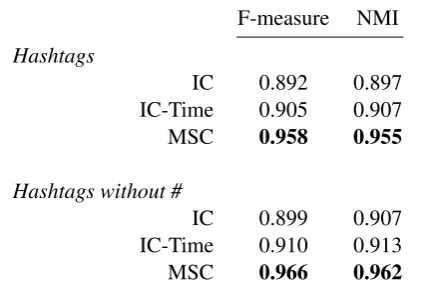
entire stream. Since hashtags are considered as good indicators of topics in the tweets, we investi-gated two different ways of using hashtags as fea-tures: first, considering hashtags in the same way as words, and second, removing the # symbol and treating hashtags as normal words. Table 1 reports the clustering accuracy using the three algorithms on the two settings.
F-measure NMI
Hashtags
IC 0.892 0.897 IC-Time 0.905 0.907 MSC 0.958 0.955
Hashtags without #
IC 0.899 0.907 IC-Time 0.910 0.913 MSC 0.966 0.962
Table 1: Comparison of clustering algorithms on F-measure and NMI metrics
The top part of the table compares the per-formance of the three algorithms using bag-of-words and original hashtags as features. We can see that, our proposed MSC algorithm is superior to the other two baselines, while IC-time performs slightly better than IC. This is because, IC only relies on the cosine similarity between textual fea-tures of tweets to form clusters, while IC-Time en-forces a time constraint in the similarity measure to reflect the time locality of events, which thus leads to better clustering accuracy. By explicitly merging related clusters, MSC achieves the high-est accuracy on both two metrics.
The bottom part of the table shows the cluster-ing results by removcluster-ing the # symbol and treatcluster-ing hashtags as normal words. We can observe that, this improves the clustering accuracy for all three algorithms. We believe that this improvement is because removing the # symbol contributes to in-creasing the term frequency of the same topic word in the tweets. It thus translates to yielding better clustering accuracy. This can be illustrated using the examples as follows.
Bold move as Google Buys Motorola for12.5 Billion, and paid cash #google #motorola.
15 30 45 60 75
Stream in Time Units (Days)
F−measure
Stream in Time Units (Days)
NMI
IC IC−Time MSC
(b) NMI Figure 1: Clustering accuracy over different time horizons
ĚƌƵŐŽǀĞƌĚŽƐĞ
Figure 2: Illustration of the cluster merge process
If we remove the # symbol, hashtags#googleand
#motorola are turned into words google and mo-torola, in the first tweet, and #Earthquake and
#Virginiaare intoEarthquakeandVirginia, in the second tweet. In both cases, this increases the term frequencies of the topic words or main entities of events, thus highlighting their contributions to forming the clusters.
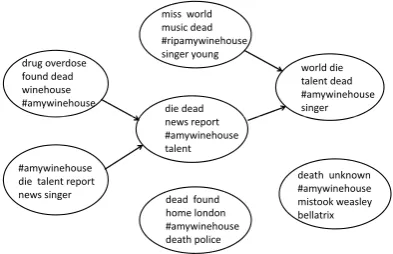
To better understand how our MSC algorithm performs cluster merges, Figure 2 illustrates the cluster merging process for the topic talking about the death of Amy Winehouse2. There are seven clusters generated from the online phase, each of which is represented using top-ranked keywords in the figure. In the offline phase, the clusters are merged based on their similarity and relatedness in a bottom-up manner, and finally three clusters remain after two rounds of cluster merges.
The other important feature of our proposed MSC algorithm is that it can merge related clus-ters upon demand for any user-specified horizon. Therefore, we carried out experiments to compare the clustering quality of the three algorithms at
dif-2http://en.wikipedia.org/wiki/Amy_
Winehouse
ferent time horizons. Figure 1 shows the clustering accuracy with respect to F-measure and NMI at different time units in the stream. We can see that, our proposed MSC algorithm consistently outper-forms the other two baselines over time. This indi-cates that, MSC has the ability to retain sufficient statistics required for effective cluster merging in the offline phase.
Conclusions and Future Work
In this paper, we proposed a new approach for clustering microtext streams into event-based clus-ters. Our proposed approach intelligently divides the clustering process into an online component which maintains summary statistics, and an offline component which uses these compact statistics to discover event-based clusters. Therefore, it has the advantage of processing and scaling to large vol-umes of microtext streams. Experiments and com-parisons demonstrated that our proposed approach achieves better clustering accuracy than state-of-the-art methods, and merging similar clusters can improve the performance of short text clustering.
References
J. Allan, R. Papka, and V. Lavrenko. On-line new event detection and tracking. InProceedings of the 21st Annual International ACM SIGIR Con-ference on Research and Development in In-formation Retrieval, pages 37–45, Melbourne, Australia, 1998.
H. Becker, M. Naaman, and L. Gravano. Be-yond trending topics: Real-world event identi-fication on Twitter. InProceedings of the Fifth International Conference on Weblogs and So-cial Media, pages 438–441, Barcelona, Catalo-nia, Spain, 2011.
J. Ellen. All about microtext: A working def-inition and a survey of current microtext re-search within artificial intelligence and natu-ral language processing. In Proceedings of the Third International Conference on Agents and Artificial Intelligence, pages 329–336, Rome, Italy, 2011.
C. Li, A. Sun, and A. Datta. Twevent: Segment-based event detection from tweets. In Proceed-ings of the 21st ACM International Conference on Information and Knowledge Management, pages 155–164, Maui, HI, USA, 2012.
S. Petrovi´c, M. Osborne, and V. Lavrenko. Us-ing paraphrases for improvUs-ing first story detec-tion in news and Twitter. InProceedings of the 2012 Conference of the North American Chap-ter of the Association for Computational Lin-guistics: Human Language Technologies, pages 338–346, Montreal, Canada, 2012.
A. Rangrej, S. Kulkarni, and A.V. Tendulkar. Comparative study of clustering techniques for short text documents. InProceedings of the In-ternational World Wide Web Conference, pages 111–112, Hyderabad, India, 2011.
T. Reuter, P. Cimiano, L. Drumond, K. Buza, and L. Schmidt-Thieme. Scalable event-based clustering of social media via record linkage techniques. In Proceedings of the Fifth In-ternational Conference on Weblogs and Social Media, pages 313–320, Barcelona, Catalonia, Spain, 2011.
K.D. Rosa, R. Shah, B. Lin, A. Gershman, and R. Frederking. Topical clustering of tweets. In
Proceedings of the SIGIR Workshop on Social Web Search and Mining, Beijing, China, 2010.
G. Salton and C. Buckley. Term-weighting ap-proaches in automatic text retrieval. Informa-tion Processing and Management, 24(5):513– 523, 1988.
A. Strehl and J. Ghosh. Cluster ensembles – a knowledge reuse framework for combining multiple partitions. Journal of Machine Learn-ing Research, 3:583–617, 2003.
O. Tsur, A. Littman, and A. Rappoport. Scal-able multi stage clustering of tagged micro-messages. In Proceedings of the 21st World Wide Web Conference, pages 621–622, Lyon, France, 2012.
J. Yin and Q. Yang. Integrating hidden Markov models and spectral analysis for sensory time series clustering. In Proceedings of the Fifth IEEE International Conference on Data Min-ing, pages 506–513, Houston, Texas, USA, 2005.