A Machine Learning based Music Retrieval and Recommendation System
Naziba Mostafa, Yan Wan, Unnayan Amitabh, Pascale Fung
Human Language Technology CenterDepartment of Electronic and Computer Engineering
The Hong Kong University of Science and Technology, Clear Water Bay, Hong Kong [email protected], [email protected], [email protected], [email protected]
Abstract
In this paper, we present a music retrieval and recommendation system using machine learning techniques. We propose a query by humming system for music retrieval that uses deep neural networks for note transcription and a note-based retrieval system for retrieving the correct song from the database. We evaluate our query by humming system using the standard MIREX QBSH dataset. We also propose a similar artist recommendation system which recommends similar artists based on acoustic features of the artists’ music, online text descriptions of the artists and social media data. We use supervised machine learning techniques over all our features and compare our recommendation results to those produced by a popular similar artist recommendation website.
Keywords:query by humming, similar artist recommendation, music information retrieval, machine learning
1.
Introduction
Faster computational speed and increasing number of on-line users have resulted in a dramatic increase in music consumption. It is getting more and more difficult for the general public, especially non-experts, to find and retrieve music from the millions of songs available online. A lot of research is being done these days to find efficient mu-sic retrieval and recommendation methods. One mumu-sic re-trieval method that is gaining a lot of popularity these days due to its convenient usage is query by humming, which is a content-based music retrieval method that can retrieve melodies using users’ hummings as queries. This allows users to find old songs that they only remember the tune of or retrieve obscure songs heard in public places. The Mu-sic Information Retrieval (MIR) community has also been doing a lot of work on automatic recommendation systems ranging from the content-based methods to social tagging and similarity networks (Cohen and Fan, 2000; Hong et al., 2008). One of the key research topics in this area that has gained a lot of traction is automatic similar artist recom-mendation.
Currently, there are several musical retrieval and similar artist recommendation apps. There are apps such as Sound-Hound, MusixMatch etc, that can retrieve songs using hum-ming as a query, and websites such as All Music Guide (AMG)1 and last.fm2that give similar artist recommenda-tion. However, accuracy and efficiency of these music re-trieval and recommendation systems still leave a lot of room for improvement. Therefore, we are planning to create a holistic music retrieval and recommendation system using machine learning techniques.
The biggest challenges of a query by humming system include i) queries sung by users often vary from the ac-tual melody in pitch, tempo etc. so the melodic similarity matching must be done at a more abstract level in order to get meaningful results, ii) background noise is often present in users’ queries which also makes it harder to identify the
1
http://www.allmusic.com 2
http://www.last.fm/
melody correctly and iii) efficient retrieval methods must be used that can search through a database and retrieve the cor-rect melody in as little time as possible. Therefore, methods used to retrieve the melody in this case need to be robust to noise and inaccuracies in the singing or humming which is very challenging, and, for the system to be practical, the entire system should be very fast.
Therefore, we propose a supervised machine learning based method for the query-by-humming system, which can learn the common errors associated with human humming and build a model that is unaffected by these errors. For this task, we have collected humming data and transcribed them in order to train a Deep Neural Network (DNN) based Hid-den Markov Model (HMM) for note transcription. This deep learning method allows us to learn the patterns present in the humming data and create a model that can detect the notes in a humming query. The proposed note transcription method is used along with a note-based retrieval method similar to Yang et al. (2010) in order to retrieve a ranked list of songs most similar to the query.
One of the biggest challenges faced by the current similar artist recommendation systems is that they perform poorly for relatively obscure artists. Therefore we are interested in using machine learning methods to build a recommendation system that can provide good similar artist recommenda-tion even for relatively unknown artists. We propose a rec-ommendation system that uses supervised machine learn-ing techniques over features such as acoustics of music, the meta-data, and online texts related to the artist to find simi-lar artists.
2.
Previous Work
measure similarity between the main songs and the query (Wang et al., 2008; Dannenberg et al., 2007). The note-based methods use the pitches as features to transcribe the notes present in a query or a song (Shih et al., 2002; Shih et al., 2003; Shifrin et al., 2002) and the notes in the query are then matched against the notes in songs using simple string matching techniques (Ghias et al., 1995; Shih et al., 2002) or linear scaling based methods (Yang et al., 2010). In this paper, we focus on note-based methods since they are more efficient (Kharat et al., 2015; Yang et al., 2010) and there still seems to be room for improvement in accu-racy in this case. These methods are often based on sta-tistical approaches. Hidden Markov model (HMM) is one of the common methods that have been used for note tran-scription (Shih et al., 2002; Shih et al., 2003; Shifrin et al., 2002; Ryyn¨anen and Klapuri, 2004). In Shih et al. (2002) and Shih et al. (2003), the note is segmented by modelling phonemes using mel-frequency cepstral coeffi-cients, energy measures, and the derivatives of these as fea-tures, and then the average pitch of the note is found on the segmented segments, which is then used to represent the individual notes. However, this approach works well when each note is hummed using one syllable such as da or ta and is not very effective for handling a large variety of queries. The most effective of these statistical melody transcription approaches is proposed in Ryyn¨anen and Kla-puri (2004), which extracts prosodic features, that are used to train HMM-GMMs for modelling notes. Since recent studies in speech recognition field have shown that using DNN instead of GMMs in HMM significantly improves the recognition accuracy (Dahl et al., 2012), we propose to use Deep Neural Networks (DNN) with HMMs instead of sim-ple HMM-GMM models as humming is similar to speech. The methodology used in our artist recommendation sys-tem differs from previous work both in the source and tar-get. We collect tons of news from mainstream news web-sites and calculate the co-occurrence of Bollywood artists’ names in these articles, which is a plausible profound and comprehensive way to tell the relativeness of two singers. On the other hand, related artists ought to influence each other in their musical style. Therefore, we are also ex-tracting audio-based features to find related artists. Voice features such as Mel Frequency Cepstrum Coefficients (MFCCs) (Mermelstein, 1976) are wildly used in speech recognition and audio fingerprinting (Cano et al., 2005). Features of MFCCs include spectral flatness, tone peaks, which could represent the features and categories of the songs. In addition, musical features like loudness, pitch and brightness are also used for query of music (Wold et al., 1996). Su et al. (2013) have previously investigated piece-level features for determining the mood of a musical piece with high accuracy.
The rest of the paper is organized as follows. Section 3 describes the overall methodology, Section 4 describes the query by humming system, Section 5 describes the similar artist recommendation system, Section 6 explains the ex-perimental setup and evaluation of the system and Section 7 summarizes the content of the paper
3.
Methodology
The overall system takes a hummed tune as an input, which is then fed to the Query by Humming (QBH) system. The QBH system uses the input to output a ranked list of songs with highest similarities to the query. The user can then either manually choose the correct song from the ranked list or use the default setting of choosing the most highly ranked song as the song to be retrieved. The retrieved song along with its metadata is then used as an input to the simi-lar artist recommendation system, which then outputs a list of most similar artists. An overview of the overall system is given below in Figure 1.
Figure 1: Overview of the overall music retrieval and rec-ommendation system
The Query by Humming system and similar artist recom-mendation system are described in more detail in sections 4 and 5 respectively.
4.
Query by Humming
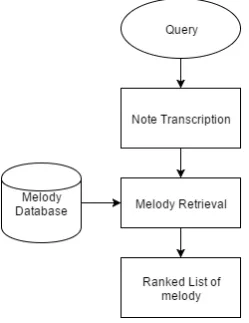
The Query by Humming system takes a few notes from a melody hummed or sung by the user as the query. The notes of the query is transcribed using our note transcrip-tion method and is then passed onto the retrieval system, which uses the transcribed query and the melody database, which refers to the entire list of pre-transcribed melodies or songs that can be recognized by our system, to give a ranked list of melodies that match the input query.
Figure 2: Overview of the QBH system
4.1.
Note Transcription
4.1.1. Feature Extractionextrac-tion algorithms is completely accurate. Therefore, we de-cided to use three of the best pitch extraction algorithms according to Molina et al. (2014) as features to improve our systems accuracy. Those features include the pitchy-infft (Brossier, 2006), melodia (Salamon et al., 2014) and pyin (Mauch and Dixon, 2014) algorithms.
4.1.2. Acoustic Modelling
For this task, we propose to train notes in the range of 35-85 since this range generally covers all the notes used for hu-man humming. We use 3-state HMM monophone models to train each of the notes and a single-state HMM to train the silence model.
The extracted features are then used to train the models by using the greedy layer-wise supervised training (Dahl et al., 2012) method, which takes the extracted features as input and uses three hidden layers for training, which was found to be the optimal number of layers for this task. The DNN is trained using the Kaldi toolkit3.
An overview of the acoustic model is shown in Figure 3.
Figure 3: Overview of the acoustic modelling of the note transcription system
4.1.3. Musicological Modelling
The musicological model controls transitions among the note models and the rest in a manner similar to the language model used in speech recognition.
The transition probabilities among note HMMs are de-fined by note bi-grams, which were estimated from a large database of MIDI files containing melodies similar to Ryyn¨anen and Klapuri (2004). Since key is important in de-termining note transitions as some note sequences are more common than others in a certain musical key, the model
3
http://kaldi.sourceforge.net/
first estimates the key of the musical piece. Then differ-ent note bigrams are defined for each key. Therefore, given the previous note i and the estimated key k, the note bi-gram probabilityP(n =j|n =i, k)gives the probability of moving from note i to note j.
4.2.
Candidate Melody Retrieval
The final step is to retrieve the candidate melody repre-sented by the hummed query. For this purpose, the melody contour of the query is matched against those of all the songs in the database. The melodies ranking the highest similarity scores are presented as the candidate melodies. The retrieval method used is similar to Yang et al. (2010). It mainly uses based linear scaling (NLS) and note-based recursive alignment (NRA). It uses the pitch and time information of the note and recursive-alignment combined with linear scaling to match the query with the melody. However, instead of using absolute pitch values like in Yang et al. (2010), we use the note transition values to match the similarities.
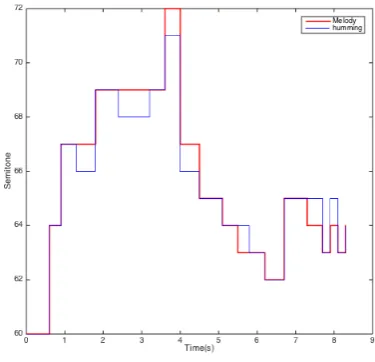
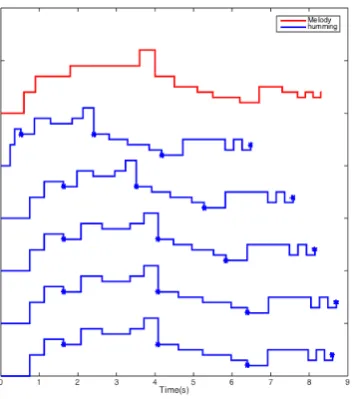
The note based linear scaling algorithm basically uses dif-ferent scale factors to stretch and contract the humming query input. The distance between the humming and the song is calculated by adding those between all the intervals. The smallest distance is then used. The basic principle be-hind the note based linear scaling method is shown using Figures 4 and 5. The same humming query is used in both figures with different scaling and the main melody. As it can be seen from the figures, the scaling of the query has a huge impact when we calculate its distance from the main melody.
Figure 4: Principle behind NLS
Figure 5: Principle behind NLS
and the melody. Figure 6 shows the general principles of NRA.
Figure 6: The procedure of NRA
The candidate songs are then ranked by their smallest tance with the query, with the song with the lowest dis-tance ranked first. The retrieval method is used to generate a ranked list of top 20 songs most similar to the query.
5.
Similar Artist Recommendation
We test the similar artist recommendation system on Bolly-wood artists mostly because BollyBolly-wood music provides us with a comparatively small set, which is easier to annotate and evaluate.
5.1.
Dataset Building
Bollywood industry is a relatively small circle with a to-tal number of 116 artists. There are three main websites that introduce and discuss Bollywood artists in both
En-glish and Hindi. They are NDTV4, The Indian Express5and Wikipedia6. We have downloaded 3431 articles, 2622 from Indian Express and 809 from NDTV and Wikipedia. The articles are very comprehensive in the scope of the news they covered, including artists influences, collaborative ef-forts, gossip news, etc.
In order to evaluate our results, we need to manually build a standard related artist set for each artist. Regretfully, there is no acceptable gold standard online for Bollywood artists and the information available on AMG is very limited in recommending similar artists for lots of singers. We se-lected three Indian students with a strong Indian musical background as the annotators, and provided them with the full artists name list. They independently chose the simi-lar artists for each target artist. We asked them to choose around 10 related artists for each candidate and pick the ones they all agree with in order to show a fair comparison to the baseline, Last.fm, which shows around 10 similar artists for each target artist. Last.fm7, a popular internet radio, and online music service, uses classification of meta-data tags to find similar artists. Since its meta-data is relatively open, it is one of the standards that music information re-trieval work compares their results to.
Figure 7: Spectral Mean Features with Principle Compo-nent Analysis
5.2.
Spectral Mean Distance of Audio Features
Bollywood music is influenced by both classical Indian mu-sic and modern western mumu-sic. A particular Bollywood artist is a composer or singer with his/her own style. For example, Rahat Fateh Ali Khan is known to fuse devotional Muslim Sufi music with other styles. We propose that mu-sical characteristics of an artist can be represented as the4
http://www.ndtv.com 5
http://www.indianexpress.com 6
aggregated average acoustic features of all his/her songs. We can then measure the similarity between two artists us-ing spectral distance measurements.
We extracted musical (Tzanetakis and Cook, 2000), psy-choacoustic (Cabrera, 1999) and speech features (Eyben et al., 2010) from Bollywood songs for each artist in a spectral vector representation. Su et al. (2013) used these features successfully in categorizing musical genres and moods. The musical features include timbre, chroma, spectral flat-ness; psychological features include loudness, sharpflat-ness; sound features include frequency and speech characteris-tics. For each artistsi, the feature dimension is 865. Each entryvi(k)is the mean value of the corresponding feature for artist si. The distance of two artists over the acoustic feature space is calculated as follows:
d(i, j) =kvi−vjk (1)
where i, j stand for two artists, d(i, j)is the distance of artisti andj over acoustic feature space,k · kis the L2-norm,viis the audio feature vector of artisti, dimension is 865.
Note that each feature in the acoustic space has been nor-malized by its mean and variance. Thus the closer the dis-tance is, the more similar the styles of the songs of two artists are.
5.3.
Co-occurrence in the texts
We extract the co-occurrence of two artists in the contexts. For two arbitrary artists, si and sj, the co-occurrence is computed as follows:
co(i, j) = c
T icj
|ci||cj|
(2)
whereco(i, j)is the co-occurrence score of artist iandj.
ciis the number of times artistioccurs in each window,| · | is the L1-norm. For simplicity, we set our window size to the length of each paragraph.
5.4.
Degree of related artists
name degree rank Listeners
Lata Mangeshkar 320 1 91.4k
A R Rahman 233 2 328.3k
Kishore Kumar 199 3 53.1k
...
Vijay Benedict 0 115 1.25k
Vijay Yesudas 0 116 2.06k
Table 1: The rank of artists sorted by their degree. Listeners are the data from Last.fm
The co-occurrence score measures the closeness of two artists in the text. In this section, we propose a new fea-ture called, degree. In Graph theory, the degree means the number of edges that are incident on the vertex. Analogous to this definition, we define the degree of an artist as the number of times that the other artists are ”incident on” the artist. Given any artist as the vertex, we calculate all the times that the other artists co-occur in the same paragraph
Figure 8: Degree: Link among Bollywood artists
when moving the window throughout the whole articles. The degree for the artist is calculated as follows:
ri= X
j6=i;k
(ck(i, j)>0 ? 1 : 0) (3)
whereck(i, j)indicate artistiandjco-occur in windowk. In our experiment, artists with the highest degree and low-est degree can be viewed from Table 1. We have cross-referenced the results with Last.fm play counts, which are shown in Table 1 Listeners column, for the artists and we have found that artists with the higher degree have larger play counts, which means they are more popular. Gener-ally speaking, the artist with a higher degree tends to be more influential. This feature helps us to re-rank the can-didate list and balance the results with more popular and lesser-known artists.
5.5.
Learning Feature Weights
candidate set Last.fm spectral Co-occurrence Spec+Co Spec+Co+Degree
Degree aritist name P R F P R F P R F P R F1 P R F
High
Lata Mangeshkar 0.90 0.38 0.53 0.72 0.33 0.46 1 0.08 0.15 0.73 0.33 0.46 0.72 0.33 0.46 A R Rahman 0.60 0.33 0.43 0.82 1.00 0.90 0.13 0.11 0.12 0.45 0.56 0.50 0.64 0.78 0.70 Kishore Kumar 0.44 0.33 0.38 0.55 0.50 0.52 1.00 0.33 0.50 0.64 0.58 0.61 0.55 0.50 0.52 Sonu Nigam 0.25 0.20 0.22 0.27 0.30 0.29 0.20 0.10 0.13 0.18 0.20 0.19 0.36 0.40 0.38
. . . .
Low
Shubha Mudgal 0.44 0.44 0.44 0.73 0.89 0.80 0 0 0 0.73 0.89 0.80 0.73 0.89 0.80 Shibani Kashyap 0 0 0 0.73 1.00 0.84 0 0 0 0.73 1.00 0.84 0.55 0.75 0.63 Rajkumari 0.33 0.13 0.19 0.55 0.75 0.63 1 0.13 0.22 0.55 0.75 0.63 0.55 0.75 0.63 average 0.25 0.14 0.17 0.57 0.63 0.58 0.31 0.06 0.10 0.55 0.61 0.56 0.53 0.60 0.55
Table 2: Results (precision, recall, F-score) in percentage for comparing three features performances over the last.fm results. It is calculated by 10-fold validation. Each fold iterates for 100 times in logistic regression.
Extracted Features MRR
Simple autocorrelation based pitch extrac-tion
0.487
Only ”PitchYinfft” algorithm 0.69
PitchYinfft, Melodia and pYin algorithms 0.8071
Table 3: Comparison of results with pitch obtained using different pitch-extraction algorithms as features
Note Transcription Algorithm MRR HMM-GMM based acoustic model 0.7679
DNN-HMM based acoustic model 0.8071
Table 4: Comparison of results with different algorithms
same size of the number of positive tuples to make a bal-anced set. We use logistic regression to train the model and update the weights with the stochastic gradient descent.
6.
Experiments and Results
6.1.
Results for Humming Recognition
For training note models, we have used humming data from the IOACAS corpus 8 and TCS corpus 9 with additional humming data collected by us. We annotated the humming data manually using the Tony software10.
For the evaluation of the overall query by humming sys-tem, we have used the standard set used by MIREX for this purpose. It uses the Roger Jang corpus 11, consisting of 4431 queries and 48 ground-truth MIDI files. So, for our experiments we first transcribe the notes in all the ground truth MIDI files. The queries are then each transcribed and passed onto our retrieval system, which generates a list of most likely candidate melodies. The system is evaluated using mean Reciprocal Ranking (MRR):
M RR= 1
We initially used different feature sets and the MRR ob-tained using the different features is shown in Table 3. It
8http://www.music-ir.org/mirex/wiki/
indicates that using a combination of pitch values as fea-tures give better results. We also first created a simple HMM-GMM based model and the results in Table 4 indi-cate that using Deep Neural Networks (DNN) with HMM improves the overall retrieval rate of the system. We have currently trained the transcription system on a relatively small dataset, and we believe that using additional train-ing data can improve our overall transcription accuracy and the retrieval accuracy.
6.2.
Results for Related Artist Recommendation
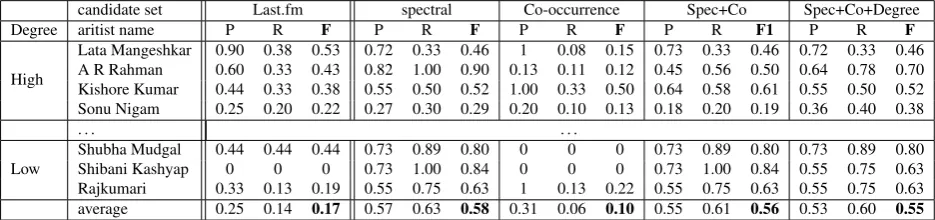
Once we have done the logistic regression, we can apply the trained weights to the test set. We evaluate each artistsi and calculate the related artists setCiˆ . Then we compare it to the standard candidate setCiand calculate the precision, recall and F-score.
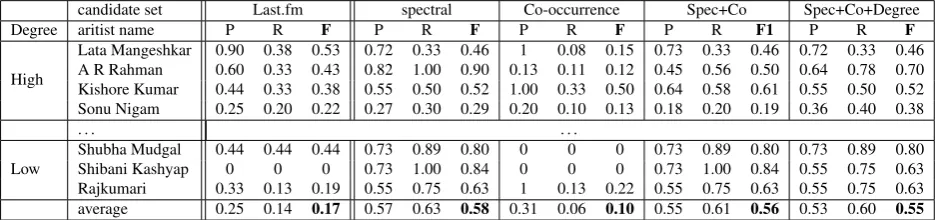
Table 5 shows parts of our results. There are five columns. The first column is the baseline of Last.fm’s results. The other four are the results from combination of features. Sec-tion 5.4. shows that artists with higher degree contain more correlation links to other artists, which partly reflect their influences. We show artists with the highest degree and lowest degree. From Table 5, we can see that Last.fm does not work very well for artists with low degree. Actually, we can not find similar artists information for artists with low degree on the last.fm’s website. On the contrary, our method compensates this shortage. We can see that our method performs smoothly when dealing with both high degree and low degree artists and performs 40% better on average in F-measure. Actually, the sole spectral mean dis-tance feature has already reached a pretty good precision and recall for some artists. Combined with co-occurrence features, we can see that precision and recall increased for the high degree artists whereas they did not decrease on the low degree artists. However, the co-occurrence feature alone does not perform so well. This may be due to the fact that our corpus is not large enough, so we will continue to collect data in order to improve our results in the future.
7.
Conclusion
candidate set Last.fm spectral Co-occurrence Spec+Co Spec+Co+Degree
Degree aritist name P R F P R F P R F P R F1 P R F
High
Lata Mangeshkar 0.90 0.38 0.53 0.72 0.33 0.46 1 0.08 0.15 0.73 0.33 0.46 0.72 0.33 0.46 A R Rahman 0.60 0.33 0.43 0.82 1.00 0.90 0.13 0.11 0.12 0.45 0.56 0.50 0.64 0.78 0.70 Kishore Kumar 0.44 0.33 0.38 0.55 0.50 0.52 1.00 0.33 0.50 0.64 0.58 0.61 0.55 0.50 0.52 Sonu Nigam 0.25 0.20 0.22 0.27 0.30 0.29 0.20 0.10 0.13 0.18 0.20 0.19 0.36 0.40 0.38
. . . .
Low
Shubha Mudgal 0.44 0.44 0.44 0.73 0.89 0.80 0 0 0 0.73 0.89 0.80 0.73 0.89 0.80 Shibani Kashyap 0 0 0 0.73 1.00 0.84 0 0 0 0.73 1.00 0.84 0.55 0.75 0.63 Rajkumari 0.33 0.13 0.19 0.55 0.75 0.63 1 0.13 0.22 0.55 0.75 0.63 0.55 0.75 0.63 average 0.25 0.14 0.17 0.57 0.63 0.58 0.31 0.06 0.10 0.55 0.61 0.56 0.53 0.60 0.55
Table 5: Results (precision, recall, F-score) in percentage for comparing three features performances over the last.fm results. It is calculated by 10-fold validation. Each fold iterates for 100 times in logistic regression.
QBH system overall shows encouraging results and can be improved with additional data. We also propose a similar artist recommendation system and experiment the system on an exhaustive list of 116 Bollywood artists and show that the recommendations based on spectral distance, co-occurrence and degree measures give better results on av-erage for all artists compared to popular similar artist rec-ommendation website. We plan to collect more data in the future and test the system on a larger dataset.
8.
Acknowledgements
This research was partially supported by Grant Number 16214415 of the Hong Kong Research Grant Council and partially supported by Bai Xian Asian Institute. We would like to thank our colleagues from Human Language Tech-nology Center of The Hong Kong University of Science and Technology, who provided expertise that greatly assisted the research. We thank Anik Dey for assistance with his Bollywood knowledge which improved the precision of our work and Ricky Chan for assistance with the acoustic mod-eling of note transcription system. We would also like to thank the three annotators who helped us label our dataset.
9.
Bibliographical References
Brossier, P. M. (2006). Automatic annotation of musical audio for interactive applications. Ph.D. thesis, Queen Mary, University of London.
Cabrera, D. (1999). Psysound: A computer program for psychoacoustical analysis. In Proceedings of the Aus-tralian Acoustical Society Conference, volume 24, pages 47–54.
Cano, P., Batlle, E., Kalker, T., and Haitsma, J. (2005). A review of audio fingerprinting. Journal of VLSI signal processing systems for signal, image and video technol-ogy, 41(3):271–284.
Cohen, W. W. and Fan, W. (2000). Web-collaborative filtering: Recommending music by crawling the web. Computer Networks, 33(1):685–698.
Dahl, G. E., Yu, D., Deng, L., and Acero, A. (2012). Context-dependent pre-trained deep neural networks for large-vocabulary speech recognition. Audio, Speech, and Language Processing, IEEE Transactions on, 20(1):30–42.
Dannenberg, R. B., Birmingham, W. P., Pardo, B., Hu, N., Meek, C., and Tzanetakis, G. (2007). A comparative evaluation of search techniques for query-by-humming
using the musart testbed. Journal of the American Soci-ety for Information Science and Technology, 58(5):687– 701.
Eyben, F., Wllmer, M., and Schuller, B. (2010). Opens-mile: the munich versatile and fast open-source audio feature extractor. In Proceedings of the international conference on Multimedia, pages 1459–1462. ACM. Ghias, A., Logan, J., Chamberlin, D., and Smith, B. C.
(1995). Query by humming: musical information re-trieval in an audio database. InProceedings of the third ACM international conference on Multimedia, pages 231–236. ACM.
Guthrie, J. A., Guthrie, L., Wilks, Y., and Aidinejad, H. (1991). Subject-dependent co-occurrence and word sense disambiguation. InProceedings of the 29th annual meeting on Association for Computational Linguistics, pages 146–152. Association for Computational Linguis-tics.
Hong, J., Deng, H., and Yan, Q. (2008). Tag-based artist similarity and genre classification. InKnowledge Acqui-sition and Modeling Workshop, 2008. KAM Workshop 2008. IEEE International Symposium on, pages 628– 631. IEEE.
Kharat, V., Thakare, K., and Sadafale, K. (2015). A survey on query by singing/humming. International Journal of Computer Applications, 111(14).
Mauch, M. and Dixon, S. (2014). pyin: A fundamen-tal frequency estimator using probabilistic threshold dis-tributions. In Acoustics, Speech and Signal Process-ing (ICASSP), 2014 IEEE International Conference on, pages 659–663. IEEE.
McDermott, J. H. and Oxenham, A. J. (2008). Music per-ception, pitch, and the auditory system.Current opinion in neurobiology, 18(4):452–463.
Mermelstein, P. (1976). Distance measures for speech recognition, psychological and instrumental. Pattern recognition and artificial intelligence, 116:374–388. Molina, E., Tard´on, L. J., Barbancho, I., and Barbancho,
A. M. (2014). The importance of f0 tracking in query-by-singing-humming.
Pachet, F., Westermann, G., and Laigre, D. (2001). Musi-cal data mining for electronic music distribution. InWeb Delivering of Music, 2001. Proceedings. First Interna-tional Conference on, pages 101–106. IEEE.
and Research Workshop (ITRW) on Statistical and Per-ceptual Audio Processing.
Salamon, J., Gomez, E., Ellis, D. P., and Richard, G. (2014). Melody extraction from polyphonic music sig-nals: Approaches, applications, and challenges. Signal Processing Magazine, IEEE, 31(2):118–134.
Shifrin, J., Pardo, B., Meek, C., and Birmingham, W. (2002). Hmm-based musical query retrieval. In Pro-ceedings of the 2nd ACM/IEEE-CS joint conference on Digital libraries, pages 295–300. ACM.
Shih, H.-H., Narayanan, S. S., and Kuo, C. J. (2002). An hmm-based approach to humming transcription. In Mul-timedia and Expo, 2002. ICME’02. Proceedings. 2002 IEEE International Conference on, volume 1, pages 337–340. IEEE.
Shih, H.-H., Narayanan, S. S., and Kuo, C. J. (2003). A statistical multidimensional humming transcription us-ing phone level hidden markov models for query by hum-ming systems. InMultimedia and Expo, 2003. ICME’03. Proceedings. 2003 International Conference on, vol-ume 1, pages I–61. IEEE.
Su, D., Fung, P., and Auguin, N. (2013). Multimodal music emotion classification using adaboost with deci-sion stumps. InAcoustics, Speech and Signal Process-ing (ICASSP), 2013 IEEE International Conference on, pages 3447–3451. IEEE.
Tzanetakis, G. and Cook, P. (2000). Marsyas: A frame-work for audio analysis. Organised sound, 4(03):169– 175.
Wang, L., Huang, S., Hu, S., Liang, J., and Xu, B. (2008). An effective and efficient method for query by hum-ming system based on multi-similarity measurement fu-sion. InAudio, Language and Image Processing, 2008. ICALIP 2008. International Conference on, pages 471– 475. IEEE.
Wold, E., Blum, T., Keislar, D., and Wheaten, J. (1996). Content-based classification, search, and retrieval of au-dio.MultiMedia, IEEE, 3(3):27–36.