Abstract
CHRISTY, DANIEL WILLIAM. An Experimental Evaluation of the Performance of the Amorphous Silicon PV Array on the NCSU AFV Garage. (Under the direction of Dr. Herbert M. Eckerlin.)
A comprehensive performance test has been conducted on the 3 kW amorphous
silicon photovoltaic (PV) system on the roof of the Alternative Fuel Vehicle Garage of the
North Carolina Solar Center. The purpose of this testing program was to measure the
performance of the PV system, to determine if any deterioration has occurred over the past
three years since installation, and to evaluate the performance of the individual circuits that
makeup the PV system.
Test conducted on the individual circuits of the PV system showed significant
differences. This is particularly true for the two different solar panel models, which were
installed using different techniques. Numerous tests were conducted on these circuits to
isolate the problem. The current-voltage curves of the factory-laminated panels were much
worse than the self-laminated panels. No cause of the poor performance could be
definitively established. Discussions with the PV panel manufacturer are continuing to
identify the cause of the variation in PV circuit performance.
Comparisons made to performance data recorded in 2003-2004 show a similar kWh
production over 3-month periods, this is encouraging. However, comparisons between
global irradiance and AC power production show a 9% reduction in power production.
Continued research is recommended to further evaluate the circuit issues and to
study how PV panel temperatures can be reduced so as to improve over PV system
An Experimental Evaluation of the Performance of the Amorphous Silicon PV Array on the NCSU AFV Garage
by
DANIEL WILLIAM CHRISTY
A thesis submitted to the Graduate Faculty of North Carolina State University
in partial fulfillment of the requirements for the Degree of
Master of Science
MECHANICAL ENGINEERING
Raleigh, North Carolina
2007
APPROVED BY:
_________________________ _________________________ Dr. James W. Leach Dr. Tarek Echekki
________________________________ Dr. Herbert M. Eckerlin
Biography
Dan Christy was born in Chardon, OH on February 26, 1980. Dan moved to
Warrenton, Virginia in 1989 and attended and graduated from Fauquier High School in
1998. He then attended the University of Virginia receiving a bachelors of science in
aerospace engineering and graduated in 2002. Starting in June of 2002 Dan started working
for Directed Vapor Technologies International. He stayed there until May of 2005 when he
moved to Raleigh, NC to attend North Carolina State University work towards a master’s of
science in mechanical engineering. While attending NC State University he worked for the
Acknowledgements
I’d like to thank Shawn Fitzpatrick for all of his help building the data logging
system and answering all the many questions I had while working on the project and
writing the thesis. I’d like to thank Dr. Herbert Eckerlin for all of his constructive feedback
Table of Contents
List of Tables ... vi
List of Figures...vii
1. Introduction and Background ... 1
1.1. Solar Array... 1
1.2. Photovoltaic Effect ... 7
1.3. Current-Voltage Curves... 10
1.4. Previous Work ... 12
2. Data Collection System ... 13
2.1. Data Logger ... 15
2.2. Pyranometers ... 16
2.3. DC Voltage ... 18
2.4. AC Power... 18
2.5. Panel Currents... 21
2.6. Temperature Measurements... 22
3. Experiments ... 23
3.1. Open Circuit Voltage and Short Circuit Current ... 23
3.2. Circuit Power Point Tests ... 24
3.3. Current-Voltage Plot Test... 25
3.4. Shading Tests... 26
4. Results, Conclusions and Recommendations ... 28
4.2. Inverter Efficiency ... 31
4.3. Individual Circuit Performance ... 32
4.4. Performance Analysis of Individual Circuits... 33
4.5. Deterioration ... 39
4.6. Shading ... 45
4.7. Comparisons ... 48
4.8. Conclusion Summary... 50
4.9. Future Work... 50
5. References... 52
Appendix... 53
A. Data Logger Program Code ... 54
B. PV Log... 60
C. Example Short Circuit Current and Open Circuit Voltage Data ... 62
List of Tables
Table 1. Electrical Specifications ... 3
Table 2. Data Logger Equipment List ... 14
Table 3. Noon Inverter Efficiency Data... 31
Table 4. Individual Panel Voltages... 34
Table 5. Short Circuit Current Comparison... 43
Table 6. Energy Production Over Each Study... 45
Table 7. Shading Data... 46
Table 8. Conclusion Summary... 50
Table 9. Example Data Logger Output... 55
Table 10. PV Log... 60
List of Figures
Figure 1. Alternative Fuels Vehicle Garage ... 2
Figure 2. Electrical Diagram of Photovoltaic System Layout (McGuffy 167) ... 3
Figure 3. Outdoor Power Conditioning Equipment... 4
Figure 4. Combiner Box ... 5
Figure 5. Current Monitoring Enclosure... 6
Figure 6. n-type/p-type Junction with Load Shown ... 10
Figure 7. Current-Voltage Curve ... 11
Figure 8. Voltage vs. Power... 12
Figure 9. Data Logging System Schematic ... 13
Figure 10. Data Logging System ... 14
Figure 11. Data Logger Channels ... 16
Figure 12. Eppley and Li-Cor Pyranometers ... 17
Figure 13. AC-Power Measurement Diagram ... 19
Figure 14. Current-Voltage Curve Tracer... 26
Figure 15. Solar Irradiance versus AC Power Output ... 29
Figure 16. Solar Irradiance on a Clear Day and a Scattered Clouds Day... 30
Figure 17. AC Power Output for Solar Conditions shown in Figure 16 ... 30
Figure 18. Variation of Inverter Efficiency as a Function of Inverter Output (AC Power) . 32 Figure 19. Energy Production for Individual Circuit on January 2, 2007 ... 33
Figure 20. Max Power Point Voltage for Individual Circuits... 35
Figure 22. Current-Voltage Curve for Circuits D and F... 37
Figure 23. Power-Voltage Curve for Circuits D and F... 38
Figure 24. Current-Voltage Curve for Individual Panels within Circuit F... 39
Figure 25. 2003 to 2004 Solar Radiation versus AC Power Output... 41
Figure 26. 2007 Solar Radiation versus AC Power Output... 41
Figure 27. Circuit A Short Circuit Current Comparison ... 43
Figure 28. Hypothetical Shading Effects on Panel Current-Voltage Curve ... 47
Figure 29. Shading Effect on Power-Voltage Curve ... 47
Figure 30. Solar Panel Specification Sheet Page 1 ... 63
1. Introduction and Background
The amorphous silicon photovoltaic system investigated in this study is located in
Raleigh, North Carolina on the campus of North Carolina State University. The
photovoltaic system was installed on the roof of the Alternative Fuels Vehicle (AFV)
Garage that is a part of the North Carolina Solar Center. The garage is located next to the
NCSU Solar House.
The purpose of this investigation was to determine the performance of the amorphous
silicon PV array, to compare its present performance with 2003-2004 performance, to
determine if any deterioration had occurred over the past three years, and to evaluate
differences in individual circuit performance.
The report begins with a description of the solar array and its components already in
place. An overview of how photovoltaic panel work is explained next. A data collection
system to monitor parameters of the array was built so that the objectives above could be
achieved. This system is described in detail. Many experiments were performed to answer
the questions about the system’s operational performance and results and conclusions are
explained in detail.
1.1. Solar Array
The photovoltaic system includes two types of solar panels in this system. There
are sixteen Uni-Solar SSR-128J panels and eight Uni-Solar PVL-128B panels. The main
difference between the two types is the PVL-128B panels were field laminated to the roof
the garage with all 24 panels. The eight PVL-128B panels are on the left or west side of the
roof while the sixteen SSR-128J panels are on the right or east side of the garage.
Figure 1. Alternative Fuels Vehicle Garage
The sixteen SSR-128J panels had been in storage for over 3 yearsbefore they were
placed on the roof. The eight PVL-128B panels were purchased shortly before the entire
system was installed on the roof and were glued to the metal roof just prior to roof
installation.
The two types of panels have identical electrical specifications. Table 1 shows the
specifications given by the manufacturer. One part of this study was to compare the actual
performance with the manufacturer’s specifications. Each panel has a rated power of 128
watts and with 24 panels the system has about a 3 kW peak power rating. This rating tells
Table 1. Electrical Specifications
Rated Power (Watts) 128 Operating Voltage (Volts) 33.0 Operating Current (Amps) 3.88 Open Circuit Voltage (Volts) 47.6 Short Circuit Current (Amps) 4.80
The array has pairs of panels (called circuits) in series with one another to raise the
output voltage of the system to a level accepted by the inverter. The resulting 12 circuits
are then placed in parallel with each other to combine the current output. Figure 2 shows an
electrical diagram of the entire system.
Several components of the system convert DC power produced by the panels into
AC power that can be used by the AFV garage or returned to the general power grid. The
inverter is the primary piece of equipment for power conditioning and is the device that
actually does the DC to AC power conversion. Figure 3 shows some of the power
conditioning and energy measurement equipment on the outside wall of the AFV garage.
Each of these components is also shown in Figure 2.
Figure 3. Outdoor Power Conditioning Equipment
The inverter plays an important role in the operation of the PV system in that it
holds the entire PV array at a certain DC voltage. This max power voltage is found by
sweeping a range of voltages to find the maximum power output. This is called maximum
power point tracking or MPPT. The inverter displays the MPPT voltage (i.e. the voltage
Additional information that is displayed on the inverter includes the operating DC
voltage, AC voltage, AC power output, watt-hours produced for the day, time the inverter
has been operating for the day and the lifetime kWh produced. These values were recorded
several times during the study (see Appendix B for log). The readings were also used
during experiments to see how the array was operating under various solar conditions.
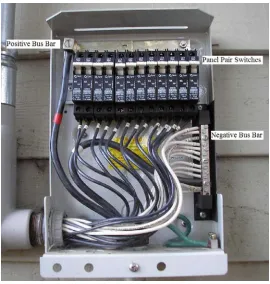
Other system components include the combiner box and the service panel. The
combiner box is where the wiring from the twelve circuits are combined together to go into
the inverter. The service panel is the circuit breaker for the garage and the point where
power comes into the garage or out to the grid (depending on the solar resource). Figure 4
shows the inside of the combiner box. The combiner box contains two bus bars where the
12 circuits are combined. The circuit switches are used to turn off individual panels.
The existing monitoring components include two kWh meters and a current
monitoring box in the attic of the garage. The first kWh meter measures the total energy
produced by the solar array. The second kWh meter is the power company meter and
measures the net energy used by the garage (i.e., utility power minus PV power provided to
the grid). Figure 3 above shows the location of the two kWh meters.
The current monitoring box in the attic has twelve 10 mΩ resistors. The current for
each circuit is sent through one of these resistors. A voltage drop can be measured across
each 10 mΩ resistor and using Ohm’s law, the current can be calculated.
R V I
R I V
= ⋅ =
Figure 5 shows the current monitoring enclosure.
1.2. Photovoltaic Effect
Some background into how the photovoltaic effect works can be useful in
understanding the basics for some of the experiments conducted in this study. A discussion
of semiconductors is necessary in order to explain how a solar cell works. An explanation
of how the photovoltaic effect works gives a science-oriented background. The final
subsection explains how a solar cell uses the photovoltaic effect to produce power.
1.2.1. Semiconductors
All atoms have an outer layer of electrons called the valence band. These are the
electrons that interact with other atoms. Conductors have few electrons in the valence band
and insulators have full valence bands. Semiconductors are in between these two. For
example, silicon (the most common base material for photovoltaic cells) has four valence
electrons with eight electrons needed to fill its particular valence band (Goswami 412).
If electrons in the valence band of an atom are energized they can reach into a
higher energy band (called the conduction band). Electrons here need only a small push to
be released from the atom entirely. The energy difference between the valence band and
the conduction band is called the band gap. Conductors have very low band gap energies
and insulators have very high band gaps. Semiconductors are in between the two
(Goswami 412).
Semiconductors used in solar cells are doped or extrinsic semiconductors. Doped
semiconductors have small amounts of impurities added to them. An n-type semiconductor
has an impurity with more electrons in its valence band than the base materials of the
appears to have an excess of electrons. A p-type semiconductor has fewer electrons in its
valence band than the base material and its overall structure seems to have fewer electrons
than expected. In other words, the p-type has holes for electrons to fill. By themselves,
n-type and p-n-type semiconductors are electrically neutral (Goswami 412).
If an n-type and a p-type semiconductor are placed next to each other, some of the
“excess” electrons from n-type semiconductor go to fill the “holes” in the p-type
semiconductor. This causes the n-type side to become electrically positive and the p-type
side to become electrically negative. This negative charge assists in directing electrons
through an external load. The electrons are freed by the photovoltaic effect (Goswami
414).
1.2.2. Photovoltaic Effect
The photovoltaic effect drives photovoltaic panels in that it causes electrons to move
into the conduction band of an atom when the electron absorbs enough solar energy. The
amount of energy needed is determined by the band gap of the material the photovoltaic
cell is made of. A single photon of light must carry the required energy to push the electron
through the band gap. If the photon energy is too small, the energy is converted into heat.
Likewise, if the energy of the photon exceeds the band gap energy, the extra energy is
converted into heat. One photon cannot energize two electrons. This is the primary reason
solar cells are relatively inefficient (Goswami 415).
Once the electron has reached the conduction band, it has potential to generate
electron will simply go back to its original energy state giving up energy as heat. This is
where the junction between the n-type and p-type semiconductors becomes important.
1.2.3. Solar Cells
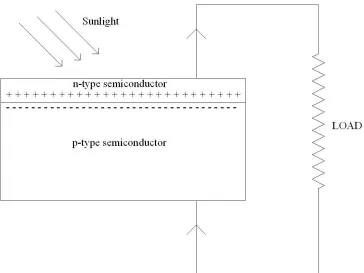
When sunlight strikes the n-type side of the solar cell, it energizes the electrons.
When this occurs, the electrons have three choices. They can go through the external load,
recombine with the holes in the n-type semiconductor, or move towards the p-type
semiconductor side of the solar cell. The goal is to get the electrons to go through the
external load. The negative charge of the p-type semiconductor side restricts the movement
in that direction. The n-type semiconductor layer is made very thin and this limits the
opportunities the electron has to recombine (Goswami 415). Thus, the only option left is
the external load, which will generate the electrical power.
Figure 6 shows a simple diagram of the n-type/p-type junction. Right at the
interface between the two is the difference in electrical charge. The n-type side gives up
electrons to the p-type side. The sunlight will strike the n-type side energizing electrons,
Figure 6. n-type/p-type Junction with Load Shown
1.3. Current-Voltage Curves
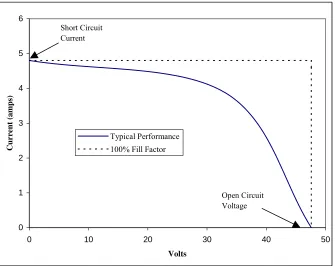
The performance of a solar panel can be judged by using a current-voltage or I-V
graph. A current-voltage curve shows the current and voltage a solar panel produces over
all resistances. The short circuit current and the open circuit voltage make up the ends of
the curve. Figure 7 shows an approximation of the rated performance of the panels
involved in this study in full sun. Important values from the graph include the short circuit
current (the y-intercept), and the open circuit voltage (the x-intercept). These values are
easily measurable and give a point of comparison between panels of the same type. These
values help in determining the possible degradation of the panels over time and for
0 1 2 3 4 5 6
0 10 20 30 40 5
Volts
Current (amps)
0 Typical Performance
100% Fill Factor Short Circuit
Current
Open Circuit Voltage
Figure 7. Current-Voltage Curve
Figure 7 shows a second plot with the open circuit voltage and the short circuit
current forming a rectangle. This is called 100% fill factor. The fill factor of a panel is
defined as the percentage of the box that is filled by the actual current-voltage curve. A
higher fill factor indicates a better performing panel.
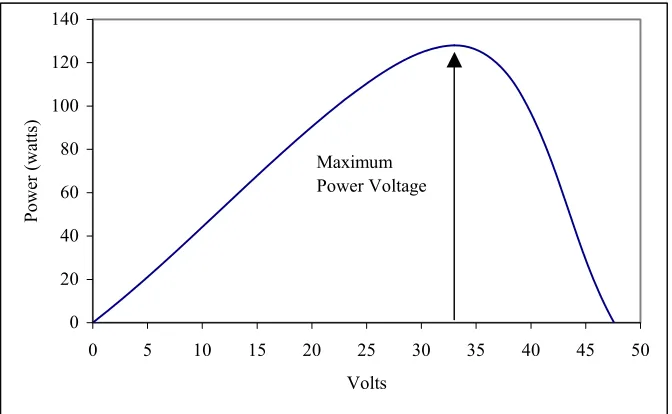
Figure 8 shows the voltage-power graph corresponding to Figure 7. The curve
shows how the power varies with voltage by simply multiplying the voltage and current at
each point on the I-V plot. This graph is used to determine the max power point, which in
0 20 40 60 80 100 120 140
0 5 10 15 20 25 30 35 40 45 50
Volts
Power (watts)
Maximum Power Voltage
Figure 8. Voltage vs. Power
1.4. Previous Work
The solar array was installed and made operational on November 13, 2003. A
performance study had been performed on the array from November 13, 2003 through April
9, 2004. The focus of the study was to analyze the relationship between the panel short
circuit current and the global irradiance. The study concluded that the ratio between short
circuit current and solar irradiance was 0.004184 amps per watt per square meter. Thus, for
a solar irradiance of 1000 watts per square meter, each circuit would yield a short circuit
current of 4.184 amps (Stanley). Additional data was collected at that time. Some of this
data was used in the present study to determine if the performance of the PV system had
2. Data Collection System
The heart of the data collection system is a Campbell Scientific CR10X data logger.
All of the data collection and initial storage takes place in this device. Data collected
includes solar intensity, AC power, DC voltage, current through circuits, ambient
temperature, and panel temperature (Appendix A shows example data output and the data
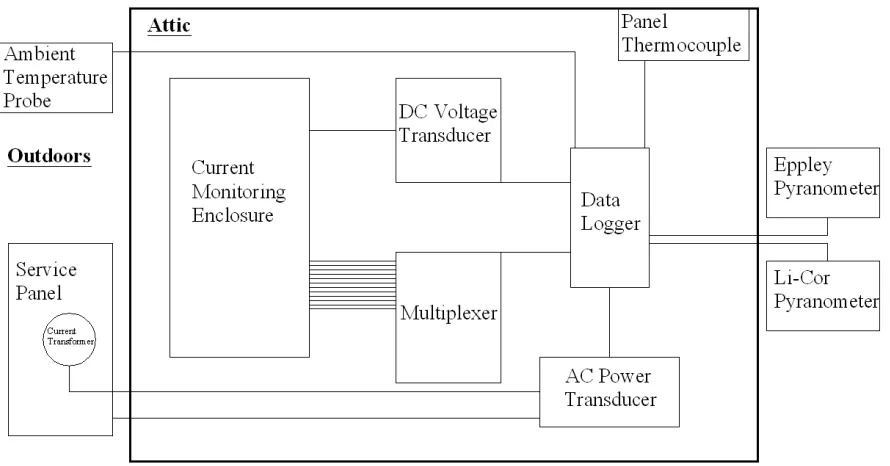
logger program. Figure 9 shows the schematic of the data logging system.
Figure 9. Data Logging System Schematic
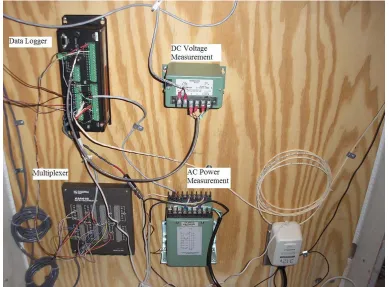
Figure 10 shows a photograph of a portion of data logging system in place in the
attic of the AFV garage. Included are the Ohio Semitronics DC voltage and AC power
measurement devices. Inputs not shown in the figure include the two pyranometers, the
thermocouple measuring panel temperature and the 107 temperature probe measuring
Figure 10. Data Logging System
Table 2 shows manufacturers and model numbers for the equipment used in the data
logging system.
Table 2. Data Logger Equipment List
Equipment Manufacturer Model No.
Data Logger Campbell Scientific CR10X
Multiplexer Campbell Scientific AM416 Voltage Transducer Ohio Semitronics VT7
Power Transducer Ohio Semitronics GWV5 Pyranometer 1 Eppley PSP
2.1. Data Logger
The Campbell Scientific CR10X data logger has twelve voltage inputs that can be
used for twelve single ended measurements or six differential voltage measurements. The
setup used a mixture of measurement types. A multiplexer was used to expand the
available channels. A multiplexer combines several channels of data down to one.
Figure 11 shows the setup of the channel inputs to the data logger. The DC Voltage
(3H), AC Power (3L), and the two pyranometers (4L, 5H) are all single-ended voltage
measurements. They are all also connected to the analog ground. The thermocouple
reference (4H) and the 107-temperature probe (5L) are single ended voltage measurements,
but they also are connected to an excitation voltage and analog ground. The single
thermocouple (6H, 6L) is used to measure the temperature on the back of a solar panel and
requires two of the twelve channels.
The multiplexer takes up four channels (1H, 1L, 2H, 2L) and has additional
connections to the data logger for power and controls. These include a 12V line, a ground,
and two control voltages. The multiplexer takes 12 differential voltages and outputs them
one at a time to the data logger. The control voltages change the differential voltage that is
Figure 11. Data Logger Channels
The data logger program was set up to take a data point from each instrument every
30 seconds. This data would then be averaged every 15 minutes and that data point would
be stored in the data logger. From time to time, the data stored would be downloaded to a
laptop for analysis. For certain tests, the storage time was reduced to one minute. This was
done to get more frequent data points.
2.2. Pyranometers
The pyranometers measure the solar intensity in watts per square meter. Two
different pyranometers were employed, an Eppley and a Li-Cor. The pyranometers were
mounted at the same angle of the roof at the bottom-west side of the roof. The two
pyranometers measure different sections of the solar spectrum and were used as a check
against each other. Figure 12 shows the two pyranometers mounted on the garage in the
plane of the roofline. The Eppley pyranometer is the larger device on the right and the
Figure 12. Eppley and Li-Cor Pyranometers
The Eppley pyranometer produces a voltage signal proportional to the solar
intensity, which is then converted with a multiplier into the correct units. The multiplier
used was 124.82
mV m
watts/ 2. This value comes from a calibration done by NREL (National
Renewable Energy Laboratory).
The Li-Cor pyranometer uses a small photovoltaic sensor to measure the solar
intensity and outputs a current proportional to the solar intensity. The current is sent
through a 147 ohm resistor and the data logger measures the voltage drop across the
resistor. The solar intensity measured is proportional to the current output of the
pyranometer multiplied by the constant shown below.
Output Current
Amp watt/m 12.55x10
Intensity Solar
2
6 ⋅
This current is sent through a resistor and using Ohm’s law, the current output can be determined. 147Ω Drop Voltage Output Current 147Ω Output Current Drop Voltage = ⋅ =
Combining two equations gives the power output in a form proportional to the voltage
output. Output) (mV 85.374 Intensity Solar 147Ω Drop Voltage Amp watt/m 12.55x10 Intensity
Solar 6 2
⋅ =
⋅ =
Thus 85.374 is the multiplier used in the data logger program to determine the Li-Cor
measured solar flux.
2.3. DC Voltage
The DC voltage of the system is measured using an Ohio Semitronics voltage
transducer (model # VT7). The VT7 receives the DC voltage from the current monitoring
enclosure in the attic of the AFV garage and converts it to a current output. This current
passes through a 2000-ohm resistor and the data logger measures the voltage drop across
that resistor.
2.4. AC Power
The inverter converts DC power into AC power that can be fed to the power grid.
An Ohio Semitronics GWV5 power transducer measures the AC power and outputs a
The available monitoring equipment however has some limitations. The power
transducer measures power up to 1000 watts and the solar array is capable of generating up
to 2500 watts. The data logger accepts voltages up to 2.5 volts while the power transducer
produces 5 volts at the top of its range. The power transducer produces 0-5 volts over a
range of 0-1000 watts. Since the data logger can only accept 2.5 volts, the maximum power
the transducer can measure is 500 watts. A current transformer was used to bring the
current going into the power transducer within allowable limits.
The voltage measurement is a direct measurement between the two lines going out
to the power grid. The current measurement is done with a current transformer using three
turns on the primary. This allows a finer resolution of the power to be determined without
bringing the voltage output of the power transducer to a level too high for the data logger.
Figure 13 shows a diagram of how the AC power is measured.
The following set of equations show the calculations used to determine the
multiplier used to convert the voltage output from the power transducer to units of power.
The actual power output is the AC voltage multiplied by the AC current. Three turns on the
primary were used so the current transformer input (ICTInput) should be three times the actual
current. AC CTInput AC AC I 3 I I V Power ⋅ = ⋅ =
The current transformer will output a 5 amp current for a 100 amp input giving a ratio of
input to output of 20:1.
20 I ICTOutput = CTInput
In order to get the ratio of measured power to actual power, a few substitutions had to be
made. The equations below show one of the substitutions required to determine the
measured power. CTOutput AC AC CTOutput I V Measured Power I 20 3 I ⋅ = = Then, AC AC I 20 3 V Measured
Power = ⋅
Finally the ratio of measured power to actually power can be determined with a third
substitution using the original power equation.
Power 20
3 Measured
The power transducer outputs a voltage range of 0-5V over a 0-1000W power input. The
equation below shows the constant needed to convert from the voltage into the data logger
to the power measured.
mV 5000
Watts 1000 Read Voltage Power
20
3 ⋅ = ⋅
A final combination of these last two equations gives the constant needed to convert the
data logger voltage into the actual power.
Voltage Logger
Data 333 . 1
Power= ⋅
With this information a multiplier of 1.333 was added into the data logger program in order
for it to output the data in units of power.
2.5. Panel Currents
The 24 panels on the roof are tied together in pairs in order to generate a voltage
that the inverter can accept. In the current monitoring enclosure in the attic, the current from each circuit is sent through a 10 mΩ current shunt (see Figure 5). By measuring the
voltage drop across the shunt, the current through each circuit can be determined.
With this information, the performance of the solar array can be evaluated. Any
differences in the current outputs of each circuit would indicate that all the panels are not
operating at expected output.
Using the sum of the twelve currents and the array DC voltage, a DC power can be
calculated. A comparison of the DC power to the AC power would give a measure of
2.6. Temperature Measurements
Temperature measurements were taken of the ambient air temperature and the PV
array. A 107-temperature probe measured the ambient air temperature and the PV array
temperature was measured by a thermocouple on the back of a single panel. The
107-temperature probe was placed underneath the side roof overhand to protect the probe from
rain. The probe was placed inside a radiation shield to prevent any sunlight from
interfering with the temperature measurement.
A thermocouple was place on the back of one of the solar panels to measure the
panel temperature. Temperature has a significant effect on photovoltaic performance.
3. Experiments
Several questions were raised after looking at the initial data from the data logging
system. Experiments were designed to answer the following questions:
- Has panel performance changed from three years ago?
- Do the individual circuits have different maximum power operating
voltages?
- What is the shape of the current-voltage curve for a good panel and a poor
performing circuit?
- How much effect does shading have on panel performance?
Each experiment discussed below attempted to answer one of these questions. The
results from the experiments are shown in the next chapter.
All comparisons made were done using identical instruments. Several methods of
measuring the solar intensity were used and care was taken to only compare this data
against data taken using the same instrument.
3.1. Open Circuit Voltage and Short Circuit Current
The open circuit voltage (Voc) and the short circuit current (Isc) were measured in a
previous study conducted from November 2003 to March 2004. To check for degradation
similar measurements were made during January and February of 2007 (Appendix C shows
an example data set).
To perform these experiments, all of the circuit breaker switches in the combiner box
voltage was measured for each of the twelve circuits independently. The measurement was
between the positive voltage coming into the combiner box and the negative bus bar in the
combiner box.
The short circuit current was measured by short circuiting the two bus bars in the
combiner box. Instead of the current leaving the combiner box and going to the inverter, all
of the current went through the ammeter, which was the shorting device. Each breaker was
turned on individually so only the current from one circuit was measured at a time. In
between each current reading, a solar irradiance measurement was taken using a handheld
pyranometer. Since the short circuit current is dependent on the amount of solar irradiance,
frequent measurements of the solar irradiance were taken to ensure reliable data.
In addition to the short circuit current and the open circuit voltage, all the information
from the inverter was recorded just before this particular experiment was conducted. This
includes the operating voltage and AC power output. In addition to the inverter data,
weather conditions, ambient temperature and panel temperatures were also recorded.
3.2. Circuit Power Point Tests
An investigation into the operating status of each circuit involved turning off 11 out
of 12 of the circuits. This allowed the inverter to find the maximum operating voltage for
each circuit rather than having to compromise by finding the maximum operating voltage
for the whole array. The readings recorded from the inverter display included the
maximum power point voltage (Vmpp), the DC voltage, and the AC power output. The solar
To perform this test, one of the twelve circuits was turned on for five minutes. The
data logger was set to store data points every minute (instead of every 15 minutes) in order
to get readings at the same time as the inverter readings. This allowed time for the inverter
to search for the maximum power point. Then the inverter readings were recorded.
During this experiment, some of the circuits produced a very low power output,
even in full sun. It is important to note that the inverter efficiency decreases at lower power
inputs.
3.3. Current-Voltage Plot Test
A current-voltage plot was generated by connecting the solar panels to a rheostat
(i.e. a variable resistor) instead of sending the power to the inverter. This resistance can be
varied between 6 Ω - 28Ω. A plot of voltage versus the current provides a good indication
of panel performance. Refer to Figure 7 to see a typical curve.
Figure 14 shows the setup of the current-voltage curve tracer. The two leads from
the solar panels come in from the bottom. The current then flows through the two resistors
and the ammeter. The ammeter is required to close the circuit. The voltage meter measures
the voltage drop across the two resistors. The resistance is varied using the coarse and fine
Figure 14. Current-Voltage Curve Tracer
3.4. Shading Tests
Shading can have a dramatic effect on PV system performance. Each panel contains
twenty-two 13.25” x 9.5” solar cells. Experiments were conducted under five different cell
shading levels defined below:
- unshaded
- ¼ cell shaded
- ½ cell shaded
- 1 cell shaded
- 1 ½ cell shaded
These levels shade from 0 to 6.8% of the total panel. For most tests, both panels in the
panels was covered. Data for each test was recorded with the data logging system on
one-minute intervals.
The current generated by each circuit was the most important parameter. Dividing
this recorded current by the pyranometer reading normalized the data to current per unit of
solar irradiance. This allows direct comparisons between data points and accounts for any
variation in solar intensity. The day chosen for the test was also a clear day around noon
when the solar irradiance fluctuates the least. An average normalized value for the
unshaded condition was used as the frame of reference to generate percentage values. The
unshaded condition was considered maximum current.
⎟⎟ ⎠ ⎞ ⎜⎜ ⎝ ⎛ = 2 meter watts amps Value Normalized Reading r Pyranomete Current Panel Power Maximum of Percent Conditions Unshaded for Value Normalize Average Value Normalized =
The percent of maximum values can then be compared to each other. Comparisons are
4. Results, Conclusions and Recommendations
4.1. Effect of Solar Flux on Array Performance
Data was collected over a period of several months. This summary shows how the
array was working during the study with some example data. The summary includes
typical irradiance data for clear days and cloudy days and the associated power outputs. A
curve showing solar irradiance versus AC power output gives a good overall indication of
the power output for a given solar irradiance. This information will be useful to determine
degradation of the array in any future work.
Figure 15 shows the relationship between AC power output and solar irradiance
based on daytime data collected from February 7, 2007 to February 28, 2007. Points
recorded when the open circuit voltage and short circuit current tests were being performed
(the AC power output at this point would be zero) are excluded. Solar irradiance data from
the Eppley pyranometer are used in this plot.
The trendline shows that there is a linear correlation between solar irradiance and
AC power output. The data indicates that in February, the solar array generates
approximately 1.78 watts for each watt per square meter of solar irradiance. This is
equivalent to the array producing 1780 watts with a solar irradiance of 1000 watts per
square meter. This experiment can be repeated for other months to determine the array
y = 1.7837x R2 = 0.9896
0 500 1000 1500 2000 2500
0 200 400 600 800 1000 1200 1400
Gt - Eppley (watts/m2)
A
C
p
o
w
e
r
(w
a
tts)
Figure 15. Solar Irradiance versus AC Power Output
Figure 16 shows the solar irradiance for two very different solar days. February 11th
was a representative clear day where the solar irradiance steadily increased to a maximum
of about 1100 watts per square meter shortly after 12:00 noon. A similar declining profile
was seen in the afternoon. Figure 17 shows that the AC power output tracks the solar
irradiance very well.
On February 12th, there were scattered clouds throughout the day. Clouds tend to
diffuse and reflect the sunlight. Figure 16 shows how the solar irradiance was scattered by
the clouds. Thus the solar irradiance curve and the corresponding AC power generation
0 100 200 300 400 500 600 700 800 900 1000 1100 1200 1300 2/11/07 12:00 AM 2/11/07 6:00 AM 2/11/07 12:00 PM 2/11/07 6:00 PM 2/12/07 12:00 AM 2/12/07 6:00 AM 2/12/07 12:00 PM 2/12/07 6:00 PM 2/13/07 12:00 AM S o la r Irrad ian ce ( w at ts /m 2 )
Figure 16. Solar Irradiance on a Clear Day and a Scattered Clouds Day
0 500 1000 1500 2000 2500 2/11/07 12:00 AM 2/11/07 6:00 AM 2/11/07 12:00 PM 2/11/07 6:00 PM 2/12/07 12:00 AM 2/12/07 6:00 AM 2/12/07 12:00 PM 2/12/07 6:00 PM 2/13/07 12:00 AM A C P o w e r (w a tts )
4.2. Inverter Efficiency
The next issue to be addressed is inverter efficiency. Two sets of data were
considered. The first set focused on sunny days around 12 noon. The data from the data
logger was recorded from 11:45 am to 12:15 pm for days with greater than 900 watts per
square meter as measured by the Eppley pyranometer. Table 3 shows the qualifying days
and the average AC and DC power produced from 11:45am to 12:15pm. Over these 10
days, the average inverter efficiency was found to be 87.4%.
Table 3. Noon Inverter Efficiency Data
Date AC watts DC watts Efficiency December 27, 2006 1794 2048 87.6% December 28, 2006 1797 2056 87.4%
January 2, 2007 1795 2055 87.3% January 3, 2007 1765 2013 87.7% January 6, 2007 1776 2051 86.6% January 9, 2007 1844 2111 87.3% January 10, 2007 1835 2093 87.7% January 11, 2007 1799 2045 87.9% January 14, 2007 1746 2005 87.1% January 19, 2007 1744 1986 87.8% Average 87.4%
The next step was to evaluate inverter efficiency over a wider range of solar
conditions. Using data collected from January 27, 2007 to February 7, 2007, a plot was
made of AC power versus inverter efficiency (see Figure 18). Note that the inverter
0% 10% 20% 30% 40% 50% 60% 70% 80% 90% 100%
0 200 400 600 800 1000 1200 1400 1600 1800 2000 2200 AC power (watts)
Efficiency
Figure 18. Variation of Inverter Efficiency as a Function of Inverter Output (AC Power)
The efficiency results shown include some losses from wiring. The DC current and
voltage measurements are taken in the current monitoring enclosure (see Figure 5).
Additional wiring losses also occur between the current monitoring enclosure and the
inverter.
4.3. Individual Circuit Performance
One of the first things noticed at the beginning of the study was the large current
imbalance between the circuits. Several investigations were initiated to determine exactly
how each panel was operating. Figure 19 shows the total energy collected in DC
watt-hours by each circuit on January 2, 2007 (a good sunny day). This analysis was repeated
0 200 400 600 800 1000 1200 1400
A B C D E F G H I J K L
Circuits
DC
W
att-Ho
ur
s
Figure 19. Energy Production for Individual Circuit on January 2, 2007
Circuits A through D utilize the eight newest panels that were laminated to the metal
roof on site. These four pairs were consistently the best performing circuits and were
always close to each other in power output (see Figure 19). Figure 19 also shows that the
performance of the other eight circuits varied widely and produced energy outputs
consistently below circuits A through D. This variation prompted a number of additional
investigations to determine the cause.
4.4. Performance Analysis of Individual Circuits
4.4.1. Current-Shunt Consistency Tests
One of the first investigations was to check for a problem with the current
resistors in the enclosure were all 10 milliohms. The shunts were checked by directly
measuring the current by bypassing the shunts and then comparing that value to the
measured voltage drop across the 10 mΩ shunt. It was found that all current measuring
shunts had a resistance of 10 mΩ and were measuring the current accurately.
4.4.2. Individual Panel Operating Voltage Comparisons
Next, the operating voltages on the individual panels within a circuit were
compared. If one of the two panels was carrying a greater percentage of the voltage then
the overall performance would be reduced. Circuits C and F were selected for this test,
since they represented good and poor circuits. Voltages were measured at the junction box
of each of the four panels involved. As shown in Table 4 below, there is no significant
voltage imbalance occurring in the panel of either circuit. This indicates that voltage
imbalance is not the cause for the poor performance of circuit F.
Table 4. Individual Panel Voltages
Panel Voltage C1 29.9 - 30.5 C2 29.1 - 30.1 F1 29.0 - 29.5 F2 30.5 - 31.0
4.4.3. Circuit Maximum Power Operating Voltage
The next test conducted was the circuit power point test to find maximum power
operating voltages for each circuit (refer to Section 3.2 Circuit Power Point Tests for test
procedure). The initial expectation was that each circuit would have a different maximum
to find a best overall voltage at which to hold the entire array. If each circuit could have its
own operating voltage, a higher maximum power could be achieved. The inverter would
then need multiple inputs for multiple maximum power point voltages. The circuit power
point test looks at each circuit individually to find the circuit’s maximum operating voltage.
These tests were conducted on January 24, 2007 and found no correlation between
the power produced by the circuits and the maximum power point voltage. The solar
intensity was very consistent throughout the test. Figure 20 shows a bar graph of the max
power point voltage for each circuit.
No correlation is seen between the imbalance in watt-hours produced (in Figure 19)
and the max power point voltage (in Figure 20). For example, circuit F produced the lowest
amount of energy, but circuit G had the lowest MPPT voltage. This suggests that there
must be another cause for the current imbalance in the circuits.
0 10 20 30 40 50 60 70
A B C D E F G H I J K L
Circuits
M
PPT Voltage (D
C Volts)
4.4.4. Circuit Comparison of DC Watt-Hours to AC Maximum Power
Another variable recorded during the circuit power point test was the AC power
output from the inverter as shown in Figure 21. The power levels recorded from the
inverter were all below the design level for the inverter. However, a comparison of Figure
19 and Figure 21 shows a strong correlation between energy produced in DC watt-hours
and power produced in AC watts. Circuits A through D are the strongest performing
circuits in both sets of data and circuit F is the weakest performing pair in both sets of data.
The difference in the two figures is exaggerated because circuit F is operating at a lower
inverter efficiency.
0 20 40 60 80 100 120 140 160 180 200
A B C D E F G H I J K L
Circuits
Max
Power Output
(AC watts)
4.4.5. Comparison of Current-Voltage and Power Voltage-Curves for Circuits D and F
In order to get a more detailed evaluation of individual circuit performance, an
individual current-voltage (I-V) plot was made for circuit D and circuit F (refer to Section
3.3 Current-Voltage Plot Test for test procedure). These two circuits were chosen because
they are at opposite extremes. Figure 22 provides a comparison of I-V plots of circuits D
and F and shows that circuit D consistently outperforms circuit F.
I-V Curve
0 0.5 1 1.5 2 2.5 3 3.5 4 4.5 5
0 20 40 60 80 100
Volts
C
urr
en
t (a
mp
s)
Circuit D Circuit F
Figure 22. Current-Voltage Curve for Circuits D and F
Figure 23 shows the power-voltage curve for circuits D and F and confirms that
0 50 100 150 200 250
0 20 40 60 80
Volts
P
owe
r (DC
wa
tts)
100 Circuit D Circuit F
Figure 23. Power-Voltage Curve for Circuits D and F
These tests were conducted on February 5, 2007. The ambient temperature was
40°F with a solar radiation 1022 watts/square meter. The solar radiation was measured
with the handheld pyranometer.
4.4.6. Comparison of Current-Voltage Plots for Individual Panels within Circuit F
To confirm the above data, a second set of tests was performed on the individual
panels within circuit F. Figure 24 shows the current-voltage curves for these two panels to
be virtually identical. This is surprising since it was thought that poor circuit performance
0 0.5 1 1.5 2 2.5 3 3.5 4 4.5 5
0 5 10 15 20 25 30 35 40 45 50
Volts
Current (a
mps)
Circuit F1 Circuit F2
Figure 24. Current-Voltage Curve for Individual Panels within Circuit F
These tests show that a maximum power voltage compromise is not causing circuits
E through L to produce less power than circuits A through D. It seems that while circuits
A-D are all operating fairly well, the other panels have some sort of unusual operating
problem. This problem could be a manufacturing defect or some sort of degradation that
occurred while the E-L panels were in storage waiting to be placed on the roof.
4.5. Deterioration
Amorphous silicon solar collectors are a newer technology with system lifetimes not
as well established as for crystalline silicon panels. This unknown made system
performance deterioration an important aspect of the subject study. To answer some of
4.5.1. Tilted Global Irradiance versus AC Power Output
The last study conducted on the AFV garage solar array was performed from
November 2003 to April 2004. The level of deterioration in the solar panels since then was
considered important to investigate. Most of the data from the 2003-2004 test period is
short circuit current and open circuit voltage data for each circuit. This data was taken
when the panels were disconnected from the inverter. The operational data that was taken
included the inverter data , the most important of which is the AC power output.
From the 2003-2004 data, a solar irradiance versus AC power plot was created. The
short circuit current measurements were all accompanied by a solar irradiance measurement
with a handheld pyranometer. If the pyranometer readings were all fairly constant during
that test, then the data from that day was used. The inverter AC power output was also
recorded during these tests. Figure 25 shows the resulting AC power output versus solar
irradiance. The resulting trendline shows that the AC power output for a clear day with a
solar irradiance of 1000 watts per square meter in 2003-2004 was 2089 watts.
The data collected in 2007 used with the same equipment. The handheld
pyranometer was placed in the same position as in 2003-2004. In addition to the points
collected during the short circuit current and open circuit voltage tests, some data points
were taken simply by measuring the solar radiation and the AC power from the inverter.
Figure 26 shows the 2007 version of Figure 25. Figure 15 uses the same type of
performance data but uses a different pyranometer and cannot be compared to the
2003-2004 data. Figure 26 shows that for a clear day at 1000 watts per square meter of solar
y = 2.0887x R2 = 0.9488
0 500 1000 1500 2000 2500
0 200 400 600 800 1000 1200
Gt-Handheld (watt/m 2 ) AC Powe r ( wat ts )
Figure 25. 2003 to 2004 Solar Radiation versus AC Power Output
y = 1.899x
R2 = 0.977
0 500 1000 1500 2000 2500
0 200 400 600 800 1000 1200
Gt-Handheld (watts/m
2 ) A C P ow er (w atts )
This comparison is not ideal, however, because it does not take into account
temperature effects. If the temperatures were colder during the 2003-2004 test period, then
better performance during that earlier period could be attributed to the lower voltage loss at
lower panel temperatures.
According to these results the panels have degraded in the three years since
installation. The 9% reduction shown in AC power production is significant. However,
further study would provide a more definitive answer to the level of degradation.
4.5.2. Tilted Global Irradiance versus Short Circuit Current
A second comparison was made between the short-circuit currents measured during
the two test periods (refer to Section 3.1 Open Circuit Voltage and Short Circuit Current for
test procedure). The short circuit current represents the maximum current a panel can
produce. Currents were recorded for each circuit, along with a pyranometer reading from
the handheld pyranometer.
To find these values, all of the data for each circuit was plotted and a trendline for
short circuit current versus solar irradiance was found using Microsoft Excel. Figure 27
y = 0.00441x R2 = 0.98606 2003-2004
y = 0.00462x R2 = 0.99181 2006-2007 0 1 2 3 4 5 6
0 200 400 600 800 1000 1200
Solar irradiance (watts/m2)
Short C ircuit C urrent (amps) 2003-2004 2006-2007 Linear (2003-2004) Linear (2006-2007)
Figure 27. Circuit A Short Circuit Current Comparison
Using the trendline slope for each circuit, the short circuit current at 1000 watts per square
meter was found using data from the 2003-2004 study and the 2006-2007 study. Table 5
shows the short circuit currents calculated for each circuit at 1000 watts per square meter.
Table 5. Short Circuit Current Comparison
Short Circuit Current at 1000
W/m2 (amps)
Panel 2003-2004 2006-2007 % change
A 4.41 4.62 4.8%
B 4.40 4.58 4.1%
C 4.47 4.65 4.0%
D 4.43 4.50 1.6%
E 4.27 4.40 3.0%
F 4.22 4.24 0.5%
G 4.31 4.39 1.9%
H 4.22 4.35 3.1%
I 4.28 4.36 1.9%
J 4.37 4.50 3.0%
K 4.39 4.42 0.7%
L 4.36 4.41 1.1%
For every circuit, the short circuit current has risen between 0.5% and 4.8% (with an
average increase of 2.5%). The increase in short circuit current is small and could be due to
minor differences in technique, temperature, and/or equipment used. From the above table,
one can conclude that the short circuit current has not degraded over the three years (since
the system was installed).
4.5.3. Energy Production over Study Periods
A third measure of possible system degradation compares the energy produced
during the two test periods. Table 6 gives a summary the data collected. The kWh readings
were recorded several times during both studies. A daily average was found for each study
period. The 2003-2004 period produced 8.54 kWh per day and the 2006-2006 period
produced 7.79 kWh per day.
No continuous solar irradiance data was collected in the 2003-2004 study.
However, the State Climate Office of North Carolina has several weather stations
throughout the state and two of these stations in Raleigh, NC measure solar radiation. An
average solar radiation was found for each period using the data from the State Climate
Office. The average solar radiation during the 2003-2004 period was 114.8 watts per
square meter (this value is low because it is averaged over a 24 hour period). The average
solar radiation during the 2006-2007 period was 103.5 watt per square meter.
The kWh per watt/m2 was found for each study period. For 2003-2004, the value is
0.074 kWh per watt/m2 and for 2006-2007 the value is 0.075 kWh per watt/m2. These
values are almost identical and indicate no degradation has occurred during the last three
Table 6. Energy Production Over Each Study
2004-2004 2006 to 2007
Start Date 2-Dec-03 2-Dec-06
kWh reading 194 9947
End Date 2-Mar-04 2-Mar-07
kWh reading 971.5 10648
Days in period 91 90
kWh Difference 777.5 701
kWh per day 8.54 7.79
Average Solar Irradiance (w/m2) 114.8 103.5
kWh per watt/m2 0.074 0.075
4.6. Shading
The shading experiment was performed on February 28, 2007, a day with clear
skies. A variety of shading configurations were used on circuit A to test the effect of
shading on individual panel output (refer to Section 3.4 Shading Tests for test procedure).
Table 7 shows a summary of the data collected that day. A1 and A2 refer to individual
panels within circuit A. These were usually shaded equally, except for two trials when one
cell of one panel shaded.
Table 7. Shading Data
% unshaded Level of Shading percent of maximum current
100.0% no shading 100.0%
98.9% A1 and A2 have 1/4 cell shaded 95.4% 97.7% A1 has 1 cell shaded 96.5% 97.7% A2 has 1 cell shaded 98.8% 97.7% A1 and A2 have 1/2 cell shaded 94.1% 95.5% A1 and A2 have 1 cell shaded 93.6% 93.2% A1 and A2 have 1 1/2 cells shaded 83.9%
An examination of the data in Table 7 suggests that the reduction in current is not
proportional to the amount of shading on the panel. A small amount of shading can greatly
affect the power output of a solar cell. The shading of 4.5% or 1 cell of each panel causes a
6.4% drop in current output. The shading of 6.8% of the array or 1½ cells of each panel
causes a 16.1% drop in current output.
The large current drop of the panel can be explained by the current-voltage curve of
the solar panels. Figure 28 shows a hypothetical example of how the panel current-voltage
curve could be affected. The unshaded case is the same as Figure 7. The shaded cases drop
the voltage proportional to the amount of the panel shaded. Shading 2 out of 22 cells
shades 9.1% of the panel and drops the maximum power voltage from 33 volts to 30 volts,
0 1 2 3 4 5 6
0 10 20 30 40 5
Volts
Current (amps)
0 Unshaded
1 Cell Shaded 2 Cells Shaded
Figure 28. Hypothetical Shading Effects on Panel Current-Voltage Curve
Figure 29 shows the power-voltage curve for the hypothetical case shown in Figure 28.
Note the reduction in the maximum power voltage as the shading is increased.
0 20 40 60 80 100 120 140
0 10 20 30 40 5
Volts
Power (watts)
0 Unshaded
1 Cell Shaded 2 Cells Shaded
Maximum Power Voltages
The inverter keeps all twelve circuits of the array at the same operating voltage.
The entire array is not drastically affected by the shading of one panel. The other 11
circuits keep the system DC voltage at about the same level with or without the small
amount of shading on one panel. This causes the shaded panel to operate at a voltage
higher than its maximum power voltage. Figure 28 shows that the current of a shaded
circuit falling off sooner than the unshaded circuit. This shows why shading has such a
significant effect on panel performance and why the current (and therefore power) of a
shaded panel drops off at a faster rate than the amount of panel shading.
A review of Table 7 suggests that the shading of ½ of a cell has a similar effect as
shading an entire cell. For example, when ½ of one cell is shaded, the current drops to
94.1%; and when a full cell is shaded, the current drops to 93.6%. These are almost equal
power reductions. Thus, partial shading of a cell has almost the same effects as full
shading.
4.7. Comparisons
4.7.1. Manufacturer Data
It is difficult to compare experimental data with manufacturer’s specifications
developed under manufacturer’s test conditions. Typical manufacturer test conditions are a
solar radiation of 1000 watts per square meter and a panel temperature of 25°C. In real
world conditions, a panel temperature of 25°C is unrealistic for a solar radiation of 1000
4.7.2. PV Watts
A simple web based program used to calculate photovoltaic potential is PV Watts.
The program is located on the National Renewable Energy Laboratory’s website. A
measure of overall system performance over 3 years could be considered. PV Watts
predicts a kWh production of 3905 kWh over a 12 month period. The kWh meter reading
on November 14, 2003 was 44 kWh. The reading on November 14, 2006 (three years later)
was 9825 kWh. Using that data, the solar array on the AFV garage produced an average of
3260 kWh per year. This is 16.5% lower than the kWh production predicted by PV Watts.
4.8. Conclusion Summary
Many tests were performed during the study and Table 8 shows a summary of the
tests performed and the conclusions made from the tests.
Table 8. Conclusion Summary
Test Conclusions
-Current measured on twelve individual circuits with the data logger system
-Data Logger shows current imbalance between individual circuits
-Tested current enclosure shunts to confirm the
resistance was still 10 mΩ -Shunts all have 10 mΩ resistance
-Tested for voltage imbalance between the two panels in a circuit
-No imbalance found between individual panels
-Tested for different maximum power voltages for
each circuit -No correlation between energy production imbalance and maximum power voltages -Comparison of energy production to individual
circuit power production
-Correlation seen between energy production and individual power production
-Generation of current-voltage curve for circuits D
and F -Circuit D has a good current-voltage curve while circuit F has a very poor current-voltage curve
-Generation of current-voltage curve for panels
within circuit F -Very similar curves for each panels, both are poor curves -Deterioration test using global irradiance versus
AC power output
-Shows a 9% drop in power production
-Deterioration test using global irradiance versus short-circuit current
-Shows no deterioration, 2.5% increase in overall short-circuit current
-Deterioration test using kWh production over three month period with comparison to solar radiation data
-Shows no deterioration
4.9. Future Work
There are several options for future work. The degradation work can be continued
measured during the subject study but the effects of temperature were never considered. A
5. References
Goswami, D. Yogi, Frank Kreith, and Jan F. Kreider. Principles of Solar Engineering.
Philadelphia, PA: Taylor & Francis, 2000.
McGuffey, Bob, Brian Roy, and Shawn Fitzpatrick. "Alternative Fuel
Vehicle Demonstration Facility PV System." Proceedings of the
Solar 2004 Conference : Including Proceedings of 33rd ASES
Annual Conference, Proceedings of 29th National Passive Solar
Conference, Portland, Oregon, July 11-14. Ed. R. Campbell-Howe.
Boulder, CO: American Solar Energy Society, 2004. 165-167.
National Renewable Energy Laboratory . PVWATTS - a Performance
Calculator for Grid-Connected PV Systems.. 13 Mar. 2007
<http://rredc.nrel.gov/solar/codes_algs/PVWATTS/>.
Stanley, John An Analysis of Short-Circuit Current Versus Irradiance in
Uni-Solar PVL-128 Amorphous Silicon Photovoltaic Cells. 10 May
2004. For PY 452 class project at NC State University
State Climate Office of North Carolina. NC CRONOS Database (LAKE) -
State Climate Office of North Carolina.. 22 Mar. 2007
A. Data Logger Program Code
This appendix shows the program code uploaded to the data logger. A separate
program called Shortcut was used to write the code. This program is downloadable from
the Campbell Scientific at:
http://www.campbellsci.com/downloads
To communicate with the data logger a serial port and a Campbell Scientific
program are required. The programs PC208W and PC200W can both be used to connect to
the data logger. PC200W is also available for download at the Campbell Scientific website.
The file uploaded must be a *.DLD file.
The scan interval is 30 seconds and this data is averaged every 15 minutes. This
information is recorded in a comma delimitated text file. Using Microsoft Excel to open
the files the data was placed into tables. Table 9 below shows an example of how the data
looks. The top row is not included in the data output; it is there to show what each column
Table 9. Example Data Logger Output
Table
Index year day time Eppley Li-Cor Ambient Temperature DC Volts AC Power Panel Temperature Circuit A Current Circuit B Current 101 2007 38 1215 848 868 52.01 58.11 1521 116.9 3.003 2.993 101 2007 38 1230 1025 1044 51.45 57.62 1825 119.3 3.626 3.616 101 2007 38 1245 1031 1047 52.52 55.92 1839 122.8 3.718 3.682
Circuit C Current Circuit D Current Circuit E Current Circuit F Current Circuit G Current Circuit H Current Circuit I Current Circuit J Current Circuit K Current Circuit L Current
3.02 2.975 2.235 1.574 1.84 2.41 2.068 2.768 2.659 2.593 3.636 3.577 2.653 1.846 2.169 2.865 2.453 3.318 3.197 3.162 3.712 3.655 2.76 1.946 2.315 2.977 2.579 3.421 3.3 3.269
};CR10X ;15min.DLD
;Created by Short Cut (2.5) ;$ ;:Batt_Volt:Prog_Sig :Panel_I_1:Panel_I_2:Panel_I_3 ;:Panel_I_4:Panel_I_5:Panel_I_6:Panel_I_7:Panel_I_8 ;:Panel_I_9:Panel__10:Panel__11:Panel__12:Panel__13 ;:Panel__14:Panel__15:Panel__16:Panel__17:Panel__18 ;:Panel__19:Panel__20:Panel__21:Panel__22:Panel__23 ;:Panel__24:Panel__25:Panel__26:Panel__27:Panel__28 ;:Panel__29:Panel__30:Panel__31:Panel__32:DC_Volt ;:AC_Power :Reference:Eppley :LiCor :Ambient ;:Panel_T
;$
;%
;Final Storage Label File for: 15min.SCW ;Date: 3/19/2007
;Time: 21:58:21 ;
;101 Output_Table 15.00 Min ;1 101 L
;19 Panel__25_AVG L ;20 Panel__27_AVG L ;21 Panel__29_AVG L ;22 Panel__31_AVG L ;
;Estimated final storage locations used per day: 2112 ;%
MODE 1
SCAN RATE 30.0000
2:40 26:P71 1:1 2:35 27:P71 1:1 2:36 28:P71 1:1 2:41 29:P71 1:1 2:11 30:P71 1:1 2:13 31:P71 1:1 2:15 32:P71 1:1 2:17 33:P71 1:1 2:19 34:P71 1:1 2:21 35:P71 1:1 2:23 36:P71 1:1 2:25 37:P71 1:1 2:27 38:P71 1:1 2:29 39:P71 1:1 2:31 40:P71 1:1 2:33 MODE 2
SCAN RATE 10.0000 1:P96
MODE 3
MODE 10 1:41 2:139 3:0
B. PV Log
The PV log recorded information from the inverter. The log was updated several
times per week during the subject study.
Table 10. PV Log
Date Time
sunny, partly
cloudy, cloudy,
rainy
Ambient
Temp. F Vac Vdc Watts
Watthours Today Time online today Lifetime Energy
kWh kWh Gt
11/14/2003 55 44
11/18/2003 73 64
9/14/2006 4:00 PM 9266
10/3/2006 5:00 PM 9478
10/24/2006 10:00 AM 9635
10/25/2006 10:08 PM sunny 49 251 59.6 1428 1275 2:24:26 9736.4 9648
10/27/2006 11:06 AM cloudy 50 249 54.3 62 195 3:04:12 9757.8 9669
10/31/2006 10:10 m sunny 68 249 59.1 1762 2111 3:10:16 9707
11/1/2006 10:35 sunny 70 249 56.3 1776 3526 3:37 9805.5 9715
11/3/2006 10:25 sunny 51 250 57 1749 3498 3:26 9826.8 9736
11/6/2006 10:41 m sunny 57 249 57.1 1746 3467 3:43 9863.5 9773
11/8/2006 10:54 cloudy 62 245 58 60 676 3:48 9872 9781
11/9/2006 16:51 dusk-sunny 68 247 66 21 12074 9:44 9884 9793
11/10/2006 10:18 sunny 73 249 54 1605 3030 3:10 9887.9 9795
11/12/2006 14:02 cloudy 53 249 58.8 262 1509 6:00 9909.1 9815
11/13/2006 10:47 p cloudy 58 250 57.1 1900 2357 3:33 9911.7 9818
11/14/2006 10:00 m sunny 59 250 59.4 1628 1887 2:53 9918.7 9825
11/15/2006 11:24 cloudy 57 248 58 125 1202 3:58 9927.7 9834
11/17/2006 10:27 sunny 50 251 57.2 1746 3321 3:15 9936.8 9844
11/20/2006 10:43 p cloudy 45 251 60 1499 995 3:18 9960.5 9872
11/27/2006 9:33 sunny 54 249 58.4 1347 1614 2:15 10010.9 9914
11/28/2006 15:26 p cloudy 69 249 58.4 651 8715 8:03 10029.2 9933
11/29/2006 10:52 cloudy 64 247 57 493 1848 3:30 10031.4 9934
12/2/2006 10:42 m sunny 47 252 56 1760 3408 3:18 10045.2 9947
12/4/2006 10:08 sunny 43 252 60.2 1579 2239 2:30 10060 9963
12/6/2006 10:15 p cloudy 47 250 60 1576 2373 2:50 10083.3 9984
12/9/2006 12:36 sunny 43 254 28.3 1851 6657 5:09 10116.5 10016