Deadline-aware Alternate Heuristic Technique
for Cloud Task Scheduling
Himani Aggarwal1, Er Amrita Chaudhary2
M.Tech Student, Dept. of CSE, Galaxy Global Group of Institution, Kurukshetra University, Dinarpur, Ambala, India1
Assistant Professor, Dept. of CSE, Galaxy Global Group of Institution, Kurukshetra University, Dinarpur,India2
ABSTRACT: The cloud computing is a blend of technologies where a large number of systems are connected in private or public networks It enables a high performance computing based on protocols which allows shared computation and storage over long distances. In cloud computing, many tasks need to execute at a time by the available resources in order to achieve better makespan with minimum user losses and maximum provider profit .This can only be achieved if user gets the task done within its deadline and provider is also making this available to the user .So there is also a requirement to complete the task within the deadline.. Because of these different factors, we need to design, develop, and propose a scheduling algorithm for the proper allocation of tasks to the resources. In this dissertation,a heuristic algorithm is proposed which allows the task to be completed within the deadline given. This algorithm based on concept of min-min heuristic and Sufferage Strategy. So the scheduling tasks within cloud environment using this
technique can achieve minimum makespan, minimum user losses and higher profit
.
KEYWORDS: Cloud computing, Heuristics, Deadline, Sufferage, Makespan
I. INTRODUCTION
Cloud computing is a nascent technology which widely spreads among researchers .It provide users with infrastructure ,platform and software as amenity which is effortlessly accessible via internet. These are scalable and flexible so that
they could be extended as per requirement. It can process huge amount of data and also store it.Cloud computing
technology virtualizes and offers many services across the network. It mainly aims at scalability, availability, throughput, and resource utilization. Cloud model promotes availability and is composed of five essential characteristics, three service models, and four deployment models. The existing task scheduling algorithms mostly consider various parameters like time, cost, make span, speed, scalability, throughput, resource utilization, scheduling success rate and so on. But, available scheduling algorithms are more complex, time consuming and does not consider reliability and availability of the cloud computing environment. Therefore there is a need to implement a scheduling algorithm that can improve the availability and reliability in cloud environment .The cloud owner’s relationship with the consumer highly depends upon how efficiently the consumers are able to use the cloud resources, which in turn depend upon the effective cloud management. Many resources, big data and high demand, may deteriorate the service due to heavy loading of the server. This calls for the scheduling tasks on server by distributing the task to the appropriate node in the server
II. RELATED WORK
algorithm based on Group of Task and Secondary Distribution. In[13]paper reports on a project concerned with various aspects of stream processing based on distributed components. In[14] Min-Min algorithm is used to reduce the make span of tasks by considering the task length. Keeping this in mind,cloud providers should achieve. .
III.PROPOSED ALGORITHM
The algorithm is completed in two steps namely deciding priority queue and then scheduling .The aim is to complete
the maximum number of tasks before deadline so as to reduce the losses and increase the profits .In this algorithm
tasks are scheduled on the virtual machines by using technique called sufferage which is an alternate heuristic technique. The sorting is done based on the deadline and task length both.
IV.PSEUDO CODE
Begin
Step1.Define Deadline Di and cloudlets length Li for each tasks Ti Step2.Put all tasks Ti in queue Q.
Step3.Sort the queue according to earliest deadline first Step4.If two tasks have same deadline
Then Sort according to minimum task length
Step5.Map the tasks with virtual machine using alternate heuristic approach Step6.Schedule the task according to space shared scheduling policy. Step7.Evaluate the profit Pi of tasks Ti.
End
Alternate heuristic algorithm:
Begin
Step1.for all task ti in meta-task Mv (in an arbitrary order)
for all machines mj (in a fixed arbitrary order) ctij = etij + rj
Step2. do until all task in Mv are mapped mark all machines as unassigned
for each task tk in Mv (in an arbitrary order)
find machine mj that gives the earliest completion time sufferage value = deadline of task k
if machine mj is unassigned
assign tk to machine mj delete tk from Mv, mark mj assigned else
if sufferage value of task ti already assigned to mj is greater than the sufferage value of task tk
unassign ti,, add ti back to Mv, assign tk to machine mj, delete tk from Mv
end for
V. SIMULATION RESULTS
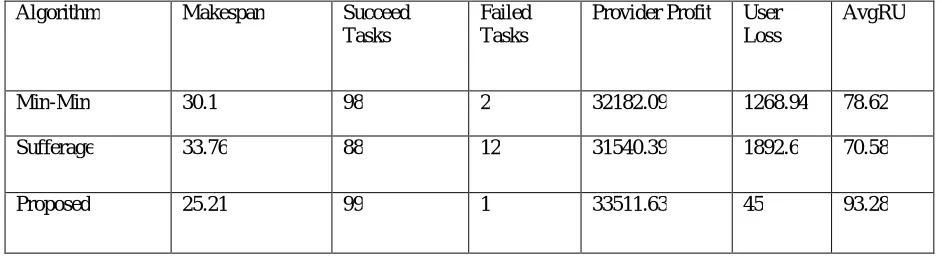
The measurements are calculated by using the cloudsim framework. The goal of our work is to maximize the user profit and minimize the loss. To achieve this, the task task must be completed before its deadline or meet its deadline.In our experiment, we have used 10 virtual machines, 100 cloudlets. All cloudlets are generated randomly .Size of each cloudlet is between 1000 to 5000 MI .Various output metrices we are going to show here are user losses ,provider profit ,makespan,failed tasks ,succeed task and average resource utilization.
Table1:Representation of measurements regarding different algos and proposed one is performing best
Algorithm Makespan Succeed
Tasks
Failed Tasks
Provider Profit User
Loss
AvgRU
Min-Min 30.1 98 2 32182.09 1268.94 78.62
Sufferage 33.76 88 12 31540.39 1892.6 70.58
Proposed 25.21 99 1 33511.63 45 93.28
Makespan
Makespan is a measure of the throughput of the heterogeneous cloud system. Lesser is the makespan of a scheduling algorithm better it works. Here the least makespan is measured by the proposed algorithm .It is better than makespan of
min-min and sufferage algorithm
.
Fig 1.Makespan
Average Resource Utilization (AvgRu)
AvgRU can be defined as the percentage of resources or VMs used by the cloudlets. More is its percentage, better is the algorithm .As, proposed algo has the highest value of it so,it is better than others. It is good to utilize the resources properly. The proposed technique makes its efficient utilization than other.
0 20 40
Min-Min Sufferage Proposed
Fig 2.AvgRU
Failed Tasks
These are the tasks which do not meet the deadline. Lesser the number of failed tasks better is the performance of
algorithm. Our proposed algo has the minimum number of failed tasks. Hence better than others
.
Fig 3.FailedTasks
Succeed Tasks:
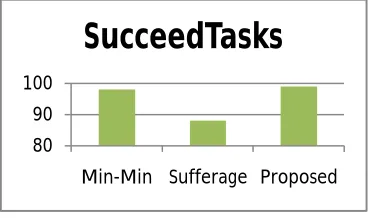
The number of tasks which are completed by algorithm before the deadline are refered to as the succeed tasks. More is the value , better the target is achieved .Proposed algorithm has this value.
Fig 4.SucceedTasks 0
50 100
Min-Min Sufferage Proposed
AvgRU
0 5 10 15
Min-Min Sufferage Proposed
FailedTasks
80 90 100
Min-Min Sufferage Proposed
User Loss
User loss is dependent on the lateness of the task in which lateness greater than 0 provide user loss.Results indicate that user loss in our approach is minimum as compared to other algorithms.
Fig 5.User losses
Provider Profit
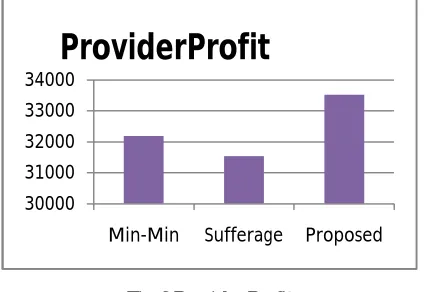
The number of succeed Tasks contribute to the provider profit. More is the profit gained by the providers more is the usefulness of our algorithm.
Fig 6.Provider Profit
VI.CONCLUSION AND FUTURE WORK
This work represents the algorithm which can be used for getting work done within deadline and with required provider profit and cost .It uses the soft real-time scheduling approach .By using this technique user losses can be minimized and provider profit maximized as compared to other techniques like min-min and sufferage. The number of failed tasks get minimized by the proposed technique. The number of tasks which are completed in deadline are maximum called the succeed tasks.
The future scope of proposed work can be that the genetic algorithm might be used for enhancing the cost optimization and to evaluate the net profit in more suitable way .Moreover,the resource utilization can be done by new method.
0 1000 2000
Min-Min Sufferage Proposed
UserLoss
30000 31000 32000 33000 34000
Min-Min Sufferage Proposed
REFERENCES
1. Himani,Harbinder Singh Sandhu “Cost-Deadline Based Task Scheduling in cloud computing”IEEE 2015.
2. Yogita Chawla, Mansi Bhonsle ”A Study on Scheduling Methods in Cloud Computing “International Journal of Emerging Trends & Technology in Computer Science (IJETTCS) 2012.
3. Harpreet Kaur , Maninder Singh ,” Review of Various Scheduling Techniques in Cloud Computing” International Journal of Networking & Parallel Computing , 2012
4. Anantkumar Vikas Salame, Prof. Pradnya V. Kulkarni and Prof. Shakti S. Kinger “ A Survey of Cloud supporter: A Load Balancing Framework In Cloud Using Smartphone ” International Journal of Latest Trends in Engineering and Technology.
5. Amandeep Kaur Sidhu , Supriya Kinger. “ Analysis of Load Balancing Techniques in Cloud Computing “ International Journal of Computers & Technology, 2013
6. Gaurang Patel,Rutvik Mehta,Upendra Bhoi “Enhanced Load Balanced Min-Min algorithm for static meta task scheduling in cloud computing”International Conference on recent trends in computing 2015.
7. Upendra Bhoi , Purvi N. Ramanuj “Enhanced Max-min Task Scheduling Algorithm in Cloud Computing ”International Journal of Application or innovation in engineering and management ,2013
8. Prachi Verma , Sonika Shrivastava , R.K. Pateriya “Enhancing Load Balancing in Cloud Computing by Ant Colony Optimization Method “International Journal of Computer Engineering In Research Trends 2017
9. Shikha Gupta, Suman Sanghwan “Load Balancing in Cloud Computing” International Journal of Science, Engineering and Technology Research (IJSETR),2015
10. Mir Salim Ul Islam ,Bhawana Rana “Task Scheduling in Cloud Computing” International Journal of Advance Research, Ideas and Innovations in Technology,2017
11. S. F. El-Zoghdy, Ahmed Ghoneim “A Multi-Class Task Scheduling Strategy for Heterogeneous Distributed Computing Systems” KSII TRANSACTIONS ON INTERNET AND INFORMATION SYSTEM,2015
12. Zhongping Zhang, Yupeng Feng, Shan Zhang ,Ying Sun “Heuristic Grid Resource Scheduling Algorithm based on Group of Task and Secondary Distribution” International Journal of Security and Its Applications ,2015
13. Paul Martinaitis, Craig Patten and Andrew Wendelborn “Remote Interaction and Scheduling Aspects of Cloud Based Streams” IEEE 2009. 14. Antony Thomasa , Krishnalal Ga, Jagathy Raj V P “Credit Based Scheduling Algorithm in Cloud Computing Environment” International