ISSN(Online): 2320-9801 ISSN (Print) : 2320-9798
I
nternational
J
ournal of
I
nnovative
R
esearch in
C
omputer
and
C
ommunication
E
ngineering
(An ISO 3297: 2007 Certified Organization)
Vol. 4, Issue 10, October 2016
SGBP: A Secure Mobile Data Gathering
Framework in Wireless Sensor Networks
using Global Best Path (SGBP) Algorithm
S.Sugantha Priya1, R.Marutha Veni 2
M. Phil Scholar, Department of Computer Science, Dr.SNS Rajalakshmi College of Arts and Science
Coimbatore, Tamil Nadu, India1
Assistant Professor, Department of Computer Science, Dr.SNS Rajalakshmi College of Arts and Science, Coimbatore,
Tamil Nadu, India2
ABSTRACT: Wireless Sensor Networks (WSNs) are emerging ad hoc networks consist of small sensor nodes that sense, measure, observe, or monitor physical environmental phenomena. Sensors are small devices with limited computation energy, limited bandwidth, and limited data aggregation. In this paper proposed to develop an algorithm for the SenCar to determine the anchor points in each time period, which achieves a desirable balance between the energy replenishing range and data gathering latency. To develop a secure Global Best Path (GBP) data gathering algorithm based dynamic routing architecture that allows the detector to verify the truthfulness of the packet delivery information reported by nodes. Meanwhile the proposed framework for identifying shortest path route using TSP (Travelling Salesman problem) algorithm based on alerts generated by specific collision detection mechanisms in path based wireless networks.
KEYWORDS: SenCar; Data gathering; Path selection; TSP
I. INTRODUCTION
Currently, wireless sensor networks (WSNs) are mainly powered by batteries. Due to limited energy storage capacity of a sensor battery, WSNs can usually remain operational only for a limited amount of time. However, in many applications, such as earthquake, soil monitoring and glacial movement monitoring, due to the harshness of the environment, a long period of unattended operability is required. Although there has been a flourish of research efforts on prolonging the lifetime of WSNs, network lifetime remains a performance bottleneck of WSNs and one of the key factors that hinder their large scale deployment. On the other hand, it has been shown that energy harvesting from natural sources, such as solar, wind, thermal and vibration can effectively improve network performance and prolong network lifetime. However, the success of extracting energy from the environment remains limited in practice. This is because that the outcome of energy-harvesting highly depends on the environment. For example, in a solar harvesting system, the amount of harvested energy is determined by the time and strength of solar radiation.
In Mobile Sink Wireless Sensor Networks all the sensors are statically deployed to sense the environment and mobile sink traverse the networks. In the sink neighborhood problem is neighbor nodes of sink participate more in the data transmission. The result is the faster energy deplete compared to other nodes in the network. If we look over the energy conservation model sensor deplete some amount of energy during the data receiving and the data transmission. As the sensor those are close to the sink, participate more data transmission i.e. for them and for those sensors away from the sink in the same direction.
ISSN(Online): 2320-9801 ISSN (Print) : 2320-9798
I
nternational
J
ournal of
I
nnovative
R
esearch in
C
omputer
and
C
ommunication
E
ngineering
(An ISO 3297: 2007 Certified Organization)
Vol. 4, Issue 10, October 2016
collection. As sink traversing throughout the network for data collection so the neighbor of the sink is not fix, so neighborhood problem will not arises. Here we use LR-WPAN IEEE 802.15.4 low cost wireless link. IEEE 802.15.4 intends the lower network layers of a type of wireless personal area network (WPAN) which focuses on low cost, low speed global communication between the sensors. IEEE 802.15.4 security consists of four kinds of security services such as access control, message integrity, message confidentiality, and replay protection. The access control feature should prevent illegal users to participate in the process. In other word, only authorized users can able join in a legitimated network. Message integrity means the validity of transferred data and message authentication implies message sender’s verification using cryptographic function.
The rest of this paper is organized as follows. In Section 2 review the existing related work. The proposed models and descriptions are described in Section 3. Finally conclude the paper in Section 4.
II. RELATED WORK
In [1] authors adopted a model to integrate data aggregation with the underlying routing scheme and present a smoothing approximation function for the optimization problem. The necessary and sufficient conditions for achieving the optimality are derived and a distributed gradient algorithm is designed accordingly. The authors showed that the proposed scheme can significantly reduce the data traffic and improve the network lifetime. In [2] authors proposed the approach constructing maximum lifetime data gathering tree without aggregation for sensor networks. In the scenario sensor nodes have the capability to adjust their transmission power with the transmission range, we approximately construct the maximum lifetime data gathering tree with the goal to balance the energy consumption among the sensor nodes to prolong the lifetime of the network. In [3] authors mainly focused on the problem of minimizing the length of each data-gathering tour and refer to this as the single-hop data-gathering problem (SHDGP). We first formalize the SHDGP into a mixed-integer program and then present a heuristic tour-planning algorithm for the case where a single M-collector is employed. In [4] authors studied an energy-efficient data gathering in wireless sensor networks using vMIMO. We define the joint vMIMO and data gathering (vMDG) problem, which is NP-hard. It also propose a distributed method called - as an approximation algorithm. This algorithm first constructs a tree-like topology by taking the unique features of vMIMO into account. In [5] authors explored the use of cooperative multi-input multi-output (MIMO) communications to prolong the lifetime of a wireless sensor network (WSN). Single-antenna sensor nodes are clustered into virtual antenna arrays that can act as virtual MIMO (VMIMO) nodes. In [6] authors considered two different cases depending on whether the mobile collector has fixed or variable sojourn time at each anchor point. To adopt network utility, which is a properly defined function, to characterize the data gathering performance, and formalize the problems as network utility maximization problems under the constraints of guaranteed network lifetime and data gathering latency. In [7] authors studied the tradeoff between energy saving and data gathering latency in mobile data gathering by exploring a balance between the relay hop count of local data aggregation and the moving tour length of the mobile collector. They first propose a polling-based mobile gathering approach and formulate it into an optimization problem, named bounded relay hop mobile data gathering (BRH-MDG).
III.PROPOSED ALGORITHM
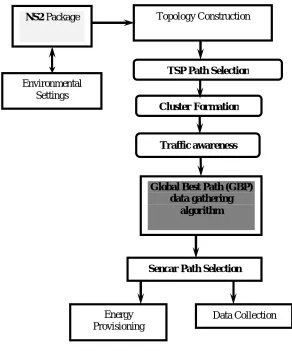
The proposed system presents the SenCar only visits a subset of selected sensor nodes (anchor points) and collects data through multi-hop transmissions, which can enhance data collection fairness, reduce data collection latency, and avoid stopping at unnecessary sensor locations for battery recharge. The propose system presents a Global Best Path (GBP) data gathering algorithm based on wireless Sensor Networks with Mobile Sink. The proposed system architecture diagram illustrated in figure 1.1.
A. NETWORK MODEL
ISSN(Online): 2320-9801 ISSN (Print) : 2320-9798
I
nternational
J
ournal of
I
nnovative
R
esearch in
C
omputer
and
C
ommunication
E
ngineering
(An ISO 3297: 2007 Certified Organization)
Vol. 4, Issue 10, October 2016
capacity battery to store sufficient energy. The SenCar periodically visits some predefined sensor positions called
anchor points in the field and stays at each anchor point for a period of sojourn time. Let Bi denote the battery capacity
of node i and N be the set of all the nodes in the network. All sensors in the coverage area of anchor point a form a
neighbouring set of the anchor point, denoted by Na. The neighbouring set is determined in a way that nodes can
communicate with the sensor node at the anchor point in l hops. The choice of l will have an impact on energy consumption of sensor nodes, i.e., a larger l can cover more sensor nodes from an anchor point location with higher energy consumption on intermediate nodes, whereas a smaller l can save energy on intermediate nodes but cover fewer sensor nodes. In practice, l is chosen such that the anchor points can cover all the sensor nodes in the network. The SenCar starts from the static sink (starting position) and roams over the entire sensing field in a pre-determined
sequence of anchor points, at a certain travelling speed Vs (in m/s).
Fig 1.1: Proposed System Architecture Diagram.
B. ANCHOR POINTS SELECTION
Choosing anchor points is a crucial step of the data gathering process since it determines the efficiency of energy transferring and the latency of data gathering. A trivial scheme is to simply visit all the sensor nodes, gather data through single-hop transmission and use the SenCar to forward data back to the static sink through long range
Sencar Path Selection
Environmental Settings
Topology Construction
Traffic awareness
NS2 Package
Global Best Path (GBP) data gathering
algorithm TSP Path Selection
Cluster Formation
Data Collection Energy
ISSN(Online): 2320-9801 ISSN (Print) : 2320-9798
I
nternational
J
ournal of
I
nnovative
R
esearch in
C
omputer
and
C
ommunication
E
ngineering
(An ISO 3297: 2007 Certified Organization)
Vol. 4, Issue 10, October 2016
communications. However, this scheme would trigger several new problems in our data collection and wireless recharge scheme. First, using single-hop data collection can only collect data from a very small number of nodes per interval. Only the nodes reside at the anchor points are able to transmit data while data generated at other nodes is not collected. Therefore, the fairness of data collection among all the nodes is greatly undermined in single hop data collection. In contrast, if multi-hop transmission is used, we can collect data from the larger neighbourhood of anchor points thereby improving the fairness of data collection. Second, the average packet latency will be increased with single-hop communication.
In contrast, in our proposed solution, the SenCar only visits a subset of selected sensor nodes (anchor points) and collects data through multi-hop transmissions, which can enhance data collection fairness, reduce data collection latency, and avoid stopping at unnecessary sensor locations for battery recharge. In wireless rechargeable sensor networks, as each sensor has different energy status at different time, it is desirable to recharge as many sensors with low energy as possible to ensure the perpetual operation of sensors. Accordingly, the sensors located at the selected anchor points should be those with the most urgent needs of energy supplement. In the meanwhile, to better enjoy benefit of energy from the SenCar, more anchor points should be selected. However, this would prolong the travelling tour length and increase the data gathering latency. Thus, it is an inherent tradeoff between the number of sensors to be recharged in a tour and the data gathering latency. Based on these observations, when determining the sequence of anchor points to visit, we jointly consider the remaining energy levels of sensors and the travelling tour length of the SenCar.
C. TRAFFIC AWARE PATH SELECTION
The data collection traffic by partitioning the network into multiple cluster and then assigns different channels to
different cluster.
Traffic aware aggregation technique in which the data gathering technique can be changed into structured and
structure-free adaptively, depending on the load status of the traffic.
In our model, to use utility function Ui(f) to characterize the impact of the data from a sensor on the overall data
gathering performance.
It also designed a technique that effectively reduces the computation and communication costs involved in the
compressive data gathering process.
The optimal data rate of a sensor for the SenCar sojourning at a particular anchor point.
It also designed a technique that effectively reduces the computation and communication costs involved in the
compressive data gathering process.
To route the data to the SenCar at each anchor point taking into account of energy and link capacity constraints
D. DATA COLLECTION AND ENERGY TRANSFER
The routing setup phase when a multi-hop data-routing tree rooted a cluster-head, is constructed. The terms a parent node and a child node along a multi-hop data-routing tree. The next hop recipient to which a sender transfers a packet destined for the cluster-head is called its (sender) parent sensor, while to the parent sensor (recipient); this sensor (sender) is its (recipient) child sensor. Each sensor becomes a source and router with the ability of data aggregation over the multi-hop data-routing tree.
The data collection traffic by partitioning the network into multiple cluster and then assigns different channels
to different cluster.
The routing setup phase when a multi-hop data-routing tree rooted a cluster-head, is constructed. the terms a
parent node and a child node along a multi-hop data-routing tree.
Their experiment showed that with this technology it is capable of transferring 60 watts with about 40 percent
efficiency over a distance of 2 meters.
Magnetic resonance, it is feasible to transfer energy wirelessly between two coils.
ISSN(Online): 2320-9801 ISSN (Print) : 2320-9798
I
nternational
J
ournal of
I
nnovative
R
esearch in
C
omputer
and
C
ommunication
E
ngineering
(An ISO 3297: 2007 Certified Organization)
Vol. 4, Issue 10, October 2016
IV.CONCLUSION AND FUTURE WORK
In this paper presents to observing data collection in WSN using traffic aware anchor point selection scheme is specifically designed for wireless Rechargeable sensor networks which have periodic traffic with different sampling rates. An develop an algorithm for the SenCar to determine the anchor points in each time period, which achieves a desirable balance between the energy replenishing range and data gathering latency. To develop a secure Global Best Path (GBP) data gathering algorithm based dynamic routing architecture that allows the detector to verify the truthfulness of the packet delivery information reported by nodes. Meanwhile the proposed framework for identifying shortest path route using TSP (Travelling Salesman problem) algorithm based on alerts generated by specific collision detection mechanisms in path based wireless networks. As future work, intend to extend the path selection problem in delay-guaranteed sensor networks with a path-unconstrained mobile sink. It also plan to study the path selection problem with network lifetime maximization as the optimization objective.
REFERENCES
1. C. Hua and T.-S. P. Yum, “Optimal routing and data aggregation for maximizing lifetime of wireless sensor networks,” IEEE/ACM Trans. Netw., vol. 16, no. 4, pp. 892–903, Aug. 2011.
2. Y. Wu, Z. Mao, S. Fahmy, and N. Shroff, “Constructing maximum-lifetime data-gathering forests in sensor networks,” IEEE/ ACM Trans.
Netw., vol. 18, no. 5, pp. 1571–1584, Oct. 2010.
3. M. Ma, Y. Yang, and M. Zhao, “Tour planning for mobile data gathering mechanisms in wireless sensor networks,” IEEE Trans. Vehicular
Technol., vol. 62, no. 4, pp. 1472–1483, May 2013.
4. Y. Sun, W. Dai, C. Qiao, and L. Huang, “Joint virtual MIMO and data gathering for wireless sensor networks,” IEEE Trans. Parallel Distrib.
Syst., vol. 26, no. 4, pp. 1034–1048, Apr. 1, 2015.
5. D. Nguyen and M. Krunz, “A cooperative MIMO framework for wireless sensor networks,” ACM Trans. Sen. Netw., vol. 10, no. 3, pp. 1–28,
Apr. 2014.
6. M. Zhao and Y. Yang, “Optimization based distributed algorithm for mobile data gathering in wireless sensor networks,” IEEE. Trans. Mobile
Comput., vol. 11, no. 10, pp. 1464–1477, Oct. 2012.
7. M Zhao and Y. Yang, “Bounded relay hop mobile data gathering in wireless sensor networks,” IEEE Trans. Comput., vol. 61, no. 2, pp. 265–