A Study on Offering Efficient Services Using
Location over IP
Bhushan Pawar1, Niraj Dighe2, Ajinkya Jadhav3, Narendra G4, Bharat Ghag5
Assistant Professor, Department of Computer Engineering, MESCOE, Savitribai Phule Pune University, India1
B.E. Student, Department of Computer Engineering, MESCOE, Savitribai Phule Pune University, India 2,3,4,5
ABSTRACT:A Location Based services (LBS) is a software-level service that uses location data to control features. Such LBS is been used in social networking today for information processing which serves various purposes like entertainment and security. These LBS are accessible using mobile devices through the mobile network and uses the geographical position of the mobile device typically with the help of Global Positioning System (GPS). However, it is not easy to access these Location Based Services for data analysis and mining, because a limited access interface is offered by them, which is a limited k-Nearest-Neighbor (KNN) search interface. This interface returns the k nearest tuples from the database for an input location provided, where k is a small constant typically ranging from 50 to 100. We create a mechanism by which tracing of user location is done by user IP address of mobile rather than traditional GPS locator. By using this mechanism we can increase the precision of user’s location and also increases number of tuples in the database which will provide more services options to the user. The mechanism is demonstrated using a real time system implementation that serves our purpose.
KEYWORDS: Mobile IP tracking, Location Based Services (LBS), Portable devices,Cloud Computing, Client-Server Model, Database Management, Distributed System.
I.INTRODUCTION
Location based services (LBS) are very feasible for solving day-to-day problem. This feasibility is the very reason for exponential increase in location based services popularity. These LBS are extremely useful and critical in many businesses and also provide data in real time of a particular location in many government organizations. LBS may include several services related to an individual's or a group’s location. The world's leading example for LBS are Google Maps, Nokia Here etc.
However, it is not easy to access these location based services for data analysis and mining, because a limited access interface is offered by them which is a limited k-nearest-neighbour (KNN) search interface. This interface returns the k nearest tuples from the database for an input location provided, where k is a small constant typically ranging from 50 to 100.
A common assumption is made that all the LBS data is accessible by the system or the data to the LBS is provides by online system. However, such data needs to be downloaded before it is provided as an input to the system for further processing. Many a times this assumption proves to be incorrect, making existing projects unable to work with almost all real-time LBS systems that strictly a here to the rule of query rate limitation, i.e., limitation is implemented on the number of requests from an IP address or API account for a certain time period. This is because the KNN method accesses only a small number of k tuples in the database per query, this drawback makes it extremely difficult, although not impossible to gather the location specific data that is necessary for the computation purpose in real-time. Also power consumption of a GPS system is quite large for an individual's perspective and cannot be used in crisis for accessing LBS.
the user’s location. This “hidden” LBS data gathered can be used for analytics through a series of aggregate queries. This can serve various business needs. Also, tracking over IP may also prove a solution to the problem of power consumption presented by global positioning system(GPS).Nowadays, almost all applications require the use of mobile data. These devices are already assigned IP for data-consumption. Using this same IP for getting location specifics instead of GPS may lead to reduction of power consumption required in functioning of LBS.
II. RELATED WORK
In [1] the authors proposed ANALOC, a web based system that enables fast analytics over an LBSby issuing a small number of queries through its restricted KNN interface. ANALOC standsin sharp contrast with existing systems for analysing geospatial data, as those systems mostlyassume complete access to the underlying data. Specifically, ANALOC supports the approximateprocessing of a wide variety of SUM, COUNT and AVG aggregates over user-specifiedselection conditions.
In [2]the authors demonstrated Taghreed; a full-fledged system for efficient and scalable querying,analysing, and visualizing geotagged microblogs, such as tweets. Taghreed supports a widevariety of queries on all microblogs attributes. The system is demonstrated based on real system implementation through different scenarios like Interactive Multi-dimensional Querying, Multi-dimensional Spatial Comparison, Temporal Analysis on Interest Changes, Spatiotemporal Interactive Heat maps and System Internals.
In [3] the authorsdistinguished between interfaces that return location information of the returned tuples(e.g., Google Maps), and interfaces that do not return location information (e.g., SinaWeibo). Focus is on the development of aggregate estimation algorithms that are based on novel techniquesfor precisely computing or approximately estimating the Voronoi cell of tuples.A set ofreal-world experiments including Google Maps, WeChat and Sina Weibo are used for testingthe algorithms.
In [4] the authors addressedthe problem of aggregate estimations over LBS. LR-LBS-AGG algorithm is developed for generating unbiased SUM and COUNT estimations over an LRLBS query interface.
In [5] the authors demonstrated LBR which is a location based reminder application for smart phones running on android platform which not only has traditional features of a reminder application, but uses modern technologies such as location based services to make the application more context aware thereby making it more relevant to real life and more useful for potential users.
In [6] the authors demonstrateda system using Mars. Mars exploits the microblogs location information to support a wide variety of important spatio-temporal queries on microblogs. Supported queries include range, nearest-neighbour, and aggregate queries. Mars employs a scalable real-time nearest neighbour and range query processing module that employs various pruning techniques so that it serves heavy query workloads in real time. Mars is demonstrated using a stream of real tweets obtained from Twitter firehose with a production query workload obtainedfrom Bing web search.
In [7] the authors demonstrated that, through real world attacks that they can all be easily destroyedby an attacker with the capability of no more than a regular LBSN user. In particular, by manipulating location information fed to LBSN client app, an ill-intended regular user can easily deduce the exact location information by running LBSN apps as location oracle andperforming a series of attacking strategies. Development of an automated user location trackingsystem and is tested on the most popular LBSNs including WeChat, Skout and Momo.
In [8] the authors discussed the development of android application for location tracking and providing location based services that can tackle tackle following issues: 1) Location positioning technologies, 2) Query processing, 3) Cache management.
In [9] the authors proposed an architecture of location based services which uses GPS. Further the challenges for context management, service trigger mechanism and preference-based services are discussed.
In [10] the authorsproposed the implementation of Location based services through Google Web Services and Walk Score Transit APIs on Android phones to give multiple services to the user based on their Location.
In [11] the authors discussed the LBS using Geographic Information System (GIS) and various other components,the use of LBS and how android operating system can be used for providing location based services.
III. OBJECTIVES
The amount of data collected has increased. The reason behind this is combined annotation of social media interactions, scientific experiments and e-commerce applications, resulting in continuous evolution of data. As a result of this, data generation from different sources, new generation data and present challenges is not all relational and lacks predefined structures.In this paper we try to sort these issues and provide a way for better acquisition and processing of this type of data. We will be analysing the real time IP tracking of mobile user’s and try to provide relevant offers of that area/location for serving B2B purpose.
IV. PROPOSED MECHANISM
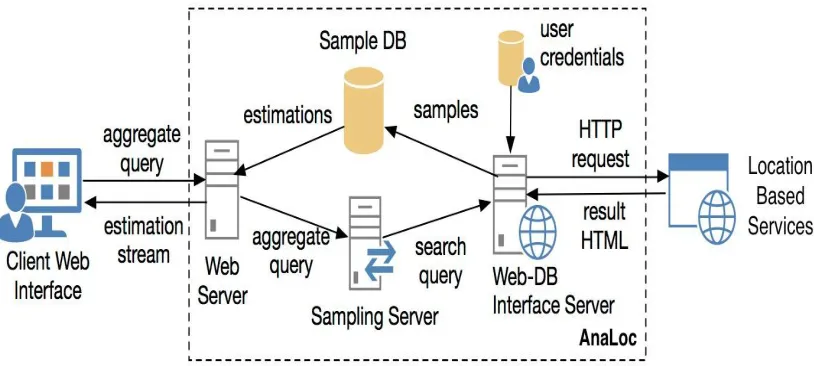
Let us discuss the proposed LBS mechanism depicted in figure below
Figure 1: Basic Architecture of Proposed LBS Mechanism.
Our LBS mechanismis divided into 4 components as depicted in Figure 1: 1. Client Web Interface
2. Web Server 3. Sample Database 4. Sampling Server
A. Client Web Interface: A Client Interface provides a Graphical User Interface (GUI) which allows users to the query the LBS system through this restricted input interface of a mobile device. Client UI takes input from user based on his/her interests and gives output in graphical manner. It provides options to the user and manages the queries as per the options. The estimated output is displayed that is concerned with options that are provided, by the web interface.
its location, the location is then filtered out and approximate location is find out so offers can be sort out as per its location. The location of the user is sent in the form of query to the sampling server.
C. Sample Database: This component stores location specific offers in its database. This component will co-ordinate with the Sampling Server for mapping the users location to the offers within the Sample Database. The results will be then returned to the Web Server.
D. Sampling Server:This component approximated the user’s location based on his IP address .The Sampling server then gives the location to the Sample Database. In sampling server the offers are mapped as per the location and set to return the result to the user. But before sending the queries to the user they are checked with the user credentials so that whether the queries are as per user specification and its credits.
This proposed mechanism is composed of three major tasks namely, IP data-set validation, location trackingandsearch for relevant offers. These tasks implement algorithms for each level of the architecture depending on the required analysis. The IP data-set validation identifies the IP address of the given subject and validates if the returned IP is true or fake. The location tracking identifies the corresponding location of a mobile user, it converse to the routing tower of the IP with which the subject is connected to get its unique area and location. Search forrelevant offers task is performed to search or shortlist the offers available for the subject in its particular area/location and displays the results.
The proposed design efficiently processes and analyses IP data and gives relevant offers data and can perform analytics for decision-making. This design is also power efficient as it avoids usage of GPS for location tracking. User can find offers which are only relevant to them.
V. APPLICATIONS
The proposed mechanism can be used in e-commerce to extend the market of given product by providing commercials and offers to relevant users. E-commerce can be extended beyond the limited range and conversely improved within a certain range.
Social Networking has become an integrated part of today’sindividual. Today almost all information is gathered through social networking. The given mechanism can be used in social networks to provide newsfeed about the location the user currently resides in.
This mechanism can also be applied for vehicle tracking which is of great importance nowadays. The business based on delivery and posting by vehicles can find great ease in keep in record of all their vehicles through this method. Government has been proved to provide substantial resources or services to citizens some of which include but may not limit to Polio doses, free check-up for heart patients etc. A person can know if such services are being provided nearby.Emergency always arrives unannounced and location tracking can be a crucial tool in such times of emergency. This mechanism can be used for location tracking in times of emergency.
VI. ADVANTAGES
The primary reason and advantage of this mechanismis specification. This mechanism can be used to provide area-specific services to user. All the services provided are relevant area-wise to the user. If any application that uses this mechanism has a basic user credential database then it may be attached and user-specific as well as area-specific
services will be provided to the users.
The intended mechanism is real time i.e. it works on real time data and provides real time outcome to the specified user. The cloud server can be used for real-time processing. Using cloud server provides a better pace and it is crucial reason behind faster processing.
VII. CONSTRAINS
The major limitation behind this mechanism is that it requires static IP address for proper functioning. Many errors may generate due to dynamic IP address which may also result in ambiguity.Also due to requirement of static IP address, the internet connection used by the mobile user should be stable. This is because fluctuating network may result in constant changing of IP address.
The intended mechanism is strictly mobile data driven as lack of a constant internet connection results in un-assigning of IP address, which may result in collapsing of entire mechanism. Thus, this mechanism is strictly data-driven.
The server should have zero or if not possible minimum downtime. This is because the entire functioning of this mechanism takes place on cloud server, thus server cannot afford having downtime and must be working 24 X 7.
Sustainability may be in question, that is the offer must not change until all the users prescribing a particular service have completed the process of using it. It should not change midway while someone is trying to use the provided service
VIII. CONCLUSION
We proposed a location based mechanism that estimates a mobile user’s location by mapping it to various pre-specified locations along with the relevant offers. We make use of cloud based services for processing high volume of user queries. This mechanism can be used for efficient analysis using estimation tools for performing various estimates as per the applications. It could be easily used by various third parties for enabling different applications for sophisticated analytics over LBS data.
Thus, in brief, this mechanism can be used as base model for various applications that seek to provide location based services for mobile devices using the IP address instead of other tracking methods.
REFERENCES
[1] Md Farhadur Rahmany, Saad Bin Suhaim, Weimo Liu, Saravanan Thirumuruganathany, Nan Zhang andGautamDas , “ANALOC: Efficient ANAlytics over LOCation Based Services” ,Data Engineering (ICDE), 2016 IEEE 32nd International Conference on 16-20 May 2016. [2] A. Magdy, L. Alarabi, S. Al-Harthi, M. Musleh, T. M. Ghanem, S. Ghani, S. Basalamah, and M. F. Mokbel,“Demonstration of Taghreed: A
system for querying, analysing, and visualizing geotagged microblogs”, ICDE, 2015.
[3] W. Liu, M. F. Rahman, S. Thirumuruganathan, N. Zhang, and G. Das, “Aggregate estimations over location based services”, PVLDB, 2015. [4] W. Liu, M. F. Rahman, S. Thirumuruganathan, N. Zhang, and G. Das, “Aggregate estimations over location based services”, arXiv preprint
arXiv: 1505.02441, 2015.
[5] Kushal Singhal, Gandhar Rane, (Professor) Amruta Ambre, Nikhil Surve and Jayesh Sonawane,“Location Based Reminder: An Android Application”, International Journal of Advanced Research in Computer Science and Software Engineering,Volume 5, Issue 1, January 2015. [6] A. Magdy, A. M. Aly, M. F. Mokbel, S. Elnikety, Y. He and S. Nath, “Mars: Real-time spatio-temporal queries on microblogs”, ICDE, 2014. [7] M. Li and etal , “All your locations are belong to us: Breaking mobile social networks for automated user location tracking”,MobiHoc, 2014. [8] Prof. Seema Vanjire, Unmesh Kanchan, Ganesh Shitole andPradnyesh Patil, “Location Based Services on Smart Phone through the Android
Application”,International Journal of Advanced Research in Computer and Communication Engineering Vol. 3, Issue 1, January 2014. [9] Priyanka Shah, Ruta Gadgil and Neha Tamhankar, “Location Based Reminder Using GPS For Mobile (Android)”, ARPN Journal of Science
and Technology, VOL. 2, NO. 4, May 2012.
[10] Manav Singhal and Anupam Shukla, “Implementation of Location based Services in Android using GPS and Web Services”, IJCSI International Journal of Computer Science Issues, Vol. 9, Issue 1, No 2, January 2012.
[11] Amit Kushwaha and Vineet Kushwaha, “Location Based Services using Android Mobile Operating System”, International Journal of Advances in Engineering & Technology, Mar 2011.