134
Usability testing on intelligent mobile web pre-fetching of cloud
storage scheme
Nur Syahela Hussien a,b,1, , Sarina Sulaiman a,b,2, *, Siti Mariyam Shamsuddina,b,3, a UTM Big Data Centre, Ibnu Sina Institute for Scientific and Industrial Research bFaculty of Computing, Universiti Teknologi Malaysia, 81310 Skudai, Johor, Malaysia
1[email protected]; 2[email protected] *; 3[email protected] * corresponding author
I. Introduction
This research has proposed and designed the development of scheme for Mobile Intelligent Cloud Storage (MOBICS) to implement the Machine Learning (ML) technique. The aim of this proposed scheme is to enable multiple Cloud Storage Services (CSS) being access by mobile users anytime and anywhere. Besides, this research enhances the loading speed of MOBICS, which reduces the total loading time to access the user data. The enhancement of loading speed is proven by using Advanced Keystroke Level Model (KLM) model. To evaluate the usability testing on the proposed scheme of MOBICS, questionnaire is distributed, in which the result may be biased if it is not properly handled. Usability testing is common with huge numbers issues identifying with how great an exploration reflects genuine framework usage. For instance, how accurately the task situation mirrors a real context of utilization and how those investigate participants represent the target client group [1]–[2]. Usability comprises the aspects effectiveness and efficiency. Normally during lab experiment bias from respondents may occur. The researcher must try to be extra cautious when they analyse the results. When the users know they are being observe, they may be bias while doing the experiment. This situation is known as Hawthorne effect that it is an experimenter outcome whereby participants, in any human-centred research, might show regularly large amounts of execution basically in light of they would mindful that they need aid being concentrated on [2]–[3].
The first investigations that provided for ascent of the Hawthorne effect were embraced toward Western electric phone manufacturing plant at Hawthorne, close to Chicago, the middle of 1924 What's more 1933 [3]. Responsiveness to constantly watched alternately hosting conduct evaluated causes convictions over specialist desires. Conventionality and social allure considerations, subsequently guide conduct technique to progress in line with these desires [3]. Chiesa and Hobbs [4] pointed out that there are distinctive implications provided for of the purported Hawthorne effect, and additionally a large number proposed components generating those effect. Altogether likelihood, the greater part as a relatable point utilization of those Hawthorne effect be similarly as post hoc translation for unforeseen look into findings, especially the place they would disappointing. Statistical test was applied to test the heterogeneity as a step to be aware of Hawthorne effect. The statistical test
ARTICLE INFO A B S T R A C T
Article history:
Received November 20, 2017 Revised November 30, 2017 Accepted November 30, 2017
Mobile device and Cloud Storage (CS) represent the trends of technology usage of the last few years. However, the difficulty in managing the data when there are too many simultaneous uses of cloud storage services at the same time that can cause latency or delayed time. This paper evaluates mobile cloud storage services using usability testing, which is intended to access by multiple of Cloud Storage Services (CSS) with the proposed Intelligent Mobile Web Pre-fetching of Cloud Storage Scheme (MOBICS). The results show most of the respondents with 95.65% agree that MOBICS system is useful and has enhanced the speed in accessing and storing data by Mobile Cloud Storage (MCS). Besides, MOBICS reduces time of interaction up to 19.28% for the local pre-fetching and 18.80% for the intelligent pre-fetching.
Copyright © 2017 International Journal of Advances in Intelligent Informatics. All rights reserved.
Keywords:
is including the Chi-square statistic (Chi2) and I2 statistic. Pocket caching scheme is exhibited Similarly as a pre-fetching reserve system to recognize those information should be stacked done a portable hub taking an interest on mobile cloud computing environment [5]. Client collaboration might make influenced toward system issues in a few focuses for enthusiasm. This circumstance need persuaded pocket caching proposition. Pocket caching recommended to decrease information accessibility issues in focuses for interest, and in addition plans a multi-objective optimisation system with incorporate aspects about Mobile Cloud Computing (MCC) nature's domain and some requisition practices.
Anu and Anu Priya[6] implemented and evaluated an initiative data pre-fetching scheme on the capacity servers for dispersed document systems, which might be utilized likewise backend capacity framework clinched alongside a boisterous nature's domain that might have certain resource-limited customer machines. The pre-fetched information can be pushed to the relevant the pertinent customer machine from the capacity server. Moreover, Wang and Chen [7] utilized the Cloud Computing (CC) innovation to propose a new framework to enhance the quality of Really Simple Syndication (RSS) reading service for portable clients called Pre-Feed. The social relationship is more effective to predict the access likelihood. For RSS feeds, clients might subscribe to well-known natives and particular content publishers. Sharma and Dubey [8] provided a semantic-based pre-fetching scheme for the web browsers should succeed those restrictions of existing frameworks. The existing techniques are based on URL’s of the web objects, client right. Utilization of area metaphysics with those semantics settles on this procedure simpler and powerful.
Nevertheless, there have been many studies carried out in pre-fetching schemes, focusing on its usage in reducing latency in different fields of study with different algorithms applied in their work. Many studies have used ML to solve such issues. Nevertheless, pre-fetching using ML is not widely used in MCC environment. Therefore, based on previous schemes this research proposes an intelligent mobile web pre-fetching scheme to improving the current CSS.
II. Method
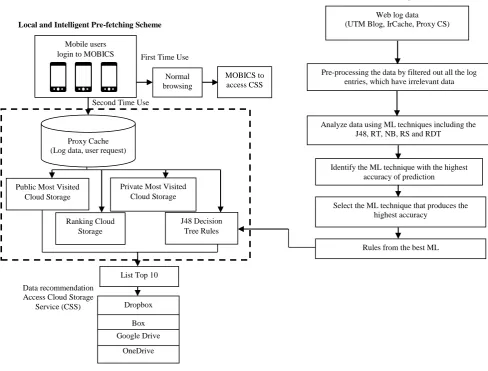
Users can access their data file faster by using MOBICS because it predicts the data requested by future users using pre-fetching technique. Besides, MOBICS provides a recommendation to store the data on CSS based on their availability and most frequent access. Fig 1 shows the scheme of the proposed MOBICS which comprises of two schemes. First, the scheme is to analyse local and intelligent mobile web pre-fetching on cloud storage services environment. For the second time and the next use, the MOBICS fetches the data from proxy cache, fetching into four kinds of pre-fetching including the public most visited cloud storage that list the most top ranking cloud storage user most visited, and then user can directly access the data.
Second, pre-fetch based on the ranking cloud storage, MOBICS will list the most recommendation of cloud storage for user to store their data on which CS is still available based on the bigger size of CS. For the private most visited CS is similar like ranking CS but has other feature by list the highest hit of CS data. The final is pre-fetching based on J48 decision tree rules, which the rules are from the best ML classifier. ML predictor is designed to determine the best ML technique by producing prediction with highest accuracy. The scheme is designed and begins with extraction of the data from log datasets including the IrCache, UTM blog and Proxy CS. The datasets need to be pre-processed before they are analysed using ML techniques. In this scheme, the effective ML techniques on prediction are determined. This research proved that, J48 decision tree provided highest accuracy and effectiveness. Therefore, J48 is selected to be used to generated decision tree rules.
users’ perceived usability of a product or system and takes in capability of the item alternately
framework constantly contemplated.
The aims for this part are to recognize the respondents’ profile and Internet use background in order to determine the top activities in MCS and to get the feedback from the implementation of a MOBICS system to the MCS users. The sixty-nine respondents tested this system. Mobile cloud storage was used as the case study to test the MOBICS system.Fig. 1. Proposed Scheme of MOBICS
III. Results and Discussion
The results for questionnaire divided into three categories; the background of respondents, the ranking activities in mobile cloud storage and feedback from users on the implementation of mobile intelligent web pre-fetching for mobile cloud storage.
A. The Background of Respondents
The aim of this part is to recognise the background profile of all respondents based on the questionnaire. In addition, Cochran’s Q Test was employed to see the significance of these results with the implementation of MOBICS with awareness of Hawthorne effect.
1) Background of Profile User
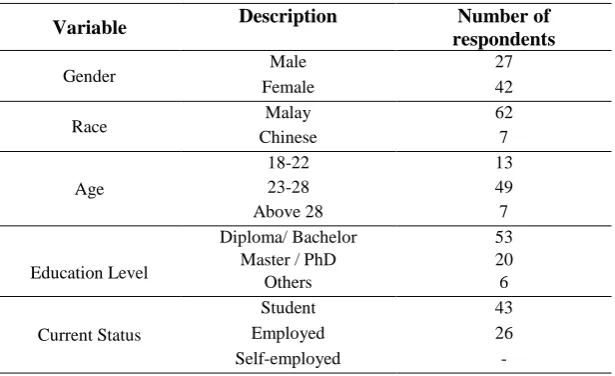
Based on the questionnaire, background information like gender, race, age, education level and current status of the respondents was collected. From the survey, about 39.13% were male and 60.87% female. Besides, about 18.84% were aged between 18 and 22, 71.01% were around 23 to 28 years old and 10.14% aged above 28 years. Based on the results, questionnaire is suitable for this evaluation because young adults are active in using the Internet and CS system. Moreover, the respondents of the diploma or bachelor degree were about 76.81%, and 28.99% were master or PhD students, and the rest only 8.70%. Table 1 summarizes the respondents’ profile. In addition, 62.32% respondents were Data recommendation
Access Cloud Storage Service (CSS)
List Top 10
Dropbox
Box
Google Drive
OneDrive Proxy Cache
(Log data, user request)
Private Most Visited Cloud Storage
Ranking Cloud Storage
J48 Decision Tree Rules Public Most Visited
Cloud Storage
Second Time Use Mobile users
login to MOBICS
Normal browsing
MOBICS to access CSS First Time Use
Local and Intelligent Pre-fetching Scheme
Web log data (UTM Blog, IrCache, Proxy CS)
Identify the ML technique with the highest accuracy of prediction
Pre-processing the data by filtered out all the log entries, which have irrelevant data
Select the ML technique that produces the highest accuracy
Analyze data using ML techniques including the J48, RT, NB, RS and RDT
Rules from the best ML
students and 37.68% were employed. Based on these results, this research could find the activity, behaviour from many kinds of users as shown in Table 1.
Table 1. Profile of respondents
Variable Description Number of
respondents
Gender Male 27
Female 42
Race Malay 62
Chinese 7
Age
18-22 13
23-28 49
Above 28 7
Diploma/ Bachelor 53
Education Level Master / PhD 20
Others 6
Current Status
Student 43
Employed 26
Self-employed -
2) Internet Experience
The results show that 85.51% respondents accessed the Internet every day. Moderately about 10.14% accessed the Internet less than five times in a week. Only 4.35% respondents browsed Internet five times a week. No one accessed the internet less than 1 hour per day based on the questionnaire. About 23.19% spent one to three hours per day on browsing while 40.58% spent about four to five hours per day, and 36.23% used more than five hours per day. The results were clearly showed that respondents had a high rating on using the Internet as shown in Tables 2 and 3. The reason is most of them spent a lot of time to browse the Internet everyday. Besides, from the questionnaire, it found that most users had the CS.
Table 2. Frequency of the Internet Usage
Internet Usage
(a week) Everyday Five times
Less than five times
Number of people 59 3 7
Percentage 85.51% 4.35% 10.14%
Table 3. Time Spent on the Internet Browsing
Time for Internet
Browsing Number of people Percentage (%)
Less than 1 hour/day 0 0
1-3 hours/day 16 23.19
4-5 hours/day 28 40.58
More than 5 hours/day 25 36.23
B. The Ranking Activities in Mobile Cloud Storage
This part is to recognize the ranking activities in Mobile Cloud Storage. Additionally, to identify the significance of these results, the effect of the respondents’ background for MOBICS, Cochran’s Q Test was specifically applied to see the trend.
1) Background on Type of CS access
Furthermore, those CS are in the list of top ten CS services[11]–[13]. Moreover, mostly one user has used multiple CS for storing their data. MOBICS has supported multiple CSS on one application. In addition, based on questionnaire result, about 80% of respondents used a CS by visiting the current data compared with just storing a new data. Hence, MOBICS is useful by having local and intelligent pre-fetching to speed up user’s data access to most visited data files.
Fig. 2.Usage of cloud storage services
2) Assessment of Mobile Cloud Storage
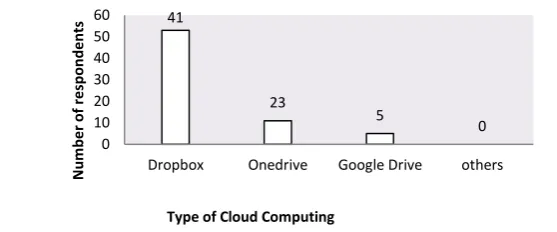
The users were asked for their favourite Mobile Cloud Storage (MCS) before the users assessed and tried the proposed system. Based on Fig. 3, about 53 respondents (76.81% users) liked using the Dropbox compared with others. Furthermore, users also liked using OneDrive and Google Drive. From the survey, most of the users used the CS to access their current data files.
Fig. 3.The most favoured types of CS
C. Feedback from users on the Implementation of Mobile Intelligent Web Pre-fetching for Mobile Cloud Storage
This section describes the evaluation performance to get an implementation feedback on the local and intelligent pre-fetching on MOBICS system. Then, the result of this part of questionnaire is used to test the variables.
MOBICS system was requested by each user and browse through any Mobile Cloud Storage (MCS). MOBICS saved and calculated the hit number for each data object of CS. Then, from the most visited pages provided in the system, the users could view the history of hit based on the elements. Most visited page provided the users with their favourite and current information. Furthermore, MOBICS also saved the size of CS available and used, so MOBICS have recommended users to store at the available CS without checking the availability of each one. In addition, MOBICS provided list of result based on decision tree that provided data being requested in future by the users. The results prove that, commonly users had interests in viewing their files as files element had the highest hit compared with other elements.
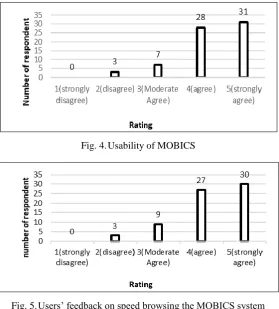
On the last question of the questionnaire, users were asked about their experiences of using the MOBICS system while browsing through the features. About 40.58% agreed on the usability of the pre-fetching features while 44.93% strongly agreed that pre-fetching was useful to provide users navigate the multiple CS data as in Fig. 4.
Fig. 5 defines the evaluation result of MOBICS based on the users’ experience while interacting with the system to browse through MCS. Some 30 and 27 users from 69 respondents strongly agreed
54
41 23
39
3 4 10
Dropbox Onedrive Box GoogleDrive Flickr SugarSync Media Fire
41
23
5
0 0
10 20 30 40 50 60
Dropbox Onedrive Google Drive others
Num
be
r
of
re
sponde
nt
s
and agreed respectively, that MOBICS sped up their browsing, and it was comparable to the traditional MCS application without MOBICS.
Fig. 4.Usability of MOBICS
Fig. 5.Users’ feedback on speed browsing the MOBICS system
The previous results presented the descriptive statistical feedback from the respondents of MOBICS system performance. Moreover, to identify the dependencies of these results for MOBICS, statistical test was also applied to test the heterogeneity as a step to be aware of Hawthorne effect. The statistical test, include the Chi-square statistic (Chi2) and I2 statistic.
Chi2 statistic. It is a test for heterogeneity. Heterogeneity is indicated by a Chi2 statistic greater than the df (degrees of freedom) and a small P value (for example: P < 0.05)
I2 statistic. I2 is a test used to measure heterogeneity and calculate the proportion of difference due to heterogeneity rather than possibility. The I2 value ranges from 0% to 100%, with higher values indicating greater heterogeneity.
As it can be seen in Fig. 5, the ratings for MOBICS are 1 (strongly disagree), 2 (disagree), 3 (moderate), 4 (agree) and 5 (strongly agree). Nevertheless, ratings 1 and 2 were grouped as one (named as group 2), rating 3 as group 3 and ratings 4 and 5 as group 4. Subsequently, the outcomes or variable labels, k=3 with test statistic are given in (1).
Q = ∑(𝑜𝑏𝑠𝑒𝑟𝑣𝑒𝑑−𝑒𝑥𝑝𝑒𝑐𝑡𝑒𝑑)2
𝑒𝑥𝑝𝑒𝑐𝑡𝑒𝑑 (1)
Compute the chi square statistic Q by carrying out the following steps:
1. On all observed number in the Table, deduct the corresponding expected number (observed - expected).
2. Square the difference [ (observed - expected)2].
3. Divide the squares obtained for every cell in the Table by the expected number for that cell 4. [(observed - expected)2 / expected].
5. Total all the values for (observed - expected)2 / expected. This is the chi square statistic.
𝐼2 = 𝑄−𝑑𝑓
𝑄 × 100% (2)
Where Q is the chi-squared statistic and df is its degrees of freedom [14]-[15]. This explains the percentage of the essentially estimates that it may be because of heterogeneity as opposed inspecting slip (chance). Thresholds to the elucidation from claiming I2 could make misleading, since the vitality about conflict relies once a few variables. The I2 represents the value of heterogeneity that may lead to risk of bias. A rough guide to understanding is as follows:
Might not be important in range of 0% to 40%;
May represent moderate heterogeneity in range of 30% to 60%;
May represent the substantial heterogeneity in range of 50% to 90%;
Considerable heterogeneity in range of 75% to 100%.
A deficiency of the Q statistic is that it has poor control should identify valid heterogeneity around investigations when the meta-analysis incorporates a little amount of investigations and too much power to recognize unimportant variability with a high number of studies [3]. Thus, a no significant result for the Q test with a little amount of studies can lead a reviewer to erroneously assume a fixed-effects model when there is true heterogeneity among the studies and vice versa. On the other hand, the Q statistic does not inform us of the degree for genuine inconsistency heterogeneity, just about its measurable hugeness.
In order to overcome the deficiencies of the Q, Higgins and Thompson [14] and Higgins, et al. [15] proposed three indices to assess heterogeneity in a meta-analysis: the H2, R2, and I2 indices in their research. The preferences from claiming I2 index include incorporate simple interpretation, extensive variety for applications, simple to calculate and might normally be determined starting with distributed meta-analyses and can be straightforwardly compared the middle of meta-analyses for separate numbers from claiming investigations and different sorts for result information [16].
Table 4 shows the effects of heterogeneity in the respondents’ profile background of the Hawthorne effect with binary outcome; whether or not it affects the ranking of MOBICS feedback. Part A from questionnaire was used to determine if the results of MOBICS were biased by the Hawthorne effect. The binary outcome as in Table 5 was used to identify the demographic and background of the Hawthorne effect on respondents. Based on the result, gender and race did not affect the results of the questionnaire because this questionnaire evaluated the system not the users. While age categories into three, which is majority is a student. Hence, they are normally known to use the system. Hence, they were less susceptible to the Hawthorne effect because users effectively got used to it. Same goes to the education level. The user effectively got used to it. It is proven by systematically testing both, the Chi2 statistic and I2 statistic. All the aspects on profile background show that the value of P > 0.05 means that gender, race, age and education level did not influence the ranking of MOBICS feedback. Moreover, the results of I2 were less than 40%, which might not be important for ranking of MOBICS feedback. Based on Part A, it can be concluded that there was less Hawthorne effect occurred because the majority of result get effectively to use it and not for the reason was being observed.
Table 5 shows the binary result in determining the MCS usage background of the Hawthorne effects on respondents. Based on the result, the frequency of the internet usage and the time spent did not affect the ranking of MOBICS feedback because the statistics result was less than 40%. However, it can be concluded that there might be less Hawthorne effect occurred. Hence, these results show proposed MOBICS reduced the Hawthorne Effect by reduce the bias’s result occurred.
Table 4. The effect of heterogeneity in respondents’ profile background on the Hawthorne Effect with binary outcomes
Q df P I2 (%)
Gender 2.273 2 0.330 12.01
Race 2.948 2 0.078 32.15
Age 2.360 2 0.573 15.27
Table 5. The effect of heterogeneity in respondents’ MCS usage background on the Hawthorne Effect with binary outcomes
Q df P I2 (%)
Frequency of the
Internet Usage 2.948 2 0.078 32.15
Time Spend 2.947 2 0.168 32.14
The other experiment was proposed to evaluate the completion time of Dropbox application with or without using MOBICS system. The advanced KLM was used to compare the performance[17], [18].This model has also been discussed by other researchers[17], [19], [20].
To obtain results for this experiment, four Scenarios were applied in this experiment. There were some facts needed to be followed:
Average non-secretariat typist (40 Web Pre-fetching): 0.28 seconds User A, username (sample default name): syahela
Password (sample password): 1234 Files: Third level data file
1) First Scenario
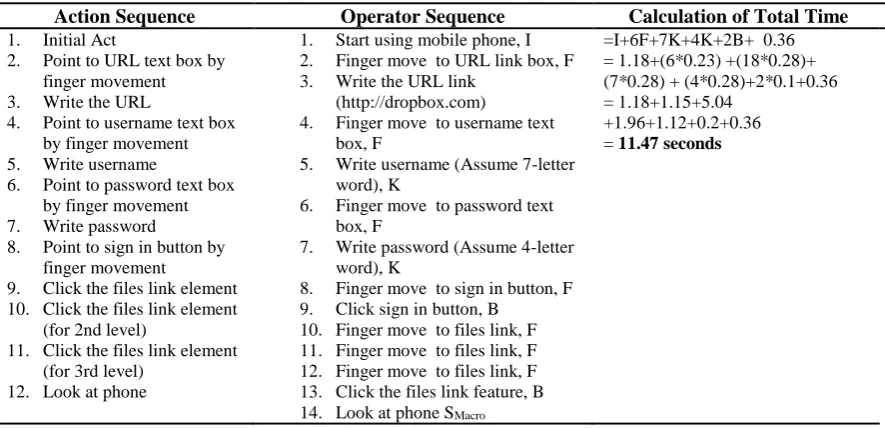
This Situation was used for a user who did not use Intelligent Mobile Web Pre-fetching at all. The user must open the web browser, then type the URL of Dropbox mobile (http://dropbox.com). A calculation of the time duration is provided in Table 6.
Table 6. 1st scenario to get the total time
Action Sequence Operator Sequence Calculation of Total Time 1. Initial Act
2. Point to URL text box by finger movement 3. Write the URL
4. Point to username text box by finger movement 5. Write username
6. Point to password text box by finger movement 7. Write password
8. Point to sign in button by finger movement
9. Click the files link element 10. Click the files link element
(for 2nd level)
11. Click the files link element (for 3rd level)
12. Look at phone
1. Start using mobile phone, I 2. Finger move to URL link box, F 3. Write the URL link
(http://dropbox.com)
4. Finger move to username text box, F
5. Write username (Assume 7-letter word), K
6. Finger move to password text box, F
7. Write password (Assume 4-letter word), K
8. Finger move to sign in button, F 9. Click sign in button, B
10. Finger move to files link, F 11. Finger move to files link, F 12. Finger move to files link, F 13. Click the files link feature, B 14. Look at phone SMacro
=I+6F+7K+4K+2B+ 0.36 = 1.18+(6*0.23) +(18*0.28)+ (7*0.28) + (4*0.28)+2*0.1+0.36 = 1.18+1.15+5.04
+1.96+1.12+0.2+0.36
= 11.47 seconds
2) Second Scenario
Table 7. 2nd scenario to get the total time
Action Sequence Operator Sequence Calculation of Total Time 1. Initial Act
2. Point to username text box by finger movement 3. Write username
4. Point to password text box by finger movement 5. Write password 6. Point to login button by
finger movement 7. Click the files link feature 8. Click the files link feature
(for 2nd level) 9. Click the files link
element (for 3rd level) 10. Look at phone
1. Start using mobile phone, I 2. Finger move to username text
box, F
3. Write username (Assume 7-letter word), K
4. Finger move to password text box, F
5. Write password (Assume 4-letter word), K
6. Finger move to login button F 7. Click login button, B
8. Finger move to files link, F 9. Finger move to files link, F 10. Finger move to files link, F 11. Click the files link feature, B 12. Look at phone SMacro
= I+5F+7K+4K+2B+ 0.36
= 1. 18 + (5*0.23) +(7*0.28) +(4*0.28)+2*0.1+0.36
= 1.18+0.92+1.96 +1.12+0.2 +0.36
= 6.2 seconds
3) Third Scenario
The first time login a user should finish some of the steps as in the first situation. Although, for the second and the next logins, a user was allowed to directly access the files pages as it was assumed the files had the highest hit number by visiting the most visited page (Table 8).
Table 8. 3rd scenario to get the total time
Action Sequence Operator Sequence Calculation of Total Time 1. Initial Act
2. Point to username text box by finger movement
3. Write username
4. Point to password text box by finger movement
5. Write password
6. Point to login button by finger movement
7. Click login button 8. Click most visited page 9. Click the files link feature 10. Look at phone
1. Start using mobile phone, I 2. Finger move to username text
box, F
3. Write username (Assume 7-letter word), K
4. Finger move to password text box, F
5. Write password (Assume 4-letter word), K
6. Finger move to login button, F 7. Finger move to login button, F 8. Finger move to login button, F 9. Click login button, B
10. Look at phone, SMacro
= I + 4F + 7K + 4K + B+0.36
= 1.18+(3*0.23)+ (7*0.28) + (4*0.28) +0.1+0.36
= 1.18 +0.69+1.96 +1.12+0.1
= 5.87 seconds
4) Fourth Scenario
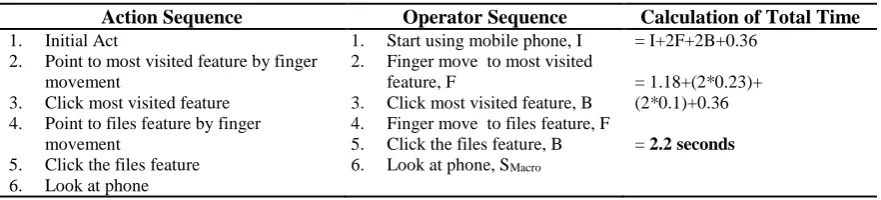
Users opened the most visited element then checked the data information and clicked on the link if the user wanted to visit or view it (Table 9).
Table 9. 4th scenario to get the total time
Action Sequence Operator Sequence Calculation of Total Time 1. Initial Act
2. Point to most visited feature by finger movement
3. Click most visited feature 4. Point to files feature by finger
movement
5. Click the files feature 6. Look at phone
1. Start using mobile phone, I 2. Finger move to most visited
feature, F
3. Click most visited feature, B 4. Finger move to files feature, F 5. Click the files feature, B 6. Look at phone, SMacro
= I+2F+2B+0.36
= 1.18+(2*0.23)+ (2*0.1)+0.36
= 2.2 seconds
according to KLM. The first scenario used Dropbox of web browser to access data level 4 and second scenario used J48 decision tree rules to access data level 4. Both scenarios were tested to access user data at level 3 to determine their speed access.
a) First Scenario to get the total time (Intelligent Pre-fetching)
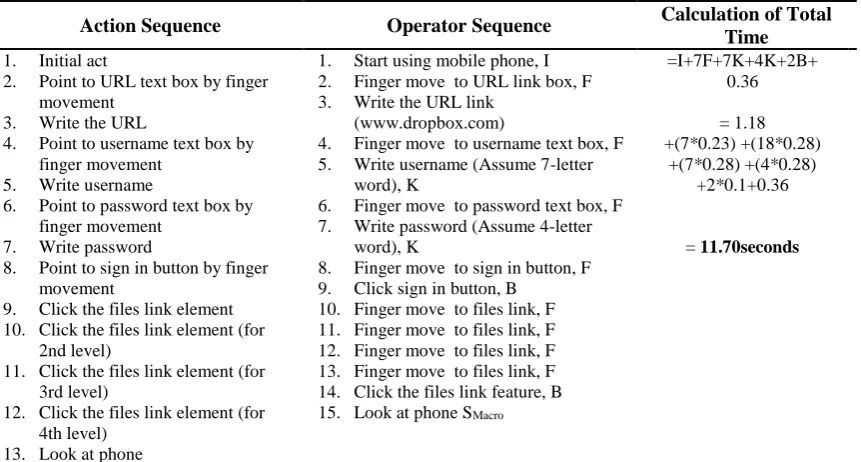
In this scenario, the sequence was built to calculate the total action time without pre-fetching. The user needed to open the web browser then type the URL of website, such as: (www.dropbox.com 14-letter word) then login as usual. The calculation is provided in Table 10.
Table 10. 1st scenario to get the total time (Intelligent Pre-fetching)
Action Sequence Operator Sequence Calculation of Total Time 1. Initial act
2. Point to URL text box by finger movement
3. Write the URL
4. Point to username text box by finger movement
5. Write username
6. Point to password text box by finger movement
7. Write password
8. Point to sign in button by finger movement
9. Click the files link element 10. Click the files link element (for
2nd level)
11. Click the files link element (for 3rd level)
12. Click the files link element (for 4th level)
13. Look at phone
1. Start using mobile phone, I 2. Finger move to URL link box, F 3. Write the URL link
(www.dropbox.com)
4. Finger move to username text box, F 5. Write username (Assume 7-letter
word), K
6. Finger move to password text box, F 7. Write password (Assume 4-letter
word), K
8. Finger move to sign in button, F 9. Click sign in button, B
10. Finger move to files link, F 11. Finger move to files link, F 12. Finger move to files link, F 13. Finger move to files link, F 14. Click the files link feature, B 15. Look at phone SMacro
=I+7F+7K+4K+2B+ 0.36 = 1.18 +(7*0.23) +(18*0.28) +(7*0.28) +(4*0.28) +2*0.1+0.36
= 11.70seconds
b) Second Scenario to get the total time (Intelligent Pre-fetching)
A User opened the decision tree element then checked the data information and clicked on the link that the user wanted to visit or view (Table 11).
Table 11. 2nd scenario to get the total time (Intelligent Pre-fetching)
Action Sequence Operator Sequence Calculation of Total Time 1. Initial act
2. Point to decision tree feature by finger movement
3. Click decision tree feature 4. Point to files feature by finger
movement
5. Click the files feature 6. Look at phone
1. Start using mobile phone, I 2. Finger move to decision tree
feature, F
3. Click decision tree feature, B 4. Finger move to files feature, F 5. Click the files feature, B 6. Look at phone, SMacro
= I+2F+2B+0.36
=1.18+(2*0.23)+(2*0.1)+ 0.36
= 2.2 seconds
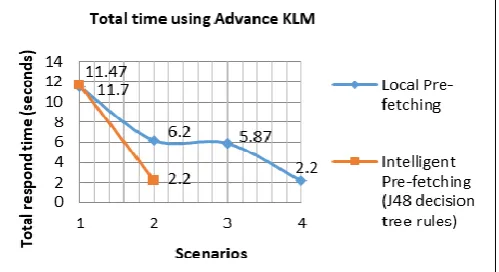
The results for the proposed work of the MOBICS have increased the speed in accessing data utilizing the mobile-based for the MCS. Moreover, an access time comparison of the four scenarios are presented to explain the performance time difference for local pre-fetching while the two scenarios are presented to explain the performance of intelligent pre-fetching using J48 decision tree rules as illustrated in Fig. 6.
users’ interaction for the proposed MOBICS with the traditional MCS. It showed time reduction of interaction up to 19.28% (2.2 seconds in comparison to 11.47 seconds) for the local pre-fetching and 18.80% (2.2 seconds in comparison to 11.70 seconds) for the intelligent pre-fetching.
Fig. 6.Local and Intelligent Pre-fetching performance of access time comparison using KLM
IV. Conclusion
This paper has enhanced the performance of Web pre-fetching for mobile cloud storage applications by proposing the MOBICS scheme. This scheme comprises of two schemes consisting of firstly, a scheme to analyse and determine the best ML technique in predicting pre-fetched objects; and secondly, a scheme to implement the best ML technique (J48 Decision Tree rules) into MCS environment to speed up and increase the scalability in accessing the data files on multiple cloud storage services. It can be seen that the proposed scheme for the intelligent technique was faster than the traditional Dropbox Mobile application access. MOBICS was more rapidly than usual browsing performance without pre-fetching. This result proves by most of the respondents with 95.65% (66 from 69 respondents) agreeing that MOBICS system was extremely practical and has enhanced the rate in accessing and storing MCS. The correspondence between efficiency, as indicated by task completion time, and effectiveness, as indicated by quality of solution, was negligible. Effectiveness, which is the accuracy and completeness with users achieve certain tasks. An indicator of effectiveness is quality of solution by measure of the outcome of user’s interaction with the system based on questionnaire. Efficiency, which is the relation between the accuracy and completeness with users achieve certain task and resources expended in achieving them. In this research, use task completion time as the indicator of efficiency. In addition, users’ usability measured based on SUS which provides a global view of subjective assessments of usability.
The statistical test (chi-square test) also proved that background of respondents did not affect the respondents’ ranking feedback on MOBICS implementation, hence MOBICS awareness from Hawthorne Effect, which means the evaluation was valid as depicted in Tables 4 and 5. A statistical test was evaluated based on Chi2 statistic and I2 statistic. The value of P > 0.05 of all aspects of profile background showed that gender, race, age and education level did not influence the ranking of MOBICS feedback. Moreover, the result of I2 was less than 40% might not be important for ranking of MOBICS feedback. It concluded that the proposed MOBICS had less Hawthorne effect because the majority of the results get effectively to use it and not for the reason being observed.
Acknowledgment
References
[1] C. R. Harrell, B. Gladwin, and M. P. Hoag, “Mitigating The ‘Hawthorne Effect’ In Simulation Studies Charles,” Proc. Winter Simul. Conf., no. 2004, pp. 2722–2729, 2013.
[2] R. Macefield, “Usability Studies and the Hawthorne Effect,” J. usability Stud., vol. 2, no. 3, pp. 145–154, 2007.
[3] J. McCambridge, J. Witton, and D. R. Elbourne, “Systematic review of the Hawthorne effect: new concepts are needed to study research participation effects.,” J. Clin. Epidemiol., vol. 67, no. 3, pp. 267– 77, Mar. 2014.
[4] M. Chiesa and S. Hobbs, “Making sense of social research: How useful is the Hawthorne Effect?,” Eur. J. Soc. Psychol., vol. 38, no. 1, pp. 67–74, 2008.
[5] M. del P. Villamil G and C. J. Urango M, “Pocket Caching : A Strategy of Prefetching Cache Based on Multi-objective Optimization for Mobile Cloud Computing,” Int. J. Comput. Theory Eng., vol. 8, no. 2, pp. 94–101, 2016.
[6] D. Anu and A. P. A, “Negotiate Emulation Data Prefetching in Diffuse File Conformity for Cloud Enumerate,” Int. J. Res. Emerg. Sci. Technol., no. 1, pp. 10–14, 2016.
[7] X. Wang and M. Chen, “PreFeed : Cloud-Based Content Prefetching of Feed Subscriptions for Mobile Users,” IEEE Syst. J., vol. 8, no. 1, pp. 202–207, 2014.
[8] N. Sharma and S. K. Dubey, “Semantic based Web Prefetching using Decision Tree Induction,” 2014 5th Int. Conf. - Conflu. Next Gener. Inf. Technol. Summit, pp. 132–137, Sep. 2014.
[9] J. Brooke and others, “SUS-A quick and dirty usability scale,” Usability Eval. Ind., vol. 189, no. 194, pp. 4–7, 1996.
[10] L. O. Colombo-Mendoza, G. Alor-Hernández, A. Rodr’\iguez-González, and R. Valencia-Garc’\ia, “MobiCloUP!: a PaaS for cloud services-based mobile applications,” Autom. Softw. Eng., vol. 21, no. 3, pp. 391–437, 2014.
[11] P. Lilly, “Top 20 cloud storage services,” 2013. [Online]. Available: http://www.techadvisor.co.uk/feature/storage/top-20-cloud-storage-services-3421715/. [Accessed: 16-Feb-2014].
[12] S. Mitroff, “OneDrive, Dropbox, Google Drive and Box: Which cloud storage service is right for you?,” 2016. [Online]. Available: https://www.cnet.com/how-to/onedrive-dropbox-google-drive-and-box-which-cloud-storage-service-is-right-for-you/. [Accessed: 10-Nov-2017].
[13] M. Casserly, “The 14 best cloud storage services 2017,” 2017. [Online]. Available: http://www.techadvisor.co.uk/test-centre/internet/best-cloud-storage-services-2017-3614269/.
[Accessed: 10-Nov-2017].
[14] J. Higgins and S. G. Thompson, “Quantifying heterogeneity in a meta-analysis,” Stat. Med., vol. 21, no. 11, pp. 1539–1558, 2002.
[15] J. P. T. Higgins, S. G. Thompson, J. J. Deeks, and D. G. Altman, “Measuring inconsistency in meta-analyses,” BMJ Br. Med. J., vol. 327, no. 7414, p. 557, 2003.
[16] T. B. Huedo-Medina, J. Sánchez-Meca, F. Mar’\in-Mart’\inez, and J. Botella, “Assessing heterogeneity in meta-analysis: Q statistic or I$^2$ index?,” Psychol. Methods, vol. 11, no. 2, p. 193, 2006.
[17] P. Holleis, F. Otto, H. Hussmann, and A. Schmidt, “Keystroke-level model for advanced mobile phone interaction,” in Proceedings of the SIGCHI Conference on Human Factors in Computing Systems, 2007, pp. 1505–1514.
[18] P. Holleis, M. Scherr, and G. Broll, “A revised mobile KLM for interaction with multiple NFC-tags,”
Human-Computer Interact. 2011, pp. 204–221, 2011.
[19] Y. Jimenez and P. Morreale, “Design and evaluation of a predictive model for smartphone selection,” in
International Conference of Design, User Experience, and Usability, 2013, pp. 376–384.