DEVELOPMENT OF AF RELAY USING USRP PLATFORM FOR INDOOR
MARDIAH BINTI MORSIN
A project report submitted in partial fulfilment of the requirements for the award of the degree of
Master of Engineering (Eletrical-Electronics & Telecommunications)
Faculty of Electrical Engineering Universiti Teknologi Malaysia
v
Specially dedicated to my beloved husband, Mak and Ayah Thanks for all of your support.
vi
ACKNOWLEDGEMENT
Assalamualaikum;
I want to express my full appreciation to my supervisor, Dr. Leow Chee Yen for the guidance, commentary and encouragement. His support makes the thesis can be completed.
I am very thankful to my classmate, Nur Fatehah and Muhammad Rushidi for their advices and assistance while preparing this research. Not to forget, NI support team specially, Mr Alan and Miss Laila. Thanks for the supportive assistance on LabVIEW.
Finally, to all my family members and my sons, Fateh, Khawarizmi and Diha. Seeing your face every day encourage me to finish my thesis successfully.
vii
ABSTRACT
The increasing customer demand in broadband mobile wireless communication technology leads to the introduction of the relay. Relay is able to increase the capacity and coverage between base station and mobile user. There are a lot of benefits that motivate the usage of relay, including reducing the power used at base station and extending coverage area. Existing literature on relay focuses mainly on simulation, with no measurement validation. This research therefore aims to develop a prototype of Amplify-and-Forward (AF) relay using software defined radio. The proposed relay is developed using LabVIEW software and programmed on NI-USRP 2922 software defined radio platform. Measurement is performed indoor and the signal strength or receive power at the mobile user with and without relay is recorded. The result shows that the receive power performance and signal-to-noise ratio (SNR) at the user improve 23% when the AF relay is deployed, as compared to direct link point to point transmission without relay. As a future work, the proposed relay can be further studied in outdoor environment and MIMO antenna configuration to determine the receive power performance in line-of-sight area.
viii
ABSTRAK
Permintaan pelanggan yang meningkat terhadap perkhidmatan jalur lebar untuk sistem komunikasi tanpa wayar telah memacu kepada pengenalan relay. Relay adalah satu teknik yang digunakan untuk meningkatkan penghantaran isyarat kapasiti antara Stesen Penghantar dan Penerima. Terdapat banyak faedah yang mempengaruhi penggunaan relay termasuk penghantaran kuasa yang kurang digunakan di Stesen Penghantar, lanjutan perlindungan yang tinggi dan lain-lain. Kajian ini dibuat untuk mengkaji pembangunan Amplify and Forward (AF) relay bermula dari Stesen Penghantar, relay AF dan akhirnya kepada Penerima. Ia dibangunkan dengan menggunakan perisian LabVIEW dan diprogramkan pada perkakas NI USRP-2922. Pengujian dilakukan di dalam bangunan Makmal WCC dan prestasi yang diukur adalah kekuatan isyarat atau Kuasa Penerima, Pr. Ia menunjukkan bahawa menerima prestasi kuasa dan SNR bagi relay AF adalah lebih baik berbanding dengan langsung titik pautan ke titik penghantaran dengan kenaikan sebanyak 23%. Pada masa hadapan, pengujian Relay ini boleh dibuat di luar bangunan serta menggunakan konfigurasi MIMO antenna untuk melihat prestasi kuasa Penerima pada kawasan Had Penglihatan.
ix
TABLE OF CONTENTS
CHAPTER TITLE PAGE
DECLARATION ii
DEDICATION iii
ACKNOWLEDGEMENT iv
ABSTRACT v
ABSTRAK vi
TABLE OF CONTENTS vii
LIST OF TABLES x
LIST OF FIGURES xi
LIST OF ABBREVIATION xiv
LIST OF APPENDICES xv
1 INTRODUCTION 1
1.1 Introduction 1
1.2 Problem Statement 2
1.3 Research Objectives 2
1.4 Scope of Work 3
1.5 Thesis Outline 3
1.6 Summary of Work 4
2 LITERATURE REVIEW 7
2.1 Introduction 7
2.2 Amplify and Forward (AF) relay 7
x
2.3 Orthogonal Frequency Division Multiplexing(OFDM)
10
2.4 Software Defined Radio 2.4.1 Advantages of SDR 2.4.2 NI USRP-2922 2.4.3 LABVIEW
11 12 12 14
3 METHODOLOGY 15
3.1 Introduction 15
3.2 Project Overview 16
3.3 Development of AF relay, Source and Destination
17
3.3.1 Source (Base Station) 3.3.2 AF Relay
3.3.3 Destination (User)
17 24 27 3.4 Deployment of the programming on-the-
shelf in the network scenario using NI USRP-2922
31
3.5 Indoor measurement 32
3.5.1 Point to point direct transmission setup
3.5.2 AF relay network setup
35
37
4 RESULT AND ANALYSIS 40
4.1 Introduction 40
4.2 Point to point direct transmission result 43
4.3 AF Relay network result 44
4.4 Point to point direct transmission and AF relay network result
45
4.5 Receive Power versus SNR 47
4.6 Power ratio versus distance 48
viii
xi
5 CONCLUSION AND FUTURE WORKS 49
5.1 Conclusion 5.2 Future Work
49 49
REFERENCES 50
Appendices A-C 53-55
xii
LIST OF TABLES
TABLE NO. TITLE PAGE
xiii
LIST OF FIGURES
FIGURE NO. TITLE PAGE
1.1 Project Overview 4
1.2 Projects schedule for (a)phase one (b) phase two 5 2.1
2.2
AF Relay network
Software Defined Radio Block Diagram
8 11
3.1 Basic Communication System 15
3.2 Transmission using AF relay 17
3.3 Point-to-point direct transmission 17
3.4 Source (Base Station) block diagram 17
3.5 Flowchart of Source Programming 18
3.6 Front panel for transmission part (1) 21
3.7 Front panel for transmission part (2) 21
3.8 Front panel for transmission part (3) 22
3.9 Source VI block diagram (1) 23
3.10 Source VI block diagram (2) 23
3.11 Source VI block diagram (3) 23
3.12 Flowchart of AF relay 24
xiv
3.13 Flowchart of AF relay 24
3.14 AF relay front panel 25
3.15 AF relay block diagram (1) 26
3.16 AF relay block diagram (2) 26
3.17 Destination block diagram 27
3.18 Flowchart of Destination Programming 28
3.19 Destination front panel (1) 29
3.20 Destination front panel (2) 30
3.21 Destination VI block diagram (1) 30
3.22 Destination VI block diagram (2) 31
3.23 Destination VI block diagram (3) 31
3.24 Transmitted signal display 32
3.25 Received signal with constellation diagram 32
3.26 Receive power measurement programming 35
3.27 Point-to-point direct transmission 36
3.28 Point to point direct transmission setup (a) actual setup (b) layout design
36
3.29 AF relay network setup 37
3.30 AF relay network in actual measurement setup 38 3.31 Scenario 1 for AF relay network measurement setup 38 3.32 Scenario 2 for AF relay network measurement setup 39
xv
4.1 Waveform at the source while running LabVIEW program.
40
4.2 Packet signal waveform and constellation diagram at destination while point-to-point direct transmission testing
41
4.3 AF relay waveform 42
4.4 Packet signal waveform and constellation diagram at destination when AF relay measurement
42
4.5 Pythagoras theorem 43
4.6 Receive power for direct transmission versus distance 43 4.7 Receive power for AF relay versus distance 44 4.8 Receive power for the direct link and relay versus
distance
45
4.9 Receive power for the direct link and AF relay versus SNR
47
xvi
LIST OF ABBREVIATIONS
AF - Amplify and Forward
OFDM - Orthogonal Frequency Division Multiplexing
DF - Decode and Forward
CF - Compress and Forward
BS - Base Station
NAF - Non-orthogonal Amplify and Forward SAF - Slotted Amplify and Forward
DMT - Discrete Multitone Modulation SISO - Single Input Single Output MIMO - Multiple Input Multiple Output USRP - Universal Software Radio Peripheral FGPA - Field Programmable Gate Array FFT - Fast Fourier Transform
IFFT - Inverse Fast Fourier Transform VI - Virtual Instrument
PC - Personal Computer
WCC - Wireless Communication Centre IQ - Quadrature signals
LOS - Line of Sight
NLOS - Non-Line of Sight
xvii
LIST OF APPENDICES
APPENDIX TITLE PAGE
A On-the-shelf NI USRP-2922 53
B NI USRP-2922 Specification 54
C VERT900 Antenna Specification 55
CHAPTER 1
INTRODUCTION
1.1 Introduction
The demand for data rate in wireless mobile communication increases drastically in recent years [1]. The number of available data capacities and the customer demand is not synchronous. The growth of the demand surpasses the available capacity. In order to enhance the data rate and spectral efficiency [2], relay has been proposed as the alternative.
Relay is a concept taken from a repeater. The main function of relay to is to forward signals from base station to user and vice versa [3]. The relay is used to increase the system cell edge coverage effectively [4]. By using relay, the data transmission between Base Station and User at cell edge increases and the quality of the channel improves [4]. The other benefit of the implementing a relay is that it can reduce the power transmission consumption at the Base Station.
2
form factor. This will make the operation faster, flexible and cost effective for operators [5].
1.2 Problem Statement
The followings are the problem statements for this project:-
i. The conventional fabricated relay is realised using fixed hardware. If any changes or modifications are needed on the relay operation, the whole set of hardware needs to be changed. This makes the implementation of relay to become very costly.
ii. Previous studies are made in simulation environment rather than based on field study in real operating environment. In this situation, simulation result is an ideal case where it does not consider any kind of practical circumstances, such as the environment factors, weather and also the propagation conditions.
1.3 Research Objectives
The objectives of this project are:
i. to develop amplify-and-forward (AF) relay prototype using universal software radio peripheral (USRP) platform and LabVIEW software,
3
1.4 Scope of Work
The objectives of this project can be achieved within the scopes outlined. The project uses the off-the-shelf NI USRP 2922 software defined radio to implement the three-node network consists of the proposed AF relay, base station and mobile user. The programming of the USRP is made using NI LabVIEW software.
The measurement is done indoor where the parameter considered is the received power at the user. The measurement is done only for downlink transmission and for single-input and single-output (SISO) antenna configuration only.
1.5 Thesis Outline
This thesis consists of five chapters. Chapter 1 gives an overview and the introduction of the project.
Chapter 2 discusses the literature review on the concept of AF relay techniques. The characteristics of AF and the purpose of choosing these techniques are explained in details by comparing with previous studies. Other than that, the concept of software defined radio (SDR) and the use of USRP is also discussed in this chapter. In addition, the benefits of using AF relay are specified. Finally, the concept of OFDM is also explained.
Chapter 3 contains the design methodology of the project. The design is illustrated using flow charts to show the development of three main nodes which are base station, AF relay and mobile user. Then, the measurement setup of the USRP with a LabVIEW implementation is be discussed in this chapter.
4
Finally, Chapter 5 presents the conclusion of this project. The future work is also elaborated in this chapter.
1.6 Summary of Work
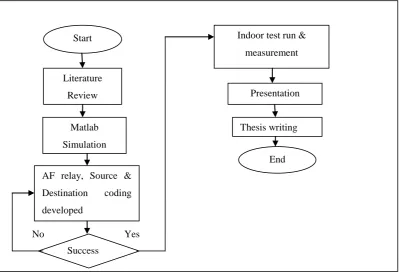
The project flow illustrated in Figure 1.1. The project begins with the literature review, followed by the simulation of the ergodic capacity versus SNR using Matlab, for AF relay associated network in comparison with point-to-point direct transmission. Next, the LabVIEW coding of a source, AF relay and destination will be developed using basic transmission and receiver block diagram with the aid of OFDM, Multiplexer, QAM Modulation, Matched Filter and some other coding’s. The coding will be programmed onto the NI-USRP2922 FPGA system and the downlink transmission will be tested. At first, the test runs on the equipment rack in the laboratory. After the system is working as specified, it runs in real indoor and environment. The parameter measured is the receiving power versus distance. The final step is presentation and thesis writing.
Figure 1.1: Project overview
Start
Literature
Review
Matlab
Simulation
AF relay, Source &
Destination coding
developed
Success
No Yes
Indoor test run &
measurement
Presentation
Thesis writing
5
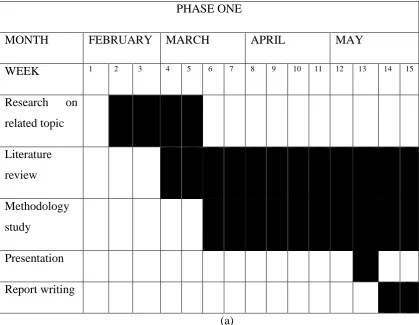
Figure 1.2 shows the Gantt chart of the project schedules for phase one and phase two. The implementation of phase one was in semester one which covers studying and understanding of literature review and also the determining the project specification. Previous research related to this project and various types of relay techniques is studied, including AF relay technique.
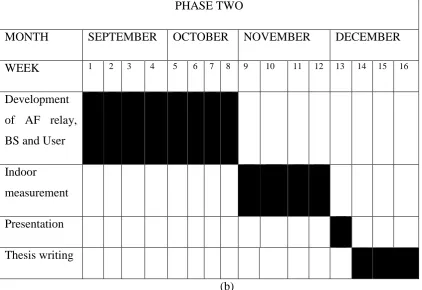
For phase two, the development of AF relay and also the Base Station (source) and user (destination) coding using LabVIEW and NI-USRP 2922 are performed. Then, indoor measurement of the receive power for relay assisted network and point-to-point direct transmission are accomplished. Finally, presentation and thesis writing are made after the development and measurement of relay is completed.
PHASE ONE
MONTH FEBRUARY MARCH APRIL MAY
WEEK 1 2 3 4 5 6 7 8 9 10 11 12 13 14 15 Research on
related topic Literature review Methodology study
Presentation Report writing
6
PHASE TWO
MONTH SEPTEMBER OCTOBER NOVEMBER DECEMBER
WEEK 1 2 3 4 5 6 7 8 9 10 11 12 13 14 15 16 Development
of AF relay, BS and User Indoor measurement Presentation Thesis writing
(b)
50
References
1
1. J. Cao, M. Ma, H. Li, Y. Zhang, Z. Luo, A Survey on Security Aspects for LTE and LTE-A Networks, IEEE Communications Surveys & Tutorials, Vol. 16, No. 1, 2014, pp. 281-302
2
2. W. Hong, J. Han, H. Wang, UL Performance Evaluation of Relay Enhanced FDD LTE-Advanced Networks, Renesas Telecommunication Technology,Beijing, China, 2011.
3
3. J. A. Aldhaibani, A.Yahya, R.B. Ahmad ,N. Omar, Z. G. Ali, Effect of Relay Location on Two-Way DF and AF Relay for Multi-User System in LTE-A Cellular Networks, IEEE Business Engineering and Industrial Applications Colloquium (BEIAC), pp. 380-385, 2013. 4
4. D. Zhiguo, K. Ioannis, R. Beiyu, J. S.Thompson, W. Chao, Y. Sheng, On Combating the Half-Duplex Constraint in Modern Cooperative Networks: Protocols and Techniques, UK , 2011.
5
5. L. Ekkehard, R. Simone, R. Bernhard, Business Impact of Relay Deployment for Coverage Extension in 3GPP LTE-Advanced, Nokia Siemens Networks, Munich, Germany, 2009
6
6. W. Zhang, U. Mitra, M. Chiang, Optimization of Amplify-and-Forward Multicarrier Two-Hop Transmission, IEEE Transactions On Comm., pp. 1434-1445, May 2011.
7
7. S.Yang, J. C. Belfiore, Towards the Optimal Amplify-and-Forward Cooperative Diversity Scheme, IEEE Transactions On Information Theory, pp. 3114-3126, Sept. 2007.
8
8. T. Cover, A. E. Gamal, Capacity theorem for the channel relay, IEEE Transactions On Communications, vol. IT-25, pp. 575-584, 1979. 9
9. P. Popovski, H. Yomo, Physical Network Coding in Two–Way Wireless Relay Channels, cs.IT, July 2007.
1
10. Y. Liu, M. Tao, An Optimal Graph Approach for Optimizing OFDMA Relay Networks, IEEE ICC 2012 - Wireless Communications Symposium, pp. 4277-4281, 2012.
1
51
System With Separate Power Constraints, IEEE Transactions On Vehicular Technology, Vol. 58, NO. 9, pp 4943-4954 Nov. 2009. 12. H. Bo, F. Xuming, Z. Yue, C. Yu, H. Rong, Dynamic Energy Saving
Subcarrier, Bit and Power Allocation in OFDMA Relay Networks, China Communications Magazines, pp. 79-87, April 2013.
1
13. J. Dohl, G. Fettweis, Evaluation of Estimation and Mitigation Algorithms for Nonlinearly Distorted OFDM Signals on a SDR Platform, IEEE 13th International Workshop on Signal Processing Advances in Wireless Communications (SPAWC), pp.535-539, 2012. 1
14. A. Marwanto, M. A. Sarijari, N. Fisal, S. K. S. Yusof, R. A. Rashid, Experimental Study of OFDM Implementation Utilizing GNU Radio and USRP – SDR, Proceedings of the 2009 IEEE 9th Malaysia Intern. Conf. on Comm.”, pp.132-135. Dec.2009.
1
15. S. Venkatachalam, T. Manigandan, B. Priyavadhana, Implementation of Orthogonal Frequency Division Multiplexing(OFDM) Using Software Definable Radio (SDR) Platform, International Conference on Computational Intelligence and Multimedia Applications, pp.398-405, 2007.
1
16. M. Tichy, K. Ulovec, OFDM System Implementation Using a USRP Unit for Testing Purposes, 22nd International Conference Radioelektronika, 2012.
1
17. M. K. Awad, X. Shen, OFDMA Based Two-hop Cooperative Relay Network Resources Allocation, ICC, pp.4414-4418, 2008.
1
18. G. Calcev, J. Bonta, Opportunistic two-hop relays for OFDMA cellular networks, IEEE, 2008
1
19. Amado Gutierrez, Gerardo Laguna, Paulino Mendoza, Victor Rangel, Physical level design of an OFDM radio for digital communication with a software defined radio(SDR) platform, IEEE, 2013.
2
20. H. G. Yeh, P. Ingerson, Software-Defined Radio for OFDM Transceivers, IEEE, 2010.
2
21. X. Li, W. Hu, H. Yousefi’zadeh, A. Qureshi, A Case Study of A MIMO SDR Implementation, IEEE 2008.
2
52
320999E-01,April 2003. 2
23. L. Johnny, A Bidirectional Two-hop Relay Network Using GNU Radio And USRP, University Of North Texas, August 2011.
2
24. H. Hassan, L. Pavel, O.F. Timothy, H. Jianhua, Practical Network Coding for Two Way Relay Channels in LTE Networks, School of Engineering Swansea University, U. K, 2011.
25. X. Liu, G. Qiu, F. Yu, Experimental Study of Cooperative Communication Utilizing GNU Radio and USRP2, Shenzhen, China, pp 2577-2580, 2012.
2 2 2 2 3 3
26. K. Wesołowsk, Application of MIMO and network coding in two-way relaying applied in LTE, IEEE 21st International Symposium on Personal Indoor and Mobile Radio Communication, pp. 619-624, 2010.
27. S. Kumar, B. Farhang-Boroujeny, S. Uysal, C. Ng, Microwave indoor radio propagation measurements and modeling at 5 GHz for future wireless LAN systems, Microwave Conference, 1999 Asia Pacific, vol.3, pp. 606–609, 30 November-3 December. 1999.
28. J. Tarng and T. Liu, Effective models in evaluating radio coverage on single floors of multifloor building, IEEE Veh. Technol. Conf., vol. 48, pp. 782–789, 1999.
29. H. Zepernick and T. Wysocki, Multipath channel parameters for the indoor radio at 2.4 GHz ISM band, IEEE Veh. Technol. Conf., vol. 1, pp. 190–193, May 1999.
30. H.Hashemi, The indoor radio propagation channel, Prociding of IEEE, vol.81, no.7, pp.943-968, July 1993.
31. K. J. A. Chisty1, S. M. A. Islam2, S. E. Ullah3, S. R. Sabuj, Performance Evaluation of Multiple Amplify and Forward Relayed Cooperative MIMO-OFDM System with Implementation of ZF-SIC and MMSE-SIC Signal Detection Schemes, Communications in Information Science and Management Engineering, Vol. 3 Issue. 9, pp. 448-454, Sept. 2013