ABSTRACT
XU, MUCHUN. Design and Characterization of a Knit Plasma Textile Filter. (Under the direction of Dr. Warren Jasper).
Room temperature plasmas have been applied to a variety of textile surfaces to
enhance their dyeing characteristics or to modify their surface tension. Recently, a new class
of materials, called plasma textiles, have been designed and developed in which plasma is
generated in situ by embedding electrodes into the fabric as opposed to externally generating
the plasma by corona discharge or dialectic barrier discharge. It has been observed in woven
and non-woven fabrics that the presence of room temperature plasma greatly enhances the
filtration efficiency of these materials, especially in the 100 – 300 nm range. In this research,
an advanced weft knitting design which integrates conductive yarns with non-conducting
filler yarns produces a fabric which can generate plasmas to enhance the filtration efficiency
to over 99.9% while an external voltage is applied to the electrodes. These knitted fabrics
are made with different synthetic yarns such a polypropylene and PET.
A series of tests were performed to measure the enhanced filtration effect due to the
plasma, by subjecting the fabric to a sodium chloride aerosol of particle diameters ranging
from 30nm to 300nm. Measurements of the upstream and downstream aerosol were taken
while applying varying voltages in the 1 to 10kV range. It was observed that the filtration
© Copyright 2015 Muchun Xu
Design and Characterization of a Knit Plasma Textile Filter
by Muchun Xu
A thesis submitted to the Graduate Faculty of North Carolina State University
in partial fulfillment of the requirements for the degree of
Master of Science
Textile Engineering
Raleigh, North Carolina
2015
APPROVED BY:
______________________________ Dr. Warren Jasper
Committee Chair
DEDICATION
BIOGRAPHY
Muchun Xu was born on February 26th, 1992 in Suihua, Heilongjiang Province of China. She got her bachelor’s degree of Textile Engineering from Donghua University in Shanghai,
China in July 2014. She came to North Carolina State University in August 2013 to pursue a
ACKNOWLEDGMENTS
First of all, I would like to express my fully gratitude to my advisor Dr. Jasper for his selfless
guidance and support throughout my research. He has taught me how to do the research and
given me encouragement and enlightenment when I was stuck in the research. I would also
like to thank my committee members: Dr. Michielsen and Dr. Guinness, for their patience,
meaningful suggestions and encouragement. Besides, I want to thank the knitting lab
manager, Brain Davis. He helps a lot during the design, production and modification of the
corona textiles. Without his help, I cannot make this advanced knit fabric successfully. I
would like to express my special thanks to Srinivasan Rasipuram, who has given me
continuous suggestions and support in my filtration tests. Thanks to his guidance, or I could
not finish my thesis research in time. Finally, I would like to thank my parent, who gave me
the change to pursue high education and get to know the culture of another country. I love
TABLE OF CONTENTS
LIST OF TABLES ... viii
LIST OF FIGURES ... ix
1. INTRODUCTION ...1
2. LITERATURE REVIEW ...3
2.1 Aerosol Properties ...3
2.1.1 Adhesion of aerosol particles ...3
2.1.2 Production of Test Aerosols ...3
2.2 Filtration Properties ...5
2.2.1 Collection Efficiency ...5
2.2.2 Face Velocity ...6
2.2.3 Pressure Drop ...6
2.2.4 Filter Quality ...7
2.2.5 Filtration Mechanism for a Single Fibe ...7
2.3 Traditional Filter Types ...10
2.4 Plasma Textile Used as Filters ...12
2.4.1 Plasma Properties ...12
2.4.2 Low-Pressure Plasma ...15
2.4.2.1 Glow Discharge Plasma ...15
2.4.2.2 Capacitively Coupled Plasma ...17
2.4.3.1 Arc Discharge ...20
2.4.3.2 Dielectric Barrier Discharge ...21
2.4.3.3 Corona discharge ...22
2.4.4 Corona Discharge in Textiles ...25
3. KNIT PLASMA TEXTILE DESIGN ...31
3.1 Equipment ...31
3.1.1 SWG 021 N Knitting Machine ...31
3.1.2 Power Source ...32
3.2 Raw Material ...33
3.3 Pattern Design ...34
3.4 Experiment Setup ...41
3.5 Experiment Results and Discussions ...42
4. FILTRATION PROPERTY TESTS ...44
4.1 Experimental Setup ...44
4.2 Experiment Apparatus ...45
4.2.1 Atomizer ...46
4.2.2 Diffusion Dryer ...46
4.2.3 Test Chamber ...47
4.2.4 Electrostatic Classifier ...47
4.2.5 Condensation Particle Counter ...47
4.3 Experiment Process and Data Analysis ...49
4.4 Experiment Results and Discussions ...51
4.4.1 Corona Discharge Ignition Point Study and Current – Voltage Relation in the Corona Discharge ...51
4.4.2 Particle Size Statistics ...56
4.4.3 Filtration Efficiency at Different Voltages ...60
4.4.3.1 Filtration Efficiency for Knit Fabric ...60
4.4.3.2 Filtration Efficiency for Knit Fabric at voltage from 1 kV to 4 kV ...62
4.4.3.3 Filtration Efficiency for Corona Discharge Textiles ...65
5. CONCLUSIONS ...71
6. FUTURE WORK ...73
REFERENCES ...74
APPENDIX ...78
Appendix A: Summary of current changes with voltages for different samples ...79
LIST OF TABLES
Table 3.1 Current varies with voltage applied for 3 kinds of electrodes in corona discharge
...42
Table 4.1 SMPS settings ...48
Table 4.2 A typical particle size statistics of generated salt aerosol ...59
Table A.1 Max and min currents at variable voltages for different samples ...79
Table B.1 Penetration for all particle sizes at variable voltages ...82
Table B.2 Penetration and error bar for selected particle sizes at variable voltages ...86
LIST OF FIGURES
Figure 2.1 Particle deposition mechanisms ...7
Figure 2.2 Relations between breakdown voltage and electrode spacing, pressure ...14
Figure 2.3 Plasma status along the length between planar electrodes ...16
Figure 2.4 Voltage varies with current of a low pressure DC glow discharge ...17
Figure 2.5 A schematic of symmetrical capacitively coupled plasma ...18
Figure 2.6 A schematic of a transformer model of the ICP ...19
Figure 2.7 A simple schematic of DBD ...20
Figure 2.8 A schematic of a common point-to-plane corona apparatus ...22
Figure 2.9 Plasma status at different stages both for positive and negative corona discharge in a point-plate electrode apparatus ...24
Figure 2.10 Set up of triode-type electrode used in corona discharge ...26
Figure 2.11 The schematic of the test chamber ...27
Figure 2.12 Penetration for particles with different diameters under different voltages of a corona discharged textile ...28
Figure 2.13 Penetrations for woven fabric, corona discharge and corona/textile ...29
Figure 3.1 SWG021N Flat Knitting Machine ...32
Figure 3.2 Synthetic yarns used, PET 150 Denier (left), PP 300 Denier (right) ...33
Figure 3.3 Conductive yarns used: multifilament yarn with diameter 0.401 mm (right), monofilament yarn with diameter 0.1 mm (middle), monofilament yarn with diameter 0.05 mm (left) ...34
Figure 3.4 Schematic of designed conductive textile ...35
Figure 3.7 Pattern program with 8 missing needles at course end ...37
Figure 3.8 Amplified repeated pattern ...38
Figure 3.9 Pattern program with 12 missing needles at course end ...39
Figure 3.10 Pattern program with 16 missing needles at course end ...40
Figure 3.11 Experiment setup for testing current ...41
Figure 3.12 Conductive yarn course ending with 8, 12 and 16 missing needles from the edge (from left to right) ...41
Figure 3.13 Narrow testing samples using PP yarn (left) and PET yarn (right) ...43
Figure 4.1 Experimental setup for filtration test ...44
Figure 4.2 Schematic of the setup flow chart ...44
Figure 4.3 Schematic of the operation principle for the atomizer Model 3076 ...45
Figure 4.4 the schematic of the desiccant dryer tube of Model 3062 diffusion dryer ...46
Figure 4.5 Distribution of ignition voltage of corona discharge ...51
Figure 4.6 Relation between the current and voltage applied ...52
Figure 4.7 Variability gauge analysis for minimum current obtained at every voltage ...54
Figure 4.8 Variability gauge analysis for maximum current obtained at every voltage ...55
Figure 4.9: Fitted lognormal distribution for salt aerosol ...56
Figure 4.10: Compare distributions for salt aerosol particle sizes ...57
Figure 4.11 A typical statistical distribution of the generated salt aerosol ...58
Figure 4.12 The aerosol penetration varies with diameter of knit fabric ...61
Figure 4.13 The effect of different deposition mechanism for different particle sizes ...61
Figure 4.15 Particle penetration of knit fabric when charged at 2 kV ...63
Figure 4.16 Particle penetration of knit fabric when charged at 3 kV ...63
Figure 4.17 Particle penetration of knit fabric when charged at 4 kV ...64
Figure 4.18 Penetration for all particle sizes measured in the experiments at 0, 1, 2, 3 and 4 kV ...65
Figure 4.19 Particle penetration of corona textile when charged at 5, 6, 7, and 8 kV ...67
Figure 4.20 Comparison of particle penetration of knit fabric when charged at 0, 4, 7 and 8 kV ...68
Figure 4.21 Penetration for particles in size around150nm at variable voltages ...69
1. INTRODUCTION
Aerosols are a colloidal suspension of fine liquid droplets or solid particles with
diameters ranging from 0.001 to more than 100 micrometer [1] in a fluid. Sometimes it is
desirable to get rid of aerosol particles from the air because of their effect on visibility,
climate, air quality, and health. Many fibrous filtration devices have been developed to filter
particles and particulates from the air. Electrostatically charged fibers or electrets are a good
choice of materials to use a filter because of their low pressure drop and high filtration
efficiency. Under the influence of a strong electric field, atoms and molecules in an aerosol
can be ionized, forming plasmas. Due to the electric field, particles will be captured and
filtered. Methods for generating plasmas differ depending on pressure (low pressure
discharge or atmosphere discharge) and temperature (thermal or non-thermal plasma).
Corona discharge generates plasma under high voltage using high curvature
electrodes at atmosphere pressure. It is a widely applied method to obtain non-thermal
plasma because of its simple geometry. Developing a textile with a corona plasma can
enhance the filtration property significantly because it combines mechanical and electrostatic
forces to entrap particles. Several researches have studied corona discharge plasma on
textiles though a variety of methods like pin to plate, point to plate, wire- cylinder, and wire
to wire discharge. However, these methods have not integrated the electrode with the fabric;
they just place the fabric on or below the electrode [34-40], which limits the regions of
applications. Most studies involved woven or non-woven fabrics. Knitted fabrics have a
advanced structure and shapes that can be produced by different kinds of knitting machines.
In this research, I have developed an advanced knit fabric integrating conducting yarns as
electrodes to study the filtration properties for sodium chloride aerosol particles by
2. LITERATURE REVIEW 2.1 Aerosol properties
2.1.1 Adhesion of aerosol particles
Aerosol particles have the ability to deposit on the surface they contact. This kind of property
is called the adhesion of aerosol particles. The adhesion mechanism is one of the most
important factors that determine particle collection performance. Many filtration products are
developed to take advantage of this property.
The adhesive forces mainly include Van der Waals forces, electrostatic forces, and the force
caused by the surface tension of adsorbed liquid films. Among them, the most important
force is Van der Waals force. Particle and surface properties (material, shape, surface
roughness and size), temperature, relative humidity, the initial contact velocity and the
duration of contact can influence these forces [1]. The random movement of electrons,
which can create dipoles and these dipoles can induce complementary dipoles in both
contacting material, and thus can produce an attractive force, the Van der Waals force. Van
der Waals forces decrease rapidly with the increase of the distance between surfaces.
2.1.2 Production of Test Aerosols
Aerosols can be divided into two categories: monodisperse aerosol and polydisperse aerosol.
A monodisperse aerosol is the aerosol where the particles have the same geometric diameter,
while particle sizes in a polydisperse aerosol vary widely. Most existing aerosol particles are
polydisperse. Mondispserse aerosols are used to test the effect of certain size particles on
experimental objects or to calibrate instruments used for measuring particle size.
mainly depend on particle size (or particle size distribution) and electric charge (or charge
distribution). The ideal aerosol generator is one that can produce monodisperse, stable,
uncharged, spherical aerosol particles.
Atomization is the most common method to disintegrate a liquid into airborne droplets.
Atomizers can usually be divided [1] into five types: pressure atomizer, pneumatic atomizer,
rotary atomizer, ultrasonic atomizer and electrostatic atomizer. The energy they used to break
up the liquid is different. The simplest method is a pressure atomizer which uses kinetic
energy to break up the liquid. They are usually divided into two different types according to
the motion after existing the nozzle: jet atomizer and swirl atomizer.
The most common method used is a pneumatic atomizer or compressed air nebulizer. It can
produce the smallest droplets by removing larger spray droplets though impaction, and it uses
compressed air to break up the liquid stream [1]. Compressed air at pressures of 30-250 kPa
moves at high velocity though a small tube, and due to the Bernoulli effect, this fast speed
causes liquid in the reservoir to be drawn into the airstream. Then the liquid is accelerated
and breaks into small droplets. Large droplets can be recycled to the liquid reservoir by
impaction effect [2]. With the increasing of the air velocity and the decreasing of the liquid
viscosity and surface tension, the particle sizes decreased. By applying impactors to remove
large and small particles, compress air nebulizer can also used to produce monodisperse
aerosols. By drying aerosols generated from a kind of solution solid particle aerosols can be
obtained.
oscillate along its axis due to a regular mechanical vibration provided by a piezoelectric
crystal, the frequency of which determines the size of the droplets produced, and then the
liquid filament breaks into small particles. Under the constant liquid flow rate and oscillation
frequency, monodisperse aerosols are produced.
Besides, by using dry dispersion method, solid particle aerosols can be produced. There are
basic two requirements for the dry dispersion dust generators: First, the powder should be
feed into the generator at constant rate. Second, the powder should have the ability to
disperse to form the aerosol [1].
2.2 Filtration Properties
Filters have been widely used in both households and industries to remove solid particles
from air or liquid. They can be used to capture dust, bacteria, and even viruses. Aerosol
filtration can also be used as respiratory protection, processing of nuclear and hazardous
materials and other diverse applications.
2.2.1 Collection Efficiency
This parameter is used to measure the ability of filters to capture particles. And it is defined
as the fraction of entering particles collected by the filter [3]. It can be described as a particle
number collection efficiency E or a mass collection efficiency Em:
E= (Nin – Nout)/Nin (2.1)
Em= (Cin – Cout)/Cin (2.2)
Where N is the number concentration and C is the mass concentration of particles entering
This kind of factor can also be expressed as penetration percentage P, which describes the
percentage of particles that penetrate the filter
P= Nout/Nin=1 – E (2.3)
Pm= Cout/Cin=1 – Em (2.4)
2.2.2 Face Velocity
The face velocity, U0, is the velocity of the aerosol flow at the surface of the filter before entering the filter:
U0=Q/A (2.5)
Where Q is the unit volume flow rate and A is the cross-sectional area of the filter.
The air velocity inside the filter U, increases slightly due to the reduced space inside the filter:
U = Q/A (1-α) (2.6)
Where α is the packing density or solidity: α= fiber volume /total volume = 1- porosity
2.2.3 Pressure Drop
Pressure drop is caused by the resistance of the filter when air flows though it [4]. The
pressure drop can be expressed as:
ΔP = ƒ (α) U0µZ/df2 (2.7)
Where Z is the thickness, df is the average of fiber diameter, and ƒ (α) is a function of fiber packing density and can be given as follows:
ƒ(α) = 64α3/2(1+56α3) (2.8)
2.2.4 Filter Quality
Filter quality is used to measure the filtration performance of different types and thickness of
filters. It can be measured though:
QF= - ln(1-η)/ΔP (2.9)
Where η is the filtration efficiency. A filtration media that has higher filtration efficiency or
lower pressure drop has higher quality factor. In order to compare the filter quality, tests
must be done under the same conditions, such as same face velocity and same test aerosol
particle size.
2.2.5 Filtration Mechanism for a Single Fiber
The reason that airborne particles can be captured by a fiber is due to a number of physical
mechanisms. Large particles are blocked on the filter surface due to the sieve effect. The
reason that causes particles smaller than the surface-pores captured by a fiber is mainly
caused by five basic mechanisms: diffusion, inertial impaction, interception, gravitational
settling, and electrostatic attraction. These effects are shown in Figure 2.1 [5]. Very fine
particles can also be captured due to Brownian motion.
Because of the inertia effect, larger particles are unable to adjust so quickly to the curve path
of the gas streamline near the fiber, so they hit and are captured by the fiber [6]. This
mechanism becomes the main deposition mechanism for larger particles and higher velocities.
The single fiber efficiency for impaction EI is expressed as:
EI = (Stk) J/2Ku2 (2.10)
Where R is a dimensionless parameter, given as:
R = dP/df (2.11)
Ku is the Kuwabara hydrodynamic factor, expressed as:
Ku = - lnα/2 – 3/4 + α-α2/4 (2.12)
J = (29.6 -28α0.62) R2 – 27.5R2.8 (2.13)
,when R is smaller than 0.4. If not, we can estimate J as 2.0.
Because aerosol particles have random Brownian motions, when they collide with the fiber,
particles can be deposited on the fiber in the aspect of diffusion mechanism. This kind of
deposition is particularly remarkable when particle has small diameter, like less than 0.1 µm.
The single fiber efficiency due to diffusion ED, is
ED = 2Pe-2/3 (2.14)
Where Pe is a dimensionless Peclet number: Pe = dfU0/D, and D is the particle diffusion coefficient.
In aspect of the interception mechanism, if the gas streamline is within one particle radius of
the fiber surface, and a finite size particle follows this streamline, the collection may occur.
the main deposition mechanism for particles in the 0.1-1 µm. The single fiber efficiency for
interception, ER, can be expressed as:
ER = (1-α) R2/Ku(1+R) (2.15)
And due to the diffusion effect, the interception deposition has been enhanced. This
interaction term can be expressed as:
EDR = 1.24R2/3/(Ku Pe) 1/2 (2.16)
The existence of the gravity also can influence deposition effect. The single fiber efficiency
for gravitational settle EG, is
EG≈ G (1+ R) (2.17)
if U0 and VTS are in the same direction. If they are in the opposite direction, then
EG≈ -G (1+ R) (2.18)
Where G is a dimensionless number,
G = VTS/U0 (2.19)
If electrical charges are on either the particle or the filter, or both, then this can create
attractive electrostatic forces to attract the particle to the fiber surface. And this kind of
mechanism is electrostatic-deposition [7]. Increasing the charge or reduce the face velocity
can increase the collection efficiency. It is difficult to quantify due to the variance of the
charge on fibers and particles.
Above all, the total single fiber efficiency EΣ can be expressed as
EΣ = 1 – (1-ER)(1-EI)(1-ED)(1-EDR)(1-EG) (2.20)
Or
The overall efficiency of a filter can be determined by:
P = 1-E=exp (-4αEΣt/πdf) (2.22)
However, in reality, only one mechanism will play the most important role in the capturing
process. In this case, the efficiency of this kind of mechanism can be used alone to replace
the overall single fiber efficiency.
2.3 Traditional Filter Types
The types of filters can usually be divided into four categories: fibrous membrane filters,
porous membrane filters, capillary pore membrane filter and fabric filters. Fibrous filters use
fine fibers arranged perpendicular to the direction of airflow. They have porosities from 70 to
more than 99%. Particles can be removed when they collide and attach to the surface of the
fibers. They are usually used to remove air containing suspended particles. Porous membrane
filters has porosities ranging from 50% to 90%. The path of gas flowing though the filter is
irregular and particles are removed when they deposit on the pore structure. They have high
collection efficiency and smaller pressure drop. The capillary membrane filter has uniform
microscopic cylindrical holes perpendicular to the surface of the filter. While fabric filtration
has low collection efficiency, they may become higher when the layers build up on the
surface [1]. The dust removal efficiency of this kind of filter is generally from 99 to 99.9%
[3]. There are many different kinds of fabric filters due to the different constructions,
processing methods, and raw materials used. In terms of the formation methods, there are
woven fabric, nonwoven fabric and knitted fabrics. And many different aspects are needed to
Woven fabric may use twisted continuous filament yarns, short staple fiber yarns or a
combination of both as raw material. Weave patterns can be variable, such as twills or satin.
Due to the different material used and different structures applied, the surface smoothness,
the resistance to flex fatigue and the resistance to stretch of woven fabrics may be different
[9]. These characters determine the resistance of filters to the gas flow and the capture
efficiency and should be considered when designing a filter. Woven fabrics are surface filters.
Dust layers will build up on the surface of the filter as filtration process goes on. The
filtration efficiency will be increased due to the dust layers [10].
Knitted fabric uses the same kinds of yarns as woven fabrics. But the fabric flexibility is
higher. And they have variable constructions such as single jersey, rib, and interlock
structures. Advanced structures and shapes can also be produced during the process by
different kinds of knitting machines. One of the most desired shapes of knitted fabrics over
other fabrics is the seamless tubular form. So the problems of having weaker areas in the
filter and the reduction in air-permeability at the seam place are solved. The possibility of
developing advanced knitted filters is considerable.
While nonwoven fabrics are the most widely used textiles in industry. Nonwovens have
relatively low weight and low cost. They have high permeability, larger surface area and high
surface to volume ratio due to the high porosity structure. Pleating of the material can further
enhance these properties [11]. So the filtration efficiency is high. Besides, the limitation of
fibers used is low. Both nature fibers (cotton, wood) and synthetic fibers can be used. Also,
there are fewer requirements of the length and diameter of fibers. Fiber diameters of
centimeter while basis weight can vary from 1 to 2000 g/m2 [12]. Different methods can be
used to produce nonwoven filter, such as drylaid (needle punch, hydroentanglements, thermal
bond process), wetlaid and extrusion processes (meltblown, spunbond, electrospinning). So
fiber cross-section shapes can be much different. It can be circular, irregular,
multilobal-shape, or even peanut shape [9]. With all these variances, nonwovens can offer adjustable
properties and can be adapted to different filtration requirements.
2.4 Plasma Textile Used as Filters
2.4.1 Plasma Properties
Since textiles have been widely used as filters, combining them with plasma can increase the
filtration properties significantly. Due to the influence of high temperature, electric or
magnetic fields, movements of gas particles become faster, which leads to more intensive
collisions between particles. Ionization occurs when the thermal kinetic energy exceeds the
bonding energy. There are the same number of negatively charged electrons as positively
charged ions resulting in a neutrally charged gas. The electrostatic force in a plasma is a
long-range Coulomb force instead of short-term Van der Waals forces. The degree of
ionization is a typical parameter of a plasma. It measures the proportion of ionized particles.
It can be expressed as α= ni/(ni + nn), where ni is the number density of ions and nn is the
number density of neutral particles. Due to the existence of the charged particles in plasma, it
can generate electrical currents with magnetic fields when it moves. Because of this property,
even though plasma has no definite shape, under the influence of a magnetic or electric field,
According to the temperature of the electrons and ions, the plasma can be divided into
thermal plasma and non- thermal plasma. Thermal plasmas have electrons and ions at the
same temperature, while non-thermal plasmas are comprised of partially ionized gas with
higher electron temperatures than ion temperatures. Since the early 1980s, non–thermal
low-pressure plasmas have been widely used to modify textile surfaces because most fabrics are
made of heat sensitive polymers. When textile surfaces are expose to a plasma, the free
radicals and electrons of the plasma will collide with the surface, and the covalent bonds at
the surface will be broken to create free radicals. In this way, the activated selected gas can
be bonded to the surface to make textiles acquire desired surface properties [13]. After
plasma treatments, the hydrophilic property of a fabric can be increased and the dyeing and
printing properties can also be improved [14].
Plasma can be generated artificially by applying electric or magnetic fields. The main
principle of all these methods is that there should have enough energy input to support the
production of ions [15]. When a dielectric gas is charged, due to the existence of a potential
difference and the influence of an electric field, electrons will be pulled toward the anode,
while positive ions will be generated around cathode [16]. With the increase of the applied
electric field strength, the electric polarization is enhanced, the resistance of the electric
insulator (gas) is decreased, and finally the dielectric limit of the dielectric gas is reached,
marked by an electric spark, which means the gas transforms from an insulator to a conductor.
The voltage applied at this time is called the breakdown voltage. The plasma only can be
electrode spacing d and the pressure p. It is described as Paschen’s law discovered by
Friedrich Paschen in 1889 [17,18]. It can be expressed as:
Vb = B (p*d)/ln [A(p*d)]- ln[ln(1+1/γse)] (2.23) Where A and B are constants, γse is the secondary electron emission coefficient of the cathode.
Figure 2.2: relations between breakdown voltage and electrode spacing, pressure [19]
Paschen has given a curve showing the relationship between breakdown voltage, electrode
spacing and pressure, as shown in Figure 2.2 [19]. It can be observed that above 10 cm·Torr,
the breakdown voltage increases monotonically, which means that the voltage needed to
initiate a plasma increases when either the pressure or the spacing between the electrodes
The methods used to generate artificial plasmas can be divided into low-pressure discharge
plasmas and atmosphere pressure discharge plasmas. Low-pressure plasmas have been
widely used in etching, material processing, thin film deposition, and manufacturing
semiconductor devices. Under the low pressure, plasma can be generated in a large volume
uniformly over a large area [20]. Low pressure plasmas have many other distinct advantages:
their breakdown voltage is low, is about 0.2-0.8 kV; they can keep stable status between
spark ignition and arcing; they can generate high concentrations of reactive species to etch
and deposit thin films at relatively high rates; they have high electron temperature but low
neutral temperature below 150°C, which will not damage sensitive substrates [21].
2.4.2 Low-Pressure Plasma
2.4.2.1 Glow Discharge Plasma
The most common low-pressure plasma is glow discharge plasma. Glow discharge plasma is
generated by applying a DC or low frequency RF (<100 kHz) electric field between two
metal electrodes in a glass tube filled with a low-pressure gas. When the applied voltage
exceeds the breakdown voltage, the gas will be ionized and becomes conductive with a
certain color glow. The color depends on the types of gas used. The plasma status varies
along the length between planar electrodes as show in Figure 2.3 [22,23]. There are both dark
and glow regions. Glow regions emit light while dark regions do not. Right beside the
cathode is the cathode dark space (‘Crookes’ or ‘Hittorf dark space’). where electrical
potential drops drastically. The negative glow is the brightest part. A well-defined boundary
between a negative glow and the cathode region can be noticed. Following the Faraday dark
glow at the end of it. If the distance between electrodes becomes larger, then the positive
column may become striated with alternating dark and bright regions. While smaller distance
will result in fewer regions, like no positive column with same negative glow region, or even
no positive column.
Figure 2.3: plasma status along the length between planar electrodes [22]
Francis, G. (1956) has given a curve showing the relationship between voltage and current of
a low pressure DC glow discharge at 1 Torr, as shown in Figure 2.4 [23]. It described the
operation of generating artificial plasma. The discharge consists of four stages: 1) the “dark”
or “Townsend discharge” before the ignition of plasma; 2) “normal glow” where the gas is in
slightly decreases with the increasing of the current; 3) “abnormal glow” where the discharge
process tends to become stable, voltage increases with current; and 4) “arc discharge” where
the discharged gas becomes highly conductive and arc occurs [21]. Stage 2) and 3) are the
effective stages that low pressure plasma can be used as material treatment. However they
tend to shrink with increasing pressure. So under high pressure, arcing occurs directly after
the spark ignition.
Figure 2.4: voltage varies with current of a low pressure DC glow discharge [23]
2.4.2.2 Capacitively Coupled Plasma
Capacitively coupled plasmas (CCPs) have been widely used for several decades for the
etching and thin films deposition in the semiconductor processing industry. CCPs apparatus
∼0.2m. Distances between electrodes are usually 3-5 cm [24]. Radio-frequency (RF) power
supply will be applied to sustain the discharge, typically at 13.56 MHz. One of two
electrodes is connected to the RF power supply, and the other one is connected to the ground.
Gas pressure usually varies from 1 to103 Pa [22]. Atoms in between the electrodes will be ionized due to the existence of electric filed. By collisions, more electrons will be produced.
When the electric field is strong enough, the electron avalanche will occur and the gas
becomes conducive. Figure 2.5 [24] shows a schematic of symmetrical capacitively coupled
plasma. The electrodes are covered by two time varying sheath regions with thicknesses sa (t) and sb (t), just like the cathode dark space in a dc glow discharge. The thickness of sheath ‘a’ will increase while sheath ‘b’ will reduce at the same time during one half RF circle.
Between the sheath regions, there are plasmas generated [22,24].
2.4.2.3 Inductively Coupled Plasma
Types of ICP reactors are various according to the different shapes and places of the coils,
such as helical coupler, helical resonator, spiral coupler, immersed coupler and
transformer-coupled plasmas [25]. The simplest model of the ICP is the transformer model. The
schematic of a transformer model is shown in Figure 2.6 [26]. In this model the primary
transformer winding connects with a RF source, the generated varying RF current forms a
time varying magnetic filed. This changing magnetic field induces an electric field in which
the plasma electrons are accelerated. This high-density plasma works as a single-turn
secondary winding. The coupling coefficient, K, between the primary and secondary
windings determines the effectiveness of the transformer.
Figure 2.6: a schematic of a transformer model of the ICP [28]
However, low-pressure plasmas cost a lot due to the expensive equipment and maintenance
of the reactors. And the size of the treated object is limited to the size of vacuum chamber.
atmospheric pressure. And requirements for equipment are reduced. But some problems still
exist under this situation. It is difficult to maintain a stable glow discharge. Besides, higher
voltages are needed to apply to overcome gas breakdown stage. And due to high voltages,
arcing is more easily to occur. In terms of these drawbacks, some new generation methods
have already been developed.
2.4.3 Atmosphere Pressure Plasma
2.4.3.1 Arc Discharge
Figure 2.7: A simple schematic of DBD [27]
If a higher current is continued to apply to a glow discharge, then an arc will occur. Or a
drawn arc can be initiated by drawing apart two contacting electrodes without the
high-voltage glow discharge. Compared with the glow discharge, the high-voltage applied in an arc
discharge is much lower with higher current density. Electrons and positive ions in arc
energy than electrons. Besides, the arc has a negative resistance characteristic, which means
the voltage between tow electrodes decreases as the current increases.
2.4.3.2 Dielectric Barrier Discharge
Dielectric barrier discharge is also called “silent” and “atmospheric-pressure-glow” discharge.
A schematic of DBD is shown in Fig 2.7 [27]. It consists of two metal electrodes, one or both
of which are coated with a dielectric layer. The geometries of the electrodes can be variable,
such as point-to-plane, plane-to-plane, packed-bed, concentric cylinders, co-planar surface
discharge and multi-wires [28]. The gap between electrodes is on the order of several mm
and the pressure applied is 1 atm. Micro arcs with diameters of the order of some 100 µm
will be formed to generate plasma when strong enough voltage applied, around 20 kV. The
micro discharges cannot last long, usually on the order of 100 ns or less [7,21]. Both the
diameter and the lasting time are determined by the gas used and the pressure applied. All the
current flows are within the filaments. There are four phases during one life circle of such
micro discharge: At the beginning, the amount of electrons increases exponentially, but does
not influence the original electric structure. This phase is called “Townsend phase”. Then a
conducting filament starts to form to connect two electrodes with further ionization. This
second phase is called the “ionization or streamer phase”. With the amount of electrons
generated increased, the current achieves its maximum value. The current density at this time
is comparable with the density obtained in low-pressure glow discharges. And electrons will
be deposited on the cathode forming a “cathode sheath”. As the discharge developing, more
electrons are deposited at the surface of the dielectric barrier, which will reduce the electric
2.4.3.3 Corona discharge
Highly curved regions on electrodes can cause corona discharge, such as sharp corners,
projecting points, edges of metal surfaces, or small diameter wires, because electric field
strength and potential gradient around these sharp points are higher than anywhere else.
When these electrodes are being charged and the potential gradient is large enough, the gas
around that point will be ionized and become conductive and increase the apparent size of the
conductor. The ions and electrons generated near the electrode will collide with other
particles in lower potential area nearby, and in this way, charges are passed. Finally, at a
certain distance from the electrode, electric field cannot provide enough energy to ionize
atoms when colliding. Beyond this range, no more other ions or electrons will be produced,
and the charged particles will find their way to be neutralized.
Figure 2.8: a schematic of a common point-to-plane corona apparatus [21]
The electrode of a corona discharge may be a positive or negative discharge. This depends on
mechanisms for the formation of positive and negative corona is different, however, both
types may exist in one sample. In a positive corona, electrons produced under the force of
electric field are attracted to the anode. They collide inelastic with other neutral atoms to
create new electrons. These new produced electrons are also attracted to the anode, thus can
form a uniform, glowing plasma region around the electrode. However a negative corona is
unstable. After the electron avalanche, electrons produced are pushed away from the cathode
due to the electric force, and thus cannot produce more electrons to sustain the corona. Due
to high-energy photons from excited atoms and the photoelectric effect, more electrons can
then be liberated [19,29].
Figure 2.8 shows a schematic of a common point-to-plane corona apparatus [22]. The metal
tip has a radius of around 3 µm, and the planar electrode has a distance of 4–16 mm from the
tip [30]. Plasma is generated 0.5 mm out from the metal point. And the drift region is the
diffusion of charged particles, which has lower electron density. There are also wire to
cylinder, wire to plate and parallel wires apparatus. Forms of the plasma generated are
different according to the different shape of electrodes and the strength of voltage applied.
Figure 2.9 [31] shows plasma status at different stages both for positive and negative corona
discharge in a point-plate electrode apparatus. For positive corona, initially, burst pulse
corona forms. With the voltage increases, discharged particles proceeds to streamer corona,
glow corona, and spark discharge due to the influence of the electric filed. For negative
corona, Trichel pulse corona is generated first. Then pulseless corona forms. And finally at a
large enough voltage, spark discharge occurs. However, the situation is different for a
around the electrode as a glowing sheath region or as a streamer moving away from the
electrode. Corona generated at negative electrodes appears like rapidly moving glow or
stable small glowing spots [31]. In cases of parallel wires apparatus, all wires should be
parallel in order to obtain stable plasma. According to the differences of diameters of wires,
different types of corona will be achieved.
Figure 2.9: plasma status at different stages both for positive and negative corona discharge in a point-plate electrode apparatus [31]
If all wires were of the same diameter, wires charged positive voltage would obtain a positive
positively. When thinner wires are grounded, a negative corona will be achieved. This is
because that high curvature has high corona power, and thinner wires have high curvature.
Besides, wire has larger curvature at the end of it, so electric breakdown occurred first at
those parts.
2.4.4 Corona Discharge in Textiles
Corona discharge is the most commonly used method for electrostatic charging of filtration
media. There have been several studies [29, 32-38] on the various methods of applying
corona discharge onto a fabric. Oda and Ochiai [34] have studied the surface potentials
property of tested fabric after being charged. Horenstein [35] has applied a pin to plane
corona discharge to charge the fabric. Fabric were laid over a 20 cm x 30 cm aluminum
ground plane and a linear array of stainless steel pins were hold on a 20-cm long, 6-mm
diameter brass rod, charged with a positive dc voltage from 4 kV to 9 kV. These pins are
1-cm long and spaced every 1.2 1-cm. The rod moved horizontally at a constant speed to charge
the fabric below it by unipolar corona ions produced. And this may induce the back discharge.
As ions collected on the fabric accumulate, the surface electric potential of the fabric
increases compared to the ground. When the difference becomes big enough, the electric
filed will eventually initiate gas breakdown in the air channels inside the fabric. In this way,
back discharges occurred. If the dielectric layer is permanently electrified by corona charge,
then back corona forms [32,35]. And that is the reason why the electric potential at the
surface of the samples has a maximum value. Horenstein’s study has compared the
current-voltage characteristics obtained with and without the PP fabric at the surface of the grounded
Plopeanu, Dascalescu and etc. [36] used dual wire-cylinder electrode and triode-type
electrode set to study both positive and negative corona discharge property of PP nonwoven
fabrics. Figure 2.10 shows the set up of this experiment. The electrode is a tungsten wire with
a diameter of 0.2 mm. It is suspended from a 26mm metallic cylinder by two metallic rods.
The wire is 34 mm from the metallic cylinder’s symmetric axis, 30 mm from the grounded
metallic plate and 15mm from the grid. The tungsten wire is 112 mm long. Samples are put
on the grounded plate. There are no grid between the wire and ground if using dual
wire-cylinder system. A special designed printed circuit board (PCB) plate with seven probes is
used to measure the corona current density repartition at the surface of the grounded
electrode. The strip probes are electrical isolated from each other.
Figure 2.10: set up of triode-type electrode used in corona discharge [36]
Kuznetsov et. al. [29] developed a plasma textile to filter bacteria using a woven fabric.
initiate and sustain a plasma on the surface of the woven fabric. Peek’s law [37] has given an
equation used to estimate conditions needed to initiate a visible corona between two parallel
wires:
V=mvgvδrln (S/r) (2.24)
Figure 2.11: the schematic of the test chamber [38]
Where V is voltage applied when a visible corona discharge occurs, mv is the irregularity
factor of the wire, gv is the visual critical potential gradient, δ is the factor related to air
density, r is the radius of the wires, and S is the distance between wires. From the
experimental results, a large difference in curvature between the two wires obtained largest
stable corona region. Using the same diameter wires, the best effects were achieved with one
centimeter spacing [29]. They found that the optimal filtration efficiency to filter particles
96% of particles were filtered. In terms of bacteria filtration, the effect is significant, but
more research is needed to be done to find the minimum residence time required in the
corona region to totally deactivate bacteria.
Figure 2.12: penetration for particles with different diameters under different voltages of a corona discharged textile [38]
Rasipuram, Wu and etc. [38] studied the filtration properties of a woven textile in an aerosol
stream. The test chamber used in this research is shown in figure 2.11. Three different
diameters of stainless steel electrodes were studied. A wire with a diameter of 0.05mm was
located in the center, while two parallel thicker wires both with a 1.6 mm diameter are placed
on either side. The distance between two thick wires was 20mm. This electrode system was
an atomizer to generate a test aerosol stream from 0.1g/L sodium chloride solution.
Diameters of particles generated were from10 to 300 nm. By measuring particles
concentration and particle numbers using a condensation particle counter and electrostatic
classifier, the filtration efficiency of woven fabric, corona and corona/textile can be obtained
respectively using the equation, F = 1 − N/N0.
Figure 2.13: penetrations for woven fabric, corona discharge and corona/textile [38]
Figure 2.12 shows penetration effect for particles with different diameters using a corona
textile under different voltages. They concluded that particle penetration decreased with an
increase in applied voltage, and that the filtration is enhanced for all particle sizes. Figure
corona/textile. The corona/textile filter decreases penetration by four orders of magnitude
compared with the woven fabric and by two orders of magnitude when compared with the
corona alone.
Corona discharge plasma textile can be widely applied as a filter because of its excellent
filtration properties for particles of all sizes. And the experiment environment is easy to
achieve, just in the ambient temperature and pressure. It can be used to filter harmful dusts in
air, deactivate bacteria and so on. More researched about plasma textiles could be done, such
as integrating wire with fabric together to make simple apparatus, to reduce power input and
3. KNIT PLASMA TEXTILE DESIGN
Knitted fabrics can be produced by a large variety of patterns and knitting stitch methods,
such as loop knit, tuck, miss, and plating. The most common structure used is single jersey.
However this kind of structure has some shortcomings such as curling and high extensibility.
In this study, different knitting methods have been used together to achieve a stable knitted
fabric. In order to develop a plasma textile, it is necessary to integrate conductive yarns
within a knitted fabric in such a way as to produce a sustained plasma.
3.1 Equipment
3.1.1 SWG 021 N Knitting Machine
Common industrial V-bed and circular knitting machines do not offer the flexibility needed
in manufacturing a plasma textile, and so a Shima Seiki whole garment computerized flat
knitting machine, SWG 021 N, was chose to knit the fabric. This machine is capable of
producing a wide range of knit and wear garments including gloves, socks, hats, mufflers,
neckties and other small items with no sewing or linking required by the design of Apex3
software.
This machine (figure 3.1) has many advanced properties. First, it uses compound slide needle
instead of conventional latch needles. This two-piece slider splits and extends beyond the
needle hook, which has the potential to eliminate the transfer clip and keep needles in the
center of the needle groove to obtain high quality fabrics. Second, a one-touch threading
system can detect knots easily during the knitting process. This is essential in the production
of the designed plasma textile because it is very easy to form knots in the conductive yarns
not found in time. When a knot is detected, the machine will stop automatically for the
operator to fix the knots. Three different yarns are needed in the design: one non-conducting
and two conducting yarns.
Figure 3.1 SWG021N Flat Knitting Machine
3.1.2 Power Source
In order to generate plasma on the designed textiles, a high-voltage power supply is needed
to charge the electrode. A Model PS/FC30R (Glassman High Voltage Inc.) was used as a
high voltage DC power supply. The voltage was measured by a digital voltmeter
Figure 3.2: Synthetic yarns used, PET 150 Denier (left), PP 300 Denier (right)
3.2 Raw Material
The requirements for the yarn used in plasma textiles are: 1) high electric resistivity; 2) the
ability to withstand high voltages; 3) the ability to withstand moderately high temperature or
combustion when subjected to sparks. Thus, PET (150 Denier, two plies) and PP (300
Denier, one ply) (Figure 3.2) were chose as the yarn material to produce two kinds of
samples. The effects of plasma generated using those two kinds of synthetic yarns have been
Figure 3.3: Conductive yarns used: multifilament yarn with diameter 0.401 mm (right), monofilament yarn with diameter 0.1 mm (middle), monofilament yarn with diameter 0.05
mm (left)
Three different kinds of conductive yarns have been used as electrodes(Figure 3.3). All of
them are made of stainless steel, but the structure and process methods are different. One is a
continuous multifilament yarn coated with a polymer, which has a diameter 0.401 mm. The
other two are monofilament yarns. The thicker one has a diameter of 0.1 mm, the thinner one
is 0.05 mm. Their capabilities to generate plasma have also been measured in this research.
3.3 Patten Design
Due to the advantages of corona discharge and large radius of curvature of the yarns,
knitting systems are needed to combine together in one fabric: a basic knitting pattern that
connects the two electrodes, one positive electrode conductive yarn and one grounded
electrode conductive yarn. The two sets of conductive yarns cannot touch each other in order
to avoid shorts or sparks. They should be posited parallel course to course in a certain
distance. Each conductive yarn should not be broken during the knitting process.
Figure 3.4: Schematic of designed conductive textile shows the initial pattern model designed.
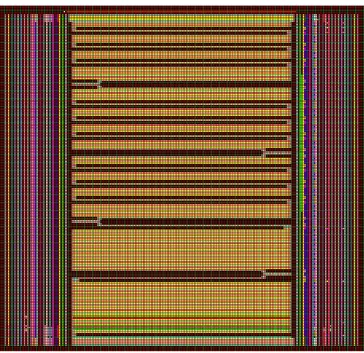
In order to obtain a stable knit fabric that is not easily deformed, different knitting stitch
methods have been applied. In the Apex3 software program, different color numbers are used
to present different knit methods.
In this design, color number 3 (Front/back knit), No. 11 (Front tuck), No.16 (No needle
selection), No. 51 (Front knit without links process), No. 52 (Back knit without links process)
Figure 3.5 Tuck stitch
Figure 3.6 Miss stitch
Front/back knit (double jersey) is performed with the needle beds in the 1/4 pitch left
position. Figure 3.5 shows a schematic of a front tuck stitch. No needle selection means then
needle is not activated and the structure is made with jumping the yarn. The floating yarn
with a miss goes through the back of the old loops. Figure 3.6 shows a miss structure. Figure
part of it. Yellow spots mean color number 3, red means No.51, green means No. 52, pink
represents No. 11, and cyan is No. 16.
In our first attempt in design the fabric, sparks were found to occur at the ends of each
conducting course. Three different programs were developed with different end lengths at
each course of the conductive yarns to determine the optimal length: missing 8 needles, 12
needles and 16 needles respectively (Figure 3.7, 3.9, 3.10)
Figure 3.11: Experiment setup for testing current
3.4 Experiment Setup
Figure 3.11 shows the setup for testing the effect of applied voltage on the discharge current.
3.5 Experiment Results and Discussions
Table 3.1 shows the measured voltage and current for the knit fabric with 8 missing needles
integrated with a thinner monofilament stainless steel wire (0.05 mm), a thicker wire (0.1
mm) and a multifilament yarn (0.401 mm). The knit fabric integrated with a multifilament
stainless steel yarn as electrode has the best ability to generate plasma compared with the
monofilament wires. The current is much higher for the same applied voltage and it is more
sensitive to changes in voltage. Sparks were observed to occur t at the ends of each
conductive yarn course, so two more patterns (ending with 12 missing needles and 16
missing needles) were designed to improve its ability to withstand high voltages without
arcing. (Figure 3.12).
Table 3.1: Current varies with voltage applied for 3 kinds of electrodes in corona discharge
Voltage (kV) Current (mA)
0.05 mm wire 0.1 mm wire 0.401 mm yarn
2 0.02 0 0.01
3 0.03 0.01 0.01
4 0.04 0.01 0.03
5 0,05 0.02 0.08
6 0.07 0.02 0.25
7 0.08 0.02 0.76
In order to test the filtration property of the designed fabric, samples were produced to match
the square dimensions of the testing chamber. Narrow samples had to be developed by
modifying the program. Fabric samples with PET and PP yarns respectively were produced
(figure 3.13) to find out whether these yarns were suitable. It turns out that the filler base
yarn material has little influence on generating plasma. Therefore, PP yarn was chose for
further studies because its high heat resistance and low cost.
4. FILTRATION PROPERTY TESTS 4.1 Experimental Setup
The experimental setup, shown in Figure 4.1 is comprised of an atomizer, diffusion dyrer,
test chamber, electrostatic classifier, and condensation particle counter. Figure 4.2 shows a
schematic of the test proceedure. Compressed air at 20 psi is supplied to the atomizer that
generates a salt spray from a 0.01 g/L NaCl deionized water solution. Moisture from the
air/salt aerosol is removed using a diffusion dryer containing a silica gel desiccant to produce
an aerosol of NaCl nanoparticles with diameters ranging from 10 to 300 nm. The aerosol
then passes through a plenum to stabilize the stream and bring it to atmospheric pressure.
Figure 4.1: Experimental setup for filtration test
Compressed Air
Atomizer
Diffusion
Dryer Plenum
Test Chamber Electrostatic
Classi<ier CPC
The aerosol was then passed though the test chamber at a flow rate of 1 lpm. It was observed
that the flow rate varied by as much as 10 percent due to the salt particles deposited on the
impactor with time goes by. The inlet particle stream or unfiltered particles then flowed out
of the test chamber and into the Electrostatic Classifier, where only particles with specified
electrical mobility (or diameter) exited the instrument and were counted by the CPC
(Condensation Particle Counter). By varying the voltage on the plates in the classifier,
particles in a range of 30 to 300 nm can be studied. The CPC counts the number of particles
in a given volume per unit time to determine upstream and downstream particle counts.
4.2 Experiment Apparatus
4.2.1 Atomizer
The atomizer used in this experiment is a constant output atomizer TSI Model 3076. The
mean particle size of the generated aerosol varies between 0.02 to 0.3 micrometers.
Compressed air (20 psi) enters an orifice, and due to the Bernoulli effect, causes liquid in the
reservoir to be drawn into the airstream (figure 4.3). The liquid is atomized by the air jet.
Large droplets are removed and recycled back to the liquid reservoir by impaction while the
fine spray leaves and goes into the diffusion dryer.
4.2.2 Diffusion Dryer
Figure 4.4 shows a schematic of the desiccant diffusion dryer TSI Model 3062. This dryer
consists of two concentric cylinders. The inner cylinder is made of a wire screen and the
outer cylinder is made of Plexiglas. Silica gel desiccant is filled in the space between them,
which is used to absorb the moisture in the aerosol without obvious solid particles loss. The
silica gel is changed before each experiment with a moisture free desiccant that has been
4.2.3 Test Chamber
A 150 mm diameter polycarbonate test chamber was fabricated to hold the test sample, apply
a high voltage to create a plasma in the textile fabric, and allow an aerosol to flow through it.
The actual test sample is placed on a supporting structure that covers a 43mm x 93mm
rectangular opening. It is used to support the fabric during the fabric filtration tests. The
opening allows the aerosol, which comes from the desiccant dryer to pass though the test
fabric and enter the electrostatic classifier.
4.2.4 Electrostatic Classifier
An Electrostatic Classifier TSI Model 3080 is used together with a Long Differential
Mobility Analyzer 3081 (DMA) to classify particles from a range of 10 to 1000 nm. When an
aerosol passes through a radioactive krypton neutralizer, particles acquire a Boltzmann
charge distribution. Then in the DMA, these charged particles are separated according to
their electrical mobility in an electric field. Particle size can be calculated from the mobility
distribution.
The impactor is used to remover particles above a certain size. With time goes by, particles
will deposit on the impactor, which will influence the pressure drop across the nozzle.
Therefor, the surface of the impactor needs cleaning very 5-50 operation hours. It is cleaned
every testing day with a soft material soaked with alcohol. And a very small amount of
vacuum grease is applied to the impactor surface after cleaning.
4.2.5 Condensation Particle Counter
A TSI Model 3785 CPC is a water-based condensation particle counter. Aerosol particles are
surrounded by wetted media. Aerosol particles work as nuclei and water vapor will be
deposit on the particles to amplify particle sizes so that particles can be detected by the
optical system.
4.2.6 Aerosol Instrument Manager (AIM) Software and Scanning Mobility Particle Sizer
(SMPS) Spectrometer
AIM is used to collect and store sample data from instruments connecting to the computer. It
can display data in graphs and tables and gives statistical information. The SMPS system
measures the size distribution of aerosols in the size range from 2.5 nm to 1000nm. SMPS
classifies particle sizes with an Electrostatic Classifier, counts particle concentrations with
CPC, and analyzes data with AIM though a personal computer. Table 4.1 shows the settings
for the SMPS used in this experiment.
Table 4.1 SMPS settings
Classifier Model 3080
DMA 3081
Impactor Type 0.071 cm
CPC Model 3785
DMA Flow Rate (lpm) -‐ Sheath 10 times the aerosol flow rate
DMA Flow Rate (lpm) -‐ Aerosol Current actual aerosol flow rate
Table 4.1 Continued
Size Range Bounds (Diameter) The range of particle sizes to be
allowed to pass through
Scan Time (sec.) Up (default) – 120
Retrace (default) – 60
Scans per sample (under the
Scheduling Tab)
Number of scans required per
sample
Number of samples (under the
Scheduling Tab)
Number of samples required
Diffusion correction (under the
Physical properties tab)
Diffusion correction is
recommended for particle sizes
less than 50 nm
Particle density (under the
Physical properties tab) Based on the particle used
4.3 Experiment Process and Data Analysis
One of the goals of this research is to characterize the filtration efficiency of a polypropylene
knit fabric when it produces a room temperature plasma. Before testing can begin, the whole
system needs to be brought to steady state which takes about 3 hours. After steady state is
reached, it takes another three minutes to obtain data from a single scan, which consists of
data showing particle concentrations for a particular size ranging from 10 to 300 nm. Before
fabric is placed in the test chamber to get the number of particles that have passed though the
filter. When the fabric is not charged, the filtration efficiency is a result of the knit fabric
only. However, if the fabric is charged with a large enough voltage to sustain a room
temperature plasma, the filtration efficiency of corona discharge textile is measured. After 60
minutes, 20 sets of scans are acquired. Then the system acquires data for another 60 minutes
with an empty chamber to get the inlet particle numbers after the sample testing. We select
the last five scans of the first 60 scans and last five scans of the final 20 scans for the empty
chamber, then average them to obtain the expectation of inlet particle numbers, Nin. This forms our best estimate of the upstream particle density entering the test chamber. In
addition, the standard deviation for these ten sets of data is calculated. In a similar manner,
the results from last five scans of the downstream particle count, Nout is determined. Nout is the average value of particle density (particles per cubic centimeter) leaving the filter. The
standard deviation for these five scans are also calculated.
Filtration efficiency, E, is then defined as the percentage of particles captured by the filter or:
E = (Nin – Nout)/Nin (4.1)
or in terms of penetration, P = 1 – E. Filtration efficiencies were calculated as the applied
voltage to the fabric varied from 0 to 8.5 kV.
And the error bar for the filtration efficiency can be obtained from equation:
(4.2)
Errorbar= Average Concentration_OUT
Average Concentration_IN
! " # $ % & ' ( ) * + ,×
StandardDeviation (Concentration_IN)
Average Concentration_IN
! " # $ % & 2
+ StandardDeviation (Concentration_OUT)
Average Concentration_OUT
It indicates the variation in experiments over time and illustrates the maximum and minimum
bounds for the filtration efficiency. Then we can get a plot for the filtration efficiency with
different particle sizes.
4.4 Experiment Results and Discussions
4.4.1 Corona Discharge Ignition Voltage Study and Current – Voltage Relation in the Corona
Discharge
The ignition voltage of the corona discharge is defined in this research as the voltage at
which a current has been measured (0.01 mA). Repeated experiments have been done five
times each for two samples to measure the ignition voltage of this kind of corona discharge
textile. Figure 4.5 shows the testing results. The initial voltage varies slightly each time, but
all around 5 kV.
![Figure 2.2: relations between breakdown voltage and electrode spacing, pressure [19]](https://thumb-us.123doks.com/thumbv2/123dok_us/1324596.1165356/27.612.181.434.235.460/figure-relations-breakdown-voltage-electrode-spacing-pressure.webp)
![Figure 2.3: plasma status along the length between planar electrodes [22]](https://thumb-us.123doks.com/thumbv2/123dok_us/1324596.1165356/29.612.215.414.206.450/figure-plasma-status-length-planar-electrodes.webp)
![Figure 2.9: plasma status at different stages both for positive and negative corona discharge in a point-plate electrode apparatus [31]](https://thumb-us.123doks.com/thumbv2/123dok_us/1324596.1165356/37.612.229.397.240.529/figure-plasma-different-positive-negative-discharge-electrode-apparatus.webp)
![Figure 2.11: the schematic of the test chamber [38]](https://thumb-us.123doks.com/thumbv2/123dok_us/1324596.1165356/40.612.175.439.200.411/figure-schematic-test-chamber.webp)



![Figure 4.3: schematic of the operation principle for the atomizer Model 3076[39]](https://thumb-us.123doks.com/thumbv2/123dok_us/1324596.1165356/58.612.208.404.319.623/figure-schematic-operation-principle-atomizer-model.webp)