Type of the Paper (Article)
1
Rosetta Mission: Electron Scattering Cross Sections—
2
Data Needs and Coverage in BEAMDB Database
3
Bratislav P. Marinković 1,*, Jan Hendrik Bredehöft 2, Veljko Vujčić 3, Darko Jevremović 3 and
4
Nigel J. Mason 4
5
1 Institute of Physics Belgrade, University of Belgrade, Pregrevica 118, 11080 Belgrade, Serbia;
6
7
2 Universität Bremen, Fachbereich 2 (Biologie/Chemie), Institute for Applied and Physical Chemistry,
8
Leobener Straße 5, 28359 Bremen, Germany; [email protected]
9
3 Astronomical Observatory Belgrade, Volgina 7, 11000 Belgrade, Serbia; [email protected] ; [email protected]
10
4 Department of Physical Sciences, The Open University, MK7 6AA, Milton Keynes, UK;
11
12
* Correspondence: [email protected]; Tel.: +381-11-316-0882
13
Abstract: The emission of [O I] lines in the coma of Comet 67P/Churyumov-Gerasimenko during
14
the Rosetta mission have been explained by electron impact dissociation of water rather than the
15
process of photodissociation. This is the direct evidence for the role of electron induced processing
16
has been seen on such a body. Analysis of other emission features is handicapped by a lack of
17
detailed knowledge of electron impact cross sections which highlights the need for a broad range of
18
electron scattering data from the molecular systems detected on the comet. In this paper we present
19
an overview of the needs for electron scattering data relevant for the understanding of observations
20
in coma, the tenuous atmosphere and on the surface of 67P/Churyumov-Gerasimenko during the
21
Rosetta mission. The relevant observations for elucidating the role of electrons come from optical
22
spectra, particle analysis using the ion and electron sensors and mass spectrometry measurements.
23
To model these processes electron impact data should be collated and reviewed in an electron
24
scattering database and an example is given in the BEAMD, which is a part of a larger consortium
25
of Virtual Atomic and Molecular Data Centre – VAMDC.
26
Keywords: electron scattering; cross sections; Rosetta mission; atomic and molecular databases
27
28
1. Introduction
29
The Rosetta spacecraft was launched in 2004 as a part of the European Space Agency (ESA) space
30
program, with the mission to rendez-vous with, orbit and place a lander upon periodic comet
31
67P/Churyumov-Gerasimenko. Rosetta was in orbit with the cometary nucleus from 2014 to
32
September 2016 during which time it was able to closely examine how the coma of the comet and the
33
frozen comet’s surface changed relative to distance from the Sun. On November 2014 Rosetta
34
dispatched a lander, Philae, which touched down on the comet’s surface and recorded, for the first
35
time, in situ data from the surface. This pioneering mission has provided us with new and unexpected
36
data that are changing our understanding of the structure and chemistry of cometary systems and
37
their role in the evolution of our solar system and possible origins of life on Earth. For example, the
38
D to H ratio in cometary water ice is very different from that on Earth and, among the other similar
39
findings, challenges the hypothesis that water on Earth was brought by cometary impact [1].
40
In this paper we will review another intriguing and unexpected result from the Rosetta mission
41
namely the role of electron induced dissociation in the comet’s coma. The data needed to model
42
electron processes in cometary coma and its possible relevance to the formation, but also the
43
dissociation and fragmentation of molecules observed by Rosetta instruments will be discussed
44
together with the current data available and the databases in which such data may be found.
45
2. Rosetta instruments and their observation of electron scattering processes in the cometary
46
coma
47
Rosetta orbiter carried eleven different complex scientific instruments, while the Philae lander
48
had ten instruments. Only those that are immediately relevant for the case study of the role of
49
electrons in comas and the detection of more complex species that may be formed by electron induced
50
chemistry will be reviewed here.
51
2.1. FUV emissions measured by the ALICE instrument
52
ALICE was a far-ultraviolet (FUV) imaging spectrograph that could specially resolve spectra in
53
the range from 70 to 205 nm. Coma emission and the reflected solar spectrum from the nucleus were
54
recorded using ALICE throughout the Rosetta encounter. The coma was identified by a spectrum
55
that contains several features that are weak in the solar spectrum and do not appear in the reflected
56
light from the nucleus [2]. Beside strong hydrogen Lyman lines, lines from oxygen multiplets at 98.9,
57
115.2, 130.4 and 135.6 nm were observed, as were weak multiplets from carbon C I lines at 156.1 and
58
165.7 nm and emission bands coming from CO. The surprise was the O I line at 135.6 nm, originated
59
from the forbidden transition 5So – 3P since this is usually not seen in comas. The presence of this line
60
and the intensity ratio of H I and O I multiplets is characteristic of the process of electron dissociative
61
excitation of water molecules [3] and led Feldman et al. [2] to establish that electron collisions with
62
H2O is the dominant source of these emissions. Similarly they attributed C I emissions to electron
63
dissociative excitation of CO2. The relative contribution of the UV and electron impact to the
64
dissociation processes are dependent on the location with respect to the nucleus and the heliocentric
65
distance as discussed in [4,5].
66
2.2. Observations from the OSIRIS instrument
67
OSIRIS (Optical, Spectroscopic, and Infrared Remote Imaging System) was one of Rosetta’s
68
major imaging systems equipped with a wide-angle camera (WAC) and a series of narrow band filters
69
covering range from 245 to 640 nm and two broad band filters, green and red, covering the spectra
70
up to 720 nm. This instrument recorded coma emission lines and specifically targeted to the
71
transitions of O, OH, CN, CS, NH, and NH2. The mapping of water distribution was possible
72
indirectly through observations of O I and OH bandpass filters. The O I filter covers the forbidden
73
transitions from the O I (2p4) 1D state which is populated directly by photodissociation of H2O
74
molecules, while the OH filter covers the (0–0) band of the A 2Σ+ - X 2Π transition of OH, centered at
75
about 308.5 nm, which is excited almost entirely by fluorescence of sunlight as pointed out in [6]. The
76
O I 1D state can be also populated from the transition from the O I (2p4) 1S state. Within the CN filter
77
lies an emission line B2Σ+ – X2S+ (0, 0) at 388 nm, within the NH2 filter there is a wide emission band
78
à 2A1 – X 2B1 (0, 10, 0), and the NH filter covers the NH A3Π1 – X3Σ− (0–0) transition [6].
79
From this data Bodewits et al. [6] derived column densities and calculated global production
80
rates using the standard Haser model. They found that the water production rates derived from OH
81
are larger than those derived from [O I], OH and [O I] photolysis. Indeed they analysed all production
82
rates and found a much larger drop in water production rates than diurnal variation can explain.
83
Therefore they concluded that the photo-dissociation and fluorescence could solely explain the
84
processes resulting in the OH, [O I], CN, and NH emission observed in the inner coma and that the
85
fragments might emanate from different parent species and/or be formed by other processes [6]. One
86
additional process is electron induced dissociation of water, when including this in their model a
87
much better fit was obtained, indeed electron driven dissociation of water was found to be dominant
88
in agreement with Feldman et al. [2].
89
2.3. Detection of Organic molecules on the comet surface – COSAC mass spectrometry
90
The COSAC (COmetary SAmpling and Composition) experiment and Ptolemy were two gas
91
analysers on the Philae lander built to monitor the chemical composition of the surface of comet 67P.
92
Due to difficulties in landing Philae was not able to deploy all of its instruments as planned and the
drill could not be deployed to collect samples for in-situ analysis. However, seven measurements
94
were made by both COSAC and Ptolemy during Philae’s hopping and at its final landing site in a
so-95
called ‘sniff mode’ that had no active sampling, but rather just ionized whatever molecules were
96
present in the ionization chamber of the mass spectrometer. The sample with the richest data was
97
acquired a few minutes after the first touchdown with subsequent decay of signal strength in the
98
other six measurements. Both instruments measured a nearly identical decay of both the water (m/z
99
18) and CO (m/z 28) peaks. However, in the COSAC measurements the peak at m/z 44 decays much
100
slower than all the other ion species, including the water peak and, the m/z 44 peak also decays much
101
slower in the COSAC measurements than in the Ptolemy data. From these results it has been
102
concluded that COSAC analyzed a regolith sample from the cometary nucleus in situ while Ptolemy
103
measured cometary gas from the ambient coma [7].
104
The compounds detected by COSAC are listed in Table 1. All of the larger molecules can be
105
formed from the smaller compounds carbon monoxide (CO), methane (CH4), water (H2O) and
106
ammonia (NH3) by simple addition reactions [8]. The m/z 44 peak measured by COSAC was likely
107
dominated by organic species, e.g from acetaldehyde (C2H4O), formamide (HCONH2) and acetamide
108
(CH3CONH2), whereas the peak measured by Ptolemy was interpreted to be mostly due to CO2.
109
Recently, a comparison and comparative analysis of the Rosetta mass spectrometers
110
(COSAC/Ptolemy/ROSINA) that puts some question mark on the presence of some of the
nitrogen-111
bearing species was presented [9]. Ptolemy measurements confirmed many of the species observed
112
by COSAC and through observation of regular peaks in the observed mass distributions indicated
113
the presence of a sequence of compounds with additional -CH2- and -O- groups (mass/charge ratios
114
14 and 16, respectively) which confirms COSAC’s observations of acetaldehyde and may be
115
explained by the presence of a radiation-induced polymer at the surface. Ptolemy measurements also
116
indicated an apparent absence of aromatic compounds such as benzene and neither H2S nor SO2 were
117
observed [10]. Ammonia believed to be the precursor of N containing compounds was not
118
unambiguously detected by either Ptolemy or COSAC, probably due to its tendency to adsorb on
119
stainless steel surface.
120
Table 1: List of molecules identified on the comet nucleus of comet 67P by the COSAC instrument
121
[8]. Abundances are given normalized to water, which is the most abundant compound.
122
Name of compound Sum formula Abundance wrt water
Methane CH4 0.5%
Water H2O 100%
Hydrogen cyanide HCN 0.9%
Carbon monoxide CO 1.2%
Methylamine CH3NH2 0.6%
Acetonitrile CH3CN 0.3%
Isocyanic acid HNCO 0.3%
Acetaldehyde CH3CHO 0.5%
Formamide HCONH2 1.8%
Ethylamine C2H5NH2 0.3%
Methyl isocyanate CH3NCO 1.3%
Acetone CH3COCH3 0.3%
Propionaldehyde C2H5CHO 0.1%
Acetamide CH3CONH2 0.7%
Glycolaldehyde CH2OHCHO 0.4%
Ethylene glycol HOC2H4OH 0.2%
Recent experiments on the irradiation of ice mixtures reveal that many of the larger molecules
123
can be formed by electron bombardment, often at low energies and this will be discussed further in
Section 5. Indeed bombardment and dissociation of ice species has been proposed as a route by which
125
molecular oxygen can form. One of the most unexpected observations of Rosetta through the Rosina
126
instrument was the detection of molecular oxygen as the fourth most abundant gas in the atmosphere
127
of comet 67P. Oxygen is reactive so it was felt that it is unlikely to survive long periods in space. The
128
amount of molecular oxygen detected showed a strong relationship to the amount of water measured
129
at any given time, suggesting that their origin on the nucleus and release mechanism are linked and
130
that irradiation of water ice leading to oxygen production and storage in the ice is a plausible
131
mechanism for oxygen formation on a comet [11].
132
2.4. Electrons in the Cometary coma
133
That there are copious amounts of electrons to induce such dissociative excitation was confirmed
134
by ion and electron sensors (RPC-IES) on the Rosetta craft. Concentrations of particles and their time
135
evolution in inner coma plasma was measured by Rosetta Plasma Consortium (RPC) [12] using a set
136
of sensors developed for this purpose. The Ion and Electron Sensor (IES) was an electrostatic plasma
137
analyzer that covered an energy/charge range from 1 eV/e to 22 keV/e with a resolution of 4% [13].
138
The sensor provided 3D ion and electron distributions over the whole measured energy range. It was
139
capable of simultaneously measuring electrons and positive ions with the single entrance aperture
140
owing to two back-to-back top-hat geometry analyzers. The LAP instrument (Langmuir probes)
141
measured the plasma density in the range of (100 – 106 cm-3), electron temperature (102 – 105 K) and
142
plasma flow velocity (up to 104 ms-1). The LAP also measured the AC electric field up to 8 kHz [14].
143
The LAP was complemented by the Mutual Impedance Probe, MIP which probes the plasma and
144
measured the natural plasma frequency which yields the electron density in the range from 2 cm-3 to
145
1.5 x 105 cm-3 and temperature from 30 K to 106 K [15].
146
Depending on the comet distance from the Sun, both the solar wind and solar radiation interact
147
with its nucleus and inner coma shielded by comet’s own atmosphere and ionosphere. Cometary ions
148
are created by photoionization of neutral species, mainly like H2O and CO2 and their products from
149
photodissociation, and by charge transfer with solar wind protons [16]. Solar wind electrons in
150
interplanetary space typically have Maxwellian distribution functions with thermal energies of
151
several eV to tens of eV [13]. This energy distribution of electrons differs from one created by
152
photoionization of cometary neutrals by solar radiation in the cometary comas at certain distances
153
from the Sun. Electrons of cometary origin are mainly the product of photochemistry, originating
154
from direct photoionization and from Auger processes. They are thermalized by collisions, elastic
155
and inelastic.
156
The electron density in the coma was measured complementary by the RPC Langmuir Probe
157
(LAP) and Mutual Impedance Probe (MIP). The first findings of the spatial distribution of the plasma
158
near comet 67P/CG showed a highly structured pattern that indicated an origin from local ionization
159
of neutral gas. The electron density fell off with distance as 1∕r in the range from 8 km from the nucleus
160
up to 260 km [17]. Edberg et al. [17] concluded that this is in accord with a model in which the
161
ionization of a neutral gas is expanding radially from the comet nucleus and when there is no
162
significant recombination or other loss source for the plasma. However, they warned that the
163
observed data have a large scatter around fitted 1∕r curve and that results could be an average effect
164
of combination of transport electric fields and solar wind.
165
From such data the suprathermal energy distribution of electrons could be derived. The electron
166
energy distribution near the comet depends on the comet distance from perihelion and mass loading
167
process when the atoms and molecules in the cometary coma are photoionized and then interact with
168
the solar wind flow. It spans from the energy distribution of the solar wind itself to the modified
169
distribution where electrons are significantly decelerated as a consequence of magnetic field causing
170
regions to pile –up. The mass loading process is connected to the outgassing rate of the comet. The
171
formation of suprathermal electrons which are accelerated from a few eV upward to hundreds of eV,
172
thus can play an important role in the electron driven chemistry of the comet. The Rosetta IES sensor
173
recorded the presence of suprathermal electrons at larger distances than expected from the previous
models of such weakly outgassing comets [18]. The observed electron energy distributions change by
175
reducing a heliocentric distance from pure solar wind distribution to non-Maxwellian one that
176
include suprathermal electrons showing maxima at energies from 10 eV to 300 eV [18]. Clark et al.
177
[18] hypothesize that the most likely mechanisms of creating accelerated electron distributions are
178
heating by waves generated by the pick-up ion instability, and the mixing of cometary
179
photoelectrons, secondaries and solar wind electrons.
180
Further statistical analysis of Rosetta IES sensor recordings by performing fitting procedures
181
that involve two separate sub-populations of electrons below and above 8.6 eV mean energy [19]
182
revealed different relationships between their density and temperature and possible mechanisms of
183
creating suprathermal electrons. Broiles et al. [19] suggested that electrons above 8.6 eV are being
184
heated by waves driven by counter streaming solar wind protons. This conclusion arises from the
185
observations that the population of electrons above 8.6 eV correlates well with the density of local
186
neutrals, while the sub-population below 8.6 eV is dominated by the local magnetic field strength.
187
Recently, Deca et al. [20] have used a fully 3D kinetic model to simulate the ion and electron dynamics
188
of the solar wind interaction with a weakly outgassing comet 67P. They used a detailed kinetic
189
treatment of the electron dynamics in order to cover energy distribution of electrons and to identify
190
the origin of the warm and suprathermal electrons.
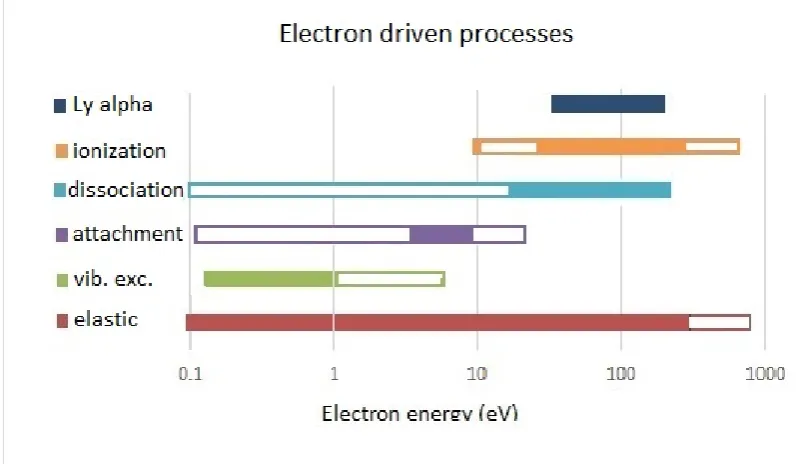
191
Electron energy ranges that correspond to the relevant processes in electron collisions with
192
atoms and molecules are shown in Figure 1. The elastic cross section is dominating over low electron
193
energies and usually is prominent even at higher energies where the ionization cross section becomes
194
comparable in magnitude. Vibrational excitations are important at low energies but they also extend
195
to higher energies due to resonance decay. Attachment and dissociation processes are relevant in
196
certain domains, in water between 6 to 9 eV and 20 to 200 eV, respectively (see the summery figure
197
of cross sections in [3]), but due to dissociative electron attachment (DEA) these processes may extend
198
to very low energies. The production of radiation due to de-excitation depends on excitation energy
199
levels. For water molecule production of Lyman alpha radiation has a high cross section in the
200
electron energy range from 50 to 200 eV.
201
202
Figure 1. Electron energy ranges that correspond to the relevant processes in collisions with atoms
203
and molecules. Full color correspond to the specific case of water (data taken from Itikawa and Mason
204
[3]) while the open bars are extended ranges that correspond to the majority of atomic species: red,
205
elastic scattering; green, vibrational excitations; violet, attachment; blue, dissociation; orange,
206
ionization; darkblue, Lyman alpha.
3. Atomic and molecular data needed for analysing electron scattering processes relevant to
208
Comet 67P
209
Despite the evidence for electron induced processes in comets many of the discrete collision
210
processes necessary to quantify such electron driven chemistry remain uncertain. In order to develop
211
a predictive model of cometary coma and the comet’s ‘atmosphere’ it is necessary to assemble a
212
‘database’ of relevant electron collision processes with the different atomic and molecular species
213
observed (or indeed inferred) from Rosetta. As discussed above Rosetta’s ROSINA, as well as
214
Ptolemy and COSAC on the Philae lander, have revealed a rich chemical inventory that would
215
require a large atomic and molecular physics database to model all possible processes. However if a
216
sensitivity analysis is performed the number of important species contributing to the model may be
217
reduced to a minimum (more manageable) number of reactions. The dominant molecules are water,
218
CO and CO2. The presence of HCN as the source of CN radicals and ammonia as source of NH and
219
NH2 is widely accepted while the simple hydrocarbons C2H2 and C2H6 are assumed to be the source
220
of C2, indeed C2H6 concentrations were unusually high in comet 67P [21]. Methane has been identified
221
in many comets and is found in comet 67P. As discussed above several oxygen containing species
222
were detected and apart from the ubiquitous water methanol CH3OH may be an important primary
223
compound. The primary source of sulphur compounds may be H2S but 67P is depleted in all other
224
sulphur bearing species (CS2, OCS and SO2) compared to other comets [22]. Thus in developing an
225
electron chemistry model of comet 67P it is necessary to have a good data base for electron
226
interactions with H2O, CO, CO2, CH4, C2H6, CH3OH, NH3, HCN and H2S. The status of such a
227
database will be discussed below but first it is necessary to understand the corollary for a ‘good’
228
database.
229
3.1 Databases
230
Many databases exist in order to assemble datasets and communicate them to different
231
audiences. The NIST database collection (https://srdata.nist.gov/gateway/gateway?dblist=0) is one of
232
the best known providing details of the structure, spectroscopy and fundamental parameters
233
(ionization and dissociation energies) of many atoms and molecules. The need for large datasets has
234
led to several communities investing in establishing data centres which assemble and maintain
235
databases. For example, the fusion community has, for several decades, compiled databases in order
236
to model plasmas in tokamak reactors and to provide data for diagnostic tools used in such plasmas.
237
Another example of large collection of collisional data is the LXCaT database [23] that provides
238
electron and ion scattering cross sections, swarm parameters (mobility, diffusion coefficient, etc.),
239
reaction rates, energy distribution functions, etc. and other data required for modeling low
240
temperature plasmas. Similarly the astronomical community has needed large databases to interpret
241
its observations, these include not only spectroscopic databases but also databases of chemical
242
reaction rates (e.g. KIDA [24]) are necessary to understand the rich inventory of molecules that have
243
been observed in the interstellar medium.
244
Many databases are simple collections of data but more recently the design and operation of
245
databases has been refined. The development of IT tools has allowed data to be provided on-line,
246
downloadable in a range of formats and allows new data to be added quickly, ensuring that the data
247
is up to date. Previously data was reviewed and published in journal reviews which once published
248
became gradually out of date until the next review, often a decade later (e.g. [25]). The opportunity
249
to add new data quickly not only ensures that the latest data is adopted by the community but also
250
reduces the likelihood of fragmentation amongst the community with different groups using
251
different data sets in accord with their knowledge (or more commonly lack of knowledge) of the data
252
available.
253
Simple assembly of data alone is not, however, the most effective form of databases. The ‘user’
254
community requires guidance as to what data to adopt. Users rarely have the necessary experience
255
to select one dataset over another and therefore each may choose different sets, leading to systematic
256
problems. For example if different datasets are used in different models, cross comparison of such
models is difficult and it may be hard to distinguish between the different physical and chemical
258
hypotheses in different models from the data used in the model to explore such effects. Therefore
259
databases should provide ‘recommended data’ which is the data that the expert community
260
providing such data believes is the optimal data reflecting state of the art measurements or
261
calculations. These values can be updated as new data becomes available. However, when changing
262
recommended data, it is essential to ensure that it is still ‘consistent’ For example in presenting a
263
comprehensive set of electron impact cross sections the individual cross sections (elastic and inelastic
264
(including ionization excitation etc.) should, when summed, be consistent with the recommended
265
data for total cross sections. Databases should also present data with stated estimates of uncertainties,
266
particularly when presenting its own composite data from several different datasets.
267
3.2 VAMDC and BEAMDB databases
268
The Virtual Atomic and Molecular Data Centre - (VAMDC) and Belgrade Electron Atom and
269
Molecule Database – (BEAMDB) are two examples of new generation of databases. The VAMDC
270
Consortium is a worldwide consortium which federates atomic and molecular databases through an
271
e-science infrastructure to provide easy access to data from different databases via a single portal
272
http://portal.vamdc.eu . About 90% of the inter-connected databases are focused on data that are used
273
for the interpretation of astronomical spectra and for modelling in many fields of astrophysics and
274
astrochemistry, although recently the VAMDC Consortium has connected databases from the
275
radiation damage and the plasma communities which makes it suitable for medical and industrial
276
applications [26]. While VAMDC does not itself select and analyse data it ensures data from its
277
component databases are accessible in a single format and ascribe to general good practices as
278
discussed above. The VAMDC Consortium includes new databases and services on a case by case
279
basis during annual general scientific and technical meetings.
280
VAMDC provides its data in a XSAMS output. XSAMS is an XML representation of an atomic
281
and molecular data model. The system allows for distributed querying of data via the VAMDC-TAP
282
protocol, an implementation-agnostic standard, where data providers can build their models in their
283
own fashion and map them to the VAMDC model via a dedicated dictionary [27].
284
The Belgrade Electron Atom and Molecule Database – (BEAMDB) [28] is an application,
285
database and a VAMDC node which contains data for elementary processes of electron scattering by
286
atoms and molecules. The database covers collisional data of electron interactions with atoms and
287
molecules in the form of differential and integrated cross sections as well as energy loss spectra. The
288
data is stored in a relational (MySQL) database, upon a static model specifically suited to this dataset
289
but easily extendable. There have already been several migrations of the model, the latest of which is
290
an extension to enable storing non-neutral molecules. Currently, there are 22 species stored in the
291
database (11 atoms and 11 molecules), presented in 71 states, involved in 59 collision processes. The
292
web interface (http://servo.aob.rs/emol) enables on-site querying of data via an AJAX-enabled web
293
form. The application is implemented in Django, a Python web framework and hosted on an Apache
294
web server at the Astronomical Observatory in Belgrade.
295
The BEAMDB is a collisional database where several types of collisions are included: Elastic,
296
Electronic Excitation, (Total) Inelastic, Ionization, and Total Scattering as well as electron
297
spectroscopic data such as Energy-loss Spectra and Threshold Photoelectron Spectra. Cross sections
298
are of several different kinds: Differential, Integral, Total, Momentum Transfer, Viscosity. Specific
299
data that are maintained in the BEAMDB are differential cross sections (DCS) for elastic scattering
300
and excitation of atoms and molecules. These are 3D entries since DCS depend on both electron
301
impact energy and scattering angle. This requires two X columns while the Y column is also
302
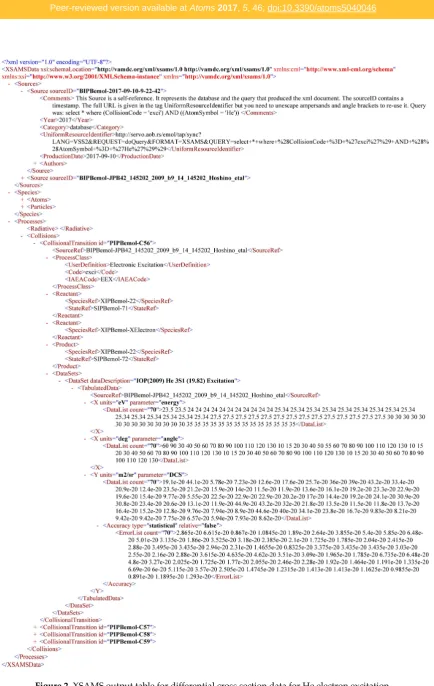
associated with the column representing uncertainty of data points. An example of the XSAMS
303
output of such kind of data for He excitation is shown in Figure 2.
305
Figure 2. XSAMS output table for differential cross section data for He electron excitation.
306
Producing a plot of DCS data is not available at the current stage of database development, but
307
such data can be visualized by using either VAMDC portal or alternatively the RADAM (RADiation
308
DAMage) database portal (http://radamdb.mbnresearch.com/). The general structure of RADAM
309
databases covers electron/positron interactions, ionic and photonic interactions, multiscale radiation
damage phenomena and radiobiological phenomena occurring at different time, spatial and energy
311
scales in irradiated targets [29]. Examples of DCS surfaces for elastic electron scattering by helium
312
atom and formamide (CH3NO) molecule are shown in Figure 3 (a) and (b), respectively.
313
314
(a) (b)
Figure 3. DCS surfaces as retrieved from RADAM database [29] for elastic electron scattering by: (a)
315
He atom – data points are taken from ref. [30]; (b) Formamide molecule – data points are taken from
316
ref. [31].
317
Initially BEAMDB was designed to maintain data of electron collisions with neutral species,
318
atoms and molecules mainly in their ground state and exceptionally in excited state. However, by
319
broadening the scope toward astrophysical applications, more specifically to the processes of comas
320
that involve electrons, the database has been upgraded to include electron collisions with ions. The
321
most recent data set included in BEAMDB is the one of electron ionisation cross sections of CN+
322
cations [32]. In the next few months BEAMDB will expand to include many more molecular systems
323
including those needed to study the electron chemistry of comet 67P.
324
4. Electron scattering processes and cross sections – Data needs
325
To understand, and treat by models, processes in cometary plasmas is a very challenging task
326
since many parameters need to be taken into account in order to cover the variety of comet types and
327
their heterogeneity. One has to consider the changing of comet distances from the Sun and hence the
328
level of irradiation and solar wind interactions both with the comet surface and cometary plasma
329
environment. Nevertheless, models have been developed and set of processes reviewed, including
330
data analysis used in such models. Particles from the solar wind, secondary electrons created in
331
plasmas and photoelectrons, produce further events of excitation, ionization and dissociation with
332
the consequence of enhanced chemical reactions and light emission. However comets are composed
333
of water, silicates and carbonaceous molecules (CO, CO2 and hydrocarbons) [33]. Recently, modelling
334
of plasma processes in cometary and planetary atmospheres have been performed by Campbell and
335
Brunger [34] with the emphasis on the role of electron-impact excitation processes. They concluded
336
in the case of comet Hale-Bopp that electron-impact could account for 40% of the fluorescence
337
emissions of the fourth positive bands (A1Π – X1Σ+) of CO [35] and thus reducing calculated
338
outgassing rates. Even more, their later paper [36] was focussed on electron initiated chemistry in
339
atmospheres.
340
Reviews of cross section data and processes that cover electron scattering and excitations are
341
numerous and they cover interactions with atoms [37,38], diatomic molecules [37,39], species in
342
interstellar clouds [40] or concentrate on specific targets of triatomic molecules like water [3] or CO2
343
and N2O [40]. Anzai et al. [41] stressed that any recommended values of cross section data currently
344
maintained in different databases, might need to be updated due to the development of new
experimental techniques and theoretical methods. The number of established benchmark cross
346
sections is rather small.
347
The energy of the electrons available for electron interactions with atoms and molecules in the
348
cometary coma ‘atmosphere’ is such that all electron scattering processes are relevant, thus a large
349
amount of data is required if a model of electron induced processing is to be included in a simulation
350
model of comet 67P. In this section the status of our knowledge of such relevant cross sections will
351
be reviewed for the primary molecules defined in Section 3.
352
4.1. Elastic electron scattering and cross sections
353
Elastic scattering conserves the kinetic energy of the colliding particles. This means that
354
quantum numbers that determine the energy are unchanged but other quantum numbers
355
corresponding to degenerate states (e.g. helicity or spin flip) may change. In the case of many
356
measurements not all states in the system are resolved due to the finite resolution of the electron
357
beams used. In this case ‘effective elastic cross sections’ are determined which may be referred to as
358
‘rotationally unresolved, vibrationally unresolved, electronically unresolved etc. Elastic scattering is
359
important since, although there are no immediate changes in the target the range and hence spatial
360
extent of the electrons is determined by such scattering.
361
Elastic cross sections are usually measured at specific energies and angles. These data are used
362
to determine the ‘total elastic cross section’ by integrating over the entire angular range (4π). The
363
total elastic cross section at given electron impact energy Eiis given by:
364
= ; , Ω, (1)
where ; , is the elastic differential cross section, (θ, φ) are the scattering angles and k is the
365
wave-vector magnitude.
366
Elastic scattering is one of the best-studied electron collision processes and provides one of the
367
best tests of developing theoretical calculations of electron-molecule scattering. The development of
368
the magnetic angle changing method [42] to extend differential cross section measurements to the
369
full range of scattering angles from 0° to 180° has significantly improved the accuracy of total elastic
370
cross sections, particularly for molecules with dipole moments, where elastic scattering is strongly
371
forward peaked.
372
Elastic scattering cross sections have been reported for all the primary molecules H2O, CO, CO2,
373
O2, CH4, C2H2, CH3OH, NH3, HCN and H2S. Elastic scattering cross sections for water have been
374
discussed in detail as part of a wider review of electron scattering from water by Itikawa and Mason
375
[3]. An updated review has recommended the corrected data of Khakoo et al. [43 and erratum] for
376
low energy scattering and Munoz et al. [44] for higher energies (where experiment and theoretical
377
evaluations merge). The benchmarking swarm paper by de Urquijo et al [45] on cross sections for
378
water that reproduced measured transport data in water/helium mixtures presented the integral
379
cross sections that are entirely self-consistent with the available total cross sections as well as the
380
swarm data over a large range of reduced electric field, E/N.
381
Cross sections for elastic scattering from methane and acetylene have recently been compiled
382
and evaluated by Song et al. [46,47]. Compilations of data for other molecules are less recent and
383
more fragmented and should be updated. Due to its toxicity there are few measurements of the elastic
384
scattering cross section from HCN and therefore there is more reliance on theoretical calculations
385
(e.g. Sanz et al. [48]).
386
In elastic collisions electrons do not lose energy, but change the direction of motion. This is
387
important for models where the kinetics of all particles is taken into account. In more dense plasmas
388
the elastic momentum transfer cross section, defined as integrated DCS with the weight of (1 – cosθ)
389
over all scattering angles, is a more relevant quantity. Differential cross sections, although being one
of the basic properties that defines electron – atom/molecule interactions, are known with relatively
391
low accuracy. In order to illustrate the current status of the agreement of DCS amongst different
392
experiments and theories, the case of absolute cross sections for elastic electron scattering by argon
393
atom is presented in Figure 4. It can be seen that although at first sight all values group around the
394
averaged values, it should be noted that the data are plotted on a logarithmic scale and that there is
395
almost an order of magnitude disagreement for particular data points.
396
397
Figure 4. DCS for elastic electron scattering by argon atom at 100 eV impact energy. The data symbols
398
used correspond to: (red circles) , Rankovic et al. [49] experiment; (dark red full line), Rankovic et al.
399
[49] theory; (margenta solid line), McEachran and Stauffer [50]; (olive dash dot line), Paikeday and
400
Alexander [51]; (dotted line), Nahar and Wadehra [52]; (violet dash dot dot line), Fon et al. [45]; (cyan
401
dash dot line), McCarthy et al. [54]; (dashed line), Joachain et al. [55]; (cyan up triangles), Milosavljević
402
et al. [56]; (violet left triangle), Panajotović et al. [57]; (orange pentagons), Srivastava et al. [58]; (blue
403
diamond), DuBois and Rudd [59]; (orange right triangles), Jansen et al. [60]; (green circles), Williams
404
and Willis [61].
405
4.2 Electron impact ionisation cross sections
406
Most of the ions observed in the comet ion tail are the result of photoionisation of the primary
407
ice species and since there are fewer high energy electrons, electron induced ionisation in comets is
408
likely to be a minor process in total ion yields. However the mass spectrometric analysis of
409
compounds observed on Rosetta (e.g. using the Rosina instrument) rely upon knowing the
410
fragmentation patterns of candidate molecules which, when compared with the instrument
411
sensitivity, can be used to calculate the relative abundances of the detected molecules. Traditionally
412
mass spectrometers operate with electron energies of 70 eV, close to but not at, the maximum of total
413
ionisation cross sections. Branching ratios for fragments of electron impact ionisation are available in
414
many databases (e.g. NIST Chemistry WebBook [62]) however, whilst these ratios are often known
415
the cross sections are not presented. These cross sections may be derived if the total ionisation cross
416
20
30
40
50
60
70
80
90 100 110 120 130 140 150
1E-3
0.01
0.1
1
10
DCS
(10
-20
m
2
sr
-1)
Scattering angle (
°
)
Rankovic et al 2017 exp Rankovic et al 2017 theory McEachran & Stauffer (2009) Paikeday & Alexander (2002) Nahar & Wadehra (1987) Fon et al (1983) Joachain et al (1977) Milosavljevic et al (2004) Panajotovic et al (1997) Srivastava et al (1981) DuBois & Rudd (1976) Jansen et al (1976) Williams & Willis (1975)
section is known. Total ionisation cross sections may be measured to an accuracy of <10% while
semi-417
empirical calculations provide reliable cross sections (at least above 100 eV). Data on all of the
418
primary molecules H2O, CO, CO2, CH4, C2H2, CH3OH, NH3, HCN and H2S exist with an accuracy
419
sufficient for providing reliable data for determining their concentrations in the cometary coma and
420
atmosphere. The recent review by Tanaka et al. [63] covered this topic in detail employing scaled
421
plane-wave Born models in order to provide comprehensive and absolute integral cross sections, first
422
for ionization and then to optically allowed electronic-state excitation.
423
4.3 Anion production
424
Anions have been observed in comets and may be formed by a variety of processes including
425
radiative electron attachment, polar photodissociation, proton transfer and Dissociative Electron
426
Attachment (DEA) where an incident electron is captured by the molecular target (AB) to form an
427
excited state of the molecular negative ion AB-. This state, a Temporary Negative Ion (TNI), generally
428
decays by ejecting the excess electron within a finite time (a process called autodetachment) but the
429
molecular negative ion may also decay through dissociation leading to the formation of a stable
430
negative ion B- and a neutral (often radical) fragment (A). DEA to the list molecules have been
431
studied, identifying the fragment channels, but there are few absolute cross sections. Node of
432
VAMDC, the IDEADB maintained by University of Innsbruck, that serves data about dissociative
433
electron attachment to molecules, lists more than 120 different fragments resulting from this process
434
[64]. Anion data from comet 67P is still under evaluation but earlier studies from the Giotto spacecraft
435
of comet 1P/Halley led to a combined chemical/hydrodynamic model for the coma of comet Halley
436
to explore various anion production mechanisms and compute the abundances of atomic and
437
molecular anions as a function of radius in the coma [65]. The dominant anion production
438
mechanisms are found to be polar photodissociation of water and radiative electron attachment to
439
carbon chains in the inner coma, followed by proton transfer from C2H2 and HCN to produce C2H
-440
and CN-, respectively. However, in the outer regions of the coma where electron temperatures reach
441
103–105 K, dissociative electron attachment may become a dominant process. Similar effects may be
442
understood for comet 67P. DEA to water yields H- and OH- and O- from CO and O2 so there are many
443
candidates for production of anions in comet 67P. DEA to all of the primary comet species (and most
444
of the larger more complex species in Table 1) has been reported with DEA fragments recorded from
445
near zero to the ionisation energy pathways. Nevertheless very few absolute cross sections are
446
available.
447
4.4 Electron impact excitation and dissociation
448
Electron impact excitation and dissociative excitation of molecular systems is a critical process
449
for a study of cometary coma and its tenuous atmosphere. As discussed above, OSIRIS and ALICE
450
data from Rosetta shows the electron induced dissociation of water may be the source of the O I line
451
at 135.6 nm while electron impact by CO and CO2 yields C I lines at 156.1 and 165.7 nm. However
452
this hypothesis is handicapped by the dearth of data on electron impact excitation and electron
453
induced neutral fragmentation for all molecules, not just those of immediate comet interest. This lack
454
of experimental data can be attributed to difficulties in measuring neutral atoms and molecules.
455
When an atom or molecule is in an excited state it may decay (fluoresce) with the emitted light being
456
detected. Such experiments may identify some fragmentation or de-excitation pathways but the
457
sensitivity of the optical detector and ability to ‘capture’ all of the emitted photons as well as the
458
problem of cascades from higher lying states into the decaying state make measurements of absolute
459
cross sections difficult. Furthermore some excited states decay to ‘dark’ non fluorescent or metastable
460
states which makes them hard to detect, although metastable fragments may be detected directly by
461
surface ionization they will suffer from the same problems as photon detection i.e. cascade
462
contributions may dominate [66,67]. Presently there are few experiments measuring electronically
463
excited fragments by optical or metastable spectroscopy and more experiments are to be encouraged,
464
building on the recent commissioning of electron induced fluorescence (EIF) experiment in Comenius
465
University Bratislava. Figure 5 shows the H atom spectra recorded by electron impact of molecular
hydrogen. This experiment is well equipped to study EIF of water, CO and CO2 as required for
467
cometary studies although, due to the low cross sections, data collection periods may be days or even
468
weeks placing stringent conditions on the stability of the incident electron and gas beams.
469
470
Figure 5. Electron induced fluorescence of the H2 molecule—Balmer lines and Fulcher α system.
471
Measurements performed by Danko et al. [68].
472
Electron Energy loss spectroscopy monitors the energy of the incident electron post collision and
473
may also be used to probe the direct excitation cross section of the parent molecule excited states but
474
cannot provide data on the fragmentation patterns of that excited state as it decays. Furthermore in
475
most molecules the electronically excited states are both close together and overlap their
ro-476
vibrational bands, making deconvolution very difficult if discrete electronic excitation cross sections
477
are to be derived.
478
Finally the production of neutral fragments in their ground state must be considered. Photon
479
and electron induced dissociation produces many fragments in their ground state where ground state
480
in this case includes fragments that are ro-vibrationally excited but still in the electronic ground state.
481
This low internal energy precludes their detection by fluorescence since IR detection has not proven
482
possible due to IR sources in the apparatus (e.g. electron filaments). Several alternative methods have
483
been proposed to detect ground state neutral fragments including using a second electron beam to
484
ionize the product, or use of surfaces to ‘getter’ the fragments. In the current context there are only
485
two experiments relevant to the modelling of electron dissociation of primary comet molecules that
486
of Harb et al. [69] measuring OH radical production from water and C and O from CO by Cosby et
487
al. [670] using a fast beam method.
488
Further experimental studies on electron impact dissociation to neutral fragments will not only
489
benefit the cometary community but the wider electron chemistry community with applications in
490
many plasma systems, aeronomy and radiation chemistry. However given the experimental
491
difficulty much of the necessary data may be provided by theoretical calculations which require more
492
detailed exploration.
5. Possibility of electron induced surface chemistry
494
As discussed above (Section 2.3) many of the larger more complex molecules observed by
495
COSAC and Ptolemy on the Philae lander may be made by addition reactions from simpler
496
molecules. How are such reactions induced? Photodissociation has been considered the primary
497
process but electron induced chemistry within ices has been shown to be an efficient route to
498
molecular synthesis and simple electron irradiation of primary ices has been shown to be produce
499
most (all) of the larger molecular species. For example Figure 6 shows the yield of formamide in an
500
ice film composed of CO and NH3 as a function of electron energy [71]. The ice was prepared with a
501
mixing ratio of 1:8 and thickness corresponding to 12–18 monolayers and an electron exposure of 200
502
μC/cm2. Formamide is readily formed and the resonance like feature between 6 and 12 eV is
503
characteristic of the synthesis by reactants prepared in a dissociative electron attachment process [71].
504
Similar experiments have shown that as many as 15 products can be formed by electron irradiation
505
of pure methanol ices [72] including ethylene glycol and methyl formate whilst formamide HCONH2
506
is formed in irradiation of binary mixtures of ammonia and methanol ice and the simplest amino acid
507
glycine from irradiation of a methylamine and carbon dioxide ice [73]. Thus electron induced
508
synthesis of simple cometary ices may be a route to formation of several of the organic species
509
observed in surface material from comet 67P.
510
511
Figure 6. The production of formamide present in mixed multilayer films of CO and NH3. The
512
resonance like feature (red line) between 6 and 12 eV is characteristic of the synthesis of formamide
513
by reactants prepared in a DEA process, Bredehöft et al. [71].
514
The route by which molecular oxygen was formed as the fourth most abundant compound in
515
the coma observed by Rosetta, is still subject to debate. However laboratory experiments [74,75] have
516
shown that radiolysis of water by both electrons and photons yields molecular oxygen but also
517
copious amounts of hydrogen peroxide. Furthermore, comparative experiments between photon and
518
electron irradiation show that electron induced yields are higher for the same energy. Whether this
519
is due to penetration depth of electrons or that electrons open more dissociative pathways (through
520
dipole or spin forbidden transitions) is unknown. The role of electron induced chemistry in comets,
521
in ice covered planetary and lunar objects and in the rich chemistry of the interstellar medium is
522
therefore an emerging topic of modern astronomy and one that has been encouraged by the results
523
of the Rosetta mission.
524
6. Conclusions
525
In this paper we have presented a review of recent results from the Rosetta mission to comet
526
67P/Churyumov-Gerasimenko. The role of electron induced processes has been highlighted with the
527
emission of [O I] lines in the coma explained by the process of electron impact dissociation of water.
528
The role of other electron processes e.g. in the production of the unexpectedly large amounts of
529
molecular oxygen in the coma, is handicapped by lack of detailed knowledge of electron impact cross
530
1 3 5 7 9 11 13 15 17 19
Formamide
abundance
[a.u.]
sections We have reviewed the need for electron scattering data and discussed how such data should
531
be collated and reviewed in electron scattering databases. The BEAMD database which is a part of a
532
larger consortium of Virtual Atomic and Molecular Data Centre – VAMDC has been used as an
533
example of modern generation of databases.
534
The importance of electron processes in comet 67P/Churyumov-Gerasimenko highlights the
535
need for closer interactions and joint projects between the cometary and electron communities and
536
this paper has identified some topics for joint research.
537
Acknowledgments: BPM recognizes support from MESTD-RS project #OI 171020 and the grant under 2016
538
VAMDC Consortium Call-#1. VV and DJ recognizes support from MESTD-RS project #III 44002. NJM recognizes
539
support from Europlanet 2020 RI which has received funding from the European Union's Horizon 2020 research
540
and innovation programme under grant agreement No 654208 and ELEvaTE grant agreementno :692335 as well
541
as support of the UK STFC and Leverhulme trust. We thank to Dr. Juraj Országh for providing us with the
542
unpublished figure of hydrogen spectrum (Fig. 5).
543
Author Contributions: BPM wrote sections 2.1, 2.2, parts of section 3 and provided figures 1-4. JHB wrote section
544
2.3, provided figure 6 and table 1 and provided language editing. VV and DJ wrote section 3.2. NJM wrote
545
sections 2,4,5 and edited the paper. BPM is responsible for maintaining electron cross section data in BEAMDB,
546
while VV and DJ are responsible for maintaining database according to the VAMDC standards.
547
Conflicts of Interest: “The authors declare no conflict of interest."
548
References
549
1. Altwegg K.; Balsiger H.; Bar-Nun A.; Berthelier J.J.; Bieler A.; Bochsler P.; Briois C.; Calmonte U.; Combi
550
M.; De Keyser J.; Eberhardt P.; Fiethe B.; Fuselier S.; Gasc S.; Gombosi T.I.; Hansen K.C.; Hässig M.; Jäckel
551
A.; Kopp E.; Korth A.; Le Roy L.; Mall U.; Marty B.; Mousis O.; Neefs E.; Owen T.; Rème H.; Rubin M.;
552
Sémon T.; Tzou C.-Y.; Waite H.; Wurz P. 67P/Churyumov-Gerasimenko, a Jupiter family comet with a high
553
D/H ratio. Science, 2015, 347(6220), 1261952, DOI: 10.1126/science.1261952
554
2. Feldman P.D.; A’Hearn M.F.; Bertaux J-L.; Feaga L.M.; Parker J.Wm.; Schindhelm E.; Steffl A.J.; Stern S.A.;
555
Weaver H.A.; Sierks H.; Vincent J-B. Measurements of the near-nucleus coma of comet
67P/Churyumov-556
Gerasimenko with the Alice far-ultraviolet spectrograph on Rosetta. Astron Astrophys 2015, 583, A8 (8pp)
557
DOI: 10.1051/0004-6361/201525925
558
3. Itikawa Y.; Mason N. J. Cross Sections for Electron Collisions with Water Molecules. Phys. Chem. Ref. Data,
559
2005, 34, 1-22 , DOI: 10.1063/1.1799251
560
4. Galand M.; Héritier K. L.; Odelstad E.; Henri P.; Broiles T.W.; Allen A.J.; Altwegg K.; Beth A.; Burch J.L.;
561
Carr C.M.; Cupido E.; Eriksson A.I.; Glassmeier K.-H.; Johansson F.L.; Lebreton J.-P.; Mandt K.E.; Nilsson
562
H.; Richter I.; Rubin M.; Sagnières L.B.M.; Schwartz S.J.; Sémon T.; Tzou C.-Y.; Vallières X.; Vigren E.; Wurz
563
P. Ionospheric plasma of comet 67P probed by Rosetta at 3 au from the Sun. MNRAS, 2016, S331-S351,
564
DOI:10.1093/mnras/stw2891
565
5. Altwegg K.; Balsiger H.; Berthelier J.J.; Bieler A.; Calmonte U.; Fuselier S.A.; Goesmann F.; Gasc S.; Gombosi
566
T.I.; Le Roy L.; de Keyser J.; Morse A.; Rubin M.; Schuhmann M.; Taylor M.G.G.T.; Tzou C.-Y.; Wright I.
567
Vertical structure of the near-surface expanding ionosphere of comet 67P probed by Rosetta. MNRAS, 2017,
568
S130–S141 DOI: 10.1093/mnras/stx1459
569
6. Bodewits D.; Lara L.M.; A’Hearn M.F.; La Forgia F.; Gicquel A.; Kovacs G.; Knollenberg J.; Lazzarin M.; Lin
570
(林忠義) Z. -Y.; Shi X.; Snodgrass C.; Tubiana C.; Sierks H.; Barbieri C.; Lamy P.L.; Rodrigo R.; Koschny D.;
571
Rickman H.; Keller H.U.; Barucci M.A.; Bertaux J.-L.; Bertini I.; Boudreault S.; Cremonese G.; Da Deppo V.;
572
Davidsson B.; Debei S.; De Cecco M.; Fornasier S.; Fulle M.; Groussin O.; Gutiérrez P.J.; Güttler C.; Hviid
573
S.F.; Ip W-H.; Jorda L.; Kramm J.-R.; Kührt E.; Küppers M.; López-Moreno J.J.; Marzari F.; Naletto G.; Oklay
574
N.; Thomas N.; Toth I.; Vincent J.-B. Changes in the physical environment of the inner coma of
575
67P/Churyumov–Gerasimenko with decreasing heliocentric distance. Astron J 2016, 152, 130 (15pp), DOI:
576
10.3847/0004-6256/152/5/130
577
7. Krüger H; Goesmann F.; Giri Ch.; Wright I.; Morse A.; Bredehöft J.H.; Ulamec S.; Cozzoni B.; Ehrenfreund
578
P.; Gautier T.; McKenna-Lawlor S.; Raulin F.; Steininger H.; Szopa C. Decay of COSAC and Ptolemy mass
579
spectra at comet 67P/Churyumov-Gerasimenko. Astron Astrophys 2017, 600, A56, DOI:
10.1051/0004-580
6361/201630286
![Table 1: List of molecules identified on the comet nucleus of comet 67P by the COSAC instrument [8]](https://thumb-us.123doks.com/thumbv2/123dok_us/8046153.1340141/3.595.148.445.487.752/table-list-molecules-identified-comet-nucleus-cosac-instrument.webp)
![Figure 3. DCS surfaces as retrieved from RADAM database [29] for elastic electron scattering by: (a) He atom – data points are taken from ref](https://thumb-us.123doks.com/thumbv2/123dok_us/8046153.1340141/9.595.97.505.138.305/figure-surfaces-retrieved-radam-database-elastic-electron-scattering.webp)