Multi-Objective Workflow Scheduling in
Amazon EC2
P. P. Madulkar, Prof. A. J. Kadam
ME Student, Department of Computer Engineering, All India ShriShivaji Memorial Society’s
College of Engineering Pune, SavitribaiPhule Pune University, Pune, India
Professor, Department of Computer Engineering, All India ShriShivaji Memorial Society’s
College of Engineering, Pune, SavitribaiPhule Pune University, Pune, India
ABSTRACT: In a Cloud model, users are charged based on their usage of resources and the required Quality of Service (QoS) specifications. Although there are many existing workflow scheduling algorithms in traditional distributed or heterogeneous computing environments, they have difficulties in being directly applied to the Cloud environments since Cloud differs from traditional heterogeneous environments by its service-based resource managing method and pay-per-use pricing strategies. In this paper, we highlight such difficulties, and model the workflow scheduling problem which optimizes both make span and cost as a Multi-objective Optimization Problem (MOP) for the Cloud environments using more than one pricing schemes, instance type groups or even multi-Clouds in a single schedule.
KEYWORDS: Scientific workflow, Workflow Scheduling, Cloud Computing, Multi-Objective Optimization, Genetic
Algorithm.
I. INTRODUCTION
optimization problem. LOSS and GAIN are two budget-constrained algorithms, which start from existing schedules and keep trying reassigning each task to another processor until the cost matches or exceeds the budget. Budget-constrained Heterogeneous Earliest Finish Time (BHEFT) is an extended variant of HEFT, which considers the best budget reservations in each assignment. Recent studies include Heterogeneous Budget Constrained Scheduling (HBCS), which also starts from existing schedules and defines a Cost Coefficient to adjust the ratio between available budget and the cheapest possibility. Also, a workflow execution planning approach using Multi-Objective Differential Evolution (MODE) is proposed in, to generate tradeoff schedules according to two QoS requirements time and cost. Recent studies include Multi- Objective Heterogeneous Earliest Finish Time (MOHEFT), a Pareto based list heuristic that extends HEFT for scheduling workflows in Amazon EC2.
II. OBJECTIVE OF THE WORK
1) Minimizing make span and minimizing monetory costs as a multi-objective optimization problem(MOP)for the cloud environments.
2) Design genetic operations of an evolutionary function,population initialization etc. 3) Design a scheduling algorithm to be directly applied to cloud.
III. LITERATURE SURVEY
Evolutionary Multi-Objective Workflow Scheduling in Cloud Zhaomeng Zhu, Gongxuan Zhang, Senior Member, IEEE, Miqing Li, Xiaohui Liu,2015.[1] We propose an Evolutionary Multi-objective Optimization(EMO)-based algorithm to solve this workflowscheduling problem on an Infrastructure as a Service (IaaS) platform. Novel schemes for problem specific encoding and population initialization, fitness evaluation and genetic operators are proposed in this algorithm.
S. Su, J. Li, Q. Huang, X. Huang, K. Shuang, and J. Wang, Cost-effective errand planning for executing extensive projects in the cloud, Parallel Comput.,vol. 39, no. 4, pp. 177188, 2013.[2] Here DAG can be executed by numerous VMs at the same time vast DAGs produced aimlessly and also on genuine applications.
G. Juve, M. Rynge, E. Deelman, J.- S. Vockler, and G. B. Berriman, Looking at futuregrid, amazon ec2, and open science framework for logical work processes, Computing in Sci. and Eng., vol. 15, no. 4, pp. 2029, 2013.[3] This paper is used to accommodating to utilize provisioning instruments, for example, Wrangler and Glidein WMS to help us in sending our application. utilization of these digital frameworks to execute logical work processes, an imperative class of logical applications.
M. Zhu, Q. Wu, and Y. Zhao, A practical booking calculation for logical work processes in mists, in 31th IEEE Int. Execution Comput. whats more, Commun. Conf. IEEE, 2012, pp. 256265.[4] In this paper enhancement of asset usage for high throughput is done. Work process based on Scientific Application.
W.- N. Chen and J. Zhang, An insect province advancement way to deal with a network work process planning issue with different QoS prerequisites, IEEE Trans. Syst. Man Cybern. A., Syst. People, vol. 39, no. 1, pp. 2943, 2009.[5] This paper is used to timetable expansive scale work processes With different QoSparameters. Lattice advances fulfill the need of countless and business figuring applications.
_ E. Deelman, G. Singh, M.- H. Su, J. Blythe, Y. Gil, C. Kesselman, G. Mehta, K. Vahi, G. B. Berriman, J. Great et al., Pegasus: A system for mapping complex logical work processes onto appropriated frameworks, Sci. Programming, vol. 13, no. 3, pp. 219 237, 2005.[7]In this paper the outcome enhancing application executionthrough work process A genuine cosmology application is utilized.
IV. EXISTING SYSTEM APPROACH
Existing booking calculations to be specifically connectedto Cloud, and define the Cloud work process planning issue with genuine Cloud qualities. These difficulties emerge from the contrasts amongst Cloud and the customary heterogeneous situations, for example, Grid, and the way that a large portion of the current calculations still accept that the heterogeneous situations are Grid-like. Because of the particular properties of the issue, the current hereditary operations, for example, two fold encoding, genuineesteemed encoding and the relating variety administrators in view of them in the EMO zone, are difficult to be embraced as arrangements.
Disadvantages Of Existing System:-
1) Real-world Cloud work process planning issue. 2) Size of the asset pool is normally restricted.
3) Make traverse and cost as a Multi-target Optimization Problem (MOP) for the Cloud situations.
V. PROPOSED SYSTEM APPROACH
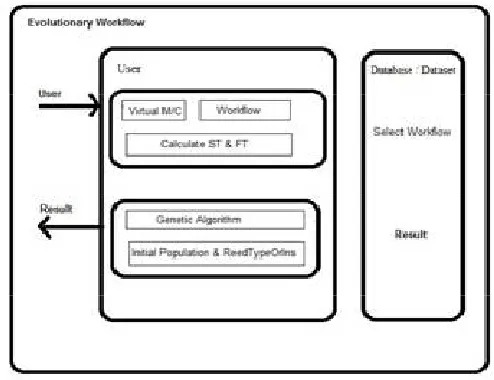
An Evolutionary Multi-objective Optimization (EMO)basedalgorithm used. First User Select the virtual machine then choose real world workflows and randomly generated workflows show that the schedules produced by our evolutionary algorithm. Then Calculate Starting time and Finishing Time,Using Genetic Algorithm Fitness evaluation, Crossover Order, Mutate Order etc. Finally calculate the execution time and cost.
Fig. 1. System Architecture
VII. EXPERIMENTAL RESULT
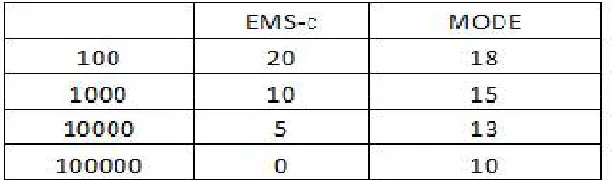
initialization scheme for this problem. We apply our designs to several popular EMO frameworks, and test the proposed algorithm on both the real-world workflows and two sets of randomly generated workflows. The extensive experiments are based on the actual pricing and resource parameters of Amazon EC2, and results have demonstrated that this algorithm is highly promising with potentially wide applicability.
Fig. 2. Trade off selected random workflows
Fig. 3. Random Workflow
VIII.CONCLUSION
To comprehend the multi-target Cloud planning issue which minimizes both make traverse and cost all the while, we propose a novel encoding plan which speaks to all the booking orders, undertaking example assignments and occasion particular decisions. In view of this plan, we likewise present an arrangement of new hereditary administrators, the assessment work and the populace instatement plot for this issue. We apply our plans to a few prominent EMO structures, and test the proposed calculation on both this present reality work processes and two arrangements of arbitrarily produced work processes. The broad tests depend on the genuine estimating and asset parameters of Amazon EC2, and results have shownthat this calculation is very encouraging with possibly wide relevance.
REFERENCES
[1] Zhaomeng Zhu, Gongxuan Zhang, Senior Member, IEEE, Miqing Li, XiaohuiLiu,”Evolutionary Multi-Objective Workflow Scheduling in Cloud”,2015.
[2] G. Juve, M. Rynge, E. Deelman, J.-S. Vockler, and G. B. Berriman, Looking at futuregrid, amazon ec2, and open science framework for logical work processes, Computing in Sci. and Eng., vol. 15, no. 4, pp. 2029, 2013
[4] M. Zhu, Q. Wu, and Y. Zhao, A practical booking calculation for logical work processes in mists, in 31th IEEE Int. Execution Comput. Whatsmore, Commun. Conf. IEEE, 2012, pp. 256265.
[5] W.- N. Chen and J. Zhang, An insect province advancement way to deal with a network work process planning issue with different QoSprerequisites, IEEE Trans. Syst. Man Cybern. A.,Syst. People, vol. 39, no. 1, pp. 2943, 2009.
[6] E. Deelman, G. Singh, M.- H. Su, J. Blythe, Y. Gil, C. Kesselman, G. Mehta, K. Vahi, G. B. Berriman, J. Great et al., Pegasus: A system for mapping complex logical work processes onto appropriated frameworks, Sci. Programming, vol. 13, no. 3, pp. 219 237, 2005.
[7] T. Fahringer, R. Prodan, R. Duan, F. Nerieri, S. Podlipnig, J. Qin, M. Siddiqui, H.- L. Truong, A. Villazon, and M. Wieczorek, Askalon: A matrix application improvement and processing environment, in sixth IEEE/ACM Int. Workshop on Grid Comput.IEEE Computer Society, 2005, pp. 122131.
[8] J. Yu, M. Kirley, and R. Buyya, Multi-objective planning for workflow execution on grids, in 8th IEEE/ACM Int. Conf. on Grid Comput. IEEE Computer Society, 2007, pp. 10 17.
[9] J. J. Durillo and R. Prodan, Multi-target work process planning in amazon ec2, Cluster Comput., vol. 17, no. 2, pp. 169189, 2014.