Electronic Theses and Dissertations Theses, Dissertations, and Major Papers
2016
Examining Multiple Approaches for the Preparation of New
Examining Multiple Approaches for the Preparation of New
Principals: A Mixed Method Comparative Study of Two Programs
Principals: A Mixed Method Comparative Study of Two Programs
Hanin Wasel Alahmadi University of Windsor
Follow this and additional works at: https://scholar.uwindsor.ca/etd
Recommended Citation Recommended Citation
Alahmadi, Hanin Wasel, "Examining Multiple Approaches for the Preparation of New Principals: A Mixed Method Comparative Study of Two Programs" (2016). Electronic Theses and Dissertations. 5793. https://scholar.uwindsor.ca/etd/5793
Examining Multiple Approaches for the Preparation
of New Principals: A Mixed Method Comparative Study of Two Programs
By
Hanin Alahmadi
A Thesis
Submitted to the Faculty of Graduate Studies through the Faculty of Education in Partial Fulfillment of the Requirements for
the Degree of Master of Education at the University of Windsor
Windsor, Ontario, Canada
2016
Examining Multiple Approaches for the Preparation
of New Principals: A Mixed Method Comparative Study of Two Programs
by
Hanin Alahmadi
APPROVED BY:
Dr. Debbie Kane Faculty of Nursing
Dr. Glenn Rideout Faculty of Education
Dr. Dragana Martinovic, Advisor Faculty of Education
DECLARATION OF ORIGINALITY
I hereby certify that I am the sole author of this thesis and that no part of this
thesis has been published or submitted for publication.
I certify that, to the best of my knowledge, my thesis does not infringe upon
anyone's copyright nor violate any proprietary rights and that any ideas, techniques,
quotations, or any other material from the work of other people included in my thesis,
published or otherwise, are fully acknowledged in accordance with the standard
referencing practices. Furthermore, to the extent that I have included copyrighted
material that surpasses the bounds of fair dealing within the meaning of the Canada
Copyright Act, I certify that I have obtained a written permission from the copyright
owner(s) to include such material(s) in my thesis and have included copies of such
copyright clearances to my appendix.
I declare that this is a true copy of my thesis, including any final revisions, as
approved by my thesis committee and the Graduate Studies office, and that this thesis has
The preparedness of principals has received much attention in recent years. Many countries
require that school leaders complete preparation programs offered by school boards, or colleges.
Do these programs, however, truly prepare novice principals to be effective school leaders? Do
new principals receive adequate preparation to meet real-life school challenges? This
comparative study explored the differences and similarities between principal preparation
programs in Saudi Arabia and Ontario, Canada, and examined the effectiveness of these
programs, as perceived by the new principals, in preparing them for this position. In addition, it
inspected if these programs implement the recommendations of the field of research regarding
the skills the principals need (e.g., technologically proficient and having political skills)? This
study also explored the possibility of establishing an exemplary program by combining aspects
of the two different program approaches. By taking what is best from both models, such a
program could be effective and dynamic, and mitigate the shortcomings of the existing
I would like to express my gratitude to my supervisor Dr. Dragana Martinovic, whose
enthusiasm, encouragement, and care reinforced me a lot. Dr. Martinovic’s constant feedback
and support throughout the thesis process have been invaluable, and the time she took out of her
busy schedule to meet with me throughout the year is greatly appreciated.
I would like to thank my committee members, Dr. Rideout, for his insightful comments
and encouragement that enrich my work throughout my study. In addition, my thankfulness goes
to Dr. Kane for being part of my committee.
I am very thankful to both groups of participants who completed the survey in my study.
If they did not voluntarily complete the survey, I would not have been able to complete the
thesis.
My sincere thanks also goes to my loving husband (Ali), who supported me and bore
both of our responsibility as parents, sons (Mohammed, Ahmed, and Amer), and daughter
(Taleen), for their great patience during my busy time. Special thanks for my father (Wasel) and
my mother (Fayiqa), for their patience and deep prayers, as well as my gratitude to my mother
TABLE OF CONTENTS
DECLARATION OF ORIGINALITY ... iii
ABSTRACT ... iv
ACKNOWLEDGEMENTS ... v
LIST OF TABLES ... viii
LIST OF FIGURES ... ix
LIST OF APPENDICES ... x
CHAPTER ONE: INTRODUCTION ... 1
Emerging Research Interest ... 1
Research on Principalship ... 2
Theoretical Framework ... 4
Statement of the Problem ... 6
Purpose of the Study ... 8
Research Questions ... 8
CHAPTER TWO: LITERATURE REVIEW ... 10
Principals’ Core Role ... 10
Challenges Facing New Principals in Today’s Schools ... 11
Principal’s Development as a Leader ... 13
Overview of School Leadership ... 15
Ontario’s Program: Principal’s Qualification Program ... 18
Saudi Arabia Leadership Preparation Program ... 19
Education- and Experience-Based Models ... 21
CHAPTER THREE: METHODOLOGY ... 24
Research Design ... 24
Participants ... 27
Data Collection ... 29
Procedures and Data Analysis ... 32
CHAPTER FOUR: RESULTS ... 36
Quantitative Findings ... 36
Demographics of the Respondents ... 37
Principals’ Preparation Program’s Structure and Content ... 42
Principals’ Perceptions of Their Preparedness (Program Assessment) ... 50
Qualitative Findings ... 52
CHAPTER FIVE: DISCUSSION ... 56
Introduction ... 56
Discussion of Study Results ... 56
Program Assessment ... 57
Identifying Strengths in the Preparation Programs ... 61
Analysis of Programs’ Differences in View of the Literature ... 67
1. Important Elements for an Exemplary Preservice Principals’ Preparation Program in the
PQP-ON and MOE-SA…………...………...23
2. The List of Independent Variables in The Study……….…… 33
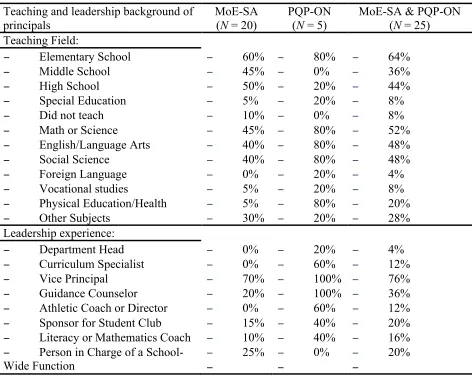
3. The Professional Background of Participants: Teaching Field and Leadership
Experience………..……….………..38
4. Principals’ Years of Teaching Experience….………..40
5. Teaching Experience According to the Gender………....41
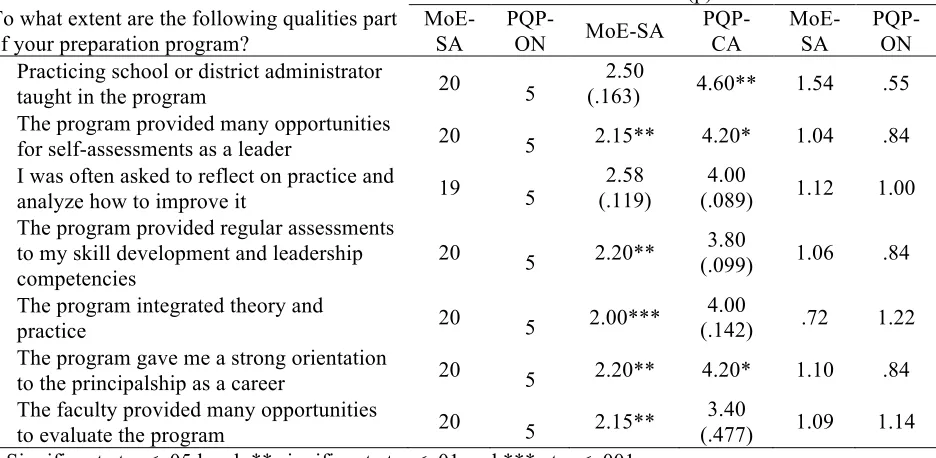
6. One Sample t-test for the Qualities of Both MoE-SA and PQP-ON Programs……43- 44
7. Results of an One Sample t-Test for the Learning Practices of Both MoE-SA and
PQP-CA…. ………45 - 46
8. Principals’ Internship Assessment for MoE-SA and PQP-ON Programs………….…49
9. Mean Score of Two Groups Regarding the Participants’ Leadership
Experience……….……...50
10.Grouping of Questions According to the Tasks That Principals Could Face During
Their Career……….…….51
11.One Sample t-test on Aspects of the MoE-SA’s Program Effectiveness…………...51
12.One Sample t-test on Aspects of the PQP-ON Program’s Effectiveness……….52
13. Summary of Positive/Negative Aspects of the Canadian and Saudi Arabia Preservice
1. Illustration of the mixed method procedure (sequential explanatory design)…….……..27
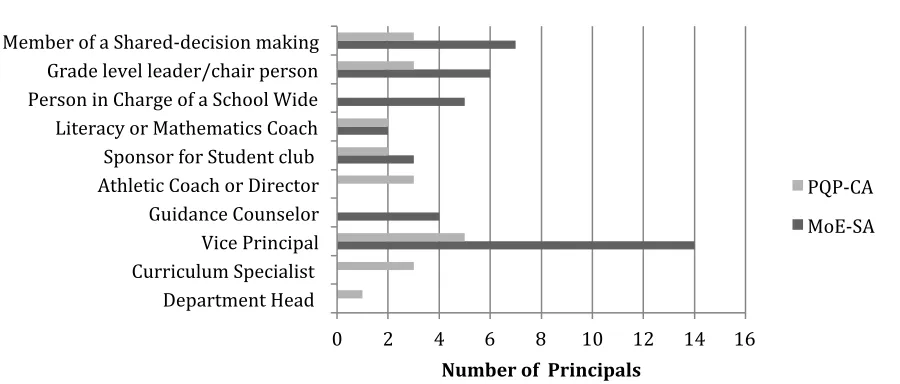
2. Leadership experience for participating principals in Saudi Arabia and Canada…...41
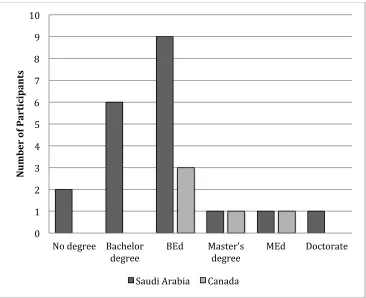
3. Principals’ educational attainment……….…………..……….42
4. Principals’ internship experience and assessment. The number of principals who had
APPENDIX A: Survey Questions……….………80
CHAPTER ONE: INTRODUCTION
Emerging Research Interest
My interest in the work that principals did began when I was a student in Saudi Arabia
and had rare opportunities to see my principal at school. My interest in the principal’s
preparation for a position grew when I taught at an elementary school in Saudi Arabia whose
principal claimed that she would benefit from taking a leadership course. The school was
multicultural, with teachers and students from different backgrounds. Unfortunately, the
principal lacked the knowledge on how to deal with school diversity or to provide effective
leadership. Although the principal had great time management skills, organizing and managing
facilities, she lacked communication skills with school staff and ways for engaging them in
decision making and creating collaborative learning environment in school diversity.
According to the Ministry of Education in Saudi Arabia (MoE-SA) regulations
(nomination for principalship, MoE teachers network), principals are not required to complete
course work in the theories of administration and leadership before assuming their position. The
MoE-SA assumes that having candidates with administrative experience (8 years) would be
enough for aspiring principals to gain necessary skills. Even though MoE-SA offers some
workshops after assigning candidates to their positions, these workshops rely more on the
participants’ professional credit and administrative experience. However, how can Saudi
principals learn about the theories of educational leadership only through experience? Aldebian
environment and demands, but they need to be more knowledgeable about educational leadership
and motivated to learn.
When I first came to Ontario, Canada, I learned that in this province, aspiring principals
must undertake the formal Principal’s Qualification Program (PQP) in order to serve as a school
leader. In contrast to the Saudi program, the PQP concentrates on course-based learning, with
rich curriculum content about educational leadership and school structure. This program provides
a theoretical grounding in educational leadership through case studies and peer discussions in the
classroom. However, the limitation of course-based learning is lack of exposure to real-life
challenges (Luu, 2010; Walker,Bryant, & Lee, 2013). Although the PQP offers a 60-hour
internship, it may be insufficient to prepare principals for the demands of today’s schools.
Principals need to have both extensive knowledge about educational leadership and
real-life training in order to effectively lead schools (Darling-Hammond, Meyerson, LaPointe, & Orr,
2010). Therefore, the pre-service program should fairly combine both educational- and
experience-based features and combining the Saudi and Canadian approaches may provide the
outlines for assembling an exemplary program.
Research on Principalship
In general, educational policy makers have paid increasing attention to school leadership
in recent years, and much research has been conducted on effective leadership styles and how
leaders’ characteristics influence school outcomes. This research has revealed the crucial role of
principals in school improvement (EQAO, 2005; Hauserman & Stick, 2013; Mulford, 2003).
Since the 1990s, the focus of research on school improvement has shifted from teaching and
classroom quality to the importance of school leaders in the development of the educational
2003; Leithwood & Jantzi, 2008; Robinson, Lloyd, & Rowe, 2008). A study of 38 secondary
schools in Australia found that leadership is a primary factor in producing “outstanding school
outcomes” (Dinham, 2004, p. 339). The principal no longer serves only as a school
administrator; principals are now accountable for creating collaborative, supportive work
environments, setting goals, and improving schools. Principals’ role in schools has become so
vital that the withdrawal of an effective leader has a negative impact even on successful schools
(Hargreaves & Fink, 2004). Research conducted by organizations, such as the Wallace
Foundation and the National Association of Secondary School Principals (NASSP), has
underscored the importance of the principals’ role in the improvement of schools.
Modern-day principals are expected to increase students’ test scores, nurture staff
members, and manage the school environment. The principal’s role extends to include creating a
school culture and climate, and to setting an achievable vision and goals, all of which have
impact on school outcomes. A positive school culture is considered a key factor in school
improvement, therefore, “[t]he principal must be the intellectual leader of the school and forge a
climate in which academic success is a basic goal” (Hoy & Miskel, 2013, p. 199). Most
principals are also responsible for evaluating teachers’ performance while following district and
state protocols. In addition, they must assist teachers in meeting the new demands of the
curriculum and help integrate technology into the classroom. For school administrators, effective
leadership is a difficult task, which requires building relationships of trust with their schools’
stakeholders (Hoy & Miskel, 2013). Principals also must lead under the pressure of
unprecedented responsibilities, challenges, and managerial issues in today’s schools. It is clear
Although there are many programs aimed at helping aspiring principals develop their
skills as leaders, most programs are criticized for lacking the resources to fully equip and
realistically prepare principals for their schools’ challenges and demands (Orr, 2011; Walker,
Bryant, & Lee, 2013). To adequately prepare school administrators for both current and future
demands, a major shift in principal preparation is needed (Orr, 2011). According to Orr, existing
programs must establish or add sufficient content to prepare principals for lifelong learning.
These programs should be more flexible and adaptable in order to meet fast-changing demands
and appropriately equip future principals to meet those demands.
Theoretical Framework
This study compares two programs operating in different cultural contexts; each culture
has its own sociological paradigms. Because an aim of the research is to propose creation of an
international preparation program, the research employed Functionalism Theory. This theory has
the benefit of transmission, where the “individuals accept their roles within the social structure of
society” (Palestini, 2003, p.14). This concept would assist in preserving cultural integrity during
the preparation of the aspiring principals. Hallinger and Leithwood (1998) developed a
framework for cross-cultural study of educational leadership. This framework highlighted the
need to understand the indigenous meaning of cultural concepts of principal leadership and
school outcomes, which are intimately associated with the cultural norms that predominate
within a given social structure.
In the functional leadership model, leadership does not preform by one person but depend
on a set of behaviours by the group that gets work done (Burke et al., 2006). Any member of the
group can perform these behaviours, so any member can participate in leadership. The
led rather than who has been formally assigned a leadership role (Burke et al., 2006). One of the
best known and most influential of functional theories of leadership, used in many leadership
development programmes, is John Adair's "Action-Centred Leadership" (Bolden, Goslin,
Marturano, & Dennison, 2003). John Adair developed a model of Action-Centred Leadership has
connecting circles that overlap because:
• the task can only be performed by the team and not by one person
• the team can only achieve excellent task performance if all the individuals are fully
developed
• the individuals need the task to be challenged and motivated (Bolden et al., 2003, P.11).
There is also another theory that was developed in Frankfurt school by Karl Marx –
Critical Theory. Its main idea, in contrast to functionalism, is that coercion and power play
primary roles in leadership and social control (Seiler, 2006). While Functionalism Theory
considers acceptance and distribution of social roles in society, since for Critical Theory the
whole society is like an organism, it suggests that society is divided into small groups, each of
which competes for economic and social resources (Dahms, 2011). Therefore, in terms of
leadership and principalship development, proponents of Critical Theory claim that dominance is
necessary for leaders in order to keep their power (Dahms, 2011).
It is also worth considering the third theory of leadership, especially in relation to
principalship development, which is Situational Leadership. This theory is based on the
relationship and interconnection between the behavior of a leader and a particular situation or
circumstances (Graeff, 1997; Grint, 2011). Thus, according to the situational leadership, leaders
can emerge and develop only as a result of cultural, social and economic conditions. It is then
Theory, which are focused on leaders and their actions, rather than on situations, changes and the
environment.
Summarizing all the written above about different theories in regards to principalship
development, it might be concluded that these theories are based on different principles.
However, internationally leader have different circumstances in their environment. and in terms
of creation of an international preparation program for aspiring principals, combining all the
above theories together may provide a more holistic venue for approaching better results and
developing better leadership skills.
Statement of the Problem
Quality school leadership is necessary to improve school performance, student
achievement, and other outcomes of educational organizations (Dinham, 2004; Leithwood,
2006). Therefore, aspiring principals need adequate training programs to enable them achieve the
desired educational outcomes. However, education leadership preparation programs have been
regularly criticized for insufficiently preparing aspiring leaders for the changing demands of the
educational field (Hess & Kelly, 2005). Bush and Jackson (2002) found many programs for
aspiring, beginning, and experienced principals but few offering a coherent curriculum that
meets all principal’s needs. Principals’ pre-service programs need to address the new challenges
faced by school leaders, especially by those new to their jobs.
Preparation programs for principals differ throughout the world and typically emphasize
either education-based leaning with a small period of internship/practical or experience-based
learning with some course work (Huber & West, 2003). Some jurisdictions, such as Ontario,
Canada, combine course-based learning with internships of varying lengths (usually less than a
combines experience-based opportunities with little course-work with emphasis put on having
administrative experiences. In certain countries, including the United States and Canada,
completing a preparation program is mandatory to be eligible for a principal’s position, but this
qualification is optional elsewhere. Generally, either governmental or non-governmental
institutions deliver principal preparation programs (Huber & West, 2003). In most Western
countries, including the United States and Australia, universities hold a monopoly in the
certification of educational leaders (Walker & Qian, 2006).
Differences among these programs include their primary approach (e.g., pre-service
preparation or learning through work) and length. For example, in some countries, programs for
educational leaders emphasize in-class education and require shorter, or none, on-the-job
internships, while some other countries value on-the-job experience and mandate little, or none,
in-class preparation. These differences indicate a challenge to develop an exemplary program
that would fit educational systems in different countries. Indeed, comparative researchers have
called for establishing an exemplary program that can work across systems (Huber & West,
2003; Walker & Qian, 2006). These researchers claim that, for principals to be equipped for their
positions, they must be prepared gradually over the long-term. In the present study, I hypothesize
that designing a well-balanced preparation program, which delivers the needed theoretical
knowledge base and requires long-term internships that enable assessment of candidate’s
performance and provides opportunities for them to gain experience would help principals
become effective leaders. Candidates need an “action-oriented” method (McIntyre, 1979, p. 32)
Purpose of the Study
The purpose of this study is to identify strengths of two educational leadership
approaches in order to propose a possibly more effective principal preparation program. The two
programs are the Principal’s Qualification Program (PQP-ON) administered in Ontario, which is
largely course-based (education-based) and includes a 60-hour internship, and the Ministry of
Education—Saudi Arabia (MoE-SA) preparation program, which requires mostly long-term,
on-the-job experience (experience-based) and provides only a few workshops. Most previous studies
have either examined the effectiveness of a particular program or compared programs which use
the same approach but different structures. In the present study which compares the professional
experiences of principals who obtained their certification/position through preparation programs
that emphasized more experience or more education, I explore how combining features from
these two types of programs could fairly expose principals to what is perceived as advantage of
each program. .
Research Questions
The guiding research questions for the first phase of the study are as follows.
1. How do new principals evaluate their preparation program and selection for the principal’s
position?
1.1. From the new principals’ perspective, how successful was their program at preparing
them for the real-life challenges they face in schools?
For the second phase of this study, the overarching research question is as follows:
2. What do principals who completed a program that emphasizes education, identify as
3. What do principals who completed a program that emphasize experience, identify as
strengths and weaknesses of their program?
Definitions and Terms
• Aspiring principals are teachers who seek to be school leaders (principals).
• Educational leadership programs (principal’s preparation programs) are programs that
aspiring principals must complete before they may be considered for a principal
positions.
• Education-based programs are principal preparation programs based on in-class learning,
through which aspiring principals gain a degree or certificate after attending courses.
These programs might or might not require internships but always provide theoretical
knowledge of educational leadership and involve case studies and peer discussions.
• Experience-based programs,are principal preparation programs that primarily use work
experience to prepare principals for their new role (aspiring principals are selected based
on their teaching experience to be vice-principals and gain more administrative
experience).These programs might or might not require course work.
• PQP-CA, abbreviationPrincipals Qualification Program in Ontario, Canada.
CHAPTER TWO: LITERATURE REVIEW
Principals’ Core Role
According to recent literature, effective leadership is among the most important
school-based factors that influence student achievement, teaching quality, and school outcomes in
general. A review of the literature on school improvement suggests that most findings indicate
the importance of principals in all aspects of the educational process (Leithwood, 1992;
Sergiovanni, 1994; Hurber & West, 2003; Mulford, 2003; EQAO, 2005; Hauserman & Stick,
2013). There is significant evidence of a correlation between effective principal leadership and
student learning (Johnson, Uline, & Perez, 2011). After a six years long investigation of the
relationship between educational leadership and student academic achievement, Louis,
Leithwood, Wahlstrom, and Anderson (2010) support the claim that “leadership is second only
to classroom instruction as an influence on student learning” (p. 9). Working with approximately
223 schools in U.S., Louis et al. (2010) stated that “we have not found a single case of a school
improving its student achievement record in the absence of talented leadership” (p. 9). At the
same time, the principal’s role has become both increasingly crucial and increasingly demanding
within any educational organization (Brauckmann & Pashiardis, 2012; Hansford & Ehrich,
2005).
The school leader has become a key element in the function of the school, and the impact
of effective principals on schools has only risen as their responsibilities have increased
(Leithwood, Louis, Anderson, & Wahlstrom, 2004). Principals play an important role in schools,
building consensus on relevant short-term goals, influencing organizational aims, solving
problems, sharing power, and managing the daily routines of the school (Hansford & Ehrich,
2005; Johnson et al., 2011). To execute these core practices, principals need “well-designed and
implemented training programs … for their chosen path” (Hansford & Ehrich, 2005, p. 49).
According to Beatty (2008), in 1992, Mulkeen and Coopers were first who mentioned the
need for preparing principals, and leadership research continues to point to this need. Since 1992,
many programs for preparing principals have been established. However, Butler (2008) and
Sherman (2008) evaluate U.S. principal preparation programs as inadequate to meet the real-life
demands of the 21st-century schools. Luu (2010) issued the same criticism about the principal
preparation program in Ontario. Luu’s (2010) study concluded that although PQP-ON well
prepared aspiring principals “for managerial tasks such as time management, budgeting and
familiarity with stakeholder prioritization,” it did not adequately prepared aspiring principals “to
provide leadership to the school in the areas of problem solving in regards to interpersonal and
supervisory relationship concerns” (p. 389).
Challenges Facing New Principals in Today’s Schools
New principals might encounter technical and psychological issues in their schools. At
times, the demands of the job overwhelm principals’ abilities to deal effectively with these
issues, making them feel vulnerable and incompetent (Darling-Hammond et al., 2010). Also,
new principals might feel isolated when adapting to a new school community (Walker & Qian,
2006); keeping up with an excessive amount of paperwork sometimes requires principals to
seclude themselves in their offices, apart from their colleagues and school’s stakeholders.
The challenges facing novice principals in 21st-century schools arise from the rapid
diverse student populations). In addition, constant educational system reforms have produced
more complex and dynamic school environments than in the past (Brauckmann & Pashiardis,
2012). The transition from an industrial to a post-industrial society not only has exacerbated the
already complex work environment of school principals but has also raised expectations of what
they should achieve (Crow, 2006). Hess (2003) claims that leaders are expected to, “leverage
accountability and revolutionary technology, devise performance-based evaluation systems,
re-engineer outdated management structures, recruit and cultivate non-traditional staff, drive
decisions with data, build professional cultures, and ensure that every child is served” (p. 1). In
addition, principals must “restructure schools and implement new educational paradigms that
focus on pedagogical findings, foster the ideals of a just and humane educational system and
prepare the populace to make moral and ethical decisions in an ever-changing society” (Cline &
Necochea, 2000, p. 157). All these responsibilities create conditions for work pressure and high
stress for principals. For aspiring principals, responsibilities have become a major concern,
discouraging them from achieving their potential as school leaders.
Since today’s principals perform the core functions of the school, all school staff
members depend on their effectiveness as leaders. Principals are expected to provide leadership
on issues regarding assessment, instruction, curriculum, parent demands, and teachers’ rights and
expectations for communication (Luu, 2010). All these responsibilities increase the stress level
of principal’s role, leading to a shortage of principals in the educational field (Walker & Qian,
2006). Studies in some Organization for Economic Co-operation and Development (OECD)
countries (e.g., Canada, the United Kingdom, the United States, Finland) have documented the
effects of these growing demands on school leaders (Schleicher, 2012). In the United Kingdom,
and “deficiencies in working practices” (Schleicher, 2012, p. 20). Principals often cannot manage
their time well; Schleicher (2012) found that administrative demands are prioritized and consume
34% of school leaders’ time. Principals work under pressure to meet other demands in their
remaining time.
The severity of these challenges reach peak at the beginning of the school year and are
difficult to handle for even experienced principals, let alone new principals (Villani, 2006).
Unfortunately, existing preparation programs do not seem to provide aspiring principals with
opportunities to develop adequate skills to manage these challenges (Luu, 2010).
Principal’s Development as a Leader
Houchen et al. (2013) define the principal as a “learning leader,” and they note that
“principals in high-performing schools devote much of their focus to the process of teaching and
learning and dedicate their efforts toward the improvement of both” (Houchen, 2013, p. 56).
Leadership training and development is a crucial process when it pertains to those who are
aspiring to become administrators in the Education field. Regardless, whether leadership training
is organized for a school system’s current personnel or for the attendees of a university’s School
of Education development program, there is much to consider.
First, as Mitgang (2012) mentioned, the problems of any leadership preparation program
typically begin with a lenient admissions process. Many programs admit nearly everyone who
decides to apply, without any consideration from the Ministry of Education or from the school
districts. The selection process mainly focuses on academic background. The process often fails
to probe for evidence of a candidate’s ability to work well with teachers or within challenging
school settings. The process reveals little about a candidate’s resilience, integrity, and belief in
(Darling-Hammond et al., 2007). According to Ash, Hodge, and Connell (2013), a strongly structured and
effective selection process would promote the most qualified candidates for the principal
position. These researchers have introduced a helpful process for recruiting principals, and it is
summarized below:
. The pre-screening process includes identifying committees and the required
qualifications for principals.
. The screening and interviewing process involves evaluating candidate applications and
conducting candidate interviews.
. The follow-up and selection process is comprised of selecting top candidates and
developing follow-up questions before selecting the new principal. (Ash, Hodge, &
Connell, 2013, pp. 98-99)
After properly screening candidates and correctly selecting the aspiring principals, next
comes the important role of conducting effective preparation for principalship.
Second, in order to reinforce aspiring leaders to be successful leaders, the program must
cover both “external” and “internal” factors (Leithwood, Day, Sammons, Harris & Hopkins,
2006, p. 68). Therefore, a program that fairly encompasses educational-based and
experience-based factors would build successful leaders. Leithwood et al. (2006) state that external factors
include (a) educational policies, (b) on-the-job leadership opportunities, (c) mentoring
experiences, and (d) professional development initiatives. Furthermore, internal factors include
(a) thoughts, (b) feelings, (c) educational histories, (d) professional identities, and (e) values.
From my perspective, external factors could be encompassed by experience-based training, and
the internal factors could be encompassed by education-based preparation. Therefore, this study
Mitgang (2012) states that there are five lessons that could exponentially increase the
level of qualified candidates for future principals and school administrators. The aim of
Mitgang’s book is not to specifically pinpoint principal certification programs and what they
require, but to impress upon those who are seeking these kinds of leaders what to look for and
what their vetting process should be. Mitgang (2012) recommends a rigorous and detailed
selection process, ensuring that potential candidates have gained the proper leadership training in
conjunction with a viable principal certification program and high-quality mentoring, particularly
for first-year principals. Mitgang’s book contributes to the rationale for affirming the empirical
over the instructional. Evidence of this affirmation is found in lesson number five, which
indicates the need for a high-quality mentorship. However, the five lessons, together, emphasise
the need for the continued progression of pre-service training through various means (Mitgang,
2012).
Overview of School Leadership
In recent decades, the importance of developing an efficient pre-service leadership
program for principals has increased in order to create successful educational leaders (Walker et
al., 2013). Indeed, many recent researches have focused on finding a productive and high-quality
leadership program.
For example, Houchen and Cabrera (2013) performed a comprehensive study on Western
Kentucky University’s (WKU) P-12 school principal certification program. WKU focuses its
leadership training and development for principals on an instructional foundation by teaching the
importance of the Common Core curriculum (Houchen et al., 2013, p. 56). The WKU program
gives aspiring principals the capacity to impart valuable knowledge, and the curriculum can
program is known for its rigorous education program, in which candidates are required to
complete an instructional framework that outlines instructional leadership (Houchen et al., 2013).
While the intensity of WKU’s program has a reputation for providing the foundation for those
seeking their principal certification, it is the program’s strong framework that raises the standards
as a whole. Mitgang (2012) also recommends a similar program to the aforementioned WKU
principal certification program. However, it seems that Mitgang does not mind the candidates’
administrative experience backgrounds; her message does not display an ideology favoring
experience over an instruction-based pre-service program.
Furthermore, Darling-Hammond et al. (2010) examined eight pre-service principal
preparation programs in the U.S., all of which were considered strongly productive. Most of
these programs included the following features:
• A comprehensive and coherent curriculum aligned to state and professional standards.
• Philosophy and curriculum that emphasize leadership instruction and school
improvement.
• Active, student-centred instruction.
• Knowledgeable faculty.
• Vigorous, carefully targeted recruitment.
• Well-designed and supervised administrative internships.(Darling-Hammond et al.,
2010, pp. 181-182)
From an international perspective, Walker et al. (2013) argue that effective leadership is
the indirect reflection of an organization’s success, and they focus on the international
development of a high-quality school leadership program;hence, there is an ideology of
(2013) compared educational organizations in Asia, North America, and Australia, and they
found that the gaps or differences between school systems, worldwide, seem to be closing and
that there is now a global awareness of leadership development and leadership training programs.
That accountability does not end or begin with the teacher in the classroom; it requires leadership
that is knowledgeable in how to organize systems and to prepare staff in order for students to
have the opportunities to become as successful as they can be academically.
Somewhat the antithesis of the previous review, the Leithwood et al.’s (2009) research
study examined a more modern phenomenon in educational leadership known as distributed
leadership, which is a part of an even larger movement of optimal and alternative ways of
organizing school management and administration. Furthermore, the definition of distributed
leadershipis broad in its current maturation (even though the term and concepts date back to
1954), but it can be described as the shared, democratic, and dispersed conceptions of leadership
(Leithwood et al., 2009). However, the Leithwood et al. (2009) book, entitled Distributed
Leadership According to the Evidence, provides a much broader presentation of distributed
leadership and all of its various nuances in order to achieve its full meaning.
Educators and those who provide comprehensive leadership training for principals widely
shun the theoretical ideologies of distributed leadership and its framework. Leithwood et al.
(2009) present various schools around the world that have built an infrastructure around
distributed leadership and that seem to thrive in that type of educational environment. However,
while some may agree with its principles, others have not quite adapted to its theories and
framework. Therefore, finding examples of distributed leadership as a training ground for
principals is nearly impossible. In fact, distributed leadership seems to reject the idea of a
leadership creates an impression that it would be more suitable for actualizing an organized team
that takes on all of the responsibilities of a traditional principal, constituting a leadership group
that functions based on the principles of distributed leadership (Leithwood et al., 2009).
Furthermore, in the event that one could create such a leadership program for an
organized group of leaders who act as a nucleus, this book would be a useful source for this kind
of group training or team leadership. Additionally, the Leithwood et al.’s book examines
Theoretical Explanations of Distributive Leadership Effects in its own section to outline the
following: Organizational Learning Theory, Distributed Cognition, Complexity Science, and
High Involvement Leadership (Leithwood et al., 2009).
Ultimately, this resource is an effective tool that contributes to this paper’s rationale, as it
fully contributes to the ideology of the empirical having the capacity to outweigh the
instructional. Leithwood et al. (2009) found that distributed leadershipfosters an educational
environment that values all school personnel who can be deemed as contributing factors during
the decision-making process; all contributing individuals participate in making and considering
the policies.
In the next section, I explore two approaches used in principal preparation programs and
how they equip aspiring principals for their positions.
Ontario’s Program: Principal’s Qualification Program
Teachers who want to pursue a career in school administration in Ontario need to
successfully complete the PQP-ON. The Ontario College of Teachers coordinates the PQP-ON
Selection process for aspiring principals. Applicants must have a minimum of five
years of teaching experience to qualify for the PQP-ON. Additional entrance requirements are as
follows:
1. Being a member in good standing of the Ontario College of Teachers;
2. Possessing basic qualifications in three of four divisions (primary, junior, intermediate,
senior), of which one must be intermediate;
3. Holding a master’s or doctorate degree, two additional specialist qualifications, or one
additional specialist qualification and have completed half of a master’s degree (Ontario
Principals’ Council, 2014).
Program content. The PQP-ON consists of two parts totaling 125 hours. Candidates
must also complete a 60-hour leadership practicum (i.e., submit a leadership proposal practicum
before Part I and successfully complete the practicum before beginning Part II). The content of
Parts I and II covers five domains using the leadership framework of principals and vice
principals developed by the Institute for Education Leadership (Walker, Bryant, & Lee, 2013).
The Ontario College of Teachers controls the PQP-ON’s curriculum to ensure consistency
among all program providers (Walker et al., 2013).
Saudi Arabia Leadership Preparation Program
Until 2009, leadership preparation in Saudi Arabia followed no clear or coherent path. A
shift toward involving academics and experts in developing and delivering a mandatory
leadership preparation occurred in response to King Abdullah’s public education development
Tatweer program. The Tatweer program, administered by the MoE-SA, focuses on developing
the education system across the country. The principal preparation project received priority as an
Aspiring principals in Saudi Arabia generally follow no particular pre-service program.
However, the MoE-SA has established a highly strict process that aspiring principals must go
through before obtaining positions as school leaders. The main goal of this process is to push
aspiring principals to build their knowledge of leadership through experience in the educational
field (MoE-SA, 2014).
Aspiring principals in the Saudi public school system must go through many sequential
steps to achieve their goal. First, teachers must accumulate at least four years of teaching
experience and gain the recommendation of their principal and superintendent to work as a vice
principal. They should serve as vice principals for at least four years in order to obtain a principal
position. The qualifications for aspiring principals are as follows:
1. Eight years’ experience in the educational field (four years as a teacher and four as a vice
principal);
2. A university degree (generally a bachelor’s degree);
3. Outstanding job evaluations (not less than very good, i.e. 80%, for the past three years);
4. A work history without receiving any poor job evaluations or being found to be
neglectful of duties;
5. Successful completion of an interview with members of the MoE-SA (MoE-SA, 2014);
6. Successful completion of the Qiyas (The National Center for Assessment in Higher
Education) test for leadership.
The MoE-SA nominates principals based on a successful completion of these
requirements. It is important to note that aspiring principals who want to be leaders in elementary
schools must acquire experience at the elementary school level (the requirement is adequate for
elementary school level cannot assume positions as high school principals. Current principals
and superintendents are responsible for the nomination and selection procedure, where they
select a candidate and recommended them for principalship. During the first year at their new
position, school principals must attend at least one leadership workshop (Tatweer, 2012). The
MoE-SA organizes these workshops, which mostly involve presentations and lectures, for all
school leaders. Typically, these workshops can last from half-day to a week maximum in one
school year (Tatweer, 2012).
There are special cases where the MoE-SA may grant principals position for candidates
who do not have experience in teaching or educational field. Those candidates follow different
regulations, such as: (a) having a postsecondary or master’s degree (either in education or
non-education major), (b) having administrative working experience, and (b) successfully completing
an interviews process. However, these cases are rare and are applicable when there are more
available positions than nominated candidates.
Education- and Experience-Based Models
Notably, the PQP-ON focuses on successfully educating aspiring principals, whereas the
MoE-SA concentrates on principals’ need for real-life experiences. The greater emphasis on
accountability and expectation in recent years has increased the demand for continuous personal
development and learning (Huber & West, 2003). Principals must strive to become lifelong
learners. In professional development courses that assign the attendees reading, research, and
project tasks, aspiring principals learn about emerging issues in education, improving schools,
and dealing with accountability. An example of this model is the PQP-ON, whose program
McIntyre (2001) describes three levels of effective learning: “familiarity, understanding,
and application” (p. 31). The first two levels can be accomplished through reading, lecture,
discussion, and student research, but the application of all the information learned requires
field-based practice (McIntyre, 2001). Therefore, candidates in a predominantly education-field-based
program will fulfill only two levels of effective learning and lack sufficient implementation of
what they have learnt. On other hand, blending education-based with experience-based program
could create balanced training program, which would help aspiring principals to accomplish all
three levels of effective learning. Many researchers claim that principal preparation programs are
out of touch with real-life demands (Butler, 2008; Luu, 2010; Sherman, 2008). Involving
principals in real-life tasks can be accomplished through long-term, on-the-job experience, as in
the Saudi principal preparation process. Principal preparation program research indicates the
need to align training with practical experience (Olson, 2007). In the Luu’s (2010) study, half of
the new principals expressed the need for job shadowing and greater exposure to real-life
situations and the ways with which school administrators handle them. Darling-Hammond et al.
(2010) argue that preparation programs fail to utilize schools as a source of learning. Requiring
aspiring principals to gain experience as vice principals for a period of time would help them to
observe, become involved in, and learn to solve real-life school challenges. That is what
MoE-SA emphases in their program.
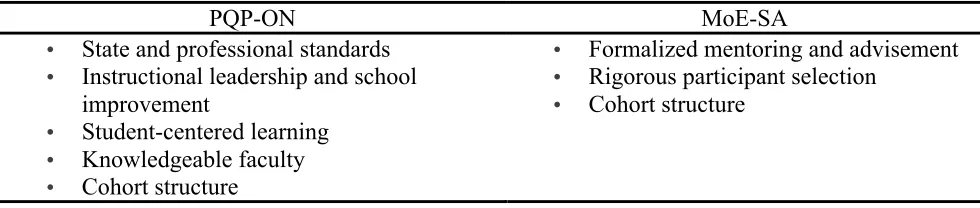
Preparation programs with high performance outcomes give priority to “state and
professional standards, as well as an emphasis on instructional leadership and school
improvement, student-centred learning, knowledgeable faculty, cohort structures, rigorous
participant selection, and well-designed internships” (Darling-Hammond et al., 2010, pp.181–
shows how these elements are distributed in the PQP-ON and MoE-SA. This research will seek
to identify strengths of each model that might create an exemplary principal preparation
program.
Table 1
Important Elements for an Exemplary Pre service Principal Preparation Program in the
PQP-ON and MoE-SA
PQP-ON MoE-SA
• State and professional standards • Instructional leadership and school
improvement
• Student-centered learning • Knowledgeable faculty • Cohort structure
• Formalized mentoring and advisement • Rigorous participant selection
• Cohort structure
The researcher expects that involving aspiring principals in an extensive program
combining both models might holistically prepare them for the real-life school demands. In
addition, the aspiring principals will develop skills, such as financial and time management,
which will help them in their everyday duties. With practical experience, either through an
internship of at least one year or administrative work, principals will know how to manage their
work environment to make it less stressful.
This chapter has provided an overview of the literature regarding principals’ preparation
program. It includes limitation of existing preparation programs. In addition, it presents how
other researches identify exemplary preparation program elements. The next chapter I will
CHAPTER THREE: METHODOLOGY
The aim of this study was to explore insights from new principals on their experiences
through the pre-service and initial principalship years. In this chapter, I will explain the
methodological approach that I utilize for the study. It will provide a detailed explanation of the
research design, participants, data collection and analysis procedure.
Research Design
This study adopted a mixed method approach as a dynamic tool for expanding the scope
and improving the analytic power of the study (Creswell & Plano Clark, 2011). Creswell (2002)
describes the mixed method approach as a procedure for collecting, analyzing, and mixing both
quantitative and qualitative data at certain stages of the research process in order to holistically
understand a research problem. I selected this method in order to deepen the scope of the study
(Sandelowski, 2000). In this study, I first assessed the effectiveness of both programs (PQP-ON
and MoE-SA) through a survey that was distributed to new principals—education leaders in two
cities (one in Ontario and the other in Saudi Arabia) who have been working for at most five
years at this position. Post analyzing the survey data, I expanded the scope of the data through
interviews with purposefully selected survey respondents. For example, the principals who
thought their program did not effectively prepare them for their position, were selected for the
interview. In the interviews, I also teased out from the new principals in one country their
perspective of the principal’s preparation approach in the other country by stating and explaining
different approaches, and asking their opinion about a unified approach. It is well known that the
quantitative and qualitative research methods complement each other, and that their combination
allows for more complete analysis (Creswell & Plano Clark, 2011; Tashakkori & Teddlie, 1998).
needs of new principals and evaluated the effectiveness of the existing programs, providing some
insight to how these programs could be combined and enhanced.
In a mixed methods approach, the researcher builds rich knowledge of and data of the
study problem (Creswell, 2003). As a researcher, I selected the approaches, variables, and units
of analysis most appropriate for finding answers to the research questions (Tashakkori &
Teddlie, 1998). The effectiveness of the mixed method derives from the complementarity of the
quantitative and qualitative methods. Therefore, combining different types of data will advance
understanding of the research problem.
In designing a mixed methods study, three issues require consideration: priority,
implementation, and integration (Creswell, Plano Clark, Guttman, & Hanson, 2003). Priority
refers to whether quantitative or qualitative research is given more emphasis in the study.
Implementation describes whether quantitative and qualitative data collection and analysis are
performed in sequence (chronologically, one stage following another) or in parallel
(concurrently). Integration refers to the phase in the research process when the mixing of
quantitative and qualitative data occurs.
This study employed a sequential explanatory mixed method design and collected data in
two phases (Creswell, 2002). Quantitative data were collected through a survey distributed to a
sample of new principals in Canada and Saudi Arabia (n = 139) of which, 20 potential
participants were from S.A. and 119 from the local Windsor SchoolBoards. All 20 participants
from Saudi Arabia responded to the invitation to complete an electronic survey and only five
Canadian principals responded. This created an imbalance in the sample size. The purpose of this
phase was to allow participants to evaluate the effectiveness of the programs they completed in
principal (n = 3) informants for interviews in the second phase. Qualitative data were collected
through individual semi-structured interviews seeking to answer the following research question:
What do principals who completed an education-based/or experience-based program identify as
strengths and weaknesses of their program? The hope was that quantitative data analysis would
enable identifying the strengths and weaknesses of each program, while qualitative data analysis
would shed light on how participants view the combined program.
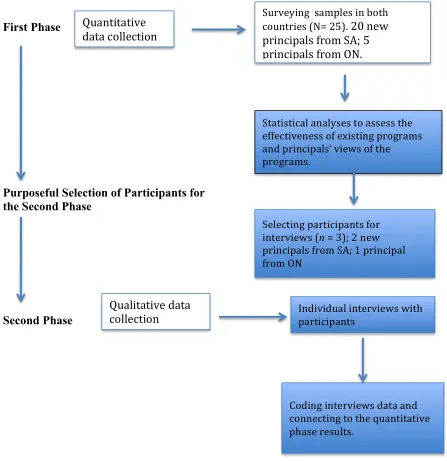
Figure 1 shows the procedures for this study’s sequential explanatory mixed methods
design. Priority in this study was given to quantitative data, because these addressed the major
theme of the study (principals’ views of unified approaches to principal preparation programs).
Quantitative research was conducted first in order to explore new principals’ views of the
existing program in their country and its effectiveness. The quantitative and qualitative methods
were integrated at the beginning of the qualitative phase while selecting interview participants
based on their answers to survey questions. The results of the two phases were also integrated
First Phase
Purposeful Selection of Participants for the Second Phase
Second Phase
Figure 1. Illustration of the mixed method procedure (sequential explanatory design).
Participants
In the first (quantitative) phase of the study, the convenience sampling technique
(Dillman, 2000) was used to recruit participants who have been principals for five years or less.
In the second (qualitative) phase of the study, purposeful sampling was employed to deliberately
select individuals with a good understanding of the central phenomenon (McMillan & Quantitative
data collection countries (N= 25).principals from SA; 5 20 new principals from ON.
Statistical analyses to assess the effectiveness of existing programs and principals’ views of the programs.
Selecting participants for interviews (n = 3); 2 new principals from SA; 1 principal from ON
Qualitative data
collection Individual interviews with participants
Schumacher, 1994; Miles & Huberman, 1994). For instance, the principals in Ontario who
believe that the PQP-ON needs to include long-term internships were selected. The intention of
this technique was to purposefully select participants who will be most informative regarding the
research questions and provide the most meaningful information to the study (Patton, 1990).
The target population of this study consisted of principals who have held their positions
for a maximum of five years. Consequently, the results were limited to this population and
cannot be generalized to all principals (Lodico, Spaulding & Voegtle, 2010). The sample group
was drawn from one city in each country: Windsor in Ontario, Canada, and Jeddah in Saudi
Arabia.
In the first phase, I acquired a list of elementary and high school principals in Windsor
from the website of the Greater Essex County District School Board and the Windsor Essex
Catholic District School Board; at the time of writing, these two largest boards of education in
Windsor had 119 principals. After receiving ethical research approval from the University of
Windsor, I requested permission from the two school boards to send the survey to new principals
who have worked in that position for 5 years or less. The survey was distributed to 20 principals
in two boards. Only five surveys were completed after two months of the distribution time and
repeated invitation to participate.
Permission from the MoE-SA was requested to conduct the study in Saudi Arabia. Next,
the sample population was selected from Jeddah public schools. The Jeddah school system is
segregated by gender, so there are separate schools for boys and girls. In all, Jeddah has 954
public elementary, secondary, and high schools. Therefore, the researcher used personal
connections to recruit 20 new principals, who volunteered to take the survey. To be considered
who have been working for five years or less and who had gone through principals’ preparation
program. The survey was translated into Arabic and the language was modified to eliminate any
misunderstandings about terminology. To achieve gender equality, the researcher recruited 10
male and 10 female principals. Finally, the survey’s informed consent form stated that
participants would be selected for voluntary, individual follow-up interviews.
For the second phase, eight participants, four from each country, were purposefully
selected. Participants were selected based on the statistically significant differences in the survey
results about program effectiveness, structure, content, and selection process. They also were
selected based on their different responses to the critical questions. I attempted to contact the
elected participants and set appointment for the interview. However, I only obtained signed
consent for interview from three participants (one from ON, and two from SA).
Data Collection
Quantitative phase.Prior to starting this study, I obtained permission from the authors
to utilize a survey instrument from Preparing Principals for a Changing World: Lessons from
Effective School Leadership Programs (Darling-Hammond et al., 2010). This instrument’s
validity through earlier research was somehow maintained. Prior to using it, I adjusted the survey
instrument in order to answer the study questions. For example, some questions were deleted
because they were not related to the present study. The goal of this phase was to explore the
effectiveness of existing programs, principals’ views of the programs, and the structure and
content of the programs. Thus, some questions in the original instrument (e.g., program cost,
principal–teacher relationship) would not help to answer the research questions in this phase. In
18-20 inquire about internship and work experience, and added question 20.1, asks how work
experience helped participants in real-life challenges (e.g., school finance, school managing,…).
After receiving ethical clearance for the research from the University of Windsor, the
Windsor school boards and MoE-SA, the revised survey (see Appendix A) was distributed in
both countries. In Windsor, Ontario, the researcher contacted the school principals directly via
email to inform them about the study and the survey. Then, the survey was sent to the schools’
mailing addresses with a return envelope. On the other hand, for principals in Jeddah, Saudi
Arabia, the survey was sent on-line to principals’ e-mail to minimize cost. The researcher
contacted the principals in Jeddah directly.
The survey includes items in different formats: multiple choice (asking respondents to
select either one option or all that apply), dichotomous answers (such as yes and no),
self-assessment items measured on a 5-point scale, and open-ended questions. The surveys were
collected and categorized according to the program approach that participants underwent. Both
principal preparation programs were evaluated based on participants’ responses. The survey
consists of 29 questions and was divided into three sections. The first section questions inquire
about demographics (e.g., respondents’ general teaching experience, how many years they have
been principals, and their professional background). Questions about program structure and
principals’ selection process followed in the second section. This section has mostly open-ended
and multiple-choice questions. Participants also ranked their responses using a 5-point scale,
ranging from “not at all” = 1, to “a great extent”= 5, in order to provide data about their
satisfaction with the program structure and the content. The types of questions about program
assessment were varied in the third section. A 5-point scale, ranging from “not at all” = 1 to
effectively did your formal leadership program prepare you?” Some questions in the survey had
an open-ended “Other (specify)” option to allow participants to select an accurate answer for
every item. The last two questions (28 and 29) on the survey were open-ended and ask for any
additional information about principals’ experience in their preparation program by illustrating
strength and weakness of the program.
Qualitative phase. The second, qualitative phase of the study focused on explaining the
results of the statistical tests conducted in the first, quantitative phase.Recorded interviews were
used to collect the qualitative data. After receiving participants’ consent (three from both
countries), I held face-to-face interviews following the list of questions provided in Appendix B.
The interview script had 10 to 15 open-ended questions, and other were added during the
interview to follow up on participant’s response. The goal of this phase was to allow participants
to expand upon their survey answers, and to give more details and additional perspectives that
explained and enriched conclusions from the quantitative phase.
After scheduling meeting times, I visited participants in both countries for an individual
interview. The face-to-face interviews in Saudi Arabia followed a different procedure due to
cultural considerations in interactions between females and males. As a female, I would not be
welcome to do interview in male school and would increase sense of discomfort for the male
interviewee. Therefore, a male assistant conducted interview with the male participant in Saudi
Arabia. First, I conducted the interview with a female participant. Second, I instructed the male
assistant on how to interview a male participant. Finally, I conducted a face-to-face interview
with the third, Windsor, participant.
The interview questions were selected from the instrument survey in Preparing
(Darling-Hammond et al., 2010). The emphasis was on questions related to program assessment.
Interviews also included questions that capture principals’ views of the program type which they
did not take and whether they think it would be useful to add a feature from one program to
another.
Each participant received the questions before the scheduled interview and was informed
that the interview would be recorded and transcribed verbatim. Respondents had an opportunity
to review and, if necessary, make corrections to the interview transcriptions.
Procedures and Data Analysis
After receiving clearance for this research, I contacted the principals from the Windsor
school boards, by sending the survey and consent forms to the schools’ mailing addresses, along
with a return envelope. In addition, I directly contacted the principals in Saudi Arabia and
emailed them a link to a web-survey and consent forms.
Participants were asked to return the survey within two weeks or as soon as they
completed it. I sent a reminder email to the principals one week after the first email.
Before the statistical analysis (which were one sample t-test and one-away ANOVA test)
of the quantitative survey data in the first phase, data screening was conducted to identify
outliers and missing data (Kline, 1998; Tabachnick & Fidell, 2000). Outliers were excluded from
some analyses, because a case within one category of outcomes that shows a high probability of
falling into another category might result in poor model fit (Tabachnick & Fidell, 2000). For
example, due to technical issue there were two questions missing in the SA online version of the
survey, which were question 15, sec. l and Question 23, sec. d. The corresponding variables were
eliminated from the analysis. Data screening included descriptive statistics for all the variables,
statistics of the survey items were summarized and reported in a tabular form. Frequencies
identified valid percentages for responses to all the survey questions. All statistical analyses of
the quantitative data were conducted using the Statistical Package for Social Sciences software
(SPSS 23).
Variables in the Quantitative Analysis. The main focus in this phase was to identify
how principals in Saudi Arabia and Ontario evaluate their respective programs. The research
question for this phase was: How do new principals evaluate their preparation program
strengths and selection for the principals’ position? This question was answered by
sub-questions: “From new principals’ perspective, how successful was their program at preparing
them for the real-life challenges they face in schools?” Hence, this question predetermined
variables of interest for this study. Ten independent variables were used in data analyses. These
variables were grouped into three clusters based on the nature of each variable and for the
purpose of statistical analysis (see Table 2). These three clusters are: (a) demographics, (b)
program content and structure, and (c) program assessment. The first cluster was created based
on the survey questions 1−9. The second cluster encompassed the questions 10−24. Finally, the
questions 25−26 were corresponded to the dependent variables addressing the assessment of the
programs, namely: principal’s evaluation of the program effectiveness and adequate preparation
for the real life challenges of the principal’s position.
Table 2
The list of independent variables in the study
Cluster of Independent Variables
Independent Variables Value
Demographics Program model
Working experience as principals
Previous administrative position
Teaching experience Multiple choice Number of years Principals’
preparation, program structure and content
Degree earned as part of leadership preparation
The emphasis of leadership qualities in the program
Learning practice and instruction in the course work
Internship or working experience
The process for principalship
MA or MS, MEd, EdD or PhD, BA or BS, and BEd
Not at all (1) - To a great extent (5)
Yes, No, Multiple choice
Yes, No
Principals’
Perceptions of Their Preparedness
Principals perspective to their preparation program
Not at all (1) - To a great extent (5)
Data analysis during the quantitative phase. The survey responses were collected and
divided according to the program approaches participants underwent (MoE-SA or PQP-ON).
Then, the responses was clustered into the following topics: (a) demographics, (b) principal
preparation, program structure and content, and (c) the program assessment. Each program was
evaluated based on participants’ responses by applying inferential statistics. One-way t-test was
used to examine significant differences within each group (MoE-SA or PQP-ON). Also,
One-way ANOVA test was preformed to examine significant differences between two programs.
One-way ANOVA test in particular is applicable for this study because “there is one independent
variable with three or more levels, two or more dependent variables that all lie on a continuum,
and one covariate that lies on a continuum; or two or more categorical independent variables,
two or more dependent variables that all lie on a continuum, and one covariate that lies on a
continuum” (Onwuegbuzie & Leech, 2006, p. 489).
Descriptive statistics were applied to analyze the data. The categorized data were used to