INTERACTING UNITIES: AN AGENT-BASED SYSTEM
By
Pagona Eleni
This thesis is submitted in partial fulfilment of the requirements for the degree of Master of Science in Virtual Environments from the University of London.
Bartlett School of Graduate Studies University College London
Abstract | ii
Abstract
Recently architects have been inspired by D’Arcy Thompson’s Cartesian deformations and Waddington’s flexible topological surface to work within a dynamic field characterized by forces. In this more active space of interactions, movement is the medium through which form evolves. This report explores the interaction between pedestrians and their environment. It regards the process of action of pedestrians within an environment. It is hypothesized that the recurrent interaction between pedestrians and environment can lead to a structural coupling between those elements. Every time a change occurs in each one of them, as an expression of its own structural dynamics, it triggers changes to the other one. An agent-based system has been developed in order to explore that interaction, where the two interacting elements, agents (pedestrians) and environment, are autonomous units with a set of internal rules. The result is a landscape where each agent locally modifies its environment that in turn affects its movement, while the other agents respond to the new environment at a later time. It is found that it is the environment’s internal rules that determine the nature and extent of change.
Keywords:
Interaction, agent-based system, environment, structural coupling, movement
Acknowledgments | iii
Acknowledgements
I am grateful to my supervisor Alasdair Turner for his extensive aid concerning both the programming and theoretical part, from the early stages until the final completion of the thesis.
I would like to thank my other supervisor Robert Thum for his advice and support during this research.
I thank Lesley Gavin and Chiron Mottram for their advices at the early stage of this thesis.
Table of contents | iv
Table of contents
List of figures KKKKKKKKKKKKKKKKKKKKKKKKKKKKKKv
1. Introduction: aim and motivationKKKKKKKKKKKKKKKKKKKKK1
Part I: Theoretical background
2. Architecture and animation..KKKKKKKKKKKKKKKKKKKKKKK4
3. The relation of time to form..KKKKKKKKKKKKKKKKKKKKKK10
4. Theory within the context of biologyKKKKKKKKKKKKKKKKKKK12
4.1 Structural coupling…KKKKKKKKKKKKKKKKKKKKK12
5. Agent-based systems..KKKKKKKKKKKKKKKKKKKKKKKKK15
5.1 Definition of the term agentKKKKKKKKKKKKKKKKKKK15
5.2 Examples of multi-agent systemsKKKKKKKKKKKKKKKKK15
Part II: An agent-based system for experimenting on the interaction pedestrians - environment
6. Interacting unities: an agent-based systemKKKKKKKKKKKKKKKK19
6.1 Description of the system KKKKKKKKKKKKKKKKKKKK19
6.2 Theoretical set of experiments.KKKKKKKKKKKKKKKKKK21
6.3 Practical applicationKKKKKKKKKKKKKKKKKKKKKKK31
7. Conclusions KKKKKKKKKKKKKKKKKKKKKKKKKKKKK 36
8. ReferencesKKKKKKKKKKKKKKKKKKKKKKKKKKKKKK38
Appendix A: Experimenting on the interaction pedestrians – environment KKK 41
Appendix B: Experimenting with vision KKKKKKKKKKKKKKKKKKK46
List of figures | v
List of figures Figure 1: Study of the transformation of a series of fishes through the deformation of a flexible grid 5
Figure 2: The epigenetic landscape seen from two different points of view, below and above respectively, in Kwinter, S. [1992] “Landscapes of change: Boccioni ’s Stati d’animo as a general theory of models”, in Assemblage 19, Cambridge MA, MIT Press 6
Figure 3: Port Authority Gateway 7
Figure 4: Aegis Hyposurface, in http://www.hyposurface.com 8
Figure 5: Paramorph project, in http://www.newitalianblood.com/ 8
Figure 6: Interaction of a system with its environment and of two systems with the environment and with each other, in Maturana, H., Varela, F. [1998] The tree of knowledge, Boston, Shambhala, p.74 13
Figure 7: Interactive virtual museum, in http://www.arch.usyd.edu.au/~mary/ijdc_02/ 16
Figure 8: The agent-based system 20
Figure 9: Agents’ traces 22
Figure 10: Working environment 23
Figure 11: Agents’ movement 24
Figure 12: Circular movement pattern 24
Figure 13: Environments’ modification 25
Figure 14: Experimenting with plasticity 25
Figure 15: Curved environment: two states of the environment in a different moment in time 26
Figure 16: Experimenting with vision and field of view 28
Figure 17: Movement guided by the longest line of sight 29
Figure 18: Agents’ movement based on vision 29
Figure 19: The longest line of sight leads agents to the central parts of the environment 30
List of figures | vi
Figure 21: The agent-based system embodied in a real built environment
32 Figure 22: Whirl pattern as the outcome of agents’ behaviour based on
vision
Introduction: aim and motivation | 1
To movement, then, everything will be restored, and into movement everything will be resolved.1
What is real is the continual change of form:
form is only a snapshot view of a transition.2
-HENRI BERGSON
1. Introduction: aim and motivation
Traditionally in architecture, the abstract space of design is conceived as a neutral space of static Cartesian coordinates. Literally and intellectually, there has been no movement in architecture, probably because by definition it is considered the study and representation of statics. This becomes evident in the work of architects until the previous decade.
With the emergence of computation and digital technologies that have given rise to new ideas, the architectural process has been affected, so the classical models of pure static, timeless form and structure are no longer adequate to describe contemporary architecture. Computation offers the opportunity of incorporating advanced systems of dynamic organizations. We can see that in the work of Foreign Office Architects in the Yokohama Ferry Terminal. The mutating form of the building was generated through the computer by combining programmatic, constructional and structural concerns into a single expression. “This project was not only born of the digital –it was also realised through the digital”. 3
Against this shifting background, architecture is evolving, re-establishing its boundaries to adjust to a new medium, between the organic and the Euclidean that is considered supple. “Architecture is recasting itself, becoming in part an experimental investigation of topological geometries […] and partly a generative, kinematic sculpting of space.”4 There is a shift from a very deterministic view of the
architectural object to a more dynamic one. This is evident in the work of Greg Lynn, where the object controls the whole process of form production. “An object defined
1Kwinter, 2001, p.53
2Ibid, p.33
3Moussavi & Zaera Polo, 2002, p.80
Introduction: aim and motivation | 2
as a vector whose trajectory is relative to other objects, forces, fields and flows, defines form within an active space of force and motion”.5
With the introduction of dynamism, space and architecture are related to the notion of time. The connection between space and time establishes the idea of movement. In order for an architect to work with movement and form, it is essential to develop techniques that can relate gradient fields of influence with flexible forms of organisation. This implies a shift from passive Cartesian static space to an active space of interactions. Architecture can be conceptualised and modelled within a field that is understood as dynamic and characterised by forces that can be crystallised into forms. To an architect, questions of the surroundings are often questions that contribute to form.As Iain Borden poses it “architecture […] is not made just once,
but it is made and remade over and over again each time it is represented through another medium, each time its surroundings change, each time different people experience it”.6
Regarding pedestrians’ movement as external force acting on the environment, this report will explore the interaction between pedestrians and their environment, aiming to contribute to the problem of generating a form dynamically responsive to its surroundings, fully embodied within the context that it exists.It intends to explore the interaction through an agent-based system, where two main interacting elements can be identified: agents (pedestrians) and environment. Each one of them is an autonomous unit with a set of internal rules. It is hypothesized that the recurrent interaction between agents and environment can lead to a structural coupling between those two elements: every time a change occurs in each one of them, as an expression of its own structural dynamics, it triggers changes to the other one.
It will attempt to approach the subject from three different perspectives: architecture, philosophy and biology, investigating respectively issues like the effect of movement on form, the connection between time and space and the relation between a unity or system with its environment. It will also explain the notion of agency and refer to examples of agent-based systems in order to familiarize the reader with these. The first part of this report concentrates on those issues and
5Lynn, 1999, p.11
Introduction: aim and motivation | 3
intends to establish the theoretical background on which the following research is going to be based.
Architecture and animation | 4
PART I: THEORETICAL BACKGROUND
2. Architecture and animation
This section will look at movement and its effect on form generation in the field of architecture. The reason for looking at that issue is that in the interaction between pedestrians and environment, movement is considered as external force acting on the environment.
Through history architects perceived movement as the travel of the moving eye in space. Usually, illustrated views of static forms addressed themes of motion and dynamics in architecture, while the cinematic model has been the main method for discussing motion. The problem with this lies in the fact that architecture is limited to static frames through which motion progresses. Force and motion are taken away and added back to architecture through imaging techniques, thus they are not included in the design process itself but operate outside of it.
With the shift of architecture from a passive space to a more active, dynamic one and the advent of the computer in studios, animation has emerged in architectural practice as a design tool at conceptual level. It has enabled architects like Greg Lynn, DECOI, Lars Spuybroek of NOX, Marcos Novak to develop dynamic and evolving design techniques. It is mainly used as part of an iterative design generation or as an evaluation procedure. Mark Burry refers to animation as ‘the representation of morphological shifts in architectural form through movement in reaction to, or in sympathy with, external forces or even ideologies. Often time is taken as the fourth dimension and is the device by which such shifts are explored’’.7
The use of animation has introduced duration and motion into static forms, so architecture is no longer based on the inert material properties. Design is viewed as a highly flexible and plastic medium in which architectural form constantly evolves through motion and transformation. According to Greg Lynn8 ‘while motion implies movement and action, animation implies the evolution of a form and its shaping forces; it suggests animalism, animism, growth, actuation, vitality and virtuality’. Simple parameters like scale, volume and dimension are no longer adequate to define forms; multivalent and external or invisible forces such as pedestrian and
7Burry, 2001, p.7
Architecture and animation | 5
automotive movement, environmental forces like wind and sun, urban views and alignments, intensities of views and occupation in time affect forms of a dynamically conceived architecture.
The issue of involvement of outside forces in the development of form is not new. The Scottish morphologist D’ Arcy Thompson is perhaps the first person who attempted to describe the transformations of natural form in response to environmental forces, in the early part of the twentieth century.9 He associated
bodies and measures in such a way that specific dissymmetries and disproportions were maintained as events within a supple geometric system of deformations. In Thompson’s deformations, particular information influences and transforms a general grid, so geometry is no longer a static measure of invariant but a more fluid and dynamic system to describe changing bodies through their appearances at singular moments. For instance, the enlargement of a fish’s eye is represented by the transformation of a grid. This dimensional fluctuation, when compared to a previous position of the transformational type, indicates a relation between light intensity and water depth influencing that particular species. In this way, the type or organism is no longer seen as a static whole separate from external forces, but as a continuously transforming body through the co-present of internal and external forces that cannot be predictable.
Figure 1: Study of the transformation of a series of fishes through the deformation of a flexible grid
Thompson’s Cartesian deformations and the use of flexible topological geometry suggest an alternative to the static morphological transformations of autonomous architectural types10. Forms of bending, twisting or folding are the result of a logic,
which tries to internalise cultural and contextual forces within form. In this way, it is the environment that deforms these flexible forms.
9 See Thompson D’ Arcy Wentworth, [1942], “On the Theory of Transformations, Or the Comparison of Related
Forms”, in On Growth and Form
Architecture and animation | 6
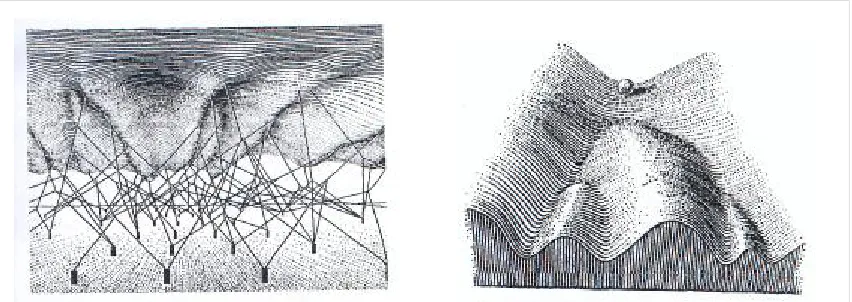
In addition to this example, another model that has been developed to describe the relationship between an evolving form or organism within its environment is Conrad Waddington’s11 concept of the epigenetic landscape. “The epigenetic landscape is an undulating topological surface whose multiplicity of valleys corresponds to the possible trajectories (shapes) of any body evolving on it”.12 Any point change in that
is distributed smoothly across the surface so that its influence is not locally related to any point. The modulations and rivulets of the landscape do not mobilize space through action but through implied virtual motion. The movement of a point across the landscape becomes the collaboration of the initial direction, speed, elasticity, density and friction of the object along with the inflections of the landscape across it is travelling. The landscape can initiate movements across itself without literally moving. The introduction of any exogenous forces at any time will perturb the evolving on the landscape body from its determined trajectory and cause it to evolve a unique and original form. ‘What we have to understand about those forms’, as Kwinter notes, ‘is that they exist, enfolded in a virtual space, but are actualised (unfolded) only in time as suite of morphological events and differentiations ever-carving themselves to the epigenetic landscape’. 13
Figure 2: The epigenetic landscape seen from two different points of view, below and above respectively
For Greg Lynn14 ‘this possibility of an animate field opens up a more intricate relationship of form and field that has not been possible before’. Rather than an entity being shaped only by its own internal definition, those topological surfaces are inflected by the field in which they are modelled. If an entity is moved in space, its
11See Waddington, C. [1957], Strategy of the Genes, New York: Macmillan
12Kwinter, 1992, p.63
13Kwinter, 1992, p.63
Architecture and animation | 7
shape might change based on the position within gradient space even though the definition of the entity remains constant. In this way, the same entity duplicated identically but in a different gradient space might have different configuration. Thus the form becomes the site for the calculation of multiple forces.In combination with time, topology and parameters it establishes the model that Lynn has developed to design in an animate rather than static space.
Lynn’s Port Authority Gateway project for a competition in Manhattan provides a characteristic example of his work, demonstrating how fluctuating dynamics and environmental forces can affect architectural form. The competition involved the design of a protective roof and lighting scheme for the underside of the ramps leading into the Port Authority Bus Terminal. The site was modelled using forces that simulate the movement of cars and buses, pedestrians and vehicles, underground and overground, land and water, each with varying speeds and velocities. In this way, a gradient field of attraction across the site is established. To find a form for this invisible field, Lynn introduced geometric particles that changed position and shape according to the influence of these forces. The particle studies were used to capture a series of phase portraits15 that showed cycles of movement over a given
period of time. This material was then combined to give the building’s tubular components.
Figure 3: Port Authority Gateway project. Particle study of motion forces in successive sequences.
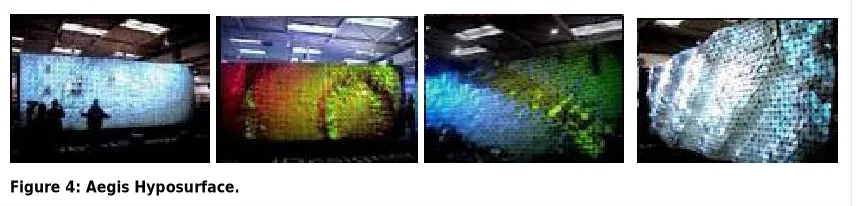
For Mark Goulthorpe of DECOI, animation is an emerging cultural phenomenon in which movement is implicit and not explicit. Even though there are technical means available to an architect to ‘flirt’ with dynamic possibilities of form, he regards the latent or virtual dynamism the essence of animation.16 An example of DECOI‘s
dynamic architecture is the Aegis Hyposurface in Birmingham Theatre. It actualises the idea of a dynamic and responsive architecture capable of responding physically to stimuli from its surrounding environment –the sounds and movements of people,
15Instead of freezing a single instant of the particle study, an animation ‘sweep’ technique captures a sequence of
positions through a phase of their motion.
Architecture and animation | 8
light and information. The surface deforms by capturing stimuli from the theatre environment and dissolving them into movements, supple fluidity or complex patterning.
Figure 4: Aegis Hyposurface.
The idea of form emerging in conjunction with dynamic and ephemeral aspects of the site was pursued in Paramorph project, but this time in a purely architectural context17. Its form derives from the capture of the movement and sound of people
passing through it, concentrating mainly on non-visual aspects of site in an attempt to reveal its dynamic rather than static character with time participating in that process. It is imagined as a series of tessellated aluminium surfaces, which relay sound in response to the passage of people moving through the form ‘as morphings of site-sound” as Goulthorpe18 refers to them. The project has been developed as an
element, a paramorph, that may change its form but its fundamental property remains the same, in this case its geometric character.
Figure 5: Paramorph project.
It is becoming obvious that space and architecture are related to time. Architects no longer limit themselves to the three dimensions of the Euclid, but incorporate time in their design; the fourth dimension that provide objects with plasticity. From Kwinter ’s 19 point of view this is ‘the design discipline’s greatest current hope for systematic
17 In comparison to Aegis Hyposurface that is a kinetic art-project, Paramorph is the design of a Gateway to the
South Bank of London, subject of architectural competition in 1999.
18Goulthorpe, 2000, p.12
Architecture and animation | 9
renewal and continued relevance’, made possible by the advent of the computer in architectural studios that allowed the manipulation of the shape and form in time.
So far we have pointed out architects’ work within a dynamic field characterised by forces, in which space and form are produced through movement and transformations. Regarding movement as the medium through which form evolves, the issue of external forces and their effect on a dynamically conceived architecture has been explored, supported by examples of architects’ work. Those issues have revealed the role of time as the fourth dimension in design.
The relation of time to form | 10
3. The relation of time to form
There is a different definition to form every time it is seen from different perspectives. Within the context of this paper and because of its relation to dynamism –it seeks to produce a dynamic form responsive to its surroundings– and biology –its hypothesis derives from theory of that field in an attempt to find a mechanism of explaining the interaction pedestrians with environment– we will look at it as a state of a system at a particular point in time.
According to Kwinter20 “forms represent nothing absolute, but rather structurally stable moments within a system’s evolution; yet their emergence derives from the crossing of a qualitative threshold that is, paradoxically, a moment of structural instability. This could be possible because forms are part of a special type of systems called dissipative systems”. The term dissipative system was coined by Ilya Prigogine
to denote systems, which continuously export entropy in order to maintain their
organization.
A dissipative system or structure is an open dynamical system, meaning an evolving system in which energy or information is moving out of it and in to it as well. This energy comes from other systems either adjacent to it or operating within it or upon it and keeps the system dynamic. As energy comes through the system it generates three general types of transformation: (1) it imports information from outside the system with very complex results. In addition to changes produced internally within the system, this also transforms the outside of the system in such a way as to affect the type of information it will transfer into the system. (2) It exports energy from within the system to the outside, producing this same effect in reverse. (3) It transports information from certain levels in the system to other heterogeneous levels that result to the production of morphological events, often dramatically unpredictable with respect to location, causal sequence and extent of effect.
Thus, all forms are produced as by-products or maps of particular evolutionary segments of one or another dynamic system. They are characterized as the irruption of discontinuity, not on the system but in it or of it. For a form to emerge, the entire system must be transformed along with it. Thus, every form enfolds within it a variety of forces over time and is the result of not one, but many different causes. As
The relation of time to form | 11
Kwinter21 poses it ‘forms are always new and unpredictable unfoldings shaped by their adventures in time; they arise from something called “universal unfolding”, a dynamical pathway in which every virtuality is activated’.
Within this context, a dynamic process that links a virtual component to an actual
one should determine the emergence and evolution of form and therefore reveal its connection to time. The virtual incorporates a developmental passage from one state to another; it does not have to be realised –it is already fully real– but only activated, actualised. ‘It exists’, as Kwinter22 argues, ‘as a free difference or singularity, not yet combined with other differences into a complex ensemble or salient form’. The virtual is selected; it passes from one complex in order to emerge differently within another. The actual does not resemble the virtual, so their relation is one of difference, innovation or actualisation. Actualisation invents through a continuous, positive and dynamic process of transmission, differentiation and evolution and occurs in time and with time. Time has no reality independent of the subject. “The dynamic view of time or temporality recognises that the future lacks the reality of the past and the present and that reality evolves as time passes. Temporality has the unity of the future that makes the present the process of having been.”23 That is real
time where we can perceive the past, present and future simultaneously. In case of actualisation, time is real, a dynamic and activated flow. The emergence of form is a creation (actualisation) itself and wedded to the ever-evolving particularities of time24. Since time is real form can be sought in time, within a dynamic and mobile
reality.
Time functioning as a form of pure information ‘is what makes the emergence and evolution of form possible by providing a communicative middle term –a metastability– affording exchanges and absorbing and transmitting tensions across many and various systems of influence. Thus time is not just a novel or superadded variable; it is that agency which multiplies all variables by themselves’.25
21Kwinter, 1992, p.61
22Kwinter, 2001, p.8
23Rahim, 2001, p.32
24Kwinter, 2001, p.10
Theory within the context of biology | 12
4. Theory within the context of biology
Autopoietic theory is a theory of self-organization, developed by the Chilean biologists Humberto Maturana and Francisco Varela (1980). The concept of self-organization has interested natural and social scientists in an attempt to understand the reason behind complex phenomena. It is used to label phenomena that appear to determine their own form and processes. By describing the self-production of biological entities, Maturana and Varela were able to distinguish living from non-living entities. The central concept of the theory is that of autopoiesis. The term was conceived by Maturana around 1972, as a combination of the Greek words auto (self-) and poiesis (creation; production), to denote the process whereby a system produces its own organization and maintains and constitutes itself within the environment.
4.1 Structural coupling
One of the key concepts of autopoietic theory and this report’s main focus is
structural coupling that defines the relation between a unity with either its environment or another unity. Because this report investigates the interaction between pedestrians and environment, it heavily relies on structural coupling –that forms its hypothesis– as a way of explaining the mechanism of interaction. In order for the reader to become familiar with the concept we will first describe and analyse briefly terms like organization, structure and structural determination.
According to Maturana and Varela, organization and structure are considered to be key elements in the determination of a system‘s nature and therefore provide an explanation of its dynamics. Organization is a set of relations that exist between the components of a system; those relations define its form at any given moment and compose its identity that is maintained in spite of dynamic changes over time. A unity’s organization is realized through the presence and interplay between components that form the unity’s structure.26 A characteristic illustration of the
distinction between those elements is given by Maturana and Varela27: “…in a toilet the organization of the system of water-level regulation consists in the relations
26Whitaker, 1995
Theory within the context of biology | 13
between an apparatus capable of detecting the water level and another apparatus capable of stopping the inflow of water. The toilet unit embodies a mixed system of plastic and metal comprising a float and a bypass valve. This specific structure, however, could be modified by replacing the plastic with wood, without changing the fact that there would still be a toilet organization”.
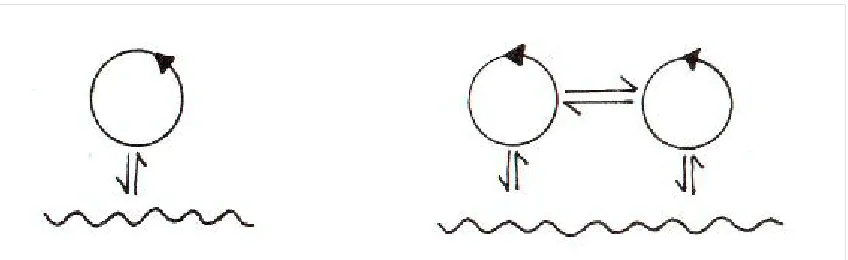
Structural determination is the principle that the behaviour of a unity is constrained by its constitution rather than direct influence of its environment. Unity and environment are considered two distinct elements operationally independent of each other. Between them there is a necessary structural congruence. In the interactions between the unity and the environment within this structural congruence, the perturbations of the environment may “trigger” a change of unity state, but it is the structure and organization of the unity that determines what change28 occurs to it.
Therefore, the changes that result from the interaction among the unity and its environment ‘are brought about by the disturbing agent but determined by the structure of the disturbed system’.29 Since “structure” refers to any constitutive
element of a unity, structural determination concerns the manner in which observable phenomena are explained, not some formalized manner in which those phenomena objectively occur.
Figure 6: Interaction of a system with its environment and of two systems with the environment and with each other
In a structurally determined dynamic system, since the structure is in ongoing change, its structural domains will also change, although they will be specified at every moment by their present structure. As long as the unity does not enter into a destructive interaction with its environment, there will be compatibility between the structure of the environment and that of the unity. As long as this compatibility
28Those structural changes are a result of the unity’s own dynamics or triggered by its interactions.
Theory within the context of biology | 14
exists, environment and unity act as mutual sources of perturbation, triggering changes of state30. This ongoing process is called structural coupling. Therefore,
according to Maturana & Varela31, we speak of structural couplingwhenever there is a history of recurrent interactions leading to the structural congruence between two (or more) systems. Structural coupling describes ongoing mutual co-adaptation without reference to a transfer of some ephemeral force or information across the boundaries of the engaged systems.
30Structural changes that a unity can undergo without a change in its organization
Agent-based systems | 15
5. Agent-based systems
5.1 Definition of the term agent
There is no universally accepted definition of the term agent and there is much ongoing debate and controversy on this subject. Although, the issue of autonomy is generally accepted as central on the notion of agency, there is little agreement beyond that. Partly, that difficulty lies on the fact that each domain is interested in different aspects associated with agency. Thus, for different application agents are defined differently.
Within the context of this report, the most appropriate definition is given by Michael Wheeler (1996), who uses the terms animats (artificial animals) or artificial autonomous agents to denote autonomous agents embedded in simulated environments and even autonomous robots with actual sensory-motor mechanisms. According to him, ‘an autonomous agent can be defined as any adaptive system which, while in continuous long-term interaction with its environment, actively behaves so as to achieve certain goals’. 32 In this definition, the notion of
adaptiveness refers to surviving long enough in an environment to achieve certain goals, so as to increase the chances of an autonomous agent to survive in a noisy, dynamic, uncertain environment.
5.2 Examples of multi-agent systems
Before presenting examples of agent-based systems, we should refer to the principles of a multi-agent system. A multi-agent system is a complex system that generates special dynamics using many agents with simple behaviours. The collective interactions allow complex behaviour to emerge. It can have many agents of the same kind and/or different kinds of agents.
5.2.1 A user-centric virtual museum
It involves a multi-agent system for designing and maintaining user-centric33 virtual
architecture, proposed by Ning Gu & Mary Lou Maher (2001) of Key Centre Virtual
32Wheeler, 1996, p.210
33 From a user-centric approach, virtual architecture is understood as the collection of the representations of
Agent-based systems | 16
Architecture Group, University of Sydney. ‘Each agent of the system represents a user, while the agents are the only entities in the system and their environment equals to empty assembly’.34 The agents carry a unit of place around them that can
be connected to other user’s place units according to design rules of the system. This kind of agent has knowledge of its own environment and can generate the spatial infrastructure needed for a specific collaborative or communication activity, so the resultant environment is not passive as the conventional, collaborative environments.35 Additionally, the agents are design agents, meaning they design,
implement and maintain the environment according to different situations. The result is a dynamic environment, which evolves from time to time based on different situations it senses.
Figure 7: Interactive virtual museum. Pre-visit stage, visit stage and post-visit stage
In this model a space is generated from agents’ actions and interactions with each other. It is a space created from scratch. It does not pre-exist but it is developed and maintained by the agents’ actions related to different situations they face, different users they interact with. The agents cannot modify the environment they can only expand it. The created environment is the outcome of a one-way interaction, a passive receiver of actions that determine its existence. What if the environment could interact with the agents? Is it possible this interaction to affect the created space and agents’ actions? And if this were the case what would be the outcome?
5.2.2 A model of distributed building
This model by Bonabeau & Theraulaz (1995) is inspired by wasp colonies. It explores the space of possible architectures that can be generated with a stigmergic
which virtual architecture is understood as a place or an assembly of places with permanent structure. (Gu & Maher, 2001)
34Gu & Maher, 2001
Agent-based systems | 17
algorithm36 and seeks to constitute a first step towards a deeper understanding of
the origins of natural shapes in terms of the logical constraints that may have affected the evolutionary path.37
At this point we should refer to the notion of stigmergy, in order to understand the logic behind the stigmergic algorithm. Stigmergy is an indirect interaction among social insects that results to the emergence of self-organization in them and describes interactions between individuals and their environment. When two individuals interact indirectly, one of them modifies the environment and the other responds to the new environment at a latter time; therefore individual behaviour modifies the environment, which in turn modifies the behaviour of other individuals. Stigmergy was introduced to explain task coordination and regulation in the context of nest reconstruction in Macrotermes termites.
The algorithm allows a swarm of simple agents to build coherent nest-like structures in a simplified model of space. The agents move randomly and independently on a tree-dimensional cubic lattice. They are capable of depositing elementary bricks according to a specified set of rules, embodied in a look-up table, whenever they run across a stimulating configuration. The agents do not communicate, have no global representation of the architecture they are building, do not possess any plan or blueprint and can only perceive the local configuration of matter surrounding them. Although, each agent can build alone a complete architecture, individual activities have been co-ordinated so as to ensure a well-organized building process, result of collective behaviour.
The model is based on the tight structural coupling between an insect society and its environment that results in a complex collective dynamics whereby coherent functional global patterns emerge from the behaviours of simple agents interacting with each other and/or with their environment. While the individual behaviour of an insect is very simple, the non-linear interactions, taking place between individuals, provide the society with a large variety of complex and adaptive collective behaviours.38 The described model gives rise to a few questions. If we shift our focus
from the generation of an algorithm that produces certain behaviour to the
36 It is a collective building algorithm in which individuals communicate only through the local environment they
perceive.
37Bonabeau & Theraulaz, 1995
Agent-based systems | 18
Interacting unities: an agent-based system | 19
PART II: AN AGENT-BASED SYSTEM FOR EXPERIMENTING ON THE INTERACTION PEDESTRIANS - ENVIRONMENT
6. Interacting unities: an agent-based system
The answer to all questions posed in the previous section is given by an agent-based system that experiments on the interaction between pedestrians and their environment. In this part of the report, we look on the process of action of pedestrians within an environment. Firstly, the agent-based system39 is introduced
and described. Secondly, through a series of experiments we present its development and explore the interaction. Thirdly, the system is applied to an actual environment and the outcome of the whole process is discussed.
6.1 Description of the system
In an attempt to investigate the role of movement as an external force in an active space of interactions, we look on pedestrians’ action within an environment. It was decided the use of agent modelling because human movement can be successfully generated by applying simple rules that describe the behaviour of individual agents. Those simple rules result to a complex overall behaviour. Considering Wheeler’s (1996) definition of agents, each agent is autonomous and seeks to modify its environment in a constant interaction with it.
Taking into consideration our hypothesis that refers to structural coupling and the definition of structure according to Maturana and Varela, it was indicated that the environment had to be constituted of components, in order for us to be able to identify changes in structure. This led us to the use of a grid, since it is easily transformable both locally and as a whole.
Agents and environment are regarded as a system –we refer to it as an agent-based system– since they constitute a complex whole, where two autonomous unities with internal rules interact together to achieve a certain goal: influence each other.
39The system has been programmed and designed in Microsoft Visual C++ 6.0 using Cosmo 3D libraries based on
Interacting unities: an agent-based system | 20
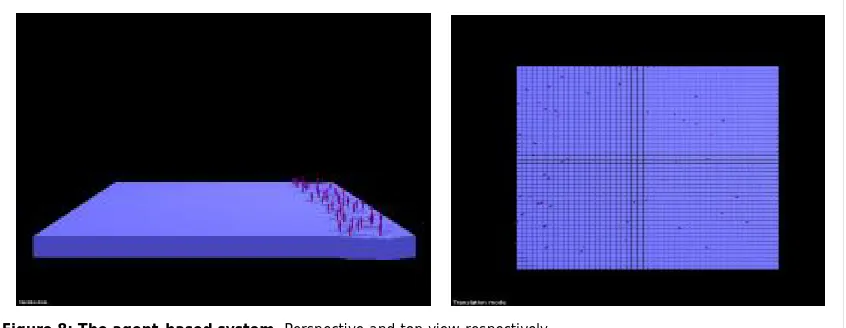
The choices already made for using agents and a grid to represent the environment determined the nature of interaction. Hence, each agent of the system represents a pedestrian, while his environment is a simplified version of space. The agents move independently on a two-dimensional grid consisted of blocks. By using an array of elements, a simple surface is created based on a geometrical simple form: a block. The agents transform their environment by translating each block they are standing on at the time, along with their height. The ‘identity’ of the block -its position on the grid- can be established by rounding agent’s location (x and z coordinates) to the nearest integer.
Figure 8: The agent-based system. Perspective and top view respectively
Thoroughly, the following simple process defines the interaction between agents – environment:
Loop
Find the block you are standing on by rounding your current location to the nearest integer.
Find that block’s height. Move a little bit.
Find the new block you are standing on by rounding your location to the nearest integer.
If the new block is different from the first then Find this block’s height.
Translate the new block you have stepped onto Translate your height along with that block. End if
End loop
Interacting unities: an agent-based system | 21
The interaction between the agents and their environment is explored through a series of experiments. Those experiments focus on movement and its effect on the whole process and on the extent of interaction agents-environment along with the result of this interaction. For the purpose of producing an experimental model, variables are established that can be manipulated to produce different conditions for comparison. Through using a set of parameters that define the relation between features of agents and features of the environment the extent of interaction is determined and the initial environment is modified in each individual case creating a different visual effect.
6.2 Theoretical set of experiments
One of the primary concerns in the development of the model, after defining the nature of interaction, is movement. It is the medium through which the system evolves and the interaction is realized in time.
Initially, movement occurred in a straight line, resulting to the continuous interaction of agents with the same part of their environment, as it was indicated by early experiments. Considering that we examine pedestrians’ action within the environment, that kind of movement and behaviour could not be considered natural. A closer approach would be random movement throughout the environment, which led us to introduce turn angles and steps. Thus, the agents move forward and change direction of movement gradually every 10 steps they take, bringing about a more realistic and smooth movement. The following process determines each agent’s movement, where turn step is a variable that defines the number of steps the agent takes while turning:
Loop
If you have not taken any turn steps and you have taken 10 steps forward then turn at an angle ranging from –0.1 to 0.1 and set turn step number to 1. End if
Otherwise, if you have taken any turn steps, then start counting them.
If these are more than 5, then
Interacting unities: an agent-based system | 22
End if
Move forward with random speed. End loop
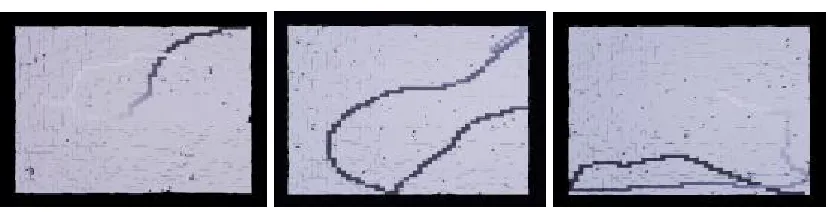
Agents’ movement is restricted within the grid, since our main concern is their interaction with the environment. Every time they reach the edges, they turn left or right quiet rapidly according to their previous direction of movement. This process results to agents’ interaction with different part of the environment each time, as it is demonstrated in figure 9. It shows the path of three different agents, as it was recorded in one of the experimentations.
Figure 9: Agents’ traces.
Each agent starts his movement from a different initial position. The blocks have been coloured lighter the more recently the agent has moved through them.
After finalizing agents’ movement at this stage, our attention was shifted to the interaction. Because it is a two-way interaction, it would be interesting to explore whether or not each interacting unity can affect it and in what extent. Regarding the structure of the whole system and nature of interaction at that moment, two sets of parameters were established: one related to agents and their internal rules and one related to environment regarding the extent of changes that occur to it due to the interaction with the agents. Those parameters are relative simple and straightforward to understand and will be explained briefly, starting with the two ones related to agents.
Speed. It controls the agent’s speed.
Init. position. It specifies agent’s starting point of movement on the grid.
Interacting unities: an agent-based system | 23
direction, otherwise he turns gradually to select another direction of movement that the height difference allows him to follow.
Maximum height. It specifies the maximum depth the agent can sink the block.
Sink height. It controls how much the agent can sink a block each time he steps onto.
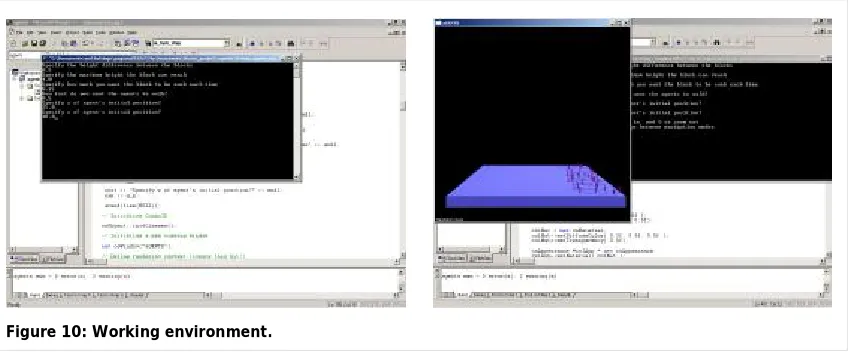
Always considering pedestrians and their behaviour, the height difference can be regarded as a physical constraint with human analogy: agents cannot move towards a direction with big height difference between blocks, like pedestrians cannot or are not willing to –depending on the value– move up or down big differences of height. Based on that, small values were given to the previously mentioned parameters and their effect on the system was tested. In all the experiments the value of the parameters can be specified by the user in a window that comes up before the program starts running, as shown in the following figure.
Figure 10: Working environment.
Interacting unities: an agent-based system | 24
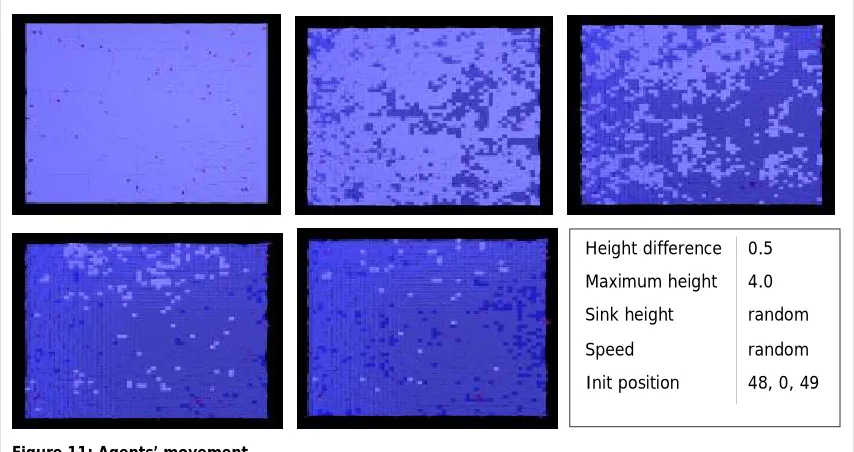
Figure 11: Agents’ movement.
Sequential top views. The blocks have been coloured darker the deeper the block has been sunk.
The ‘end’ of the experiment gave rise to an interesting behavioural pattern: the agents get trapped in a continuous circular movement on a block either as individuals or in groups. When they form a group, the agents create holes made by more than one sunken block (figure 12). The pattern emerges when the height difference prohibits agents’ movement towards any direction. It was observed –by repeating the experiment several times– that it is easier for the agents to get trapped in the corners or the edges of the grid, because their movement is limited within the grid and have to pass by those points to turn. This results to a quick change of blocks’ height that reaches the constraining limit. [Animation 1]
Figure 12: Circular movement pattern.
Looking at the transformations40 of the environment throughout the experiment –the
initial and final form of which is presented in figure 13– we see that it is uniformly
40The whole process is presented in Appendix A (2) in successive sequences.
Height difference 0.5 Maximum height 4.0
Sink height random
Speed random
Interacting unities: an agent-based system | 25
shaped. This can be attributed to the local character of the interaction: each agent locally modifies the environment –by translating one block every time– while the other agents respond to the new environment at a later time.
Figure 13: Environment’s modification. Initial and final form respectively.
Taken it a step further, we expand agents’ interaction to a neighbourhood of blocks instead of only one. This results to a smoother, plastic shape of environment.
[Animation 2]. Although the interaction can still be considered local because changes affect only a part of the environment and not the whole, it is indicated that the shape can be manipulated and by extending the interaction, the whole environment can be affected by one agents’ action.
Figure 14: Experimenting with plasticity.
(1) Interaction with one block. (2) Interaction with a neighbourhood at the same moment in time as the previous
one. (3) Final forms of environment superimposed showing the difference of shapes. Neighbourhood marked in red.
Interacting unities: an agent-based system | 26
Regarding movement, the agents exhibited the same behaviour observed in the previous experiment: they mostly interact with the blocks close to the edges of the grid and tend to move from the edges towards the centre of the surface.41 In this
case because of the large value given to ‘height difference’ and ‘maximum height’ the agents are able to interact continuously with the environment and move towards any direction without any limitation. We can regard the interaction non-constrained since it can be infinite. This constant unlimited interaction results to an unexpected curved form. It is unexpected because there had been no indication before that such a modification can be possible. That shape is the outcome of agents’ movement towards the edges and corners, for reasons already mentioned, and interaction with these parts mainly. [Animation 3]
Figure 15: Curved environment. Two states of the environment in a different moment in time.
Until now the experiments were based on different values basically given to two parameters –height difference and maximum height– because those two are mainly associated to interaction, while the others were kept random. Additional experiments42 in parameters’ values showed that ‘sink height’, with either negative or
positive value –meaning that the agents build up instead of sinking blocks– or ‘speed’ can only affect the time within the final form will emerge, while the agents’ initial position on the grid results to local changes on the surface when the interaction is constrained, while in any other case the interaction or its result is not affected.
Up to now, the experimentation has shown that the height difference between the blocks and the maximum depth a block can reach are mainly the parameters –part of environment’s internal rules– that determine the extent of interaction and its duration. The agents select the direction of their movement, but it is the environment that either allows or prevents that movement that in turn brings about
41It is presented in Appendix A (1).
Interacting unities: an agent-based system | 27
the changes that will occur on it. The bigger the height difference the longer the agents interact with the environment and manipulate it, resulting to more interesting forms.
So far we have concentrated on the interaction between agents and their environment based on random movement generated by a few simple rules. Considering that our agents represent pedestrians and their movement is based on vision, we take it a step further to experiment with agents’ behaviour based on vision and the effect of that on their interaction with the environment. According to Gibson (1979) natural vision is the interaction between humans and environment, where humans move in a direction that allows them possible further movement.43
Experimenting with vision
Taking into consideration Hillier’s theory of natural movement44, we apply agents
that decide on which direction to go based on the length of the line of sight from their current position. The agents are able to see and perceive their environment and other agents, as part of the environment. At the moment the agents do not interact with each other, they only avoid collision.
Initially, a few changes were made to the model in order to test agents’ behaviour based on vision. Surrounding walls were added to prevent them from moving out of the grid and two walls were placed in the middle of the grid as obstacles that the agents have to see and avoid.
Regarding the length of line of sight the guiding mechanism of movement, we give our agents the ability to select one out of three possible directions. It is used a simple agent decision process:
Loop
Check whether you can see something along your line of sight. If you have seen something,
calculate the length of line of sight from your current position. End if
Otherwise, set the length of your line of sight to 50.
43Turner, 2002, p.2
44That theory shows that the majority of human pedestrian movement occurs along lines of sight. It considers the
Interacting unities: an agent-based system | 28
Turn 85° left and check if you can see something along that line of sight. If you have seen something,
calculate the length of line of sight from your current position. End if
Otherwise, set the length of your line of sight to 50.
Turn 85° right from your initial position and check whether you can see something along the new line of sight.
If you have seen something,
calculate the length of line of sight from your current position. End if
Otherwise, set the length of your line of sight to 50.
Compare the length of these three different lines of sight and move towards the longest one of the above.
End loop
When the agents come too close to an obstacle, since they are able to see it they turn rapidly to avoid it and select a different direction of movement.
Initially, the agents’ field of view was set randomly to 60°. This resulted to movement into corners since the agents did not look to the sides enough, as it is shown in figure 16. Taking into consideration that human’s field of view is 170° for male and 180° for female and the previous observation we set our agents’ field of view to 170°.
Figure 16: Experimenting with vision and field of view
Interacting unities: an agent-based system | 29
with the environment. That this is the case is demonstrated in figure 17. It is indicated that ‘vision’s location’ is possible to affect agents’ behaviour, since vision is represented by a vector positioned on agent.
Figure 17: Movement guided by the longest line of sight
First, we made agents move throughout the environment by changing the decision process of selecting a direction of movement: the agents still check three different probable directions of movement, but they do not follow the one with longest line of sight. Instead, they add the lengths of the three lines of sight, they randomly select a number within that range (from 0 to sum) and according to its fluctuation they take three steps towards the corresponding direction. The result of that process is shown in figure 18. Then in order to prevent agents from blocking each other’s sight, we shifted vision’s position higher.
Figure 18: Agents’ movement based on vision
Interacting unities: an agent-based system | 30
leads them. The centrality of an area in the environment is determined by configuration and availability of free space. For instance, if there are no obstacles in the environment, all agents concentrate exactly in the middle of the environment, while in the current model with the two internal walls they concentrate on the centre of the area demarcated by those two obstacles. Figure 19 supports our observation.
Figure 19: The longest line of sight leads agents to the central parts of the environment.
The constant interaction with the same part of the environment results to the modification of that part, giving rise to a curved form, a whirl. [Animation 4] Three states of the environment in different points in time are shown in the following figure, while the whole process is presented in Appendix B.
Interacting unities: an agent-based system | 31
6.3 Practical application
So far we have concentrated on the interaction between agents –representing pedestrians– and their environment experimenting with parameters that affect that interaction and ignored the subject matter that lies behind. Looking at the process and the outcome from that perspective, we can say that the environment evolves in time through movement. Movement is the external force acting on the environment that constitutes the medium through which the interaction is realized. Referring to the result of that interaction, we could use the landscape metaphor to characterise the environment’s final form. At this point we should clarify the terms environment,
form and landscape and how these are linked together. Environment refers to the surroundings in which the pedestrians act, while form is the environment’s shape at different points in time or if looking at it as a system, a system’s state at a particular point in time. The landscape metaphor is used to characterise the result of the interaction, the final form, the final state.
Looking back to the experiments and emerging forms, in most cases despite randomness or diversity in values given to parameters, the result is an evenly shaped form, a uniform landscape using the above metaphor. Taking into consideration Waddington’s epigenetic landscape we should attribute this outcome to local character of interaction. Any change in the environment caused by agents’ movement is not distributed smoothly in the whole surface, but its influence is locally related to a block. A change evenly distributed across the environment would result to an undulating form. This was indicated by the experiment presented in section 6.2 where the agents modify a neighbourhood instead of one block –the outcome of which is shown in figure 14. In a way this interaction could still be considered local because changes affect only a part of the environment not the whole, however it indicates the difference in the outcome.
Interacting unities: an agent-based system | 32
In order to explore those new possibilities, we decided to apply the system in an actual built environment, shown in the following figure.45
Figure 21: The agent-based system embodied in a real built environment. Initially the grid was covering the whole site. For simplicity, it was decide to limit it in the central rectangular area.
A site was selected in the city of Plymouth. The site, Armada Way, is in an area of landscaped public open space and is subject of architectural competition. It is required the development of a pavilion with a mix of uses –food and drink, a tourist information facility, exhibition spaces– and re-modelling of the adjacent landscape. That particular site was selected because it is at the heart of the commercial city centre and constitutes a junction of pedestrians’ movement.
The agents’ movement is guided by vision; the decision process of selecting a direction of movement is the same as the one described in the previous section, at the final stage of its development. Initially, the grid was covering the whole site. Due to the size of the actual environment we had to use an array of 120 by 160 blocks for the grid to cover it –22400 objects that additionally were changing state constantly because of the interaction with the agents– that affected the speed of running program. For simplicity, we limited the grid to the central rectangular area of the site; the agents interact with that part only while they are able to walk throughout the site. The two stages of the model are shown in figure 21.
Although initially the agents move throughout the site, they end up in the centre of it and interact mainly with this part of the environment –again because they follow the longest line of sight– resulting to a conical form, shown in figure 22. The agents exhibited similar behaviour to behaviour in previous experiments with vision before
45A simplified version of the site has been simulated using the Virtual Reality Modelling Language (VRML 2.0) and
Interacting unities: an agent-based system | 33
the model was applied to the real site. The result of that behaviour in both cases is a curved, conical shape. Since it is repeated we can talk about a pattern, the whirl pattern.
Figure 22: Whirl pattern as the outcome of agents’ behaviour based on vision.
The systems application to the real site shows that there is an indirect correlation between the surroundings and environment’s form: what the agents can see guides their movement that in turn affects the interaction –since as we have already discussed movement is the medium through which interaction is realized in time– resulting to a particular form. That form emerged because of specific conditions and interactions that took place at the particular moment the whole process occurred. The system’s application to the real environment revealed us the possibility of generating a unique form responsive to the context that it exists: each time the surroundings change, each time different pedestrians interact with the environment, paraphrasing Borden’s words, a different unique form can evolve.
Interacting unities: an agent-based system | 34
movement the environment’s shape changes at every point in time: each agent locally modifies the environment giving rise to a particular form, while the other agents respond to the new environment and transform it at a later time. It is an environment that constantly evolves along with its form. As far as agents are concerned there is an indirect interaction between them, indicating that the phenomenon of stigmergy, explored by Bonabeau & Theraulaz’s model (1995), is possible to take place among interactions with human analogy. The changes that occur in the environment are structural changes allowing us to regard form as the representation of a system’s state at every moment. It becomes obvious that this is a process totally connected to time and cannot be realized otherwise. As we have already argued in the introduction of this report, space, time and movement combined are connected to dynamism.
Taking into consideration the evolving environment and the changes that occur to it as structural changes lead us to our hypothesis. It has been hypothesised that the recurrent interaction between agents and environment can lead to a structural coupling between those elements. It means that every time a change occurs in each one of them, as an expression of its own structural dynamics, it triggers changes to the other one. Our results so far imply that it is possible for the agent-based system to evolve structural coupling but in its current state we cannot argue that the hypothesis is fully verified. A presupposition for structural coupling, as it has already been mentioned in chapter 4, is structural determination: agents’ movement on the environment brings about the changes that occur on it, but it is the environment’s internal rules that determine the nature and extent of change. Given that the agent-based system has succeeded on that we can speculate that it is possible for the system to be developed to verify its hypothesis, as long as the interactions between agents are developed to result to adaptive behaviour.
Interacting unities: an agent-based system | 35
phenomena, emergent or not, and not a formalised manner of how these phenomena might occur.
Conclusions | 36
7. Conclusions
This report has explored the interaction between pedestrians and their environment, in an attempt to contribute to the problem of generating a form dynamically responsive to its environment, fully embodied within the context that it exists. In order to establish its theoretical background, it has investigated issues from three different fields: architecture, philosophy and biology. Those issues are the effect of movement on form, the relation of time to form and the relationship of an evolving organism or system with its environment respectively.
An agent-based system has been developed to experiment on the interaction between pedestrians and environment. Movement as part of agents’ internal dynamics is considered an external force acting on the environment, affecting the interaction. Two interacting elements can be identified in the system, agents (pedestrians) and environment, each one of which is an autonomous unit with a set of internal rules. It is hypothesised thatthe recurrent interaction between agents and environment can lead to a structural coupling between those elements.
The result is a landscape where each agent locally modifies its environment, while the other agents respond to the new environment at a later time. It is found that agents’ movement on the environment brings about the changes that occur on it, but it is the environment’s internal rules that determine the nature and extent of change. It has been argued that the hypothesis has not been fully verified, but the system implies that it is possible to evolve a structural coupling by developing interactions between agents.
The idea of involvement of outside forces in the generation of a form dynamically responsive to its environment proved to be fascinating, giving rise to interesting results. Although, the whole process revealed possibilities of exploration, we had to limit the system’s development within the timeframe of an MSc project.
Conclusions | 37