Automated OPD Card System Using RFID
& Databases
Prof.Pranali Hatode1, AmishaShinde2, Saurabh Dambal3
Professor, Dept. of Electronics & Telecommunication, K.J. Somaiya Institute of Engineering& IT, Sion,
India1
Mumbai, India1
B. E Student, Dept. of Electronics & Telecommunication, K.J. Somaiya Institute of Engineering & IT, Sion,
Mumbai, India2
B. E Student, Dept. of Electronics & Telecommunication, K.J. Somaiya Institute of Engineering & IT, Sion,
Mumbai, India3
ABSTRACT: In today time hospitals are facing a need of better patient-doctor management system. In peak hours, when the number of patient are more, better data and patient management is required. Our project ‘Automated OPD Card System’ is based on this intension to reduce and improvise the patient-doctor management. This project is designed to automate OPD system. This is achieved by using RFID technique, HTML and PHP language. RFID is used so that the data can be synced at one place and it can be retrieved after scanning. For e.g., if the user wish to take treatment, he or she has to follow some protocols. By using ‘Automated OPD Card System’ efforts of paper work and storage of data are reduced. Automate OPD card is used to keep a tract of services provided to patient and medical history of patient. Data of patient will be stored on the server and whenever RFID is scanned, data will be displayed on the computer. GUI of the system is made up of using HTML codes and Data is connected with database using PHP language.
KEYWORDS:OPD Card, RFID, Server, Database Management.
I.INTRODUCTION
In today time hospitals are facing a need of better patient-doctor management system. In peak hours, when the number of patient are more, better data and patient management is required. Our project “AUTOMATED OPD CARD SYSTEM” is based on this intension to reduce and improvise the patient-doctor management. This system is mostly useful for senior citizens and new born children who frequently visit the hospitals for various check-up. Speciallyfor new born babies who have their weekly check-up for various vaccination.
This project is used to sync and store information of patients. In hospital, paper work is more before and after of treatment. To avoid this paper work and storage of heavy files, OPD card system is useful. By using this system, longer queues for paper making will reduce to greater extent. In this system, RFID card is used to sync and store data on server. User can store his/her personal information and medical history using RFID card. When RFID card is scanned by doctor, he/she will get all information of patient. After treatment, list of prescribed medicines also gets updated. This card will remain with patient. Whenever user come for treatment, he/she can directly meet the doctor without waiting in queue.
User interface is created with HTML language. 6 forms of various sections are included in Graphical User Interface. Uploading and downloading of data is arranged with the help PHP language. By this system, requirement of paper is eliminated. Paper will require only for print of prescribed medicines.
II. BACKGROUND & RELATED WORKS
Somewhat same system is presently used by K. J. Somaiya hospital, Ayurvihar, sion. In that system, they are providing a card with 15 day validity. After those 15 days if a patient comes, then the person on the counter scans the RFID card and provide new case paper. In addition to that, they maintain a register for storing numbers on RFID card of patient. In that register, they maintain every detail of patient. Here our system and their system differs by each other. In our system, we are not providing any case paper to the patient. All the treatment related details will be directly stored on the server by operating doctor. Only prescription will be on the paper. Otherwise no paper will used. This increases accuracy and reliability of data of patient.
Any many other hospitals and chemical labs, such process is used. But overcoming all the problems in previous systems, we are introducing a new efficient method of data/record management.
III. SCOPE OF RESEARCH
In this section some advantages of ‘Automated OPD card’ are- a) Lots of time consuming paper work is saved.
b) To increase accuracy of data using RFID card and database (digital storage). Life span of the database increases as all the data will be stored virtually on the server.
c) Earlier queue system for patient can be avoided. Patient management will become easy task. d) Keeping a track of any patient's medical history is very easy.
e) Data maintenance is improved as everything is saved in server directly.
f) If incase same doctor is not available on the session, then any doctor can access the previous medical history of the patient using patient’s RFID card.
IV. PROPOSED METHEDOLOGY & DISCUSSION
i. Flow of data and Procedures
1st time user:
A B C
A B C D
A. 1st time user will get RFID card after basic amount of down payment of the card. The RFID number will be saved along with the name of the patient
B. On the same counter, basic details of patients like name, age, address, contact number, gender etc. is saved along with date and time.
Doctor
RFID scanner Treatment &presciption RFID readerC. When patient will reach particular OPD doctor will have patient full basic details through RFID reader D. Health problem of patient along with treatment and medicines details will be saved on RFID card at doctor’s
end. A printer will be connected to this computer from where medicine receipt and other details can be printed.
2 nd time user:
E F
E. When same patient will come for re-checking or any other health issue, he/she need not go to counter, and instead he/she can bypass point A and B and can directly go to OPD
F. Here point C and D will be repeated
V. RESULT AND DISCUSSION
i. Webpage using HTML, CSS & PHP-
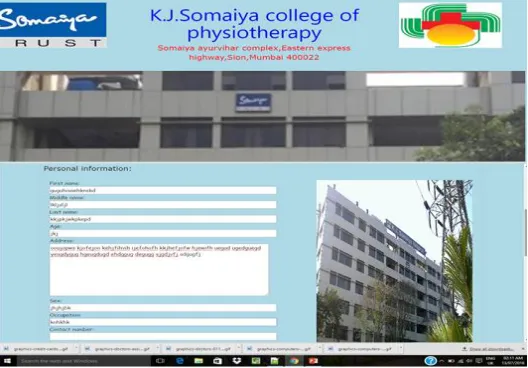
We have made web pages (medical forms) using HTML coding with CSS to give its font, colour, size etc. Page of personal information have a submit button which is used to connect this data with our database according to the medical proforma the data will be saved or taken from. Fig. 1 shows one of the webpage in the collection. This page is “welcome” page, which is basic introduction page. Similar 6 pages of various sections in defined sector are made.
Fig. 1. Web pages GUI
ii. Database using MYSQL-
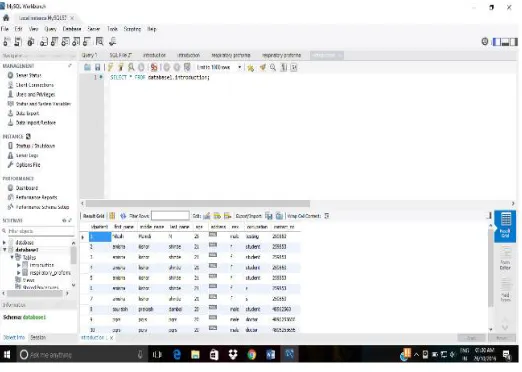
When the data of patient will be filled in the form, the data will be saved in the server as per the RFID number which will be unique of every patient. The data will be updated through MySQL which is a management system for our local and sever database.Further, the data according to specification of patient problem will be updated for the particular
select.Updated database can be any time accessed by any doctor having information about patient’s RFID card number, which will help doctors to analyse and track the progress of patients.
Fig.2 shows the database of the webpages. When data is filled in webpage and submitted, then all the data gets arrange in proper tables in respective database.
Fig. 2. Databases of webpages
iii. Connection to Server-
We have the XAMPP sever along with the cmd having local database data entered in it. In XAMPP control panel we have to connect it with MySQL local database which we have made earlier and the after entering the data in the forms the data of the patient will be entered in the database according to its particular RFID number.
VI.CONCLUSION
The amount of paper work and the amount of paper used both can be reduced by using this system. Not only paper but it also minimizes our effort to maintain the data of patient. Along which this system can in future be linked with internet to fall in Internet of Things and can contributed to Digital India.
VII. ACKNOWLEDGEMENT
We would like to express our whole-hearted thanks to our project guide Prof.PranaliHatode, who shared with us her valuable experiences, time and knowledge and provided us constant guidance from starting to the completion of our project “AUTOMATED OPD CARD SYSTEM”.
We would like to thanks to our HOD Prof.JayashreeKhanapuri. We are greatly thanked to other prof. for their help and guidance. We are also greatly thanked our collage and lab assistant for proving us lab facilities, which shows their support. And last but not the least; we want to thanks all those important people who have directly and indirectly given their special time and attention towards making project successful.
REFERENCES
TECHNICAL BOOKS:
[1] StaciaVarga, Denny Cherry, and Joseph D’Antoni"Introducing Microsoft SQL Server 2016: Preview EditionMicrosoft Press”, December
[3] Preston Prescott "SQL: Learn the Structured Query Language for the Most Popular Databases including Microsoft SQL Server, MySQL, MariaDB, PostgreSQL, and Oracle Kindle Edition"
[4] ClydeBank Technology “SQL: QuickStart Guide - The Simplified Beginner's Guide to SQL (SQL, SQL Server, Structured Query Language)
Kindle Edition"
[5] David Pitt "Modern Web Essentials Using JavaScript and HTML5” InfoQ May 2014.
TECHNICAL REPORTS:
[6] BalazsBezeczky. “Integration of a BECKHOFF PLC into an HVAC model plant”. A-Lab @ Automation Systems Group,Technical Report 183/1-177, TU Vienna, December 2015.
[7] Thomas Johannes Stipsits. “Security Analysis of the Austrian Citizen Card Environment MOCCA” A-Lab @ Automation Systems Group
Technical Report 183/1-174, , TU Vienna, August 2015
[8] P. K. Visscher, “How Self-Organization Evolves Nature”, vol. 421, pp. 799–800 Feb.2003.