All-But-Many Encryption
A New Framework for Fully-Equipped UC Commitments
Eiichiro Fujisaki
NTT Secure Platform Laboratories [email protected]
Abstract. We present a general framework for constructing non-interactive universally composable (UC) commitment schemes that are secure against adaptive adversaries in the non-erasure model under a re-usable common reference string. Previously, such “fully-equipped” UC commitment schemes have been known only in [11, 12], with expansion factorΩ(κ); meaning that to commitλbits, communication strictly requiresΩ(λκ) bits, where κdenotes the security parameter. We introduce new abstraction, calledall-but-many encryption(ABME), and prove that it can be transformed to a fully-equipped UC commitment scheme. We construct ABME from a variety of assumptions. In particular, we present an ABME scheme related to the DCR assumption, which implies the first fully-equipped UC commitment scheme withoptimal expansion factor O(1). In addition, it turns out an all-but-many lossy trapdoor function (ABM-LTF) [31] with a better lossy rate than [31].
Keywords:Public-key encryption, universally composable commitments, non-interactive, re-usable, non-erasure and adaptive security, and all-but-many lossy trapdoor functions.
1 Introduction
1.1 Motivating Application: Fully-Equipped UC Commitments
Universal composability (UC) framework [10] guarantees that if a protocol is proven secure in the UC framework, it remains secure even if it is run concurrently with arbitrary (even insecure) protocols. This composable property gives a designer a fundamental benefit, compared to the classic definitions, which only guarantee that a protocol is secure if it is run in the standalone setting. UC commitments is an essential ingredient to construct high level UC-secure protocols, which imply UC zero-knowledge protocols [11, 20] and UC oblivious transfer [12]. Therefore, any UC-secure two-party and multi-party computations can be realized in the presence of UC commitments. Since UC commitments cannot be realized without an additional set-up assumption [11], the common reference string (CRS) model is widely used.
A commitment scheme consists of a two-phase protocol between two parties, a committer and a receiver. In the commitment phase, a committer gives a receiver the digital equivalent of asealed envelope containing value x, and, in the opening phase, the committer revealsx in a way that the receiver can verify it. From the original concept, it is required that a committer cannot change the value inside the envelope (binding property), whereas the receiver can learn nothing aboutx(hiding property) unless the committer helps the receiver open the envelope.
to any value. On the other hand, extractability can be interpreted as the ability of the simulator extracting the contents of a commitment generated by any adversarial algorithm, even after the adversary sees many equivocal commitments generated by the simulator.
Several factors as shown below feature UC commitments:
Interactivity. If an execution of a commitment scheme is completed, simply by sending each one message from the committer to the receiver both in the commitment and opening phases, then it is called non-interactive; otherwise, interactive. From a practical viewpoint, non-interactivity is definitely favorable – non-interactive protocols are much easier to implement and more resilient to real threats such as denial of service attacks. Even from a theoretical viewpoint, non-interactive protocols generally make security proofs simpler.
CRS Re-Usability. The CRS model assumes that CRS strings are generated in a trusted way and given to every party. For practical use, it is very important that a global single CRS string can be fixed beforehand and it can bere-usablein an unbounded number of executions of cryptographic protocols. Otherwise, a new CRS string must be set up in a trusted way every time when a new execution of a protocol is invoked.
Adaptive Security. If an adversary decides to corrupt parities only before a protocol starts, it is called a static adversary. On the other hand, if an adversary can decide to corrupt parties at any point in the executions of protocols, it is called anadaptive adversary. The attacks of adaptive adversaries are more realistic in the real world. So, adaptive UC security is more desirable.
Non-Erasure Model. When a party is corrupted, its complete inner state is revealed, including the randomness being used. Some protocols are only proven UC-secure under the assumption that the parties can securely erase their inner states at any point of an execution. However, reliable erasure is a difficult task on a real system. So, it is desirable that anon-erasure protocol is proven secure.
1.2 Previous Works
Canetti and Fischlin [11] presented the first UC secure commitment schemes. One of their proposals is “fully-equipped”, i.e., non-interactive, adaptively UC secure in the non-erasure model under a re-usable common reference string. By construction, this scheme requires Ω(λκ) bits when com-mitting toλ-bit secret, whereκ denotes the security parameter. Canetti et al. [12] constructed its generalized version from (enhanced) trapdoor permutations, which is simply inefficient. Damg˚ard and Nielsen [20] proposed the first adaptively UC secure commitment schemes in the non-erasure model with expansion factor O(1), meaning that to commit to λ-bit secret, communication re-quires onlyO(λ) bits. However, the commitment phase must take three round interactions between a committer and a receiver. In addition, the CRS size grows linearly in the number of the parties. Soon after, Damg˚ard and Groth [18] removed the dependency of the CRS size, using the simulation sound trap-door commitments, but the improved proposal is still interactive.
commitments, but the CRS is just one-time, i.e., one needs a new common-reference string for each execution of the commitment protocol. Lindell [36] presented efficient static and adaptively UC secure commitment schemes based on the DDH assumption. Later, Blazy et al.[5] improved Lindell’s UC commitment schemes. However, those constructions require interaction and secure era-sure. Fischlin, Libert, and Manulis [23] transformed Lindell’s static UC secure commitment scheme and Camenish and Shoup verifiable encryption scheme [9], into non-interactive adaptively UC se-cure commitment schemes, by removing the interaction in the sigma protocol using non-interactive Groth-Sahai proofs [29]. The resulting protocols still require secure erasure.
Recently, there is a series of the works [26, 17, 13, 24], in which efficient UC commitments have been proposed in the UC oblivious transfer (OT) hybrid model. The constuructions are fast and compact except for the overhead of UC OT protocols. Using the OT extenstion techinique [1], one can make the number of the execution of commitments independent of the number of the execution of OT protocols. However, those scheme are onlystatic UC-secure.
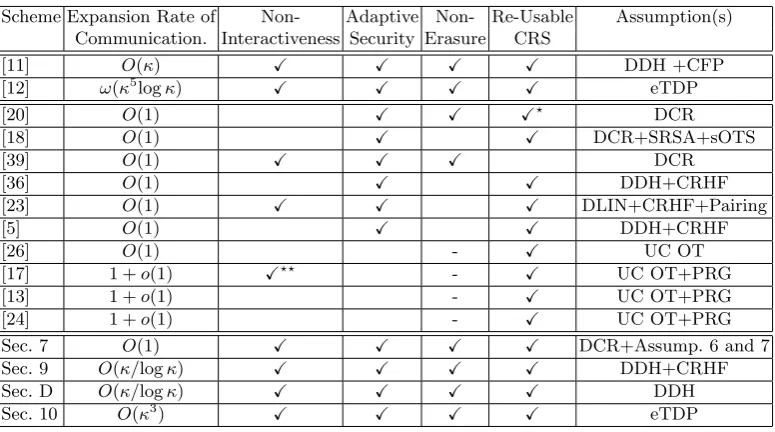
To the best of our knowledge, there is no “fully-equipped” UC commitment that breaks the barrier of expansion factorΩ(κ). So far, efficient construction of a fully-equipped UC commitment scheme is a long-standing open problem (even with strong assumptions).
Table 1.Comparison among UC Commitments
Scheme Expansion Rate of Non- Adaptive Non- Re-Usable Assumption(s) Communication. Interactiveness Security Erasure CRS
[11] O(κ) X X X X DDH +CFP
[12] ω(κ5logκ)
X X X X eTDP
[20] O(1) X X X? DCR
[18] O(1) X X DCR+SRSA+sOTS
[39] O(1) X X X DCR
[36] O(1) X X DDH+CRHF
[23] O(1) X X X DLIN+CRHF+Pairing
[5] O(1) X X DDH+CRHF
[26] O(1) - X UC OT
[17] 1 +o(1) X?? - X UC OT+PRG
[13] 1 +o(1) - X UC OT+PRG
[24] 1 +o(1) - X UC OT+PRG
Sec. 7 O(1) X X X X DCR+Assump. 6 and 7
Sec. 9 O(κ/logκ) X X X X DDH+CRHF
Sec. D O(κ/logκ) X X X X DDH
Sec. 10 O(κ3) X X X X eTDP
DDH: Decisional DH assumption. CFP: Claw-Free Permutations. eTDP: Enhanced Trap-Door Permutations. DCR: Decisional Composite Residuosity assumption. SRSA: Strong RSA assumption. sOTS: Strong One-Time Signa-tures. CRHF: Collision-Resistant Hash Family. DLIN: Decisional Linear assumption. Pairing: Pairing Groups. UC OT: UC Oblivious Transfer Oracle. PRG: Pseudo Random Generator.?: A CRS grows linearly with the number of parties.??: After the UC OT set-up phase.
1.3 Our Contribution
compli-cated definitions and proofs with many subtleties. Therefore, we believe that it is desirable to translate the essence of basic UC secure protocols into simple cryptographic primitives. To instan-tiate ABME, we divide the functionality into two primitives. Then, we consider the case that the primitives are suitably combined. We believe that this construction strategy would be helpful for finding more constructions in the future. We remark that our construction of ABME is inspired by that of all-but-many lossy trapdoor function (ABM-LTF) given by Hofheinz [31]. We will expose the relation in Sections, 1.10 and E.
We present a compact ABME scheme related to the DCR assumption, i.e., the first fully-equipped UC commitment scheme with expansion factor O(1), meaning that to commit to λ-bit secret, it requires O(κ) bits with a constant number of modular exponentiations. Our DCR-based ABME scheme can be transformed into an ABM-LTF scheme with a better lossy rate than [31] under the same assumption. We also provide ABME from the DDH assumption with overhead
O(κ/logκ), which is slightly better than prior works with O(κ). We also present a fully-equipped UC commitment scheme from weak ABME under a general assumption in which (enhanced) trap-door permutations exist, which is far more efficient than the previous work [12] under the same assumption.
In the following sections, we describe more details.
1.4 All-But-Many Encryption
All-but-many encryption (ABME) enables a party with a secret-key (i.e., the simulator in the UC framework) to generate afakeciphertext and to open it to any message with consistent randomness. In the case that a party is not given the secret-key (i.e., the adversary in the UC framework), it cannot distinguish a fake ciphertext from a real (honestly generated) ciphertext even after the message and randomness are revealed. In addition, it cannot produce a fake ciphertext (on a fresh tag) even after seeing many fake ciphertexts and their openings. We construct ABME from two new primitives, denoted probabilistic pseudo random functionsand extractable sigma protocols. The former is a probabilistic version of a pseudo random function. The latter is a special type of a sigma protocol [15] with someextractability.
1.5 Probabilistic Pseudo-Random Function.
A pPRF = (KG,Spl) is a probabilistic pseudo-random function associated with a key-generation algorithm KG. Let Lpk(t) :={u|∃(sk, v) : u =Spl(pk, sk, t;v)}, where (pk, sk) is generated byKG
and v denotes random coins of Spl. Additionally, pPRF should be unforgeable – it is difficult to sample u∈Lpk(t) for fresh t, if sk is not given. Sometimes, it should be unforgeable even on some
supersetLbpk(t).
1.6 Extractable Sigma Protocols
A sigma protocol Σ [15] on NP language L is a canonical 3-round public coin interactive proof system, so that a prover can convince a verifier that he knows witness w behind common input
x∈L, where the prover first sends commitmenta; the verifier sends back challenge (public-coin)e; the prover responds withz; and the verifier finally accepts or rejects conversation (a, e, z) onx. A sigma protocol is associated with simulation algorithmsimPcom
without witness w. If x ∈ L, the distribution of (a, e, z) produced by simPcomΣ (x, e) on random e
is statistically indistinguishable from the transcript generated between two honest parties, called honest-verifier statistically zero knowledge (HVSZK). Ifx 6∈ L, for every a there is at most one e
such that (a, e, z) can be an accepting conversation onx, calledspecial soundness.
An extractable sigma protocol Σext = (Σ,Ext) on Lpk is a special type of a sigma protocol,
associated with a DPT algorithmExt, with the following properties:
– Σ is a sigma protocol onLpk.
– There is a disjoint set Lcopk such that Lpk ∩Lcopk = ∅ and for all pk, there is sk such that
Ext(sk, x, a) = e for all x ∈ Lcopk and all a ∈ simPcomΣ (x, e)1, where simPcomΣ (x, e)1 is the first
output of simPcomΣ (x, e).
Due to special soundness, for all (x, a) withx6∈Lpk,eis uniquely determined (if it exists). So,
the extraction algorithm is well defined. We will show how to construct extractable sigma protocols in Sec. 1.8.
1.7 pPRF+Σext → ABME
We say that pPRF= (KG,Spl) and Σext= (Σ,Ext) are well-combined if:
– KG(1κ) outputs (pk, skspl, skext), where skspl is used as a secret key of Spl and skext is a secret
key of Ext.
– For each pk, there is a set Lcopk such that Σext is an extractable sigma protocol on Lpk =
{(t, u)|∃(skspl, v) :u=Spl(pk, skspl, t;v)}, and has extractability on setLcopk withskext.
– pPRF is unforgeable onLpkb :=Upk0 \Lcopk, whereUpk0 is a universe.
For well-combined pPRFand Σext, one can construct an ABME scheme, by taking the similar method to convert an ordinary sigma protocol to an instance-dependent commitment scheme [3, 32]. Here is the strategy.
– To encrypt message e on tag t, a sender picks random u, runs simPcomΣ on instance (t, u) with challenge e with random z, to compute (a, e, z) = simPcom
Σ (pk,(t, u), e;z), and finally outputs
(u, a) as a ciphertext. Here z is regard as the random coins of the ciphertext. Due to the unforgeability condition of pPRF, it holds that (t, u) ∈Upk0 \Lbpk(=Lcopk) with an overwhelming
probability. Then,eis uniquely determined given ((t, u), a). By our precondition, we can decrypt (t, u, a) using skext, as e=Ext(skext,(t, u), a) because (t, u)∈Lcopk.
– To make a fake (equivocable) ciphertext on tag t, one picks up random v and compute u =
Spl(pk, skspl, t;v) usingskspl. Then he computesa, as same as an honest prover computes the first message on common input (t, u) with witness (skspl, v). To openato arbitrarye, he produces the
responsez in the sigma protocol. By construction, he can openato anyebecause (t, u)∈Lpk.
1.8 Realizing Extractable Sigma Protocols.
Although sigma protocols (with HVSZK) exist onmany NP languages, it is not known how to ex-tract the challenge as discussed above. Here we observe that sigma protocols are often implemented on Abelian groups associated with homomorphic maps, in which the first message of such sigma protocols implies a system of linear equations witheand z. Hence, there is a matrix derived from the linear systems. Due to completeness and special soundness, there is an invertible (sub) matrix if and only if x6∈Lpk (provided that the linear system is defined in a finite field). Therefore, if one
knows the contents of the matrix, one can solve the linear systems when x 6∈Lpk and obtain eif its length is logarithmic. Suppose for instance that Lpk is the DDH language – it does not form a pPRF, but a good toy example to explain how to extract the challenge. Letx= (g1, g2, h1, h2)6∈Lpk,
meaning that x1 6=x2 where x1 := logg1(h1) and x2 := logg2(h2). The first message (A1, A2) of a canonical sigma protocol onLpk implies linear equations
a1 a2
=
1 x1 α αx2
z e
whereA1 =ga11,A2 =ga22, andg2=g1α. The above matrix is invertible if and only if (g1, g2, h1, h2)6∈ Lpk. We note that e is expressed as a linear combination of a1 and a2, i.e., (β1(detA)−1)a1 +
(β2(detA)−1)a2, where the coefficients are determined by the matrix. Therefore, if the decryption
algorithm takes (α, x1, x2) and the length of e is logarithmic, it can find e by checking whether
(g1detA)e=Aβ1
1 A β2
2 or not. In a general case where a partial information on the values of the matrix
is given, the decryption algorithm can still find logarithmic-lengtheif the matrix is made so thate
can be expressed as alinear combination ofunknown values – the unknown values do not appear with a quadratic form or a more degree of forms in the equations.
In a good case, the decryption algorithm can invert homomorphic mapf(a) =ga, using trapdoor
f−1. Then, one can obtain (a1, a2) as well as the entire values of the matrix and hence extract even
polynomial-length e. This corresponds to the case of our DCR based implementation, where the corresponding linear system is defined on a finite ring, such as Znd. The matrix (say A) derived from the linear system is invertible if and only if (detA)−1 modndexists, which corresponds to the conditionx6∈Lpkb for some supersetLpkb . We note that althoughx6∈Lpk iff detA6= 0 (mod nd), it
does not suffice for the above because of the divisors. We require unforgeability not onLpk but on
b
Lpk, so that the output produced by an adversary can be forced in Lcopk =Upk0 \Lbpk.
1.9 Instantiations.
In Appendix D, we simply use as pPRFthe Waters signature scheme on the prime order group without bilinear map and provide the DDH version of the ABME scheme above. Although its expansion factor is justO(κ/logκ), it is better than the prior work [11] (with O(κ)). This scheme is helpful to understand our main proposal, because of the simpler construction. So, we recommend the reader to read that section first, if the main proposal looks complicate.
In another construction, pPRF is given by combining a semantic secure PKE scheme with an IND-CCA secure Tag-PKE scheme. We combine ElGamal PKE with tag-based Twin Cramer-Shoup PKE [14] and construct an ABME scheme frompPRFunder the DDH assumption. The expansion factor of this scheme is alsoO(κ/logκ). One advantage of this scheme is that it has a short public key (of a constant number of group elements), unlike the proposed schemes above.
We also provide a generic construction of pPRF from a pseudo random function family and a semantically secure PKE scheme. We employ this type of pPRFs to construct a UC commitment scheme from general assumptions.
1.10 Other Related Works
Fehr et al. [22] proposed a PKE scheme secure against simulation-based selective opening chosen-ciphertext attack (SIM-SO-CCA). In general, the notion of SIM-SO-CCA secure PKE is related to that of ABME, but both are incomparable. Indeed, Fehr et al. scheme [22] does not satisfy the requirements of ABME, while ABME does not satisfy SIM-SO-CCA PKE in general, because it does not support CCA security. Although [22] could be tailored to a fully-equipped UC commitment scheme, it cannot overcome the barrier of expansion factor Ω(κ), because it strictly costs Ω(λκ) bits to encryptλbit.
Hofheinz presented the notion of all-but-many lossy trapdoor function (ABM-LTF) [31], mainly to construct indistinguishability-based selective opening CCA (IND-SO-CCA) secure PKE. ABM-LTF is a lossy trapdoor function (ABM-LTF) [42] with (unbounded)manylossy tags. The relation between ABM-LTF and ABME is a generalized analogue of LTF and lossy encryption [41, 2] with unbounded many loss tags. However, unlike the lossy encryption, ABME always requires anefficient opening algorithm that can open a ciphertext on a lossy tag to any message with consistent randomness. As mentioned earlier, our construction idea of ABME is strongly inspired by that of ABM-LTF [31]. Hofheinz provided a matrix-based function Y =AX, whereA denotes a square matrix andY,X denote column vectors. The algorithm to produce lossy tags is pPRF in our definition. The lossy tags are carefully embedded in matrix X so that the matrix can be non-invertible if tags are lossy; otherwise invertible. Hofheinz proposed two instantiations. In the DCR-based ABM-LTF, the lossy tags are an analogue of Waters signatures defined in DJ PKE, which is the same as our DCR-based pPRF. Therefore, it is not surprising that our DCR-based ABME scheme requires the same assumptions as the Hofheinz’s ABM-LTF counterpart does. In the latest e-print version [31], Hofheinz has shown that the DCR-based ABM-LTF can be converted to SIM-SO-CCA PKE. To realize this,an opening algorithm for ABM-LTF is essentially needed. So, he gave it by sacrificing efficiency. We remark that ABM-LTF equipped with an opening algorithm meets the notion of ABME. However, compared to our DCR-based ABME scheme in Sec. 7, Hofheinz’s ABM-LTF-based ABME scheme is less efficient for practical use. Indeed, its expansion rate of ciphertext length per message length is ≥ 31. In addition, you must use a modulus of ≥ n6. On the other hand, our DCR-based ABME scheme has a small expansion rate of (5 + 1/d) and you can use modulus of nd+1 for any d ≥ 1. On the contrary, our DCR-based ABME can be converted to
2 Preliminaries
For n ∈ N, [n] denotes the set {1, . . . , n}. We denote by O,Ω, and ω the standard notations to
classify the growth of functions. We let negl(κ) to denote an unspecified function f(κ) such that
f(κ) =κ−ω(1), saying that such a function is negligible in κ. We write PPT and DPT algorithms to denote probabilistic polynomial-time and deterministic poly-time algorithms, respectively. For PPT algorithm A, we write y←A(x) to denote the experiment of running A for given x, picking inner coinsr uniformly from an appropriate domain, and assigning the result of this experiment to the variabley, i.e.,y=A(x;r). LetX={Xκ}κ∈NandY ={Yκ}κ∈Nbe probability ensembles such that eachXκ and Yκ are random variables ranging over {0,1}κ. The (statistical) distance between XκandYκ isDist(Xκ, Yκ), 12· |Prs∈{0,1}κ[X=s]−Prs∈{0,1}κ[Y =s]|. We say that two probability ensembles, X and Y, are statistically indistinguishable (in κ), denoted X ≈s Y, if Dist(Xκ, Yκ)
=negl(κ). We say thatXandY are computationally indistinguishable (inκ), denotedX ≈c Y, if for every (non-uniform) PPTD(ranging over{0,1}), it holds that {D(1κ, Xκ)}κ∈N
s
≈ {D(1κ, Yκ)}κ∈N.
LetAandB be PPT algorithms that both takex∈S(κ), whereS(κ) is a set associated with each
κ ∈ N. We write {A(x)}κ∈N,x∈S(κ) ≈ {s B(x)}κ∈N,x∈S(κ) to denote {A(xκ)}κ∈N
s
≈ {B(xκ)}κ∈N for every sequence{xκ}κ∈Nsuch that xκ ∈S(κ).
3 Building Blocks: Definitions
We now formally define probabilistic pseudo random functions and extractable sigma protocols.
3.1 Probabilistic Pseudo Random Function (pPRF)
pPRF= (KG,Spl) consists of the following two algorithms:
– KG, the key generation algorithm, is a PPT algorithm that takes 1κ as input, creates (pk, sk).
– Spl, the sampling algorithm, is a PPT algorithm that takes (pk, sk) and t ∈ {0,1}κ, picks up
inner random coins v ← COINspl, and outputs u =Spl(pk, sk, t;v). We often omit to write pk
and instead write this experiment as u←Splsk(t).
Let Lpk(t) = {u| ∃sk, ∃v : u = Spl(pk, sk, t;v)}, and let Lpk = {(t, u)|t ∈ {0,1}κ and u ∈ Lpk(t)}. We assume that pk defines set Upk such that Lpk(t) ⊂Upk for all t∈ {0,1}κ. Let U0
pk =
{(t, u)|t∈ {0,1}κ and u∈U
pk}. We are interested in the case thatLpk(t) is so small in Upk, that
no one can sample an element from Lpk(t) by chance. We require that pPRFs satisfy the following
security requirements:
Efficiently samplable and explainable domain: For all pk given by KG and all t ∈ {0,1}κ, Upk is efficiently samplable and explainable [22], that is, there is an PPT sampling algorithm U
that takes (pk, t), picks up random coins R, and outputsu that is uniformly distributed in domain
Upk. In addition, for every pk, every t∈ {0,1}κ, and everyu∈Upk, there is an efficient explaining
Pseudo randomness: No adversaryA, givenpk, can distinguish whether it has access toSpl(pk, sk,·) or U(pk,·). Here U(pk,·) denotes the uniform sampling algorithm mentioned above. We say that
pPRFis pseudo-randomif, for all PPT A,
AdvprfpPRF,A(κ) =
Pr[Expt prf
pPRF,A(κ) = 1]−Pr[Expt
prf
U,A(κ) = 1]
is negligible inκ, where
ExptprfpPRF,A(κ): (pk, sk)←KG(1κ)
b←ASpl(pk,sk,·)(pk) returnb.
ExptprfU,A(κ):
(pk, sk)←KG(1κ)
b←AU(pk,·)(pk) returnb.
We note that if Spl(pk, sk,·) is deterministic, we change oracle U(pk,·) as follows: Given fresh
t as input, it picks up random R and computes u = U(pk, t;R). It returns u and register (t, u). Given the same queryt, it outputs the same u.
Unforgeability: Let Lbpk(t) be some superset of Lpk(t). Let Lbpk = {(t, u)|t ∈ {0,1}κ and u ∈ b
Lpk(t)}. We define the game of unforgeability onLbpk as follows: An adversaryAtakespkgenerated
byKG(1κ) and may have access toSpl(pk, sk,·). The aim of the adversary is to output (t∗, u∗)∈Lpkb
such that t∗ has not been queried. We say that pPRF is unforgeable on Lbpk if, for all PPT A,
Adveuf-Lb
pPRF,A(κ) = Pr[Expteuf
-b
L
pPRF,A(κ) = 1] (whereExpteuf
-b
L
pPRF,A is defined in Fig. 1) is negligible inκ.
In some application, we require a stronger requirement, where in the same experiment above, it is difficult for the adversary to output (t∗, u∗) in Lpkb , which did not appear in the query/answer
list QA. We say that pPRF is strongly unforgeable on Lbpk if, for all PPT A, AdvseufpPRF-Lb,A(κ) =
Pr[Exptseuf-Lb
pPRF,A(κ) = 1] (whereExptseuf
-b
L
pPRF,A is defined in Fig. 1) is negligible inκ.
Expteuf-Lb
pPRF,A(κ):
(pk, w)←KGpprf(1κ) (t∗, u∗)←ASpl(pk,w,·)(pk)
Ift∗has not been queried andu∗∈Lbpk(t∗), return 1; otherwise 0.
Exptseuf-Lb
pPRF,A(κ):
(pk, w)←KGpprf(1κ) (t∗, u∗)←ASpl(pk,w,·)(pk)
(t∗, u∗)6∈ QA
andu∗∈Lbpk(t∗), return 1; otherwise 0.
Fig. 1.The experiments of unforgeability (in the left) and strong unforgeability (in the right).
We remark that if Spl is a DPT algorithm and Lbpk =Lpk, unforgeability is implied by pseudo
randomness.
3.2 Extractable Sigma Protocol
We defineextractable sigma protocols. LetL={Lpk}pkbe an NP language consisting of a collection
derived from Lpk. Let Σext = (PcomΣ ,PansΣ ,V
vrfy
Σ ,simPcomΣ ,Ext) be a tuple of algorithms (associated
withL) as follows:
– PcomΣ is a PPT algorithm that takes (x, w) ∈ Rpk, picks up inner coins ra, and outputs a =
PcomΣ (x, w;ra). – Pans
Σ is a DPT algorithm that takes (x, w, ra, e) and outputs z=PansΣ (x, w, ra, e), where eis an
element in a specific domain determined by pk.
– VΣvrfy is a DPT algorithm that accepts or rejects (x, a, e, z).
– simPcomΣ is a PPT algorithm that takes (x, e) and outputs (a, e, z) =simPcomΣ (x, e;rz), whererzis inner coins. For our purpose,we additionally require thatrz =z,i.e., (a, e, rz) =simPcomΣ (x, e;rz). We note that many sigma protocols satisfy this property.
– Ext is a DPT algorithm that takes (sk, x, a) and outputs e or ⊥, where sk is a string with respects to pk.
We say that Σext isan extractable sigma protocolonL={Lpk}pk, if for allpk, there is a setLcopk
such thatLpk∩Lcopk =∅, and it satisfies the following properties:
Completeness: For every (x, w)∈Rpk and everyra,e(in appropriate specified domains,
respec-tively), it always holds that VvrfyΣ (x,PcomΣ (x, w;ra), e,PansΣ (x, w, ra, e)) = 1.
Special Soundness: For everyx6∈Land everya, there is at most oneesuch thatVvrfyΣ (x, a, e, z) = 1. This implies that if there are two different accepting conversations for the sameaonx, i.e., (a, e, z) and (a, e0, z0), withe6=e0, it must hold that x∈L. We say that such a pair is a collision onx. We require for our purpose that there is some superset U0 such that L⊂U0, and for every x∈ U0\L
and everye, there is an accepting conversation (a, e, z) on x.
Extractability: We write (pk, skext)∈Rext if it holds thatVΣvrfy(x, a, e0, z) = 1 for allx∈Lcopk and all aso that there are (e, z) such that VΣvrfy(x, a, e, z) = 1, where e0 =Ext(skext, x, a). We call that
Σext hasextractability on {Lcopk}pk if for all pk∈ PK, there existsskext such that (pk, skext)∈Rext. We note that, combining with special soundness, we can say that for all x ∈ Lcopk, all e, and allz, it always holds thate=Ext(sk, x,simPcomΣ (x, e;z)1), wheresimPcomΣ (x, e;z)1 denotes the first
output ofsimPcomΣ (x, e;z).
Enhanced Honest-Verifier Statistical Zero-Knowledgeness (eHVSZK): For all (pk, skext)∈
Rext, all (x, w)∈Rpk, and all ein a specific domain, the following ensembles are statistically
indis-tinguishable inκ:
{simPcomΣ (x, e;rz)}κ∈N, pk,(x,w)∈Rpk, e
s
≈{(PcomΣ (x, w;ra), e,PansΣ (x, w, ra, e))}κ∈N, pk,(x,w)∈Rpk, e
Here the probability of the left-hand side is taken over random variable rz and the right-hand side is taken over random variable ra. We remark that since (a, e, rz) = simPcomΣ (x, e;rz) (by our
precondition), we have Vrfy(x, a, e, z) = 1 if and only if (a, e, z) = simPcom
Σ (x, e;z).Therefore, one
We note that the concept of the extractable sigma protocol is not entirely new. A weaker notion, calledweak extractable sigma protocol, appears in [25] to construct (interactive) simulation sound trapdoor commitment (SSTC) schemes (see [27, 38, 28] for SSTC). This paper requires a stronger notion, which is used in a different way.
4 ABM Encryption
All-but-many encryption schemeABM.Enc= (ABM.gen,ABM.spl,ABM.enc,ABM.dec,ABM.col) con-sists of the following algorithms:
– ABM.gen is a PPT algorithm that takes 1κ and outputs (pk, skspl, skext), where pk defines a universe Upk0 ={0,1}κ×U
pk, which contains two disjoint sets (as defined below), Ltdpk andLextpk,
i.e., Ltdpk∩Lextpk =∅ and Ltdpk∪Lextpk ⊂Upk0 .
– ABM.spl is a PPT algorithm that takes (pk, skspl, t), wheret∈ {0,1}κ, picks up inner random
coinsv←COINspl, and computes u∈Upk. We let
Ltdpk(t) ={u∈Upk| ∃skspl,∃v: u=ABM.spl(pk, skspl, t;v)}.
We let Ltdpk ={(t, u)|t∈ {0,1}κ andu ∈Ltd
pk(t)}. Define Lbtdpk =Upk0 \Lextpk. Since Ltdpk∩Lextpk =∅,
we have Ltdpk ⊆Lbtdpk ⊂Upk0 .
– ABM.encis a PPT algorithm that takes pk, (t, u) ∈Upk0 , and message x∈MSP, picks up inner random coinsr ←COINenc, and computes c=ABM.enc(t,u)(pk, x;r).
– ABM.dec is a DPT algorithm that takes skext, (t, u), and ciphertext c, and outputs x =
ABM.dec(t,u)(skext, c).
– ABM.col= (ABM.col1,ABM.col2) is a pair of PPT and DPT algorithms, respectively, such that
• ABM.col1 takes (pk,(t, u), skspl, v) and outputs (c, ξ) ←ABM.col(1t,u)(pk, skspl, v), wherev∈
COINspl.
• ABM.col2 takes ((t, u), ξ, x), withx∈MSP, and outputs r∈COINenc.
We require that all-but-many encryption schemes satisfy the following properties:
1. Adaptive All-but-many property: (ABM.gen,ABM.spl) is a probabilistic pseudo random function (pPRF) as defined in Sec. 3.1 with unforgeability onLbtdpk(=Upk0 \Lextpk).
2. Dual mode property:
– (Decryption mode) For all κ ∈ N, all (pk, skext) ∈ ABM.gen(1κ), all (t, u) ∈ Lextpk, and everyx∈MSP, it always holds that
ABM.dec(t,u)(skext,ABM.enc(t,u)(pk, x)) =x.
– (Trapdoor mode) Define the following random variables:
• distenc(pk, t, skspl, skext, x) denotes random variable (pk, t, u, c, r) defined as follows: v←
COINspl;u=ABM.spl(pk, skspl, t;v); r←COINenc;c=ABM.enc(t,u)(pk, x;r).
• distcol(pk, t, skspl, skext, x) denotes random variable (pk, t, u, c, r) defined as follows:v ←
Then, for all (pk, skspl, skext) ∈ ABM.gen(1κ), all t ∈ {0,1}κ, all x ∈ MSP, the following
ensembles are statistically indistinguishable inκ:
n
distenc(pk, t, skspl, skext, x)o
κ∈N,(pk,skspl,skext)∈ABM.gen(1κ),t∈{0,1}κ,x∈MSP
s
≈ndistcol(pk, t, skspl, skext, x)o
κ∈N,(pk,skspl,skext)∈ABM.gen(1κ),t∈{0,1}κ,x∈MSP
We say that a ciphertext c on (t, u) under pk is valid if there exist x∈ MSPand r ∈COINenc
such that c= ABM.enc(t,u)(pk, x;r). We say that a valid ciphertext c on (t, u) under pk is real if (t, u)∈Lextpk, otherwise fake. We remark that as long asc is a real ciphertext, regardless of how it is generated, there is only one consistent x inMSPand it is equivalent toABM.dec(t,u)(sk, c).
To suit actual instantiations, we assume that COINspl and MSPare defined by pk. We further allowCOINenc to depend on messagexto be encrypted as well aspk, in order to be consistent with our weak ABM encryption scheme from general assumption in Sec. 10.
5 ABME from Σext on Language derived from pPRF
Suppose a probabilistic pseudo random function pPRF = (KG,Spl) and an extractable sigma pro-tocolΣext = (Σ,Ext) are well-combined. That is,
– KG(1κ) outputs (pk, skspl, skext). Later, skspl is used as a secret key of Spl and skext is used as
a secret key of Ext.
– For all pk, there is a set Lcopk such that Lpk∩Lcopk = ∅, where Lpk = {(t, u)| ∃(skspl, v) : u = Spl(pk, skspl, t;v)}.
– Σext is an extractable sigma protocol on L
pk and has extractability on Lcopk where skext is the
extractable key.
– pPRF is unforgeable onLbpk:=Upk0 \Lcopk, whereUpk0 is a universe (with respects topk).
Here, an ABME scheme is constructed as in Fig. 2.
– ABM.gen(1κ) runsKG(1κ) to output (pk, skspl, skext). – ABM.spl(pk, skspl, t;v) outputsu=Spl(pk, skspl, t;v).
– ABM.enc(t,u)(pk, m;r) outputsasuch that (a, m, r) =simPcomΣ (pk,(t, u), m;r). – ABM.dec(t,u)(skext, c) outputsm=Ext(skext,(t, u), c).
– ABM.col(1t,u)(pk, sk
spl
, v;ra) outputs (c, ξ) such that c = PcomΣ (pk,(t, u),(skspl, v);ra), and ξ = (pk, t, u, skspl, v, r
a).
– ABM.col(2t,u)(ξ, m) outputsr=P
ans
Σ(pk,(t, u), skspl, v, ra, m), whereξ= (pk, t, u, skspl, v, ra). Fig. 2.ABME fromΣexton language derived frompPRF
– If (t, u)∈Lext
pk, the first output ofsimPcomΣ (pk,(t, u), m) is perfectly binding to challenge m due
to special soundness (becauseLext
pk ⊂Upk0 \Ltdpk, withLtdpk:=Lpk), andm can be extracted given
(pk,(t, u), a) usingskext due to extractability.
– If (t, u) ∈Ltdpk,ABM.col runs the real sigma protocol with witness (skspl, v). Therefore, it can produce a fake commitment that can be opened in any way, while it is statistically indistinguish-able from that of the simulation algorithm simPcomΣ (that is run byABM.enc), due to enhanced HVSZK. We note that even given the same (fixed) skext to both algorithms, it does not affect the statistical distance, because it is fixed.
Hence, the resulting scheme is ABME.
6 Fully-Equipped UC Commitment from ABME
We show that ABME implies fully-equipped UC commitment.
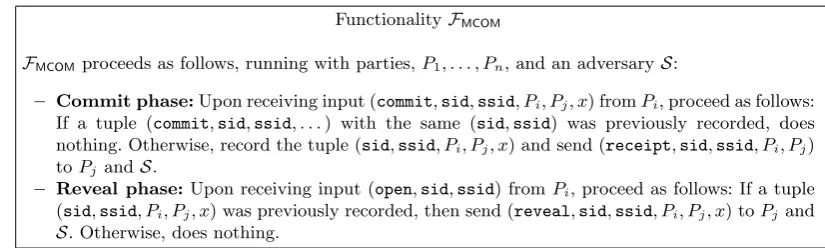
We work in the standard universal composability (UC) framework of Canetti [10]. We concen-trate on the same model in [11] where the network is asynchronous, the communication is public but ideally authenticated, and the adversary is adaptive in corrupting parties and is active in its control over corrupted parties. Any number of parties can be corrupted and parties cannot erase any of their inner state. We provide a brief description of the UC framework and the ideal commitment functionality for multiple commitments, denoted FMCOM, in Appendix B.1.
To construct fully-equipped UC commitment, we first put public keypkof ABME in the common reference string. A committerPi takes tagt= (sid,ssid, Pi, Pj) and a messagex committed to. It then picks up random u from Upk and compute an ABM encryption c =ABM.enc(t,u)(pk, x;r) to send (t, u, c) to receiver Pj, which outputs (receipt,sid,ssid, Pi, Pj). To open the commitment,
Pisends (sid,ssid, x, r) toPj andPj accepts if and only ifc=ABM.enc(t,u)(pk, x;r). IfPj accepts, he outputs (open, t, x), otherwise do nothing. We formally describe our framework for constructing a UC commitment scheme from ABME in Fig. 3.
Theorem 1. The proposed scheme in Fig.3 UC-securely realizes the FMCOM functionality in the
FCRS-hybrid model in the presence of adaptive adversaries in the non-erasure model.
Proof (Sketch). For simplicity, we remove the injective map ι : {0,1}κ → MSP from the
scheme. The formal proof is given in Appendix B.2. We here sketch the essence. We consider the man-in-the-middle attack, where we will show that the view of environment Z in the real world (in the CRS model) can be simulated in the ideal world. Let C, R be honest players and let Pa
be a corrupted player controlled by adversary A. In the man-in-the-middle attack,Pa (i.e.,A) is simultaneously participating in the left and right interactions. In the left interaction, A interacts withC, as playing the role of the receiver. In the right interaction,Ainteracts withR, as playing the role of the committer. In the ideal world, simulatorS simulates the task ofC andR by interacting withA.
In the left interaction:In the real world,Z chooses (commit,sid,ssid, C, Pa, x) and gives it
toCto start the commitment protocol withA. However, in the ideal worldS cannot receivexuntil the decommit phase, but must start the commitment protocol only with t= (sid,ssid, C, Pa). At the decommit phase, S receivesx for the first time and needs to open to xcorrectly.
Common reference string:pkwhere (pk, sk)←ABM.gen(1κ).
pkuniquely determinesUpk0 ={0,1} κ×
Upk. We implicitly assume that there is injective mapι:{0,1}κ→MSPsuch thatι−1 is efficiently computable andι−1(y) =εfor everyy6∈ι({0,1}κ), and also assume that (sid,ssid, P
i, Pj)∈
{0,1}κ .
The commitment phase:
– Upon input (commit,sid,ssid, Pi, Pj, x) where x ∈ {0,1}κ, party Pi proceed as follows: If a tuple (commit,sid,ssid, Pi, Pj, x) with the same (sid,ssid) was previously recorded, Pi does nothing. Otherwise,
Pi sets t= (sid,ssid, Pi, Pj)∈ {0,1}κ. It picks up u ←Upk and r ← COINenc, and encrypts messageι(x) to compute c=ABM.enc(t,u)(pk, ι(x);r).Pi sends (t, u, c) to partyPj, and stores (sid,ssid, Pi, Pj,(t, u), x, r). – Pjignores the commitment ift6= (sid,ssid, Pi, Pj),u6∈Upk, or a tuple (sid,ssid, . . .) with the same (sid,ssid)
was previously recorded. Otherwise,Pjstores (sid,ssid, Pi, Pj,(t, u, c)) and outputs (receipt,sid,ssid, Pi, Pj). The decommitment phase:
– Upon receiving input (open,sid,ssid),Pi proceeds as follows: If a tuple (sid,ssid, Pi, Pj, x, r) was previously recorded, thenPisends (sid,ssid, x, r) toPj. Otherwise,Pidoes nothing.
– Upon receiving input (sid,ssid, x, r),Pjproceeds as follows: Pj outputs (reveal,sid,ssid, Pi, Pj, x) if a tuple (sid,ssid, Pi, Pj,(t, u, c)) with the same (sid,ssid, Pi, Pj) was previously recorded, and it holds thatx∈ {0,1}κ,
r∈COINenc, andc=ABM.enc(t,u)(pk, ι(x);r). Otherwise,P
jdoes nothing. Fig. 3.Fully-Equipped UC commitment from ABME
S can start the commit phase withA(without givenx). In both worlds,Z sends (open,sid,ssid) to activate C to start the decommit phase, but in the ideal world C simply sends it to FMCOM, which sends (reveal,sid,ssid, C, Pa, x) to S so that S can start the decommit protocol with x
withA.
In the right interaction:In the real world,Z receives (open,sid0,ssid0, Pa, R, x0) opened by
AfromRat the decommit phase. In the ideal world,S must correctly extract ˜xfrom (t0, u0, c0) sent byA, where t0 = (sid0,ssid0, Pa, R), and commit it to the ideal commitment functionalityFMCOM
at the commit phase. At the decommit phase, when A correctly opens the commitment,S must let FMCOM reveal stored ˜x toZ, instead of the value thatAactually opened to.
More precisely, in the ideal world, when receiving (open,sid0,ssid0) (from S), FMCOM sends (reveal,sid0,ssid0, Pa, R,x˜) to R, where ˜x is the stored value at the commit phase. R simply
conveys it fromFMCOM toZ.
Adaptive corruption: In the real world, when C orR is corrupted,A may read their inner state and start to fully control the parties. In the ideal world, the honest parties do nothing except storing inputs to them. So,S simulates the inner state of the real-world honest party (afterS read the inner state of the ideal-world honest party when it is corrupted) and gives it toAas if it comes from the real world. The inner state of the real-world honest party includes randomness it has used. In the non-erasure model, honest parties cannot erase any of their state.
The view of Z: In the real world, Z have access to A to order many tasks, for instance, to execute the right interaction withRwith valuex0, to corrupt either party, or to send the adversary’s entire view in the left and right interactions. In the ideal world,Z instead have access to (the ideal-world adversary)S, which tries to simulate the role ofA. The view ofZ consists of each interaction withC,R, and the (real-world or ideal-world) adversary, as well as its inner state.
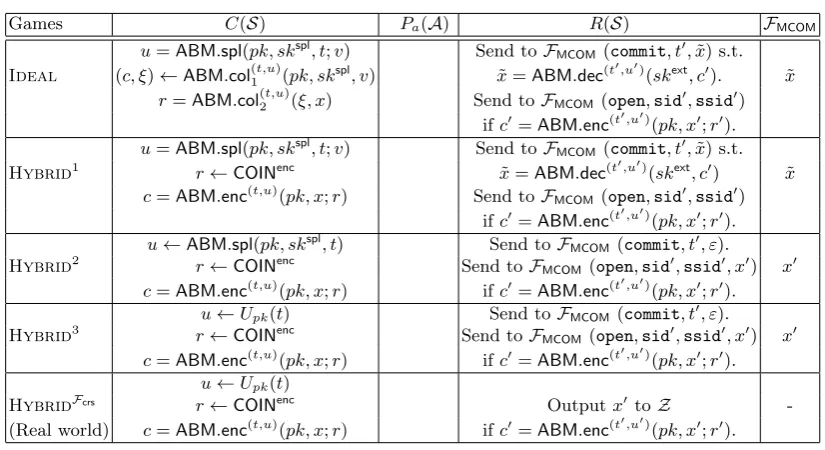
Ideal World: In the Ideal world,Ainteracts with simulatorS in both interactions, whereS simu-lates the roles ofC and Rrespectively. In the set-up,S generates (pk, skspl, skext)←ABM.gen(1κ), puts pk in the common reference string, and keeps (skspl, skext). In the left interaction, S first receives (receipt,sid,ssid, C, Pa) and starts the commitment phase with adversaryAas the
com-mitterwithout given messagex.Scomputesu=ABM.spl(pk, skspl, t;v) and (c, ξ)←ABM.col(1t,u)(pk, skspl, v), to send (commit, t,(u, c)) to adversary A, where t= (sid,ssid, C, Pa). At the decommit phase, S
receives (reveal,sid,ssid, C, Pa, x) and then computes r = ABM.col(2t,u)(ξ, x) to send (t, x, r) to
A. In the right interaction, S receives (commit, t0, u0, c0) from A where t0 = (sid0,ssid0, Pa, R). S
then extractsx˜=ABM.dec(t0,u0)(sk, c0) and sends (commit, t0,x˜) toFMCOM. At the decommit phase when A opens (t0, u0, c0) correctly with (x0, r0), S sends (open,sid,ssid) to FMCOM; otherwise,
do nothing. Upon receiving (open,sid,ssid), if the same (sid,ssid, ..) was previously recorded,
FMCOM revealsstored x˜ to environmentZ; otherwise, do nothing.
In case of adaptive corruption of C after the commit phase but before the decommit phase, S
readxfrom the inner state ofC and computesras in the case of the decommit phase and compute
R such that Upk(t;R) = u, which can be efficiently computable because Upk is an explainable
domain. Finally it reveals (x, r, R).
Hybrid Game 1: In this game, the left interaction is modified so thatSinstead receives (commit, t, x) wheret= (sid,ssid, C, Pa).Sthen computesu←ABM.spl(pk, skspl, t) andc=ABM.enc(t,u)(pk, x;r)
wherer←COINenc, to send (commit, t, u, c) to adversaryA. In the decommit phase whenSreceives (open, t), it sends (t, x, r) to A.
In case of adaptive corruption of C after the commit phase but before the decommit phase, S
outputs (t, u, x, r, R) after computingR such thatUpk(t;R) =u.
The view ofZ in this game is statistically close to that in the ideal world, because
{distcol(pk, t, skspl, skext, x)}κ∈N
and
{distenc(pk, t, skspl, skext, x)}κ∈N,
defined in Sec. 4, are statistically indistinguishable inκ.
Hybrid Game 2: In this game, the right interaction is changed as follows. After receiving (t0, u0, c0), where t0 = (sid0,ssid0, Pa, R), S sends (commit, t0, ε) to the ideal functionality. In the decommit
phase when A opens (t0, u0, c0) correctly with (x0, r0), S sends (open,sid0,ssid0, x0) to the ideal functionality. Then, the ideal functionality revealsx0 (instead of ε) to Z.
In case of corruption ofRbefore the decommit phase,S simply outputs (t0, u0, c0). We note that
R has no secret.
The difference of the views of Z between this game and the previous game is bounded by the following event. Let BD denote the event that S receives a fake ciphertext (t0, u0, c0) from A in
the right intersection. Remember that ciphertext c is called fake if (t, u) ∈ Ltdpk and c is a valid ciphertext (which means that there is a pair of message/randomness consistent with c). If this event does not occur, the views ofZ in both games are identical. Hence, the difference of the views of Z between the two games is bounded by Pr[BD]. Event BD occurs (in Hybrid Game 2) if and
Hybrid Game 3: In this game, the left interaction is modified again. At the commit phase, when receiving input (commit, t, x) where t = (sid,ssid, C, Pa), S chooses random u = Upk(t;R) with randomR and computes c=ABM.enc(t,u)(pk, x;r), to send (t, u, c) toA. At the decommit phase, upon receiving input (open,sid,ssid),S plays the same as in the previous game.
In case of corruption of C before the decommit phase, S simply reveals (x, r, R) (where u =
Upk(t;R)).
By construction, the difference of the two views of Z between this game and the previous game is bounded by the advantage of pseudo-randomness of pPRF= (ABM.gen,ABM.spl).
HybridFcrs Game: It corresponds to the real world in the CRS model, where A interacts with
honest C and R respectively, and executes the man-in-the-middle attack. In the left interaction, environment Z activates C to start the commit phase by sending (commit, t, x) to C where t = (sid,ssid, C, Pa).ZactivatesC to start the decommit phase by sending (open,sid,ssid) toC. In the right interaction, at the commit phase whenRreceives (t0, u0, c0) fromA, it outputs (receipt, t0) toZwheret0 = (sid0,ssid0, Pa, R). At the decommit phase, upon receiving (sid0,ssid0, x0, r0) from
A, R checks its consistency with (t0, u0, c0). If the opening is correct, it outputs (reveal, t0, x0) to
Z.
By construction, the two views of Z between this game and the previous game are identical.
Table 2.The man-in-the-midle attack in the hybrid games
Games C(S) Pa(A) R(S) FMCOM
u=ABM.spl(pk, skspl, t;v) Send toF
MCOM(commit, t0,x˜) s.t. Ideal (c, ξ)←ABM.col1(t,u)(pk, skspl, v) x˜=ABM.dec(t0,u0)(skext, c0). x˜
r=ABM.col(2t,u)(ξ, x) Send toFMCOM(open,sid0,ssid0)
ifc0=ABM.enc(t0,u0)(pk, x0
;r0).
u=ABM.spl(pk, skspl, t;v) Send toFMCOM(commit, t0,x˜) s.t. Hybrid1 r←COINenc x˜=ABM.dec(t
0
,u0)(skext, c0
) x˜
c=ABM.enc(t,u)(pk, x;r) Send toFMCOM(open,sid0,ssid0)
ifc0=ABM.enc(t0,u0)(pk, x0;r0).
u←ABM.spl(pk, skspl, t) Send toFMCOM(commit, t0, ε). Hybrid2 r←COINenc Send toFMCOM(open,sid0,ssid0, x0) x0
c=ABM.enc(t,u)(pk, x;r) ifc0=ABM.enc(t0,u0)(pk, x0;r0).
u←Upk(t) Send toFMCOM(commit, t0, ε). Hybrid3 r←COINenc Send toFMCOM(open,sid0,ssid0, x0) x0
c=ABM.enc(t,u)(pk, x;r) ifc0=ABM.enc(t0,u0)(pk, x0;r0).
u←Upk(t)
HybridFcrs r←COINenc Outputx0toZ
-(Real world) c=ABM.enc(t,u)(pk, x;r) ifc0=ABM.enc(t0,u0)(pk, x0;r0).
In the commit phase (of the left interaction of A), committer C sends (t, u, c) to corrupted party
Pa(A), where t = (sid,ssid, C, Pa). In the decommit phase, C opens (x, r) such that c =
7 Compact ABME from Damg˚ard-Jurik PKE
We present a DCR-based ABME scheme with compact ciphertexts. This is the first fully-equipped UC commitment scheme with expansion factorO(1). We start by recalling Damg˚ard-Jurik public-key encryption scheme (DJ PKE) [19].
Damg˚ard-Jurik PKE. Let Π = (K,E,D) be a tuple of algorithms of Damg˚ard-Jurik (DJ) PKE [19]. A public key of DJ PKE ispkdj = (n, d) and the corresponding secret-key isskdj = (p, q)
wheren=pqis a composite number of distinct odd primes,p and q, and 1≤d < p, q is a positive integer (when d = 1 it is Paillier PKE [40]). We often write Π(d) to clarify parameter d. We let
g:= (1 +n) throughout this paper. To encrypt messagex∈Znd, one computesEpkdj(x;R) =gxRn d
(modnd+1) whereR ←
Z×n 1. For simplicity, we writeE(x) instead ofEpkdj(x), if it is clear. DJ PKE
is enhanced additively homomorphic as defined in Appendix C.3. Namely, for everyx1, x2∈Znd and everyR1, R2 ∈Z×n, one can efficiently computeR such thatE(x1+x2;R) =E(x1;R1)·E(x2;R2).
Actually it can be done by computing R = gγR
1R2 (modn), where γ is an integer such that x1+x2=γnd+ ((x1+x2) modnd). It is known thatZ×nd+1 is isomorphic toZnd×Z×n (the product of a cyclic group of orderndand a group of orderφ(n)), and, for anyd < p, q, elementg= (1 +n) has order nd in
Z×nd+1 [19]. Therefore, Z
×
nd+1 is the image of E(·;·). We note that it is known that
Z×nd+1 isefficiently samplable and explainable [20, 22]. It is also known that DJ PKE is IND-CPA if the DCR assumption holds true [19].
Construction Idea. (ABM.gen,ABM.spl) below forms Waters-like signature scheme based on DJ PKE, where there is no verification algorithm and the signatures look pseudo random assuming that DJ PKE is IND-CPA. We then construct an extractable sigma protocol on the language derived from (ABM.gen,ABM.spl), as discussed in Sec. 1.4. Here, the decryption algorithm works only when the matrix below in (2) is invertible, which is equivalent to that (t,(ur, ut))∈Lextpk, where
Lextpk ={(t,(ur, ut))|D(ut)6≡x1x2+y(t)D(ur)(modp) ∧ D(ut)6≡x1x2+y(t)D(ur)(modq)}.
Therefore, we require that (ABM.gen,ABM.spl) should be unforgeable on Lbtdpk(= Upk0 \Lextpk). To
prove this statement, we additionally require two more assumptions on DJ PKE, called the non-multiplication assumption and the non-trivial divisor assumption. The first one is an analogue of the DH assumption in an additively homomorphic encryption. If we consider unforgeability onLtdpk, this assumption suffices, but we require unforgeability onLbtdpk. Then we need one more assumption. We
define these assumptions in Appendix C. We note that these assumptions are originally introduced in [31] to obtain the DCR-based ABM-LTF scheme.
7.1 ABME from Damg˚ard-Jurik with Optimal Expansion FactorO(1)
– ABM.gen(1κ): It gets (pkdj, skdj) ← K(1κ) (the key generation algorithm for DJ PKE), where
pkdj = (n, d) and skdj = (p, q). It computes g1 = E(x1;R1) and g2 = E(x2;R2) by picking
up randomly x1, x2 ← Znd and R1, R2 ← Z×
nd+1. It chooses ˜h ← E(1) and y = (y0, . . . , yκ) 1In the original scheme,Ris chosen from
Z×nd+1. However, sinceZ
×
n is isomorphic to the cyclic group of orderndin
Z×nd+1 by mappingR∈Z
×
n toRn
d
∈Z×nd+1, we can instead chooseRfromZ
×
where yj ← Znd+1 for j = 0,1, . . . , κ. It then computes h = (h0, . . . , hκ) such that hj := ˜hyj.
Let H(t) = h0Qκi=1h ti
i (mod nd+1) and lety(t) = y0+Piκ=1yiti (modnd), where (t0, . . . , tκ)
is the bit representation of t. We note that H(t) = ˜hy(t). It outputs (pk, skspl, skext) where
pk:= (n, d, g1, g2,h),skspl :=x2, and skext := (p, q, y0,y), where Upk0 :={0,1}κ×(Z×nd+1)2 that contains the disjoint sets of Ltdpk and Lextpk as described below.
– ABM.spl(pk, skspl, t; (r, Rr, Rt)) where skspl =x2: It chooses r← Znd and outputs u:= (ur, ut) such that ur :=E(r;Rr) and ut:=g1x2E(0;Rt)·H(t)r whereRr, Rt←Z×nd+1. We let
Ltdpk={(t,(ur, ut))| ∃(x2,(r, Rr, Rt)) : ur =E(r,;Rr) and ut=g1x2E(0;Rt)H(t)r}.
We then define
Lextpk ={(t,(ur, ut))|D(ut)6≡x1x2+y(t)D(ur) modp ∧ D(ut)6≡x1x2+y(t)D(ur) modq}.
Since (t,(ur, ut))∈Ltdpk holds if and only ifD(ut)≡x1x2+y(t)D(ur) (mod nd), it implies that D(ut)≡x1x2+y(t)D(ur) (mod n). Hence,Ltdpk∩Lextpk =∅.
– ABM.enc(t,(ur,ut))(pk, m; (z, s, R
A, Ra, Rb)): To encrypt message m ∈ Znd, it chooses z, s
U
←
Znd and computes A := g1zH(t)sumt Rn d
A (modnd+1), a := E(z;Ra)·g2m (modnd+1) and b := E(s;Rb)·umr (modnd+1), whereRA, Ra, Rb ←U Z×nd+1. It outputsc:= (A, a, b) as the ciphertext of m on (t,(ur, ut)).
– ABM.dec(t,(ur,ut))(skext, c) where skext = (p, q, y
0, . . . , yκ): To decryptc= (A, a, b), it outputs
m:= x1D(a) +y(t)D(b)−D(A)
x1x2−(D(ut)−y(t)D(ur))
modnd. (1)
– ABM.col(t,(ur,ut))
1 (pk, skspl,(r, Rr, Rt)) whereskspl =x2: It picks upω, η U
← Znd, R0A, R0a, R0b
U
←
Z×nd+1. It then computesA:=g1ω·H(t) η·
R0And (modnd+1),a:=gωR0and (mod nd+1), andb:=
gηR0bnd (modnd+1). It outputsc:= (A, a, b) and ξ:= (x2,(r, Rr, Rt),(ur, ut), ω, η, R0A, R0a, Rb0). – ABM.col2(ξ, m): To open c to m, it computes z = ω −mx2 modnd, s = η −mrmodnd,
α=b(ω−mx2−z)/ndc, and β=b(η−mr−s)/ndc. It then setsRA:=R0A·R
−m
t ·gα1 ·H(t)β
(mod nd+1),Ra:=Ra0 ·R−2m·gα (modnd+1), andRb :=R0b·Rr−m·gβ (modnd+1). It outputs
(z, s, RA, Ra, Rb), where A = gz1H(t)sumt Rn
d
A (modnd+1), a =E(z;Ra)·g2m (modnd+1), and b=E(s;Rb)·umr (mod nd+1).
We note that ABM.col runs a canonical sigma protocol onLtdpk to prove that the prover knows (x2,(r, Rr, Rt)) such thatur=Epk(r;Rr) andut=g1x2Epk(0;Rt)H(t)r. Hence, the trapdoor mode
works correctly when (t,(ur, ut))∈Ltdpk. On the contrary, ABM.enc runs a simulation algorithm of the sigma protocol with message (challenge) m. Notice that (A, a, b) implies the following linear system onZnd,
D(A)
D(a)
D(b)
=
x1y(t)D(ut)
1 0 x2
0 1 D(ur)
z s m (2)
The matrix is invertible if
D(ut)6= (x1x2+y(t)D(ur)) (modp) and D(ut)6= (x1x2+y(t)D(ur)) (modq),
Lemma 1 (Implicit in [31]).(ABM.gen,ABM.spl)ispPRFwith unforgeability onLbtdpk(=Upk0 \Lextpk),
under the assumptions, 5, 6 and 7.
The proof is given in Sec. C.4. By this lemma, we have:
Theorem 2. The scheme constructed as above is an ABME scheme if the DCR assumption (As-sumption 5), the non-tirvial divisor assmuption (As(As-sumption 6), and the non-multiplication as-sumption (Asas-sumption 7) hold true.
This scheme has a ciphertext consisting of only 5 group elements (including (ur, ut)) and optimal
expansion factor O(1). This scheme requires a public-key consisting ofκ+ 3 group elements along with some structure parameters.
8 ABM-LTF from DCR-based ABME and Vice Versa
Hofheinz [31] has presented the notion of all-but-many lossy trapdoor function (ABM-LTF). We provide the definition in Appendix E. We remark that ABM-LTF requires that, in our words, (ABM.gen,ABM.spl) bestrongly unforgeable, whereas ABME only requires it be unforgeable. How-ever, as shown in [31], unforgeable PPRF can be converted into strongly unforgeable PPRF via a chameleon commitment scheme. Therefore, this difference is not important. We note that we can regard Hofheinz’s based ABM-LTF (with only unforgeability) as a special case of our DCR-based ABME scheme by fixing a part of the coin space as (RA, Ra, Rb) = (1,1,1). Although the involved matrix of his original scheme is slightly different from ours, the difference is not essential. In the end, we can regard Hofheinz’s DCR-based ABM-LTF as
ABM.eval(t,(ur,ut))(pk,(m, z, s)) :=ABM.enc(t,(ur,ut))(pk, m; (z, s,1,1,1)),
where (m, z, s) denotes a message. This ABM-LTF has ((d−3) logn)-lossyness. In the latest e-print version [31], Hofheinz has shown that his DCR-based ABM-LTF can be converted to SIM-SO-CCA PKE. To construct it, Hofheinz implicitly considered the following PKE scheme such that
ABM.enc(t,(ur,ut))(pk, M; (m, z, s)) := (ABM.eval(t,(ur,ut))(pk,(m, z, s)), M ⊕H(m, z, s)),
where H is a suitable 2-universal hash function from (Znd)3 to {0,1}κ (or Z/nZ). According to his analysis in Sec. 7.2 in [31], if d ≥ 5, it can open an ciphertext arbitrarily using Barvinok’s alogorithm, when (t,(ur, ut))∈Lloss. Then it turns out ABME in our words. For practical use, it is rather inefficient, because its expansion rate of ciphertext length per message length is ≥31, and the modulus of ≥n6 is required. The opening algorithm is also costly. Table 3 shows comparison.
On the contrary, our DCR-based ABME (strengthened with strong unforgeability) can be con-verted to ABM-LTF2. Remember that (A, a, b) =ABM.enc(t,(ur,ut))(pk, m; (z, s, R
A, Ra, Rb)). It is
obvious that we can extract not only messagembut (z, s) by inverting the corresponding matrix, but we point out that we can further retrieve (RA, Ra, Rb), too. This mean that our DCR based ABME turns out ABM-LTF. Indeed, after extracting (m, z, s) from (A, a, b), we have (RA)nd,(Ra)nd,(Rb)nd
2
Table 3.Comparison among ABMEs
ABME expansion factor ciphertext-length message-length pk-length ABME from [31] ≥31∗ (5(d+ 1) + 1) logn logn (κ+ 3)dlogn
Sec. 7.1 (d≥1) 5 + 1/d 5(d+ 1) logn dlogn (κ+ 3)dlogn
Sec. 9 5κ/logκ (5`+ 5) logq `logκ 7 logq ∗:d≥5 is needed.
inZ×nd+1. We remark thatRA, Ra, Rblie not inZ
×
nd+1 but in (Z/nZ)
×. So, lettingα=rnd
modnd+1
wherer ∈(Z/nZ)×,r=α(n
d)−1
modn is efficiently solved byφ(n). Thus, our DCR based ABME turns out ABM-LTF with (dlogn)-lossyness for anyd≥1, whereas Hofheinz’s DCR based ABM-LTF is ((d−3) logn)-lossy for any d≥4.
Table 4.Comparison among ABM-LTFs
ABM-LTF expansion factor output-length input-length lossyness notes [31] 5/3 (5(d+ 1) + 1) logn 3dlogn (d−3) logn d≥4 ABM-LTF (Sec. 7) 5/3 (5(d+ 1) + 1) logn3(d+ 1) logn dlogn d≥1
9 ABME from Twin Cramer-Shoup
We construct an ABME scheme from the DDH assumption. The expansion factor of this scheme is not optimal butO(κ/logκ). However, this expansion rate is still better than the previous work [11] (withO(κ)). We note that we provide an alternative ABME scheme with the same expansion factor from the DDH assumption in Appendix D, which is the DDH version of the scheme in Sec. 7. So, its public key includesO(κ) group elements. On the other hand, this scheme has a short public key only with a constant number of group elements.
We consider the following pPRF. Let Πcpa be an IND-CPA (or even one-way) PKE scheme and let Πcca be an IND-CCA Tag-based PKE scheme. Letpkcpa and pkcca be public keys of both schemes, respectively. Then, seepk= (pkcpa, pkcca,Ecpa(ξ)) as the public key ofpPRF, whereξ is a random message. Then, we seeEcca(t, ξ) as the output ofSplon tagt, whereskspl=ξ. This indeed forms pPRF. We now describe a concrete construction by using El Gmal PKE and a tag-based version of Twin-Cramer-Shoup PKE [16, 14] as ingredients, with a slight optimization.
Let CH = (CHGen,CHEval,CHColl) be a chameleon hash commitment scheme. Let g be a generator of a multiplicative group G of prime order q, where we assume that G is efficiently samplable and the DDH assumption holds on the group. Let TwinCS = (CS.gen, CS.enc,CS.dec). be a tag-based version of Twin-Cramer-Shoup PKE [16, 14], where
– CS.gen(1κ): Via (pkcs, skcs)← CS.gen(1κ), it picks up hash (pkCH, skCH)←CHGen(1κ),
gener-ator g ← G×, and sets X = gx, ˆX = gxˆ, Y =gy, and ˆY = gyˆ, where x,x, y,ˆ yˆ ←
Z/qZ, and
– CS.enc(pkcs, t, m): Via c ← CS.enc(pkcs, t, m), where message m ∈ G, and tag t ∈ {0,1}κ, it
outputs c = (r, d, e, πx, πy), by picking upr ←U COINCH, and computing d:= gv,e:= m·Xv,
τ :=CHEval(pkCH,(t, d, e);r),πx := (XτXˆ)v, and πy := (YτYˆ)v, where v U
←Z/qZ. – CS.dec(skcs, t, c): Via m= CS.dec(skcs, t, c), where c:= (r, d, e, πx, πy), it checks if πx
?
= dτ x+ˆx
and πy =? dτ y+ˆy, where τ = CHEval(pkCH,(t, d, e);r) and outputs m := e·d−x if the above
equations both hold, otherwise m:=⊥.
TwinCS is anIND-CCAsecure Tag-PKE scheme if the DDH assumption holds true andCH is
a chameleon commitment scheme. The proof is omitted.
pPRF= (Genspl,Spl) fromTwinCS is constructed as follows:
– Genspl(1κ): It picks up (pk
cs, skcs)←CS.gen(1κ), where pkcs= (pkCH, g, X,X, Y,ˆ Yˆ) andskcs=
(x,x, y,ˆ yˆ). It picks up ζ ←U G×,v0 U
← Z/qZ, and computes (d0, e0) = (gv0, ζ−1Xv0). It finally
outputspk:= (pkcs, d0, e0) and skspl:=ζ.
– Spl(pk, skspl, t):It takes (pk, skspl, t) and outputsu= (r, d, e, πx, πy) =CS.enc(pkcs, t, ζ;v) where
v←U Z/qZ.
We let Ltdpk :=
{(t,(r, d, e, πx, πy))| ∃(ζ, v0, v) : (d0, e0) = (gv0, ζ−1Xv0) and (r, d, e, πx, πy) =CS.enc(pkcs, t, ζ;v)}.
and Lbtdpk :=
{(t,(r, d, e, πx, πy))| ∃(˜v, v) : (d0d, e0e) = (g˜v, X˜v) and (d, πx, πy) = (gv,(XτXˆ)v,(YτYˆ)v)},
where τ = CHEval(pkCH,(t, d, e);r). We note that Ltdpk = Lbtdpk. Hence, Lextpk = Upk0 \Ltdpk, where
Upk0 :={0,1}κ×COIN
CH×G4.
Lemma 2. The scheme obtained above is a PPRF with unforgeability onLbtdpk if the DDH
assump-tion holds true and CH is a chameleon commitment scheme.
Proof. By construction, it is obvious that the above scheme satisfies pseudo randomness. The unforgeability follows from the following analysis.
Let us define G0 as the original unforgeability game, in which the challenger sets up all secrets
and public parameter pk = (pkcs, d0, e0). The challenger returns (d, e, πx, πy) ← CS.enc(pkcs, t, ζ)
for every querytthat the adversaryA submits as query. Let0 be the advantage ofAin gameG0,
i.e., the probability that it outputs (d0, e0, πx0, πy0)∈CS.enc(pkcs, t0, ζ) wheret0 is not queried.
We consider a sequence of q+ 1 games,G1,0,. . . ,,G1,q, whereq denotes the number of queries
that A submits. We define Game G1,0 as G0. Let t1, . . . , tq be a sequence of queries from A. In
game G1,i, where i ∈ {0, . . . , q}, the challenger returns (d, e, πx, πy) ← CS.enc(pkcs, tj,0|ζ|) for
j ≤ i, whereas returns (d, e, πx, πy) ← CS.enc(pkcs, tj, ζ) for j > i. Let 1,i be the advantage of A
in gameG1,i, i.e., the probability that it outputs (d0, e0, πx0, π0y)∈CS.enc(pkcs, t0, ζ) where t0 is not
queried.
The difference of the adversary’s advantage, 1,i−1,i+1, between each two games, G1,i and G1,i+1, for everyi∈ {0, . . . , q−1}, is evaluated by the advantage of IND-CCA security forTwinCS.
B takes pkcs and chooses ζ
U
← G× and sets (d0, e0) := (gv0, ζ−1Xv0) where v0 U
← Z/qZ. For
the first j queries of A, with j ≤ i, B returns CS.enc(pkcs, tj,0|ζ|). When A submits the i+
1-th query ti+1, B submits (0|ζ|, ζ) to the encryption oracle, and receives the challenge ciphertext
(d∗, e∗, π∗x, π∗). For the remaining queries,B returns CS.enc(pkcs, tj, ζ) wherei+ 1< j.
When A outputs c0 = (d0, e0, πx0, π0y) for a fresh tag t0, B queries c0 to the decryption ora-cle. If the decryption oracle returns ζ, B outputs bit 0; otherwise 1. By construction, we have
1,i(κ)−1,i+1(κ)≤AdvTwinCSind-cca,A(κ), for everyi∈ {0, . . . , q−1}, which is negligible inκ if the DDH
assumption holds on G and CH is a chameleon hash commitment scheme. We note that B needs the decryption oracle only once, to check thatc0 is a ciphertext ofζ.
In Game G2, the challenger behaives as follows: It is given pkcs and |ζ| as input, chooses a
random tag t, and obtains ciphertext (d, e, πx, πy) of a random message ζ−1 on tagt. It then sets
(d0, e0) := (d, e). Here, the challenger is not given ζ. For every query ti of A, 1 ≤ i ≤ q, the
challenger returnsCS.enc(pkcs, ti,0|ζ|). Let2 be the advantage ofA in gameG2. Since this change
is conceptual fromG1,q 1,q =2.
Game G3 is the same game as G2 except that when A finally outputs c0 = (d0, e0, π0x, πy0) on
a fresh tag t0, the challenger submits it to the decryption oracle and outputs its reply. We note that the challenger did not reveal any information on t to A, because it feeds only (d0, e0) to A.
Hence, it holds that t0 6=t with probability 1− 2qκ. If c0 is a ciphertext ofζ, the challenger results in decrypting c= (d, e, πx, πy) on tag t, which is bounded by the advantage of an adversary that breaks one-wayness ofTwinCSin the chosen-ciphertext attack. The advantage is bounded by twice of that of IND-CCA security of TwinCS.
Hence, we have0(κ)≤(q+ 2)AdvindTwinCS-cca,B(κ) + q 2κ.
We now construct an ABME scheme from the Twin-Cramer-Shoup based pPRFscheme .
– ABM.gen(1κ): It gets (pkcs, skcs)←CS.gen(1κ) (the key generation algorithm of Twin
Cramer-Shoup), where pkcs = (pkCH, g, X,X, Y,ˆ Yˆ) and skcs = (x,x, y,ˆ yˆ). It chooses ξ
U
← G×, v0 U
←
Z/qZ, and computes d0 := gv0, and e0 := ξ−1Xv0. It sets λ = O(logκ). It finally outputs pk, skspl, skext), wherepk:= (pkcs, d0, e0, λ),skext:=skcs, andskspl :=ζ. We letUpk0 :={0,1}κ×
COINCH×G4 that contains the disjoint sets, Ltdpk and Lextpk, as defined below.
– ABM.spl(pk, skspl, t;v): It takes (pk, skspl, t) where skspl =ζ, picks up v ←U Z/qZ, and outputs u := (r, d, e, πx, πy) = CS.enc(pkcs, ζ;v), where τ := CHEval(pkCH,(t, d, e);r). Here we define
Ltdpk=Lbtdpk=
{(t,(r, d, e, πx, πy))| ∃(˜v, v) :d0d=gv˜, e0e=hv˜, d=gv, πx = (XτXˆ)v, and πy = (YτYˆ)v}.
We note that ˜v=v0+v. We define Lpkext=Upk0 \bLtdpk.
– ABM.enc(t,u)(pk, m; (zˆ,z)):To encrypt messagem∈ {0,1}n, it parsesmas (m
1, . . . , m`) where ` = n/λ and mi ∈ {0,1}λ. It picks up vectors, z˜,z U
← G`, where z˜ = (˜z1, . . . ,z`˜) and z =
(z1, . . . , z`), and computes 2-by-`matrixA 3-by-` matrixB such that
A=
g d0d X e0e
˜
z1 . . . z˜` m1. . . m`
, and B =
g d
XτX πˆ x YτY πyˆ
z1 . . . z` m1. . . m`
. (3)
– ABM.dec(t,u)(skext, c): Let A = (a1, . . . ,a`) and B = (b1, . . . ,b`), where ai = (a1,i, a2,i)T and
bi= (b1,i, b2,i, b3,i)T. For alli∈[`], it searches “consistent” mi ∈ {0,1}λ such that
(a1,i)x a2,i
=(d0d)
x
e0e
mi
ife0e6= (d0d)x,
(b1,i)τ x+ˆx b2,i
=d
τ x+ˆx
πx
mi
ifπx6=dτ x+ˆx,
and (b1,i)
τ y+ˆy
b3,i
=
dτ y+ˆy
πy
mi
ifπy 6=dτ y+ˆy, whereτ =H(t, d, e). (4)
It aborts if it find no mi or “inconsistent” one for some i ∈ [`]; otherwise outputs m = (m1, . . . , m`)∈ {0,1}n.
– ABM.col(1t,u)(pk, t, skspl, v; (w˜,w)): It picks up ˜wi, wi ←U Z/qZ for i ∈ [`]. It sets a1,i := gw˜i, a2,i := Xw˜i, b1,i := dwi, b2,i := (XτXˆ)wi, and b3,i := (YτYˆ)wi, where τ = H(t, u, e). It finally
outputsc= (A, B) andξ = (v0, v,w˜,w), wherew˜ = ( ˜w1, . . . ,w˜l) and w= (w1, . . . , wl). – ABM.col(2t,u)(ξ, m): To open c= (A, B) tom, it parsesmas (m1, . . . , m`) and computes, for all
i∈[`], ˜zi := ˜wi−mi·v˜modq and zi:=wi−mi·vmodq, where ˜v=v0+v. It finally outputs
(z˜,z), consistent withm in Equation (3).
Suppose that (t,(r, d, e, πx, πy))∈Ltdpk. Each column vectorai = (a1,i, a2,i)TinAfromABM.col1
can be seen as the first message in a canonical sigma protocol on common input (d0d, e0e) to prove
that logg(d0d) = logX(e0e), and ˜zi from ABM.col2 corresponds to the response on challenge mi.
Hence, (A,m,z) is the accepting conversation of the parallel execution of the sigma protocol with˜
parallel challenge m = (m1, . . . , m`), where mi ∈ {0,1}λ. Similarly, (B,m,z) is the accepting
conversation of the parallel execution of a sigma protocol on common input (d, πx, πy) with parallel
challenges m to prove that logg(d) = logXτXˆ(πx) = logYτYˆ(πy). By construction, the trapdoor
mode works correctly.
The decryption mode works as follows: We note that (t,(r, d, e, πx, πy)) ∈ Ltdpk if and only if
rank(A(t, u)) = 1 and rank(B(t, u)) = 1, where A(t, u) :=
g d0d X e0e
andB(t, u) :=
g d
XτX πxˆ YτY πyˆ
.
So, when (t,(r, d, e, πx, πy)) ∈ Lextpk(= Upk0 \Ltdpk), rank(A(t, u)) = 2 or rank(B(t, u)) = 2. Hence,
each mi can be retrieved by checking either of equations in (4). We note that if rank(A(t, u)) = rank(B(t, u)) = 2, the linear system (3) is overdetermined. Then, one should check if mis incon-sistent to the system (that is, there is no solution in the system), using the other equations. If so, the decryption is rejected.
We note, however, that the “consistency check” is unnecessary for our motivating application (fully-equipped UC commitments), because it suffices that the simulator can decrypt valid cipher-texts correctly, because an adversary cannot correctly open an invalid ciphertext on (t, u)∈Lextpk.
Theorem 3. The scheme constructed as above is an ABME scheme if the DDH assumption onG
holds true and CH is a chameleon hash commitment scheme.
This scheme has a ciphertext consisting of 5`+ 4 group elements plus |COINCH|-bit string
(includingu= (r, d, e, πx, πy)), for encrypting messagem∈ {0,1}`λ, with a public-key consisting of