Finding Lower Bounds on the Complexity of Secret Sharing
Schemes by Linear Programming
∗Carles Padr´o† Leonor V´azquez‡ An Yang† † School of Physical and Mathematical Sciences,
Nanyang Technological University, Singapore {carlespl, yang0246}@ntu.edu.sg
‡ ORIONEARTH, Oil Reservoir Integration on Earth, Mexico
August 14, 2012
Abstract
Optimizing the maximum, or average, length of the shares in relation to the length of the secret for every given access structure is a difficult and long-standing open problem in cryptology. Most of the known lower bounds on these parameters have been obtained by implicitly or explicitly using that every secret sharing scheme defines a polymatroid related to the access structure. The best bounds that can be obtained by this combinatorial method can be determined by using linear programming, and this can be effectively done for access structures on a small number of participants.
By applying this linear programming approach, we improve some of the known lower bounds for the access structures on five participants and the graph access structures on six participants for which these parameters were still undetermined. Nevertheless, the lower bounds that are obtained by this combinatorial method are not tight in general. For some access structures, they can be improved by adding to the linear program non-Shannon in-formation inequalities as new constraints. We obtain in this way new separation results for some graph access structures on eight participants and for some ports of non-representable matroids. Finally, we prove that, for two access structures on five participants, the combi-natorial lower bound cannot be attained by any linear secret sharing scheme.
Key words. Secret sharing, linear programming, polymatroid, non-Shannon information inequalities.
1
Introduction
Secret sharing, which was independently introduced by Blakley [7] and Shamir [40], deals with
methods to distribute asecret value among a set of participants, in such a way that only some
qualified subsets can recover the secret value. In this work we consider only unconditionally secure perfect secret sharing schemes, in which the shares of the participants in an unqualified ∗A previous version of this paper appeared in the Proceedings of LATIN 2010 [38]. Several new results have
set do not provide any information about the secret. The collection of qualified subsets is
called the access structure of the secret sharing scheme. The reader that is unfamiliar with
secret sharing will find more information about the topic in the surveys by Stinson [41] and by Beimel [2]. In addition, some of the concepts appearing in this paper are described in more detail in [31].
The length of the shares, when compared to the length of the secret value, is usually
con-sidered as a measure of the efficiency of a secret sharing scheme. Specifically, thecomplexity, or
information ratio, of a secret sharing scheme is defined as the ratio between the maximum length
of the shares and the length of the secret. Theaverage complexity, oraverage information ratio,
is defined analogously from the average length of the shares. In every secret sharing scheme, the length of every share is at least the length of the secret [30]. A secret sharing scheme is said
to be idealif all shares have the same length as the secret. The optimal complexity σ(Γ) of an
access structure Γ is defined as the infimum of the complexities of all secret sharing schemes
for Γ. The optimal average complexity eσ(Γ) is defined analogously. Clearly, 1≤eσ(Γ)≤σ(Γ).
Determining the values of these parameters is one of the main open problems in secret shar-ing. Even though many partial results have been found, important questions remain unsolved. In particular, the asymptotic behavior of these parameters is unknown and there is a huge gap between the best known upper and lower bounds. Because of the difficulty of finding general results, this problem has been considered for several particular families of access structures in [8, 13, 14, 15, 16, 23, 29, 32] among other works. And a great achievement has been ob-tained recently by Csirmaz and Tardos [15] by determining the optimal complexity of all access structures defined by trees.
In a linear secret sharing scheme, the secret value and the shares are vectors over some finite field, and every share is the value of a given linear map on some random vector. The homomorphic properties of linear secret sharing schemes are very important for some of the main applications of secret sharing as, for instance, secure multiparty computation. On the other hand, linear secret sharing schemes are obtained when applying the best known techniques to construct efficient schemes, as the decomposition method by Stinson [42]. Because of that,
it is also interesting to consider the parameters λ(Γ) and eλ(Γ), the infimum of the (average)
complexities of alllinear secret sharing schemes for Γ. Obviously, σ(Γ)≤λ(Γ). In fact, almost
all known upper bounds on the optimal complexity are upper bounds onλ, and the same applies
to the corresponding parameters for the average optimal complexity. Even though non-linear secret sharing schemes have been proved to be in general more efficient than the linear ones [3, 6],
not many examples of access structures withσ(Γ)< λ(Γ) are known.
On the other hand, Csirmaz [12] explained how most of the known lower bounds on the opti-mal complexity have been found by implicitly or explicitly using a combinatorial method based on the connection between the Shannon entropy and polymatroids presented by Fujishige [24]. The best known asymptotic lower bound [12] was obtained by using this method. The
parame-terκ(Γ) was introduced in [31] to denote the best lower bound onσ(Γ) that can be obtained by
this method. We introduce here the corresponding parameter eκ(Γ) for the combinatorial lower
bounds on the optimal average complexity.
As far as we know, κ(Γ) = λ(Γ) for all access structures whose optimal complexity σ(Γ)
has been determined. This is due of course to the techniques that have been most used until
now. Namely, the combinatorial method, which provide lower bounds on κ, and several
de-composition methods, which provide almost always linear secret sharing schemes, and hence
upper bounds on λ. In particular, these are the methods used by Jackson and Martin [29] to
improvements in the upper bounds for the unsolved cases were presented in [11, 19].
Determining the values of κ(Γ) and eκ(Γ) for a given access structure Γ is a linear
pro-gram. Both the number of variables and of constraints grow exponentially in the number of participants. Moreover, Csirmaz [14, Section 1.2] pointed out that the system of constraints is
overdetermined. Nevertheless, linear programming can be used to compute κ(Γ) and eκ(Γ) for
access structures on a small number of participants. This method has been applied on access structures with four minimal qualified subsets [32] and on bipartite access structures [23].
The use of linear programming, whenever it is possible, to compute κ(Γ) andκe(Γ) has two
useful advantages. First, it does not only provide a lower bound on the optimal (average) complexity, but the best bound that can be obtained by using that combinatorial method. That is, other techniques are needed if the obtained lower bound is not tight. And second, after
solving the linear program, a polymatroid attaining the optimal value ofκ(Γ) andeκ(Γ) is given,
which may facilitate the search for optimal secret sharing schemes.
In this paper, we present the results of such a computation on the access structures on five participants and the graph access structures on six participants whose optimal complexities have not been previously determined. Several known lower bounds are improved and, in a few cases, the value of the optimal (average) complexity is determined. After the publication of the previous version of this paper [38], Gharahi and Dehkordi [25] presented lower bounds on the optimal complexities of some graph access structures. Their bounds coincide with the values of
κ(Γ) that we computed by linear programming, but a different proof is given. For one of those
access structures, an upper bound is given in [25] that makes it possible to determine σ(Γ).
The lower bound κ(Γ) on the optimal complexity is not tight in general. The first found
examples of access structures with κ(Γ) < σ(Γ) were the ports of the Vamos matroid [4]. An
infinite family of graph access structures with κ(Γ) < λ(Γ) was presented by Csirmaz [14].
These results are proved, respectively, by using the non-Shannon information inequality by Zhang and Yeung [43] and the Ingleton inequality [26]. These and other known information inequalities, as for instance the ones in [20, 35, 21, 22], are linear inequalities, and hence they
can be added as constraints to the linear program computingκ(Γ). For some access structures,
better lower bounds on σ(Γ) (or on λ(Γ) if the Ingleton inequality is used) are obtained in
this way. Nevertheless, Beimel and Orlov [5] proved that all known non-Shannon information inequalities cannot improve our knowledge on the asymptotic behavior of the optimal (average) complexity.
We checked that, for the aforementioned access structures on five participants and graph
access structures on six participants, no better lower bounds onλ(Γ) can be obtained by adding
the Ingleton inequality to the linear program. Nevertheless, we found in this way three graph
access structures on eight participants with κ(λ) < λ(Γ). By using in the same way the
non-Shannon information inequalities from [20, 43], we present other examples of access structures withκ(Γ)< σ(Γ). As in [4], they are ports of non-representable matroids.
Finally, we analyze in more detail two of the access structures on five participants and we prove, by using other techniques, that there is no linear secret sharing scheme for those
access structures with complexity equal to κ(Γ). For one of them, we prove the same result
2
Polymatroids and Secret Sharing
We use P(Q) to denote the power set of a set Q. Apolymatroid is a pair (Q, f), where Q is a
finite set, and f is a mapf:P(Q)→Rsatisfying the following properties.
1. f(∅) = 0.
2. f is monotone increasing: if A⊆B ⊆Q, thenf(A)≤f(B).
3. f is submodular: f(A∪B) +f(A∩B)≤f(A) +f(B) for all A, B⊆Q.
The set Q and the map f are called, respectively, the ground set and the rank function of
the polymatroid. A polymatroid is said to be integer if its rank function is integer-valued. A
matroid M is an integer polymatroid M = (Q, f) such that f(A) ≤ |A|for every A⊆Q. The
independent sets of M are the subsetsA⊆Qwith f(A) =|A|.
Let (Vi)i∈Q be a family of subspaces of some vector space E. Then the map f: P(Q)→R
defined by f(A) = dim(∑i∈AVi) for every A ⊆ Q. The polymatroids that can be defined in
this way from a family of vector subspaces are calledlinear. IfS = (Q, f) is a polymatroid, the
polymatroids of the form (Q, cf) for some real numberc >0 are called the multiples ofS. The
multiples of a linear polymatroid are called poly-linear.
For a finite set Q, consider a family of discrete random variables (Si)i∈Q, whereSiis defined
on a set Ei. For every A ⊆ Q, we use SA to denote the random variable (Si)i∈A on the
set ∏i∈AEi, and H(SA) will denote its Shannon entropy. The map h: P(Q) → R defined
by h(∅) = 0 and h(A) = H(SA) if ∅ ̸= A ⊆ Q is the rank function of a polymatroid with
ground set Q. This connection between Shannon entropy and polymatroids was discovered by
Fujishige [24]. Every polymatroid that can be defined in this way from a family of random
variables is called entropic. The multiples of an entropic matroid are said to be poly-entropic.
An access structure Γ on a setP of participants is a monotone increasing family of subsets
of P, which are called the qualified sets. Since every superset of a qualified set is qualified,
an access structure Γ is determined by the family min Γ of its minimal qualified sets. In a
connected access structure, every participant is in a minimal qualified set. Only connected access structures are considered in this paper.
LetQbe a finite set with a distinguished elementp0 ∈Qcalleddealer, and letP =Q−{p0}
be the set of participants. Consider a finite set E with a probability distribution on it and,
for every i ∈ Q, consider a finite set Ei and a surjective map πi: E → Ei. The tuple Σ =
(πi)i∈Q induce a family (Si)i∈Q of discrete random variables on the sets (Ei)i∈Q. Consider
the polymatroid (Q, h) given by h(A) = H(SA) for every A ⊆Q. In this situation, the tuple
Σ = (πi)i∈Q is a secret sharing scheme with access structure Γ on the set of participants P if
h({p0})>0 and, for everyA⊆P, the following properties are satisfied.
1. h(A∪ {p0}) =h(A) if A∈Γ.
2. h(A∪ {p0}) =h(A) +h({p0}) if A /∈Γ.
In this situation, every random choice of an elementx ∈E according to the given probability
distribution results in a distribution of shares (si)i∈Q, where si = πi(x) ∈ Ei is the share
of the participant i∈ P and sp0 = πp0(x) ∈ Ep0 is the shared secret value. The polymatroid
S(Σ) = (Q, f) defined byf(A) =h(A)/h({p0}) for everyA⊆Qis calledpolymatroid associated
to the secret sharing scheme Σ.
The complexity of a secret sharing scheme Σ is defined as σ(Σ) = maxi∈Ph({i})/h({p0}),
that is, the maximum length of the shares in relation to the length of the secret. The average
participants. It is not difficult to check that h({i})≥h({p0}) for every participant i∈P, and
hence σ(Σ)≥σe(Σ)≥1. Secret sharing schemes with σ(Σ) = 1 are said to be ideal and their
access structures are called ideal as well.
Ito, Saito and Nishizeki [27] proved that there exists a secret sharing scheme for every access
structure. The optimal complexity σ(Γ) of an access structure Γ is defined as the infimum of
the complexitiesσ(Σ) of the secret sharing schemes for Γ. Theoptimal average complexity eσ(Γ)
is defined analogously.
A secret sharing scheme Σ is said to belinear if the setsEandEiare vector spaces over some
finite field K, the maps πi are K-linear, and the uniform probability distribution is considered
on E. For every i ∈ Q, consider the subspace Vi = (kerπi)⊥ of the dual space E∗. Then
h(A) = H(SA) = log(|K|) dim(
∑
i∈AVi), and hence the polymatroid (Q, h) is poly-linear. By
reversing this argument, it can be easily proved that every linear polymatroid is poly-entropic. As a consequence of the general construction in [27], every access structure admits a
lin-ear secret sharing scheme. For an access structure Γ, we notate λ(Γ) for the infimum of the
complexities of the linear secret sharing schemes for Γ. We consider as well the corresponding
parametereλ(Γ) for the average complexity.
Csirmaz [12] used the aforementioned connection between Shannon entropy and polyma-troids to provide a unified description for the methods previously used to find most of the known lower bounds on the optimal complexity. Namely, they can be obtained by using the fact that the access structure of a secret sharing scheme implies certain restrictions on the polymatroid derived from the random variables involved in the scheme. More details about this combinatorial method to obtain lower bounds on the optimal complexity are given in the following.
An elementp0 ∈Qis said to be anatomic point of the polymatroidS = (Q, f) iff({p0}) = 1
and, for everyA⊆Q, eitherf(A∪ {p0}) =f(A) orf(A∪ {p0}) =f(A) + 1. For a polymatroid
S = (Q, f) with an atomic pointp0 ∈Q, we define on the setP =Q− {p0}the access structure
Γp0(S) ={A⊆P : f(A∪ {p0}) =f(A)},
which is clearly a monotone increasing family of subsets of P. For an access structure Γ on P,
a polymatroidS with ground setQ=P∪ {p0} is said to be a Γ-polymatroid ifp0 is an atomic
point of S and Γ = Γp0(S). Obviously, if Σ is a secret sharing scheme with access structure
Γ, then the associated polymatroid S(Σ) = (Q, f) is a Γ-polymatroid. If S is a matroid, then
the access structure Γp0(S) is called the port of the matroid S at the point p0. If Σ is an ideal
secret sharing scheme, then its associated polymatroidS(Σ) is a matroid, and hence the access
structure of Σ is a matroid port [9].
For a polymatroid S = (Q, f) and p0 ∈ Q, we define σp0(S) = max{f({i}) : i ∈ P} and
e
σp0(S) = (1/n)
∑
i∈Pf({i}), where P = Q− {p0} and n = |P|. Clearly, σ(Σ) = σp0(S(Σ))
andσe(Σ) =eσp0(S(Σ)) for every secret sharing scheme Σ. Moreover, from the discussion in this
section it is clear that, for every access structure Γ,
σ(Γ) = inf{σp0(S) : S is a poly-entropic Γ-polymatroid} (1)
and
λ(Γ) = inf{σp0(S) : S is a poly-linear Γ-polymatroid}, (2)
and the analogous properties apply to eσ(Γ) and eλ(Γ). Therefore, the parameter
κ(Γ) = inf{σp0(S) : S is a Γ-polymatroid}, (3)
compute most of the known lower bounds. The parameter eκ(Γ), which is introduced here for the first time, is defined analogously and it is a lower bound on the optimal average complexity.
For an access structure Γ on a setP, thedual access structure Γ∗is defined by Γ∗ ={A⊆P :
P−A /∈Γ}. From every linear secret sharing scheme for an access structure Γ, a linear scheme
with the same (average) complexity can be obtained for the dual access structure Γ∗ [18, 28],
and henceλ(Γ∗) =λ(Γ) andeλ(Γ∗) =eλ(Γ). In addition, it was proved in [31] thatκ(Γ∗) =κ(Γ)
and, by using the same arguments, it is not difficult to check that eκ(Γ∗) =eκ(Γ). Nevertheless,
the behavior of the parameters σ,eσ with respect to duality is unknown.
3
Linear Programming Approach
We discuss here how the valuesκ(Γ) andeκ(Γ) can be obtained by solving linear programming
problems. Nevertheless, the number of variables and of constraints is exponential in the number of participants, and hence, this only can be done if the set of participants is not too large.
Observe that, by ordering in some way the elements in P(Q), the rank function of a
poly-matroid S = (Q, f) can be seen as a vector f = (f(A))A⊆Q ∈ Rk, wherek = |P(Q)|= 2n+1.
The polymatroid axioms imply a number of linear constraints on this vector. If, in addition,
we assume thatS is a Γ-polymatroid for some access structure Γ onP =Q− {p0}, other linear
constraints appear. Since eσp0(S) is also a linear function on the vector f, one can determine
e
κ(Γ) by solving the linear programming problem
Minimize (1/n)∑i∈Pf({i})
subject to f is the rank function of a Γ-polymatroid.
Observe that σp0(S) is not linear. Because of that, we introduce a new variable v. Obviously,
κ(Γ) is the solution of the linear program
Minimize v
subject to f is the rank function of a Γ-polymatroid and
v≥f({i}) for everyi∈Q.
The feasible region for the first linear programming problem is
Ω = Ω(Γ) ={f ∈Rk : f is the rank function of a Γ-polymatroid}.
Since there exist Γ-polymatroids for every access structure, Ω ̸= ∅. For the other linear
pro-gramming problem, the feasible region is
Ω′ ={(f, v)∈Rk+1 : f ∈Ω andv≥f({i}) for everyi∈Q},
which is obviously nonempty as well. Therefore, both linear programs are feasible and bounded,
and henceκ(Γ) = min{σp0(S) : S is a Γ-polymatroid}andκ(Γ) is a rational number. The same
applies to eκ(Γ).
The number of constraints to define these feasible regions can be reduced by using the
following characterization of polymatroids given by Mat´uˇs [34]. Namely, f :P(Q) →R is the
rank function of a polymatroid with ground setQ if and only if
1. f(∅) = 0,
3. f(A∪ {i}) +f(A∪ {j})≥f(A∪ {i, j}) +f(A) for everyi, j∈Q withi̸=j and for every
A⊆Q− {i, j}.
Moreover, we can further reduce the number of constraints by taking into account that a
poly-matroid S = (Q, f) is a Γ-polymatroid if and only if
4. f({p0}) = 1,
5. f(A∪ {p0}) =f(A) if A⊆P is a minimal qualified subset of Γ, and
6. f(B∪ {p0}) =f(B) + 1 ifB⊆P is a maximal unqualified subset of Γ.
For every A ⊆ Q, we consider the vector eA ∈ Rk with eA(A) = 1 and eA(B) = 0 for every
B ∈ P(Q)− {A}. At this point, we can present a set of linear constraints defining the feasible
region Ω (vectors are considered as columns).
1. eT∅f = 0.
2. (eQ−{i}−eQ)Tf ≤0 for every i∈Q.
3. (eA∪{i,j} +eA −eA∪{i} −eA∪{j})Tf ≤ 0 for every i, j ∈ Q with i ̸= j and for every
A⊆Q− {i, j}.
4. eT{p
0}f = 1.
5. (eA∪{p0}−eA)
Tf = 0 for every A∈min Γ.
6. (eB∪{p0}−eB)
Tf = 1 for every maximal unqualified subsetB.
Both the number of variables and the number of constraints grow exponentially on the number
n of participants. The number of variables is k= 2n+1. Ifm =|min Γ| and m′ is the number
of maximal unqualified subsets, then the number Nc of constraints isNc=
(n+1
2
)
·2n−1+n+
2(m+m′) + 5. In addition, m, m′ ≤(⌊n/n2⌋) by Sperner’s Theorem [1].
4
New Bounds
Jackson and Martin [29] determined the optimal (average) complexities of all access structures on five participants except a few ones, for which upper and lower bounds were given. Specifically, there are 180 non-isomorphic access structures with five participants, and they found the optimal complexities of 170 of them and the optimal average complexities of 165 of them. The techniques
used in [29] provide lower bounds on κ(Γ) and upper bounds on λ(Γ). The value of σ(Γ) is
determined only if these bounds imply thatκ(Γ) =λ(Γ). The same applies to the corresponding
parameters for the optimal average complexity. Because of that, the results that are obtained for an access structure apply as well to its dual. Taking this into account, the unsolved cases in [29] reduce to the 13 ones that are listed in Table 1, which involve access structures on
P ={1,2,3,4,5} described in the following and their duals. They are enumerated as in [29].
The lower bound on σe(Γ73) was improved by van Dijk [17]. From now on, we unburden the
notation by writing the subsets ofP in compact form, that is, 12 instead of{1,2}.
• min Γ73={12,13,24,35,145}.
• min Γ80={12,13,234,235,45}.
• min Γ83={12,13,234,235,145,245,345}.
• min Γ86={12,13,234,45}.
• min Γ88={12,13,234,145,245}.
• min Γ89={12,13,234,145,245,345}.
• min Γ150={123,124,134,125,235}.
• min Γ152={123,124,134,125,345}.
• min Γ153={123,124,134,125,2345}.
Table 1: Our results for access structures on five participants
Access σ σe κ eκ Current Number of
structure from [29] from [29, 17] with LP with LP σe constraints
Γ73∼= Γ∗151 [3/2,5/3] [3/2,8/5] 3/2 3/2 [3/2,8/5] 272
Γ80∼= Γ∗18 3/2 [6/5,7/5] 13/10 [13/10,7/5] 274
Γ82∼= Γ∗107 [3/2,5/3] [6/5,7/5] 3/2 13/10 [13/10,7/5] 274
Γ83∼= Γ∗136 3/2 [6/5,7/5] 13/10 [13/10,7/5] 280
Γ86∼= Γ∗123 3/2 [6/5,7/5] 13/10 [13/10,7/5] 268
Γ88∼= Γ∗88 3/2 [6/5,7/5] 7/5 7/5 270
Γ89∼= Γ∗113 3/2 [6/5,7/5] 13/10 [13/10,7/5] 274
Γ150∼= Γ∗40 [3/2,12/7] 7/5 3/2 7/5 272
Γ152∼= Γ∗53 [3/2,5/3] [7/5,8/5] 3/2 3/2 [3/2,8/5] 272
Γ153∼= Γ∗30 [3/2,5/3] 7/5 3/2 7/5 274
By using our linear programming approach, we are able to improve the results in [29] by
determining the values of κ(Γ) and eκ(Γ) for all those access structures. The obtained results
are given in Table 1. The entries with an interval correspond to a lower and an upper bound.
Observe that we improved some of the lower bounds on σe(Γ) but we could not improve the
lower bounds onσ(Γ) for any of these access structures. Nevertheless, the exact values of κ(Γ)
and eκ(Γ) have been determined. Therefore, we know now that no better lower bounds can be
obtained by the combinatorial techniques used in [29]. That is, whether better constructions of secret sharing schemes are obtained for those structures, or better lower bounds have to be searched by considering information inequalities other than the basic Shannon inequalities, as discussed in Section 5. We also included in the table the number of constraints that define the feasible region.
1 2
6 3
4 5
1 2
6 3
4 5
1 2
6 3
4 5
1 2
6 3
4 5
1 2
6 3
4 5
Γ6,40 Γ6,42 Γ6,43 Γ6,61 Γ6,22
1 2
6 3
4 5
Γ6,9
The optimal complexities of 94 of the 112 non-isomorphic graph access structures on six participants were determined by van Dijk [16], while lower and upper bounds were given for the remaining ones. Some of these upper bounds were improved in [11, 19]. By using linear
programming, we have computed the values ofκ(Γ) for the 18 unsolved cases from [16], which
improve the lower bounds for six of them, namely the ones in Figure 1. The results are shown in
Table 2. We notice that, by mistake, we did not include the results about Γ6,22in the previous
version of this paper [38]. Except for Γ6,61, these new lower bounds determine the values of
σ(Γ). After the publication of the previous version of this paper [38], Gharahi and Dehkordi [25]
presented lower bounds on the optimal complexities of all access structures in Figure 1 except
Γ6,9. Their bounds coincide with the values ofκ(Γ) that are given in Table 2, but they are proved
by using the same techniques as in [16]. Moreover, they present a decomposition construction
of a linear secret sharing scheme for Γ6,61 that makes it possible to determine the optimal
complexity of this access structure.
Table 2: Our results for graph access structures on six vertices
Access σ σ κ Current Number of
structure from [16] from [11] with LP σ constraints
Γ6,9 [5/3,2] [5/3,7/4] 7/4 7/4 703
Γ6,22 [5/3,9/5] [5/3,7/4] 7/4 7/4 705
Γ6,40 [5/3,9/5] [5/3,7/4] 7/4 7/4 707
Γ6,42 [5/3,7/4] no improvement 7/4 7/4 707
Γ6,43 [5/3,7/4] no improvement 7/4 7/4 707
Γ6,61 [5/3,2] [5/3,16/9] 7/4 7/4 ([25]) 707
5
Sharpening the Feasible Region
The lower bounds on the optimal (average) complexity given byκ(Γ) and eκ(Γ) are not tight in
general. This is due to the fact that the sets in (1), (2) and (3) are different.
This is due to the existence of the so-called non-Shannon information inequalities. The
polymatroid axioms correspond to the basic Shannon information inequalities (namely, the
mutual information is nonnegative). Zhang and Yeung [43] presented an information inequality that must be satisfied by the rank function of every poly-entropic polymatroid but is independent from the polymatroid axioms. Many other such non-Shannon information inequalities have been found since then [20, 22, 35]. Moreover, Zhang-Yeung inequality was used in [4] to present the
first examples of access structures with κ(Γ)< σ(Γ). The bounds in [4] were improved in [36]
by using the inequalities from [20]. In addition, there exist severalrank inequalities, which are
satisfied by the rank function of every poly-linear polymatroid. The first one was presented by Ingleton [26], and other such inequalities were given by Dougherty, Freiling and Zeger [21].
Beimel and Orlov [5] proved that all known non-Shannon information inequalities cannot improve our knowledge on the asymptotic behavior of the optimal (average) complexity. Never-theless, since all these inequalities are linear, they can be added to the linear programs that are
discussed in Section 3. In this way, better lower bounds onσ(Γ), or onλ(Γ) if rank inequalities
are used, can be found for some access structures. Differently to the one in (3), the sets in (1) and (2) cannot be described by a finite number of linear inequalities [21, 35], and hence the
In this section, we explain how to use the Ingleton inequality to obtain a linear program
providing better lower bounds on λ(Γ). For a polymatroid S = (Q, f) and A, B, C, D ⊆ Q,
consider
I(f;A, B, C, D) = f(A) +f(B) +f(C∪D) +f(A∪B∪C) +f(A∪B∪D) −f(A∪B)−f(A∪C)−f(A∪D)−f(B∪C)−f(B∪D).
Specifically, Ingleton inequality states that, ifS = (Q, f) is a poly-linear polymatroid, then
I(f;A, B, C, D)≤0 for every A, B, C, D⊆Q. (4)
Moreover, according to the main result of [10], a polymatroid S = (Q, f) satisfies (4) if and
only if
I(f;A∪X, B∪X, C∪X, D∪X)≤0
for all disjoint sets A, B, C, D, X ⊆ Q with A, B, C, D nonempty. For an access structure Γ,
consider the linear program
Minimize v
subject to f is the rank function of a Γ-polymatroid,
I(f;A∪X, B∪X, C∪X, D∪X)≤0
for all disjoint setsA, B, C, D, X ⊆QwithA, B, C, D nonempty, and
v≥f({i}) for everyi∈Q.
Since there exists a linear secret sharing scheme for Γ, this linear program is feasible and
bounded. The solution λIN(Γ) is a lower bound on λ(Γ). Moreover, it is the best lower bound
onλ(Γ) that can be obtained by adding only the Ingleton inequality to the Shannon information
inequalities.
By solving this linear program, we obtained that λIN(Γ) = κ(Γ) for the 5 access
struc-tures on five participants and the 12 graph access strucstruc-tures on six participants whose optimal complexities are still undetermined. Therefore, the Ingleton inequality does not improve the
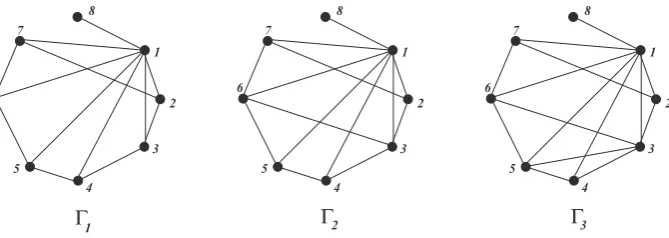
lower bounds onλ(Γ) for these access structures. Nevertheless, we explored graph access
struc-tures on more than 6 participants and we found three examples, the graphs in Figure 2, with
λIN(Γ) > κ(Γ), and hence they are new examples of access structures with κ(Γ) < λ(Γ).
Specifically, λIN(Γ1) = 19/10 and λIN(Γ2) = λIN(Γ3) = 13/7, while κ(Γ1) = 11/6 and
κ(Γ2) =κ(Γ3) = 9/5.
8
7
6
5
4 3
2 1
8
7
6
5
4 3
2 1
8
7
6
5
4 3
2 1
Γ
Γ1 2 Γ3
6
Ports of Non-representable Matroids
In this section, we use linear programming to extend the results in [4, 36, 39] about the ports
of the V´amos matroid to the ports of other non-linear matroids. Seymour [39] proved that
the V´amos matroid is not poly-entropic, and hence the two non-isomorphic ports V1 and V6 of
the V´amos matroid do not admit any ideal secret sharing scheme. By using the non-Shannon
information inequality by Zhang and Yeung [43], lower bounds on the optimal complexities of
those access structures proving thatσ(Vi)> κ(Vi) = 1 where presented in [4]. This bounds were
improved in [36] by using some of the non-Shannon information inequalities given by Dougherty,
Freiling and Zeger [20] (DFZ inequalities from now on). In addition, a lower bound on λ(Vi)
(the same for both structures, because they are dual of each other) are obtained in [4] from the
Ingleton inequality. A construction given in [31] provides an upper bound onλ(Vi). Specifically,
the results in [4, 31, 36] are summarized as follows.
• κ(V1) = 1<19/17≤σ(V1)≤λ(V1)≤4/3.
• κ(V6) = 1<21/19≤σ(V6)≤λ(V6)≤4/3.
• 5/4≤λ(V1) =λ(V6)≤4/3.
These results were obtained without using linear programming. Nevertheless, linear
program-ming was used in [36] to prove that no better lower bounds on σ(Vi) can be obtained by using
only the Zhang-Yeung and DFZ inequalities. In the Appendix of [37], we find two
matroid-s, AG(3,2)′ and Q8, that, similarly to the V´amos matroid, are among the smallest non-linear
matroids. By using linear programming, we prove similar results for the ports of these matroids.
1 2
3 4
5 6
7 8
Figure 3: AG(3,2)′ and Q8
Definition 6.1. The matroidAG(3,2)′ is defined on the set V ={1, . . . ,8}. Its independent sets are all the sets with at most 4 elements except the six faces, the six diagonal planes and
the twisted plane {1,3,6,8} of the cube in Figure 3.
Definition 6.2. The matroid Q8 is defined on the set V = {1, . . . ,8}. Its independent sets
are all the sets of cardinality at most 4 except the six faces and exactly five of the six diagonal
planes of the cube in Figure 3. Assume that the diagonal plane {1,3,5,7} is the independent
one.
It is not difficult to check that there are only two non-isomorphic ports of the matroid
AG(3,2)′, namely AG1 = Γ1(AG(3,2)′) and AG2 = Γ2(AG(3,2)′). Moreover, AG∗1 = AG2.
Similarly, the two non-isomorphic ports of the matroid Q8 areQ1= Γ1(Q8) and Q2 = Γ2(Q8).
As before, Q∗1 = Q2. The minimal qualified sets of these access structures are listed in the
• minAG1={234,256,458,357,278,467,368,2457}.
• minAG2={134,367,156,178,358,468,4578,4567,3457,1457}.
• minQ1 ={234,256,458,278,467,2368,2457,3468,3568,3678,2357,3457,3567,3578}. • minQ2 ={156,367,134,468,178,358,1357,4567,1457,3567,1567,1368}.
Zhang-Yeung inequality [43] implies that, for every poly-entropic polymatroid (Q, f) and
for everyA, B, C, D⊆Q,
ZY(f;A, B, C, D) = f(A) + 2f(B) + 2f(C) +f(A∪D) + 4f(A∪B∪C) + 4f(B∪C∪D) −3f(A∪B)−3f(A∪C)−3f(B∪C)−f(B∪D)−f(C∪D)≤0
If we set {A, B, C, D} = {18,36,27,45} for AG(3,2)′ and {A, B, C, D} = {15,26,37,48} for
Q8, then ZY(f;A, B, C, D) > 0. Therefore, the matroids AG(3,2)′ and Q8 are not
poly-entropic, and hence their ports do not admit any ideal secret sharing scheme. By adding to the corresponding linear program the Zhang-Yeung inequality, or the DFZ inequalities, or the
Ingleton inequality, with the previous choices of the setsA, B, C, D, we obtain the lower bounds
in Table 3. In particular, these are new examples of access structures with κ(Γ)< σ(Γ).
Table 3: Result for AG(3,2)′ and Q8
Access Lower bound Lower bound Lower bound
structure of σ by ZY ofσ by DFZ ofλby Ingleton
AG1 10/9 19/17 5/4
AG2 9/8 9/8 5/4
Q1 9/8 9/8 5/4
Q2 10/9 19/17 5/4
7
An Impossibility Result
Since no better bounds on λ(Γ) can be obtained for the access structures in Tables 1 and 2 by
using Ingleton inequality, one could expect that there exist for those access structures linear
secret sharing schemes with complexity equal to the lower boundκ(Γ). We prove in this section
that, at least for two of those access structures, this is not the case.
If Γ is an access structure with κ(Γ) = κe(Γ) and S = (Q, f) is a Γ-polymatroid with
σp0(S) =κ(Γ), thenh({i}) =κ(Γ) for everyi∈P. This simplifies the search for linear schemes
with complexity equal to κ(Γ). We find in Table 1 two access structures with that property.
Namely κ(Γ) = eκ(Γ) = 3/2 if Γ = Γ73 or Γ = Γ152. We prove in the following that the
complexity of every linear secret sharing scheme for one of these structures is larger than 3/2.
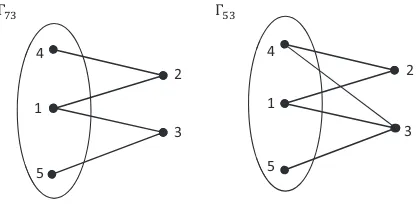
Moreover, for Γ73, the same applies to the average complexity. Here we consider Γ53 = Γ∗152
instead of Γ152. The minimal qualified sets of Γ73 and Γ53, which are represented in Figure 4,
are
• min Γ73={12,13,24,35,145}, and
Ȟଷ Ȟହଷ
4
1
5
2
3
4
1
5
2
3
Figure 4: Access Structures Γ73 and Γ53
The remaining of this section is devoted to prove the following impossibility result. The proof is quite long and it is divided into several partial results.
Proposition 7.1. There does not exist any linear secret sharing schemeΣwith access structure
Γ53 or Γ73 with complexity σ(Σ) = 3/2. There does not exist any linear secret sharing scheme
Σ with access structure Γ73 with average complexity eσ(Σ) = 3/2.
When using linear programming to compute the value of κ(Γ) for Γ = Γ53 or Γ = Γ73, we
always obtain as an optimal solution the polymatroidS1and, respectively,S2that are described
in Definition 7.2. We prove in Lemma 7.4 that these polymatroids are not poly-linear.
Definition 7.2. The polymatroids S1 and S2 are defined as the only Γ53-polymatroid and,
respectively, the only Γ73-polymatroid satisfying the following properties.
1. f(i) = 3/2 for every i∈P.
2. f(A) = 5/2 for every unqualified setA⊆P with|A|= 2.
3. f(A) = 3 for every qualified set A⊆P with|A|= 2.
4. f(A) = 7/2 for every A⊆P with|A| ≥3.
Lemma 7.3. Let V1, V2, V3 be subspaces of a vector space E. Then,
max
{
0, s−∑si+
∑ ri
}
≤dim(V1∩V2∩V3)≤min{t1, t2, t3},
where s= dim(V1+V2+V3), si = dim(Vj+Vk), ri = dimVi, and ti = dim(Vj ∩Vk) for every {i, j, k}={1,2,3}.
Proof. Putt= dim(V1∩V2∩V3). Since (V1∩V3) + (V2∩V3)⊆(V1+V2)∩V3, we have that
dim((V1+V2)∩V3)−dim((V1∩V3) + (V2∩V3)) =
∑ si−
∑
ri−s+t≥0.
Obviously,t≤ti.
Lemma 7.4. The polymatroids S1 and S2 are not poly-linear.
Proof. Take Q={0,1,2,3,4,5} withp0= 0. Let S = (Q, f) be one of these polymatroids and
suppose that it is poly-linear. Then there must exist a positive integer cand subspaces (Vi)i∈Q
of a vector spaceE such that dim∑i∈AVi= 2c f(A) for everyA⊆Q.
Clearly, dim(V1∩V4) = dim(V1∩V5) = dim(V4∩V5) =c, and hence dim(V1∩V4∩V5) =c
Since dim[(V2+V3)∩V5] = dim(V2+V3) + dimV5−dim(V2+V3+V5) = 5c+ 3c−7c=c
and dim(V2 ∩V5) = c, we have that U0 ∩(V2 +V3) ⊆ V5∩(V2+V3) = V5 ∩V2. Therefore,
U0∩(V2+V3) ={0}because V1∩V2 ={0}.
The subspace V0 corresponding to the dealer is contained inVAfor everyA∈Γ. Therefore,
V0⊆(V1+V2)∩(V1+V3)∩(V2+V4)∩(V3+V5) =W
We prove in the following that 3c≤dimW ≤4c. Indeed, on one hand,
dimW = dim{[(V1+V2)∩(V2+V4)]∩[(V1+V3)∩(V3+V5)]}
= dim[(V1+V2)∩(V2+V4)] + dim[(V1+V3)∩(V3+V5)]
−dim{[(V1+V2)∩(V2+V4)] + [(V1+V3)∩(V3+V5)]}
≤ 5c+ 5c−dim[V2+ (V1∩V4)] + [V3+ (V1∩V5)]
= 5c+ 5c−dim(V2+V3+U0)
= 5c+ 5c−6c
= 4c. (5)
On the other hand, dim{[(V1 +V2)∩(V2 +V4)] + [(V1 +V3)∩(V3+V5)]} ≤ 7c, and hence
dimW ≥5c+ 5c−7c= 3c.
The next step is to prove that dim[W ∩(V2+V5)] = 2c.
dim[W ∩(V2+V5)] = dimW + dim(V2+V5)−dim(W +V2+V5)
≤ dimW + dim(V2+V5)−dim(V0+V2+V5)
≤ 4c+ 5c−7c
= 2c. (6)
The other inequality is obtained by
dim[W ∩(V2+V5)] = dim{(V1+V2)∩(V1+V3)∩(V2+V4)∩(V3+V5)∩(V2+V5)}
= dim{[(V1+V2)∩(V2+V5)∩(V2+V4)]∩[(V1+V3)∩(V3+V5)]}
≥ dim[(V2+U0)∩(V3+U0)]
= dim(V2+U0) + dim(V3+U0)−dim(V2+V3+U0)
= 4c+ 4c−6c
= 2c (7)
In particular, all inequalities in (6) must be equalities, which implies that dimW = 4c.
More-over, the inequality in (5) must be also an equality, and hence
[(V1+V2)∩(V2+V4)] + [(V1+V3)∩(V3+V5)] = [V2+ (V1∩V4)] + [V3+ (V1∩V5)]
= V2+V3+U0.
Therefore, (V1+V3)∩(V3+V5)⊆V2+V3+U0 and (V1+V3)∩(V3+V5)⊆V2+V3+U0.
dim(W ∩V2) = dim[(V1+V3)∩(V3+V5)∩V2]
= dim[(V1+V3)∩(V3+V5)] + dimV2
−dim{[(V1+V3)∩(V3+V5)] +V2}
≥ dim[(V1+V3)∩(V3+V5)] + dimV2−dim(V2+V3+U0)
= 5c+ 3c−6c
Analogously, dim(W ∩V3)≥2c. Therefore,
dim[W ∩(V2+V3)] ≥ dim[(W ∩V2) + (W ∩V3)]
= dim(W ∩V2) + dim(W ∩V3)−dim(W ∩V2∩V3)
≥ 2c+ 2c−c
= 3c (8)
Finally, since V0 ⊆W,
dim[V0∩(V2+V3)] = dim[V0∩W ∩(V2+V3)]
≥ dim(V0) + dim[W ∩(V2+V3)]−dim(W)
≥ 2c+ 3c−4c
= c,
a contradiction with the fact that{2,3} is not qualified.
We prove in Lemma 7.7 that the polymatroids S1 and S2 are the only optimal solutions of
the linear programs computing κ(Γ53) and κ(Γ73), respectively. We need two technical results.
The first one is due to Csirmaz [12], while the second one is proved by using the independent sequence technique [8].
Lemma 7.5. Let Γ be an access structure. The following properties are satisfied by every
Γ-polymatroid S = (Q, f).
1. If B ∈Γ, andA⊆B and A /∈Γ, then f(A)≤f(B)−1.
2. If A, B∈Γ but A∩B /∈Γ, then f(A∪B) +f(A∩B)≤f(A) +f(B)−1.
Lemma 7.6. Let Γ be an access structure and S = (Q, f) a Γ-polymatroid. Ifa, b, c, d∈P are such that ab, bc, acd∈Γ and b, ac, ad /∈Γ, then f(bc)≥3.
Lemma 7.7. If Γ = Γ53 or Γ = Γ73, there exists a unique Γ-polymatroid S with σp0(S) = 3/2.
Proof. Let S = (Q, f) be such a polymatroid. Obviously, f(i) = 3/2 for every i ∈ P since
κ(Γ) =κe(Γ) = 3/2. If ij ∈Γ, then f(ij) = 3 by Lemma 7.6 and f(ij) ≤f(i) +f(j). Clearly,
every 3-subset ofP is qualified. Take three different participantsi, j, k∈P such thatij, jk /∈Γ.
By Lemma 7.5,
f(ij) + 1≤f(ijk)≤f(ij) +f(jk)−f(j),
which implies that f(ij) ≥ 5/2. Symmetrically, f(jk) ≥ 5/2, and hence f(ijk) ≥ 7/2.
Ob-viously, this implies that f(ij) ≥ 5/2 for every pair ij /∈ Γ. In addition, since every 3-subset
contains at least one unqualified 2-subset,f(A)≥7/2 for every A⊆P with|A|= 3. Consider
now three different participantsi, j, k ∈P such that ij, jk∈Γ. Applying Lemma 7.5 again,
f(ijk)≤f(ij) +f(jk)−f(j)−1 = 7/2,
and hence f(ik) = 5/2. This implies thatf(ij) = 5/2 for every pair ij /∈Γ except for 45 for
Γ73. Therefore,
f(145)≤f(14) +f(15)−f(1) = 7/2,
and hence f(45)≤f(145)−1 = 5/2. Analogously, f(A) = 7/2 for every A⊆P with |A|= 3,
and f(A) = 5/2 for every A ⊆P with |A|= 2 and A /∈ Γ. Let A be a 4-subset of P, and let
B ⊆A be an unqualified 2-subset. ThenA=B∪ij and
and hence f(A) = 7/2. One can prove in the same way that f(P) = 7/2. All these facts
determine a unique Γ-polymatroid S.
Lemmas 7.4 and 7.7 suffice to prove the first statement in Proposition 7.1. In order to prove the impossibility result about the average complexity, we need to analyze in more detail the
properties of the Γ73-polymatroids that are optimal solutions for the linear program determining
e κ(Γ73).
Letτ be the permutation on Qthat interchanges 2 with 3 and 4 with 5 and leaves 1 andp0
fixed. Clearly, τ induces an automorphism of the access structure Γ73. Therefore, ifS = (Q, f)
is a Γ73-polymatroid, thenτS = (Q, f τ) is also a Γ73-polymatroid. Moreover, ifS is poly-linear
over some finite field K, the same applies to τS. Consider the polymatroid S′ = (Q, f′) with
f′ = (f+f τ)/2. Clearly,S′ is a Γ73-polymatroid. Moreover,τS′ =S′ becauseτ2 is the identity
map. Finally, if there exists a linear secret sharing scheme Σ for Γ73 that is associated to the
polymatroid S, then there exists a linear secret sharing scheme Σ′ for Γ73 that is associated to
the polymatroid S′, and both schemes have the same average complexity. By taking this into
account, Lemma 7.8 concludes the proof of Proposition 7.1.
Lemma 7.8. There exists a uniqueΓ73-polymatroidS = (Q, f)such thatτS =S andeσp0(S) = 3/2.
Proof. By Lemma 7.6,f(ij)≥3 if ij∈Γ. Then,
• f(1) +f(3) =f(1) +f(2)≥3, and
• f(2) +f(4) =f(3) +f(5)≥3.
We have used here that τS = S. Combining these inequalities with ∑5i=1f(i) = 15/2, we
obtain f(4) =f(5)≤3/2, andf(2) =f(3)≥3/2, andf(1)≤3/2.
By Lemma 7.5,
f(23) + 1≤f(234)≤f(23) +f(34)−f(3), (9)
and hence f(34)≥5/2. Similarly, f(23)≥5/2 and f(234)≥7/2. In addition, by using again
thatτ is an automorphism of the polymatroid,f(235) =f(234)≥7/2 andf(25) =f(34)≥5/2.
Moreover, f(345) = f(245) ≥ f(25) + 1 ≥ 7/2, and similarly f(134) = f(125) ≥ 7/2 and
f(123)≥7/2.
We claim f(124) =f(135)≤7/2 and f(145)≤7/2. Indeed,
f(124) ≤ f(12) +f(24)−f(2)−1
≤ f(1) +f(2) +f(4)−1
= 1/2×15/2 +f(1)/2−1 (10)
≤ 7/2.
And
f(145) ≤ f(14) +f(15)−f(1)
= 2f(14)−f(1)
≤ 2[f(124)−1]−f(1)
≤ 2[f(12) +f(24)−f(2)−2]−f(1)
= 2[f(12)−f(2)−f(1)] + 2f(24) +f(1)−4
≤ 2f(24) +f(1)−4
≤ 2f(2) + 2f(4) +f(1)−4
The next step is to prove thatf(124)−f(14) =f(135)−f(15) = 1. Observe thatf(124)−
f(14) = 1 +ϵfor someϵ≥0, and hence f(14) =f(15)≤5/2−ϵ. Since 1 +f(14) +f(1245)≤
f(124) +f(145), we have that
7/2≤f(1245)≤ϵ+f(145)≤f(14) +f(15)−f(1)≤5−ϵ−f(1), (11)
and hence f(1) ≤3/2−ϵ. Now, inequality (10) implies that f(124) ≤7/2−1/2ϵ, and hence
f(15) =f(14)≤5/2−3/2ϵ. By using this last inequality in (11), we have thatf(1)≤3/2−2ϵ.
By repeating this argument, f(1) ≤ 3/2−nϵ for every positive integer n, which implies that
ϵ= 0.
Therefore, f(145) ≥ f(1245) by (11), and hence f(145) = f(1245) = f(1345) = 7/2.
Moreover, f(245) = f(345) = 7/2 and f(134) = f(125) = 7/2, which implies that f(25) =
f(34) = 5/2. We can now use (9) to obtain f(2) = f(3) = 3/2, and hence f(i) = 3/2 for all
i∈P. By far, we conclude the proof of Proposition 7.1.
8
Conclusion and Open Problems
In this paper, we present several results on the optimization of the (average) complexity of secret sharing schemes that have been obtained by using linear programming. Other results by using the same technique have been given in [23, 32]. Differently to these other works, some of our results are obtained by using non-Shannon information inequalites (as the one by Zhang and Yeung [43]) and the Ingleton inequalities. Nevertheless, since the number of variables and constraints in the involved linear programs is exponential in the number of participants, the power of the techniques applied in this paper seems to be rather limited.
The most obvious open problem that can be posed here is to finish the projects initiated by Jackson and Martin [29] and by van Dijk [16] for access structures on five participants and graph access structures on six participants, respectively. As we saw in Section 5, the Ingleton inequality does not provide any improvement on the bounds. In addition, the impossibility result in Section 7 indicates that this is not an easy task.
In regard to that impossibility result, we notice that it does not imply that κ(Γ)< λ(Γ) for
the involved access structures. Indeed, there could exist infinite linear secret sharing schemes
whose complexities are arbitrarily close to 3/2. Maybe other rank inequalities different from
the Ingleton one can prove that stronger separation result.
Another interesting line of future work is to apply the techniques in Section 6 to other ma-troids that are not poly-entropic, as the non-Desargues mama-troids and other examples presented in [33].
References
[1] I. Anderson, Combinatorics of Finite Sets, Oxford University Press, 1987.
[2] A. Beimel, Secret-Sharing Schemes: A Survey, IWCC’2011. Lect. Notes Comput. Sc. 6639 (2011) 11–46.
[3] A. Beimel, Y. Ishai, On the power of nonlinear secret sharing schemes, SIAM J. Discrete Math. 19 (2005) 258–280.
[4] A. Beimel, N. Livne, C. Padr´o, Matroids can be far from ideal secret sharing, Proc. of
[5] A. Beimel, I. Orlov, Secret Sharing and Non-Shannon Information Inequalities, Proc. of TCC’2009, Lect. Notes Comput. Sc. 5444 (2009) 539–557.
[6] A. Beimel, E. Weinreb, Separating the power of monotone span programs over different fields, SIAM J. Comput. 34 (2005) 1196–1215.
[7] G.R. Blakley, Safeguarding cryptographic keys, AFIPS Conf. P. 48 (1979) 313–317.
[8] C. Blundo, A. de Santis, R. de Simone, U. Vaccaro, Tight bounds on the information rate of secret sharing schemes, Des. Codes Cryptogr. 11 (1997) 107–122.
[9] E.F. Brickell, D.M. Davenport, On the Classification of Ideal Secret Sharing Schemes, J. Cryptology, (1991) 123–134.
[10] T.H. Chan, L. Guill´e, A. Grant, The minimal set of Ingleton inequalities, IEEE Trans.
Inform. Theory Vol. 57 Iss. 4 (2011) 1849–1864.
[11] B.L. Chen, H.M. Sun, Weighted Decomposition Construction for Perfect Secret Sharing Schemes, Comput. Math. Appl. Vol. 43 Iss. 6–7 (2002) 877–887.
[12] L. Csirmaz, The size of a share must be large, J. Cryptology 10 (1997) 223–231.
[13] L. Csirmaz, Secret sharing on the d-dimensional cube, Cryptology ePrint Archive, Report
2005/177 (2005)http://eprint.iacr.org.
[14] L. Csirmaz, An impossibility result on graph secret sharing, Des. Codes Cryptogr. 53 (2009) 195–209.
[15] L. Csirmaz, G. Tardos, Secret sharing on trees: problem solved, Preprint (2009), Available athttp://eprint.iacr.org/2009/071.
[16] M. van Dijk, On the information rate of perfect secret sharing schemes, Des. Codes Cryp-togr. 6 (1995) 143–169.
[17] M. van Dijk, More information theoretical inequalities to be used in secret sharing? Inform. Process. Lett. 63 (1997) 41–44.
[18] M. van Dijk, W.A. Jackson, K.M. Martin, A note on duality in linear secret sharing schemes, Bull. Inst. Combin. Appl. 19 (1997) 93–101.
[19] M. van Dijk, T. Kevenaar, G. Schrijen, P. Tuyls, Improved constructions of secret sharing
schemes by applying-(λ, ω)-decompositions, Inform. Process. Lett. Vol. 99 Iss. 4 (2006)
154–157.
[20] R. Dougherty, C. Freiling, K. Zeger, Six new non-Shannon information in-equalities, ISIT’2006, (2006) 233-236.
[21] R. Dougherty, C. Freiling, K. Zeger, Linear rank inequalities on five or more variables,
Available atarXiv.org, arXiv:0910.0284v3 (2009).
[22] R. Dougherty, C. Freiling, K. Zeger, Non-Shannon Information Inequalities in Four Random
Variables, Available atarXiv.org, arXiv:1104.3602v1 (2011).
[23] O. Farr`as, J.R. Metcalf-Burton, C. Padr´o, L. V´azquez, On the optimization of bipartite
[24] S. Fujishige, Polymatroidal Dependence Structure of a Set of Random Variables, Inform. and Control. 39 (1978) 55–72.
[25] M. Gharahi, M.H. Dehkordi, The complexity of the graph access structures on six partici-pants, Des. Codes Cryptogr, Online First (2011).
[26] A.W. Ingleton, Representation of matroids, in: D.J.A Welsh (Ed.), Combinatorial Mathe-matics and its Applications, Academic Press, London, 1971, pp. 149–167.
[27] M. Ito, A. Saito, T. Nishizeki, Secret sharing scheme realizing any access structure, Proc. IEEE Globecom’87, (1987) 99–102.
[28] W.A. Jackson, K.M. Martin, Geometric secret sharing schemes and their duals, Des. Codes Cryptogr. 4 (1994) 83–95.
[29] W.A. Jackson, K.M. Martin, Perfect secret sharing schemes on five participants, Des. Codes Cryptogr. 9 (1996) 267–286.
[30] E.D. Karnin, J.W. Greene, M.E. Hellman, On secret sharing systems, IEEE Trans. Inform. Theory 29 (1983) 35–41.
[31] J. Mart´ı-Farr´e, C. Padr´o, On Secret Sharing Schemes, Matroids and Polymatroids, J. Math.
Cryptol. 4 (2010) 95–120.
[32] J. Mart´ı-Farr´e, C. Padr´o, L. V´azquez, Optimal Complexity of Secret Sharing Schemes with
Four Minimal Qualified Subsets, Des. Codes Cryptogr. 61 (2011) 167–186.
[33] F. Mat´uˇs, Matroid representations by partitions, Discrete Math. 203 (1999) 169–194.
[34] F. Mat´uˇs, Adhesivity of polymatroids, Discrete Math. 307 (2007) 2464–2477.
[35] F. Mat´uˇs, Infinitely many information inequalities, IEEE International Symposium on
Information Theory (2007) 41–44.
[36] J.R. Metcalf-Burton, Improved upper bounds for the information rates of the secret sharing
schemes induced by the V´amos matroid, Discrete Math. vol. 311, Iss. 8-9 (2011) 651C662.
[37] J.G. Oxley, Matroid Theory, Second ed., Oxford University Press, New York, 2011.
[38] C. Padr´o, L. V´azquez, Finding Lower Bounds on the Complexity of Secret Sharing Schemes
by Linear Programming, LATIN 2010: Theoretical Informatics. Lecture Notes in Comput. Sci. 6034 (2010) 344-355.
[39] P.D. Seymour, On secret-sharing matroids, J. Combin. Theory Ser. B, 56 (1992) 69–73.
[40] A. Shamir, How to share a secret, Commun. of the ACM. 22 (1979) 612–613.
[41] D.R. Stinson, An explication of secret sharing schemes, Des. Codes Cryptogr 2 (1992) 357–390.
[42] D.R. Stinson, Decomposition constructions for secret-sharing schemes, IEEE Trans. Inform. Theory. 40 (1994) 118–125.