A Multi-Function Provable Data Possession Scheme
in Cloud Computing
Xiaojun Yu, Qiaoyan Wen
State key laboratory of networking and switching technology, Beijing University of Posts and Telecommunications, Beijing, 100876, China
{[email protected], [email protected]}
Abstract: In order to satisfy the different requirements of provable data possession in cloud computing, a multi-function provable data possession (MF-PDP) is proposed, which supports public verification, data dynamic, unlimited times verification, sampling verification. Besides, it is security in RO model and it is verification privacy under half trust model and can prevent from replacing attack and replay attack. The detail design is provided and the theory analysis about the correct, security and performance are also described. The experiment emulation and compare analysis suggest the feasibility and advantage.
Keywords: multi-function; provable data possession; cloud computing;
1 Introduction
With the cost and technology advantage, the cloud computing is considered as the best solution for information development requirement. However, there are many security problems in cloud computing. One of the basic security problems is data security and privacy.. Thus, many security technologies were used, such as Searchable encryption [1](SE) for data search with confidentiality , proof of deletion [2](POD) for data clear up in shared storage, provable of data possession (PDP)[3-15] for data integrity audit.
This paper focus on the PDP, which is used to check data integrity without downloading the real data from the server. The PDP can also be used as security service to improve the trust level of cloud service provider. However, this technology is faced on many challenges in some cloud, where (a)the data is dynamically updated (b) the client is performance limited.(c) the cloud service provider is untrusted and may take attacks to avoid responsibility if the real data was broken. Thus, a good PDP in such environment should meets both low computing complex and high security. Though there are many work of PDP, Most of which have limitation in performance or security. According to the current works, especially work [3], this paper proposed an improved version of PDP, named MF-PDP, which is better than most of works in function, performance and security.
The main contributions of this paper are summarized as followings:
(1) We proposed how to design the PDP that can simultaneously support multi-function requirements in cloud computing environment, including public verification, data dynamic, unlimited times verification; sampling verification, verification privacy.
(2) We give a theory analysis in security and performance. Under assumptions of KEA1-r and RSA, the proposed PDP scheme is security in Random Oracle model. The Complexity of communication is
(
n
)
, Storage complexity are
(
1
)
,
(
n
)
and
(
1
)
for the dataowner, the cloud service provider and the third party auditor respectively. Computing
complexity are
(
n
)
,
(
c
)
,
(
c
)
for the data owner, the cloud service provider and thethird party auditor respectively.
(3) We give an evaluation of the proposed scheme. The experiment evaluation show the consistency with theory analysis and high efficiency in performance .The comparison with other works in function shows the advantage.
2 Related work
Ateniese[3]firstly proposed the provable data possession model named PDP and two schemes named SPDP and EPDP based on RSA homomorphic verifible tag were designed. The EPDP is the specific of the SPDP and both support sampling verification and unlimited times verification. The SPDP can’t support the public verification and data dynamic. The EPDP support public verification but not verification privacy. In the following work, Ateniese proposed an efficient verification scheme based on Hash function [4]. Though it supports sampling verification, it doesn’t support public verification, unlimited times verification.
Sebe[5]designed a Proof of Retrievability based on homomorphic linear authentic which not only can be used to verify the data integrity but also to retrieve the data if some error has occurred. However, this scheme can’t support public verification and have data leakage problem in verification progress.
Erway[6]proposed the DPDP model for supporting the data dynamic. He also designed two DPDP scheme, named DPDP-I and DPDP-II, which can support data dynamic, sampling verification, unlimited verification. However, the DPDP-I have replay attack issue and the DPDP-II cannot support verification privacy. Chen[15] add the robustness to DPDP through a combination of technologies such as RS codes based on Cauchy matrices, but the performance need further improved.
verification, unlimited times verification, publicly verification and verification privacy, but cannot support data dynamic.
Zhuo[13]designed a PDP scheme based on homomorphic linear code, which support data dynamic, unlimited verification, publicly verify and privately verify, but can’t support sampling verification that means all data must be used in each verification process. Furthermore, this scheme can’t prevent from replacing attack that the prover uses other data and data verification tag to build the integrity proof of the challenged data.
3 Preliminaries
Definition 1. (KEA1-r)Knowledge of Exponent Assumption[16]
For any adversary A that take input( , , s)
g g
N and returns group elements(C,Y), such
that s
C
Y ,there exists an extractor ε which, given the same inputs as A ,returns
x ,such that x
g
C .
Definition 2. Privacy against third party verifier[17].
We say provable data possession scheme is privately computesfv, if there exist a
probabilistic polynomial-time algorithm emulator Sv , such that
{0,1} , {0,1}
, { ( , )}
))} , ( , ( {
y x V
C
y x v
v x f x y view x y
S Where fvis the verification function and a
deterministic functionality.
view
V(
x
,
y
)
is the view of verifier during an execution of
on
x,y .view
v(
x
,
y
)
=(x,r,m1,....mt), where r represents the outcome of the internal cointosses, and mi represents the i -th message it has received.
C
denotes computational
indistinguishability by (non-uniform) families of polynomial-size circuits. Definition 3. RSA problem
For *
N
Z
y , find the root
x
,such that xe y nmod
. Where Npq be a multiplication
of two big primes, Φ(N) is Euler function ofN,
e
Z
*N is an integrity number and be primeto Φ(N).
Definition 4. RSA assumption
4 MF-PDP Design
4.1 Assumption
4.1.1 System model
云服务端 Cloud Server Cloud Service Provider
(CSP)
Data Owner (OWN) Third Party
Auditor (TPA)
3.Upload Data 2.Download Data 1.Data Intergrity
Verification 1.Data Intergrity
Verification
Client Cloud Server
Figure.1 system model
Figure.1 is the system model, including two parts: the Client and the Cloud Server. And the Client can be two types that are data Owner (OWN) and Third Party Auditor (TPA).
The cloud server is managed by cloud service provider (CSP), which provides data storage service and data integrity verification service. The OWN is the customer of cloud storage service and participate in the data integrity verification. The TPA is the independent part who is represent the OWN to take data integrity audit task.
4.1.2 Threat model
We assume that the CSP may replace proof or replay proof in order to pass the verification. The TPA also may record related information in order to discover the user’s data. The TPA is independent of the CSP, thus they will not take collusion attack. The client environment is safe and the OWN is trust for the data is belong to him.
4.2 Notations
For convenient, some notations are given in Table 1. Table.1: notations description
F Data File F={m1,m2,…mn} chal Challenge
mi data block. |x| Length operation
n Data block number of each file. x||y Link operation
l The length of data block. fk(x) pseudo-random function
c Number of challenged data block πk(x) pseudo-random permutation
k Random number key H(x) hash function
pk, sk Public key, Secret key V Proof
Tm the tag of data block m R Random sequence R={r1,r2…rn}
4.3 Design Idea
The MF-PDP is an improved version of PDP[3],but It supports some new requirements in cloud environment by using new ideas. See Table 2 .
In function requirement: it supports data dynamic by remove the data block index when computing the data block tag and public verification by using public key in verification stage.
In performance requirement, it uses the homomorphic verifiable tag[3] to reduce the communication cost and the random sampling verification to reduce computing cost.
In security requirement, the verification procedure is dependent on two parts proof information that one part comes from the prover and the other comes from the verifier, this idea not only make sure the valid of proof but also resisting the proof replacing attack.
Table 2: Design idea
function Design idea
Data Dynamic The data block tag rule is
T
g
r
dN
x m m
x
x
(
)
mod
, which is only depend on the data block content, thus the update operation on x-th data block has no effect on other data block tag.Sampling verification
in each verification, the challenged data blocks are chosen based on the
random challenge
chal
(
k
1,
k
2,
g
s,
c
)
, we use AES as the random method toensure the result valid with high probability and low computing cost.
Public verification
the data integrity proof is verified with public key, that is
pk
chal
V
CheckProof
,
,
,thus anyone who get the pk can verify the proof.Verification privacy
we use SHA-1 as one-way hash function to compute the data integrity proof. In RO model, it ensures the TPA can’t find any information of the challenged data except the output of hash function.
Unlimited times
verification in each verification, the challenge
chal
(
k
1,
k
2,
g
s,
c
)
and proof are createdrandomly which make the each challenge and proof independently and security for statistical attack.
Anti-replacing attack
the data integrity proof is computed based on two parts information ,one part is stored on the prover, such as data block tag, the other part is provided by verifier, such as random numbers in challenge. The verifier will check the proof with random numbers in challenge. Thus, if the prover uses other data block tag or data content, the verify result will be failure.
Anti-replay attack
4.4 MF-PDP Scheme
Based on the definition model of Provable Data Possession Scheme[3], we propose our MF-PDP definition.
Definition 5 : The Multi-Function Provable Data Possession Scheme, MF-PDP, is composed of five probability algorithms, MF-PDP={KeyGen,TagBlock,
GenChal
,GenProof,CheckProof ,Update
},where:
KeyGen
1
k
pk
,
sk
: The OWN computes pk(e,g,N) ,sk(d,N) ,N pq,1) -1)( -( )
(N p q
Φ , 2 ' 1
p
p , 2 ' 1
q
q ,p,q , '
p , '
q are primes. eis a primes
and d is the inverse of e, ed1modΦ(N), g is the generator of QRN ,which is
multiplication cycle group composed of the quadratic residues modulo
N
.Thepk
ispublished in from of certificate,
sk
is kept by the OWN.
TagBlock
pk
,
sk
,
m
T
m :The OWN computes tag of each data blockN r
g
T i d
m m
i
i ( ) mod ,in which, pk(e,g,N) , sk(d,N) ,1in , riZN ; R =
r1,r2,..rn
is the random sequence, HR = H r r r r N dn)) mod
|| ... | || (
( 1 2| 3 is the digital
signature of random sequence. The OWN sends M= (F ,Σ={ i
m
T },R,HR) to CSP.
GenChal
pk
chal
: The OWN (or TPA) randomly chooses(k1,k2,s)ZN,c
Z
n andcomputes
g
g
sN
s
mod
, then thechal
(
k
1,
k
2,
g
s,
c
)
is sent to the CSP. GenProof
pk,F,chal,Σ
V :The CSP computes ( 111 2 2 .. mod )N g
H
P am ami acmic
s h ) mod
(g 1 N
H c j j i jm a s ,
c j a d i m c j a mt T g r N
P j j j i j j i 1 * 1 mod )
( ,where ( )
1 j
π
ij k ,
) (
2 j
f
aj k ,pk(e,g,N). The proof V =
Ph,Pt,R,HR
. Then the CSP return V to OWN(or TPA).
CheckProof
pk
,
chal
,
V
"
success
"
,
"
failure
"
: The OWN(or TPA) check?
3 2
1|| || ...|| |)mod
(r r r r N
H n (HR)e,if not equal, meaning the random sequence is not
integrity, output “failure”, else, compute P r N
c j a i r j j mod 1
, C = (( )s)
) (
1 j
π
ij k , ( )
2 j
f
aj k , r R
J
i ,then check C?Ph,if not equal, then the verification
failure, output "failure"; if equal, it means the CSP possess the OWN’s data and output
"
success
"
. Update
, , , , , ,
, , , '
' ' '
R R
x i optype T F R H T F R H
m
: where
m
xis the new data block for insert or target data block for modification and deletion.i
is the data block operationindex.
optype
= , “Insert”, “Modify”, “Delete” -. The OWN checks the valid of R withR
H , if failure, output warning and exit update process, or else according to the
optype
,the OWN run the functions with the CSP, the CSP updates
T,F,R,HR
to
, , , '
' ' '
R
H R F T
.
4.5 MF-PDP System
Based on the definition model of Provable Data Possession System[3], we propose MF-PDP Systemdefinition.
Definition 6: The Multi-Function Provable Data Possession Systembased on MF-PDP scheme
consists of three stages, MF-PDP System={ Setup stage, Challenge stage ,update stage},where:
Setup stage: The OWN runs KeyGen
1k
pk,sk
, and then execute
i
m
i T
m sk pk
TagBlock , , for1in. The OWN publishes the pk and keep sk, and then the OWN sends message M= (F ,Σ={Tmi},R,HR) to the CSP for storage and
delete local file Fand Σ .
Challenge stage: The OWN(or TPA)runs GenChal
pk chal to generate a challenge)
,
,
,
(
k
1k
2g
c
chal
s ,and sendschal
to the CSP. The CSP runsGenProof
pk,F,chal,Σ
V to generate proof of possessionV
=
Ph,Pt,R,HR
and sendsV
to the OWN(or TPA).Finally, The OWN ( or TPA ) checks the validity of proof V by running
pk sk chalV
CheckProof , , ,
"
success
"
,
"
failure
"
. Update stage: The OWN runs Update
, , , , , ,
, , , '
' ' '
R R
x i optype T F R H T F R H
m
,
check the valid of R
,and execute sub functions according to the optype value with the CSP.
The result is updates
T
,
F
,
R
,
H
R
to
,
,
,
'
' ' 'R
H
R
F
5 MF-PDP Analysis
5.1 Correctness
Theorem 1: if both the verifier and the prover follow the MF-PDP scheme, the prover can success passed the verification stage.
Proof: according the returned information
p
t, the verifier computes:N r g N r g T P c j a i m a c j e a d i m c j e a i e j j c j j i j j j j i j j
t ( ) ( ( ) mod ) ( )mod
1 * 1 * 1 1
As
p
r
c i a i N r j j 1
mod ,then (( )s)
r e t
P P
H ) )
mod mod ) ( (( 1 1 * 1 s c i a i c i a i m a N r N r g H j j j j c j j i j
s m a N g H c j j i j ) mod (( 1 * ( mod )
1 * N g H c j j i j m a s h m a
s N P
g H c j j i j ) mod ( 1 *
5.2 Detection Probability of Data Integrity Broken
The detection probability of data Integrity Broken Pxis an important evaluation part,which
has relation to the total number of data block
n
,data block loss numbert, challenge data block numberc
, as follows:1
1
1
1
1
0
1
1
c
n
t
c
n
n
t
n
n
t
n
X
P
X
P
P
x{
}
{
}
...
Because
1
1
i
n
t
i
n
i
n
t
i
n
,
0
i
c
1
, thusc x c c n t c n P n t n 1 1 1 1
Figure 2. Detection Probability of Data Integrity Broken
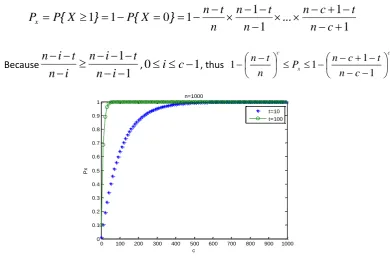
Figure 2 show the relation ofPx,t,
c
, whenn
=1000. We can see that (1) with the samec
,the Px is increased as the t; (2) under the same Px,
c
is decreased as the t’s increase, e.g.When
P
x=99%, n=1000, t=10,c
is about 458, while t=100,c
is about 43. Thus, the MF-PDP canfind the data integrity broken status with appropriate parameters.
5.3 Security
5.3.1 Provable data possession
Theorem 2: Under assumptions of KEA1-r(Definition 1)and RSA(Definition 4) , the MP-PDP scheme is provable data possession in Random Oracle model.
Proof: We use the data possession game [3] to explain the security of MF-PDP. We assume that if the adversary A wins the PDP game with challenger C, then there is an extractor who helps the challenger C to extract the challenged data block or else the challenger can break the RSA problem or integer factoring.
We first look at the case when all the coefficientsa1 a2…ac are equal to 1. This case
proves the challenger C possesses the sum of the requested data blocks. Then the coefficients a1 a2…acare random and distinct, which corresponds to the case that
proves the challenger C possesses all the challenged data block.
The Challenge C and Adversary A play the PDP game as followings: Setup:
C computesgy2modN
, sets the public key pk(N,g) and sends pk to A. Query:
C makes the tag queries adaptively: C selects a block m1and the position index i1,then
sends (m1,i1) to A. According to the (m1,i1),A generates the data block metadata
1 1,i
m
T and sends it back to C who continues to query A for the metadata
n ni
m i m i
m T T
T , , , ... ,
3 3 2
2 on the blocks m2,m3,...mnand index i2,i3,...in.The only restriction is that C cannot make tag queries for two different blocks using the same index.
C answers the A’s tag oracle queries as followings:
When A receives a tag query for a data block
m
and indexi ,If a previous tag query has been made for the samem
and index i, then A retrieves the recorded tuple(m
,i,i
Challenge:
C generates the chal(gs,i1,..ic),where g gs N
s mod ,
*
N
Z
s ,i1,...ic are the
challenged data block index.1ijn,1 jc,1cn,C sends chalto A.
Forge:
According to the queried data block, A generates a data proof V (T,ρ),where }
,.. { .. 1 2
1 i ic, c
i m m i i
m
T
T ,let Mmi1 mi2...mic,then return V (T,ρ) to C.
Analysis:
Case(1): a1 a2…ac are equal to 1
As H is the random Oracle, with overwhelming probability, C can extract the pre-image value pρthat A utilized to calculateρ. In the PDP game, the challenger C sends (g,gs)to attack
A who returnsV(T,ρ), by which we can get
c
j i e
j υ T τ
1
.Assume the adversary A can pass the
verification, then there is ρ s
p
τ ,thus, we can say adversary A returns implicitly the(τ,pρ).
According to the KEA1-r, there exists a extractor
ε
help the challenger C extract a validvalue *
M ,which satisfy M*
g
τ (if gM* τ
,then Challenger sets T TmodN). If M*M
, then the challenger can successfully extract the challenged data block sum M.
If M* M
,then there exits gM* gM modΦ(N)
, that means the Challenger can
compute a multiple of Φ(N) that is gM* gM KΦ(N) for some KZ-{0} ,the factorization of N can be efficiently computed[18].
We now could say our MF-PDP scheme support the possession of the sum of all the data blocks, which means the Challenger either get the challenged data block or break the factorization of big integrity.
Case (2): a1 a2…ac are random and pairwise distinct
Note that each time in executing the MF-PDP scheme, there is a knowledge extractor
ε
can get a linear equation of the form ick c i k i k
k a m a m a m
M ..
. 2
1 2
1 .By choosing independent
coefficients k c k
a
a1.... in c times on the same blocks mi1…mic, the
ε
obtains c independent c c c i c c i c i c c i c i i i c i i m a m a m a M m a m a m a M m a m a m a M .. .... .. .. . 2 1 . 2 1 . 2 1 2 1 2 2 2 2 1 2 1 1 2 1 1 1
By resolving above equation group, the
ε
can extract the challenged data blocksmi1…mic.Above all, under the assumption of ERA1-r and RSA, the MF-PDP satisfied the security
property of provable data possession.
5.3.2 Verification privacy
Theorem 3: Under half honest model, the verification operation of the MF-PDP scheme is privacy against to the third party auditor.
Proof: we first build emulation as the view of verifier, and then we show the output of emulation is indistinguishable with output of verifier. The Input of emulation is come from the verifier. The input of verifier is{N,g,e,R,HR}, the output of verifier is bit b,standing for “ success”
or “failure” of the CheckProof result. In the half-honest model, we assume the service provider (the prover) is honest, thus, the value of b is always 1, besides the set of
} , , , ,
{N g e R HR is public.
Emulation Ε is composed of steps as follows:
Step1: Ε create random number 1 2 1 1 1
, ,k k
s ,and compute g gs N
s mod
1 1
.
Step2: Ε create random sequences 1( )
1 j
π
ij k and challenge number
1
c
,and computesrandom coefficient 1( )
2 j f a k j
Step3: Ε sends challenge 1 1 1 2
1
1,k ,g ,c
k s to the prover who returns proof massage<
1
t
P ,
P
h1,R
,H
R> .Step4: using
R
,HR,{
a
j}
,pk{N,g,e},Ε computes1
r
P and compute
1 1 1 s r e t P Pτ (( ) m o d)
1 1 * 1 N g H c j j i i m a s
based on Pr1,
1
t
P .
Step5: let x{N,g,e,R,HR} to be the input of verifier, then the output of Ε can be expressed as E
output ( , , , 1, 1, 1, 1)
2 1 1 1 τ c g k k s
the distribution of ph= ( mod ) 1 * N g H c j j i i m a s
is determined by k1,k2,gs,c.Under the same
input
x
, as the distribution between 1 1 1 2 1 1 1 , , ,,k k g c
s s and s,k1,k2,gs,c is same, so
the distribution between
τ
1 andp
h is same too, this means the output of Ε Eoutput and
p v
view are indistinguishable.
According to definition 2, the verifier know nothing about real data in executing the MF-PDP scheme except the input and output of the scheme, thus the MF-PDP scheme can keep the
privacy against the third party auditor.
5.3.3 Anti-replacing attack
The MF-PDP scheme uses two policies to avoid the proof replacing attack. (1) Each data block Ti is banded with random numberri.
(2) The verification result is determined by the proof information from both the prover and the verifier.
Analysis:
For the first policy, without the random number ri in computing data tag Tmi, the data
tags 1
m
T for m1 and Tm2 for m2 are the same when the m1=m2. The prover can modify
the m1 but use the m2 and the corresponded Tm2 to replace the m1 and Tm1when
computing proof. Thus the verifier can’t find the modification of m1. However, if using the
random number ri , the same content of different data block will make different data tags.
For the second policy, If the proof information is only provided by the prover, there may be proof replacing problem. Assume the prover returns directly the proof V
Ph,Pt,Pr
and theCheckProof is to compute whether (( )s)
r e t
P P
H is equal to Ph , where
) mod ( ) mod ( 1 2 2 1 1 1 .. N g H N g H P c j j i j c i c
i am
s m a m a m a s
h
,
c j a d i m c j a mt T g r N
P j j j i j j i 1 * 1 mod ) ( , N r P c j a i r j j mod 1
kj
m
T , we can see that the prover can use other data block mi and Tmij to compute
Ph Pt Pr
V , , and this operation will not change the correctness of CheckProof, thus the proof replacing attack happened. The second policy migrate the computing task of Pr to the verifier,
thus the returned proof information is
V
=
Ph,Pt,R,HR
.According to
chal
(
k
1,
k
2,
g
s,
c
)
,the verifier choose the random number ri from
R,HR
and compute Pr with ri. Thus, if the prover want to pass the CheckProof, he mustcompute the
Ph,Pt
with the challenged data block and data tag instead of other data blockand data block tag. we use the digital signature to ensure the intergrity proof of random sequence R which is used to ensure the integrity of data block.
5.3.4 Anti-replay attack
The MF-PDP scheme uses the dynamically proof from GenProof
pk,F,chal,Σ
Vbased on random
chal
(
k
1,
k
2,
g
s,
c
)
to resist replay attack with high probability.Analysis:
If the integrity proof is static that means for the same data block the proof is same. Dynamic.
Given to the GenProof
pk,F,chal,Σ
V, the proof is different if thechal
(
k
1,
k
2,
g
s,
c
)
is different. The same value probability of two proofs is decided by the random function.From (k1,k2,s)ZN andcZn ,the equality probability of two different proof is
2 6
3 1 1 1
1 1
n N n n N N P
( ) ( ) , when Nand n big enough, the equality probability trend
zero . Thus, the proposed scheme can resist the replay attack. 5.4 Performance
The MF-PDP performance analysis include three parts: (1)the Storage Cost : SOWN,SCSP,
TPA
S and Storage Complexity: ΟSO WN,ΟSCS P,ΟST PA(2) Communication Cost: Ccom,ΟCco m,
C
Setup,challange
C
,C
update and Communication Complexity: ΟCsetu p,Οcch a llen g e,ΟSu p d ta e(3)Computing Cost: TOWN,CSP
5.4.1 Storage cost
(1) The OWN stores nothing except the public key pair, the cost of storage is independent of the data block number, so the complexity of storage is ΟSO WN=Ο(1).
(2) The CSP stores the OWN’s data fileF
mi , data block tagsT= {Tmi}, random numbersR= {ri} used to computing data block tags and the digital signature
H
Rof R. Thus, thecost of storage SCSP=|F|+|T|+|R|+|HR|, the max is nl+(2n1)|N|.As the cost
of storage is mainly dependent on the data block number, so the storage complexity is
CS P
S
Ο =Ο(n).
(3) The TPA stores nothing except the public key for verifying. The cost of storage is
S
TPA=|
|
e
+|
g
|
+|N|, the max is 3|
N
|
and the complexity of storage is TPA S
=
(1
)
.5.4.2 Communication cost
(1) Setup stage
The partners of this stage are the OWN and the CSP. The content of communication include data file F
mi ,data block tagsT
={Tmi},random numbers sequence R={ri},the digital signature HR.The communication cost of setup stage is
C
Setup=|F| +|T|+|R|+|HR|, the max is
n
l
+(2n1)|N|, the communication complexity is ΟCsetu p=Ο(n).(2) Challenge stage
The partners of this stage are the TPA and the CSP. The content of communication
include the challenge
chal
(
k
1,
k
2,
g
s,
c
)
and the proof informationV
=
Ph,Pt,R,HR
.The communication cost of Challenge stage isC
challange=|k1|+|k2|+|gs | +|
|c +|Ph |+|Pt |+|R|+|HR|, the max is (7n)|N|,the communication complexity is
ch a llen g e
c
Ο = Ο(n).
(3) Update stage
tag Tmx(it is not used in data block deletion operation), the updated random numbers
'
R and The updated digital signature HR',thus the cost of communication is
C
update=|R|+|HR|+| | ’
R +| ‘ |
R
H +| |
x
m
T , the max is (2n3)|N|,the communication complexity is ΟSu p d ta e=Ο(n).
Above all, the total communication cost is Ccom=
C
Setup+C
challange+C
update, the max is nl+| | ) 1 2
( n N +(7n)|N|+(2n3)|N|and the total communication complexity is ΟCco m=Ο(n).
5.4.3 Computing cost
(1) the OWN
The OWN’s computing cost include the setup stage cost S etu p
Own
t and the data update stage
u p d a te
Own
t .
In setup stage, the OWN computing cost include a public key pair creation
t
KeyGen, n datablock tag computing,
n
t
TagBlock ,n random number creation ntrand , a digital signaturesign
t
,thus the setup stage computing cost is S etu pOwn
t =
t
KeyGen+n
t
TagBlock+ntrand +t
sign,thecomputing complexity is
S etu p
Own
O =Ο(n).
In data update stage, the OWN cost include a data block tag creation x
m
T , a random
number creation trand and a digital signature
t
sign, thus the data update stage cost isu p d a te
Own
t =
TagBlock
t
+trand+t
sign, the computing complexity isU p d ta e
Own
O =Ο(1).
Above all, the total computing cost of the OWN is Town=tOwnS etu p+tOwnu p d a te=
t
KeyGen+TagBlock
t
n
1
)
(
+(n1)trand+2
t
sign and the total computing complexity is ΟTO WN=Ο(n). (2) the CSPThe CSP’s computing cost mainly from challenge stage as
ch a llen g e
CSP
t .
pseudo random functionsctPSF, a phcreation and a pt creationtPt, the computing cost of the CSP is TCSP=ctPSP+ctPSP+tPh+tPt, the computing complexity of the CSP is ΟTCS P=Ο(c). (3) the TPA
The TPA’s computing work is in challenge stage. For each challenge, the TPA computing cost includes the challenge creation tGenChal,
c
pseudo random permutations ctPSP,c
pseudorandom functions ctPSF,the digital signature verification
t
very, thep
r creationt
Pr ,the comparison of prooftcompare,the total computing cost is TTPA=tGenChal+ctPSP+ctPSF+t
very+tPr+compare
t and the computing complexity is ΟTT PA=Ο(c).
6 Evaluation
6.1 Performance experiments
We implement the MF-PDP scheme with C++ and the MIRACAL. The test environment is a computer with configure 2.1GHz CPU,4G memory. The test parameters: N=143, p=11, q=13, g=4, file size is 4MB (=2^22 B), all the data is average value of ten times test.
.
Table 3 shows that the computing cost of setup stage, which is increased with n and this result is in consisting to the performance analysis. Table 4 shows that the computing cost in challenge stage is low when the challenge is small. The computing cost of challenge stage is increase as the challenge number increase which is in consisting to the performance analysis before.
Data block number n Time(ms)of setup
64(26
) 7.982
128(27
) 20.245
256(28
) 37.554
512(29
) 102.167
1024(210
) 351.012
Challenged data block number c
Time of OWN (or TPA)(ms)
Time of CSP (ms)
10 19.281 3.877
20 41.487 5.013
50 72.322 19.338 100 97.528 23.783 1000 568.319 54.126 Table 3. Pre-computing time of the OWN
Table.4 Computing Cost of the OWN(or TPA) and The CSP( = 212
6.2 Comparison with other works
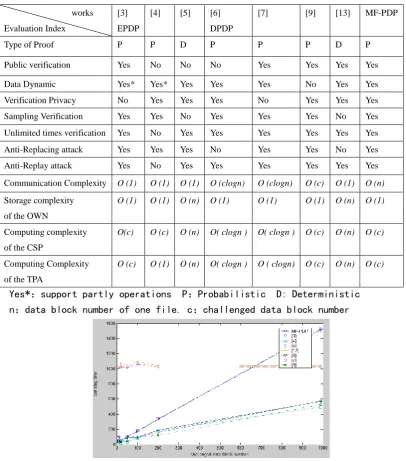
Table 3 show the comparison result between the MF-PDP and other PDP schemes. In functions support side, the MF-PDP is better. In the performance, the MF-PDP has some advantage in storage complexity of the OWN and computing complexity of the CSP. The MF-PDP has some disadvantage in communication complexity because it has download the random sequence R and the response digital signature HR in each verification or data update stage. However, we can use some method to relieve, such as the data cache scheme that means the once the random sequence R and digital signature HR is download, then the verifier only need to download the HR.. If the current download HR is same to the previous saved one, the verifier will not need to download the R, thus the communication cost will be decrease much.
Figure 3. The challenged data block number and the TPA computing cost works
Evaluation Index
[3] EPDP
[4] [5] [6] DPDP
[7] [9] [13] MF-PDP
Type of Proof P P D P P P D P
Public verification Yes No No No Yes Yes Yes Yes
Data Dynamic Yes* Yes* Yes Yes Yes No Yes Yes
Verification Privacy No Yes Yes Yes No Yes Yes Yes Sampling Verification Yes Yes No Yes Yes Yes No Yes Unlimited times verification Yes No Yes Yes Yes Yes Yes Yes Anti-Replacing attack Yes Yes Yes No Yes Yes No Yes Anti-Replay attack Yes No Yes Yes Yes Yes Yes Yes Communication Complexity O (1) O (1) O (1) O (clogn) O (clogn) O (c) O (1) O (n)
Storage complexity of the OWN
O (1) O (1) O (n) O (1) O (1) O (1) O (n) O (1)
Computing complexity of the CSP
O(c) O (c) O (n) O( clogn ) O( clogn ) O (c) O (n) O (c)
Computing Complexity of the TPA
O (c) O (1) O (n) O( clogn ) O ( clogn) O (c) O (n) O (c) Table.5. Comparison of different works
Yes*:support partly operations P:Probabilistic D: Deterministic
Figure 4. The challenged data block number and the CSP computing cost
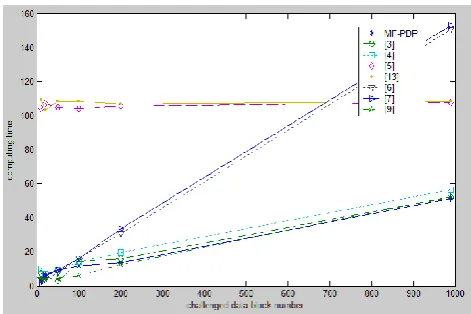
Figure 3 and Figure 4 are the emulated results. It show the computing cost is consistent to the analysis result of table 2.The emulated result also suggest that the propose PDP is low complex and more effective than most of works.
7 Conclusion
For the data security in untrusted cloud, the PDP has been a tool to check data integrity. However, in cloud environment, most of the current works have limitation in performance or security. Based on current works and some new ideas, we designed a multi-function PDP scheme, which can meet different requirements of cloud computing environment. The further work is to study the relation among different functions and the multi-copy support where the data copy may store in different places.
Reference
[1]Hyun-A Park,Jae Hyun Park and Dong Hoon Lee. PKIS: practical keyword index search on cloud datacenter.
EURASIP Journal on Wireless Communications and Networking 2011.2011:64.pp.1-16.
[2]Mithun Paul and Ashutosh Saxena Proof Of Erasability For Ensuring Comprehensive Data Deletion In Cloud Computing Recent Trends in Network Security and Applications Communications in Computer and Information Science, Springer, V.89, 2010, pp.340-348
[3]G. Ateniese, R. Burns, R. Curtmola, J. Herring, L. Kissner, Z. Pe-terson, and D. Song, Provable data possession at untrusted stores .In Proceedings of the 14th ACM conference on Computer and communications security , New York, USA, 2007,pp.598–609
[4]G.Ateniese, R.D. Pietro, L.V. Mancini, and G. Tsudik, Scalable and Efficient Provable Data Possession. In Proceedings of the Fourth Int’l Conf. Security and Privacy in Comm. Networks .SecureComm’08, New York: ACM, 2008,pp.1-10.
[5]Sebé F, Domingo J F, Martinez A B, et.al. Efficient remote data possession checking in critical information infrastructures. IEEE Trans on Knowledge and Data Engineering, 2007,20(8):1034-1038
[6] C. Erway, A. Kupcu, C. Papamanthou, and R. Tamassia, Dynamic provable data possession.In Proceedings of the 16th ACM conference on Computer and communications security , New York, USA, 2009, pp.213–222 [7] Q. Wang, C. Wang, J. Li, et al. Enabling public verifiability and data dynamics for storage security in cloud
computing. LNCS 5789: Proceedings of 14th European Symposium on Research in Computer Security , Berlin:Springer, September 2009,pp.355–370
[9] C.Wang, Q. Wang, K. Ren ,et al, Privacy-preserving public auditing for data storage security in cloud computing, In Proc of INFOCOM 2010.Piscataway,NJ:IEEE, March 2010,pp.1-9
[10] C.XU , HE Xiao-hu, Daniel Abraha.Cryptanalysis of auditing protocol proposed by Wang et al. for data storage security in Cloud Computing.2012, http://eprint.iacr.org/2012/115.pdf
[11]C. Wang, S. S.-M. Chow, Q. Wang, et.al , Privacy-preserving public auditing for secure cloud storage. Cryptology ePrint Archive, Report 2009/579, 2009. http://eprint.iacr.org/2009/579.pdf
[12]Y. Zhu, H. Wang, Z. Hu,et.al. Efficient Provable Data Possession for Hybrid Clouds. Cryptology ePrint Archive, Report 2010/234. http://eprint.iacr.org/2010/234.pdf
[13]Zhuo Hao, Sheng Zhong, Nenghai Yu.A Privacy-Preserving Remote Data Integrity Checking Protocol with Data Dynamics and Public Verifiability. IEEE TRANSAC TIONS ON KNOWLEDGE AND DATA ENGIN EERING, SEPTEMBER 2011, 23(9):1432-1437.
[14]P.Syam Kumar, R. Subramanian RSA-based dynamic public audit service for integrity verification of data storage in cloud computing using Sobol sequence Int. J. Cloud Computing, 2012,1(2/3): 167-200.
[15]Bo Chen, Reza Curtmola .Robust Dynamic Provable Data Possession.In Proceeding ICDCSW '12 Proceedings of the 2012 32nd International Conference on Distributed Computing Systems Workshops (ICDCSW '12). 2012.pp.515-525.
[16]M.Bellare and A.Palacio. The knowledge-of-exponent assumptions and 3-round zero-knowledge protocols.In CRYPTO 2004, LNCS 3152, Springer, 2004,pp.273–289.
[17]Oded.Goldreich.Foundations.of.Cryptography.Volume.2.Basic. Applications , New York: Cambridge University Press.2004.