I EG
WORLD BANK
I
IFC I MIGA
INDEPENDENT EVALIJATIOM GROUPFTS TIMOR-LESTE COLL. 338.959 87
Timor-Leste Country Program
Evaluation, 2000-2010
Evaluation of the World Bank Group Program
IEG
INDEPENDENT EVALUATION GROUP
Report No. _ _
FTS TIMOR- LESTE COLL. 338.95987 TIM
30001009719271
Timor-Leste country program evaluation, 2000-2010 :
evaluation of the world Bank Group program
©2011 The Independent Evaluation Group The World Bank Group
1818 H Street NW Washington DC 20433 Telephone: 202-458-4497
Internet: http://www.\vorldbank.org/ieg/ E-mail: [email protected]
All rights reserved
l 2 3 4 5 14 13 12 11
\
~ 1~'2.
RESOURCE CE
.
NTR!E
O
VFF\ p,1 ,I\. Jl"'".j.;.;111:.i r .... t\: •"-.d)":V ~~~?~1 I: - ~t\LU
'.\
132 lcicez
:
:~r
St
C
arlt
on Vic. 30
5
3
9
'S,9
.'dlo
\ °t'\
b
~\
This volume, except for the "Government's Comments," the "Management Response" and "The Chairman's Summary," is a product of the staff of the Independent Evaluation Group (IEG) of the World Bank Group. The findings, interpretations, and conclusions expressed in this volume do not necessarily reflect the views of the Executive Directors of The World Bank or the governments they represent. This volume does not support any general infe-rences beyond the scope of the evaluation, including any infeinfe-rences about the World Bank Group's past, current, or prospective overall performance.
IEG does not guarantee the accuracy of the data included in this work. The boundaries, col-ors, denominations, and other information shown on any map in this work do not imply any judgment on the part of The World Bank Group or IEG concerning the legal status of any territory or the endorsement or acceptance of such boundaries.
Rights and Permissions
The material in this publication is copyrighted. IEG encourages dissemination of its work and permits this document to be copied or otherwise transmitted, with appropriate credit given to IEG as the authoring body.
How to cite this report:
IEG (Independent Evaluation Group). 2011. Timor-Leste Country Program Evaluation, 2000-2010. Washington, DC: Independent Evaluation Group, the World Bank Group.
Cover:
ISBN-13: 978-1-60244-182-8 ISBN-10: 1-60244-182-0
Printed on Recycled Paper
Independent Evaluation Group
Strategy, Communication, and Leaming (IEGCS) E-mail: [email protected]
Abbreviations and Acronyms
AAA Analytic and Advisory Activities MAFF Ministry of Agriculture, Forestry,
ADB Asian Development Bank and Fisheries
ANZ Australia and New Zealand MDG Millennium Development Goals
Banking Group Limited MDTF Multi-Donor Trust Fund
AusAID Australian Agency for MOH Ministry of Health
International Development Mo PF Ministry of Planning and Finance
BBi Better Business Initiative MSS Ministry of Social Solidarity
BDC Business Development Centers NDP National Development Plan
BPA Banking and Payments Authority NORAD Norwegian Agency for
CAS Country Assistance Strategy Development Cooperation
CEM Country Economic Memorandum NGO Non-government Organizations
CHC Community Health Center NYP National Youth Policy
CPE Country Program Evaluation PAD Project Appraisal Document
CSP Consolidation Support Program PCF Post-Conflict Fund
DGF Development Grant Facility PDO Program Development Objective
DPO Development Policy Operation PEDF Pacific Enterprise Development
EAP East Asia and Pacific Facility
EC European Commission PER Public Expenditure Review
EDTL Electricidade de Timor-Leste PFM Public Financial Management
EICB Economic Institutions Capacity PFMCB Public Financial Management
Building Project Capacity Building
EITI Extractive Industries PFMCBP Planning and Financial
Transparency Initiative Management Capacity Building
EMIS Education Management Project
Information System PIU Project Implementation Unit
ESW Economic and Sector Work PPAR Project Performance Audit Report
EU European Union PSD Private Sector Development
FIAS Foreign Investment Advisory PS PIP Power Sector Priority Investment
Services Project
FRETILIN Revolutionary Front for an PTAP Petroleum Technical Assistance
Independent Timor-Leste projects
GDP Gross Domestic Product QAG Quality Assurance Group
GNI Gross National Income SME Small and Medium Enterprises
GTZ Deutsche Gesellschaft fur SSYS State Secretariat for Youth and
Technische Zusammenarbeit Sports
IBRD International Bank for TA Technical Assistance
Reconstruction and Development TFET Trust Fund for East Timor
ICR Implementation Completion TSO Timor Sea Office
Report TSP Transitional Support Program
IDA International Development TSS Transitional Support Strategy
Association TSTD Timor Sea Tax Division
IDF Institutional Development Fund UN United Nations
IEG Independent Evaluation Group UNDP United Nations Development
IFC International Finance Corporation Program
IFU Investment Infrastructure Unit UNTAET UN Transitional Administration
IMF International Monetary Fund for East Timor
ISN Interim Strategy Note US AID United States Agency for
JAMR ,, Joint Assessment Mission Report International Development
FOREWORD
This Country Program Evaluation assesses the outcomes of the World Bank Group (WBG) program in Timor-Leste during the review period (2000 to 2010). The World Bank Group's strategy during this period was to support the Government of the nascent country in three broad areas: (a) poverty alleviation and the provision of basic social services, including health and education; (b) development of state institutions, including creating good gover-nance and building the capacity of state institutions; and (c) promoting sustainable non-petroleum growth, especially through the development of agriculture and the private sector. During the review period, the Bank was actively involved in the reconstruction and devel-opment of the economy, through 39 operations, financed through regular IDA (US$24.6 mil-lion) and IBRD grants (US$5 milmil-lion), in addition to numerous grants from the Trust Fund for East Timor and other donor trust funds (US$316.3 million in total). Over the same pe-riod, IFC had four advisory service (AS) activities.
While the WBG made some important contributions to Timor-Leste's development, the CPE rates the overall outcome of its support to the country over the review period as moderately unsatisfactory: The Bank Group strategy was broadly congruent with the country's own as-pirations, but its relevance and effectiveness waned through the evaluation period. From its initial focus on immediate reconstruction needs, the restoration of key social services and alleviation of basic deprivation, the strategy became diffuse and all-inclusive, to the detri-ment of the most critical areas, such as agriculture and capacity-building of state institu-tions, and failed to respond to critical social challenges arising from youth unemployment and rising poverty. The outcome of the Bank Group's support was mixed. The outcome of assistance to Timor-Leste in securing its petroleum revenues and managing them transpa-rently was highly satisfactory. The outcome of assistance in health and on veterans' issues was moderately satisfactory. The outcome of Bank Group support fell well short of objec-tives in the remaining areas, particularly so in promoting sustainable non-petroleum growth, notably through the development of agriculture and the private sector.
Contents
FOREWORD .................... I
PREFACE ... VII
TIMOR-LESTE: SUMMARY OF WORLD BANK GROUP PROGRAM OUTCOME RATINGS ................ IX
EVALUATION SUMMARY ...... : ... XIII
MANAGEMENT ACTION RECORD ........
xxv
CHAIRPERSON'S SUMMARY ....... XXIX 1. CONTEXT ................ 1
Recent History and Political Developments ... 1
Very Difficult Initial Conditions ... 2
Significant Progress Since 1999 ... 2
Poverty Increased between 2002 and 2007 ... 4
Current Economic Structure ... 4
Strong International Donor Presence ... 6
Road Map of the CPE ... 7
2. WORLD BANK GROUP STRATEGY AND PROGRAM ........ 9
World Bank Group Strategy ... 9
Strengths ... 12
Shortcomings ... 13
World Bank Program ... 15
Operations ... 15
Financial Support ... 16
The Transition Support Program (TSP) (2003-05) ... 19
Ways of Doing Business and Principles of Engagement ... 22
Program Quality ... 26
QAG's Quality Enhancement Review ... 27
3. PILLAR I. PROVISION OF BASIC SOCIAL SERVICES, SOCIAL PROTECTION AND ALLEVIATION OF POVERTY AND UNEMPLOYMENT ... 29
The Health Sector ... 29
The Setting ... 29
The Bank's Program ... 29
Outcomes in the Health Sector ... 33
The Education Sector ... 34
Evaluation Managers •!• Vinod Thomas
Director-General, Evaluation •!• Cheryl W. Gray
Director, IEGPS •!• Ali Mahmoud Khadr
Senior Manager, IEGCC •!• Stoyan Tenev
Chief Evaluation Officer, IEGPR
The Setting ... 34
The Bank's Program ... 34
Outcomes in the Education Sector ... 38
Poverty and Unemployment Alleviation ... 39
The Setting ... 39
The Bank's Program ... 39
Outcomes in Poverty and Unemployment Alleviation ... 42
Youth Unemployment and Disaffection ... 43
The Setting and the Bank's Strategy ... 43
The Bank's Program for Youth Issues ... 44
Outcomes on Alleviation of Youth Unemployment and Disaffection ... 45
Veterans' Programs ... 45
The Setting ... 45
The Bank's Program ... 45
Outcomes on Veterans' Policy ... 46
4. PILLAR 11. GOVERNANCE AND DEVELOPMENT OF STATE INSTITUTIONS. 47 Capacity of the State ... 47
The Setting ... 47
The Bank's Program ... 48
Outcomes for State Capacity-Building ... 57
Fiscal and Public Financial Management Systems ... 58
The Setting ... 58
The Bank's Program ... 58
Outcomes for Fiscal and Public Financial Management Systems ... 63
Basic Legislative Framework ... 64
The Setting ... 64
The Bank's Program ... 65
Outcomes for Legislative Framework ... 68
5. PILLAR Ill. SUSTAINABLE AND DIVERSIFIED NON-PETROLEUM SECTOR FOR JOB CREATION AND ECONOMIC GROWTH ... 71
The Setting ... 71
Private Sector Development ... 72
WBG's Strategy and Objectives for Private Sector Development.. ... 72
The Bank's Program ... 74
IFC in Timor-Leste ... 78
Outcomes: Some Progress, But No Headway in Critical Areas ... 79
Agriculture ... 82
The Setting ... 82
Bank Strategy and Objectives in the Agriculture Sector ... 82
The Bank's Program ... 83
Outcomes: Little Progress in Increasing Agricultural Production and Yields, or in Diversification ... 88
Energy ... 90
Bank Strategy and Objectives in the Energy Sector ... 90
The Bank's Program ... 92
The Power Sector ... 94
Outcomes: Progress in Hydrocarbons, Few Achievements in Power ... 95
6. DONOR COORDINATION: ALIGNMENT AND HARMONIZATION ... 97
7. CONCLUSION ... 101
The Evolving Role of the World Bank Group in Timor-Leste ... 101
Assessing the World Bank Group's Contribution ... 102
Relevance ... 102
Efficacy ... 103
Efficiency ... 104
Overall Assessment. ... 105
Findings and Recommendations ... 105
Key Findings of the WBG Evaluation ... 105
Sector Findings ... 105
The First Pillar -Provision of Basic Social Services, Social Protection and Alleviation of Poverty And Unemployment ... 105
The Second Pillar -Governance and Development of State Institutions ... 106
The Third Pillar -Sustainable and Diversified Non-Petroleum Sector for Job Creation and Economic Growth ... 108
Broad Program Findings ... 110
General Lessons ... 112
Recommendations ... 114
APPENDIX 1. GUIDE TO IEG'S COUNTRY PROGRAM EVALUATION METHODOLOGY ... 117
APPENDIX 2. THE PETROLEUM SECTOR ... 121
APPENDIX 3. TRUST FUNDS IN TIMOR-LESTE ... 124
APPENDIX 4. NOTE ON PUBLIC FINANCIAL MANAGEMENT CAPACITY BUILDING EFFORTS IN TIMOR-LESTE ... 136
APPENDIX 5. MONEY PATH - FROM BUDGET PREPARATION TO BUDGET EXECUTION ... 148
APPENDIX 6. TIMOR·LESTE ·LIST OF APPROVED PROJECTS, 2000-201011 .. 157
APPENDIX 7. TIMOR·LESTE ·ANALYTICAL AND ADVISORY WORK, FYOO-FY10 """." .... " ... """"""" ... " .... " ... " ... " .... " ... " ... " """"' "" ... 159
APPENDIX 8. LIST OF PEOPLE MET ... 162
ATTACHMENT 1: COMMENTS FROM GOVERNMENT ... 189
Boxes
Box 1. Languages in Timor-Leste ... 1Box 2. Macroeconomic Data in Timor-Leste ... 5
Box 3. Bank's Approach to Capacity Building for PFM ... 55
Box 4. Information on Trust Funds ... 98
Box 5. The Petroleum Fund ... 140
Tables
Table 1. Timor-Leste: Summary of Findings and Recommendations ... xxiiiTable 2. Timor-Leste Average Growth Rates ... 3
Table 3. Shrinking Role of Bank: Percentage Distribution of No. of Projects, Project Cost and IDA and TFET Funding During FY00-10 ... 17
Table 4. Relative Importance of Agriculture Projects ... 17
Table 5. Importance of the Three Pillars in New Lending Approvals, 2000-10 ... 18
Table 6. Budget Support Operations FY03-06 ... 19
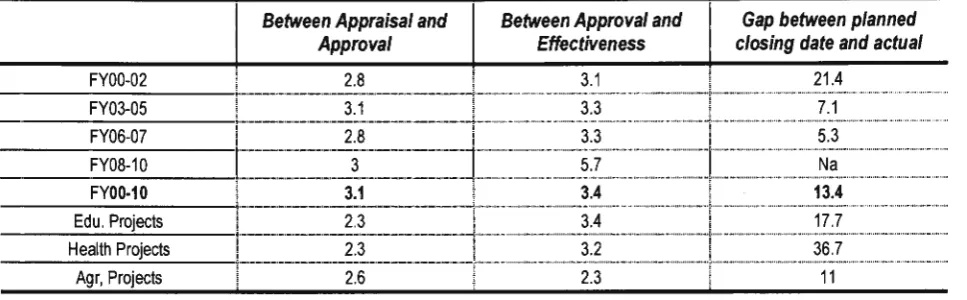
Table 7. Simplicity in Projects, 2000-10 ... 24
Table 8. Timor-Leste: Speed of Project Preparation and Implementation: ... 25
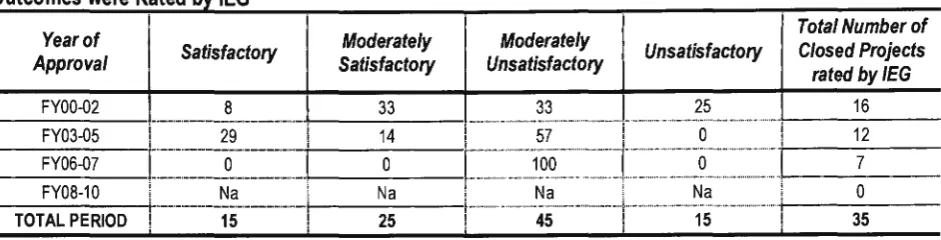
Table 9. Project Outcome Ratings for Closed Projects, as a Percentage of Closed Projects whose Outcomes were Rated by IEG ... 27
Table 10. Comparison of Project Outcome Ratings in Timor-Leste and Other Regions ... 27
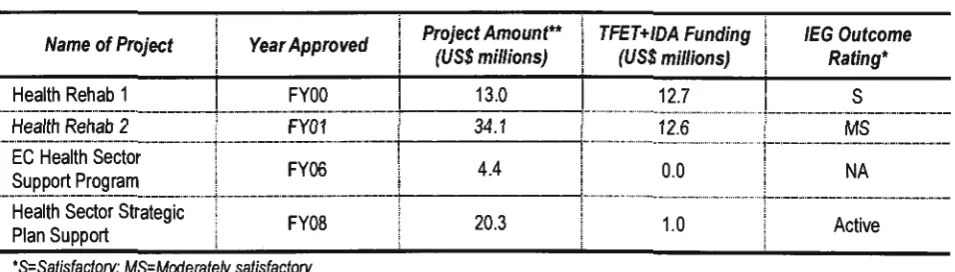
Table 11. Health Sector Projects FY00-10 ... 30
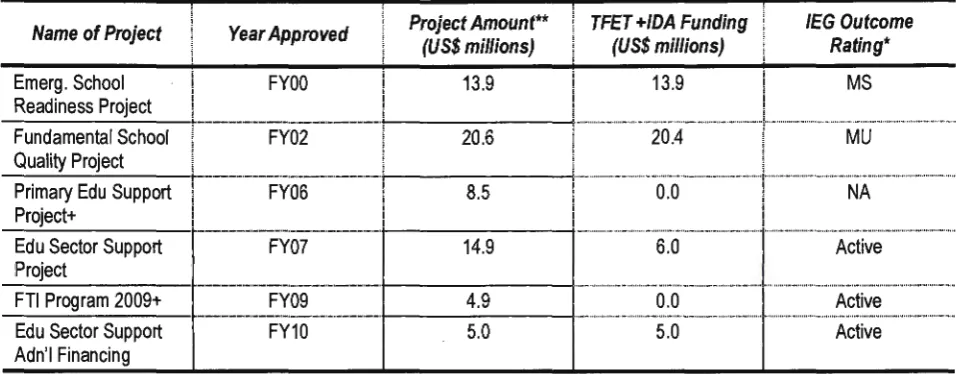
Table 12. Bank-Administered Projects in the Education Sector, 2000-10 ... 35
Table 13. Bank-Administered Programs and Projects for State Capacity Building, 2000-2010 ... 50
Table 15. Main Bank-Administered Projects for Legislative Framework, 2000-2010 .65
Table 16 Timor-Leste - Legislation Adopted with World Bank Group Support ... 68
Table 17. Bank-Administered Projects in Support of PSD, 2000-10 ... 74
Table 18. IFC Advisory Services in Timor-Leste, FY06-10 ... 78
Table 19. Bank Administered Project in Support of Agriculture Sector, 2000-10 ... 84
Table 20. List of Bank Administered Projects in the Energy Sector, 2000-10 ... 92
Table 21: Investment Cost by Projects in Selected Sectors ... 136
Table 22: Bank Disbursement by Cost Category ... 137
Table 23: Comparison of Capacity Building Efforts ... 138
Table 24. Ratings by National Government Staff on Capacity/Skills Transfer of Bank Support ... 145
Figures
Figure 1. Food Crop Production (tons), 1999-2009 ... 89Preface
This Country Program Evaluation examines the World Bank Group's assistance strategy to Timor-Leste during the period FYOO-FY10. It analyzes the objectives and content of the assis-tance program during this period, the outcomes in terms of economic and social develop-ment, and it notes the contributions of the World Bank Group to these outcomes. Appen-dix 1 describes the methodological framework.
The evaluation team visited Timor-Leste in June and August 2010, and met with past and present senior officials of the Government of Timor-Leste, representatives of the private sec-tor, civil society and external development partners, as well as staff from the World Bank Group. The June mission overlapped with the visit to the country of a team of the Asian Development Bank's Independent Evaluation Department. During that period the two mis~ sions shared some meetings with government officials and stakeholders, and met regularly to discuss information and findings. Prior to visiting Timor-Leste, the evaluation team met with most of the World Bank Group staff members that had worked or are working on the Timor-Leste country program. All cooperation and assistance received is appreciated with gratitude.
The CPE report is based on background papers covering the main areas of the World Bank Group's support to Timor-Leste, prepared on the basis of desk reviews and validated in the two evaluation missions as well as through interviews with World Bank Group staff. The background papers relied on reviews of project files, economic and sector reports, imple-mentation completion reports, project performance assessment reports, other IEG evalua-tions, available Quality Assurance Group assessments including ratings of quality at entry and supervision for Timor-Leste projects and economic and sector reports. A list of persons interviewed during report preparation, including those in Timor-Leste during the 2010 mis-sions, is provided in Appendix 8.
Comments from the Bank's Regional Management were received on March 24, along with the Regional response to the Management Action Record. These comments have, to the ex-tent possible, been addressed in the report. A draft of the evaluation was shared with the Government of Timor-Leste on April 11. The comments received from the Government, dated May 26, 2011, are reproduced verbatim as Attachment 1. A discussion of the report by the CODE Subcommittee was held on May 23, 2011, and a summary of the discussion is included.
The report was prepared by Chandra Pant, under the direction of Jaime Jaramillo-Vallejo (Task Manager), with background papers and other substantive inputs from Nils Fostvedt, David Gairdner, Gita Gopal, Maria Ines Agudelo, Min Joo Kang, and Allan G. Dizioli. Nils Fostvedt prepared the annex on Trust Funds. With support from NORAD and as self-standing papers, Gita Gopal and Allan G. Dizioli prepared the annex on Public Financial
PREFACE
Management Capacity Building Efforts, and Maria Ines Agudelo on Money Path-From Budget Preparation to Budget Execution. Roderick L. de Asis provided administrative sup-port, and Barbara Balaj provided editorial support.
This evaluation benefited from the comments from peer reviewers Jose Braz (external) and Nalini B. Kumar (internal). Prem Garg also provided comments. The report also benefited from comments received within IEG' s review process, especially from Daniela Gressani, Cheryl W. Gray, Hans Martin Boehmer, Ali M. Khadr, Mark Sundberg, Stoyan Tenev and Anis A. Dani.
Timor-Leste:
Summary of World Bank Group Program
Outcome Ratings
IEG's Country Program Evaluations assess and rate the outcomes (the "results") of a given
World Bank Group (WBG) countn; program relative to its objectives. This differs from rating the country outcomes of the Government of Timor-Leste or the WBG, as well as the performance
of either of these. The central question underlying the table that follows is" to what extent
did the WBG program achieve the outcomes that it set out to achieve?" Distinct ratings and
sub-ratings are typically assigned to each "pillar'' or set of strategic goals set out in the
rele-vant WBG strategy documents. In the case of the pillar on growth and job creation, the eval-uation gives greater weight to the areas of private sector development and agriculture, due to their high relevance for generating employment and reducing poverty. Appendix 1 of the
evaluation elaborates on IEG's rating methodology.
WBG STRATEGIC AND OPERATIONAL GOALS
i
ACHIEVEMENT OF RESULTSi
ASSOCIATED WITH WBG GOALSMAIN WBG INSTRUMENTS TO HELP RE SUL TS MATERIALIZE
PROVISION OF BASIC SOCIAL SERVICES, SOCIAL PROTECTION AND ALLEVIATION OF POVERTY AND UNEMPLOYMENT
WBGPROGRAM OUTCOME
RATINGS
Moderately Unsatisfactory WBG's objectives in the health sector
were to improve access to and quality of basic health services in the country.
;··
rv;-ar;y
··
i10aitti
-
centersiiliiiCri1oilife
-·-·---·
·-rtiewsG;s-i>rovlciecfsu-?iJart"·-·---·-·--i--·-·--r;;foaerateir-···
-·--,
l
clinics made operational, hospitals through four projects that sought tol
Satisfactoryi
rehabilitated and reconstructed. improve access and quality throughi
More immunizations and births su- reconstruction of primary health care!
pervised by health care profession- centers and hospitals, and adequateI
als led to declining infant mortality provision of essential medicali
rates. However, progress was less equipment and medicines. ThroughI
than expected. Moreover, strict en- i four development policy operations 1I
forcement of WBG rules delayedI
(DPOs), the WBG provided technical!
I
procurement of the equipment forI
assistance and training for enhanc-l
I four new hospitals for a full year.i
ing the capacity of the Ministry ofi
i
Health and health service providers.!
I , I
! Sector AAA was completed m FY07. !
> - - - ! ·---·-.. ·---·-·----···-·----·-·----··"··---·-··--··t·-·---·-·----·-·----·-·-·----·-·----·---·-·--·--·-·-·--j--·-·--·--·-.. ··--·--·-·---···-·--!
In the education sector, the primary Primary and secondary enrollment i The WBG's program provided sup- Moderately I objectives of the WBG's program were rates improved. However, little
i
port through six projects and four Unsatisfactoryi
to increase access to education at pri- progress was made in improving thei
DPOs. The projects aimed at thei
I I
mary and secondary levels and improve quality of education which remains
I
reconstruction, rehabilitation and the quality of education. poor. Progress on school infrastruc-i
refurbishment of schools, and theture and textbooks was held back by
!
production and distribution of text-the lack of adequate attention to text-the J books and other learning material complex language situation for effec-I
(which were for the most part in a tive teaching. A full cohort of thel
language foreign to many teachers, population may be functionally illite-I
pupils and parents). DPOsbut-1 rate.
i
tressed institutional capacity building!
!
in the Ministry of Education and!
!
educational institutions. An educa-1 tion sector study was completed in! FY03. , ,
In the area of poverty and unemploy- "'siiort~term'](itis"'an<Ti'iicomecreated ___ '"init5Tiiltiai"interve"ntioiistti'e-w8(3"'""'" --·-··unsatisfactory'"'"-· ment alleviation, WBG objectives in- with targeted Bank projects in the provided grants (three operations
eluded providing a short-term social early years did well but, as ex- related to the second Pillar and five safety net through labor-intensive jobs pected, were not sustainable. In operations related to the third Pillar) (urban and rural), and having a sus- subsequent years, the WBG did to facilitate economic activity in rural tainable and effective social safety net poorly with unemployment and so- and urban areas. Poverty and
un-.__fo_r t_h_e_m_o_st_v_u_ln_er_a_bl_e. _ _ _ _ _ ~ ... ~J~!~.5.-~~!~!!.c_~.f9!_~~ .. 1!1~5-t_~~!.'!~t~:___ -~!.'Ie!~¥!.'I~~!J~~-~~-~~!!!_9.!~Q .. '!~~-~~-·---·-·---·-
SUMMARY OF WORLD BANK PROGRAM OUTCOME RATINGS
WBG STRATEGIC AND OPERATIONAL GOALS
i
!
ACHIEVEMENT OF RESULTS!
ASSOCIATED WITH WBG GOALSi
!
ble. Poverty and unemployment rosel
significantly through most of theI
evaluation period and declined onlyi
after 2007, when the government,I
against Bank advice, increased its! spending using petroleum resources
l
including in the form of cashtrans-!
fers.i
T
o
"
acfdress youih
u"nemployment andI
There is no evidence that youthi
disaffection, the WBG goals included!
empowerment has increased ori
temporary employment creation, partic-i
youth disaffection has lessened.!
ularly in rural areas and engagement of!
Youth issues were a major factorl
alienated youth in productive communi-I
behind the 2006 civil strife.i
ty-based activities :i·
vii8G
j
s
'
obfective
'
io
-
r
"
veteran
'
swas
"
i()
"' .
.
i
By the end of 2005, more than 75 i provide technical assistance and sup-i
thousand veterans or their survivors!
port to enable the Government of Ti-i
had been registered. A Veterans!
mor-Leste to alleviate the veterans'I
Law was adopted by Parliament ini
concerns about recognition, apprecia-l
March 2006, providing the legal!
tion and assistance.i
basis for the recognition of veterans;
i
and their assistance. A Veterans'i
pension system was established andI
the first pension payments to 12i
thousand beneficiaries were made inMAIN WBG INSTRUMENTS TO HELP RESULTS MATERIALIZE
in DPOs, but these interventions were at the policy level. The WBG did two poverty assessments (FY03 and FY09).
The Bank came late to a realization that youth unemployment was an issue and contribution to address youth issues has been modest. Two studies (FY08) helped inform the governmenf s policy responses to the youth challenges and a project targeted to the youth, which was approved in FY09 but has barely disbursed.
Veterans' issues were addressed in the Transitional Support Program (2003-05) and first steps were in
-itiated. With Timorese government leadership, the 2006 Veterans Law was drafted and a veterans' data base was created to determine and administer benefits. In FY05 TA was provided on veterans' policy and its implementation. WBGPROGRAM OUTCOME RATINGS Unsatisfactory Moderately Satisfactory
~
---·--·
--
~
i
_Ju~ly_2_0_08_.~~~~~~~~~~~~~~~~~~~~~~~~~
!
GOVERNANCE AND DEVELOPMENT OF STATE INSTITUTIONSu!~~i:~~~~ry
, ... ., ... -... ~ ... ~---~---,__
_____
__.!
WBG's objective was the reconstitution!
Institutional capacity is uneven Initial WBG efforts aimed at improv- Moderatelyi
of the capacity of the state, including j across ministries, and remains weak ing local governance through three Unsatisfactoryi
establishing and re-enforcing key eco-I
in many of them. Overall, the human projects. Health and educationi
nomic ministries, procurement and!
skills base is still very low and the projects also bolstered capacity ini
audit agencies, customs, revenue!
government remains dependent on the line ministries. A more frontali
agency, and developing and streng-!
foreign advisers even for routine line WBG effort came through an FY01!
thening the state's capacity for policy,i
functions. Capacity building initia- capacity-building project, which wasj planning and service delivery.
I
tives have not generally worked supported by four DPOs. Later, a!
because of absence of strategy and major capacity-building projectbe-1 of a needs-based assessment, in came effective in FY06 and is still in
i
addition to barriers such as Ian- place..
l
ua e.1·
'
improve(ftisc
-
ai
.
an
-
cf i>ul>Tic
-
tinanciai'· -
·,_I -=-Fi,...sca_.._,_1 -po-:-:li-cy-,i-n-ge_n_e-ra..,...1-an-d~e-x-pe-n"""d,,-i--+-T=h,...e-..,.w~BG~p-ro-vi-de_d_s_u_p_po_rt_, -as _ _ _,_ __ M_o-de-r-at_e_ly _ _,i
management, including revenues fromI
ture policy in particular are now noted above, through four DPOs, Unsatisfactory!
petroleum, was an important part of thei
planned and with increasing focus AAA, and the capacity buildingi
WBG's institution-building agenda.!
on public service delivery. Better projects for the Ministry of FinanceI
budget execution was achieved with and the Petroleum Fund. Limited!
a significant number of foreign advi- assistance was provided by theI
sors. Procurement system devel- WBG to parliamentarians, focusingi
oped with the Bank's help is not on the Petroleum Fund, but not oni
delivering on expectations and is budget oversight.i
now being reformed and in need of a!
comprehensive refurbishing. Thei
Petroleum Fund is an effective andWBG STRATEGIC AND OPERATIONAL GOALS
SUMMARY OF WORLD BANK PROGRAM OUTCOME RATINGS
ACHIEVEMENT OF RESULTS ASSOCIATED WITH WBG GOALS
!
savings rule does not factor in Ti-!
mor-Leste's significant deficit ofl human and physical cap
ital. While!
Parliament's oversight is now in!
place, its role in checks andbal-i
ances is limited due to capacity con-i
straints. The system of checks andI
balances is further weakened by the!
non-inclusion of donor-financed ,MAIN WBG INSTRUMENTS TO HELP RE SUL TS MATERIALIZE
!
projects, including the Bank, in the!
.
WBGPROGRAM OUTCOME
RATINGS
:---·
+L.
9_~~~~1
.
!
_
~~
-
~9
-
~~
----·----·-·----
-
-·
-
---
-
-·
-
·-
-
J.-·----
-
·
-
----·-
·
---
-
·-·-·---
·
----·---·-·---·-·-·-J
____ , _____ ,_,,_, __ , __ ,_, ________j
Legislation. Adoption of laws to im-I
New institutions for governance j The WBG provided support, asI
Unsatisfactoryi
prove governance and creation of insti-I
have been created and many laws : noted above, through four DPOs and ·tutions to strengthen governance and
!
have been adopted. However, theiri
AAA. accountability were also part of theI
functioning remains constrained byWBG's governance objectives.
i
shortages of trained and qualifiedi
staff, and the new laws' weak con-!
gruence with Timor-Leste's legal!
system and its reality. New institu-1 tions (the Ombudsman and the
In-!
spector General) have been mostly!
ineffective. No significant effort!
seems to have been made to adapti
the new legislation to the civilser-!
vice capacity that was actually oni
the ground. Issuing the implement-!
ing regulations and working on the!
consistency of the new laws are ; ; ;I tasks where further work is needed. !
I
i
i - - - -'-·---·-.. ·---·-·----···-·----··-·----·-··-·---·-··---···-·---·-·----·-·----·-·-·----·-·----·---·-·---·-·-·--i--·-·---·-····--·--·-·---···-·--·j
SUSTAINABLE AND DIVERSIFIED NON-PETROLEUM SECTOR FOR JOB CREATION AND ECONOMIC ! U t' f
!
GROWTH l nsa 1s actory l
The WBG's objective under this pillar was to create a vibrant private sector that would generate sustainable non
-petroleum sector economic growth and productive jobs. Aside from the right legal environment, the objective in-cluded stimulating local investment through improved access to credit and infrastructure. This objective included increasing the efficiency and coverage of the power supply.
' '
r·
"No-si9iliffcantTmi>roveme-nfln
-
-
rion=-
--
·-
ttiewscfiiairiWo
-
siTiaijenterprise
-·-·T
-
·-·-
0;;5
-
at
f
stactoiY-
-
·
-1
!
oil foreign or domestic private in- projects until FY02. Subsequent!
·
l
vestment. Infrastructure and finance, WBG support was largely centeredl
!
key binding constraints on private on the adoption of laws and the!
i
sector growth, remain to be ad- establishment of institutions to facili-i
i
dressed properly, including by the tate private sector activity, withsup-i
WBG. Limited progress in improving ! port through the three DPOs. IFCi
regulatory framework for PSD, whichI
focused mostly on advisory services!
is too complex and has yet to regu-!
including a hotel e-booking system,! late contract enforcement and use of ! public-private dialogue, and
busi-i
collaterals in loans.i
ness registration and licensingI I
- - - ;!. ! reform. . .
,-"N0Tii-c-reas0-1n-ro.ocf?rcicilictian·o-r-·----·rttiew-sG"·ii-ro-mo-te-ciitifsa9eiicfa·--·-·-·-r·-·-u;;-s-atfstactoiY-·--1
In the agriculture sector, the WBG's objectives were to increase agricultural production and productivity, improve food security, enhance business-oriented production of agriculture prod-ucts, and promote sustainable resource management in forestry and fisheries.
I
agricultural productivity for most ofI
through three agricultural rehabilita-I
!
j the evaluation period. Food insecur-
i
tion projects approved during 2000- j iJ ity remains a serious concern. Very J 04, as well as DPOs during 2003-06. !
!
limited business-oriented productioni
l
of agriculture products; the sectorl
I
dominated by subsistence farming, !I
and production hampered by poori
I I
I
roads and high transportation costs !!
to markets. Some improvements in '!
developing sector policy, but low!
WBG involvement. Rehabilitated! , . . _ _ _ _ _ _ _ _ _ _ _ _ ____,i __ l~~9~!!Q.~-°-~!l..!:.~§!-~~~J.~Q.J~~!.~~~!._o..f_.l,_, _____
,
__
_______
_
_
__
.
_
__
_
_
_
_
_
__
_____________
_.! ___________________ , ____ ,,_, __ jSUMMARY OF WORLD BANK PROGRAM OUTCOME RATINGS
WBG STRATEGIC AND OPERATIONAL GOALS
i
i
ACHIEVEMENT OF RESULTSI
ASSOCIATED WITH WBG GOALS i!
rice-production land.MAIN WBG INSTRUMENTS TO HELP RESULTS MATERIALIZE
WBGPROGRAM OUTCOME
RATINGS
~---·~· ~~~~~~~~~~~~~~~~~~~~~~~~~~~~~~~~
I In the Hydrocarbon Sector, the WBG's I A petroleum regime that is interna- The WBG had two projects which Highly
I
objective was to bring transparency andI
tionally competitive in its terms and aimed to provide technical assis- SatisfactoryI
probity in managing petroleum reve-I
in line with international best practice tance in this sector. PTAP I providedI
nues, in order to effectively manage oil!
was established. In many respects, support to the Government ofTimar-!
and gas revenues and sav1ings to bene-!
the regime has set new standards Leste on negotiations withneighbor-!
fit present and future generations.I
for developing countries in regard to ing countries and oil companies ini
i
transparency and accountability in the petroleum sector. PTAP II con-1 the management of petroleum reve- tributed to the oversight of thepetro-l
nues. It has limited the scope for leum sector in the areas of invest-'!
arbitrary use of revenues, even if the ment and project development,I
savings rule is not adapted to Timor- sector policy and administration, andI
leste's circumstances. Evidence of revenue col.lection and manage-, 1i this achievement is the recent decla- ment.I
!
i
ration of Timor-Leste as EITIcom-;
i
patible, only the third membercoun-l
--- ---
-
~!
_try~~_r_e_ac_h_t_hi_s_st_aage_·~~~~~~~~~~~~~~~~~~~~~~~~~
l In the Power Sector, the WBG
's objec-l
lack of access to reliable power The Bank's interventions include one ModeratelyI
tives included improved efficiency of!
supply is still a bottleneck for private completed project addressing Dili's UnsatisfactoryI
power supply and collection efficiencyI
sector development and there is power supply and two ongoing,I
in national capital to allow greaterI
limited evidence of a strong policy which have been troubled by cost!
spending on district power services;i
impetus for this sector. overruns and delays. The projectsI
and enhanced availability of reliable,!
aimed to improve the generation!
affordable power in the districts to sup-I
capacity and distribution efficiency!
port social and economic development. ! and to provide technical assistancei
i
and training to support projectim-1
I
plementation and strengthening ofL---~!~~~~~~~~~~~~~th_e_~_s_ti_tu_tio_n_a_l_ca~p_a_ci~ty-·~~~~~~~~~~~
i i
i
Overall AssistanceI
l'
i .............................. ~ ... ~ ... -... ..
Evaluation Summary
Timor-Leste Country Program Evaluation,
2000-2010
The Evolving Role of the WBG in Timor-Leste
From a new state under UN protection in 2000, entirely dependent on the international com-munity, Timor-Leste has transformed itself into a state that stands on its own and has pro-gressed considerably in developing its basic institutions and economy. The country is still chal-lenged by potential instability, limited institutional and human capacity, and limited economic opportunity, but now has the benefit of substantial petroleum resources. Timor-Leste's institu-tional layout appears better able than before to manage political competition and tensions, and the expectations of citizens have matured in recent years. The Timorese leadership brought the country out of civil unrest in 2006-07 and its aftermath, and has become increasingly assertive in defining its development vision and priorities.
The World Bank Group (WBG) strategy in Timor-Leste during 2000-10 was articulated in a se-ries of documents. The Joint Assessment Mission Report QAMR), produced in December 1999 by the Timorese in collaboration with the Bank and other donors, formed the basis of the
Bank's initial interventions. In November 2000, the Bank's Executive Board discussed a
Transi-tional Support Strategy (TSS), which covered the period until Timor-Leste became eligible to apply for membership of IBRD /IDA, expected to occur after full independence (May 2002). A first full CAS was prepared in June 2005, outlining the strategy for the period FY06-08. That strategy was derailed by the outbreak of civil strife in 2006-07, and a new Interim Strategy Note (ISN) that was discussed by the Bank's Board in August 2009 defined the strategy of the WBG for the period FYl 0-11. Throughout these strategy documents, the WBG planned to support Timor-Leste in three broad areas: (a~ poverty alleviation and the provision of basic social servic-es, including health and education; (b) development of state institutions, including creating good governance and building the capacity of state institutions; and ( c) promoting sustainable non-petroleum growth, especially through the development of agriculture and the private sector.
The relevance of the WBG strategy waned through the evaluation period, despite being broadly congruent with the country's own aspirations. During the first three years, the WBG strategy was relevant, focusing on immediate reconstruction needs, the restoration of key social services and alleviation of basic deprivation. At that time the Bank was the trustee and co-manager of the Trust Fund for East Timor (TFET), which brought together resources from different donors and funded investments through grants. As years went by, this immediate focus dissipated. The strategy became more diffuse and all-inclusive, covering a very broad front to the detriment of
EVALUATION SUMMARY
the most critical areas such as agriculture and capacity-building of state institutions. WBG sup-port increasingly took the form of development policy operations and extensive analytical and advisory services. The WBG failed to respond to critical social challenges arising from youth un-employment and rising poverty, as the initial emphasis on delivering early tangible benefits to the population lost momentum.
The efficacy of the program varied over time and by sector. The Bank performed relatively well in the early reconstruction period, when conditions were most challenging. As a result, access to basic health and education services improved and dire human deprivation was mitigated. The-reafter, measured against the objectives set by the WBG for itself, the results of its interventions with respect to long-term development challenges became much more uneven. Overall, mod-erately satisfactory outcomes in health and veterans' issues and highly satisfactory outcomes in the petroleum sector were offset by weak outcomes in other areas covered by the WBG pro-gram. Despite the priority accorded throughout the succession of WBG strategy documents to agriculture, private sector development and employment generation, very little was achieved af-ter the initial period of reconstruction and stabilization. Progress in improving governance and building state institutions, another priority area for the WBG, was good in some respects, but in others opportunities for greater impact were missed. Overall, the outcome of the WBG's pro-gram was Moderate/y Unsatisfactory when rated against the goals that it set for itself.
Country Context
In 1999, after some 24 years of armed conflict against the Indonesian occupation and a referen-dum for independence, Timor-Leste was beset by
unprecedented violence and destruction. Under
the mandate of the UN Security Council, peace and security were restored and the country was
governed directly by the UN, until in 2001-02 free
elections led to the establishment of a representa-tive government. The country became indepen-dent in May 2002.
Since then Timor-Leste has made much progress in building the institutions of the
state and restoring basic services to the people.
The architecture and institutions of government foreseen in the Constitution have been established and are functioning, albeit at varying levels of
ef-fectiveness. The government is managing a
signifi-cantly bigger budget and providing basic social services to an increasing share of its citizens. Oth-er institutions outside of the executive branch-such as the Parliament and the Judiciary-have also been established, and civil society is also more empowered and engaged.
The violence following the 1999 referendum was devastating for the people and the
econ-omy of Timor-Leste. ~fore than a thousand
people died, hundreds of thousands were dis-placed and the country's infrastructure was
de-stroyed. The agriculture sector suffered a major
blow with the destruction of livestock and
machi-nery.. The modern sector was most affected by
the destruction of vital physical infrastructure, as
well as the exodus of the non-Timorese popula-tion that had provided much of the public
admin-istration and technical expertise. Basic social
ser-vices were hit hard. There was a total breakdown in the health care system and the education system also ground to a halt. Valuable records and files, including land and property titles and the civil
re-gistry were destroyed. There were no government
institutions left. The economy was devastated, and real GDP fell by 33 percent from already low le-vels.
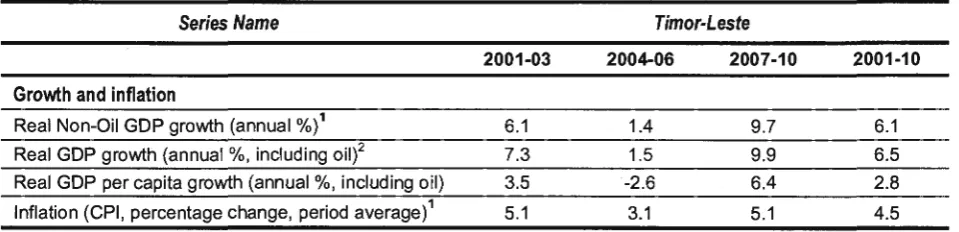
Since the difficult beginning, the economy has gone through several periods of vigorous eco-nomic growth, although with significant annual variations. Under the impetus of the reconstruc-tion activities initiated with the support of donors following the restoration of peace and stability, economic activity picked up considerably in 2000-01. The sharp draw-down of international pres-ence following the withdrawal of UN peacekeep-ing operations after independence in 2002 and the
civil unrest of 2006-7 led to a slowdown of eco
coalition government took office in August 2007, which took urgent steps to address the grievances of disaffected soldiers, unemployed and poor, and other sections of society.
The improved security environment, the recovery of the agriculture sector from drought in 2007, and significantly increased levels of public spend-ing (includspend-ing capital expenditures) resulted in strong economic growth, averaging around 9 per-cent annually between 2007 and 2010. However, unemployment remains high, especially among the youth. The country continues to face a serious shortage of qualified and trained professionals in most spheres. Institutional capacity is still very weak in many areas of government and outside, contributing to inefficiencies and leakages in gov-ernment programs.
The international community has had a sig-nificant presence since 1999, when the UN moved quickly to restore peace and security and prepare the foundations for independence in 2002. Apart from purely humanitarian aspects, development assistance supported reconstruction of damaged facilities including schools and hospit-als, rehabilitation of infrastructure such as roads and ports, restoration of electric power and water supply and sanitation, support for agriculture and the private sector, and, most importantly, develop-ing the capacity of state institutions at all levels.
Support has been provided in the form of fman-cial grants, technical assistance and analytical and policy advice. Since 1999, Timor-Leste has re-ceived about US$ 3.6 billion of foreign assistance from roughly 28 bilateral donors (most promi-nently Australia, Portugal, the European Union, Japan, and USA) and multilateral organizations
(UN agencies, WBG, Asian Development Bank and IMF.) Few other post-conflict countries have received higher levels of fmancial support on a per capita basis. Yet, poverty increased from 2001 to 2007-the period of the largest aid inflow-and almost half of the population was poor in 2007.
The role and influence of donors, including the WBG, has declined since 2007. Though the coun-try still requires substantial international technical support, increased hydrocarbon revenues make it less dependent on foreign fmancial assistance. The government shows growing frustration with what it sees as complex, heavy donor mechanisms. It also appears more skeptical about the advice re-ceived from the WBG and other donors. The
de-EVALUATION SUMMARY
clining influence of the traditional donors includ-ing the WBG is takinclud-ing place in the context of an apparent larger realignment of Timor-Leste's de-velopment policy and international alliances, with particular expansion towards countries in Asia and in the Lusophone community.
Program Overview
The First Pillar - Human Development
The stated objectives of the Bank's program in the health sector were to improve access to and quali-ty of basic health services in the country. Bank projects sought to improve access and quality through reconstruction of primary health care centers and hospitals, adequate provision of essen-tial medical equipment and medicines, and tech-nical assistance and training to enhance the capaci-ty of the Ministry of Health and health service providers.
Progress was made in improving the population's access to basic health services. A large number of health centers were built, mobile clinics were made operational, hospitals were rehabilitated and reconstructed and the supply of medical equip-ment and drugs was improved. Basic health ser-vices were restored. These interventions had a positive impact on the delivery of health care, de-spite delays in the equipment of hospitals caused by strict enforcement of Bank procurement rules. Immunization coverage for children 12-23 months rose; an increasing number of births were super-vised by health care professionals; and infant mor-tality rates fell. However, progress was slower than expected, child malnutrition worsened and the health of the population in many respects (life expectancy at birth, maternal mortality, malnutri-tion among children) still remains well below the average in the region and is closer to the average for low-income countries.
In the education sector, the primary objectives of the Bank's program were to increase access to education at primary and secondary levels and improve the quality of education. The Bank's pro-gram included the reconstruction, rehabilitation and refurbishment of schools, the production and distribution of textbooks and other learning ma-terial and institutional capacity building in the Ministry of Education and educational institu-tions.
These interventions succeeded in bringing child-ren back to school quickly and contributed to an
EVALUATION SUMMARY
overall improvement in enrollment rates at the primary and secondary levels, though progress was much slower than expected after the initial years. As late as 2007, 40 percent of population aged 6
~nd above had never attended school. Also, very little was achieved in improving the quality of education which remains poor. Moreover, the im-plications of the complex language situation for effective teaching were not given adequate atten-tion by the Bank, so that learning materials were for ~e most part unintelligible to many teachers, pupils and parents.
Poverty and unemployment alleviation were
also important objectives of the Bank under the first pillar. In its initial interventions the Bank provided grants and loans to facilitate economic activity in rural and urban areas. These interven-tions succeeded in providing much needed cash among the poor in remote areas and, to some ex-tent, in creating short-term jobs and employment, as was often the key intention. But many of these jobs were not sustainable and many of the new businesses did not survive the significant UN de-partures in 2002-03.
A major shortcoming of the WBG program was
its inability to help develop a significant and sus
-tainable program for alleviating unemployment, especially of the youth, which remains a potent threat to social and political stability. The Bank also missed an opportunity to have impact by not providing hands-on assistance in designing and implementing a program of social assistance in the aftermath of the 2006 civil strife. Through most of the evaluation period, poverty and unemployment rose significantly and the youth issues were not addressed.
The Bank played a useful role in supporting the government in developing and implementing a sensible policy to alleviate legitimate concerns of
veterans for recognition, appreciation and
assis-tance, although earlier results would have abated tensions. The Bank's program of policy advice and technical assistance helped establish the gov-ernment's policy as well as the institutional framework and the administrative systems to im-plement the policy.
Overall, the outcome of WBG support for the first pillar is rated Moderatefy Unsatisfactory.
The Second Pillar - Governance
Taken from the starting point of 1999, the state's
capacity to govern and deliver public goods has
increased significantly. The architecture and insti-tutions of government foreseen in the Constitu-tion have been established and are funcConstitu-tioning. The Government of Timor-Leste is managing a significantly expanded budget, driven by growth in petroleum revenues. :Ministries and agencies of the state are better able to plan and manage their ac-tivities and resources. On its side, the legislative branch of government has produced a significant body of legislation and is making efforts to carry out its oversight functions. A cadre of well-trained and knowledgeable Timorese is at the heart of these considerable developments.
Macroeconomic management was prudent throughout most of the period, although the fiscal stance was too tight until the civil unrest. This stance was consistent, however, with the saving rule of the Petroleum Fund, which did not take into account the sizable deficit of human and physical capital faced by Timor-Leste, nor the ur-gent need to provide social services and relieve deep poverty.
Timor-Leste, however, still faces major gover-nance challenges. Institutional capacity is uneven across ministries, and remains weak in many of them: There has been almost no strengthening at the district and local levels. The Judiciary remains a challenge. Overall, the human skills base is still very low and the government remains highly de-pendent on advisors, many of them foreign, with o~y limited success in transferring knowledge and skills between the advisors and national staff.
T~e ~ank had state capacity building as a key pnonty from the start. However, the contribution to capacity development has been limited, as noted in the WBG's Interim Strategy Note (ISN). For most of the evaluation period the Bank did °:ot have a clear needs assessment, a strategic vi-sion, or a realistic and monitorable strategy that
c~uld have ~ded its actions to bolster capacity in Tunor-Leste 1n a more effective way. Moreover
WBG
tech~cal
assistance has been hindered b;problems with the mentoring mode~ in addition to factors such as language and poor education. Timor-Leste has also made very significant progress in setting up a system of fiscal and
ma-croeconomic environment and the improved budget execution in recent years are evidence of this progress. The basic institutions for fiscal and public financial management have been set up and are functioning. Fiscal policy in general and ex-penditure policy in particular, are now planned and with increasing focus on public service deli-very. These policies are better grounded, using more reliable estimates of the macroeconomic aggregates and the needs of the population. The utilization of petroleum revenues is governed by a prudent and transparent framework widely re-garded as best practice. Institutions of the state outside of the executive, such as Parliament, are also in better condition to discharge their func-tions on the petroleum fund.
Nevertheless, use of the financial management systems needs to be spread evenly across all gov-ernment agencies and all levels of govgov-ernment, including the local. Parliament, the Judiciary and the other oversight institutions need to be streng-thened so that they can fulfill their function as checks and balances. The part of the budget that is financed with donor funds must be brought into the overall budget, and the investment budget must catch up with the current budget in execu-tion rates.
The Bank's efforts in this area were late to bear fruit, and have faced significant adaptation chal-lenges. Had the system of fiscal and financial management been in place when the flow of pe-troleum revenues started, the government would have been in a better position to tackle the unem-ployment and the deficiencies that helped brew the civil strife of 2006. Moreover, some of com-ponents of the system suggested by the Bank, e.g. procurement, turned out to be ill-adapted to Ti-mor-Leste. The successes with the Petroleum Fund and the recent project on public financial management need to be weighed against these shortcomings.
On the creation of a legal framework, Timor-Leste has also made very significant progress. It now has laws that govern taxation and customs, as and the exploitation and use of its petroleum wealth. It also has a public financial management law better adapted to its reality. Procurement legis-lation has taken several rounds, but also seems to be better adapted now. However, Timor~Leste still needs to harmonize the different the pieces of legislation stemming from separate legal traditions, so that they are congruent and adapted to the uses
EVALUATION SUMMARY
and mores of the country. An additional challenge is to develop the implementing regulations that are needed to bring these laws to life. Yet another one is to fill in the blanks that were left behind in the haste that seems to have dominated the legisla-tive process until now.
The WBG has supported the development of the legislative framework in a wide set of areas. Per-haps the coverage has been too wide for Timor-Leste's capacity constraints-too many draft laws for a new Parliament and for a few lawyers capa-ble of adjusting the drafts to the Timor-Leste's nascent legal system-which are even greater if the capacity to implement the new laws is factored in. While the urgency was pressing, the need for a structured and strategic vision was all the more relevant in light of the limited resources and ca-pacity. So were the need for a better understand-ing of the challenges of settunderstand-ing up a new legal sys-tem under a civil law tradition, and an
acknowledgement of the limitations faced by Ti-mor-Leste.
Overall, the outcome for WBG support for the second pillar is rated as Moderatefy Unsatisfactory.
The Third Pillar- Growth
The WBG's objective under this pillar was to create a vibrant private sector that would gener-ate sustainable economic growth and productive jobs. Timor-Leste's non-petroleum economy is dominated by the public sector, which contributed roughly 45 percent of non-petroleum GDP in
2007, the last year for which data on the sectoral composition of GDP is available, and private non-petroleum investment was estimated by the IMF at US$12 million in 2007, about 3 percent of non-petroleum GDP.
The private sector development agenda supported by the WBG was largely centered on the adoption of laws and the establishment of institutions to facilitate private sector activity. Left aside were the more pressing binding constraints posed by bad infrastructure and the difficulty of accessing credit. Much of its agenda was implemented through the development policy operations of 2003-06.
A number of laws meant to facilitate private
in-vestment were adopted during this period, includ-ing those on commercial entities, investment, in-surance, bankruptcy, cooperatives, and leasing of government property. A land law addressing pub-licly owned real estate was also passed in 2003.
EVALUATION SUMMARY
However, a clear sense of priorities or legislative
strategy has been missing. As was the case with
governance, congruence among the various sets of legal advice received by Timor-Leste is uncertain
and critical laws, such as on contract enforcement
and securitizing land for collateral, are still pend-ing. Moreover, while a lot of attention was paid to developing laws, less attention was paid to the more difficult issues of developing enabling regu-lations and enforcement, including the judicial system's ability to resolve disputes within the ex-isting legal framework.
At a different level, IFC helped create the Better
Business Initiative, a forum to improve the dialo-gue between the government and the private sec-tor. This forum was largely responsible for the recent creation of the Chamber of Commerce and Industry. IFC also helped develop an e-booking system to help international travelers and the tour-ism sector, and has made some efforts in easing microcredit using resources from another donor.
In total, there were four advisory services since
IFC launched its operations in 2006. No IFC
in-vestment was approved during this period.
Under a reasonable division of labor agreed at the start with ADB (but one that could have been revisited at some point), the WBG's program did not address two critical constraints to private sec-tor development: poor infrastructure (except for some relatively modest power projects) and lack of access to credit. Progress in both these areas has been quite limited, and they remain the key binding constraints on private sector develop-ment. Shortages of electricity and poor roads and other infrastructure are increasing private sector costs, while banks remain reluctant to lend in the absence of debtor discipline and a credible frame-work for contract enforcement. Overall, as noted
in the ISN (p15), "there has been a serious and
damaging failure to create conditions conducive to
the emergence of a vibrant private sector".
In the agriculture sector, the WBG's objectives were to promote sustainable resource manage-ment (in forestry and fisheries), increase agricul-tural production and productivity and improve
food security. This agenda was promoted through
a series of agricultural rehabilitation projects ap-proved during 2000-04 as well as the development policy programs approved during 2003-06.
As a result of the Bank's interventions, almost
4,000 hectares of land were rehabilitated in 46
community-based irrigation schemes, covering 2.4 percent of arable land. An extensive program of vaccination of livestock was undertaken through early Bank projects, which reduced mortality rates. In addition, a sector policy framework was devel-oped, as well as a forestry and watershed man-agement policy and strategy. A fisheries decree law
and supporting legislation were also approved.
However, the overall impact of Bank interven-tions on production and yields was limited be-cause other complementary inputs such as fertiliz-ers and high yielding seed varieties were not used. Many of the production activities supported by Bank projects in upland and coastal communities did not have a significant impact because they were hampered by poor roads and high transpor-tation costs to markets. The pilot agricultural ser-vice centers established by Bank projects to pro-vide services to farmers were not viable as farmers were unwilling (or unable) to pay for the services on offer.
Considering the entire period 2000-10, the
out-comes in the sector have been disappointing.
Af-ter the early recovery that followed the 1999 col-lapse, there was no generalized increase in production (but significant annual variations) of the three main food crops (maize, cassava and rice) between 2000 and 2008. However, there was a significant increase in the output of all three in 2009. Nevertheless, agricultural productivity has not increased and remains very low, both for food-crops and livestock. The sector is still domi-nated by subsistence farming, which suffers from poor quality of inputs (seeds, fertilizers, pesticides, irrigation) and lack of knowledge regarding new technologies and best practices.
Food security remains a serious concern, especial-ly in rural areas. Despite large imports of rice, the 2007 Survey of Llving Standards found that rural households did not have sufficient rice or maize to eat for about four months each year. As
acknowl-edged in the ISN (" ... support for this sector since
independence has not been adequate·to tackle
un-derlying factors."
The energy agenda of the WBG included the hy-drocarbon sector and power. Timor-Leste has made considerable progress in dealing with the petroleum wealth stemming from the find in the
Timar Sea. There is a negotiated treaty with Aus~
Evi-dence of the progress is the recent declaration of Timor-Leste as EITI compatible, only the third member country to reach this stage. The Bank gave significant support to Timor-Leste in its ne-gotiations with Australia, and in setting up the system of taxes and revenues. In collaboration with the IMF and NORAD, the Bank helped create the Petroleum Fund by helping gather wide
support for its approval. The negotiations and the system of taxes and revenues for hydrocarbons are the highlights of the Bank's program in Timor-Leste.
In the power sector Timor-Leste has made only modest overall progress, and lack of access to reli-able power is still a bottleneck for private sector development. In the early years, ADB was the lead agency. The Bank also engaged in the sector early on. Progress in the areas supported by the Bank, namely improving the availability and efficiency of the power supply and collections from users, has also been modest.
Overall, the outcome of 'W'BG support for the third pillar is rated as Unsatisfactory despite highly satisfactory rating for hydrocarbon.
Findings on the World Bank Group Program
On the positive side, the evaluation finds note-worthy the Bank's assistance to Timor-Leste in negotiating with Australia its rights in the hy-drocarbons find in the Timor Sea, as well as the establishment of a petroleum regime that is internationally competitive in its terms and in line with international best practice. In many respects, the regime has set new standards for developing countries in regard to transparency and accountability in the management of petro-leum revenues, and in limiting their arbitrary use. This example could be followed in other coun-tries, being mindful, however, of their deficits in human and physical capital when setting the sav-ings rule.
The evaluation also fmds several weaknesses in the design and implementation of the WBG's program in Timor-Leste that negatively affected outcomes. Grouped by areas, these are:
The program in Timor-Leste:
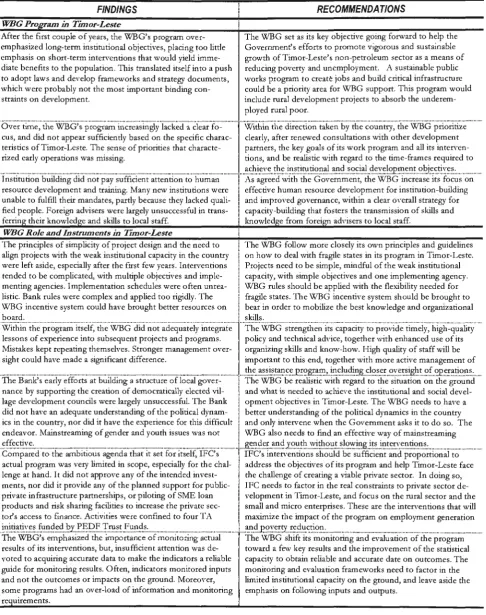
• After the first couple of years, the WBG's program over-emphasized long-term institutional objectives, placing too little emphasis on short-term interventions
EVALUATION SUMMARY
that would yield immediate benefits to the population. The disconnect between increasing poverty and unemployment during these years and the large volumes of foreign assistance (which focused mostly on long-term policy and institutional development) contributed to a perception in the country that external support did not serve the country's population-the heavy dependence on foreign advisers helped to reinforce this perception. The high emphasis on the long-term translated itself into a push to adopt laws and develop frameworks and strategy documents, particularly in the development policy operations. While laws and
frameworks are important, they were probably not the most important binding constraints on development at the time.
Instead, the emphasis could usefully have been on concrete actions that had a more direct and immediate link to the objectives of policy. For example, with respect to private sector development, instead of laws that have apparently made little difference, the focus could have been on concrete measures to improve electricity supply, roads, and access to credit.
• Over time, the WBG's program increasingly lacked a clear focus. The program also did not appear sufficiently based on the specific characteristics of Timor-Leste. The sense of priorities that characterized the Banles early operations was missing. In particular, agriculture did not receive the support it deserved, given its importance in the economy and the
preponderance of poverty in the rural areas. This lack of focus was evident in the
development policy operations, which sought to cover as broad a front as possible without a clear sense of priorities or apparent awareness of institutional capacity
constraints. Even within a given area, focus was lacking in some cases and the program was spread thin, as was the case with capacity building. It would have been preferable to focus on a couple of key areas such as strengthening of public financial
management (to improve budget execution, which was hampering delivery of basic services) and the key ministries involved with it.