Constants Count: Practical Improvements to Oblivious RAM
Ling Ren
MIT
Christopher Fletcher
MIT
Albert Kwon
MIT
Emil Stefanov
UC Berkeley
Elaine Shi
Cornell University
Marten van Dijk
UConn
Srinivas Devadas
MIT
Abstract
Oblivious RAM (ORAM) is a cryptographic primitive that hides memory access patterns as seen by untrusted storage. This paper proposes Ring ORAM, the most bandwidth-efficient ORAM scheme for the small client storage setting in both theory and practice. Ring ORAM is the first tree-based ORAM whose bandwidth is in-dependent of the ORAM bucket size, a property that unlocks multiple performance improvements. First, Ring ORAM’s overall bandwidth is 2.3× to 4×better than Path ORAM, the prior-art scheme for small client storage. Second, if memory can perform simple un-trusted computation, Ring ORAM achieves constant on-line bandwidth (∼60×improvement over Path ORAM for practical parameters). As a case study, we show Ring ORAM speeds up program completion time in a secure processor by 1.5×relative to Path ORAM. On the the-ory side, Ring ORAM features a tighter and significantly simpler analysis than Path ORAM.
1
Introduction
With cloud computing and storage gaining popularity, privacy of users’ sensitive data has become a large con-cern. It is well known, however, that encryption alone is not enough to ensure data privacy. Even after encryp-tion, a malicious server still learns a user’s access pattern, e.g., how frequently each piece of data is accessed, if the user scans, binary searches or randomly accesses her data at different stages. Prior works have shown that access patterns can reveal a lot of information about encrypted files [14] or private user data in computation outsourc-ing [32, 18].
Oblivious RAM (ORAM) is a cryptographic primi-tive thatcompletelyeliminates the information leakage in memory access traces. In an ORAM scheme, aclient
(e.g., a local machine) accesses data blocks residing on aserver, such that for any two logical access sequences
of the same length, the observable communications be-tween the client and the server are computationally in-distinguishable.
ORAMs are traditionally evaluated by bandwidth— the number of blocks that have to be transferred between the client and the server to access one block,client stor-age—the amount of trusted local memory required at the client side, andserver storage—the amount of untrusted memory required at the server side. All three metrics are measured as functions ofN, the total number of data blocks in the ORAM.
A factor that determines which ORAM scheme to use is whether the client has a large (GigaBytes or larger) or small (KiloBytes to MegaBytes) storage budget. An ex-ample of large client storage setting is remote oblivious file servers [30, 17, 24, 3]. In this setting, a user runs on a local desktop machine and can use its main memory or disk for client storage. Given this large client storage budget, the preferred ORAM scheme to date is the SSS construction [25], which has about 1·logN bandwidth and typically requires GigaBytes of client storage.
In the same file server application, however, if the user is instead on a mobile phone, the client storage will have to be small. A more dramatic example for small client storage is when the client is a remote secure processor — in which case client storage is restricted to the pro-cessor’s scarce on-chip memory. Partly for this reason, all secure processor proposals [18, 16, 8, 31, 22, 7, 5, 6] have adopted Path ORAM [27] which allows for small (typically KiloBytes of) client storage.
Server
Position map
Client
StashZ = 4
log N levels ~
Figure 1: Path ORAM server and client storage. Sup-pose theblackblock is mapped to the shaded path. In that case, the block may reside in any slot along the path or in the stash (client storage).
1.1
Path ORAM and Challenges
We now give a brief overview of Path ORAM (for more details, see [27]). Path ORAM follows the tree-based ORAM paradigm [23] where server storage is structured as a binary tree of roughly logN levels. Each node in the tree is a bucket that can hold up to a small num-ber Z of data blocks. Each path in the tree is defined as the sequence of buckets from the root of the tree to some leaf node. Each block is mapped to a random path, and must reside somewhere on that path. To access a block, the Path ORAM algorithm first looks up a posi-tion map, a table in client storage which tracks the path each block is currently mapped to, and then reads all the (∼ZlogN) blocks on that path into a client-side data structure called the stash. The requested block is then remapped to a new random path and the position map is updated accordingly. Lastly, the algorithm invokes an eviction procedure which writes the same path we just read from, percolating blocks down that path. (Other tree-based ORAMs use different eviction algorithms that are less effective than Path ORAM, and hence the worse performance.)
The bandwidth of Path ORAM is 2ZlogN because each access reads and writes a path in the tree. To prevent blocks from accumulating in client storage, the bucket sizeZ has to be at least 4 (experimentally veri-fied [27, 18]) or 5 (theoretically proven [26]).
We remind readers not to confuse the above read/write path operation with reading/writing data blocks. In ORAM, both reads and writes to a data block are served by the read path operation, which moves the requested block into client storage to be operated upon secretly. The sole purpose of the write path operation is to evict blocks from the stash and percolate blocks down the tree.
Despite being a huge improvement over prior
Online Bandwidth Overall Bandwidth Path ORAM ZlogN=4 logN 2ZlogN=8 logN
Ring ORAM ∼1·logN 3-3.5logN
Ring ORAM + XOR ∼1 2-2.5logN
Table 1: Our contributions.Overheads are relative to an in-secure system. Ranges in constants for Ring ORAM are due to different parameter settings. The bandwidth cost of tree ORAM recursion [23, 26] is small (<3%) and thus excluded. XOR refers to the XOR technique from [3].
schemes, Path ORAM is still plagued with several im-portant challenges. First, the constant factor 2Z ≥8 is substantial, and brings Path ORAM’s bandwidth over-head to>150×for practical parameterizations. In con-trast, the SSS construction does not have this bucket size parameter and can achieve close to 1·logNbandwidth. (This bucket-size-dependent bandwidth is exactly why Path ORAM is dismissed in the large client storage set-ting.)
Second, despite the importance of overall bandwidth, online bandwidth—which determines response time— is equally, if not more, important in practice. For Path ORAM, half of the overall bandwidth must be incurred online. Again in contrast, an earlier work [3] reduced the SSS ORAM’s online bandwidth to O(1) by grant-ing the server the ability to perform simple XOR compu-tations. Unfortunately, their techniques do not apply to Path ORAM.
1.2
Our Contributions
In this paper, we propose Ring ORAM to address both challenges simultaneously. Our key technical achieve-ment is to carefully re-design the tree-based ORAM such that the online bandwidth is O(1), and the amortized overall bandwidth is independent of the bucket size. We compare bandwidth overhead with Path ORAM in Ta-ble 1. The major contributions of Ring ORAM include:
• Small online bandwidth. We provide the first
tree-based ORAM scheme that achieves∼1 online bandwidth, relying only on very simple, untrusted computation logic on the server side. This repre-sents at least 60×improvement over Path ORAM for reasonable parameters.
• Bucket-size independent overall bandwidth.
While all known tree-based ORAMs incur an over-all bandwidth cost that depends on the bucket size, Ring ORAM eliminates this dependence, and im-proves overall bandwidth by 2.3×to 4×relative to Path ORAM.
• Simple and tight theoretical analysis.Using novel
algorithm, we obtain a much simpler and tighter theoretical analysis than that of Path ORAM. Of in-dependent interest, we note that the proof of Lemma 1 in [27], a crucial lemma for both Path ORAM and this paper, is incomplete (the lemma itself is cor-rect). We give a rigorous proof for that lemma in this paper.
As mentioned, one main application of small client storage ORAM is for the secure processor setting. We simulate Ring ORAM in the secure processor setting and confirm that the improvement in bandwidth over Path ORAM translates to a 1.5×speedup in program comple-tion time. Combined with all other known techniques, the average program slowdown from using an ORAM is 2.4×over a set of SPEC and database benchmarks.
Extension to larger client storage. Although our
ini-tial motivation was to design an optimized ORAM scheme under small client storage, as an interesting by-product, Ring ORAM can be easily extended to achieve competitive performance in the large client storage set-ting. This makes Ring ORAM a good candidate in obliv-ious cloud storage, because as a tree-based ORAM, Ring ORAM is easier to analyze, implement and de-amortize than hierarchical ORAMs like SSS [25]. Therefore, Ring ORAM is essentiallya united paradigm for ORAM con-structions in both large and small client storage settings.
Organization. In the rest of this introduction, we give
an overview of our techniques to improve ORAM’s on-line and overall bandwidth. Section 2 gives a formal se-curity definition for ORAM. Section 3 explains the Ring ORAM protocol in detail. Section 4 gives a complete for-mal analysis for bounding Ring ORAM’s client storage. Section 5 analyzes Ring ORAM’s bandwidth and gives a methodology for setting parameters optimally. Section 6 compares Ring ORAM to prior work in terms of band-width vs. client storage and performance in a secure pro-cessor setting. Section 7 describes how to extend Ring ORAM to the large client storage setting. Section 8 gives related work and Section 9 concludes.
1.3
Overview of Techniques
We now explain our key technical insights. At a high level, our scheme also follows the tree-based ORAM paradigm [23]. Server storage is a binary tree where each node (a bucket) contains up toZblocks and blocks per-colate down the tree during ORAM evictions. We intro-duce the following non-trivial techniques that allow us to achieve significant savings in both online and overall bandwidth costs.
Eliminating online bandwidth’s dependence on
bucket size. In Path ORAM, reading a block would
amount to reading and writing allZslots in all buckets on a path. Our first goal is toread only one block from each bucket on the path. To do this, we randomly permute each bucket and store the permutation in each bucket as additional metadata. Then, by reading only metadata, the client can determine whether the requested block is in the present bucket or not. If so, the client relies on the stored permutation to read the block of interest from its random offset. Otherwise, the client reads a “fresh” (unread) dummy block, also from a random offset. We stress that the metadata size is typically much smaller than the block size, so the cost of reading metadata can be ignored.
For the above approach to be secure, it is impera-tive that each block in a bucket should be read at most once—a key idea also adopted by Goldreich and Ostro-vsky in their early ORAM constructions [11]. Notice that any real block is naturally read only once, since once a real block is read, it will be invalidated from the present bucket, and relocated somewhere else in the ORAM tree. But dummy blocks in a bucket can be exhausted if the bucket is read many times. When this happens (which is public information), Ring ORAM introduces anearly reshuffle procedure to reshuffle the buckets that have been read too many times. Specifically, suppose that each bucket is guaranteed to haveSdummy blocks, then a bucket must be reshuffled everyStimes it is read.
We note that the above technique also gives an addi-tional nice property: out of theO(logN)blocks the client reads, only 1 of them is a real block (i.e., the block of interest); all the others are dummy blocks. If we allow some simple computation on the memory side, we can immediately apply the XOR trick from Burst ORAM [3] to get O(1) online bandwidth. In the XOR trick, the server simply XORs these encrypted blocks and sends a single, XOR’ed block to the client. The client can recon-struct the ciphertext of all the dummy blocks, and XOR them away to get back the encrypted real block.
Eliminating overall bandwidth’s dependence on
bucket size. Unfortunately, na¨ıvely applying the above
strategy will dramatically increase offline and overall bandwidth. The more dummy slots we reserve in each bucket (i.e., a largeS), the more expensive ORAM evic-tions become, since they have to read and write all the blocks in a bucket. But if we reserve too few dummy slots, we will frequently run out of dummy blocks and have to callearly reshuffle, also increasing overall band-width.
ORAM performs evictions on a path in a similar fashion as Path ORAM, but eviction paths are selected based on a reverse lexicographical order [9], which evenly spreads eviction paths over the entire tree. The improved eviction quality allows us to perform evictions less frequently, only once every AORAM accesses, where Ais a new parameter. We then develop a proof that crucially shows
Acan approach 2Zwhile still ensuring negligible ORAM failure probability. The proof may be of independent interest as it uses novel proof techniques and is signifi-cantly simpler than Path ORAM’s proof. Theamortized
offline bandwidthis now roughly 2AZlogN, whichdoes
not depend on the bucket sizeZeither.
Second, bucket reshuffles can naturally piggyback on ORAM evictions. The balanced eviction order further ensures that every bucket will be reshuffled regularly. Therefore, we can set the reserved dummy slotsSin ac-cordance with the eviction frequencyA, such that early reshuffles contribute little (<3%) to the overall band-width.
Putting it all Together. None of the aforementioned
ideas would work alone. Our final product, Ring ORAM, stems from intricately combining these ideas in a non-trivial manner. For example, observe how our two main techniques act like two sides of a lever: (1) per-muted buckets such that only 1 block is read per bucket; and (2) high quality and hence less frequent evictions. While permuted buckets make reads cheaper, they re-quire adding dummy slots and would dramatically in-crease eviction overhead without the second technique. At the same time, less frequent evictions require increas-ing bucket size Z; without permuted buckets, ORAM reads blow up and nullify any saving on evictions. Addi-tional techniques are needed to complete the construc-tion. For example, early reshuffles keep the number of dummy slots small; piggyback reshuffles and load-balancing evictions keep the early reshuffle rate low. Without all of the above techniques, one can hardly get any improvement.
2
Security Definition
We adopt the standard ORAM security definition. In-formally, the server should not learn anything about: 1) which data the client is accessing; 2) how old it is (when it was last accessed); 3) whether the same data is be-ing accessed (linkability); 4) access pattern (sequential, random, etc); or 5) whether the access is a read or a write. Like previous work, we do not consider informa-tion leakage through the timing channel, such as when or how frequently the client makes data requests.
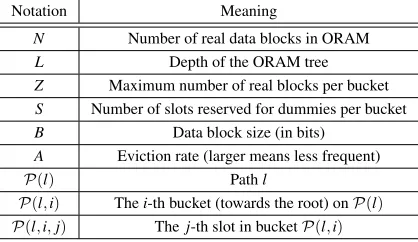
Notation Meaning
N Number of real data blocks in ORAM L Depth of the ORAM tree Z Maximum number of real blocks per bucket S Number of slots reserved for dummies per bucket B Data block size (in bits)
A Eviction rate (larger means less frequent)
P(l) Pathl
P(l,i) Thei-th bucket (towards the root) onP(l)
P(l,i,j) Thej-th slot in bucketP(l,i)
Table 2: ORAM parameters and notations.
Definition 1. (ORAM Definition)Let
←−y = ((op
M,addrM,dataM), . . . ,(op1,addr1,data1))
denote a data sequence of length M, whereopidenotes whether the i-th operation is a read or a write,addri de-notes the address for that access anddatai denotes the data (if a write). Let ORAM(←−y) be the resulting se-quence of operations between the client and server under an ORAM algorithm. The ORAM protocol guarantees that for any ←−y and ←−y0, ORAM(←−y) and ORAM(←−y0) are computationally indistinguishable if|←−y|=|←−y0|, and also that for any←−y the data returned to the client by ORAM is consistent with←−y (i.e., the ORAM behaves like a valid RAM) with overwhelming probability.
We remark that for the server to perform computations on data blocks [3],ORAM(←−y)andORAM(←−y0)include those operations. To satisfy the above security definition, it is implied that these operations also cannot leak any information about the access pattern.
3
Ring ORAM Protocol
3.1
Overview
We first describe Ring ORAM in terms of its server and client data structures. All notation used throughout the rest of the paper is summarized in Table 2.
Server storage is organized as a binary tree of buckets
where each bucket has a small number of slots to hold blocks. Levels in the tree are numbered from 0 (the root) toL(inclusive, the leaves) whereL=O(logN)andNis the number of blocks in the ORAM. Each bucket hasZ+ Sslots and a small amount of metadata. Of these slots, up toZslots may contain real blocks and the remaining
show that server storage in practice for both Ring ORAM and Path ORAM can be 2Nor even smaller.
Client storage is made up of a position map and a
stash. The position map is a dictionary that maps each block in the ORAM to a random leaf in the ORAM tree (each leaf is given a unique identifier). The stash buffers blocks that have not been evicted to the ORAM tree and additionally storesZ(L+1)blocks on the eviction path during an eviction operation. We will prove in Section 4 that stash overflow probability decreases exponentially as stash capacity increases, which means our required stash size is the same as Path ORAM. The position map storesN∗Lbits, but can be squashed to constant storage using the standard recursion technique (Section 3.7).
Main invariants. Ring ORAM has two main
invari-ants:
1. (Same as Path ORAM): Every block is mapped to a leaf chosen uniformly at random in the ORAM tree. If a blockais mapped to leafl, blockais contained either in the stash or in some bucket along the path from the root of the tree to leafl.
2. (Permuted buckets)For every bucket in the tree,
the physical positions of theZ+Sdummy and real blocks in each bucket are randomly permuted with respect to all past and future writes to that bucket. Since a leaf uniquely determines a path in a binary tree, we will use leaves/paths interchangeably when the con-text is clear, and denote pathlasP(l).
Access and Eviction Operations. The Ring ORAM
access protocol is shown in Algorithm 1. Each access is broken into the following four steps:
1.) Position Map lookup (Lines 3-5): Look up the
po-sition map to learn which pathlthe block being accessed is currently mapped to. Remap that block to a new ran-dom pathl0.
This first step is identical to other tree-based ORAMs [23, 27]. But the rest of the protocol differs substantially from previous tree-based schemes, and we highlight our key innovations inbold.
2.) Read Path (Lines 6-15): TheReadPath(l,a)
oper-ation reads all buckets alongP(l)to look for the block of interest (blocka), and then reads that block into the stash. The block of interest is then updated in stash on a write, or is returned to the client on a read. We remind readers again that both reading and writing a data block are served by aReadPathoperation.
Unlike prior tree-based schemes, our ReadPath op-eration only reads one block from each bucket—the
Algorithm 1Non-recursive Ring ORAM.
1: functionACCESS(a,op,data0)
2: Global/persistent variables:round
3: l0← UniformRandom(0,2L−1)
4: l← PositionMap[a]
5: PositionMap[a]← l0
6: data←ReadPath(l,a)
7: ifdata=⊥then
8: BIf blockais not found on pathl, it must 9: be inStashC
10: data←read and removeafromStash 11: ifop=readthen
12: returndatato client 13: ifop=writethen 14: data← data0
15: Stash← Stash∪(a,l0,data)
16: round←round+1 modA
17: ifround=? 0then
18: EvictPath()
19: EarlyReshuffle(l)
block of interest if found or a previously-unread
dummy block otherwise. This is safe because of
In-variant 2, above: each bucket is permuted randomly, so the slot being read looks random to an observer. This lowers the bandwidth overhead ofReadPath(i.e., online bandwidth) toL+1 blocks (the number of levels in the tree) or even a single block if the XOR trick is applied (Section 3.2).
3.) Evict Path (Line 16-18): TheEvictPathoperation
readsZ blocks (all the remaining real blocks, and po-tentially some dummy blocks) from each bucket along a path into the stash, and then fills that path with blocks from the stash, trying to push blocks as far down towards the leaves as possible. The sole purpose of an eviction operation is to push blocks back to the ORAM tree to keep the stash occupancy low.
Unlike Path ORAM, eviction in Ring ORAMselects paths in the reverse lexicographical order, and does not happen on every access. Its rate is controlled by
a public parameterA: everyAReadPathoperations
trigger a singleEvictPathoperation. This means Ring
4.) Early Reshuffles (Line 19): Finally, we perform
a maintenance task calledEarlyReshuffleonP(l), the
path accessed by ReadPath. This step is crucial in
maintaining blocks randomly shuffled in each bucket, which enablesReadPathto securely read only one block from each bucket.
We will present details ofReadPath, EvictPathand EarlyReshuffle in the next three subsections. We de-fer low-level details for helper functions needed in these three subroutines to Appendix A. We explain the security for each subroutine in Section 3.5. Finally, we discuss additional optimizations in Section 3.6 and recursion in Section 3.7.
3.2
Read Path Operation
Algorithm 2ReadPathprocedure.
1: functionReadPath(l,a) 2: data← ⊥
3: fori←0 toLdo
4: offset← GetBlockOffset(P(l,i),a)
5: data0← P(l,i,offset)
6: InvalidateP(l,i,offset)
7: ifdata06=⊥then 8: data←data0
9: P(l,i).count← P(l,i).count+1
returndata
TheReadPathoperation is shown in Algorithm 2. For each bucket along the current path,ReadPathselects a
singleblock to read from that bucket. For a given bucket, if the block of interest lives in that bucket, we read and invalidate the block of interest. Otherwise, we read and invalidate a randomly-chosen dummy block that is still valid at that point. The index of the block to read (either real or random) is returned by theGetBlockOffset func-tion whose detailed descripfunc-tion is given in Appendix A.
Reading a single block per bucket is crucial for our bandwidth improvements. In addition to reducing online bandwidth by a factor ofZ, it allows us to use largerZ
andAto decrease overall bandwidth (Section 5). Without this, read bandwidth is proportional toZ, and the cost of largerZon reads outweighs the benefits.
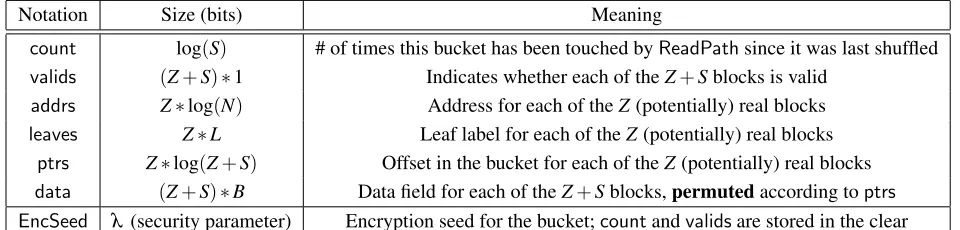
Bucket Metadata. Because the position map only
tracks thepathcontaining the block of interest, the client does not know where in each bucket to look for the block of interest. Thus, for each bucket we must store the permutation in the bucket metadata that maps each real block in the bucket to one of theZ+S slots (Lines 4, GetBlockOffset) as well as some additional metadata. Once we know the offset into the bucket, Line 5 reads
the block in the slot, and invalidates it. We describe all metadata in Appendix A, but make the important point that the metadata is small and independent of the block size.
One important piece of metadata to mention now is a counter which tracks how many times it has been read since its last eviction (Line 9). If a bucket is read too many (S) times, it may run out of dummy blocks (i.e., all the dummy blocks have been invalidated). On fu-ture accesses, if additional dummy blocks are requested from this bucket, we cannot re-read a previously inval-idated dummy block: doing so reveals to the adversary that the block of interest is not in this bucket. Therefore, we need to reshuffle single buckets on-demand as soon as they are touched more thanStimes usingEarlyReshuffle (Section 3.4).
XOR Technique. We further make the following key
observation: during ourReadPathoperation, each block returned to the client is a dummy block except for the block of interest. This means our scheme can also take advantage of the XOR technique introduced in [3] to reduce online bandwidth overhead to O(1). To be more concrete, on each access ReadPath re-turnsL+1 blocks in ciphertext, one from each bucket, Enc(b0,r0),Enc(b2,r2),· · ·,Enc(bL,rL). Enc is a ran-domized symmetric scheme such as AES counter mode with nonce ri. With the XOR technique, ReadPath will return a single ciphertext — the ciphertext of all the blocks XORed together, namely Enc(b0,r0)⊕ Enc(b2,r2)⊕ · · · ⊕Enc(bL,rL). The client can recover the encrypted block of interest by XORing the returned ciphertext with the encryptions of all the dummy blocks. To make computing each dummy block’s encryption easy, the client can set the plaintext of all dummy blocks to a fixed value of its choosing (e.g., 0).
3.3
Evict Path Operation
Algorithm 3EvictPathprocedure.
1: functionEvictPath
2: Global/persistent variablesGinitialized to0
3: l←G mod 2L 4: G←G+1 5: fori←0 toLdo
6: Stash←Stash∪ReadBucket(P(l,i))
7: fori←Lto 0do
8: WriteBucket(P(l,i),Stash)
9: P(l,i).count←0
evic-Time
G = 0 G = 1 G = 2 G = 3
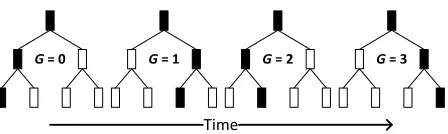
Figure 2: Reverse-lexicographic order of paths used by EvictPath. After pathG=3 is evicted to, the order re-peats.
tion operation happens after everyA reads. At a high level, an eviction operation reads all remaining real blocks on a path (in a secure fashion), and tries to push them down that path as far as possible. The leaf-to-root order in the writeback step (Lines 7) reflects that we wish to fill the deepest buckets as fully as possible. (For read-ers who are familiar with Path ORAM,EvictPathis like a Path ORAM access where no block is accessed and therefore no block is remapped to a new leaf.)
We emphasize two unique features of Ring ORAM eviction operations. First, evictions in Ring ORAM are performed to paths in a specific order called the reverse-lexicographic order, first proposed by Gentry et al. [9] and shown in Figure 2. The reverse-lexicographic order eviction aims to minimize the overlap between consecu-tive eviction paths, because (intuiconsecu-tively) evictions to the same bucket in consecutive accesses are less useful. This improves eviction quality and allows us to reduce the fre-quency of eviction. Evicting using this static order is also a key component in simplifying our theoretical analysis in Section 4.
Second, buckets in Ring ORAM need to be randomly shuffled (Invariant 2), and we mostly rely onEvictPath operations to keep them shuffled. An EvictPath oper-ation reads Z blocks from each bucket on a path into the stash, and writes out Z+S blocks (only up to Z
are real blocks) to each bucket, randomly permuted. The details of reading/writing buckets (ReadBucketand WriteBucket) are deferred to Appendix A.
3.4
Early Reshuffle Operation
Algorithm 4EarlyReshuffleprocedure.
1: functionEarlyReshuffle(l) 2: fori←0 toLdo
3: ifP(l,i).count≥Sthen
4: Stash← Stash∪ReadBucket(P(l,i))
5: WriteBucket(P(l,i),Stash)
6: P(l,i).count←0
Due to randomness, a bucket can be touched >S
times by ReadPath operations before it is reshuffled
by the scheduled EvictPath. If this happens, we call EarlyReshuffleon that bucket to reshuffle it before the bucket is read again (see Section 3.2). More precisely, after each ORAM accessEarlyReshuffle goes over all the buckets on the read path, and reshuffles all the buck-ets that have been accessed more thanS times by per-forming ReadBucket and WriteBucket. ReadBucket and WriteBucket are the same as in EvictPath: that is, ReadBucket reads exactly Z slots in the bucket and WriteBucket re-permutes and writes back Z+S
real/dummy blocks. We note that thoughSdoes not af-fect security (Section 3.5), it clearly has an impact on performance (how often we shuffle, the extra cost per reshuffle, etc.). We discuss how to optimally selectSin Section 5.
3.5
Security Analysis
Claim 1. ReadPathleaks no information.
The path selected for reading will look random to any adversary due to Invariant 1 (leaves are chosen uniformly at random). From Invariant 2, we know that every bucket is randomly shuffled. Moreover, because we invalidate any block we read, we will never read the same slot. Thus, any sequence of reads (real or dummy) to a bucket between two shuffles is indistinguishable. Thus the adversary learns nothing duringReadPath.
Claim 2. EvictPathleaks no information.
The path selected for eviction is chosen statically, and is public (reverse-lexicographic order). ReadBucket always reads exactly Z blocks from random slots. WriteBucketsimilarly writesZ+Sencrypted blocks in a data-independent fashion.
Claim 3. EarlyShuffleleaks no information.
To which buckets EarlyShuffle operations occur is publicly known: the adversary knows how many times a bucket has been accessed since the lastEvictPathto that bucket. ReadBucketandWriteBucketare secure as per observations in Claim 2.
3.6
Other Optimizations
Minimizing roundtrips. To keep the presentation
sim-ple, we wrote theReadPath(EvictPath) algorithms to process buckets one by one. In fact, they can be per-formed for all buckets on the path in parallel which re-duces the number of roundtrips to 2 (one for metadata and one for data blocks).
Tree-top caching. The idea of tree-top caching [18] is
simple: we can reduce the bandwidth forReadPathand EvictPathby storing the topt(a new parameter) levels of the Ring ORAM tree at the client as an extension of the stash1. For a givent, the stash grows by approximately 2tZblocks.
De-amortization. We can de-amortize the expensive
EvictPathoperation through a period ofAaccesses, sim-ply by reading/writing a small number of blocks on the eviction path after each access. After de-amortization, worst-case overall bandwidth equals average overall bandwidth.
3.7
Recursive Construction
With the construction given thus far, the client needs to store a large position map. To achieve small client stor-age, we follow the standard recursion idea in tree-based ORAMs [23]: instead of storing the position map on the client, we store the position map on a smaller ORAM on the server, and store only the position map for the smaller ORAM. The client can recurse until the final position map becomes small enough to fit in its stor-age. For reasonably block sizes (e.g., 4 KB), recursion contributes very little to overall bandwidth (e.g., <5% for a 1 TB ORAM) because the position map ORAMs use much smaller blocks [26]. Since recursion for Ring ORAM behaves in the same way as all the other tree-based ORAMs, we omit the details.
4
Stash Analysis
In this section we analyze the stash occupancy for a non-recursive Ring ORAM. Following the notations in Path ORAM [27], byORAMZL,A we denote a non-recursive Ring ORAM withL+1 levels, bucket size Z and one eviction per Aaccesses. The root is at level 0 and the leaves are at level L. We define the stash occupancy st(SZ)to be the number of real blocks in the stash after a sequence of ORAM sequences (this notation will be fur-ther explained later). We will prove that Pr[st(SZ)>R] 1We call this optimization tree-top caching following prior work.
But the word cache is a misnomer: the toptlevels of the tree are per-manentlystored by the client.
decreases exponentially inRfor certainZandA combi-nations. As it turns out, the deterministic eviction pattern in Ring ORAM dramatically simplifies the proof.
We note here that the reshuffling of a bucket does not affect the occupancy of the bucket, and is thus irrelevant to the proof we present here.
4.1
Proof outline
The proof consists of the two steps. The first step is the same as Path ORAM, and needs Lemma 1 and Lemma 2 in the Path ORAM paper [27], which we restate in Sec-tion 4.2. We introduce∞-ORAM, which has an infinite bucket size and after a post-processing step has exactly the same distribution of blocks over all buckets and the stash (Lemma 1). Lemma 2 says the stash occupancy of ∞-ORAM after post-processing is greater than R if and only if there exists a subtreeT in∞-ORAM whose
“occupancy” exceeds its “capacity” by more thanR. We note, however, that the Path ORAM [27] paper only gave intuition for the proof of Lemma 1, and unfortunately did not capture of all the subtleties. We will rigorously prove that lemma, which turns out to be quite tricky and requires significant changes to the post-processing algo-rithm.
The second step (Section 4.3) is much simpler than the rest of Path ORAM’s proof, thanks to Ring ORAM’s static eviction pattern. We simply need to calculate the expected occupancy of subtrees in∞-ORAM, and apply a Chernoff-like bound on their actual occupancy to com-plete the proof. We do not need the complicated eviction game, negative association, stochastic dominance, etc., as in the Path ORAM proof [26].
For readability, we will defer the proofs of all lemmas to Appendix B.
4.2
∞
-ORAM
We first introduce∞-ORAM, denoted asORAM∞,A L . Its buckets have infinite capacity. It receives the same input request sequence as ORAMZL,A. We then label buckets linearly such that the two children of bucketbiareb2iand b2i+1, with the root bucket beingb1. We define the stash to beb0. We refer tobi ofORAML∞,A asb∞i, andbi of ORAMZL,AasbZi. We further define ORAMstate, which consists of the states of all the buckets in the ORAM, i.e., the blocks contained by each bucket. LetS∞be the state
ofORAM∞L,AandSZbe the state ofORAMZL,A.
We now propose a new greedy post-processing algo-rithm G (different from the one in [27]), which by re-assigning blocks in buckets makes each bucketb∞
i in∞ -ORAM contain the same set of blocks asbZi. Formally,G
1 (note that the decreasing order ensures that a parent is always processed later than its children),Gprocesses the blocks in bucketb∞
i in the following way:
1. For those blocks that are also inbZi, keep them in
b∞ i .
2. For those blocks that are not inbZi but in some an-cestors ofbZi, move them fromb∞
i tob∞i/2(the parent ofb∞
i , and note that the division includes flooring). If such blocks exist and the number of blocks re-maining inb∞
i is less thanZ, raise an error. 3. If there exists a block inb∞
i that is in neitherbZi nor any ancestor ofbZi, raise an error.
We sayGSZ(S∞) =SZ, if no error occurs during G andb∞
i afterGcontains the same set of blocks asbZi for i=0,1,· · ·2L+1.
Lemma 1. GSZ(S∞) =SZafter the same ORAM access
sequence with the same randomness.
Next, we investigate what state S∞ will lead to the stash occupancy of more than R blocks in a post-processed∞-ORAM. We say a subtreeT is a rooted sub-tree, denoted asT ∈ORAM∞L,AifT contains the root of ORAM∞,A
L . This means that if a node in ORAM ∞,A L is inT, then so are all its ancestors. We define n(T) to be the total number of nodes inT. We definec(T)(the capacity ofT) to be the maximum number of blocksT
can hold; for Ring ORAMc(T) =n(T)·Z. Lastly, we defineX(T)(the occupancy ofT) to be the actual num-ber of real blocks that are stored in T. The following lemma characterizes the stash size of a post-processed
∞-ORAM:
Lemma 2. st(GSZ(S∞)) >R if and only if ∃T ∈
ORAM∞L,As.t. X(T)>c(T) +R before post-processing.
By Lemma 1 and Lemma 2, we have
Pr[st(SZ)>R] =Pr[st(GSZ(S∞))>R]
≤
∑
T∈ORAM∞,A L
Pr[X(T)>c(T) +R]
<
∑
n≥1
4n max
T:n(T)=nPr[X(T)>c(T) +R] (1)
The above inequalities used a union bound and a bound on Catalan sequences.
4.3
Bounding the Stash Size
We first give a bound on the expected bucket load:
Lemma 3. For any rooted subtree T inORAM∞,A
L , if the number of distinct blocks in the ORAM N≤A·2L−1, the
expected load of T has the following upper bound:
∀T ∈ORAM∞,A
L ,E[X(T)]≤n(T)·A/2.
LetX(T) =∑iXi(T), where eachXi(T)∈ {0,1}and indicates whether thei-th block (can be either real or stale) is inT. Let pi=Pr[Xi(T) =1]. Xi(T) is com-pletely determined by its time stampiand the leaf label assigned to blocki, so they are independent from each other (refer to the proof of Lemma 3). Thus, we can apply a Chernoff-like bound to get an exponentially de-creasing bound on the tail distribution. To do so, we first
establish a bound onEhetX(T)iwheret>0,
EhetX(T)i=Ehet∑iXi(T)i=EhΠ ietXi(T)
i
=ΠiE h
etXi(T)i (by independence)
=Πi pi(et−1) +1
≤Πi
epi(et−1)=e(et−1)Σipi
=e(et−1)E[X(T)] (2)
For simplicity, we write n=n(T)anda=A/2. By Lemma 3, E[X(T)]≤n·a. By the Markov Inequality, we have for allt>0,
Pr[X(T)>c(T) +R] =PrhetX(T)>et(nZ+R)i
≤EhetX(T)i·e−t(nZ+R)
≤e(et−1)an·e−t(nZ+R)
=e−tR·e−n[tZ−a(et−1)]
Lett=ln(Z/a),
Pr[X(T)>c(T) +R]≤(a/Z)R·e−n[Zln(Z/a)+a−Z] (3)
Now we will chooseZandAsuch thatZ>aandq= Zln(Z/a)+a−Z−ln 4>0. If these two conditions hold, from Equation (1) we havet=ln(Z/a)>0 and that the stash overflow probability decreases exponentially in the stash sizeR:
Pr[st(SZ)>R]≤
∑
n≥1(a/Z)R·e−qn< (a/Z)
R
1−e−q.
4.4
Stash Size in Practice
Now that we have established that Zln(2Z/A) +A/2− Z−ln 4>0 ensures an exponentially decreasing stash overflow probability, we would like to know how tight this requirement is and what the stash size should be in practice.
We simulate Ring ORAM withL=20 for over 1 Bil-lion accesses in a random access pattern, and measure the stash occupancy (excluding the transient storage of a path). For severalZvalues, we look for the maximumA
0 100 200 300 400 500 600 700 800 900 1000
0 100 200 300 400 500 600
A
Z
Analytical Empirical
0 10 20 30 40 50 60
0 10 20 30 40
Zoomed in:
Figure 3: For eachZ, determine analytically and em-pirically the maximumAthat results in an exponentially decreasing stash failure probability.
Z,A Parameters
4,3 8,8 16,20 32,46 16,23 Max Stash Size
λ
80 32 41 65 113 197
128 51 62 93 155 302
256 103 120 171 272 595
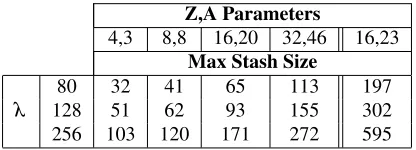
Table 3: Maximum stash occupancy for realistic security parameters (stash overflow probability 2−λ) and several
choices ofAandZ. A=23 is the maximum achievable
AforZ=16 according to simulation.
probability. In Figure 3, we plot both the empirical curve based on simulation and the theoretical curve based on the proof. In all cases, the theoretical curve indicates a only slightly smaller A than we are able to achieve in simulation, indicating that our analysis is tight.
To determine required stash size in practice, Table 3 shows the extrapolated required stash size for a stash overflow probability of 2−λ for several realistic λ. We
showZ=16,A=23 for completeness: this is an aggres-sive setting that works forZ=16 according to simulation but does not satisfy the theoretical analysis; observe that this point requires roughly 3×the stash occupancy for a givenλ.
5
Bandwidth Analysis
In this section, we answer an important question: how doZ (the maximum number of real blocks per bucket),
A(the eviction rate) andS(the number of extra dummies per bucket) impact Ring ORAM’s performance (band-width)? By the end of the section, we will have a theoretically-backed analytic model that, givenZ, selects optimalAandSto minimize bandwidth.
We first state an intuitive trade-off: for a givenZ, in-creasingAcauses stash occupancy to increase and
band-3 4 5 6 7 8 9
0 10 20 30 40 50
S −A
Z=4, A=3 Z=8, A=8 Z=16, A=20 Z=32, A=46
C
onstan
t
fo
r
𝑂
(log
2
𝑁𝐵
)
b
an
d
wi
d
th
Figure 4: For differentZ, and the corresponding optimal
A, varySand plot bandwidth overhead. We only consider
S≥A
width overhead to decrease. Let us first ignore early reshuffles and the XOR technique. Then, the overall bandwidth of Ring ORAM consists of ReadPath and EvictPath. ReadPathtransfersL+1 blocks, one from each bucket. EvictPathreadsZ blocks per bucket and writesZ+S blocks per bucket,(2Z+S)(L+1)blocks in total, but happens every A accesses. From the re-quirement of Lemma 3, we have L=log(2N/A), so the ideal amortized overall bandwidth of Ring ORAM is(1+ (2Z+S)/A)log(4N/A). Clearly, a largerA im-proves bandwidth for a givenZ as it reduces both evic-tion frequency and tree depthL. So we simply choose the largestAthat satisfies the requirement from the stash analysis in Section 4.3.
Now we consider the extra overhead from early reshuffles. We have the following trade-off in choos-ing S: as S increases, the early reshuffle rate de-creases (since we have more dummies per bucket) but the cost to read+write buckets during anEvictPathand EarlyReshuffleincreases. This effect is shown in Figure 4 through simulation: forStoo small, early shuffle rate is high and bandwidth increases; forS too large, eviction bandwidth dominates.
cumula-Find largestA≤2Zsuch that
Zln(2Z/A) +A/2−Z−ln 4>0 holds. FindS≥0 that minimizes
(2Z+S)(1+Poiss cdf(S,A))
Ring ORAM offline bandwidth is
(2Z+S)(1+Poiss cdf(S,A))
A ·log(4N/A)
Table 4: Analytic model for choosing parameters, given
Z.
0 1 2 3 4 5 6 7 8 9
0 10 20 30 40 50 60 Z
Ring ORAM (overall) Path ORAM (overall)
C
onstan
t
fo
r
𝑂
(log
2
𝑁𝐵
)
b
an
d
wi
d
th
Ring ORAM (online) Path ORAM (online)
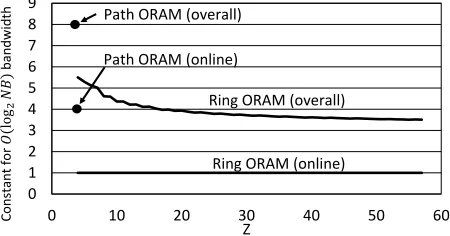
Figure 5: Overall bandwidth as a function ofZ. Kinks are present in the graph because we always roundAto the nearest integer. For Path ORAM, we only studyZ=4 since a largerZstrictly hurts bandwidth.
tive density functionBinom cdf(S,2lA,2−l).2 Based on this analysis, the expected number of times any bucket is involved inReadPathoperations between consecutive EvictPathoperations isA. Thus, we will only consider
S≥A as shown in Figure 4 (S<A is clearly bad as it needs too much early reshuffling).
We remark that the binomial distribution quickly con-verges to a Poisson distribution. So the amortized overall bandwidth, taking early reshuffles into account, can be accurately approximated as(L+1) + (L+1)(2Z+S)/A· (1+Poiss cdf(S,A)). We should then choose theSthat minimizes the above formula. This method always finds the optimal S and perfectly matches the overall band-width in our simulation in Figure 4.
We recap how to chooseAandSfor a givenZin Ta-ble 4. For the rest of the paper, we will chooseAandS
this way unless otherwise stated. Using this method to setAandS, we show online and overall bandwidth as a function ofZin Figure 5. In the figure, Ring ORAM does not use the XOR technique on reads. ForZ =50, we achieve∼3.5 logN bandwidth; for very largeZ, band-width approaches 3 logN. Applying the XOR technique, online bandwidth overhead drops to close to 1 which re-duces overall bandwidth to∼2.5 logN for Z=50 and
2The possibility that a bucket needs to be early reshuffled twice
before an eviction is negligible.
0 50 100 150 200 250
0 1000 2000 3000 4000
B
an
d
w
id
th
mu
lt
ip
lier
Storage (in KiloBytes)
B = 64 Bytes B = 4 KiloBytes
2.7X 2X
Ring ORAM Path ORAM
Figure 6: Bandwidth overhead vs. data block storage for 1 TB ORAM capacities and ORAM failure probability 2−80.
2 logNfor very largeZ.
6
Evaluation
6.1
Bandwidth vs. Client Storage
To give a holistic comparison between schemes, Figure 6 shows the best achievable bandwidth, for different client storage budgets, for Path ORAM and Ring ORAM. For each scheme in the figure, we apply all known optimiza-tions and tune parameters to minimize overall bandwidth given a storage budget. For Path ORAM we chooseZ=4 (increasingZstrictly hurts bandwidth) and tree-top cache to fill remaining space. For Ring ORAM we adjustZ,A
andS, tree-top cache and apply the XOR technique. To simplify the presentation, “client storage” includes all ORAM data structures except for the position map – which has the same space/bandwidth cost for both Path ORAM and Ring ORAM. We remark that applying the recursion technique (Section 3.7) to get a small on-chip position map is cheap for reasonably large blocks. For example, recursing the on-chip position map down to 256 KiloBytes of space when the data block size is 4 KiloBytes increases overall bandwidth for Ring ORAM and Path ORAM by<3%.
Online, Overall Bandwidth overhead
Block Size (Bytes) Z,A(Ring ORAM only) Ring ORAM Ring ORAM (XOR) Path ORAM
64 10,11 48×, 144× 24×, 118× 120×, 240×
4096 33,48 20×, 82× ∼1×, 60× 80×, 160×
Table 5: Breakdown between online and offline bandwidth given a client storage budget of 1000×the block size for several representative points (Section 6.1). Overheads are relative to an insecure system. Parameter meaning is given in Table 2.
tpcc ycsb astar bzip2 gcc gob h264 libq mcf omnet perl sjeng Avg 02
4 6 8 1012 14 16 18 20
Slowdown
29.4
Path ORAM Ring ORAM w/o XOR Ring ORAM w/ XOR
Figure 7: SPEC benchmark slowdown.
6.2
Case Study: Secure Processors
In this study, we show how Ring ORAM improves the performance of secure processors over Path ORAM. We assume the same processor/cache architecture as [5], given in Table 4 of that work. We evaluate a 4 GigaByte ORAM with 64-Byte block size (matching a typical pro-cessor’s cache line size). Due to the small block size, we parameterize Ring ORAM at Z =5,A=5,X =2 to reduce metadata overhead. We use the optimized ORAM recursion techniques [22]: we apply recursion three times with 32-Byte position map block size and get a 256 KB final position map. We evaluate performance for SPEC-int benchmarks and two database benchmarks, and simulate 3 billion instructions for each benchmark. We assume a flat 50-cycle DRAM latency, and com-pute ORAM latency assuming 128 bits/cycle processor-memory bandwidth. We do not use tree-top caching since it proportionally benefits both Ring ORAM and Path ORAM. Today’s DRAM DIMMs cannot perform any computation, but it is not hard to imagine having simple XOR logic either inside memory, or connected to
O(logN)parallel DIMMs so as not to occupy processor-memory bandwidth. Thus, we show results with and without the XOR technique.
Figure 7 shows program slowdown over an insecure DRAM. The high order bit is that using Ring ORAM with XOR results in a geometric average slowdown of 2.8×relative to an insecure system. This is a 1.5× im-provement over Path ORAM. If XOR is not available, the slowdown over an insecure system is 3.2×.
We have also repeated the experiment with the unified ORAM recursion technique and its parameters [5]. The geometric average slowdown over an insecure system is 2.4×(2.5×without XOR).
7
Ring ORAM with Large Client Storage
If given a large client storage budget, we can first choose very largeAandZfor Ring ORAM, which means band-width approaches 2 logN (Section 5).3 Then remaining client storage can be used to tree-top cache (Section 3.6). For example, tree-top cachingt =L/2 levels requires
O(√N) storage and bandwidth drops by a factor of 2 to 1·logN—which roughly matches the SSS construc-tion [25].
Burst ORAM [3] extends the SSS construction to han-dle millions of accesses in a short period, followed by a relatively long idle time where there are few requests. The idea to adapt Ring ORAM to handle bursts is to de-lay multiple (potentially millions of)EvictPath opera-tions until after the burst of requests. Unfortunately, this strategy means we will experience a much higher early reshuffle rate in levels towards the root. The solution is to coordinate tree-top caching with delayed evictions: For a given tree-top sizet, we allow at most 2t delayed EvictPathoperations. This ensures that for levels≥t, the early reshuffle rate matches our analysis in Section 5. We experimentally compared this methodology to the dataset used by Burst ORAM and verified that it gives comparable performance to that work.
8
Related Work
ORAM was first proposed by Goldreich and Ostro-vsky [10, 11]. Since then, there have been numerous follow-up works that significantly improved ORAM’s ef-ficiency in the past three decades [21, 20, 2, 1, 29, 12, 13, 15, 25, 23, 9, 27, 28]. We have already reviewed two state-of-the-art schemes with different client storage re-quirements: Path ORAM [27] and the SSS ORAM [25]. Circuit ORAM [28] is another recent tree-based ORAM, which requires only O(1) client storage, but its band-width is a constant factor worse than Path ORAM.
Reducing online bandwidth. Two recent works
[3, 19] have made efforts to reduce online bandwidth (response time). Unfortunately, the techniques in Burst ORAM [3] do not work with Path ORAM (or more generally any existing tree-based ORAMs). On the
3We assume the XOR technique because large client storage implies
other hand, Path-PIR [19], while featuring a tree-based ORAM, employs heavy primitives like Private Informa-tion Retrieval (PIR) or even FHE, and thus requires a significant amount of server computation. In compari-son, our techniques efficiently achieveO(1)online cost for tree-based ORAMs without resorting to PIR/FHE, and also improve bursty workload performance similar to Burst ORAM.
Subsequent work.Techniques proposed in this paper
have been adopted by subsequent works. For example, Tiny ORAM [6] and Onion ORAM [4] used part of our eviction strategy in their design for different purposes.
9
Conclusion
This paper proposes Ring ORAM, the most bandwidth-efficient ORAM scheme for the small (constant or poly-log) client storage setting. Ring ORAM is simple, flexi-ble and backed by a tight theoretic analysis.
Ring ORAM is the first tree-based ORAM whose online and overall bandwidth are independent of tree ORAM bucket size. With this and additional proper-ties of the algorithm, we show that Ring ORAM im-proves online bandwidth by 60× (if simple computa-tion such as XOR is available at memory), and overall bandwidth by 2.3×to 4×relative to Path ORAM. In a secure processor case study, we show that Ring ORAM’s bandwidth improvement translates to an overall program performance improvement of 1.5×. By increasing Ring ORAM’s client storage, Ring ORAM is competitive in the cloud storage setting as well.
Acknowledgement
This research was partially by NSF grant CNS-1413996 and CNS-1314857, the QCRI-CSAIL partner-ship, a Sloan Fellowpartner-ship, and Google Research Awards. Christopher Fletcher was supported by a DoD National Defense Science and Engineering Graduate Fellowship.
References
[1] BONEH, D., MAZIERES, D.,ANDPOPA, R. A. Remote oblivious storage: Making oblivious RAM practical. Manuscript, http://dspace.mit.edu/bitstream/ handle/1721.1/62006/MIT-CSAIL-TR-2011-018. pdf, 2011.
[2] DAMGARD˚ , I., MELDGAARD, S.,ANDNIELSEN, J. B. Perfectly secure oblivious RAM without random oracles. InTCC(2011).
[3] DAUTRICH, J., STEFANOV, E.,ANDSHI, E. Burst oram: Minimizing oram response times for bursty access pat-terns. InUSENIX(2014).
[4] DEVADAS, S.,VANDIJK, M., FLETCHER, C. W., REN, L., SHI, E., AND WICHS, D. Onion oram: A con-stant bandwidth blowup oblivious ram. Cryptology ePrint Archive, 2015.http://eprint.iacr.org/2015/005.
[5] FLETCHER, C., REN, L., KWON, A., VANDIJK, M.,
ANDDEVADAS, S. Freecursive oram: [nearly] free recur-sion and integrity verification for position-based oblivious ram. InASPLOS(2015).
[6] FLETCHER, C., REN, L., KWON, A., VAN DIJK, M., STEFANOV, E., SERPANOS, D., ANDDEVADAS, S. A low-latency, low-area hardware oblivious ram controller. InFCCM(2015).
[7] FLETCHER, C., REN, L., YU, X., VAN DIJK, M., KHAN, O., ANDDEVADAS, S. Suppressing the obliv-ious ram timing channel while making information leak-age and program efficiency trade-offs. InHPCA(2014).
[8] FLETCHER, C.,VANDIJK, M.,ANDDEVADAS, S. Se-cure Processor Architecture for Encrypted Computation on Untrusted Programs. InSTC(2012).
[9] GENTRY, C., GOLDMAN, K. A., HALEVI, S., JUTLA, C. S., RAYKOVA, M.,ANDWICHS, D. Optimizing oram and using it efficiently for secure computation. InPET (2013).
[10] GOLDREICH, O. Towards a theory of software protection and simulation on oblivious rams. InSTOC(1987).
[11] GOLDREICH, O.,ANDOSTROVSKY, R. Software pro-tection and simulation on oblivious rams. In J. ACM (1996).
[12] GOODRICH, M. T.,ANDMITZENMACHER, M. Privacy-preserving access of outsourced data via oblivious ram simulation. InICALP(2011).
[13] GOODRICH, M. T., MITZENMACHER, M., OHRI
-MENKO, O., AND TAMASSIA, R. Privacy-preserving group data access via stateless oblivious RAM simula-tion. InSODA(2012).
[14] ISLAM, M., KUZU, M.,ANDKANTARCIOGLU, M. Ac-cess pattern disclosure on searchable encryption: Ramifi-cation, attack and mitigation. InNDSS(2012).
[15] KUSHILEVITZ, E., LU, S., ANDOSTROVSKY, R. On the (in) security of hash-based oblivious ram and a new balancing scheme. InSODA(2012).
[16] LIU, C., HARRIS, A., MAAS, M., HICKS, M., TIWARI, M.,ANDSHI, E. Ghostrider: A hardware-software sys-tem for memory trace oblivious computation. InASPLOS (2015).
[17] LORCH, J. R., PARNO, B., MICKENS, J. W., RAYKOVA, M.,ANDSCHIFFMAN, J. Shroud: Ensuring private ac-cess to large-scale data in the data center. InFAST(2013).
[18] MAAS, M., LOVE, E., STEFANOV, E., TIWARI, M., SHI, E., ASANOVIC, K., KUBIATOWICZ, J., AND
SONG, D. Phantom: Practical oblivious computation in a secure processor. InCCS(2013).
[20] OSTROVSKY, R. Efficient computation on oblivious rams. InSTOC(1990).
[21] OSTROVSKY, R., ANDSHOUP, V. Private information storage (extended abstract). InSTOC(1997).
[22] REN, L., YU, X., FLETCHER, C.,VANDIJK, M.,AND
DEVADAS, S. Design space exploration and optimiza-tion of path oblivious ram in secure processors. InISCA (2013).
[23] SHI, E., CHAN, T.-H. H., STEFANOV, E., ANDLI, M. Oblivious ram witho((logn)3)worst-case cost. In
Asi-acrypt(2011).
[24] STEFANOV, E.,ANDSHI, E. Oblivistore: High perfor-mance oblivious cloud storage. InS&P(2013).
[25] STEFANOV, E., SHI, E.,ANDSONG, D. Towards practi-cal oblivious RAM. InNDSS(2012).
[26] STEFANOV, E., VAN DIJK, M., SHI, E., CHAN, T.-H. T.-H., FLETCHER, C., REN, L., YU, X., AND DE
-VADAS, S. Path oram: An extremely simple oblivious ram protocol. Cryptology ePrint Archive, 2013. http: //eprint.iacr.org/2013/280.
[27] STEFANOV, E.,VANDIJK, M., SHI, E., FLETCHER, C., REN, L., YU, X., ANDDEVADAS, S. Path oram: An extremely simple oblivious ram protocol. InCCS(2013).
[28] WANG, X. S., CHAN, T.-H. H., AND SHI, E. Cir-cuit oram: On tightness of the goldreich-ostrovsky lower bound. Cryptology ePrint Archive, 2014. http:// eprint.iacr.org/2014/672.
[29] WILLIAMS, P.,ANDSION, R. Single round access pri-vacy on outsourced storage. InCCS(2012).
[30] WILLIAMS, P., SION, R.,ANDTOMESCU, A. Privatefs: A parallel oblivious file system. InCCS(2012).
[31] YU, X., FLETCHER, C. W., REN, L., VANDIJK, M.,
AND DEVADAS, S. Generalized external interaction with tamper-resistant hardware with bounded information leakage. InCCSW(2013).
[32] ZHUANG, X., ZHANG, T.,ANDPANDE, S. HIDE: an in-frastructure for efficiently protecting information leakage on the address bus. InASPLOS(2004).
A
Bucket Structure
Table 6 lists all the fields in a Ring ORAM bucket and their size. We would like to make two remarks. First, only thedata fields are permuted and that permutation is stored in ptrs. Other bucket fields do not need to be permuted because when they are needed, they will be read in their entirety. Second, countandvalidsare stored in plaintext. There is no need to encrypt them since the server can see which bucket is accessed (deduc-ingcountfor each bucket), and which slot is accessed in each bucket (deducingvalidsfor each bucket). In fact, if the server can do computation and is trusted to follow
Algorithm 5Helper functions.
count,valids,addrs,leaves,ptrs,dataare fields of the inputbucketin each of the following three functions
1: functionGetBlockOffset(bucket,a) 2: read invalids,addrs,ptrs 3: decryptaddrs,ptrs 4: for j←0 toZ−1do
5: ifa=addrs[j]andvalids[ptrs[j]]then
6: returnptrs[j] .block of interest
returna pointer to a random valid dummy
1: functionReadBucket(bucket)
2: read invalids,addrs,leaves,ptrs 3: decryptaddrs,leaves,ptrs
4: z←0 .track # of remaining real blocks 5: for j←0 toZ−1do
6: ifvalids[ptrs[j]]then
7: data0←read and decryptdata[ptrs[j]]
8: z←z+1
9: ifaddrs[j]6=⊥then
10: block←(addr[j],leaf[j],data0)
11: Stash← Stash∪block
12: for j←ztoZ−1do
13: read a random valid dummy
1: functionWriteBucket(bucket,Stash)
2: find up toZblocks fromStashthat can reside 3: in this bucket, to formaddrs,leaves,data0 4: ptrs←PRP(0,Z+S) .or truly random 5: for j←0 toZ−1do
6: data[ptrs[j]]←data0[j]
7: valids← {1}Z+S
8: count←0
9: encryptaddrs,leaves,ptrs,data
10: write outcount,valids,addrs,leaves,ptrs,data
the protocol faithfully, the client can let the server up-datecountandvalids. All the other structures should be probabilistically encrypted.
Having defined the bucket structure, we can be more specific about some of the operations in earlier sec-tions. For example, in Algorithm 2 Line 5 means reading P(l,i).data[offset], and Line 6 means setting
P(l,i).valids[offset]to 0.
Notation Size (bits) Meaning
count log(S) # of times this bucket has been touched byReadPathsince it was last shuffled
valids (Z+S)∗1 Indicates whether each of theZ+Sblocks is valid
addrs Z∗log(N) Address for each of theZ(potentially) real blocks
leaves Z∗L Leaf label for each of theZ(potentially) real blocks
ptrs Z∗log(Z+S) Offset in the bucket for each of theZ(potentially) real blocks
data (Z+S)∗B Data field for each of theZ+Sblocks,permutedaccording toptrs
EncSeed λ (security parameter) Encryption seed for the bucket;countandvalidsare stored in the clear
Table 6: Ring ORAM bucket format. All logs are taken to their ceiling.
ReadBucketreads all of the remaining real blocks in a bucket into the stash. For security reasons,ReadBucket always readsexactly Z blocks from that bucket. If the bucket contains less thanZvalid real blocks, the remain-ing blocks read out are random valid dummy blocks. Im-portantly, since we allow at mostSreads to each bucket before reshuffling it, it is guaranteed that there are at least
Z valid (real + dummy) blocks left that have not been touched since the last reshuffle.
WriteBucketevicts as many blocks as possible (up to
Z) from the stash to a certain bucket. If there arez0≤Z
real blocks to be evicted to that bucket,Z+S−z0dummy blocks are added. TheZ+S blocks are then randomly shuffled based on either a truly random permutation or a Pseudo Random Permutation (PRP). The permutation is stored in the bucket fieldptrs. Then, the function resets countto 0 and all valid bits to 1, since this bucket has just been reshuffled and no blocks have been touched. Finally, the permuteddatafield along with its metadata are encrypted (exceptcountandvalids) and written out to the bucket.
B
Proof of the Lemmas
To prove Lemma 1, we made a little change to the Ring ORAM algorithm. In Ring ORAM, aReadPath opera-tion adds the block of interest to the stash and replaces it with a dummy block in the tree. Instead of making the block of interest in the tree dummy, we turn it into astale
block. On anEvictPathoperation to pathl, all the stale blocks that are mapped to leaflare turned into dummy blocks. Stale blocks are treated as real blocks in both ORAMZL,AandORAM∞L,A(includingGZ) until they are turned into dummy blocks. Note that this trick of stale blocks is only to make the proof go through. It hurts the stash occupancy and we will not use it in practice. With the stale block trick, we can use induction to prove Lemma 1.
Proof of Lemma 1. Initially, the lemma obviously holds. SupposeGSZ(S∞) =SZafter some accesses. We need to
show thatGS0
Z(S∞) =S
0
ZwhereSZ0 andS∞0 are the states
after the next operation (eitherReadPathorEvictPath). AReadPathoperation adds a block to the stash (the root bucket) for bothORAMZL,AandORAM∞,A
L , and does not move any blocks in the tree except turning a real block into a stale block. Since stale blocks are treated as real blocks,GS0
Z(S∞) =S
0 Zholds.
Now we show the induction holds for an EvictPath operation. LetEPZl be an EvictPathoperation to P(l)
(pathl) inORAMZL,AandEP∞
l be anEvictPathoperation toP(l)inORAM∞,A
L . Then, S 0
Z = EPZl (SZ)andS∞0 = EP∞
l (S∞). Note that EPZl has the same effect as EP∞l followed by post-processing, so
SZ0 =EPZl (SZ) =GS0
Z(EP
∞ l (SZ)) =GS0
Z(EP
∞
l (GSZ(S∞)))
The last equation is due to the induction hypothesis. It remains to show that
GS0
Z(EP
∞
l (GSZ(S∞))) =GSZ0(EP∞l (S∞)),
which isGS0
Z(S
0
∞). To show this, we decomposeGinto
steps for each bucket, i.e.,GSZ(S∞) =g1g2· · ·g2L+1(S∞)
wheregi processes bucketb∞i in reference tobZi. Sim-ilarly, we decompose GS0
Z into g
0 1g
0 2· · ·g
0
2L+1 where
each g0i processes bucket b0∞ i of S
0
∞ in reference
to b0iZ of SZ0. We now only need to show that for any 0<i <2L+1, GS0
Z(EP
∞
l (g1g2· · ·gi(S∞))) = GS0
Z(EP
∞
l (g1g2· · ·gi−1(S∞))). This is obvious if we
consider the following three cases separately:
1. Ifbi∈ P(l), thengibeforeEP∞l has no effect since EP∞
l moves all blocks onP(l)into the stash before evicting them toP(l).
2. If bi 6∈ P(l) and bi/2 6∈ P(l) (neither bi nor its parent is on Path l), then gi and EP∞l touch non-overlapping buckets and do not in-terfere with each other. Hence, their order can be swapped, GS0
Z(EP
∞
l (g0g1g2· · ·gi(S∞))) = GS0
Zgi(EP
∞
bZi =b0iZ (sinceEP∞
l does not change the content of bi), so gi has the same effect as g0i and can be merged intoGS0
Z.
3. Ifbi6∈ P(l)butbi/2∈ P(l), the blocks moved into
bi/2 bygi will stay inbi/2 after EP∞l sincebi/2 is the highest intersection (towards the leaf) that these blocks can go to. Sogican be swapped withEP∞l and can be merged intoGS0
Z as in the second case.
We remind the readers that because we only remove stale blocks that are mapped toP(l), the first case is the only case where some stale blocks inbimay turn into dummy blocks. And the same set of stale blocks are removed fromORAMZL,AandORAM∞,A
L . This shows
GS0
Z(EP
∞
l (GSZ(S∞))) =GSZ0 (EP∞l (S∞)) =GS0
Z S
0
∞
and completes the proof.
The proof of Lemma 2 remains unchanged from the Path ORAM paper [27], and is replicated here for com-pleteness.
Proof of Lemma 2. If part:SupposeT∈ORAM∞L,Aand
X(T)>c(T) +R. Observe thatGcan assign the blocks in a bucket only to an ancestor bucket. SinceT can store at most c(T)blocks, more than R blocks must be as-signed to the stash byG.
Only if part: Suppose thatst(GSZ(S∞))>R. LetT
be the maximal rooted subtree such that all the buck-ets inT contain exactlyZ blocks after post-processing
G. Supposeb is a bucket not inT. By the maximality ofT, there is an ancestor (not necessarily proper ances-tor) bucketb0 ofbthat contains less thanZ blocks after post-processing, which implies that no block frombcan go to the stash. Hence, all blocks that are in the stash must have originated fromT. Therefore, it follows that
X(T)>c(T) +R.
Proof of Lemma 3. For a bucket b in ORAM∞L,A, de-fineY(b)to be the number of blocks inb before post-processing. It suffices to prove that ∀b∈ORAM∞,A
L , E[Y(b)]≤A/2.
Ifbis a leaf bucket, the blocks in it are put there by the lastEvictPathoperation to that leaf/path. Note that only real blocks could be put inbby that operation, although some of them may have turned into stale blocks. Stale blocks can never be moved into a leaf by anEvictPath operation, because that EvictPath operation would re-move all the stale blocks mapped to that leaf. There are at mostNdistinct real blocks and each block has a prob-ability of 2−L to be mapped to b independently. Thus
E[Y(b)]≤N·2−L≤A/2.
Ifbis not a leaf bucket, we define two variablesm1and
m2: the lastEvictPathoperation tob’s left child is the
m1-thEvictPathoperation, and the lastEvictPath oper-ation tob’s right child is them2-thEvictPathoperation. Without loss of generality, assume m1<m2. We then time-stamp the blocks as follows. When a block is ac-cessed and remapped, it gets time stamp m∗, which is the number ofEvictPathoperations that have happened. Blocks with m∗≤m1 will not be in b as they will go to either the left child or the right child of b. Blocks with m∗>m2 will not be in b as the last access to b (m2-th) has already passed. Therefore, only blocks with time stampm1<m∗≤m2 will be put inb by them2 -th access. (Some of -them may be accessed again after them2-th access and become stale, but this does not af-fect the total number of blocks in bas stale blocks are treated as real blocks.) There are at mostd=A|m1−m2| such blocks, and each goes to b independently with a probability of 2−(i+1), whereiis the level ofb. The de-terministic nature of evictions in Ring ORAM ensures
|m1−m2|=2i. (One way to see this is that a bucket b at leveliwill be written every 2iEvictPathoperations, and two consecutive EvictPathoperations to b always travel down the two different children ofb.) Therefore,