ISSN 2286-4822
www.euacademic.org DRJI Value: 5.9 (B+)
The Moderating Effect of Government Interference
on the Relationship between Staff Commitment and
Performance of Nigerian National Petroleum
Corporation (NNPC)
GONI IBRAHIM AHMAD ZUBAIR IBRAHIM BADARIAH HAJI DIN
Abstract:
of the corporation as this would boost the performance of the organization.
Key words: Organizational performance, staff commitment, government interference, NNPC, Corruption.
1. INTRODUCTION
In a purely oil dependent country like Nigeria, the mainstay of the entire economy is depended upon the effective performance of the National Oil Company (Thurber, Emilefe & Heller, 2010). Nigerian National Petroleum Corporation (NNPC), the Nigerian's National Oil Company has been operating at below optimum level due to number of visible and invisible factors (Echendu, Iledare, & Onwuka, 2012). Specifically, it has been observed that, challenges are enormous and abound with regards to the low performance of the NNPC which invariably touches every aspect of life in Nigeria (African Development Bank, 2015; Essia, 2012). The deplorable, and arguably the discouraging and unimpressive performance of the NNPC, has for long, been a source of concern to many critical stakeholders in the country (Badmus, Oyewola & Fagbenle, 2012). Anecdotal evidences and cursory look at the picture of this scenario will perhaps provide an unfortunate image of the organization with promising prospects but affected with multifaceted internal and external pressures that are overwhelmingly heavy (Essia, 2012; African Development Bank, 2015). In a nutshell, NNPC has been apparently grappling with a number of obvious problems that are hampering the smooth performance of the organization (Essia, 2012).
institutional performance (Odularu, 2008; Okpanachi, 2011; McPherson, 2003; Badmus et al., 2012). For instance, PETRONAS and PETROBRAS are among the most effective and profitable organizations around the globe being run based on the global best standards of practice in the oil and gas sector (Ichan, 2009). Conversely, Thurber et al. (2010) argues that, NNPC is too diverse, incoherent and essentially lack control over its own activities, hence its internal activities left much to be desired. Equally still NNPC is obviously incapable of setting its own strategies and fail clearly to build internal organizational processes and procedures that would deservedly support improved outcome, productivity and effective performance (Ismaila, Olanrewaju & Olayiwola, 2012).
Specifically, the performance of the NNPC keeps deteriorating on a yearly basis due to the factors that are extremely and generally requires a thorough empirical examination and exercises. For instance, the NNPC or more broadly the petroleum sector's contribution to the Nigerian GDP for nine years is a clear testimony of the above claim. Thus, the contribution falls from 32 percent in 2000 to 18 percent in 2008 (Onwe, 2012).
institutional policy makers as well as seasoned experts have demonstrated great effort to unravel the mystery, but still this issues have not been turned around for better (Ismaila etal., 2012).
Specifically, staff commitment is believed to be a significant factor for performance improvement in any organization operating in public or private sector (Taboli & Soltani, 2014; Sharma, Chuen Kong & Kingshot, 2016). Organization human resources are the most cherished assets worthy of careful management, evaluation and assessment (Dost, Ahmed, Shafi & Shaheen, 2011). It is quite believe that, commitment of NNPC's staff is a key variable that may be examined to clearly assess its performance. Researchers in other climes have demonstrably exhibited a number of procedures for investigating the relationship between staff commitment and performance. For instance, weak capabilities premise on lack of commitment and coherent goal orientation would invariably affect the organization performance in various ways (Essia, 2012).
However, going by the several studies conducted between corruption, staff commitment, antisocial behaviour on one hand, and the performance on the other hand, there seems to be inconsistencies in the previous findings. For instance, while Ahmad et al. (2014),Taboli and Soltani (2014), Chen, Wu, Chanc, and Lin (2013), Sharma, Chuen and Kingshot (2016) and Chen Tsui & Farm (2002) have documented significant positive relationship between staff commitment and organizational performance, others (e.g.,Lau, Tong, lien, Hsu & Chong,2016; Guay et al, 2016) have documented significant negative relationship between the variables.
predictor variables and the output variable. Therefore, in this context, government interference is selected to serve as the moderating variable. This implies that a number of studies suggest that Government policies directly or indirectly affect the performance of public corporations (Sayne et al., 2015; Odularu, 2008). In view of this, when government at all levels pay attention closely to the performance drivers, the NNPC could likely sprung up and appropriately record optimal organizational performance (Udofia & Joel, 2012).
It is in line with this background that this paper is inclined to determine the moderating effect of government interference on the relationship between staff commitment and organizational performance. The paper has five sections, the next section reviewed related empirical studies including the underpinning theory and theoretical framework. The section is followed by research methodology where the research design, population of the study and sampling design are discussed. This was followed by data presentation and analysis and finally conclusion and recommendations.
2. LITERATURE REVIEW AND HYPOTHESIS
DEVELOPMENT
2.1Concept of performance
Kouassi, 2002; Esu &Inyang. 2009). Therefore, to explore organizational performance is to focus on evaluation, ability to exploit existing capabilities and to devise pragmatic approach to success (Gberevbie, 2008; Alvesson & Sandberg. 2013).
Performance of an organization has been an emotive issue in the empirical research study. It is a concept that is often mentioned but rarely explained. It is established that, the complexities and various perspectives with regards to the concept of performance might continue to remain so (Samuda, 2001). Arguably, performance is one of the most important variables in the social and management research (Becker, Huselid, becker & Huselid, 1998). Initially, in the 1950's performance was defined as the evaluative social systems that motivate individuals and organizations to accomplish their stated goals (Wei, Samiee & Lee, 2014). Fast forward, the performance began to assume new perspectives, directions and angles that cut across numerous areas of modern endeavors encompassing efficiency, effectiveness and resourcefulness of individuals and organizations in the discharge of their chosen goals (Samuda, 2001; Wei. Samiee & Lee, 2014). For instance, according to Alvesson and Sandberg (2013), performance is defined as capabilities and abilities of the individuals and organizations to exploit their environment so as to utilize the available resources effectively and efficiently.
2.2Concept of staff commitment
Staff commitment refers to contentious process through which staff of an organization are concern about their job, organization as well as their interest, success and personal happiness (Taboli & Solnani, 2014). Staff commitment is essentially an important factor in an organization both private and public alike (Dost, Ahmed, Shafi & Shaheen, 2011). It is observed that, this variable is crucial resource of organizations that assists tremendously is their human resources management (Taboli & Soltani, 2014), hence an organization with competence hand and coupled with the necessary commitment is likely to accomplished its goals quickly and successfully (Ahmed, Igbal, javed & Hamid,2014).
Furthermore, researchers, theorists and experts have variously described, staff commitment as basic pillar and strong motivating factor that tremendously assists organization in realizing its potentials (Meyer, Vandenberghe & Becker, 2004). This fact has been amply demonstrated by the volume of studies on the staff commitment in different disciplines, professions and areas of studies; from psychology to management and general humanities (Dixit & Bhati, 2012). This implies that, although staff commitment had its root and origin in sociology, the concept has been exhaustively discussed and empirically examine in countless discipline in social science, management sciences and host of others (Mowday, Potter & Steers, 2013).To illustrate this point further, commitment involves psychological attachment and motivation that enables organization to critically examine behaviour upon which its performance (both short term and long term) is strongly hinges (Meyer et al., 2004 ).
observed inconsistences and mixed outcomes (Dixit & Bhati, 2012). Impressively, this fact has been the background for similar attempts in other environments in an ongoing effort for reasonable and convincing finding.
2.3Relationship between Staff Commitment and
Performance
A lot of studies have investigated the relationship between staff commitment and performance indifferent countries and under different context. Specifically, Ahmad et al. (2014) conducted a study in a Pakistan banking sector. The objective of the study was to examine the relationship between employee's staff commitment and organizational performance. The data of the study was collected from 10 employees ranging from 10 different banks. The study utilized questionnaire as the instrument for data collection. The data of the study was analyzed using correlation analysis, regression analysis 'and Anova. The result of the study found that there is significant positive relationship between staff commitment and organizational performance.
Again, Taboli and Soltani (2014) conducted a study on workers of social security administration in Iran. The objective of the study is to investigate relationship between commitment and performance. The data was collected from the employees of insurances subsidiaries. The data was collected using questionnaire .The data was further analyzed using Pearson correlation coefficient. The result of the analysis found that, there is strong positive association between the variable under reviewed. The study recommended that, the similar study should be under taken in other sectors or countries.
from 275 employees using questionnaire. The data was analyzed using Amos. The study found that, employee and organizational commitment positively improves rotational performance.
On another score, Sharma, Chuen and Kingshot (2016) conducted study on the relationship between commitment and performance in the People's Republic China. The purpose of the study was to examine the role of commitment in improving performance. The data was collected using questionnaire from 250 employees. The study data was analyzed using SPSS and Amos. The finding of the study supported the hypothesis that positive significant relationship exists between commitment and performance.
In the study of Chen Tsui & Farm (2002), commitment was examined in relation to performance. The study also examined loyalty and performance; and consequently the strength of association between commitment and performance, and loyalty and performance were compared. Specially, the study was conducted in China and involves employees selected from some 20 companies. The correlation analysis was conducted to examine the level of association between the constructs under review. The findings revealed that, both commitment and loyalty are strongly associated with performance. The study recommended for further empirical evidence with regards to the supposed relationship between commitment and performance.
with performance. The study further calls for similar studies in other sectors of the economy.
Pillai and Williams (2004) tested a proposed model that integrated the two components of commitment and performance together. The aim of the study was to lend efficiency to the model and to back it up with available empirical evidence. The study was conducted in the US fire service department. The study involves 303 personnel whom filled the study questionnaire specifically, 271 valid responses was used for data analysis. The data was analyzed using structural equation modeling using LISREL 8. The findings of the study reveal that, commitment and performance are inextricably linked and obviously have strong and positive relationship.
However, in a study conducted by Lau, Tong, lien, Hsu & Chong (2016), the study examine the relationship between staff commitment among other variables on one hand and outcomes (performance) on the other hand. The data was collected from 200 employees working under various shopping malls in Malaysia. Specifically, six shopping malls were covered. The data was further analyzed by using Amos. The result of the study found that, negative relationship exists between effective staff commitment and outcomes.
In another study conducted by Guay et al (2016), the commitment of staff in relation to output and workplace deviance was assessed. The data for the study were collected from 113 employees in South Korea. The data analysis was conducted using Amos. The result of the analysis found that, some dimensions of the commitment like conscientiousness and trait are negatively associated with outcome. In line with this, our first hypothesis is as follows
2.4Government interference in NNPC Performance
Governments across the globe interfere seldom in the activities of some autonomous public sector organizations so as to bring added vigor and support. Government interference often rationalizes the activities of the affected organizations in many positive ways (Zhu, 2014; Jensen, Scoth, Slocombe, Boyd & Cowey, 2014). Government support and interference quite apparently strengthen staff commitment (Brinkerhoff & Brinkerhoff, 2015). For example, the interference of government with regards to the staff commitment involves the appointment of board of directors of the NNPC and all other subsidiaries to oversee the day to day activities of the members of staff (Okpara &Wyan, 2008). Others include the appointment of specialized auditors to ensure smooth running of the organization. Equally important, a public sector-wide committee to ensure the welfare of the members of staff is improved, are convened occasionally by the government (Aina, Adeyeye & Ige, 2012).
H2: Government interference has no significant effect on organizational performance.
2.5 Moderating effects of government interference on the
relationship between staff commitment and
performance
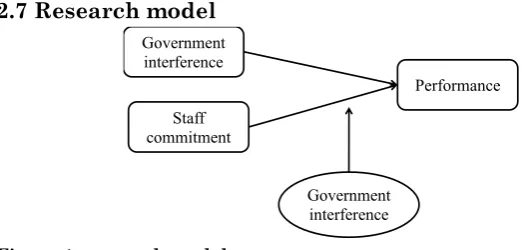
Generally, government interference in the management and running of the affairs the public sector organizations is to fundamentally remedy both the co coordinating and structural failures (Bejorot & Hasselbladh, 2013). Mild inconsistencies and some virtually minor activities being undertaken in the organization strongly affect performance (Savara, 2004). Staff commitment or lack of it always justifies a reason for the government active presence in the management of critical public sector organizations (Zhu, 2014; Bejorot & Hasselbladh, 2013). Sufficient government interference has been cited by researchers as a major factor promoting sound staff commitment which otherwise would have improved general performance of the organization itself (Shunk, Dulay, Chou, Janson & O'Brien, 2014; Zhu, 2014; Nosal & Ordonez, 2016). Besides, big Push from external elements simultaneously generated by well found needs brings about efficient & better staff commitment (Nosal & Ordonez, 2016), this willingly implies that, performance of the organization would be boosted. Specifically, the aforementioned assertions stressed that, good staff commitment hinges on strong push from external elements. By so doing, the absorptive capacity and performance of the organization would be enhanced. Thus, the following hypothesis is proposed for comprehensive examination of the moderating effect of the government interference on the staff commitment and performance.
2.6Theoretical framework underpinning the study
The Evaluative theory was anchored as the theoretical framework for analysis in this study because of its simplicity and adequacy in assessing a given Programme, as was the case of NNPC. The theory proposed five modalities or criteria by which the success and failure of a programme could be evaluated. This includes an evaluation of effort, performance, and adequacy of performance, efficiency, and process.
Effort: Effort here implied the various resources made available to NNPC to carry out its activities. Thus, in terms of assessing NNPC, the study examined the efforts put in place to achieve the stated objectives of the corporation. These efforts include the strategy/ approach, and structure put in place to the aim of the NNPC
The Performance aspect had to do with Output. This essentially referred to the outcome of the various products in terms of the number of intended beneficiaries who had benefited from the products. The question was how many people had actually been reached in terms of products like; kerosene, pms, ago, dpk ask, etc services provided by NNPC.
The Adequacy of Performance (effectiveness) in this study basically hinged on the ability of NNPC through the various products mentioned above to meet the priority or needs of the people. Here the appropriateness, relevance and suitability of the various projects and Programmes to the needs of the beneficiaries in their various communities were determined. Also, the appropriateness, relevance and suitability of the approach, structure, funding of its operations.
was does the efforts in terms of time, human, financial, material and other resources actually committed worth the achievement or success (service delivery) achieved so far?
Process: Finally on the evaluation criteria is the Process. In evaluating the Process, the study examined the strategy, structure, funding among others of NNPC with a view to identifying constraints (if any) which constituted an impediment in the achievement of its overall objectives. After identifying the constraints, recommendations were made on how the corporation can be made more functional and effective in economic development in Nigeria.It was against this background that this study adopted the Evaluative theory as the theoretical framework for analysis.
2.7 Research model
Figure 1: research model
3. Research methodology
3.1 Research design
A survey research design is used for the purpose of this study because the researcher used a structure questionnaire which was administered to the participants. The use of questionnaires is advantageous because questionnaires are economical, speedy, there is no bias (as in interviews), and the possibility of anonymity and privacy encourages candidates to be willing to respond on sensitive issues, and do so honestly.
3.2 population and Sample size
The population of this study comprises of the entire middle cadre staff of the NNPC. The total population of the middle cadre NNPC staff is 6,342 (Erne, Chukwurah & Iheanacho, 2015). This number involved only middle level personnel. It is worthy to note that, in this study the sample size of the study is automatically drawn from the Krejcie and Morgan table (1970) specifically established for determining the sample size. Therefore, based on the NNPC Bulletin (2016), there is 15,350 staff currently engaged in the organization. Out of this number, 6,342 are middle cadre staff. Therefore, since the focus of this study is the middle cadre staff, then, the sample is drawn from this number using Krejcie & Morgan (1970) table. Thus, 361 staff was selected as the study's sample size. However, to minimize errors in sampling and to avoid non-response problem, the sample size was multiplied by 2. Therefore, 722 questionnaires was administered in order to get enough response for the conduct of effective statistical analysis. The lower the sample size the higher the tendencies of errors and less accurate the validity and the precision of the study's conclusions (Hair et al, 2010).
3.3 Measurement and Instruments
and their reliability values were within acceptable value of 0.7 and above as recommended by Hair et’al (2013).
3.4 Data analysis technique
The study utilized SmartPLS 3 in order to compute the two basic model of PLS path modeling which includes measurement model and structural model. Some of the reasons for the use of PLS were its superiority over others in terms of flexible restriction in respect distribution and population of the study as noted by Haenlein and Kaplan (2004) and it has the possibility of providing a more reliable and accurate computations of mediating effect because its accounts for error that is capable of reducing the possible relationship as well as the improvement of the validation of the theory (Henseler & Fassott, 2010).
4. Results and discussions
In using PLS-SEM, Garson (2016) specified two models that must be examined, the measurement (outer) model and the structural (inner) model.
4.1Measurement Model
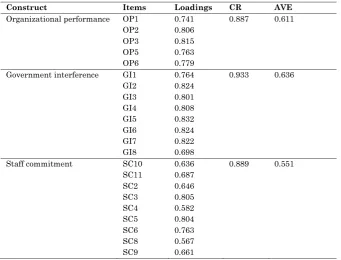
the values of AVE were greater than 0.5, as it ranges between .551 and .636. These are presented in table 4.1.
Table 4.1
Construct reliability and convergent validity
Construct Items Loadings CR AVE
Organizational performance OP1 0.741 0.887 0.611 OP2 0.806
OP3 0.815 OP5 0.763
OP6 0.779
Government interference GI1 0.764 0.933 0.636 GI2 0.824
GI3 0.801 GI4 0.808 GI5 0.832 GI6 0.824 GI7 0.822
GI8 0.698
Staff commitment SC10 0.636 0.889 0.551 SC11 0.687
SC2 0.646 SC3 0.805 SC4 0.582 SC5 0.804 SC6 0.763 SC8 0.567
SC9 0.661
Table 4.2
Discriminates validity
Government interference
Organizational performance
Staff commitment Government
interference 0.798 Organizational
performance 0.392 0.782
Staff commitment 0.448 0.575 0.742
The square roots of AVE are presented in bolded font on the diagonal and it can be observed that the values are greater than the correlations among the constructs, thus this criterion is satisfied.
4.2Structural model (Inner model)
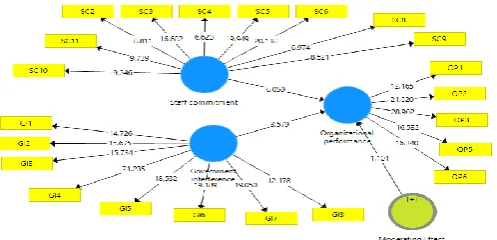
Figure 2: Structural model
4.2.1 Test of hypotheses
Table 4.3 presented the results of the structural model with the beta value of the relationships, t-statistic and adjusted r square. From table 4.3, it can be seen that Staff commitment has positive relationship with organizational performance (beta =0.575, p value<0.05), Government interference is positively related to organizational performance (beta = 0.392, p value <0.05) and Government interference does not significantly affect organizational performance (beta = 0.094, p value > 0.05).
Table 4.3
Path coefficients
Hypotheses Relationship Beta Std err T-value P-value Decision H1 SC=>OP 0.575 0.099 5.826 0.000 Rejected H2 GI=>OP 0.392 0.115 3.401 0.001 Rejected H3 GI*SC=>OP 0.094 0.091 1.032 0.303 Accepted
R2 0.703
organizational performance is also not supported. Finally, government interference does not significantly affect the relationship between staff commitment and organizational performance significant at p value >0.05. Thus, our third hypothesis which states that government interference moderates the relationship between staff commitment and organizational performance is rejected.
4.2.2 Effect size and predictive relevance
The study assessed the effect size of the exogenous variables (staff commitment and government interference and GI * SC) on endogenous variable (organizational performance) using the f2. Cohen (1988) recommended that f2values of 0.02, 0.15, and
0.35, to represents small, medium, and large effects respectively. Q2 was used to determine the predictive relevance
of the exogenous variable. According to Garson (2016), Q2 value
of 0 or negative showed that the model is irrelevant in predictive the endogenous variable the results are presented in table 4.4 below
Table 4.4
Construct f2 Effect size
Staff commitment 0.619 Large
Government interference 0.268 Mediun
Q2 0.361
The f2 value for staff commitment is 0.619 indicating a large
effect size, government interference has 0.268 effect size which implied medium effect size. Also the Q2 of the model stood at
5. Discussion of findings
Staff commitment was discovered to have significant positive effect on performance. This implies that with higher commitment, performance higher. This finding is consistent with the findings of previous studies (e.g., Gould—Williams, 2004; Fu & Desponded, 2014; Aina et al., 2012). A staff who perceived his/her job to be satisfactory will be highly commited to the job and the resulting outcome is improvement in performance. This explained the positive relationship found in this study. Government interference was discovered to have a significant positive effect on organizational performance. This finding is in line with the position of Zhu (2014); Jensen, Scoth, Slocombe, Boyd & Cowey (2014).
6. Conclusions and Recommendations
The study, based on the findings, concludes that staff commitment and government interference have significant effect on organizational performance and that government interference does not significantly moderates the relationship between staff commitment and organizational performance. Based on the findings and conclusion of this study, the study recommended that NNPC can make considerable efforts in improving the performance of the organization by enhancing staff commitment to both their job and their organization. By creating a fair motivation and convenient environment, management of NNPC can improve the tendency of staff to engage in cynic behaviour at work. For example, rewarding those staff who accomplishes their goals by behaving in ways that are consistent with stated norms and punishing deviant acts can enhance the perceptions of formal control system in organizations. Government should also strive constantly supervise the activities of the corporation as this would the performance of the organization.
The results of the current study suggest though that government interference was not a significant moderator of the relationship between staff commitment, corruption, pipelines vandalism and organizational performance, this by implication, does not mean government should desist from intervening in the affairs of the NNPC, rather they should select agents or representatives trust worthy for intervention roles. Lay down guidelines and rules and regulations should be provided for strict compliance.
does not allow causal inferences to be made from the population. Therefore, a longitudinal design in future needs to be considered to measure the theoretical constructs at different points in time to confirm the findings of the present study.
Secondly, organizational performance was assessed using self-report measures. Self-report measures are valid in assessing organizational performance at work particularly when anonymity was assured during the data collection (Bennett & Robinson, 2000). Nevertheless, the use of self-reports is associated with common method variance (Podsakoff et al., 2003) and social desirability bias (Dodaj, 2012 & Podsakoff & Organ, 1986). Although this study attempts to reduce these problems by ensuring anonymity and improving scale items, it is possible that the participants in this study might have over-reported organizational performance on their survey questionnaires. Therefore, in the future, researchers may wish to employ other strategies to assess organizational performance. More specifically, financial performance, productivity, their effectiveness and efficiencies and level of revenue should be used to control for the common method variance and social desirability bias.
REFERENCES
1. Aina, S., Adeyeye, F. and Ige, K. (2012), ―Organization Culture and Employees Commitment in Public Tertiary Institutions in Lagos State‖, Nigeria European Journal of Globalization and Development Research vol. 3, no. 1, pp. 127-142.
3. Alvesson, M., & Sandberg, J. (2013). Has management studies lost its way? Ideas for more imaginative and innovative research. Journal of Management Studies, 50(1), 128-152.
4. Becker, B. E., Huselid, M. A., Becker, B. E., & Huselid, M. A. (1998). High performance work systems and firm performance: A synthesis of research and managerial implications. In Research in personnel and human resource management.
5. Brinkerhoff, D. W., & Brinkerhoff, J. M. (2015). Public sector management reform in developing countries: Perspectives beyond NPM orthodoxy. Public Administration and Development, 35(4), 222-237.
6. Chen, Z. X., & Francesco, A. M. (2003). The relationship between the three components of commitment and employee performance in China. Journal of Vocational Behavior, 62(3), 490-510.
7. Chen, Z. X., Tsui, A. S., & Farh, J. L. (2002). Loyalty to supervisor vs. organizational commitment: Relationships to employee performance in China. Journal of occupational and organizational psychology, 75(3), 339-356.
8. De Montclos, M. A. P. (2014). The politics and crisis of the Petroleum Industry Bill in Nigeria. The Journal of Modern African Studies, 52(03), 403-424.
9. Echendu, J. C., Iledare, O. O., & Onwuka, E. I. (2012, January). Comparative Performance Analysis of Petroleum Sharing Contracts in Angola, Equatorial Guinea, Gabon and Nigeria. In Nigeria Annual International Conference and Exhibition. Society of Petroleum Engineers.
11.Erne, O. L, Chukwurah, D. C., & Iheanacho, E. N. (2015). Addressing Revenue Leakages In Nigeria. Arabian Journal
of Business and Management Review (Oman Chapter), 5(4),
1.
12.Essia, U. (2012). Oil Revenue and Development Performance in Nigeria: Cursed By Resources, Institutions or Capabilities?. British Journal of Economics, Finance and Management Sciences, 6(2).
13.Estache, A., & Kouassi, E. (2002). Sector organization, governance, and the inefficiency of African water utilities. World Bank Policy Research Working Paper, (2890).
14.Esu, B. B., & Inyang, B. J. (2009). A case for performance management in the public sector in Nigeria. International Journal of Business and Management, 4(4), 98.
15.Esu, B. B., & Inyang, B. J. (2009). A case for performance management in the public sector in Nigeria. International Journal of Business and Management, 4(4), 98.
16.Frazier, P. A., Tix, A. P., & Barren, K. E. (2004). Testing moderator and mediator effects in counseling psychology research. Journal of counseling psychology, 51(1), 115. 17.Gberevbie, D. E. (2008). Staff recruitment, retention
strategies and performance of selected public and private organizations in Nigeria (Doctoral dissertation, Covenant University Ota).
18.Guay, R. P., Choi, D., Oh, I. S., Mitchell, M. S., Mount, M. K., & Shin, K. H. (2016). Why people harm the organization and its members: Relationships among personality, organizational commitment, and workplace deviance. Human Performance, 29(1), 1-15.
19.Hair, J. F., Ringle, C. M., & Sarstedt, M. (2013). Partial least squares structural equation modeling: Rigorous applications, better results and higher acceptance. Long
Range Planning, 46(1–2), 1-12. doi:
20.Hair, J. F., Black, W. C., Babin, B. J., & Anderson, R. E. (2010). Multivariate data analysis (7th ed.). Upper Saddle River, New Jersey: Prentice Hall.
21.lachan, R. (2009). A Brazilian experience: 40 years using operations research at Petrobras. International Transactions in Operational Research, 16(5), 585-593.
22.Ismaila, B., Miracle Olanrewaju, O., & Richard Olayiwola, F. (2012). A review of performance appraisals of Nigerian Federal Government-Owned Refineries. Energy and Power Engineering, 2012.
23.Jensen, K., Scott, R., Slocombe, L., Boyd, R., & Cowey, L. (2014). The management and organisational challenges of more joined-up government: New Zealand's Better Public Services reforms.
24.Lau, P. Y. Y., Tong, J. L. T., Lien, B. Y. H., Hsu, Y. C., & Chong, C. L. (2017). Ethical work climate, employee commitment and proactive customer service performance: Test of the mediating effects of organizational politics. Journal of Retailing and Consumer Services, 35, 20-26. 25.McPherson, C. (2003). National oil companies: Evolution,
issues, outlook. Fiscal policy formulation and implementation in oil-producing countries, 184-203.
26.Mowday, R. T., Porter, L. W., & Steers, R. M. (2013). Employee—organization linkages: The psychology of commitment, absenteeism, and turnover. Academic press. 27.Nosal, J. B., & Ordonez, G. (2016). Uncertainty as
commitment. Journal of Monetary Economics, 80, 124-140. 28.Okpanachi, E. (2011). Confronting the Governance
Challenges of Developing Nigeria's Extractive Industry: Policy and Performance in the Oil and Gas Sectorl. Review of Policy Research, 28(1), 25-47.
Some conceptual and contextual issues. Journal of Human Resources Management and Labor Studies, 2(2), 113-128. 30.Odularu, G. O. (2008). Crude oil and the Nigerian economic
performance. Oil and Gas business, 1-29.
31.Odularu, G. O. (2008). Crude oil and the Nigerian economic performance. Oil and Gas business, 1-29.
32.Okafor, E. E. (2007). Rethinking African development: a critical overview of recent developments in the petroleum sub-sector in Nigeria. Journal of Social Science, 75(1), 17-29.
33.Okolo, P. O., & Etekpe, A. (2010). Oil Pipeline Vandalization and the Socio-Economic Effects in Nigeria's Niger Delta Region. Available at SSRN1723169.
34.Okoli, A. C., & Orinya, S. (2013). Oil pipeline vandalism and Nigeria's national security. Glob J Hum SocSci, 13(5), 67-75.
35.Pillai, R., & Williams, E. A. (2004). Transformational leadership, self-efficacy, group cohesiveness, commitment, and performance. Journal of organizational change management, 17(2), 144-159.
36.Shunk, R., Dulay, M., Chou, C. L., Janson, S., & O'Brien, B. C. (2014). Huddle-coaching: a dynamic intervention for trainees and staff to support team-based care. Academic Medicine, 89(2), 244-250.
37.Sharma, J., & Dhar, R. L. (2016). Factors influencing job performance of nursing staff:mediating role of affective commitment. Personnel Review, 45(1), 161-182.
38.Sayne .A, Gillies .A. & Katsouris .C (2015) Inside NNPC Oil Sales: A Case for Reform in Nigeria. Natural resources governance institute
40.Taylor, I. (2006). China's oil diplomacy in Africa. International affairs, 82(5), 937-959.
41.Udofia, O. O., & Joel, O. F. (2012, January). Pipeline Vandalism in Nigeria: Recommended Best Practice of Checking the Menace. In Nigeria Annual International Conference and Exhibition. Society of Petroleum Engineers 42.Wei, Y. S., Samiee, S., & Lee, R. P. (2014). The influence of
organic organizational cultures, market responsiveness, and product strategy on firm performance in an emerging market. Journal of the Academy of Marketing Science, 42(\), 49-70.
43.Yo-Essien, L. P. E. (2008). Oil spill management in Nigeria: challenges of pipeline vandalism in the Niger Delta region of Nigeria. In Proc. Int. Petr. Env. Conf.