EMG Based Human Motion Identification and
Person Postioning Using Low Cost Embedded
System
S.Jegadeesan, M.Mahalakshmi
Associative Professor, Dept. of Electronics and Communication Engineering, V.S.B. Engineering College, Karur, India
PG Student, Dept. of Electronics and Communication Engineering, V.S.B. Engineering College, Karur, India
ABSTRACT: This paper shows the feasibility of using EMG sensors in sensing muscle activities to detect the corresponding locomotion patterns, and as a result, this approach recognizes different locomotion patterns using EMG signals and constructs stride length models according to the recognition results, is then used to improve the positioning accuracy and robustness of the EMG-based PDR solution by adapting the stride length model into different locomotion patterns.
I. INTRODUCTION
As the need for prosthetic hands has grown, those going beyond cosmetic applications have been requested in order to improve the amputee’s Activity of Daily Living (ADL) [1]. So, it becomes important to develop active prosthetic hands reflecting the user’s intent. Electromyogram (EMG), studied for use as control signals for powered prosthetic hands, involves electrical signals based on motor commands from the brain, that arises about 100 ms earlier than motor actions and effectively reflect an amputee’s intent. Conventional approaches determining motor intent from EMG are roughly classified into 1) Directly estimating deriving torque from EMG, and 2) Identifying intended movement patterns from EMG. The first approach enables the prosthetic hand to control movement by estimating the muscle tension from EMG as a continuous value [2]. EMG sensors in sensing muscle activities to detect the corresponding locomotion patterns, and as a result, this approach recognizes different locomotion patterns using EMG signals and constructs stride length models according to the recognition results, is then used to improve the positioning accuracy and robustness of the EMG-based solution by adapting the stride length model into different locomotion patterns.
A method mimicking dynamic neuromuscular control, which represents the relationship between myoelectric action potential and muscle tension taking into account muscle visco elasticity and stretch reflexes . This enables mechanical impedance to be varied as is done with the human hands. To adapt to multiple Degrees-of-Freedom (DOF), however, it is necessary to identify various muscles combinations. Morita et al. [3] Achieved palmar and dorsal flexion by directly determining driving torque from EMG using an artificial neural network .The second approach extracts feature vectors and discriminates among motor intents to control the prosthetic hand [4]. Tsuji et al. [5] Conducted six movement discrimination using the AR (autoregressive) model and discrimination functions, realizing a discrimination rate of 93%with stationary EMG of 100ms. Hudgins et al. [6] Improved the discrimination rate using multiple sets of features obtained from a 200ms-EMG with an Artificial Neural Network (ANN).Francis et al. [7] Achieved a similar result by combining fuzzy and neural networks.
II.PREVIOUS WORKS
Certain feature sets, such as the wavelet packet transform, have to be used in conjunction with dimension reduction algorithms such as principal components analysis or linear discriminant.
To estimate the angular velocity and position of a human elbow joint from the EMG signals measured by surface electrodes that were placed on the biceps brachii. An Inertial Measurement Unit (IMU) was also attached to the human forearm to actually measure the elbow joint movements and used as a reference to verify the estimations. All the results of the EMG-model-based estimations were compared with the IMU measurements, to demonstrate the validity and improvements of the proposed methods
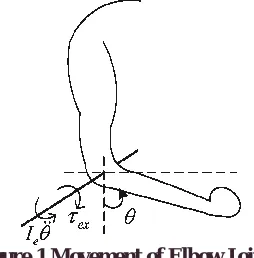
Figure 1 Movement of Elbow Joint
where Ie is the moment of inertia of the forearm about the elbow joint, which is assumed to be constant for a
fixed external load, τex is a combination of the external torque and the forearm gravity torque, and τex_max is the
maximum value of τex.
By substituting the identified parameters into the state-space model of (19), we were able to use the EKF algorithm to estimate the motion states of the human arm only with the EMG measurements. In order to verify the improvement of the measurement equation, first, we used only the state equation of (14) to do the EKF-based estimation. Then, we used both the state and feedback equations of (19) to perform the same EKF estimation.
III.PROPOSED METHOD
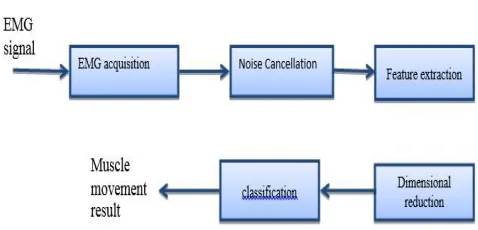
Figure 2 Block Diagram of Simulation
MUSCLE ACTIVATION DYNAMICS
The transformation from EMG to muscle activation is not trivial. In this section we will examine the many steps necessary to perform this transformation, but one should keep in mind that most researchers use a subset of the approaches that will be described.
u (t ) =α e (t − d ) − β1 u (t − 1) − β2 u (t − 2)
The basic steps can be seen in. Although some type of mathematical transformation must be performed it is often combined with the next stage in the process—muscle contraction dynamics . Although the technique has provided impressive results, it is not currently feasible to implement the required instrumentation in a form factor suitable for integration in a prosthesis in which the tendons of muscles are connected to external cables, offer a more accurate measurement of tendon excursion. To estimate the angular velocity and position of a human elbow joint from the EMG signals measured by surface electrodes that were placed on the biceps brachii.
EMG PROCESSING
The purpose of EMG signal processing is to determine each muscle’s activation profile. A raw EMG signal is a voltage that is both positive and negative, whereas muscle activation is expressed as a number between 0 and 1, which is smoothed or filtered to account for the way EMG is related to force .The first task is to process the raw EMG signal into a form that, after further manipulation, can be used to estimate muscle activation. To accomplish this, the first step is to remove any DC offsets or low frequency noise. With low quality amplifiers or movement of the electrodes, it is possible to see the value of the mean signal of the raw EMG change over time. This must be done before rectifying and the cutoff frequency should be in the range of 5–30 Hz, depending on the type of filter and electrodes used.
u (t ) =α e (t − d ) − β1 u (t − 1) − β2 u (t − 2)
Once this is done, it is safe to rectify the signal where the absolute values of each point are taken, resulting a rectified EMG signal .The simplest way to transform rectified EMG to muscle activation is to normalize the EMG signal, which is done by dividing it by the peak rectified EMG value obtained during a maximum voluntary contraction (MVC), and then applying a low-pass filter to the resultant signal. The bottom line is that if the normalized EMG signal ever goes over 1.0, it is clear that the maximum values were not properly obtained. Well motivated participants can reach true maximal values.
for the EMG signal to be correlated with the muscle force, it is important to filter out the high-frequency components. The cutoff frequency will vary with the sharpness of the filter used, but something in the range of 3 to 10 Hz is typical.
ACTIVATION DYNAMICS
Is normalized, rectified, filtered EMG appropriate to use for values of muscle activation? For some muscles during static conditions it may be reasonable, but in general a more detailedmodel of muscle activation dynamics is warranted in order to characterize the time varying features of the EMG signal.
IV. SIMULATION RESULTS
A.OUTPUT- Muscle classified signal
Figure 3 Input Signal
Figure 4 Filtered Output
B. COMPARISON TABLE
S.No Existing method Proposed method Advantage In Proposed method 1. Torque
sensor
EMG Electrode
Power is less
2. Kalman filter
NMF Algorithm
More accurate
3. HMM
Model State space model High reliability of execution V. CONCLUSION
In this paper, an EMG-driven state-space model for joint motion estimation was constructed, where the continuous angular displacement and velocity could be estimated using only the EMG signals. Extensive experiments, as well as the comparison between the estimations and IMU measurements demonstrated the effectiveness of the proposed model. Also used the estimations to control a robotic arm tracking human movements, which showed the possibility that the proposed method to be used in robotic assisted rehabilitation. Method satisfactorily works even for estimation of forces exerted by the hand contra-lateral respect to the side where the EMG is recorded during mirrored bilateral movements. Nevertheless, this approach was limited to two DOFs movements whereas for a clinical application it is necessary to include pronation / supination movements. The scheme proposed in this study provided performance comparable for both contra-lateral hand at the three DOFs, making the training strategy suitable for practical application.
.
REFERENCES
[1] Koji Ito, Ayuko Ibe and Manabu Gouko,” Discrimination of Intended Motions for Prosthetic Hands using Non stationary EMG” ,2009 IEEE paper proposes a multiple neural network to determine the movement intended by an amputee from Electromyogram (EMG) signals
[2] P. Geethanjali, Member, IEEE, and K. K. Ray,” A Low-Cost Real-Time Research Platform for EMG Pattern Recognition-Based Prosthetic Hand”, IEEE/ASME TRANSACTIONS ON MECHATRONICS, VOL. 20, NO. 4, AUGUST 2013
[3] Silvia Muceli, Student Member, IEEE, Ning Jiang, Member, IEEE, Dario Farina, Senior Member, IEEE, ”Multichannel Surface EMG Based Estimation of Bilateral Hand Kinematics during Movements at Multiple Degrees of Freedom”, 32nd Annual International Conference of the IEEE EMBS Buenos Aires, Argentina, August 31 - September 4, 2010
[4] Chiharu Ishii Akitoshi Harada and Takashi Nakakuki Hiroshi Hashimoto,” Control of Myoelectric Prosthetic Hand Based on Surface EMG”, Proceedings of the 2011 IEEE International Conference on Mechatronics and Automation August 7 - 10, Beijing, China
[5] Nozomu Araki, Kenji Inaya, Yasuo Konishi and Kunihiko Mabuchi,”An Artificial Finger Robot Motion Control Based on Finger Joint Angle Estimation from EMG Signals for a Robot Prosthetic Hand System”, Proceedings of the 2012 International Conference on Advanced Mechatronic Systems, Tokyo, Japan, September 18-21, 2012
[6] Beyda TAŞAR, Turgay KAYA, Arif GÜLTEN,”CONTROL OF ROBOTIC HAND SIMULATOR via HUMAN HAND MOTION ANALYSIS BASED ON EMG”, 2014 IEEE 22nd Signal Processing and Communications Applications Conference (SIU 2014)
[7] Masahiro Yoshikawa1, Yuya Taguchi1 2, Noritaka Kawashima3, Yoshio Matsumoto1, and Tsukasa Ogasawara,” Hand Motion Recognition Using Hybrid Sensors Consisting of EMG Sensors and Optical Distance Sensors”, 2012 IEEE RO-MAN: The 21st IEEE International Symposium on Robot and Human Interactive Communication. September 9-13, 2012. Paris, France
[8] Jin Zhong, Jun Shi, Yin Cai, Qi Zhang, Member, IEEE,”Recognition of Hand Motions via Surface EMG Signal with Rough Entropy “,33rd Annual International Conference of the IEEE EMBS Boston, Massachusetts USA, August 30 - September 3, 2011.
[9] Guanglin Li,” Electromyography Pattern-Recognition-Based Control of Powered Multifunctional Upper-Limb Prostheses”, Shenzhen Institutes of Advanced Technology, CAS P. R. China.
[10] M. Khezri and M. Jahed, “A neuro-fuzzy inference system for EMG based identification of hand motion commands,” IEEE Trans. Ind. Electron., vol. 58, no. 5, pp. 1952–1960, May 2011.