Finger Vein Recognition Using computational
Intelligence Techniques
RamaPrabha R1,
Prof Dr. Vasantha Kalyani David2
1,2
Computer Science,
Avinashilingam Institute for Home Science and Higher Education for Women
Abstract- Nowadays, personal identification plays a major
role in authentication process in many fields. This paper proposes computational intelligence methods for personal authentication in a biometric system. A personal identification system can be implemented by using finger vein biometric trait. Finger vein recognition has a lot of advantages compare to other biometric trait. This system is trained using Genetic based Principal Component Analysis for extraction of vein pattern and Back Propagation Network for pattern matching of the finger vein. The proposed system consumes high performance, reduced power and overcomes the disadvantages of existing system. This paper shows the finger vein framework with the parameter of false acceptance rate (FAR), false rejection rate (FRR) and total execution time for the system.
Index Terms- Personal identification, Finger vein pattern, genetic PCA, Back Propagation Network, False acceptance rate, False rejection rate.
I.INTRODUCTION
As the number of activities has been increased in the internet it is impossible to secure personal authentication which affects individual persons. So authentication plays an important role in a person’s life. Biometric system is developed to protect and safeguard the identity of the person’s information. In a biometric system identifiers cannot be misplaced. Biometric system utilizes pattern recognition which analyzes the physiological characteristics and biological characteristics. The uniqueness and persistence of finger images are well known for biometric system. The finger image consists of both finger print and finger vein image. Finger print has been used in many applications, but it is exposed to others and hence vulnerable to forgery. To overcome this, finger vein has been considered. Finger vein recognition comes below physiological characteristics which uses vein pattern from fingers for human identification. The finger vein image is basically captured by Infra Red light which can be observed effectively by hemoglobin in the blood of vein which makes the vein pattern appear darker.
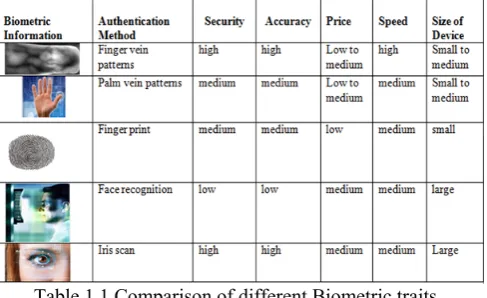
Finger vein system has several benefits. It is hard to replicate, quality of image is not influenced by skin conditions, device is smaller [1,3] and contactless. From the table 1.1 it is clear that finger vein provides the better effectiveness.
Table 1.1 Comparison of different Biometric traits
Even twins do not have identical finger vein patterns. Regardless of advantages there are some challenges to be overcome to achieve high accuracy and performance for this system. The challenges are, poor lighting, recognition rate and misalignment. Computational intelligence methods are used to overcome these challenges, they include genetic algorithm, neural network, fuzzy logic and evolutionary computing.
As the captured image contains noise, vein pattern are extracted after noise reduction and normalization. To get better accuracy more vein pattern is extracted and preserved. Therefore, extracting vein pattern is important for authentication process. Basically vein pattern fall into four forms of board categories such as, tracking based method, transform based method, filter based method and threshold method. This paper focuses on threshold method form of categorizing the vein patterns by implementing it in the extraction methods.
The methods for vein pattern extraction basically fall into three types namely, pattern based, dimensionality reduction based method and local binary based method. This paper proposes thresholds form with dimensionality reduction based method to give accuracy of vein pattern extraction.
The dimensionality reduction based method transform image into low dimensional space to classify. This method includes PCA [16], LDA[17], (2D)2PCA[18] and manifold
learning[8] used. It needs the training process to learn a transform matrix.
Local binary based methods are based on binary formation. The local binary pattern(LBP)[6], the local line
binary pattern(LLBP)[13],personalized bit maps(PBM)[18], personalized weight map(PWM)[14] and
local directional code(LDC) methods are used to measure the similarity distance between the vein features. In this paper, PCA is used to extract features and thus reduce data dimension. Genetic Programming is then applied to the extracted features to get the optimized features.
The focus is on the “feature extraction” step, and the preprocessing step is kept as simple as possible. As for matching, Back Propagation Network is used to calculate match and mismatch ratio. For performance evaluation, the SDUMLA-HMT finger vein database that is publicly available is used.
Yang et al [17] proposed the width of phalangeal joint as a soft biometric trait to enhance the recognition accuracy for finger vein. Kono et al [18], Japanese medical researchers, proposed finger vein based identity identification, and gave an effective feature extraction method. Yanagawa et al [19] proved the diversity of human finger vein patterns and the usefulness of finger veins for identity identification on 2024 fingers of 506 persons.
The rest of the paper is organised as follows: in section 2 research elaborations are carried out, section 3 presents the results and discussion and section 4 discuss the conclusion and future work.
II – RESEARCH ELABORATIONS
Finger vein recognition has following four main steps image capturing
pre-processing feature extraction matching
Image Acqusition or Input Image:
The device for image acquistion of a finger vein system is through the use of a infrared(IR) illumination system whose objective is to create the required lighting conditions to generate an input frame for the infrared sensor from the light that passes through the user fingers and extracts a pattern in the input image. In this light transmission method the infrared light is placed in finger’s dorsal side and the light will penetrate the finger. An infrared light illuminates the backside of the hand and the light passes through the finger. The intensity of the light is adjusted according to the brightness of tne image from the LED. It can capture high-contrast images. The data are collected from both public finger vein database, namely SDUMLA-HMT database and from typical database. In the capturing process, each subject was asked to provide images of his/her index finger of both hands. Therefore, this finger vein database consisit of 150 image samples. Every image is stored in “jpg “ format with 320x240 pixels in size and each image is in grayscale. The length of the
finger is in horizontal direction, the fingertip is on the right side of the image.
Image pre-processing
After the finger vein image is captured image, it is required to pre-process the raw image before feature extraction is carried out. The captured finger vein images are noisy and of low contrast with translational and rotational variations from unconstrained imaging. Initially in samples of finger vein image pre-processing involves image enhancement, image ROI detection, image normalization and image filtering as shown in the figure 1.1
Figure 1.1 Pre-processing methods
The elaborate sub-blocks of Pre-Processing methods are as follows:
1. Colour to Gray scale conversion 2. Histogram equalization
3. Gray scale median filter
4. Finger foreground detection(ROI) 5. Binarization
6. Thinning
Colour to Gray scale conversion:
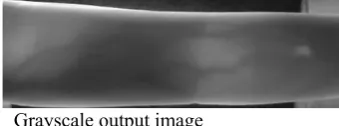
As the raw finger vein image occupy nearly 3 bytes per pixel the memory space and time consumption will be high. To solve this problem the first step of pre-processing is colour to gray scale conversion. The raw finger vein image which is in RGB format is converted to Gray scale image to reduce the size from 3 bytes. Due to this, while storing the template the image will occupy less memory space in the board. The sample output of the image is shown below
Grayscale output image Histogram Equalization:
Histogram Equalization increases the contrast of images by changing the values in the intensity image and the values in the indexed image, so that the histogram of the output image matches the specified histogram. Approximately identical number of pixels are portrayed to each of the levels in the output image, so that the histogram of output image is roughly flat. The sample output of histogram image is shown below
Output of histogram equalization
Preprocessing
Image Normalization
Image Filtering Image ROI Detection
Gray scale Median Filter:
To minimize the significant effect of the noisy background and to smoothen the noisy background a gray scale median filter is applied to the gray scale image. It helps for the detection of better finger region in the next step of process. The sample output of the filter image is shown below
Output of Gray scale Median filter Finger Foreground Region Extraction:
A segmentation process is performed to distinguish the finger region from the background. This process includes the following three steps[13]:
canny edge detection technique is used to detect the edge of the finger region
smoothing where the edge is smoothed to join the broken edge
filling the region inside the finger region is filled with white pixels (255)
The sample output of ROI detection is shown below
Output of finger foreground extraction Binarization:
It is the technique to convert the gray scale image into the black pixel value(0) and white pixel value(255) which is known as bi-level representation. Binarization extracts the approximate vein patterns from the captured finger vein image. The sample output of binarization is shown below
Output of Binarization image Thinning:
Thinning process gives the binding vein pattern from the binarized image, the extraction of the skeleton image of the vein texture consist of only a single pixel value. The pattern yield by this process almost matches with the original vein image. This output is provided as the input of the next process to extract its hidden features. The sample output of thinning process is shown below
Output after thinning process
Feature Extraction:
Next step of pre-processing is feature extraction. This section describes the feature extraction process extracted from the vein pattern. In this the images are represented in numerical features to eliminate redundancy and to minimize dimension. Nan Liu and Han Wang(2006) proposed Genetic based PCA(GPCA) to extract the features of finger vein patterns. The Genetic algorithm is combined with PCA to select a more relevant feature set vector from the vein patterns. By using GPCA, the dimensionality of the vector space is reduced and that result is given to the input of the classifier
Genetic Programming
Genetic programming is a methodology inspired by bio-logical evolution to find equations, computer programs, analog circuits or in general any suitable structure for a predefined problem [9]. Genetic programming’s general mechanisms are almost identical to genetic algorithms, as genetic programming is considered either as a specialized form of genetic algorithms or an expansion of it [6]. Genetic programming is usually implemented similar to the following algorithm:
1) Create initial population. Individual solutions are usually generated randomly.
2) Evaluate the fitness of each individual in the popu-lation. 3) Select best-ranking individuals to reproduce.
4) Breed new generation through crossover and/or mutation (genetic operations) and give birth to offspring.
5) Repeat from step 2 until a termination condition is reached (time limit or sufficient fitness achieved).
After obtaining the selected features the values are rounded off , and that value is sent as input to the next process Neuro- Fuzzy classifier. The output of the Genetic PCA is shown below. Each time when the finger vein patterns are added to the database for extraction, the Genetic PCA value is generated by carrying the above process. GPCA gives the higher extraction accuracy and higher performance.
The sample form of gentic PCA result will be
6.46731 23.45765 27.81263 55.20167 66.84267 The extracted vein patterns of the input image can directly be compared with the templates. A certain distance is defined to calculate the similarity between the template and the input patterns. But when the template is not small, the comparing time lasts long. After pattern extracting process, most systems classify the vein patterns.
Back Propagation Neural Network Classifier
It is a common method of teaching artificial neural networks how to perform a task. It is a supervised learning method and is a generalization of the delta rule. It is mostly used in feed forward networks which process with a back propagation of errors. BPNN requires the activation function used by the artificial neurons.
The algorithm of BPNN is
Give a set of input-output patterns Initial setting of weights are arbitrary
Output signal is equal to the input activation value Activation of unit i in the input layer
Activation of unit k in the output layer Update the weights on output layer Calculate the error
Total error for all patterns
Apply the given patterns one by one to update the weights until the total error reduces to an acceptable value.
III – RESULTS AND DISCUSSSION
As seen in the finger vein recognition literature the methods are compared based on the FAR and FRR
Genetic PCA
Genetic PCA method is outlined in this Section 3. The features are extracted to reduce the dimensionality of the features by using GPCA.Table 1.2 shows the comparison of extraction techniques. The comparison GPCA performs with consistent and improved performance.
Optimization
Technique Features Input Features Optimal Optimization Accuracy of
PCA 424 27 82%
Fuzzy 424 23 80%
GPCA 424 36 87%
Table 1.2 comparison of extraction technique
From the above table it is clearly known that genetic PCA acquires more accuracy than other optimization technique. Based on the threshold value the false acceptance rate and false rejection rate are identified for BPNN classifier
BPNN Classifier Identification
Method Threshold value FAR % FRR %
BPN
0.55 0 5.45
0.50 0.125 2.92
0.45 0.250 1.45
0.40 0.575 1.70
0.30 1.310 0.29
Table 1.3 results of FAR and FRR
From the above table threshold is obtained to be 0.40 which is a good recognition rate.
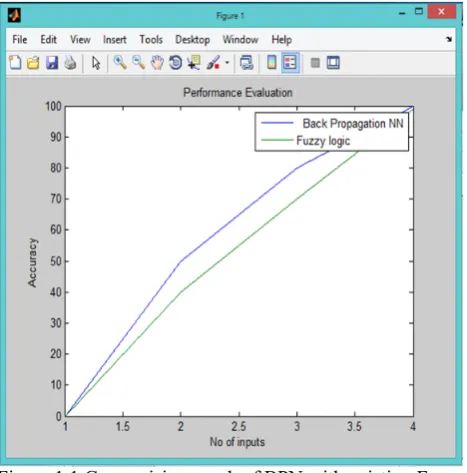
Figure 1.1 Comparision graph of BPN with existing Fuzzy logic
Figure 1.2 Performance evlauation
Approach No .of input neurons No .of output neurons No.of Hidden layers Learning Rate Learning Time(μs) Recognition Accuracy Back propogation
network 25 1 5 0.92 0.65 94.59%
Table 1.4 accuracy calculation of BPN
Table 1.5 Total Execution time
Process Type Proposed System
Preprocessing 58 milliseconds
Image registration 113 milliseconds Feature Extraction 23milliseconds
CONCLUSION
This work presents an algorithm for finger vein authentication. Experimental results show that FFR and FAR are 0.575% and 1.70% respectively with an execution time of 194 milliseconds. Fewer steps improve the processing speed especially suitable for the finger vein authentication system based on DSP. In the future research, will be dedicated to optimize the pre-processing algorithm, especially reduce the noise caused by light sources.
REFERENCES
1. Ajay Kumar, Senior Member, IEEE, and Yingbo Zhou; Human Identification Using Finger Images IEEE TRANSACTIONS ON IMAGE PROCESSING, VOL. 21, NO. 4, APRIL 2012.
2. Dai, Y.G., Huang, B.N., Li, W.X., Xu, Z.Q.: A method for capturing the finger-vein image using nonuniform intensity infrared light. In Proceedings of Congress on Image and Signal Processing, PP: 501-505, Sanya, China, 2008.
3. Dingrui Wan and Jie Zhou, Senior Member, IEEE Fingerprint Recognition Using Model-Based Density Map. IEEE TRANSACTIONS ON IMAGE PROCESSING, VOL. 15, NO. 6, JUNE 2006
4. Faris E.Mohammed, Eman M.AL daidamony, A.M.Raid”Multi Model Biometric Identification System: Finger Vein and Iris”IJSCE, ISSN: 2231-2307,volume 4, sep 2014
5. Kumar, A., Zhou, Y.B.: Human identification using finger images. IEEE Transactions on Image Process, 21(4): 2228–2244, 2012. 6. Lee, H.C., Kang, B.J., Lee, E.C., Park, K.R.: Finger vein recognition
using weighted local binary pattern code based on a support vector machine. Journal of Zhejiang University SCIENCE C, 11(7): 514-524, 2010.
7. Liu, T., Xie, J. B., Yan, W., Li, P.Q., Lu, H.Z.: An algorithm for finger-vein segmentation based on modified repeated line tracking. The Imaging Science Journal, 61(6): 491-502, 2013.
8. Liu, Z., Yin, Y.L., Wang, H., Song, S., Li, Q.: Finger vein recognition with manifold learning. Journal of Network and Computer Applications, 33(3): 275-282,2010
9. Meng, X.J., Yang, G.P., Yin, Y.L., Xiao, R.Y.: Finger vein recognition based on local directional code. Sensors, 12(11): 14937-14952, 2012.
10. Naoto Miura, Akio Nagasaka, Takafumi Miyatake. Feature Extraction of Finger Vein Patterns Based on Repeated Line Tracking and Its Application to Personal Identification [J]. Machine Vision and Applications,2004, 15(4): 194 – 203
11. Naoto Miura, Akio Nagasaka, Takafumi Miyatake. Extraction of Finger-Vein Patterns Using Maximum Curvature Points in Image Profiles[J]. IEICE-Transactions on Information and Systems, 2007, E90-D(8):1185-1194.
12. Qin, H.F., Yu, C.B., Qin, L.: Region growth–based feature extraction method for finger-vein recognition. Optical Engineering, 50(5): 057208-057208, 2011
13. Rosdi, B. A., Shing, C.W., Suandi, S.A.: Finger vein recognition using local line binary pattern. Sensors, 11(12): 11357-11371, 2011. 14. Song, W., Kim, T., Kim, H.C., Choi, J.H., Kong, H. J., Lee, S.R.: A
finger-vein verification system using mean curvature. Pattern Recognition Letter, 32 (11):1541-1547, 2011.
15. Wu, J. D., Liu, C.T.: Finger-vein pattern identification using principal component analysis and the neural network technique. Expert Systems with Applications, 38(5): 5423-5427, 2011
16. Wu, J. D., Liu, C. T.: Finger-vein pattern identification using SVM and neurall network technique. Expert Systems with Applications, 38(11): 14284-14289, 2011.
17. Yang, G.P, Xi, X.M., Yin, Y.L.: Finger vein recognition based on (2D)2PCA and metric learning. Journal of BioMedicine and Biotechnology, 2012:1-9, 2012
18. Yang, G.P., Xi, X.M., Yin, Y.L.: Finger vein recognition based on a personalized best bit map. Sensors 12 (2): 1738-1757, 2012
AUTHORS
R.RAMAPRABHA
M.sc(SoftwareSystems).,M.Phil(Computer Science) Avinashilingam University, Coimbatore