131
Muqarnas form efficiency in diffusing Sound
waves within the Space
Dr. Hanan M. Al jumaily
Associated professor, Architectural Engineering Department Middle East University, Amman, Jordan.
Abstract
This study evaluates the sound performance of Muqarnas geometrical configuration and its effect on diffusing sound waves when exposed to sound source.
A description of Muqarnas design and its element`s composition in addition to a description of different types of sound diffusers geometry is presented. Some Given models are selected in a practical study to evaluate their performance as Sound diffusers. This is done practically by choosing some forms of Muqarnas elements to create a Modular unit that are designed and analyzed as proposed case studies (different types of geometrical design of Muqarnas models) to test the behavior of sound wave spreading and its random reflections from its surfaces.
The objective is to study the Muqarnas form efficiency in scattering sound waves to treat some sound problems and improve the hearing environment within a space by giving the appropriate forms configuration of Muqarnas to act as a sound wave diffuser. This study concludes some useful findings depicting appropriate new forms of Muqarnas that act as efficient sound wave diffusers proposing their location in the closed space.
Keywords: Architectural acoustics, Muqarnas design, Sound diffusion, Diffusers, Muqarnas forms
1.
Introduction
Muqarnas is considered as one of the traditional architectural elements of Islamic and Persian architecture which has been used as a smooth transition from the rectangular basis of the
building to the domed ceiling. Muqarnas can be viewed as an ornamented element which is
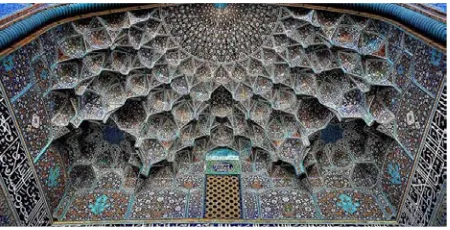
regarded as a sort of wall sculpture adorned with painting or tile mosaics. In its most basic form, Muqarnas is beautiful enough to be more decorated. See [figure 1].
Fig. 1 Muqarnas as an ornamented element(2)
In addition to its ornamental and sculptures role with a certain symbolic meaning, the Muqarnas can work as a specific construction function as well.
www.ijiset.com
132 surfaces and curved ones to be converted from a rectangular to octagonal shape, and then to a circular dome.The study assumes that there is another function for the Muqarnas, which is the dispersion and propagation of the sound waves in closed space, by finding the relationship between the form of the Muqarnas and its efficiency in scattering the sound waves to improve the hearing state inside the space and to eliminate some sound problems.
The study Methodology consists of a brief theoretical background to indicate the effect of Muqarnas as a sound diffuser in a certain space. A hypothesis is set to study the impact of the Muqarnas form configuration on sound waves diffusion to treat one of the main factors affecting sound problems in a closed space like sound coloration and echo…etc. A computer geometrical form simulation of some case studies is applied to test the validity of the given hypothesis using simulated cases of different types of Muqarnas forms.
Results of this study indicate that the configuration forms ofsome merged Muqarnas elements act to disperse the reflected sound waves randomly and so, improve the hearing state.
Hypothesis- The geometrical configuration of Muqarnas forms exposed to the sound wave influence the paths of spreading sound waves and its random reflections which can improve the sound environment.
2.
Muqarnas – Definition
Muqarnas is a structural and decorative architectural component that may appear in different designs and shapes. It consists of different layers of elements called tiers. Among these basic elements we can distinguish cells and intermediate elements. (2)
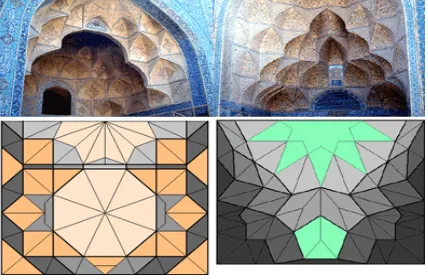
The cells look like small pieces of a vault, while the intermediate elements can be used to combine cells together. Those are formed out of small pointed niches with rhythmic modularity and infinite compositions to break down vaults and domes into multiple facets with the purpose of unifying a dome’s transitional zone into a compositional unity. Muqarnas designs are two-dimensional; that can be transferred to three-dimensional structures. See [figure 2]. (4)
133
3.
History of Muqarnas
In the middle of the tenth century Muqarnas began to develop in North Eastern Iran and central North Africa. Muqarnas spread throughout the Islamic world from the eleventh century on. The earliest mathematical approach to Muqarnas is given by al-Kashi. He distinguished four types of Muqarnas: the simple Muqarnas, the clay-plastered Muqarnas, the curved Muqarnas and the Shirazi Muqarnas. (5)
The top views of the simple, clay-plastered and curved Muqarnas consist of triangles and quadrilaterals, while Shirazi Muqarnas plan contains other polygons such as pentagons, hexagons, octagons and multipoint stars.
Shiro Takahashi classes Muqarnas into three types: the square lattice Muqarnas, the pole table Muqarnas and `other style' Muqarnas, which do not belong to the two types, see [table 1].
Table 1: Types of Muqarnas / Shiro Takahashi (5)
Type of Muqarnas Muqarnas Forms
Square lattice Squares and 45 degree rhombuses.
. Square lattice: Design of a Muqarnas in Samarqand Pole table The center of the pole and
the star shaped elements.
Pole table: The design and a picture of the Shah Mosque. other style Cannot be properly
categorized.
www.ijiset.com
134
4.
Muqarnas designs
The three-dimensional Muqarnas can be projected into a plane since elements do not overlap. Hence, elements of a Muqarnas can be distinguished between cells and intermediate elements. The word cell is used as a translation for the Arabic word (Bayt). (5)
4-1.
The element`s composition of Muqarnas:
• Muqarnas consists of cells, and those cells can be divided into facets and a roof. The facets are the straight planes perpendicular to the horizon and the roof is the upper part of the cell as shown in [figure 3].
Muqarnas cell. Intermediate element.
Fig. 3 Muqarnas cell and intermediate element components (5)
• Between the roofs of two adjacent cells a curved surface can be located in the form of either a triangle or two triangles. These intermediate elements can also be divided into facets and a roof, between two adjacent cells either one intermediate element (one triangle) can be located or two intermediate elements (two triangles). One intermediate element can thus connect the roofs of two cells or of one cell and another intermediate element. It is also possible that two cells lack the connection of an intermediate elem.
• Adjacent cells, which have their bases on one and the same surface parallel to the horizon, are called one tier (tabaqa), they are constructed with the same unit of measure.
• Every element of a Muqarnas has two curved sides which all have the same measurements
135
Fig. 4 Side A is the apex; side B is the backside (5)
4-2. Basis of the Elements
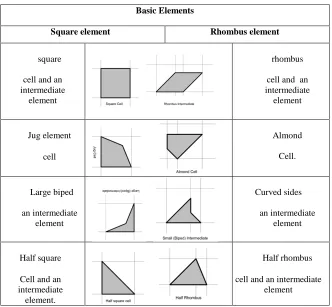
The top views of the elements are based on the square and the rhombus. We can merge two types or more of elements and intermediate elements to create new different forms. See [table 2].
Table 2: Forms of Muqarnas Elements (5)
Basic Elements
Square element Rhombus element
square cell and an intermediate
element
rhombus cell and an intermediate element Jug element cell Almond Cell. Large biped an intermediate element Curved sides an intermediate element Half square Cell and an intermediate
element.
Half rhombus cell and an intermediate
www.ijiset.com
136 4-3. Combining Muqarnas Elements
There are different ways to conjoin Muqarnas elements:
• Muqarnas as a structure built from elements as if they were in the steps of a stair which are called one tier (tabaqa).
• They can also meet other intermediate elements at other sides. The front of intermediate elements can meet at the apex.
• The backside of a cell can stand on the curved side of an element in a lower tier.
• The backside of a cell can stand on the front side of an intermediate element in a lower tier.
• An intermediate element can stand on the front of a cell in a lower tier.
4-4. Directing a Muqarnas graph
The direction of the top view of an element, can determine whether it is a cell or an intermediate cell and even in which tier it is located.
Every directed line (called arrow) represents a curved side and points to the apex of the associated element. See [figure 5].
Fig. 5 Directing Muqarnas: The arrows represent a curved side. (5)
This means that an arrow often gives the position where two elements join at the curved side. The curved sides of a cell join at the apex. In contrast the curved sides of arrows of an
intermediate element may join at the backside.
137
Table 3: The possible directions of the top views of the elements (author)
The directions of the top views of the elements (cell or an intermediate element)
Intermediate cell Element
Intermediate cell element
cell cell
intermediate element intermediate element
intermediate cell element
intermediate cell element
5.
Sound diffusion
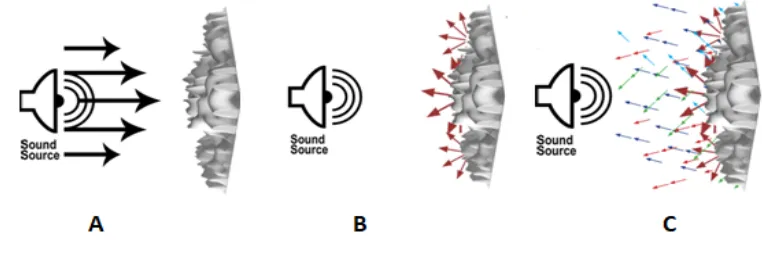
Sound diffusion is defined as the bending and scattering of sound waves around obstacles and surfaces in the space. It can be created by using surface irregularities and scattering elements.
Diffusers are hard surfaced acoustical treatments with either irregular surfaces that break up and scatter sound waves in multiple directions, or convex curved surfaces to gently split frequencies and deflect them in multiple directions. As a consequence, the diffusers enhance the hearing state
within the room.(6)
The diffusers do not absorb the incident sound but it reflects it in as many directions as possible. Rather than removing any sound energy, diffusers are used to effectively reduce distinct echoes
www.ijiset.com
138 The projections of the surface irregularities must be at least one- seventh of the wavelengths of diffused sound waves. So the obstacles should be too small compared to the wavelengths of sound waves. This is more effective for low than high-frequency sounds.
5-1. Acoustic parameters of sound diffusers
1. Diffusion coefficient
This value describes the degree of diffusion as a function of frequency. The degree of absorption exists since every real diffuser also absorbs part of the sound.
2. Sound absorption coefficient (α)
The sound absorption coefficient is the energy of the incident sound which is absorbed by the surface. Its value is between (0 and 1). Sound diffusers are usually made of hard materials, so that their sound absorption is minimal.
3. Sound scattering coefficient (S)
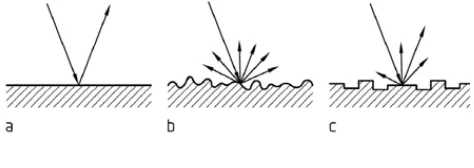
It defined as the ratio between the acoustic energy reflected in non-specular directions and the totally reflected acoustic energy from rough surface. A sound scattering surface is defined as a surface with (S) ≥ 0.5.A sound scattering coefficient of (1.0) indicates that 100% of the reflected sound is scattered in all directions, whereas a value of (0.0) indicates that the sound is reflected in one specular direction. Likewise, a sound absorption coefficient of (1.0) indicates that the sound is totally absorbed, whereas (0.0) means that it is entirely reflected.
See [figure 6]. (7)
Fig. 6 Specular and diffuse reflection (7)
a= specular (regular) reflection, b,c = scattered reflection (diffused reflection)
5-2. Types of Diffusers
Diffusers come in many shapes and materials. Two-dimensional diffusers scatter sound in a hemispherical pattern by the creation of a grid, whose cavities have wells of varying depths.
Generally, diffusers can be divided in two basic forms; Mathematical and Geometric, [Table4]. Geometric Diffusers break up sound reflections and disperse them more evenly throughout the listening space. Random dispersion of sound reflections improves sound quality and consistency for the listener. The types of Mathematical & Geometric diffusers can be classified as follows:
1. MLS (Maximum length sequence) diffusers
2. QRD (Quadratic Residue Diffusers)
3. Two-dimensional (hemispherical) diffusers
139 5. Irregular geometric structures
6. Periodic geometric structures 7. Art diffusers
The most common types of sound diffusers that have forms close to those of Muqarnas are the irregular, pyramidal and conical forms of geometric diffusers, such as those of type (5), (6) and (7) in particular. It will randomly diffuse the sound to prevent some sound problems, such as, echo and sound coloration…etc.).
The unique organic curvature of the Art Diffuser type control specular reflections above 4 kHz makes it preferable to other designs. The Art Diffuserdeflects the sound hemi-spherically, as a result of the bi-cubic concentric rings, and the various quadratic well depths. See [figure 7]. (3)
These diffusers reduce the intensity of sound by scattering it over an expanded area. This prevents standing waves while maintaining the live intensity of the sound.
Fig. 7 Sound scattering by art diffuser(3)
To summarize the forms of sound diffusers that can be selected to act as a Muqarnas:
1. Pointed small cones
2. Prisms with horizontal section of (triangle or convex surface) 3. Irregular pyramidal and conical forms
www.ijiset.com
140
Table 4: Some of Mathematical & geometrical type of Muqarnas (3)
Type No. Type of Mathematical & Geometric diffusers Form configuration
1 MLS - Maximum length sequence diffusers
MLS are made of strips of material with two different depths. The width of the strips is smaller than or equal to half the wavelength of the
frequency
2 QRD - Quadratic-residue diffusers
Combine the excellent diffusion characteristics of MLS designs with wider bandwidth called a quadratic-residue diffuse (Schroeder
diffuser).
3 Two-dimensional (hemispherical) diffusers
Two-dimensional diffusers scatter sound in a hemispherical pattern. This is done by the creation of a grid, whose cavities have wells of
varying depth, according to the matrix.
4
Simple curved surfaces
Convex surfaces will scatter sound, concave surfaces can focusing of sound
5 Irregular geometric structures
Consisting of concave, convex and pointed units (pyramidal and conical forms) arranged irregularly.
6 Periodic geometric structures
Pyramids or triangular have interesting acoustic properties, depending of the angle of the sides of the surface.
7 Art diffuser
141
6.
Practical study
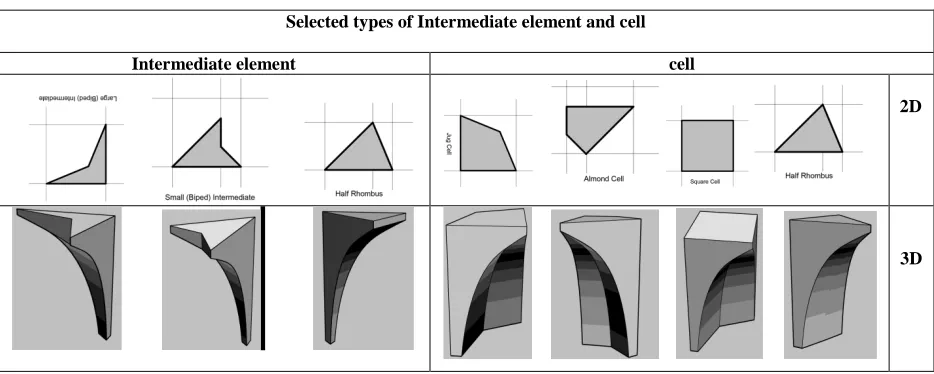
This study has used some of the basic forms of Muqarnas elements that can act as sound diffusers, some of them as cell and others as intermediate elements. See [table 5].
They can be arranged to compose different types of module unites by merging two or three elements to create new different forms of module units.
Table 5: Some of selected Muqarnas elements to create the studied module unit form
Selected types of Intermediate element and cell
Intermediate element cell
2D
3D
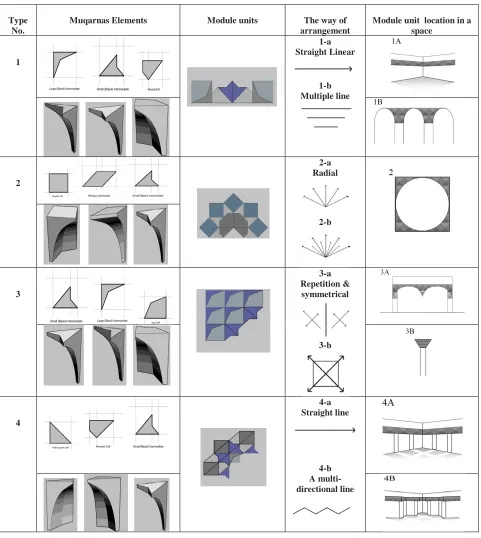
These elements are re-configured to form a geometrical module unit with certain specifications and dimensions. They are considered as case studies whose forms and dimensions are chosen and arranged in different axes then located in different locations within the space to work as sound diffusers, see [table 6].
www.ijiset.com
142 Table 6: Some of the Muqarnas element studied as a module unit to act as diffuser (author)
Type No.
Muqarnas Elements Module units The way of
arrangement
Module unit location in a space 1 1-a Straight Linear 1-b Multiple line 2 2-a Radial 2-b 3 3-a Repetition & symmetrical 3-b 4 4-a Straight line 4-b A multi-directional line
143 dispersion with randomly scattered sound wave propagation and reflections can be found. See figures in [Tables 7-1, and 7-2] which illustrate the behavior of scattered sound waves after their reflection from the surfaces of the model units.
Table 7-1: The effect of geometrical configuration of module units on sound diffusing Type (1-2) (author)
Type No. 1 2
Module unit
Shape and dimension
www.ijiset.com
144 Table 7-2: The effect of geometrical configuration of module units on sound diffusing
Type (3-4) (author)
Type No. 3 4
Module unit
Shape and dimension
Module units as diffuser
It is possible to replicate and combine the modular units in different patterns to form a set of combined merging modules giving different types of geometric formations, which can be used in several places within the space and used as Muqarnas, as shown in [Table 6].
145 Table 8-1: Two & three dimensional forms of combined modules- type (1) (author)
Type No. 1
1-A
combined merging module (2D) combined merging module (3D)
1-B
Table 8-2: Two & three dimensional forms of combined modules- type (2)
Type No. 2
2-A
combined merging module (2D) combined merging module (3D)
www.ijiset.com
146 Table 8-3: Two & three dimensional forms of combined modules- type (3) (author)
Type No. 3
3 –A
combined merging module (2D) combined merging module (3D)
147 Table 8-4: Two & three dimensional forms of combined modules- type (4) (author)
Type No. 4
4-A
combined merging module (2D) combined merging module (3D)
4A
4 -B
A composed model can also be created by merging several types of combined module units together. Those can be formed symmetrically on both sides of certain axis or in random order.
This composed model can be used in the location of spherical triangles placed at the corners on the vertical structural elements around the domed square space. See [Table 9, and 10].
Table 9: The component of composed module (author)
Combined models units Module unit arrangement Module unit location in a space
Symmetrical on diagonal axis Of Spherical triangles of the
www.ijiset.com
148 Table 10: Two & three dimensional composed model from merging different combined models.
Composed model type Type – 5
(2D)
(3D)
149
7.
Conclusions
The most common sound diffuser forms that can be used in Muqarnas are those having
irregularly pyramidal, conical forms, and sharp angled triangular shape, as shown in [Table 4] of types (5), (6), and (7).
The Pyramidal form and the sharp angled triangular shape are the forms that exist in both the sound diffuser (such as; irregular geometrical structure, periodic geometrical structure, and art diffuser), with the forms of Muqarnas elements (such as: small biped, large biped, half rhombus, jug, and almond).
It was observed after measuring the dimensions of the modules units (case studies), and through the geometrical analysis of the incident and reflection sound wave paths as well as measuring the incident and reflection angles, that the sound waves dispersed randomly scattering the sound waves with multi-reflections from the module surfaces. This dispersion of the incident sound waves make it works as a good sound diffuser.
The proposed Muqarnas forms that act as sound diffusers can be used in several locations within the space, such as:
Spherical triangles in the junction of the vertical walls with the dome, where the square shape of the space plan is transformed into the circle shape of the dome plan or its (podium), as shown in the type (5) in[ table 10], and type (2A), (2B) in [table 8-2] respectively.
column`s capital as shown in type (3B) in [table 8-3].
Arcade collider such in type (3A) / [table 8-3], and between arches as shown in type (1B)/ [table 8-3].
Frieze on the upper part of surrounding walls like in type (1A) / [table 8-1], and type (4A) / [table 8-4].
The curved wall as in type (4B) / [table 8-4] to treat some of the sound problems such as sound concentration and echo…..etc.
Acknowledgment
www.ijiset.com
150
8.
References
[1] Cox T. J.,“Acoustic Diffusers the Good, the Bad and the Ugly”,Proceedings of the Institute of Acoustics, Salford University, 2004, pp.(1-11).
[2] Dadkhah Negin, Safaeipo Hadi, and Memarian Gholam Hossein, “Traditional Complex Modularity in Islamic and Persian Architecture”, ACSAFall Conference, 2012,
pp. (130 – 138).
[3] Dingemans Toine, “Evaluating specifications and characteristics of Diffusers”, Sound Scopes, 2012.
[4] Al-Hassani Salim, “New Discoveries in the Islamic Complex of Mathematics,
Architecture, and Art”, Foundation for Science Technology and Civilization, Muslim Heritage, 2007.
[5] Van den Hoeven Saskia, Van der Veen Maartje, “Mathematics in Islamic Arts”, Utrecht University,2010.
[6] Pilch Adam, Kamisinski Tadeusz, “The effect of Geometrical and Material Modification of Sound Diffusers on Their Acoustic Parameters”, Archives of Acoustics, vol.36, issue 4, dec.2011.