Digital Visual Cryptographical Image Sharing
Using DIM
Bhagyashri Machale1, Prajakta Baravakar1, Padmashri Thorat1, Tejshri Bavale1, Prof.Pankaj Agarkar2
U.G. Student, Department of CSE, Dr.D.Y.Patil School of Engineering, Lohegaon Pune, Maharashtra, India1
Professor, Department of CSE, Dr.D.Y.Patil School of Engineering, Lohegaon Pune, Maharashtra, India2
ABSTRACT: In this paper, we search technique on how to ameliorate the safety for an original data by hiding important data behind cover image (which may be digital or printed image) by using data hiding, cryptography and NVSS algorithm. The proposed system hides the secret data which is first encrypted and then is hidden behind a one of the patch of a cover image. The total effort of the proposed method is the achievement of hiding and extracting secret images and secret data. In proposed method, we have tried to improve the capacity of the original scheme by improving the capacity of hiding data and increasing security to send image through different media. Our method increase security, efficiency and reliability of the any persons, systems,or organisations important data which is autherised by using data hiding, cryptography method and NVSS algorithm. The natural shares which are unchanged are distinct and inofensive, hence it mainly decreases the risk of traject over communication media. The proposed approach is best for solving the problem of transmission risk for the VSS schemes is shown by experimental results..
KEYWORDS: Digitalimage sharing, Secret image, VSS cryptography, Visual secret sharing.
I. INTRODUCTION
II. LITURATURE SURVEY
Kai-Hui Lee and Pei-Ling Chiu proposed that Conventional visual secret sharing (VSS) schemes hide secret images in shares that are either printed on transparencies are encoded and stored in a digital form. The shares can appear as noise-like pixels or as meaningful images; But during transmission of the shares there may be interception risk arise. To solve this problem, they proposed a natural-image-based VSS scheme (NVSS scheme). To protect the secret images and participants during transmission NVSS shares secret images through different carrier media. The proposed (n, n) - NVSS scheme can share one digital secret image over n -1 arbitrary selected natural images (called natural shares) and one noise-like share [1].Sunil G. Jare proposed the technique called Visual Cryptography (VC). This technique encrypts a secret image into n shares, and every participant involved in this holding one or more shares. The participants who has less number of shares than n shares cannot uncover any information about the secret image. This technique is mainly used to avoid transmission risk and to increase security to share data across various carrier media [2].Priyanka R. Pawar, Manjusha S. Borse, proposed Visual Secret Sharing scheme (VSS). To avoid the problem generated by this scheme NVSS is proposed. In this technique they used the concept of OR code. QR code technique is used to encrypt the data by generating QR code of that data [3].MayuriSonkusare, Prof. NitinJanwe proposed A natural-image-based VSS scheme (NVSS scheme) which is use to share secret images during transmission. In this technique feature extraction is performed on natural shares. In this scheme Share-Hiding algorithm is also used in which shares are hide by generating OR code. At the receiver side original image is recovered by using share extraction algorithm and decryption [4]. Miss A ANaphade, Dr. R N Khobaragade, Dr. V M Thakareproposedvisual cryptography (VC). This paper focused on five visual cryptographies i.e. multiple image visual cryptography (MIVC), optimal gray scale reserving visual cryptography (GRVCS), Embedded extended visual cryptography scheme (Embedded EVCS), simulated-annealing-based algorithm.This VC technique is based on black-and-white or binary images. But it will increase interception risk during transmission of the images [5].Mr. Thanguganesh.M and Prof.Sarnaya R proposed system which is used to protect important data from hackers and unauthorized users. In this technique they made use of different types of images like digital image, gray image and natural image [6].
III.MODULE DISCRIPTION
1. IMAGE PROCESSING
Image processing is the method in which input image is crop. Cropping is performed by manually and stored for further processing. The cropped image is resized with predicted size.
2. FEATURE EXTRACTION
Binarization is used to carried out feature extraction of the natural share. It is performed by calculating the median value of the natural share. The stabilization process uses the result of binarization method. The process which is used to balance the number of black and white pixels of an extracted feature image in each block is called stabilization process. The process ensures that the number of black and white pixels in each block is equal. These clustered pixels have the same feature value. The chaos process is used to eliminate the texture that may appear on the extracted feature images and the generated share. The original feature matrix will be disordered by adding noise in the matrix.
Fig 1. The block diagram of the feature extraction
In binarization process, a set threshold is determined by a simple threshold function F to determine a binary feature value. Median M is calculated to obtain approximate appearance for binary values 0 and1.Median M is the threshold value.
In the Binarization process, the binary feature value of a pixel can be determined by a simple threshold function F with a set threshold. To obtain an approximate appearance probability for binary values 0 and 1, the median value M of pixels in the same block is an obvious selection as the threshold. Hence, for each block,
We define the notations as follows: b represents the block size, b .even. N denotes a natural share.
x, y.denotes the coordinates of pixels in the natural shares and the secret image, 1 .x .w, 1 .y .h. x1, y1.represents the coordinates of the left-top pixel in each block.
px,y ϕ denotes the value of color ϕ, ϕ._R,G,B.for pixel .x, y.in natural share N, 0 .px,y ϕ .255.
Pixel value Hx,y is the sum of RGB color values of pixel .x, y.in natural share N and Hx,y_px,yR.px,y G .px,y B . (1) M represents the median of all pixel values (Hx1,y1, . . . ,Hxb,yb ) in a block of N.
F is the feature matrix of N, the element fx,y .F denotes the feature value of pixel .x, y_. If the feature value fx,y is 0, the feature of pixel .x, y.in N is defined as black. the extraction function of pixel x, y_ of N is defined as follows:
In the stabilization process the number of black and white pixels are balanced in each block the number of unbalanced pixels Qs is calculated by using the formula
In the process, there are Qs pixels in which f x,y = 1 is randomly selected and then the value of these pixels is setto 0. The process ensures that the number of black and white pixels in each block is equal. In a natural image, pixels with the same or approximately the same values may cluster together in a continuous region. These clustered pixels have the same feature value; hence it will lead to the feature image and to the generated share revealing some textures of the natural image in the subsequent encryption process. The chaos process is used to eliminate the texture that may appear on the extracted feature images and thegenerated share. In the process, the original feature matrix will be disordered by adding noise in the matrix. First, randomlyselect Qc black feature pixels ( fx,y = 0) and Qc white feature pixels ( f x,y = 1) from each block, then alter the value of thesepixels. That is, the feature value of a pixel at coordinates (x,y)will be changed to 0 when f x,y = 1, and vice versa. AssumePnoise be the probability to add noise in the matrix, the value of Qc is as follows:
Fig2. Graphical user interface of Feature extraction taking three natural shares at the sender side
Encryption/Decryption:
The (n ,n)-NVSS schemes encrypts a true color secret image by n-1 natural shares and one noise share. Algorithm for encryption/ Decryption as follows.
Input S, N1…..,Nnp+np,np,nd,b,Pnoise ,ƿ,t Output: S
1. Initialize the random number generator G by the seed ƿ 2. nnP + nd+1
3. 1<= α < n, φ Є (R, G, B), Fl α,φ 0
4. 1<= α < n, φ Є (R, G, B), 0 <= i<=7 repeat steps 5 to 6 5. Call procedure FE(Na,B,Pnoise,F)
6. (X,Y),x Є[1,h],px,y α,φ px,yα,φ+f x,y *2i 7.Ifnp=0 then goto step 12
8. 1<= α <np repeat step 9-11 times
9. Randomly select (x1,y1),x1 Є[1,w],y1 Є[1,h] 10. Randomly select (x2,y2),x1 Є[1,w],y2 Є[1,h]
11. φ Є(R,G,B),exchange value of px1,y1 α,φ and px2,y2 α,φ
12. φ Є(R,G,B), SφSφ F11,φ F1n-1, φ
13.Output S
Algorithm: Feature Extraction Algorithm (FE)
Algorithm (FE) Input: N,b,Pnoise Output: F
1. Divide N into blocks with b*b 2. For each block repeat steps 3-11
3. ⩝x1≤x≤xb, y1≤y≤yb, calculate Hx,y by eq.(1)
4. calculateM
5. ⩝x1≤x≤xb, y1≤y≤yb, determine fx,y by eq(2)
6. calculateQsbyeq(3)
7. randomlyselect Qs pixels where fx,y and Hx,y = M, let fx,y←0
8. calculateQcbyeq(4)
10. randomlyselectcandidatepixelswherefx, y = 0
11. Alter all values of fx,y that were selected in steps 9 and 10 12. Output F
Fig.3.a Encryption process
Fig.3.b.Decryption process
3
. ENCRYPTIONIn encryption process secret image is encrypted by using cover image concept and for the text QR code is generated .For the secret image ,it is hide behind the one of the patch of the cover image so that attacker can not reveal there is any another image which is hide in that cover image. Text data is encrypted by introducing the concept of OR code. In this OR code of that text is created so that it is difficult uncover original text.
4. DATA HIDING
Fig.4.Compression/hiding process
5. DECRYPTION
By repeating the reversal process of encryption process to predict the secret image. Again feature extraction and pixel swapping performed to predict the secret image.
IV.EXISTING SYSTEM
A. Background
In cryptography, the one-time pad (OTP), which was proven to be impossible to break if used correctly, was developed by Gilbert Vernam in 1917. Each bit or character from the plaintext is encrypted by a modular addition (or a logical XOR operation) with a bit or character from a secret random key of the same length as the plaintext resulting in a cipher text. The cipher text was sent to a receiver; then, the original plaintext can be decrypted in the receiver side by applying the same operation and the same secret key as the sender used for encrypting the cipher text.
B. Assumptions
The proposed (n, n)-NVSS scheme adopts arbitrary natural shares and one generated share as media to share one digital true color secret image that has 24-bit/pixel color depth. The objective of this study is to reduce the transmission risk of shares by using diverse and innocuous media. We make the following assumptions:
1. When the number of delivered shares increases, thetransmission risk also increases.
2. The transmission risk of shares with a meaningful cover image is less than that of noise-like shares. 3. The transmission risk decreases as the quality of themeaningful shares increases.
4. The natural images without artificially altered or modified contents have the lowest transmission risk, lower than that of noise-like and meaningful shares.
In the NVSS scheme, the natural shares can be gray
FIG 5.EXISTING SYSTEM
V.PROPOSED SYSTEM
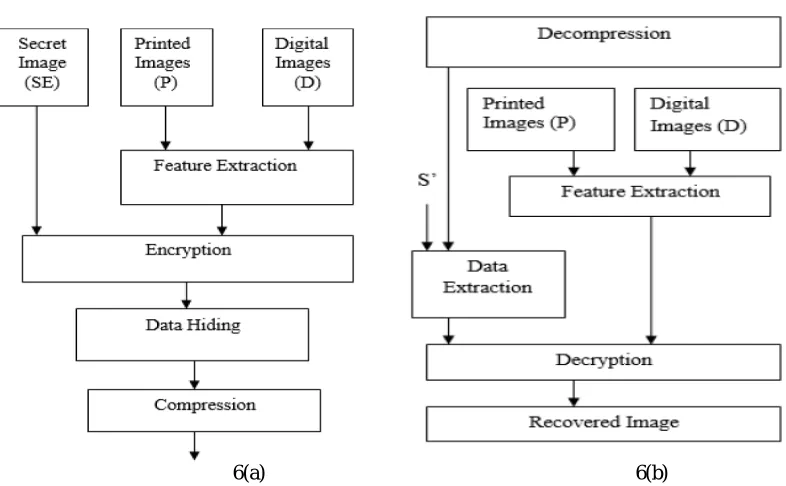
This system proposed (n, n)-NVSS scheme, n is greater than 2, includes two main phases: QR code generation and encryption/Data hiding. QR code generation consist generating one QR image of the secrete data. This QR code is decoded or read by barcode reader or smart phones. In the encryption phase, the n shares of the natural image were created. Then the QR code image of the secrete data or text is hidden behind any one of the share of this created shares. The secrete image which we want to send secretly is resized using feature extraction process. And after resizing this image is hidden behind the natural image shares.The n- 1 innocuous natural shares and the generated share are n shares in the (n, n)-NVSS scheme. When all n shares are received, the decryption end extracts n-1 feature images from all natural shares and then executes the XOR operation with share S_ to obtain the recovered image, as shown in Fig. (b). Each module in Fig. is described inthe following sections.The (n, n)-NVSS scheme takes arbitrary n - 1 natural shares and one generated share as carrier media toshare one digital true colour secret image that has 24-bit/pixel color depth. The objective is to reduce thetransmission risk of shares by using diverse and innocuous media.
1. As the number of delivered shares increases, the transmission risks increases.
2. The transmission risk of shares with a meaningful cover image is less than that of noise-like shares. 3. The transmission risk decreases as the quality of the meaningful shares increases.
VI.SYSTEM ARCHITECTURE
6(a) 6(b) Fig 6(a): Extraction process 6(b):Decryption process
VII. EXPERIMENTAL RESULTS
In this section, we perform three experiments to evaluate the performance of the proposed NVSS scheme.
A. Experiment I
Fig. is the graphic representation showing the statisticalresults on the distribution of pixel values in share S and secret image (SE1, Lena). The distributions in SE1 in the red, green, and blue color planes are denoted as Secret (R), Secret (G), and Secret (B), respectively. Fig.shows that thedistribution in S (denoted as Share in Fig, in each color plane is random;
it is totally different from the distribution in SE1. Hence, it is difficult to obtain any information related to SE1 from share S. The distribution in share S also agrees with Property 5.
B. Experiment II
This experiment evaluates the performance of the proposed NVSS scheme for sharing color and binary secret images by diverse shares. The shares used in the NVSS scheme include three digital images and one hand-painted picture. The digital images and the color secret image are the same as those used in Experiment I. The hand-painted picture is drawn on A4 paper, as shown in Fig. The picture is processed by the image preparation process to obtain two digitized shares, one for the encryption process and one for the decryption process.
C. Experiment III
This subsection demonstrates the performance of theNVSS scheme by using the QR code to hide the noise share. The natural shares are as shown in Fig10. (a) to Fig. (c).
The secret images are binary and have the same cipher text— “NO SECRET Here”. Parameters b and Pnoiseare set to 8 and 0.5, respectively
VIII. CONCLUSION
The paper proposes a VSS scheme, (n, n)-NVSS scheme, that are used to avoid interception risk which may arise during transmission of secret data. In this scheme secret data is encrypted by generating QR code of that data and then it is hidden behind one of the patch of the natural image. For the image it is hide behind one of the natural image and at the receiver side exact reverse process is performed to recover original data. Thisscheme is more efficient to transfer data trough carrier media; it is friendly as well as original data cannot get recover easily by attackers.
REFERENCES
[1] . Kai-Hui Lee and Pei-Ling Chiu,”Digital Image Sharing by Diverse Image Media”, IEEE transactions on information forensics and security, vol. 9, no. 1, January 2014.
[2]. Sunil G. Jare, ”Digital Image Sharing Using Visual Cryptography Techniques”, Sunil G. Jareet al, International Journal of Computer Science and Mobile Computing, Vol.4 Issue.4, April- 2015, pg. 717-721.
[3] .Priyanka R. Pawar, Manjusha S. Borse, “transmission risk reduction in image sharing scheme with diverse image media”
[4]. MayuriSonkusare, Prof. NitinJanwe,“Analysis of Digital Image Sharing By Diverse Image Media” ,MayuriSonkusare et al, / (IJCSIT) International Journal of Computer Science and Information Technologies, Vol. 6 (4) , 2015, 3784-3786.