Secured Access Control Using Two-Way
Approach for Cloud Computing Services
Saraswati Gore1 , Prof. Kalyan. D. Bamane2
M.E Student, Department of IT, Alard college of Engg, Murunji, Savitribai Phule Pune University, Pune, India1.
Prof, Department of IT, D Y Patil college of Engg, Akurdi, Savitribai Phule Pune University, Pune, India2.
ABSTRACT: Cloud computing is an internet based computing which enables sharing of services. With cloud computing, users can remotely store their data into the cloud and use on-demand high-quality applications. Cloud allows users to use applications without installation any application and access their personal files and application at any computer with internet or intranet access. The advantage of cloud is cost savings. The prime disadvantage is security. We present another Secured Access Control Using Two-Way Approach for Cloud Computing Services to achieving security in distributed cloud storage. In particular, in our proposed access control framework, a property based access control system is executed with the need of both a client secret key and a lightweight security device. As a client can't access the data on the off chance that they don't hold both secrete key and OTP. Moreover, we use Identity Based Encryption (IBE) algorithm to encrypt user data or file. IBE is an important primitive of ID-based cryptography. As such it is a type of public-key encryption in which the public key of a user is some unique information about the identity of the user (e.g. a user's email address). We also apply Cauchy approach for data storage on cloud. In this approach first we divide (fragment) our file and then store each fragments on nodes. When user wants to upload another file then system checks is any fragment is similar to previous fragments. If any similar fragment is found then Cauchy approach assign pointer to new similar fragment instead of storing that fragment. With the help of our system we can achieve maximum security of data in distributed cloud. Likewise, characteristic based control in the framework too enables the cloud server to restrict the access to those clients with the same arrangement of properties while preserving client protection, i.e., the cloud server just realizes that the client satisfies the required predicate, however no clue has on the precise personality of the client.
KEYWORDS: Access control, ASA, Cauchy Approach, Delfi Hellman, Fine-grained, Identity Based Encryption,
RSA, Two-factor, Web services.
I. INTRODUCTION
Background:
Motivation:
In the existing system each user has a user secret key issued by the authority but the user’s secret key is stored inside the personal computer. Even though the computer may be locked by a password, it can still be possibly guessed or stolen by undetected malwares. We propose a Secured Access Control Using Two-Way Approach for Cloud Computing Services to achieving security in distributed cloud storage. As a user cannot access the system if they do not hold both OTP and secrete key. The mechanism can enhance the security of the system, especially in those scenarios where many users share the same computer for web-based cloud services.
Our system has the following properties:
(1) It can compute some lightweight algorithms.
e.g. hashing and exponentiation.
(2) It is tamper resistant, i.e., it is assumed that no one can break into it to get the secret information stored inside.
Objective and Goal:
• To propose a secured access control using two-way approach web-based cloud computing services.
• To achieve reliability, security, integrity of the data on the cloud.
• To reduced storage space.
II. LITERATURE SURVEY
No Author Name Topic Name Algorithm/Techniques Output Year
1 Rashmi 1,Dr.G.Sahoo2, Dr.S.Mehfuz3
Securing Software as a Service Model of Cloud
Computing: Issues and Solutions
Survey is performed in this paper:
• Data Segregation • Data Access
• Web application security • Data breaches
• Backup
•Identity management and sign-on process
• An attempt to describe the security challenges in Software as a Service (SaaS) model of cloud computing and also endeavors to provide future security research directions
2013
2 Kashif Munir and Prof Dr. Sellapan Palaniappan
Framework for Secure Cloud Computing
• Generic cloud security model
• Identifies security and privacy challenges in cloud computing • Satisfy security
and privacy requirements in the clouds and
protect them against various vulnerabilities
3 Mr. Ankush Kudale, Dr. Binod Kumar
A Study on Authentication And Access Control For Cloud Computing
• A grid distributed parallel authentication model • SSL
• TLS protocols
• Stream cipher heuristic code generator models
•Will give you many ideas about different methods and frameworks designed by many researchers
2014
4 Harvinder Singh1, Amandeep Kaur2
Access Control Model for Cloud Platforms Using Multi-Tier Graphical Authentication
• Use security questions and image based for the login protection in cloud platforms on mobile devices and software systems for computers
• Use Unique Identification Number (UIN) • Supports anonymous authentication and performs decentralized key management • Prevents replay
attacks and supports creation, modification and reading data stored in the cloud
2015
5 Joseph K. Liu, Tsz Hon Yuen, Man Ho Au, Xinyi Huang, Willy Susilo, and Jianying Zhou
k-times attribute-based
anonymous access control for cloud computing
• Implementations of Protocol PK0 and PK1
• Allows a user to authenticate himself/herself • Provides k-times
limit for
anonymous access control
2014
6 J. Bethencourt, A. Sahai, and B. Waters Ciphertext-policy attribute based encryption • ciphertext-policy attribute-based encryption (CP-ABE)
• Access tree T
• Encrypted data can be kept confidential even if the storage server is untrusted • Methods are
secure against collusion attacks
2007
7 D. Boneh, X. Ding, and G. Tsudik
Fine-grained control of security capabilities
• mRSA Key Generation Algorithm
• mRSA Signature Algorithm • mRSA Decryption
Algorithm
• mRSA Key Generation for multiple SEM-s
• Revoking the client’s certificate • Revokes the
client’s ability to perform
cryptographic operations such as signature
generation and
decryption
8 J. Camenisch, M. Dubovitskaya, and G. Neven
Oblivious transfer with access control
• Issuer Setup algorithm • Database Setup algorithm • Issue protocol
• Transfer protocol
• Present a protocol for anonymous access to a database where the different records have different access control permissions 2009
9 K. Liang, W. Susilo, and J. K. Liu
Privacy-preserving ciphertext multisharing control for big data storage
ciphertext sharing mechanism with the following properties: • Anonymity
• Multiple receiver-update
• Conditional sharing
• Preserve the anonymity for ciphertext sender/receiver, conditional data sharing and multiple recipient-update 2015
10 J. K. Liu, M. H. Au, W. Susilo, K. Liang, R. Lu, and B. Srinivasan
Secure sharing and searching for real-time video data in mobile cloud
• AES encryption • Searchable Symmetric
Encryption (SSE) • Ciphertext policy
attribute-based encryption (ABE)
• Digital signature
•Proposed an infrastructure for secure sharing and searching for real-time video data
11 Y. Wu, Z. Wei, and R. H. Deng
Attribute-based access to scalable media in cloud-assisted content sharing networks
• Multi-message Ciphertext Policy Attribute-Based Encryption (MCP-ABE)
• Allows a data owner to enforce access control based on attributes of data consumers without explicitly naming the specific data consumers • Supports only one
privilege level
2013
IV. SOFTWARE REQUIREMENT SPECIFICATION
User Classes and Characteristics
features and deploys them over low-level features (terms). In proposed work is designed to implement above software requirement. To implement this design following software requirements and hardware requirements are used.
Software Requirements
• Operating System - Windows XP/7
• Programming Language - Java/J2EE
• Software Version - JDK 1.7 or above
• Tools - Eclipse
• Front End - JSP
• Database - Mysql
Hardware Requirements
• Processor - Pentium IV/Intel I3 core
• Speed - 1.1 GHz
• RAM - 512 MB (min)
• Hard Disk - 20GB
• Keyboard - Standard Keyboard
• Mouse - Two or Three Button Mouse
• Monitor - LED Monitor
V. IMPLEMENTATION STATUS
• Registration and login
• User first have to registered with the system and then login with the system • At the time of login system must have to check user is authorized person or not • After login successful user entered in his/her account and perform other operations • Cloud Server and Authority directly perform login without registration with the system
• Key generation
• For uploading file first user choose cloud type and choose file. Then user send request for key to authority
• Authority is responsible for generating key
• Fragmentation and duplication checking
• If fragment is duplicate then system assign pointer to that original fragment and original fragment is not stored on cloud to reduce storage space
• If fragment is not duplicate then system stored that particular fragment on cloud
• Generate OTP
• For downloading other users file user must request to system for OTP • System creates OTP and sends on users mail account
VI. COMPARISON BETWEEN EXISTING SYSTEM AND PROPOSED SYSTEM
As sensitive data may be stored in the cloud for sharing purpose or convenient access; and eligible users may also access the cloud system for various applications and services, user authentication has become a critical component for any cloud system. A user is required to login before using the cloud services or accessing the sensitive data stored in the cloud. There are two problems for the traditional account/password based existing system. First, the traditional account/password-based authentication is not privacy-preserving. However, it is well acknowledged that privacy is an essential feature that must be considered in cloud computing systems. Second, it is common to share a computer among different people. It may be easy for hackers to install some spyware to learn the login password from the web-browser. Therefore such systems are not fully secured. In the existing system each user has a user secret key issued by the authority but the user’s secret key is stored inside the personal computer. Even though the computer may be locked by a password, it can still be possibly guessed or stolen by undetected malwares. We propose a Secured Access Control Using Two-Way Approach for Cloud Computing Services to achieving security in distributed cloud storage. As a user cannot access the system if they do not hold both OTP and secrete key. The mechanism can enhance the security of the system, especially in those scenarios where many users share the same computer for web-based cloud services.
Our system has the following properties:
(1) It can compute some lightweight algorithms.
e.g. hashing and exponentiation.
(2) It is tamper resistant, i.e., it is assumed that no one can break into it to get the secret information stored inside.
VII. ALGORITHM FOR RELEVANT FEATURE DISCOVERY
• File Fragmentation Algorithm:
1. If file is to be split go to step 2 else merge the fragments of the file and go to step 8 2. Input source path, destination path
3. Size = size of source file 4. Fs = Fragment Size
5. NoF = number of fragments 6. Fs = Size/Nof
7. We get fragments with merge option 8. End
• Secrete Key Generation Algorithm:
Random r=new Random(); //pass identity to generate key
(r,"useremail”,16).getBytes())); String key=KeyGenerator.generateString(r,s,16);
public class KeyGenerator { //setup process
//public static final String publickey="0023542123qwersa"; // public static final int publickeyLength=16;
//extract key process according userid
public static String generateString(Random rng, String characters, int length) {
System.out.println("String:"+characters); char[] text = new char[length]; //array size is 16 for (int i = 0; i < length; i++)
{
text[i] = characters.charAt(rng.nextInt(characters.length())); }
// System.out.println("text is:"+ new String(text)); return new String(text);
} }
• AES Encryption Algorithm Input: Key 128 bit and Data
Output: CipherText
Step1: Declare initVector=”RandomInitVector” //This is 16 byte IV to generate the random key.
Step2: Create the objects
IvParameterSpec iv = new IvParameterSpec(initVector.getBytes("UTF-8")); //UTF-8 is use to convert plaintext bytes into string
SecretKeySpec skeySpec = new SecretKeySpec(key.getBytes("UTF8"),"AES"); //SecretKeySpec class specifies a secret key
Step3: Create the objects
Cipher cipher = Cipher.getInstance("AES/CBC/PKCS5PADDING");
// cipher class provides the functionality of a cryptographic cipher for encryption //CBC-cipher block chaining i.e algorithm mode
Step4:
cipher.init(Cipher.ENCRYPT_MODE, skeySpec, iv); byte[] encrypted = cipher.doFinal(value.getBytes());
//doFinal(byte[] input)-Encrypts data in a single-part operation, or finishes a multiple-part operation.
Step5:
Base64.encodeBase64String(encrypted));
//encodeBase64String(byte[] binaryData)-Encodes binary data using the base64 algorithm
Step6: End
• OTP Generation Algorithm:
public class CreateToken {
char[] characterSet = "ABCDEFGHIJKLMNOPQRSTUVWXYZ0123456789".toCharArray(); int length=10;
String Result=null;
public String Create_Token_Method(){
Random random1 = new SecureRandom(); char[] result = new char[length];
for (int i = 0; i < result.length; i++) {
// picks a random index out of character set > random character int randomCharIndex = random1.nextInt(characterSet.length); result[i] = characterSet[randomCharIndex];
}
Result=new String(result);
System.out.println ("resultttttttttttt"+ Result); return Result;
}
• AES Decryption Algorithm Input: Key 128 bit and CipherText
Output: PlainText
Step1: Declare initVector=”RandomInitVector” //This is 16 byte IV to generate the random key.
Step2: Create the objects
IvParameterSpec iv = new IvParameterSpec(initVector.getBytes("UTF-8")); //UTF-8 is use to convert plaintext bytes into string
SecretKeySpec skeySpec = new SecretKeySpec(key.getBytes("UTF8"),"AES"); //SecretKeySpec class specifies a secret key
Step3: Create the objects
Cipher cipher = Cipher.getInstance("AES/CBC/PKCS5PADDING");
// cipher class provides the functionality of a cryptographic cipher for decryption //CBC-cipher block chaining i.e algorithm mode
Step4:
cipher.init(Cipher.DECRYPT_MODE, skeySpec, iv); byte[] encrypted = cipher.doFinal(value.getBytes());
// doFinal(byte[] input)- decrypts data in a single-part operation, or finishes a multiple-part operation.
Step5:
Base64.decodeBase64String(encrypted));
//encodeBase64String(byte[] binaryData)-Decodes cipher text using the base64 algorithm Step6: End
VIII. SYSTEM ARCHITECTURE
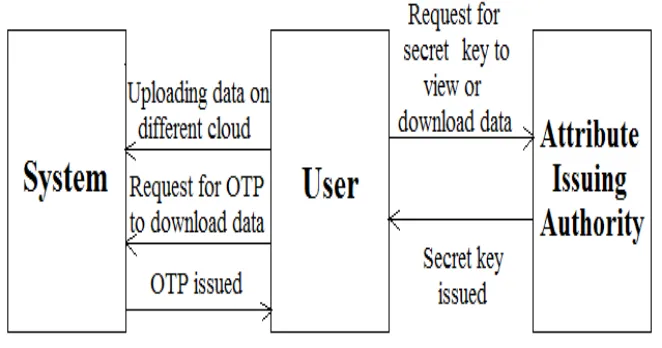
Figure 1: System Architecture
In our system we use two important parameter for downloading the file i.e. OTP and secret key. Client can't access the data on the off chance that they don't hold both secrete key and OTP. Moreover, we use Identity Based Encryption (IBE) algorithm to encrypt user data or file. IBE is an important primitive of ID-based cryptography. As such it is a type of public-key encryption in which the public key of a user is some unique information about the identity of the user (e.g. a user's email address). We also apply Cauchy approach for data storage on cloud. In this approach first we divide (fragment) our file and then store each fragments on nodes. When user wants to upload another file then system checks is any fragment is similar to previous fragments. If any similar fragment is found then Cauchy approach assign pointer to new similar fragment instead of storing that fragment.
The above diagram represents our system architecture. User has choice to select any cloud i.e. public cloud or private cloud for data uploading (storing). At the time of uploading we encrypt file by using Identity Based Encryption (IBE) algorithm and then we fragment file. Then we use Cauchy approach for checking same fragment is already stored or not to reduce storage space on cloud. When user wants to view data then he/she must need to get a secrete key and when user wants to download data from cloud then he/she must need to get a secrete key and OTP.
IX. MATHEMATICAL MODEL
The following terms shows in detail working of project. S={s, e, X, Y,}
Where,
s = Start of the program. 1. Log in with webpage. 2. Load Files on cloud.
e = End of the program. User can download file.
Input should be File which is uploaded by user.
Y = Output of the program.
User can download file if and only if user have both OTP and secrete key.
X, Y U
Let U be the Set of System.
U= {Client, OTP, Sk,}
Where, Client, F, R, T are the elements of the set.
Client = User
OTP = One Time Password
OTP is generated by system and required to user for downloading file. Sk = Secret key
Sk is generated by system and required to user for view or downloading file.
= Failures and Success conditions.
Failures:
1. Huge database can lead to more time consumption to get the information. 2. Hardware failure.
3. Software failure.
Success:
1. Search the required information from available in Datasets. 2. User gets result very fast according to their needs.
X. TEST CASES
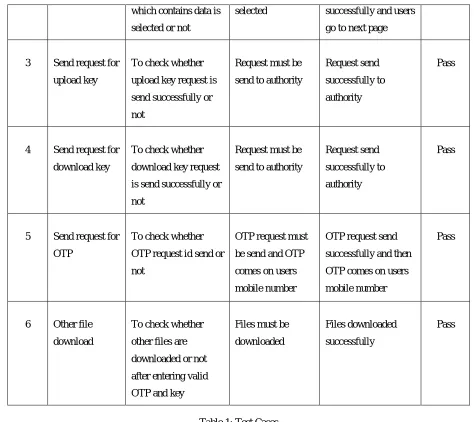
The following table shows the test cases of the Secured Access Control Using Two-Way Approach for Cloud Computing Services. It shows the expected result and actual result.
Test
Case
Id
Name Purpose of Test Expected Result Actual Result Status
Pass
or Fail
1 User login To check whether
user can access to
system or not using
valid and invalid
credential
User only login
with valid
credential
User only login
with valid
credential, for
invalid user it is
throwing error
Pass
which contains data is
selected or not
selected successfully and users
go to next page
3 Send request for
upload key
To check whether
upload key request is
send successfully or
not
Request must be
send to authority
Request send
successfully to
authority
Pass
4 Send request for
download key
To check whether
download key request
is send successfully or
not
Request must be
send to authority
Request send
successfully to
authority
Pass
5 Send request for
OTP
To check whether
OTP request id send or
not
OTP request must
be send and OTP
comes on users
mobile number
OTP request send
successfully and then
OTP comes on users
mobile number
Pass
6 Other file
download
To check whether
other files are
downloaded or not
after entering valid
OTP and key
Files must be
downloaded
Files downloaded
successfully
Pass
Table 1: Test Cases
XI. EXPERIMENTAL SET UP AND RESULT TABLE
• Result Table
Sr. No. File Length (Bytes) Time (ms)
1 1702193 902
2 1116625 422
4 1702193 841
5 1702193 918
6 61 185
7 19474 1138
Table 2: File Downloading Time
Above table shows that how much time required for merging all fragments related to that file and downloads that particular file. We take file length i.e. size in bytes and time is in milliseconds (ms).
• Result Graph
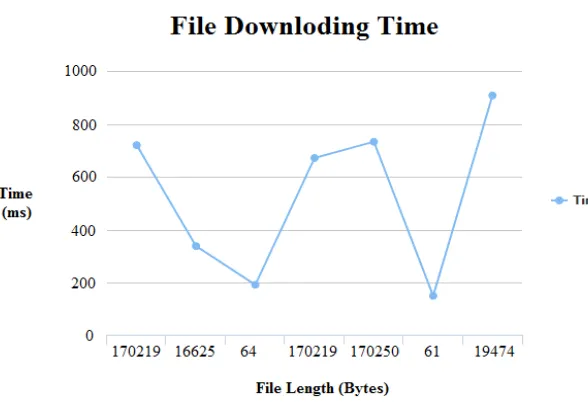
Figure 2: Result Graph of File Downloading Time
The above Figure 2 shows that the File Downloading Time of proposed system. As can be seen in Figure 2 x-axis represent File Length in Bytes and y-axis represents time in milliseconds (ms). Figure 10.1 shows that how much time is required for merging all fragments and download the particular file .The above graph shows how much system need time when user want to download any file.
XII. CONCLUSION
proposed access control framework accomplishes the coveted security prerequisites. We leave as future work to assist enhances the productivity while keeping every single pleasing part of the framework.
REFERENCES
1.Rashmi 1, Dr.G.Sahoo2, Dr.S.Mehfuz3, “Securing Software as a Service Model of Cloud Computing: Issues and Solutions”, IJCCSA, Vol.3, No.4, August 2013.
2.Kashif Munir and Prof Dr. Sellapan Palaniappan,” FRAMEWORK FOR SECURE CLOUD COMPUTING”, IJCCSA, Vol.3, No.2, April 2013.
3.Mr. Ankush Kudale, Dr. Binod Kumar,” A STUDY ON AUTHENTICATION AND ACCESS CONTROL FOR CLOUD COMPUTING”, Vol.
1(2), July 2014 (ISSN: 2321-8088).
4.Harvinder Singh1, Amandeep Kaur2,” Access Control Model for Cloud Platforms Using Multi-Tier Graphical Authentication”, Volume 4 Issue 11, November 2015.
5.Joseph K. Liu, Tsz Hon Yuen, Man Ho Au, Xinyi Huang, Willy Susilo, and Jianying Zhou,”k-times attribute-based anonymous access control for cloud computing”, IEEE Transactions on Computers, 64 (9), 2595-2608.
6.J. Bethencourt, A. Sahai, and B. Waters, “Ciphertext-policy attribute based encryption,” in Proc. IEEE Symp.Secur. Privacy, May 2007, pp. 321– 334.
7.D. Boneh, X. Boyen, and H. Shacham, “Short group signatures,” in Advances in Cryptology. Berlin, Germany: Springer-Verlag, 2004, pp. 41–55. 8.D. Boneh, X. Ding, and G. Tsudik, “Fine-grained control of security capabilities,” ACM Trans. Internet Technol., vol. 4, no. 1, pp. 60–82, 2004. 9.J. Camenisch, “Group signature schemes and payment systems based on the discrete logarithm problem,” Ph.D. dissertation, ETH Zurich, Zürich,
Switzerland, 1998.
10. J. Camenisch, M. Dubovitskaya, and G. Neven, “Oblivious transfer with access control,” in Proc. 16th ACM Conf. Comput.Commun.Secur.(CCS), Chicago, IL, USA, Nov. 2009, pp. 131–140.
11. J. Baek, Q. H. Vu, J. K. Liu, X. Huang, and Y. Xiang, “A secure cloud computing based framework for big data information management of smart grid,” IEEE Trans. Cloud Comput., vol. 3, no. 2, pp. 233–244, Apr./Jun. 2015.
12. K. Liang, W. Susilo, and J. K. Liu, “Privacy-preserving ciphertext multisharing control for big data storage,” IEEE Trans. Inf. Forensics Security, vol. 10, no. 8, pp. 1578–1589, Aug. 2015.
13. J. K. Liu, M. H. Au, W. Susilo, K. Liang, R. Lu, and B. Srinivasan, “Secure sharing and searching for real-time video data in mobile cloud,”
IEEE Netw., vol. 29, no. 2, pp. 46–50, Mar./Apr. 2015.
14. Z. Wan, J. Liu, and R. H. Deng, “HASBE: A hierarchical attributebased solution for flexible and scalable access control in cloud computing,”
IEEE Trans. Inf. Forensics Security, vol. 7, no. 2, pp. 743–754, Apr. 2012.