Available online:
https://edupediapublications.org/journals/index.php/IJR/
P a g e | 1770User Revocation Mechanism on Anonymous Abe in Cloud
Computing
Kavitha Guda & Doolam Ramdarshan
1Associate Professor Dept. of CSE Hyderabad, TS, India
2Test Lead, Hyderabad, TS, India
Email: [email protected] & Email id [email protected]
Abstract
Web utility has been augmenting in everyday
lives since its initiation. Web gives
numerous utilities, for example, circulated
registering, lattice figuring. What's more,
withal numerous lodging, for example, pay –
per-use, virtualization? These utilities were
fundamental driver to play with any
application, independent of necessities.
Research reviews on information security
pass on that the touchy information put
away on hard drives or USBs was not
secured for the business associations. USBs
were more hazardous since the information
won't not be held in scrambled frame.
Sundry systems have been proposed to for
fend the information substance security by
means of get to control. Personality
predicated encryption (IBE) was first
presented by Shamir, in which the sender of
a message can assign a character to such an
extent that exclusive a beneficiary with
coordinating character can unscramble it.
Barely any years after the fact, Fuzzy
Identity-Predicated Encryption is proposed,
which is also kenned as Attribute-Predicated
Encryption (ABE). In such encryption
conspire, a personality is seen as an
arrangement of engaging characteristics,
and decoding is conceivable if a decrypt’s
personality has a few covers with the one
assigned in the cipher text.
Key words: - CP-ABE, Anonymity,
Multi-Authority, Cloud Storage, Access Control,
Attribute Revocation
Introduction
In Recent years, Cloud Computing is an
innovation has many components like get to
anyplace from anyplace and whenever.[1]
There are some get to controls and
validation plans are given to shun the
unapproved access to the cloud information.
The primary issue in distributed computing
is information security. Since the cloud
server may not reliable record-breaking and
the noxious utilizer may collude with each
Available online:
https://edupediapublications.org/journals/index.php/IJR/
P a g e | 1771distributed storage. CP-ABE is the standout
amongst the most foremost system used for
get to control in the distributed storage. By
using this method the information proprietor
have their own particular control over
information put away in cloud server.
[4]The data security in cloud is discovered
by using CP-ABE conspire.
A. Distributed storage:
The Cloud server is the principle
convenience of distributed computing. This
can give lodging to information proprietor to
transfer their information into the storage
cloud. [2] Here the principle issue is
information [3] get to control plot with
information facilitating and information get
to settlement, on the grounds that malicious
utilizer may abuse their rights and intrigue
with each other to get the information from
the distributed storage server. Henceforth
the cloud server is not reliable and it will
influence from conspiracy assault and
furthermore once in a while it bargains when
a security rupture unfolds.
B. CP-ABE
The most ideal innovation for information
get to control in distributed storage server is
CP-ABE. [6]The CP-ABE Provides the
cloud information proprietor to coordinate
control over the information put away in the
cloud server. Here the power is in charge of
the key era and characteristic key
administration. [5]There are two sorts of
CP-ABE plot they are Single Ascendancy
CP-ABE and Multi Ascendancy CP-ABE.
Single Ascendancy Ciphertext-Policy
Attribute Predicated Encryption: In this just
a single brought together power which deals
with all the key era and characteristic keys.
Multi-Ascendancy Cipher text-Policy
Attribute Predicated Encryption: In this plan
N number of Decentralized Ascendant
elements is works freely to incite key and
traits.
C. Utilizer Revocation:
Utilizer Revocation is a procedure of
abstracting the get to right of clients. This is
finished by the trait Ascendancy. [7]Here
the disavowed clients are kept up in the
repudiation rundown and this rundown is
accessible in the cloud.
2. RELEGATED WORK 2.1Existing System
The information secrecy in distributed
storage, less importance is given to rampart
clients' personality protection amid those
intelligent conventions. It can't stand
subjectively numerous clients conspiracy
assault. [8]-[9]Their answers don't turn away
Available online:
https://edupediapublications.org/journals/index.php/IJR/
P a g e | 1772stage. This paper displays a semi in secret
benefit control conspire AnonyControl to
unravel both the information content
protection issue and utilizer character
security issues in subsisting access control
plans. The usage of various ascendant
substances in cloud figuring framework, this
plan accomplishes absent cloud information
get to control and fine-grained utilizer
benefit control. In additament, this
subsisting framework tolerates the trade off
assault towards properties ascendant
substances. In this work encryption
arrangement is portrayed with a tree called
get to tree. Each leaf hub is portrayed by a
characteristic.[10] Bracing utilizer
renouncement is a central issue in the true
application, and this an extraordinary test in
the utilization of Incognito
Multi-Ascendancy CP-ABE conspire.
2.2 Proposed System 2.2.1 System Models
In our proposed conspire there are four
elements: They are Revocable
Multi-Ascendancy, Cloud Storage Server, Data
customer and Information proprietor.
Revocable Multi-Ascendancy is mindful to
renounce an utilizer and withal issue of trait
key. Every Whole Attribute set is split into
N-Disjoint sets then every individual trait is
overseen by N-Attribute Ascendancy. So
Each Attribute Ascendancy as it were kens a
segment of detail. Distributed storage server
is a capacity stage which keeps up the record
transfer and download history of every
utilizer without utilizer character. Cloud
Utilizer is the two Data Owner and
Consumer of information put away in Cloud
stockpiling.
2.2.2 Threat Models:
We infer that the Cloud Storage server is
now and again may not be veracious so they
connive with the threatening utilizer and get
the advantage of unlawful information
record get to. Utilizer Revocation Predicated
Innominate Access Provision for Efficient
Cloud Utilizer Privacy Deduce once in a
while the N-Attribute Ascendancy is not
reliable. Information shoppers moreover not
veracious now and again, they will plot with
each other to get unlawful access of
information.
3) Security Model (Our Contribution)
a) Construction of Anonymous control
Scheme:
This development includes five stages
1) Setup (Pk,MKK)
In this calculation takes input and execute
the general population parameter and ace
Available online:
https://edupediapublications.org/journals/index.php/IJR/
P a g e | 17732) Key incites (PK, MKk, Au) → SKu)
Here the Algorithm authorizes the utilizer to
speak with each property command using
open key and master key to induce the
mystery key.
3) Encrypt (PK, M, T) → (CT)
This calculation takes the contribution of
Public key and Message and withal the
benefit tree set to cause the figure content
and confirmation set. on the off chance that
the utilizer slakes the benefit tree just ready
to peruse the document.
4) Decrypt ((PK, SKu , CT) → M
This calculation takes open key, mystery
key and figure message as info and incites
the Message. on the off chance that the
information purchaser who satisfies the
confirmation set just can ready to alter the
substance of the record.
5) User Revocation (uid, attribute)
UsrRvk
Using of this method attribute authority can
revoke the users. To accomplish full
namelessness we are using Full
AnonyControl conspire over everyday
AnonyControl plot. In additament to that we
are using the renouncement idea over
AnonyControl-F plan to increase improved
security. Disavowal AnonyControl-F plot
accomplished through one out of n-unaware
exchange and making usage of
Multi-command CP-ABE plot and withal through
supplemental disavowal conspire.
3. IMPLEMENTATION
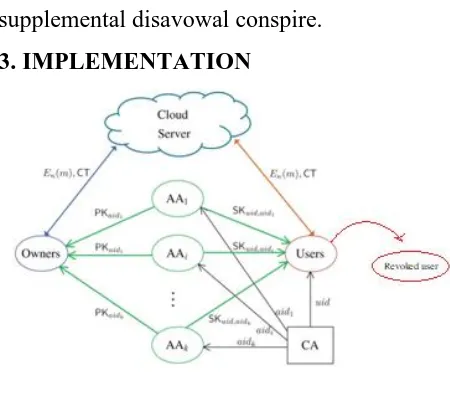
Fig 1 Architecture Diagram 3.1. Testament power (CA):
The testament power is an ecumenical
trusted substance in the framework that is in
charge of the development of the framework
by setting up framework parameters and
quality open key (PK) of each property in
the entire trait set. CA acknowledges clients
and AAs' enrollment asks for by allotting a
remarkable uid for each licit utilizer and an
interesting profit for every AA. CA
moreover chooses the parameter t about the
limit of AAs that are associated with clients'
mystery key era for each time. Nonetheless,
CA is not associated with AAs' lord key
sharing and clients' mystery key era.
Available online:
https://edupediapublications.org/journals/index.php/IJR/
P a g e | 1774administration associations or venture
offices which are in charge of the enlistment
3.2. Characteristic Ascendant elements (AAs):
The characteristic ascendant elements focus
on the errand of quality administration and
key era. Additionally, AAs remove a portion
of the obligation to develop the framework,
and they can be the executives or the
administrators of the application framework.
Not quite the same as other subsisting
multi-power CP-ABE frameworks, all AAs
mutually deal with the entire characteristic
set , be that as it may, any of AAs can't
relegate clients' mystery keys alone for the
ace key is shared by all AAs. All AAs
coordinate with each other to allot the ace
key. By this means, every AA can pick up a
bit of ace key offer as its private key, at that
point every AA sends its relating open key
to CA to induce one of the framework open
keys. With regards to incite clients' mystery
key, every AA just ought to induce its
relating mystery key autonomously. That is
to verbally express, no correspondence
among AAs is required in the period of
clients' mystery key era.
3.3. Information (Owner):
The information proprietor (Owner) encodes
his/her record and characterizes get to
strategy about who can access his/her
information. Above all else, every proprietor
encodes his/her information with a
symmetric encryption calculation like AES
and DES. At that point the proprietor details
get to arrangement over a quality set and
scrambles the symmetric key under the
approach as indicated by property open keys
picked up from CA. Here, the symmetric
key is the key used in the previous
procedure of symmetric encryption. From
that point forward, the proprietor sends the
entire encoded information and the
scrambled symmetric key to store in the
cloud server. In any case, the proprietor
doesn't depend on the cloud server to lead
information get to control. Information put
away in the cloud server can be picked up
by any information shopper. Regardless of
this, no information buyer can pick up the
plaintext without the quality set satisfying
the get to approach.
3.4. Information Consumer (Utilizer):
The information shopper (Utilizer) is doled
out with an ecumenical utilizer personality
uid from CA, and applies for his/her mystery
keys from AAs with his/her distinguishing
proof. The utilizer can liberatingly get the
ciphertexts that he/she is interested with
Available online:
https://edupediapublications.org/journals/index.php/IJR/
P a g e | 1775unscramble the scrambled information if and
just if his/her quality set delights the get to
strategy obnubilated inside the encoded
information.
3.5 User Revocation
In this system we are enhancing user
revocation of ABE for Backward Security. It
means before user revocation users can
access the existing files which is shared by
data owner in cloud, but once if the user
revoked by attribute authority then the
revoked user should not be access the
existing files. While revocation attribute
authority can revoke any one attribute from
users attribute list at a time. Here so using of
attribute revocation also we can control
cloud data access privileges.
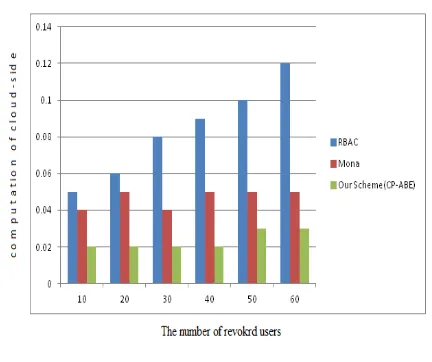
4. EXPERIMENTAL RESULTS
Fig 2 Uploading 1 MB File
Comparison on computation cost of Members for file upload among RBAC, Mona and our scheme
Fig 2: Downloading 1MB File
Comparison on computation cost of the cloud for file download among RBAC, Mona and our scheme 5. CONCLUSION
This paper proposes a revocable undercover
multi-power CP-ABE plan to upgrade the
security and also gives solid characteristic
disavowal. The development of our get to
control conspire is strong for the distributed
storage condition.
6. REFERENCE
[1] Jun beom hur and dong kun
Noh(2011),”Attribute-Based Access Control
with Efficient Revocation in Data
Outsourcingsystems”, IEEE Transactions on
parallel and Distribute systems, Vol:22 no.7
PP:1214-1221.
[2] Kan Yang,Xiahoua
jia,(2013),“Expressive, Efficient and
Revocable Data Access Control for
Available online:
https://edupediapublications.org/journals/index.php/IJR/
P a g e | 1776on Parallel and Distributed Systems
Vol:25,Issue:7,PP:1735-11744.
[3] Liu Zhenpeng, Zhu Xianchao, Zhang
Shouhua (2014), “Multi authority attribute
based encryption with
attributerevocation”,IEEE 17th International
Conference on Computational Science and
Engineering,DOI:10.1109/CSE.2014.343,PP
:1872-1876.
[4] S.Yu, C.Wang, K.Ren and
W.Lou,”Attribute Based Data Sharing with Attribute Revocation” (2010), Proc.5th
ACM Symp.Information, Computer and
Comm. Security (ASIACCS’10), pp:
261-270.
[5] Sushmita Ruj, Milos Stojmenovic, and
Amiya Nayak (2014), “Decentralized
Access Control with Anonymous
authenticationof Data Stored in Cloud”,
IEEE Transactions on Parallel and
Distributed Systems, 2014 VOL. 25, NO. 2,
PP: 384-395.
[6] S.J.Hur and D.K.Noh (2010), “Attribute – Based Access Control with Efficient
Revocation in Data Outsourcing
System”,IEEE Transactions on Parallel and
Distributed System,
DOI:10.1109/TPDS.2010.203 PP:
1045-1221.
[7] S.Jahid, P.Mittal and N.Borisov (2013),
“Scalable and Secure Sharing of Personal
Health Records in Cloud Computing
UsingAttribute Based Encryption”, IEEE
Transaction on Parallel and Distributed
Systems Vol:24,Issue:1,PP:131-143.
[8] Tacho Jung, Xiang-Yang Li, Zhiguo
Wan and Meng Wan. (2015). “Control
Cloud Data Access Privilege and
Anonymity withFully Anonymous Attribute
Based encryption”. IEEE Transaction on
Information Forensics and Security, vol: 10
no.1, pp:190-198.
[9] Xingxing xie,Hua ma,jin li xiaofeng
chen(2015), ”Multi-Authority Attribute
Based Encryption scheme with
revocation”,(ICCCN) 24th Internal
Conference on computer communication
and
Networks,DOI:10.1109/ICCCN.2015.72884
31,PP:1-5.
[10]Yong cheng,Zhi ying wang Jun
ma,Jiang-Jiang Wu,Song-zhu Mei(2013),
“Efficient Revocation in cipher text- policy