Performance Analysis of Box Girder Using
ANSYS Software
Najla Yas V 1, Priyanka Dilip P 2
P.G. Student, Department of Civil Engineering, AWH Engineering College, Kozhikode, Kerala, India1
Assistant Professor, Department of Civil Engineering, AWH Engineering College, Kozhikode, Kerala, India2
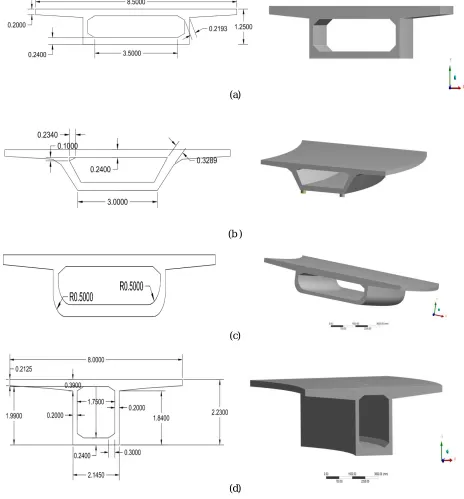
ABSTRACT: In this Paper Analysis of Box Girder using ANSYS software is done. Box girder bridges are commonly used for highway flyovers and for modern elevated structures of light rail transport. Although normally the box girder bridge is a form of Beam Bridge, box girders may also be used on cable-stayed bridges and other forms. It is considered as “The box is typically rectangular or trapezoidal in cross-section”; this paper is to justify this statement. Even though we have different options for cross sectional shapes, why do engineers keep sticking to trapezoid and rectangle? In this paper analysis of different shapes of box girder is done A section of box girder is selected with a certain mass. Box girders of different cross sections such as Rectangle, Square, Trapezoidal and curved are modelled. Mass of all sections is kept constant so that it becomes comparable with each other. Analysis of these sections is done in ANSYS Software for results such as Moment, Stress, Deformation, Frequency and Time period. The results are compared to find a better sectional shape.
KEYWORDS:Box Girder, Frequency, Performance analysis, Time period, Bending stress, Moment.
I. INTRODUCTION
Analysis of box girder in a systematic manner is very necessary in the present condition. So far there are many journals published on analysis of box girder on different aspects. There are papers published on parametric study, performance analysis alone. In this project, analysis of box girder is carried down in a systematic manner. Primarily a performance analysis on the shape of box girder is done, and then parametric study on radius of curvature and skew of span on the efficient shape is done. Finally a Response spectrum analysis and cost effective study of different shapes is done. Box girders are known for their structural efficiency. Major add-ons of using box girders are that they have high stability, high aesthetic beauty, high serviceability and better economy in construction. Analysis of box girders is complex due to bending, torsion and distortion in both transverse and longitudinal direction. Box girders can be classified under different basis such as shape, use, method of construction. Although significant research has been underway on advanced analysis for many years to better understand the behavior of all types of box-girder bridges, the results of these various research works are scattered and unevaluated. Hence, a transparent understanding of more recent work on straight and curved box-girder bridges is highly desired. The main objective is give a clear vision about non composite straight and curved box girder bridges. This study would enable bridge engineers to better understand the behavior of box girders with different variations in cross section.
II. RELATEDWORK
Various literature reviewed on box girders is presented in this section. A number of works have been carried on optimization of box girder by varying different parameters. A review of literatures is summarized in brief by various scholars and researchers on box girder. There are several literature studies on straight and curved box girder bridges dealing with systematic formulations to have a clear understanding the behavior of these complex structural systems. Some experimental studies are undertaken by a few authors to investigate the accuracy of existing elastic analysis methods such as finite element method, finite strip method and so on.
W.Y.Li et al. (1998) employed three examples of box-girder bridges of various geometrical shapes to illustrate the accuracy and versatility of the finite strip method. This work points out that compared to the finite element method, this method yields substantial savings in both time and effort, since only a few number of unknowns are generally required in the analysis.
Khaled et al. (2003) conducted a parametric study on multi cell box girder bridges using finite element method and the bridges are subjected to AASHTO truck loading and dead load. In this study, a parametric study of multiple steel box girder bridge was conducted by an experimentally calibrated finite-element model and the shear distribution characteristics under dead load and AASHTO live loadings are determined. Based on the results obtained from this study it wasfound that the presence of solid end diaphragms at the abutment supports coupled with a minimum of three bracing systems, equally spaced along the span with a maximum spacing of 7.5 m, and significantly enhances the transverse shear distribution. Another conclusion from this study is that stiffer cross bracings can significantly improve the transverse shear distribution and reduce lifting upward at the abutments.
Ayman et al. (2004) conducted a detailed investigation of warping related stress of composite steel concrete box girder bridges of different radius of curvature and span length. This paper points out that there can be a large subset of bridges where the warping effect is small enough which may be ignored in structural calculations. This is particularly useful to designers, because warping calculations are complicated and time-consuming.
III.METHODOLOGY
Four box girder bridge models are considered with constant span length and varying Shape such as rectangular, trapezoidal, curved, square. In order to validate the finite element modelling method, an example of box Girder Bridge is selected from literature to conduct a validation study. The example of box girder is modelled and analysed in ANSYS software and the responses are found to be fairly matching. For the purpose of the performance study, the four box girder bridges are modelled in ANSYS. Then parametric study on the best shape is carried down .The span length, cross-section and material property remains unchanged. The only parameter that changes is the radius of curvature in plan. The cross section of the superstructure of the box girder bridge consists of single cell box. All the models are subjected to self weight and moving load. A static analysis for dead load and moving load, and a modal analysis are performed. The longitudinal stress at top and bottom of cross sections, bending moment, deflection and fundamental frequency are recorded.
IV.EXPERIMENTALRESULTS
(a)
(b )
(c)
(d)
(a)
(b)
(c)
0 2 4 6 8 10 12 14
RECTANGULAR CURVE TRAPEZOIDAL SQUARE
RECTANGULAR CURVE TRAPEZOIDAL SQUARE DISPLACEMENT 10.702 12.932 12.879 3.7239
DISPLACEMENT
0.00E+00 1.00E+09 2.00E+09 3.00E+09 4.00E+09 5.00E+09
RECTANGULAR CURVE TRAPEZOIDAL SQUARE
RECTANGULAR CURVE TRAPEZOIDAL SQUARE MOMENT 3.94E+09 3.78E+09 3.71E+09 3.57E+08
MOMENT
0 10 20 30 40 50 60 70 80
RECTANGULAR CURVE TRAPEZOIDAL SQUARE
RECTANGULAR CURVE TRAPEZOIDAL SQUARE STRESS 23.917 42.549 72.94 12.129
(d)
(e)
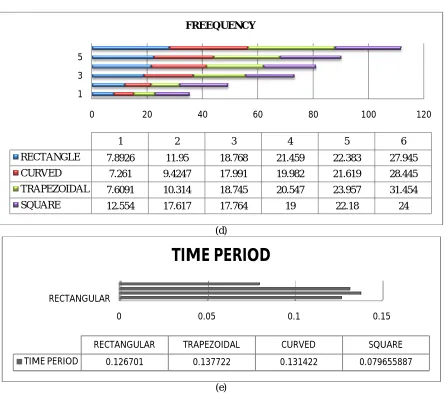
Fig. 2.Results obtained in ANSYS software (a) Displacement(b)Moment (c) Stress (d) Frequency (e) Time period
V. CONCLUSION
After the analysis it is clear that Square cross section shows least results on all analysis. In all aspects square is a better cross section for box girder but since in practical case providing a square cross section for a box girder will limit the road span overhead. As length and depth for square should be same ,it will restrict provision of depth beyond a limit. considering the second best result Trapezoidal cross section match with an engineers expectation. hence all cross sections commonly used are Trapezoidal in cross section. After trapezoidal rectangular and curved shows almost similar results. Considering all results in Table below trapezoidal section is selected for further studies.
Table 1 Table showing results of Performance analysis
0 20 40 60 80 100 120
1 3 5
1 2 3 4 5 6
RECTANGLE 7.8926 11.95 18.768 21.459 22.383 27.945 CURVED 7.261 9.4247 17.991 19.982 21.619 28.445 TRAPEZOIDAL 7.6091 10.314 18.745 20.547 23.957 31.454 SQUARE 12.554 17.617 17.764 19 22.18 24
FREEQUENCY
0 0.05 0.1 0.15
RECTANGULAR
RECTANGULAR TRAPEZOIDAL CURVED SQUARE
TIME PERIOD 0.126701 0.137722 0.131422 0.079655887
REFERENCES
1. Farzad Naeim and James. M. Kelly, Design of seismic isolated structures: From Theory to practice, John Wiley & Sons, 1999 2. Anil. K. Chopra, Dynamics of structures: Theory and practice to Earthquake engineering, Prentice Hall, 1995
3. Andriono, T and Carr, A. J (1991), “A simplified earthquake resistant design method for base isolated multi storied structure ”, Bulletin of the New Zealand National Society for Earthquake Engineering. Vol 24, No 3 pp238-250
4. Indian Standard Criteria for earthquake resistant design of structures Part 1: General provisions and buildings (Fifth revision), IS 1893:Part1(2002)
5. Reddy G.R. - Response spectrum method for non-linear systems
6. IJRET,” International Journal of Research in Engineering and Technology”, eISSN: 2319-1163 | pISSN: 2321-730.
7. ‘STUDY ON PARAMETRIC BEHAVIOUR OF SINGLE CELL BOX GIRDER UNDER DIFF RADIUS OF URVATURE’,
IJCSIET--International Journal of Computer Science inf ormation and Engg., Technologies ISSN 2277-4408 || 01102015-019
8. ‘AN OVERVIEW ON BOX GIRDER BRIDGES’. International Research Journal of Engineering and Technology(IRJET) e-ISSN: 2395-0056 Volume: 04 Issue: 01 | Jan-2017
9. ‘Parametric Study of Horizontally Curved Box Girders for Torsional Behavior and Stability’. International Refereed Journal of Engineering and Science (IRJES)ISSN (Online) 2319-183X, (Print) 2319-1821 Volume 3, Issue 2 (January 2014), PP.50-55
10. Review on “Box Girder Culvert Analysis Using Ansys”, International Journal of Engineering Research in Mechanical and Civil Engineering (IJERMCE) Special Issue
11. ‘Comparison and Study of Different Aspect Ratio of Box Culvert’. IJSRD -International Journal for Scientific Research & Development| Vol. 3, Issue 07, 2015| ISSN (online): 2321-0613,
12. ‘Analysis and Design of RCC Box Culvert’. International Journal of Scientific & Engineering Research, Volume 5, Issue 12, December-2014 ISSN 2229-5518
SLNO NAME STRESS DISPLACEMENT MOMENT FREQUECY TIME PERIOD