A Survey on Priority Based Packet Scheduling
Swati Patil1, Namita Armoor 2, Gaurav Deswal3, Kanishk Hivarekar4, Sayali Gardi5
Associate Professor, Department of Computer Engineering, JSCOE, Pune, Maharashtra, India1 U.G Student,Department of Computer Engineering, JSCOE, Pune, Maharashtra, India2,3,4,5
ABSTRACT: Now a days we are moving towards wireless technology so one of them is Wireless Sensor network, it is used in wide applications like health monitoring, weather monitoring, anti-missile defense system etc.WSN is nothing but collection of different sensor nodes deployed in various regions. Sensor nodes have limited resources like battery power, memory storage, etc. For extending the life- time of WSNs there should be Less Energy Consumption. In this paper we are going to concentrate on priority based packet scheduling technique like FCFS, SJF, RR(Round Robin),Preemptive,non- Preemptive packet scheduling, etc. But this scheduling algorithms have some drawbacks like high end-to-end delay, more Energy consumption routing overheads. In order to overcome these limitations, We are proposing a new packet scheduling algorithm that achieves Reliability, less energy consumption, avoids inconsistent delay of packets. The proposed algorithm is Dynamic Multilevel Priority(DMP) Scheduling Method.DMP changes the concept of Preemption which will assign and dynamically change the priority of the lower priority packets due to existing high priority packet rush at the same queue. In this paper we introduce the concept of the Multilevel queues. For this algorithm we are using three level Queues for processing Real time and Non-Real time packets. In first queue we process highest priority real time packets. In second queue Non-Real time highest priority types of packets are processed and then third queue. In third queue non-real time local data packets with less priority are processed.
KEYWORDS: Wireless Sensor Network, Energy consumption, First Come First Serve, Packet scheduling, Non-preemptive priority scheduling ,Preemptive priority scheduling, Real time, Non-Real time, Dynamic Multilevel Packet Scheduling
I. INTRODUCTION
Priority based scheduling technique i.e., scheduling the packets based on their priority which is assigned using the FIFO structure (First In First Out). Whichever the packet comes first into the queue of the Sensor Node’s Buffer that packet gets highest priority. It is most typical solution we hired in wireless sensor networks (WSN) for data traffic control and reducing in the packet transfer delay.On behalf of Buffer Memory. Buffer is the one type of part of computer’s memory it is the portion that holds data temporary which needs to be scheduled for sending or for receiving from the external node. We are willing to provide high throughput in less data traffic over the nodes and network lanes. Here it will Increase PDR (Packet Delivery Ratio) with DMP (Dynamic multilevel priority) which will be used in packet scheduling in buffer memories. So in the buffers there will be three level queues those are i) Real time (highest priority) packets, ii) Non Real time(second highest)priority packets iii) Non-Real time Local Priority packets.
II. LITERATUREREVIEW
We have referred following papers for our Survey:
[2]AN EFFICIENT PRIORITY PACKET SCHEDULING ALGORITHM FOR WIRELESS SENSOR NETWORK:
The three class priority packet scheduling scheme is used here. Location of sensor nodes and processing of pre-emption are the mark factors used for efficient scheduling.
[3] An Energy Efficient Routing Protocol for Wireless Sensor Networks using A-star Algorithm:
In this paper the author have proposed “Energy Efficient Routing Protocol”(EERP) using A* algorithm.It improves network lifetime by sending data packets via the optimal shortest path.
[4] Joint Congestion Control and Scheduling in Wireless Networks With Network Coding:
It performs joint congestion and scheduling with network coding in wireless networks.The sent packets need to be forgetten otherwise the buffer space is full hence it leads to dropping of new incoming packets.This affects the overall output of the application.
[5] Reduced-Packet-Delay Generalized Buffer-Aided Relaying Protocol: Simultaneous Activation of Multiple Source-to-Relay Link:
In this paper there are multiple types of sources that provide links to relay node.
[6] Throughput of Wireless-Powered Relaying Systems with Buffer-Aided Hybrid Relay:
In this paper they have used two protocols namely-block wise harvest and transmit and block wise mode adaption protocol for storing the information it received.
[7] Schedulability Analysis for non-Preemptive fixed Priority Multiprocessor scheduling:
In this paper they have studied the schedulability analysis problem of global “Non preemptive fixed priority scheduling” (NP-FP) on multi processors.
[8] Priority Based Energy Aware (PEA) Routing Protocol for WBANs:
Here body area networks are used to collect data. Selection of possible path by giving priorities.
[9] WSN Lifetime Optimization through Controlled Sink Mobility and Packet Buffering:
In this paper the network lifetime increases by load balancing of the nodes. In this, by using multiple hop path the nodes send the data.
[10] Utility-based Scheduling Algorithm for Wireless Multi-media Sensor Networks:
Multi media have high requirement of Quality of Service for which they have proposed “Utility-based scheduling” Algorithm that could increase the energy efficiency and satisfies the requirements of QoS of multi media. It includes two steps i) Semi-Markov Model ii) Utlility function.
[11] A Pre-emptive Multiple Queue based Congestion Control for Different Traffic Classes in WSN:
Here reduced packet drop probability and high system utilization and mean queue length is achieved. Here they have maintain multiple queues for controlling congestion.
[12] A Coverage-Based Drop-Policy in Wireless Sensor Network with Disruptive Connection:
[13] Mind the Smart Gap: A Buffer Management Algorithm for Delay Tolerant Wireless Sensor Networks: This paper proposes a novel buffer management algorithm, Smart-Gap, a Quality of Information (QoI)
targeted buffer management algorithm. Efficient management and limited memory capacity are the major factors in the delay tolerant Wireless Sensor Network
Table 1:Literature survey-
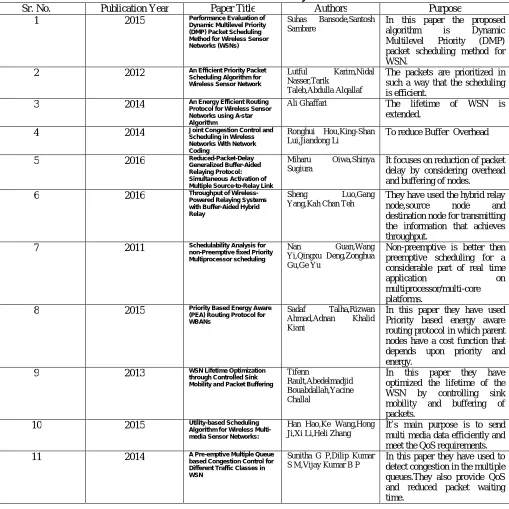
Sr. No. Publication Year Paper Title Authors Purpose 1 2015 Performance Evaluation of
Dynamic Multilevel Priority (DMP) Packet Scheduling Method for Wireless Sensor Networks (WSNs)
Suhas Bansode,Santosh Sambare
In this paper the proposed
algorithm is Dynamic
Multilevel Priority (DMP) packet scheduling method for WSN.
2 2012 An Efficient Priority Packet Scheduling Algorithm for Wireless Sensor Network
Lutful Karim,Nidal Nasser,Tarik
Taleb,Abdulla Alqallaf
The packets are prioritized in such a way that the scheduling is efficient.
3 2014 An Energy Efficient Routing Protocol for Wireless Sensor Networks using A-star Algorithm
Ali Ghaffari The lifetime of WSN is
extended.
4 2014 Joint Congestion Control and Scheduling in Wireless Networks With Network Coding
Ronghui Hou,King-Shan Lui,Jiandong Li
To reduce Buffer Overhead
5 2016 Reduced-Packet-Delay Generalized Buffer-Aided Relaying Protocol: Simultaneous Activation of Multiple Source-to-Relay Link
Miharu Oiwa,Shinya Sugiura
It focuses on reduction of packet delay by considering overhead and buffering of nodes.
6 2016 Throughput of Wireless-Powered Relaying Systems with Buffer-Aided Hybrid Relay
Sheng Luo,Gang
Yang,Kah Chan Teh
They have used the hybrid relay
node,source node and
destination node for transmitting the information that achieves throughput.
7 2011 Schedulability Analysis for non-Preemptive fixed Priority Multiprocessor scheduling
Nan Guan,Wang
Yi,Qingxu Deng,Zonghua Gu,Ge Yu
Non-preemptive is better then preemptive scheduling for a considerable part of real time
application on
multiprocessor/multi-core platforms.
8 2015 Priority Based Energy Aware (PEA) Routing Protocol for WBANs
Sadaf Talha,Rizwan Ahmad,Adnan Khalid Kiani
In this paper they have used Priority based energy aware routing protocol in which parent nodes have a cost function that depends upon priority and energy.
9 2013 WSN Lifetime Optimization through Controlled Sink Mobility and Packet Buffering
Tifenn
Rault,Abedelmadjid Bouabdallah,Yacine Challal
In this paper they have optimized the lifetime of the WSN by controlling sink mobility and buffering of packets.
10 2015 Utility-based Scheduling Algorithm for Wireless Multi-media Sensor Networks:
Han Hao,Ke Wang,Hong Ji,Xi Li,Heli Zhang
It’s main purpose is to send multi media data efficiently and meet the QoS requirements.
11 2014 A Pre-emptive Multiple Queue
12 2012 A Coverage-Based Drop-Policy in Wireless Sensor Network with Disruptive Connection
Daniel Frazao Luiz,Carlos M. S. Figueiredo,Eduardo F.Nakamura
Buffer manages the coverage Based Drop Policy that improves the network coverage.
13 2015 Mind the Smart Gap: A Buffer Management Algorithm for Delay Tolerant Wireless Sensor Networks
Pehr Soderman,Karl-Johan Grinnemo,Markus Hidell,Peter Sjodin
Efficient buffer management.
In table 1. we have surveyed the Last 5-6 years Journal papers on the Wireless sensor networks, Data packet transfer. We have studied overall different types of buffer management and packet scheduling techniques from the above Journal papers. Following things we have concluded from the above papers which we have shown in the existing system and the proposed system.
III.EXISITINGSYSTEM
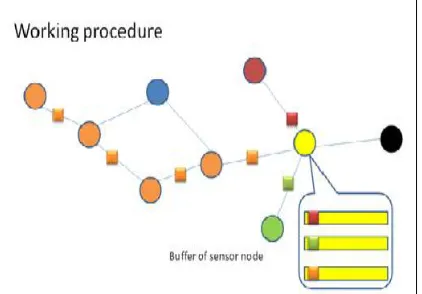
In the given existing system different types of scheduling methods are given namely Earliest Deadline First(EDF),First Come First Served(FCFS),Pre-emptive,Non-preemptive,Single Queue,Multi-level Queue,Real-Time and Non-Real Time Packet Scheduling methods are studied.In the [1] they have proposed an algorithm called “Dynamic Multilevel Priority”(DMP) packet scheduling.They have used a multilevel buffer with 3-levels of queue.
Fig. 1(a)Working procedure of existing system: Buffer Management with 3-Multi-Level Queue
s
Fig. 1:(b)Real-Time Highest Priority Packets
Fig.1 (b): In the first queue all the real time highest priority packets are processed first for avoiding packet loss and to get efficient throughput of overall application. Hence as shown in first queue the packet ‘RED’ is having highest priority so it will get processed first and will be transferred to the next node for further processing and to achieve efficiency for overall application.
Fig. 1:(c) Non Real-Time Second Highest priority packets
Fig.1 (d):finally in the third queue all the non-real time lowest priority packets are processed. The packets which arrive at the sink node at the last time slot will be assigned third lowest priority.
First priority is given to all the real-time packets,second priority is given to all the non-real time packets and then at the end lowest priority is given to all the Non-Real time local packets.
IV.PROPOSEDSYSTEM
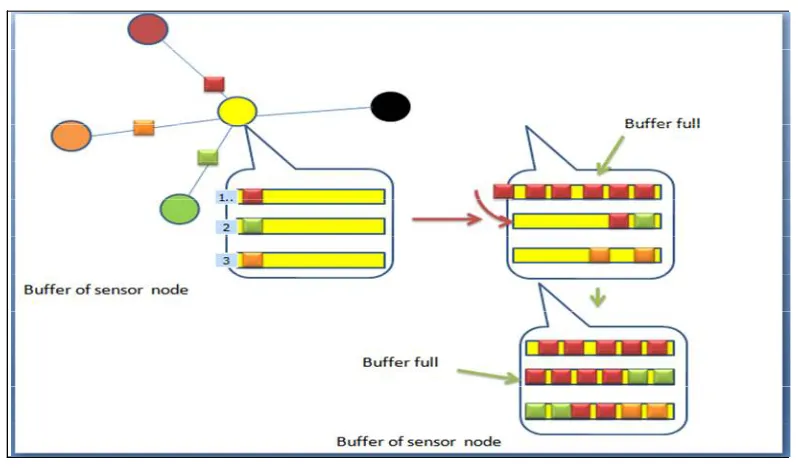
Fig. 2 Proposed system
In our “proposed system” we are using 3-multilevel queues concept for proper buffer management,.to avoid packet loss and buffer overflow,we are going to use an efficient packet scheduling method.
In Fig.2there are 3-queues queue 1,2,and,3.As discussed about the 3-multilevel queues concept when the
Queue 1 becomes full with real-time packets which are present in the network the other real-time packets are then dropped in the network for avoiding it all the real-time packets are moved to the second queue so that the real time packets get processed with some delay to achieve QoS like Reliability.
Similarily,if Queue 2 becomes full then both real-time packets and non-real time second highest priority packets are moved to Queue 3 and all 3 types of packets are processed with some delay to achieve efficient throughput of the overall application.
V.CONCLUSION
REFERENCES
[1]”Performance Evaluation of Dynamic Multilevel Priority (DMP) Packet Scheduling Method for Wireless Sensor Networks (WSNs)”,Suhas Bansode1 ,Santosh Sambare2,Student Department of Computer Engineering, GHRCEM Associate Professor Department of Computer Engineering, PCCOE,Pune, IEEE,2015
[2] ”An Efficient Priority Packet Scheduling Algorithm for Wireless Sensor Network”,Lutful Karim1, Nidal Nasser2, Tarik Taleb3, and Abdullah Alqallaf4 1School of Computer Science, University of Guelph, Ontario, Canada 2College of Engineering, Alfaisal University, KSA 3NEC Europe Ltd , IEEE ICC 2013
[3] “An Energy Efficient Routing Protocol for Wireless Sensor Networks using A-star Algorithm”,Ali Ghaffari Department of Computer Engineering College of Engineering,Tabriz Branch Islamic Azad University, Tabriz, Iran,2014.
[4] “Joint Congestion Control and Scheduling in Wireless Networks With Network Coding”Ronghui Hou, King-Shan Lui, Senior Member, IEEE, and Jiandong Li, Senior Member, IEEE ,september-2014
[5] ”Reduced-Packet-Delay Generalized Buffer-Aided Relaying Protocol: Simultaneous Activation of Multiple Source-to-Relay Link”,MIHARU OIWA, (Student Member, IEEE), AND SHINYA SUGIURA, (Senior Member, IEEE) Department of Computer and Information Sciences, Tokyo University of Agriculture and Technology, Tokyo 184-8588, Japan Corresponding author: S. Sugiura,2016
[6] ”Throughput of Wireless-Powered Relaying Systems with BufferAided Hybrid Relay”,Sheng Luo, Gang Yang, Member, IEEE, and Kah Chan Teh, Senior Member, IEEE,2016
[7] ”Scheduling Analysis for non-Preemptive fixed Priority Multiprocessor scheduling”,nann guan,qingxu den, wang yi,2015 IEEE journals, china. [8] ”Priority Based Energy Aware (PEA) Routing Protocol for WBANs”,Sadaf Talha, Rizwan Ahmad and Adnan Khalid Kiani School of Electrical Engineering and Computer Science (SEECS) National University of Sciences and Technology (NUST) H-12 Campus, Islamabad, Pakistan,2015. [9] ”WSN Lifetime Optimization through Controlled Sink Mobility and Packet Buffering”,Tifenn Rault, Abdelmadjid Bouabdallah, Yacine Challal Universit´e de Technologie de Compi`egne Heudiasyc UMR CNRS 7253 60205 Compi`egne, France,2013 IEEE.
[10] ”Utility-based Scheduling Algorithm for Wireless Multi-media Sensor Networks”,Han Hao, Ke Wang, Hong Ji, Xi Li, Heli Zhang Beijing University of Posts and Telecom., P.R. Chin,2015.
[11] ”A Pre-emptive Multiple Queue based Congestion Control for Different Traffic Classes in WSN”,Sunitha G P1, Dilip Kumar S M2, and Vijay Kumar B P,2014 IEEE