Modeling of the fuel mechanical behavior"
and physics of solids
Internal variables
Leclercq S. (1),
S a u t e r F.(2), C u n a t C.(2)(1)EDF R&D EMA branch 77818 Moret sur Loing, France
(2)LEMTA/INPL, 2 av. de la For~t de Haye, 54504 Vandoeuvre Cedex, France
A b s t r a c t
In this paper, one first recalls the issues of the Pellet Cladding Mechanical Interaction (PCMI) occurring in a P W R fuel rod under nominal and incidental operating conditions. In order to demonstrate that P C M I does not induce any fuel rod failure, Electricit6 de France (EDF) develops constitutive equations allowing to simulate the viscoplastic behavior of the Zircaloy cladding and the
U02
fuel pellet. The latter is being discussed in the present study. After having identified the mechanisms responsible for the mechanical behavior of industrial pellets, one puts the emphasis on a dislocation based model allowing to describe the non monotonous viscoplastic flow (yield compressive point). This approach is afterwards introduced at a local scale in the framework of a polycrystalline approach. The numerical results exhibit a very good agreement with the experimental ones.I n t r o d u c t i o n
The fuel rods in Pressurized Water Reactor are made of
U02
pellets inside a Zircaloy cladding tube. During class 2 incidents or power changes due to load follow, Pellet-Cladding Mechanical Interaction may occur, inducing a cladding stress increase. The viscoplastic behavior of the pellet at its center (high t e m p e r a t u r e zone) tends to reduce the stress level.The accurate estimate of the stress level in the cladding is a major concern for E D F since it is the first barrier for irradiation wastes. Therefore in order to quantify sharply the stress level in the cladding E D F R&D develops viscoplastic models. Since P C M I is a transient phenomenon, steady state creep laws are useless, thus mechanical constitutive equations are required. A phenomenological approach was first used, it consisted in a Lemaitre's model extended by (Leclercq, 1998) and (Sauter and Letaief, 2000) to take into account the irradiation effects and the variations of the porosity. These models are unfortunately unable to describe the non monotonous behavior of industrial pellets - i.e. a yield point during strain hardening tests (see Fig. 3a, 3c, 3d) or a sigma creep curve - furthermore their predictive abilities are relatively poor.
Consequently, E D F R&D has begun the development of a thermodynamical a p p r o a c h - the Cunat's Distribution of Non Linear Relaxations (D.N.L.R.) model (see Sauter et al. (2000) or Cunat (1991)). More recently the emphasis has been put on a dislocation based model in the framework of Pilvin and Cailletaud's polycrystalline approach. Hereafter we will focus on the latter.
The demonstration requires a recall of the material properties (crystallography and viscoplasticity) and a study of the dominant deformation mechanism (dislocations glide, vacancy diffusion) and damage. Afterwards, the constitutive equations of the model will be described.
2
M a i n F e a t u r e s o f t h e m a t e r i a l
2 . 1 C r y s t a l p r o p e r t i e s
U02
fuel pellets are partially ionic solids with a fluorite structure. The oxygen ions are arrayed in a simple cubic lattice and the uranium ions form a fcc sublattice. The unoccupied interstitial positions in the body centers of the small cubes do not contain uranium ions (Olander, 1976). At room temperature, they exhibit a very high yield stress and a mainly brittle behavior. This is due to the very high Peierls Nabarro stress (10-2#) 1 and the very low dislocation density. At high temperatures, viscoplasticity resulting from dislocations motions appears in the range of stress we deal with. The Burgers' vector is ao (110} where a0 - 5 . 4 7 . 1 0 - 1 ° m The easier active slip plane is {001} and for higher energy level (011} v~1 # is the shear m o d u l u s
SMiRT 16, Washington DC, August 2001 Paper # 1061
T E M P E R A T U R E f t ; 1
,o,,~.n~ .. ~ .._ . . . ! ... ,, r .,,. ~ " x , ~ , ~ ~!~i ... ' ~ "::i
8
~ ~.~.~I'~ ~ ~ ' ; . . . ... ~ i ... O : ~ ... ~ . . 1 ~ _~..!~ ... .%1 . . . ~ ... ~ .
(a) Deformation-map mechanisms for
U02
(Ashby and Frost, 1982)
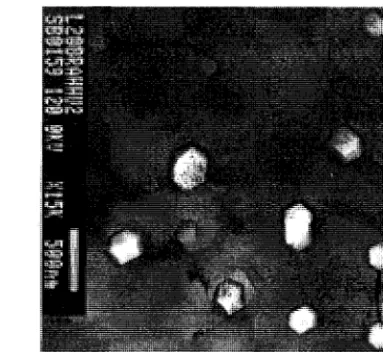
(b) Dislocations pinned on pores
Figure 1: Viscoplastic mechanism and interactions with pores.
and finally {111}. Note t h a t this is the opposite rule as in crystalline materials. Sometimes, the plane {111} interacts with the (110} {001} slip thus an hexagonal network appears (Alamo et al., 1978). As the stacking fault energy is very high, glissile dislocations do not dissociate (see Lefebvre (1976)).
2.2
Viscoplastic properties
Steady state creep of
U02
has been formerly widely studied. Ashby and Frost (1982) have summarized these results on a deformation-map mechanisms which gives the viscoplastic strain rate versus temperature and the associated deformation mechanism, see Fig.(la). The colored area stands for the range of stress and t e m p e r a t u r e of the present study. It brings out t h a t dislocation glide and vacancy diffusion (especially grain boundary diffusion) are likely to occur but actually dislocation glide is the leading viscoplastic deformation mechanism.On Fig.(lb) one can see dislocations pinned on pores. This mechanism leads the stress necessary to activate dislocation glide to increase. This feature may be responsible for the yield point or the sigma creep curve. These primary stages correspond to a stiff creation of mobile dislocations. Thus, the strain is likely to decrease at the beginning of viscoplastic flow whereas the strain increases. This characteristic has been successfully modeled by Alexander and Haasen (1968), in a framework initially developed for single crystal of silicium which exhibit a high yield point. This will be detailed in the next section.
As
U02
is a ceramic it is well known t h a t the stoichiometric ratio is likely to evolve if the partial pressure of oxygen is not perfectly controlled. These evolutions have been modeled by Lindemer and Besmann (1985) see Tab.(1) with x the stoichiometric excess. Obviously, the crystallography is closely dependent on the stoichiometry. The atoms of oxygen are in interstitial position so in case of hypersto- ichiometry some of these atoms can pin dislocations and trigger a yield point. The literature provides also indications on the influence of stoichiometry on the elastic and viscoplastic properties ofU02.
For a complete review of these dependency (see Sauter (2001)).2.3
D a m a g e evidences
C o m p o s i t i o n
U02-~
UO2.00 (T < 3015 K)
U02+~
0 < x < 0.01
x > 0.01
Expression of the oxygen potential R T in Po2 ( J / m o l ) _
1300000 ~ 225.7T 3 R T l n 1.5x
. ( l + x ) ~ ( 1 - - ~ ) ~ -
-897000 ~ 224.8T
360000 + 214T + 4 R T l n ~ (1-4z
312800 + 126T + 2 R T l n (1_3x)3
Table I: Evolution of the oxygen potential versus x (Lindemer a n d B e s m a n n , 1985).
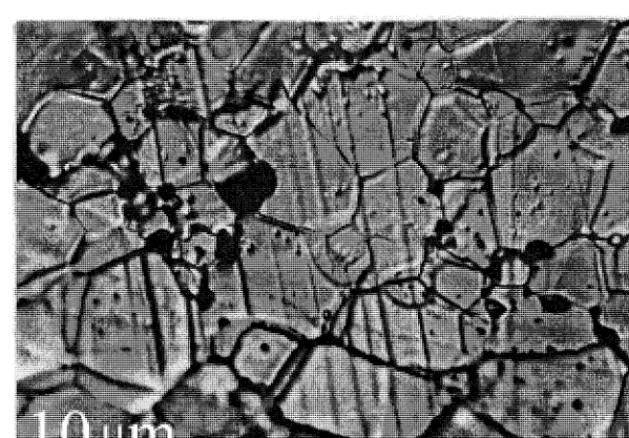
Figure 2: Creation of intergranular cavities in U02, e ..~ 6% (Vivant-Duguay, 1998)
of
U 0 2
pellets. N o t e that d a m a g e h a d never been introduced in the behavior of n o n irradiated pelletsbefore due to a lack of experimental evidence.
A s a first approximation, the Young's m o d u l u s will be calculated as decreasing function of the vis-
coplastic strain cvP:
E ~ = E~ • (1 -ceeVP). (1)
3
M o d e l description
T h e Alexander a n d Haasen's m o d e l is well k n o w n for its ability to describe the yield point. W e first have modified the m o d e l according to K u b i n a n d identified its parameters to fit the mechanical behavior of
U02.
T h e n it has been introduced in the f r a m e w o r k of Pilvin a n d Cailletaud's polycrystalline approach(Cailletaud (1987); Pilvin (1990)) to take into account the crystallographical properties of
U 0 2
(such ascritical resolved shear stress a n d slip plane orientation) a n d hence have a better estimation of the internal
variables responsible for the viscoplastic behavior of
U02,
a n d of internal stresses.Strain (%)
Young's modulus (MPa)
0 229000
4.47 6.50 7.02
163948
163156 157663
This framework is based on a local behavior description (here Alexander and Haasen's approach) at the phase scale (a phase is defined as the continuum media which exhibits one crystalline orientation and a given glide system) and a scale transition which allows to link the local mechanical fields (local stress, local strain) with the macroscopic ones (strain and stress fields at the Representative Elementary Volume scale). Thus a R E V is made of several phases (200, with random crystallographic orientation, in order to account for the isotropic behavior of polycrystalline U 0 2 ) .
3.1
L o c a l b e h a v i o r
T h e A l e x a n d e r a n d Haasen's basic m o d e l reads:
v -- v0 exp -
T* -- max (0; T -- ~-~),
-- K p v T *
AHo]
(2)
R T '
(3)
(4)
(5)
where 7, v, b, AH0, p, T*,Ti, M are respectively the shear strain, the speed of dislocations, the magnitude of the Burgers' vector, the activation free enthalpy, the density of dislocations, the effective shear stress, the internal shear stress and the stiffness of the assembly which is equivalent to an apparent shear modulus. Taking into account the stiffness of the experimental device and the range of temperatures M is quite different from the shear modulus # (M _~ ~ from our identifications which agrees with Rabier and George (1987)'s indications). Furthermore, it is found in the literature 1 ~< m ~< 2. Note that the lower value stands for thermodynamical stability.
This model is able to describe the yield point in the case of a strain rate controled test. Indeed, T* -- 0 until T < T{ ,hence T increases and no dislocation is created. As soon as T yields the value of the internal shear stress (close to the yield point) T* > 0 and the multiplication of dislocations occurs (p increases). In order to comply with Equation (3), "/- must be negative (this transient effect is called the overshoot). Afterwards hardening occurs and the viscoplastic flow becomes monotonous, as an equilibrium arises between the effective shear stress and the dislocation density. According to Alexander and Haasen the evolutions of the yield point T y p can be estimated by:
(
)
T y p ~ 3 , ' ~ -2exp ( m + 2 ) R T ' (6)
In order to i m p r o v e the A l e x a n d e r a n d Haasen's basic model, Estrin a n d K u b i n (1986) have proposed kinetics for the dislocation density based on coupled differential equations in w h i c h sessile (or forest)
dislocations Ys - ~ a n d glissile (or mobile) dislocations
Xs
= pm are taken into account.P f o Prno
- - q - - C I V / ~ s - c 3 X s +
c4~-~s
(7)
d <
d7 = ( c~ x / ~ - c2Y~ + c3X~) , (8)
T h e A l e x a n d e r a n d Haasen's m o d e l provides a local behavior in terms of shear strain a n d stress, for a given glide system. Nevertheless, one has n o w to evaluate the total viscoplastic strain tensor e ~p. T h e heterogeneity of the representative element v o l u m e ( R E V ) of the material is introduced in the model. Dislocations can not be represented directly in this approach. T h e first level of heterogeneity is the grain. T h e m o r p h o l o g y of the grains (shape, size) is identical but the grains differ f r o m each other in terms of crystallographic orientations. T h u s a phase will be defined with its Euler's angles a n d its v o l u m e fraction
fg
w h i c h is related to the n u m b e r of occurrence of an orientation. This set of values defines a F D O C(Function of Distribution of the Crystalline Orientations). F r o m a mechanical point of view, each phase is considered as a c o n t i n u u m m e d i a w h i c h behavior takes into account the crystallographic structure
(fcc) a n d the glide systems ((011} (I00), (01i} 1 (01), (01i} (III)). T h e following variables
(a,e,e vp)
areis defined by the Schmid's tensor ms calculated with the direction of glide ls and the normal vector to the glide plane ns as follows:
1 ( l s ® n s + n s ® l ) , I s
bs
ms
- ~ ~ - b--'~'(9)
T h e contribution of a glide s y s t e m (s) to the plastic strain e Èp is given by:
-
sES
Note t h a t we respect the hypothesis of small p e r t u r b a t i o n s hence rhs - 0 . The viscoplastic shear strain rate ~s is settled by2:
"r~
= m a x (0; ~ ) ,(11)
(12)
with the following internal stress:
(13)
~ rES
where To is the critical resolved shear stress and Ps the total dislocation density ( Ps - P~ + P~). The hardening m a t r i x A can be written A~s = hl~t + (1 -
hl~t) 5~s
where 5~s is the Kronecker's index so t h a t withhl~t
= 1 one obtains the unity m a t r i x and Taylor's formula can be derived (Franciosi, 1984):T~--T0 + c ~ # b ~ ~ p r • (14)
W i t h hlat = 0, there is no interaction between glide systems. Strain hardening in a given system is controlled by its own density of dislocations. As we do not have any indication on the phenomenon
htat
is defined as a variable to be numerically identified. According to Moulin et al. (1999), the value of a is given by:
1.48
o~
=(15)
2 -(1 -
2~ (1 - r,) being the signature of edge dislocations.
3.2
S c a l e t r a n s i t i o n s
N o w that w e dispose of the mechanical variables (G,s,~ p) for each phase, w e have to p e r f o r m a scale transition to obtain the m a c r o s c o p i c data ( ] E , E , E P ) . T o the aim, spatial average on the R E V are necessary. T h e R E V is defined a set a phases characterized b y the F O C :
F , -
E (&a),
(16)
gEG
E -
Z
(17)
gEG
Hill has written, in case of a n elastic-plastic behavior, the scale transition rule as follows:
w h e r e Z2* is a fourth order tensor. This calculus is c o m p l e x since Eq.(18) is an implicit equation. Solving
this equation in case of elastoviscoplasticy does not m e e t industrial considerations.
m c I C2 C3 C4
10.24 3.000E3 3.144E 7 2.987E3
Cd
8.507E 3
9.157 ~ (8 -1 )
2.707E 24
p,po
2.27 • 10 s
hlat A 5 E~
(MPa)
6.874E 1 1.019E4 7.941E 3 2.023E5
Table 3: Parameters of the polycrystalline model.
Here the scale transition rule is set a priori -explicitly- taking into account the morphologic similarity of grains considered identical with an ellipsoidal shape. This is Pilvin and Cailletaud's method who introduced a set of variables/~g taking into account intergranular hardening, the kinetic of which is given phenomenologically Eq. (20):
o- = + C ( I - S ) ( B (19)
- - / X - 'li (20)
where B = E g c G ( f ~ g ) , C" tensor of elastic moduli (isotropic and homogeneous), $" the Eshelby's
tensor for an e11ipsoida1 shape inclusion. Thus there are n e w set of parameters to identify (A, 5).
According to Pilvin a n d Geyer (1997), the validity of the scale transition rule, i.e. the values of (A, 5), can be checked c o m p a r i n g the stress tensors of particular grains to the ones calculated either with the so-called Berveiller a n d Zaoui (1979)'s m e t h o d or using Finite Elements M e t h o d . This w o r k is currently
in progress.
3.3
R e s u l t s a n d d i s c u s s i o n
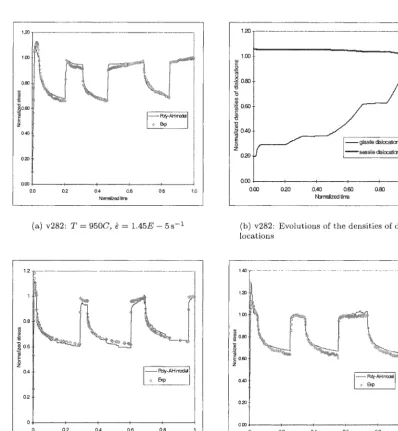
T h e table 3 provides the set of parameters of the polycristalline m o d e l identified on three hardening- relaxation tests presented on Fig. 3. N o t e first that
hzat
is b e t w e e n 0 a n d 1 w h i c h m e a n s there are s o m e interaction b e t w e e n the slip systems a n d second A a n d 5 are such that the contribution of intergranular p h e n o m e n a to the strain hardening is quite small. O n e can see the very g o o d agreement b e t w e e n numericala n d experimental tests.
N o t e that the temperature range of the present study is [950 °C, 1150 °C], so that the d a m a g e due to
grain b o u n d a r y sliding evidenced at temperatures above 4 0 0 ° C can be neglected.
4
C o n c l u s i o n
T h e a i m of the present w o r k w a s to propose an original approach to simulate the n o n m o n o t o n o u s viscoplastic behavior of nuclear fuel pellets under nominal a n d incidental operating conditions.
T h e leading viscoplastic m e c h a n i s m of
U 0 2
pellets has been identified, a n d a dislocation based ap-proach has been used to represent it at a local scale. T h e Alexander a n d Haasen's m o d e l was chosen
for its ability to reproduce the yield point evidenced on strain rate controlled compressive tests. T h e use of a polycristalline f r a m e w o r k allows one to take into account the crystallographic structure a n d the
grain heterogeneity of
U02.
O n e can therefore expect g o o d predictive abilities of the present model. T h egrain b o u n d a r y sliding w h i c h has been evidenced for tests performed above 1 4 0 0 ° C has been neglected here, as the database available for the identification procedure belongs to [950°C, I150°C] temperature range. T h e effect of d a m a g e on the elastic properties is taken into account. Nevertheless, future works
will m a n a g e an extension of the m o d e l validity up to 1400°C, a n d a d a m a g e variable will be introduced
in the modeling.
Acknowledgement
1 The authors would like to thank Dr. A. Mocellin, Dr. F. Dherbey and Mr. M. Sladkoff (CEA) .for providing the experimental data. The help o.f Pr P. Pilvin (Ecole Centrale de Paris) is also gratefully acknowledged.R e f e r e n c e s
A l a m o , Lefebvre, a n d Soullard (1978). D6formation plastique du bioxyde D ' U r a n i u m : Observation des
1.20 1
i
1.00 ¢i~;~ i ~:~.~i,. ,, ~':~:~."*~'~'~"'] '~'~x:''~'*~i~"I"*~i
o ll:
0 4 O t ,.': Exp I
i i -
0.0 0.2 0 8
I I
0.4 0.6 1.0
Norrmlized tn-e
1.20-
1.00-
o
~ 0.80-
~ 0.60-
i 0.40-
f
0.20-
0.00 0.00
. f " glissile cislocations
I
" ' ~ s e s s e dslocations I I
I I 1- I
0.20 0.40 0.60 0.80 1.00
Norrralized time
(a) v 2 8 2 : T = 9 5 0 C , k = 1 . 4 5 / / ; - 5 s - z (b) v 2 8 2 ' E v o l u t i o n s of t h e d e n s i t i e s of dis- l o c a t i o n s
1.2 ~! ...
... ~ ~ ~ : ... ~;..
~N0.6
0.4 J ~ Poly-AH rrodel
I
I
Exp0.2
oi
I I I I0 0.2 0.4 0.6 0 8
Norrmlized firm
" I" I ::' aP ]
0.20+I i
000 ~ I , , I I . . . I . . .
0 0.2 04 06 0.8
Norrn~[zed trre
(c) v 2 8 3 ' T -- 9 5 0 C , b -- 6 . 2 4 E - 5 s - 1 (d) v285" T = 1 1 5 0 C , k = 2 . 3 6 E - 5 s - 1
Alexander and Haasen (1968). Solid St. Phys., 22:27.
Ashby and Frost (1982). Deformation-Mechanism Maps. Pergamon press, London.
Berveiller and Zaoui (1979). An extension of the self-consistent scheme to plastically flowing polycristal.
Journal of the Mechanics and Physics of Solids, 26:325-344.
Cailletaud (1987). Une Approche Microm~canique Ph~nom~nologique Du Comportement In~lastique Des
M~taux. PhD thesis, Universit6 de Paris 6.
Cunat (1991). A thermodynamical theory of relaxation based on a distribution of non linear processes.
Journal of Non Crystalline Solids, 131:196 812.
Estrin and Kubin (1986). Local strain hardening and nonuniformity of plastic deformation. Acta Metallica,
34:2455-2466.
Franciosi (1984). Etude Th~orique et Exp~rimentale Du Comportement Elastoplastique Des Monocristaux M~talliques Se Ddformant Par GIissement: Mod~lisation Pour un Chargement Complexe Quasi Sta-
tique. PhD thesis, Universit6 de Paris Nord.
Leclercq (1998). Modeling of the fuel mechanical behavior: From creep laws to internal variable models.
Nuclear engineering and design, 185:221-228.
Lefebvre (1976). Contribution A L'~tude de la D4formation Plastique D'une C~ramique de Stuucture
Fluorite: Le Bioxyde D'uranium. PhD thesis, Universit6 de Poitier.
Lindemer and Besmann (1985). Chemical thermodynamic representation of UO2+/-X. Journal of Nuclear
Materials, 130:473-488.
Moulin, Condat, and Kubin (1999). Mesoscale modelling of the yield point properties of silicon crystals.
Acta Mater., 47:2879-2888.
Olander (1976). Fundamental Aspects of Nuclear Reactor Fuel Elements. U.S. Department of commerce, Berkeley, California.
Pilvin (1990). Approches Multi-fi, cheIIes Pour la Pr~vision Du Comportement An~lastique Des M~taux.
PhD thesis, Paris 6.
Pilvin and Geyer (1997). Modelling of uniaxial and multiaxial ratchetting of stainless steel 316 SPH by a micromechanical approach, l~th International Conference on Structural Mechanics in Reactor
Technology.
Rabier and George (1987). Dislocations and plasticity in semi conductors. II. the relation between dislocation dynamics and plastic deformation. Revue de Physique Appliqude., 22:1327-1351.
Sauter (2001). Comportement Viscoplastique Du Dioxyde D'uranium. PhD thesis, INPL.
Sauter, Leclercq, Cunat, and Rahouadj (2000). Non-linearity and relaxed state in a viscoplastic model based on the theory of fluctuations. Euromech~ Metz.
Sauter and Letaief (2000). Evolution du module de lemaitre pour la pastille combustible. Technical
Report HT-25/00/051/A, EDF.
Vivant-Duguay (1998). Contribution .]i L'~tude Du FIuage Du Dioxyde D'Uranium. R61e Des Activateurs