DOI: 10.1534/genetics.106.061564
Why Molecular Chaperones Buffer Mutational Damage: A Case Study
With a Yeast Hsp40/70 System
Joanna Bobula,*
,1Katarzyna Tomala,*
,1Elzbieta Jez,* Dominika M. Wloch,*
Rhona H. Borts
†and Ryszard Korona*
,2*Institute of Environmental Sciences, Jagiellonian University, 30-387 Krakow, Poland and †Department of Genetics, University of Leicester, Leicester LE7 1RH, United Kingdom
Manuscript received June 2, 2006 Accepted for publication July 17, 2006
ABSTRACT
The malfunctioning of molecular chaperones may result in uncovering genetic variation. The mo-lecular basis of this phenomenon remains largely unknown. Chaperones rescue proteins unfolded by environmental stresses and therefore they might also help to stabilize mutated proteins and thus mask damages. To test this hypothesis, we carried out a genomewide mutagenesis followed by a screen for mutations that were synthetically harmful when the RAC–Ssb1/2 cytosolic chaperones were inactive. Mutants with such a phenotype were found and mapped to single nucleotide substitutions. However, neither the genes identified nor the nature of genetic lesions implied that folding of the mutated proteins was being supported by the chaperones. In a second screen, we identified temperature-sensitive (ts) mutants, a phenotype indicative of structural instability of proteins. We tested these for an association with sensitivity to loss of chaperone activity but found no such correlation as might have been expected if the chaperones assisted the folding of mutant proteins. Thus, molecular chaperones can mask the nega-tive effects of mutations but the mechanism of such buffering need not be direct. A plausible role of chaperones is to stabilize genetic networks, thus making them more tolerant to malfunctioning of their constituents.
T
HE remarkable constancy of phenotypes in face of genetic alteration was recognized decades ago (Shmalhausen 1949; Waddington 1957; Lewontin1974). Recent technical developments have revealed that the degree of genetic variation hidden under com-mon phenotypes is greater than expected. Targeted mutagenesis of entire genomes has demonstrated that often as many as half of the genes can be indi-vidually inactivated without causing visible alteration of a phenotype (Goffeau et al. 1996; Oliver 1996;
Gerdeset al.2003; Kobayashiet al.2003). Studies with
microorganisms demonstrated that strains carrying dozens of harmful mutations may still have relatively high fitness (Cooperand Lenski2000; Funchainet al.
2000; Sliwa et al. 2004). This genetic robustness has
attracted renewed interest and a number of general explanations for its occurrence have been proposed (Kirschnerand Gerhart1998; Hartmanet al.2001;
Siegal and Bergman 2002; Hermisson and Wagner
2004; Wagner 2005). Among the most appealing
hy-potheses are those assuming that the ability to resist genetic perturbations results from the ability to cope with environmental challenges. The genetic robustness
would be simply congruent with the environmental one or derived from it in a course of evolution (Wagner
et al. 1997; Miklejohn and Hartl 2002). Molecular
chaperones seem to be an especially plausible example of such adaptation. These molecules, also known as heat-shock proteins (hsp’s), are able to disaggregate and refold proteins destabilized by a variety of environmen-tal stresses (Estruch 2000; Gasch et al. 2000). The
realization that they may also uphold the functionality of genetically damaged proteins came from studies of endosymbiotic bacteria. These organisms experience elevated rates of mutation accumulation due to the operation of genetic drift. They also have a high cellular level of GroEL chaperone. This was interpreted as an adaptation to a high incidence of mutational destabilization of proteins (Moran1996). Subsequent
experiments confirmed that bacteria carrying multiple mutations grow better when the chaperones GroEL or DnaK are overexpressed (Fareset al.2002; Maisnier
-Patinet al.2005). But, although it was shown that the
mutations were present in the bacterial genomes and that the levels of chaperones were enhanced, there is no evidence that the mutations caused a massive mis-folding and that this led to upregulation of the chaper-ones’ expression (Moran1996; Maisnier-Patin et al.
2005). Moreover, it is known that overexpression of the chaperones facilitates folding of many native proteins, not only the mutated ones (Genevaux et al. 2004;
1These authors contributed equally to this work.
2Corresponding author:Institute of Environmental Sciences, Jagiellonian
University, Gronostajowa 7, 30-387 Krakow, Poland. E-mail: [email protected]
Vorderwulbeckeet al.2004). In eukaryotes, a decreased
activity of the Hsp90 chaperone results in unmask-ing of heritable phenotypic variation. This indicates that the chaperone’s activity dampens expression of genetic variation (Rutherfordand Lindquist 1998;
Queitsch et al. 2002; Rutherford 2003). Again,
in-terpretation of these findings is not straightforward because of the complex role of Hsp90 in the cellular metabolism. Hsp90 maintains activity of key signaling factors, including steroid hormone receptors and pro-tein kinases (Zhaoet al.2005). Hsp90 is also needed for
the development of a correct structure of chromatin and therefore it affects epigenetic inheritance (Sollars
et al. 2003). Thus, the scarcity of Hsp90 may have a general epistatic effect and not a direct effect due to insufficient aid in the folding of mutated proteins. As a result, although the extent of phenotypic buffering by Hsp90 is impressive, its molecular underpinnings re-main unknown (Sangsterand Queitsch2005).
This work is based on the assumption that virtually all chaperones should be able to participate in buffering genetic variation because they are all likely to support folding of mutationally damaged proteins (Sangster
et al.2004). Although several chaperones are essential to a cell’s viability under nonstressful conditions, the position of the Hsp70 family of chaperones is special because they are found at the beginning and at the crossroads of all major pathways of protein folding (Younget al.2004). They are also engaged in numerous
specialized processes such as protein translocation, re-modeling, and degradation (Lund 2001). Therefore
alteration of their activity is likely to be highly pleiotro-pic, as is the case for GroEL and Hsp90. A special fea-ture ofSaccharomyces cerevisiaeis that it has two Hsp70’s dedicated to aiding the folding of newly synthesized proteins. These are Ssb1 and Ssb2, the chaperones responsible for the bulk of Hsp70 binding to ribosome-bound nascent chains (Pfund et al.1998; Craiget al.
2003; Yamet al.2005). The peptide-binding activity of
Ssb is dependent on the ribosome-associated complex (RAC) of an Hsp40 protein, Zuo1, and of another Hsp70 protein, Ssz1 (Yanet al.1998; Michimotoet al.
2000; Gautschi et al. 2001; Huang et al. 2005). Ssb,
Zuo1, and Ssz1 form a functional triad. Deletion of a single constituent results in inactivation of the whole system and a decrease in the rate of growth (Gautschi
et al. 2002; Hundley et al. 2002). Although the RAC
complex appears to be specialized, components of the complex also participate in other activities. For exam-ple, Ssb is involved in post-translational transportation of some proteins (Siegerset al.2003) while Zuo1 and
Ssz1 may perform some regulatory functions outside the ribosomal context (Eisenmanand Craig2004).
Never-theless, in yeast the cotranslationally acting Ssb’s appear functionally distinct from multipurpose Hsp70’s, such as Ssa1–4 (Craig et al. 2003). This is in contrast to
mammalian systems where a multipurpose Hsp70 is also
recruited to the cotranslational folding by a ribosome-tethered Zuo1 homolog (Hundleyet al.2005). For these
reasons, we selected the Ssb–RAC system as especially attractive for the study of the phenotypic buffering that results from the activity of chaperones during folding of nascent proteins.
We used a classic genetic approach. We chemically mutagenized a yeast strain and screened for mutants whose lethal (slow-growth) phenotype was apparent only in the absence of active Ssb–RAC. Tests of comple-mentation with a genomic library and subsequent gene cloning allowed us to identify a sample of single-locus mutations that interacted genetically with the Ssb– RAC. However, there was no clear indication that the role of the chaperones was to stabilize the mutant proteins. Subsequently, we looked for thermosensitive mutants to identify proteins of reduced spatial stability (Varadarajan et al. 1996; Hampsey 1997). We then
tested whether the thermally unstable proteins were also sensitive to the absence of Ssb–RAC but found no evi-dence that the chaperones can stabilize such proteins.
MATERIALS AND METHODS
Strains and media: A haploid clone acquired from the Yeast Deletion Project collection, BY4742zuo1Dura3 leu2 his3 lys2, was used in all experiments. For the purpose of genetic analysis, thekangene used to constructzuo1Dwas replaced with thehphgene that conferred resistance to hygromycin B (Goldstein and McCusker 1999). This strain was
trans-formed with a pRS416 URA3 plasmid (ATCC 87521) con-taining the ZUO1 gene. This plasmid and those used in complementation tests contained a centromere and therefore were present as one or a few copies per yeast cell. Standard synthetic complete (SC) and omission media (e.g., SC–uracil) were used when appropriate. Loss of the pZUO1 URA3plasmid was selected for on complete synthetic medium with 0.1% 5-fluoroorotic acid (5-FOA) (Boekeet al.1984). All experiments
plates to force the loss of the pZUO1 URA3plasmid. These were then screened for good growth, which indicated that the cloned gene complemented the mutant and relieved the requirement for Zuo1p. The library plasmids were isolated from these transformants and used for retransformation of the original mutants. Strong growth upon acquisition of the plasmid marked genuine complementation. The genomic fragments present in these plasmids were identified by se-quencing their ends in reactions primed from the adjacent sequences of pBS32. Single genes from the complementing clones were amplified by PCR and subcloned into a pRS413 HIS3plasmid (ATCC 87518).
In the screen for thermosensitive mutants, the plates with transformants were replica plated on SC–ura–leu plates and incubated at 36°. The library plasmids were isolated from colonies that were able to grow at this temperature; the iden-tity of chromosomal fragments was determined as described above.
Allele replacement: To compare the phenotypes of the mutant alleles to those of gene deletions, the open reading frame of the nonessential pZUO1-dependent alleles was re-placed with thekanMX4 cassette by a one-step replacement technique (Wach et al. 1994). Acquisition of resistance to
geneticin and positive results of PCR amplifications from the expected constructs were used to confirm each replacement. In other experiments, the thermosensitive alleles were replaced by wild-type ones. The screen for a clone with a successful replacement was done by incubation of a post-transformation culture at 36°. The sequence of DNA in a locus in question was determined to confirm that the replacement actually happened and that the observed phenotypic change was not caused by a compensatory mutation in another locus. In all cases of DNA sequence analysis at least two in-dependent PCR products were sequenced. The sequences obtained from wild-type genes matched those published in the Saccharomyces Genome Database (http://www.yeastgenome. org). The mutations reported here are the reproducible se-quence deviations from the wild-type alleles.
RESULTS
Phenotypes dependent on zuo1D: The goal of this experiment was to find strains with impaired growth due to a synthetic effect of inactivation of the Ssb–RAC complex and acquisition of a random mutation. We used EMS to mutagenize a haploid strain of yeast in which the gene coding for the Zuo1 protein was deleted from the chromosome (zuo1D) but expressed from a plasmid, pZUO1 URA3. We then compared growth of 20,000 colonies on media selecting for either presence or absence of the plasmid. We found 93 mutant strains that grew well on the former but poorly on the latter medium.
We hypothesized that the growth defects observed on thezuo1Dbackground were caused by point muta-tions and that the mutated loci could be complemented by their wild-type alleles. To test this assumption, we transformed every mutant, initially harboring pZUO1, with a library of single-copy plasmids carrying random fragments of the yeast genome. We expected that com-plementing plasmids would allow sustained ability to grow after losing pZUO1. Successful implementation of this approach required that three conditions were
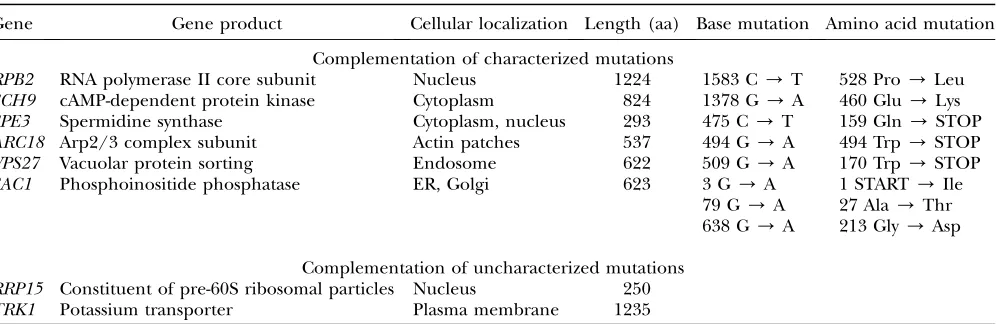
met for every mutant: the efficiency of transformation was high, the rate of spontaneous reversion to fast growth was low, and the difference in the growth rate between the background and the candidate colonies of comple-mented mutants was easy to detect. These requirements were fulfilled for 37 mutant strains. The library plas-mids from these transformants were isolated and used to retransform the original mutant strains and to retest the ability to complement the growth defect. Plasmids passing this test were found for 32 mutant strains. In all cases, at least one library plasmid containedZUO1; for 8 mutants, we also found unique complementing chro-mosomal regions. We carried out two further tests on the latter. First, we found which individual genes from the fragments provided complementation. We also sequenced the same genes from the chromosomal loci of the mutant strains. For two strains, we did not find a mutation in the genes that were responsible for com-plementation,RRP1andTRK1. These genes were iden-tified as the only ones shared by all library fragments complementing a given mutant. For the remaining six mutants, we identified a single gene in which the results of both tests agreed; that is, the cloned wild-type allele complemented the growth defect and the chro-mosomal allele contained a mutation. All eight cases of complementation are described in Table 1. The muta-tions were transimuta-tions at GC sites, as expected for the EMS mutagenesis (Sega1984). No substitutions other
than those reported in Table 1 were found. Thus, the occurrence of three substitutions in a single clone of
sac1was striking but was confirmed by repeated cloning and sequencing.
Figure 1 illustrates the phenotype of mutants in which eitherZUO1or a complementing gene were sufficient to improve growth. Strains carrying mutations in non-essential genes were compared with strains derived directly from them by deletion of the mutated locus. In the cases of ARC18, VPS2, and possibly SPE3 and
SAC1, the negative growth effect of the substitution was stronger than that of the deletion compared with strains missingZUO1. We also asked whether the strains differ in the maximum growth rate measured in liquid cultures. The results generally corresponded to those obtained in the dot test although not all mutant strains were suitable for assays in liquid cultures (see supplemental Figure 1S at http://genetics.org/supplemental/).
strains in which onlyZUO1provided complementation, at least two per strain, while none of them occurred in the 8 strains with mapped loci. Having the proportion of the class with zero events,p0¼8/32¼0.25, we can use
Poisson distribution to calculate the frequency of the class with a single event (p1 ¼ 0.347, which gives the
expected number of such mutants, 11.1, in contrast to the zero observed) and the frequency of the class with multiple mutations (pm ¼ 0.403; expected 12.9,
ob-served 24). The ratios of expected/obob-served are clearly inconsistent with the hypothesis that our results were confounded by strains with multiple mutations byZUO1
(x2¼20.632, d.f.¼1,P>0.001).
Thermosensitivity and dependence on zuo1D: Our second approach was to design a screen in which we identified conditionally structurally unstable proteins and then demonstrated their phenotypic dependence on the chaperones at the permissive conditions. To im-plement this idea, we tested whether thermal sensi-tivity of mutated proteins, a known marker of spatial instability, was associated with sensitivity to the absence of functional Ssb–RAC at the permissive temperature. We reasoned that a link between the ts- and zuo1D -dependent phenotypes would be the most straight-forward method for interpreting essential genes. A mutationally caused instability of such proteins might be enhanced by either heat or absence of the chaper-ones. Either would result in an insufficient level of an essential protein and, consequently, in a growth defect. We mutagenized the zuo1D strain harboringpZUO1 URA3as above. Survivors were screened for tempera-ture-sensitive (ts) growth after replica plating and incu-bation at 36°. A total of 125 strains whose ts phenotype was reproducible were identified. These mutants were streaked to single cells on 5-FOA medium at 25°to force the loss ofpZUO1 URA3. In 54 mutant strains, we could unequivocally demonstrate that there were no signs of poorer growth after losing the pZUO1plasmid. The remaining strains were further analyzed to test the
asso-ciation between sensitivity to thermal stress and absence of chaperones. We transformed the mutants with the genomic library and selected for restoration of growth at 36°. Of the 47 mutant strains that transformed with high efficiency, complementing plasmids were found for 38 mutant strains. These strains, complemented for the ts effect, were then tested for dependence on Zuo1p at 25°. For 22 of them, we decided that the apparent association between ts and dependence onzuo1Dcould not be confirmed because, while the complementing plasmid clearly cured the ts phenotype, it did not alle-viate thezuo1Ddependence.
For the remaining 16 mutant strains, the association between ts and the sensitivity to absence of Zuo1p could not be excluded although it was not clearly evident. The observed small differences in growth could have been caused by differences in relative plasmid stabilities or in nutritional properties of the media used. To exclude such nuances and map the complementation effects to single genes, we first determined the stretch of DNA that was shared by clones complementing a given mutant strain. We found 18 essential genes, distributed among 14 chromosomal fragments. We analyzed the DNA se-quence of all corresponding genes in the appropriate mutants. For 6 mutants, we found substitutions of a single base in a single essential gene. To confirm that these were the critical changes, we amplified the corre-sponding wild-type alleles, transformed the mutants, and selected for the ability to grow at 36°. We found revertants of temperature sensitivity in all six strains. Restoration of the original DNA sequence was confirmed in every case. Figure 2 presents the six strains whose ts effect was reverted by restoring the original nucleotide at the point of mutation. However, reversion of the ts pheno-type was not associated with loss of the sensitivity to the absence of ZUO1. Thus, association between the two phenotypes was not confirmed although these strains were regarded as the most likely to provide examples of such pleiotropy. Only in the case of rrp1 did we find TABLE 1
Complementation of mutants with azuo1D-dependent slow-growth phenotype
Gene Gene product Cellular localization Length (aa) Base mutation Amino acid mutation
Complementation of characterized mutations
RPB2 RNA polymerase II core subunit Nucleus 1224 1583 C/T 528 Pro/Leu
SCH9 cAMP-dependent protein kinase Cytoplasm 824 1378 G/A 460 Glu/Lys
SPE3 Spermidine synthase Cytoplasm, nucleus 293 475 C/T 159 Gln/STOP
ARC18 Arp2/3 complex subunit Actin patches 537 494 G/A 494 Trp/STOP VPS27 Vacuolar protein sorting Endosome 622 509 G/A 170 Trp/STOP
SAC1 Phosphoinositide phosphatase ER, Golgi 623 3 G/A 1 START/Ile
79 G/A 27 Ala/Thr 638 G/A 213 Gly/Asp
Complementation of uncharacterized mutations RRP15 Constituent of pre-60S ribosomal particles Nucleus 250
the phenotypic difference between the mutant and wild type in the background. However, the molecular ba-sis of this genetic interaction could be very special. It is probably not coincidental thatrrp1andnop4(as well as
rrp15, identified in the first screen) are mutations in genes required for maturation of the 60S ribosomal unit (Sun and Woolford 1994; Horsey et al. 2004; deMarchiset al.2005), the complex to which Zuo1p is
anchored. It indicates that Zuo1p participates in bio-genesis of the ribosome either passively as its future constituent or actively as a working enzyme. This
hypoth-esis is appealing in that Zuo1p can bind both nucleic acids and ribosomal proteins (Zhanget al. 1992; Yan
et al. 1998). We therefore suggest that the interaction between zuo1D and rrp1, the only one producing the searched co-occurrence of ts and zuo1D depencence, is not rooted in the need of active Zuo1p for cotransla-tional folding of the mutant Rrp1p. Thus, co-occurrence of ts and dependence onZUO1was confirmed for none of the original 125 mutations.
Most of our ts mutations remained unidentified. We therefore decided to include in our tests a set of Figure 1.—Mutants
well-characterized ts mutations that were all in the same S288C-derived strain (Davierwalaet al. 2005). These
werearp2-14,cdc12-1,cdc42-1,exo84-102,nip7-1,nop1-3,
prt1-1, rfc5-1, sec1-1, sec7-1,sec15-1, andsec18-1. An ad-ditional three ts mutations,stu1-5,stu2-10, andmyo2-14, were obtained from T. Huffaker (Brewand Huffaker
2002). We confirmed the thermosensitivity of these strains and then deletedZUO1in each of them to test for a link between the ts phenotype and sensitivity to the loss of chaperone function. The results were nega-tive for all mutants (see supplemental Figure 2S at http://genetics.org/supplemental/), confirming that proteins that are unstable at elevated temperatures are not dependent on the RAC–Ssb complex at normal temperatures.
DISCUSSION
Our study provides further evidence that malfunc-tioning of molecular chaperones is likely to uncover cryptic mutational variation. Thus, chaperones may be counted among the factors promoting genetic robust-ness of an organism (deVisseret al.2003). However, we
suggest that it is necessary to reconsider what is the ba-sis of this phenomenon. In particular, we did not find support for the hypothesis that molecular chaperones directly interact with mutationally destabilized polypep-tides and facilitate their refolding. Consider first the mutants that grew slowly due to a synthetic effect of an EMS-induced mutation and inactivation of the cytosolic chaperone system RAC–Ssb. Most of them remained unidentified because they were complemented only by library clones containingZUO1. The insensitivity to com-plementation by specific library clones suggests that these were not simple loss-of-function mutations but ones involved in defects of other types (Herskowitz
1987). There were strains (RRP5andTRK1) in which a
zuo1D-dependent growth defect was compensated by acquisition of additional copies of the wild-typeRRP5
andTRK1but were not mutated in these genes. It
ap-pears as if doubling the dose of these proteins helped to overcome defects in other aspects of cellular metab-olism. In four strains, thezuo1D-dependent mutations were nonsense mutations in nonessential genes (arc18,
vps27,spe3,sac1). The chaperones probably did not re-store functionality to these truncated proteins; rather, their activity helped in alleviating toxicity of malformed proteins. The conjecture that the proteins were toxic was supported by the observation that complete de-letion of the mutant alleles resulted in alleviation of the growth defects. There were two missense mutations located in loci whose deletion would be lethal (RPB2) or very harmful (SCH9). However, mutations in a core subunit of RNA polymerase II or an important pro-tein kinase are known to be extensively pleiotropic (Archambault and Friesen 1993; Jorgensen et al.
2002; Wilson and Roach2002). Therefore, it is
pos-sible that the absence of chaperones did not decrease the stability of the altered proteins but rather widened the spectrum of their negative pleiotropic interactions. Having these negative or ambiguous results, we per-formed an entirely new screen that was designed to search specifically for mutations that lead to destabili-zation of protein structure (ts phenotype) and whose negative effects would be alleviated by the activity of molecular chaperones (presence of Zuo1p). Such an as-sociation was not found. In addition, no link was found between temperature sensitivity and dependence on Zuo1p in a collection of ts mutants.
Molecular chaperones are best known for their ef-fectiveness in preventing the massive misfolding and aggregation of proteins in the face of strong environ-mental stress. Therefore, it appears especially plausible to invoke their direct assistance in reactivation of mutationally impaired proteins. However, there is an alternative explanation of the buffering role of the chaperones. They uphold functioning of a multitude of other proteins and therefore an insufficient level of their activity will result in improper behavior of their client proteins even if the latter are not mutated. Figure2.—Test for
Impaired folding of the chaperones’ clients, in turn, would change the cellular environment and sensitize it to malfunctioning of the proteins that happened to be mutated (Sangsteret al.2004). In this way, the
chap-erones would buffer mutations without any physical interaction with mutated proteins. At higher levels of cellular organization, the chaperones—with their abil-ity to form weak, dynamic, and temporary interactions with a great number of proteins—appear to be impor-tant stabilizing factors of cellular networks (Csermely
2004; Sotiet al.2005). Indeed, a study devised to map
the genomic network of gene interactions in yeast found that genes coding for molecular chaperones ex-hibited the highest number of interactions, confirming their role as global stabilizers (Tonget al.2004).
Despite a decade of interest in the role of molecular chaperones in the masking of genetic variation (Moran
1996; Rutherford and Lindquist 1998), there is a
dearth of experimental examples that the chaperones act by improving folding of mutationally defective pro-teins (Rutherford2003; Sangsteret al.2004; Maisnier
-Patinet al.2005; Sangsterand Queitsch2005). Neither
of our experiments provide support for this hypothesis. Thus, we suggest that chaperones buffer mutations by stabilization of interactions between proteins rather than by direct assistance of their folding. Further experimental tests are needed to evaluate both hypotheses. Advance-ment in basic research on the molecular chaperones will be also important. It is interesting to note that recent years have witnessed an important change in perception of their cellular role. Once seen mostly as helpers in disassociation and refolding of proteins, molecular chap-erones are now known to be involved also in their deg-radation. The chaperones, together with the ubiquitin pathway, form cellular systems of protein quality control. An older view was that molecular chaperones save de-stabilized proteins from entering the degradation path-way (Wickneret al.1999). Newer concepts postulate that
the chaperones may actually cooperate with the ubiquiti-nation enzymes in detecting destabilized chains (Esser
et al.2004; McClellanet al.2005; Bukauet al.2006). The
quality control is normally tuned to maintain the balance between folding and degradation of nativeproteins be-cause, even for the wild-type genes, as many as 30% of the ribosomal products do not attain the proper structure and therefore they need to be detected and removed (Schubertet al.2000). From this perspective, the
hypoth-esis that the function of chaperones is to save mutationally destabilized proteins has to be considered especially carefully. There is no indication that molecular chaper-ones can distinguish proteins destabilized by random events or environmental stress from those destabilized by mutations. If the cellular surveillance against misfolded polypeptides were lowered to save mutated proteins, massive misfolding and aggregation of native proteins could develop and result in an array of cytotoxic effects (Goldberg2003).
We thank J. Marszalek for reading and commenting on the manu-script and B. Bobula for help with the figures. Some of the tested ts mutants were provided by T. Huffaker, C. Boone, and T. R. Hughes. This work was partially funded by a grant from The Wellcome Trust (CRIG 066091).
LITERATURE CITED
Archambault, J., and J. D. Friesen, 1993 Genetics of eukaryotic
RNA polymerases I, II, and III. Microbiol. Rev.57:703–724. Boeke, J. D., F. Lacrouteand G. R. Fink, 1984 A positive selection
for mutants lacking orotidine 59-phosphate decarboxylase activity in yeast. Mol. Gen. Genet.197:345–346.
Brew, C. T., and T. C. Huffaker, 2002 The yeast ubiquitin
prote-ase, Ubp3p, promotes protein stability. Genetics 162: 1079– 1089.
Bukau, B., J. Weissmanand A. Horwich, 2006 Molecular
chaper-ones and protein quality control. Cell125:443–451.
Cooper, V. S., and R. E. Lenski, 2000 The population genetics of
ecological specialization in evolvingEscherichia colipopulations. Nature407:736–739.
Craig, E. A., H. C. Eisenmanand H. A. Hundley, 2003
Ribosome-tethered molecular chaperones: The first line of defense against protein misfolding? Curr. Opin. Microbiol.6:157–162. Csermely, P., 2004 Strong links are important, but weak links
stabi-lize them. Trends Biochem. Sci.29:331–334.
Davierwala, A. P., J. Haynes, Z. Li, R. L. Brost, M. D. Robinson
et al., 2005 The synthetic genetic interaction spectrum of essen-tial genes. Nat. Genet.37:1147–1152.
de Marchis, M. L., A. Giorgi, M. E. Schinina, I. Bozzoni and
A. Fatica, 2005 Rrp15p, a novel component of pre-ribosomal
particles required for 60S ribosome subunit maturation. RNA
11:495–502.
deVisser, J. A. M. G., J. Hermisson, G. P. Wagner, L. A. Meyers,
H. Bagheri-Chaichianet al., 2003 Perspective: evolution and
detection of genetic robustness. Evolution57:1959–1972. Eisenman, H. C., and E. A. Craig, 2004 Activation of pleiotropic
drug resistance by the J-protein and Hsp70-related proteins, Zuo1 and Ssz1. Mol. Microbiol.53:335–344.
Esser, C., S. Albertiand J. Hohfeld, 2004 Cooperation of
mo-lecular chaperones with the ubiquitin/proteasome system. Biochim. Biophys. Acta1695:171–188.
Estruch, F., 2000 Stress-controlled transcription factors,
stress-induced genes and stress tolerance in budding yeast. FEMS Microbiol. Rev.24:469–486.
Fares, M. A., M. X. Ruiz-Gonzalez, A. Moya, S. F. Elena and
E. Barrio, 2002 Endosymbiotic bacteria—GroEL buffers against
deleterious mutations. Nature417:398.
Funchain, P., A. Yeung, J. L. Stewart, R. Lin, M. M. Slupskaet al.,
2000 The consequences of growth of a mutator strain of Escher-ichia colias measured by loss of function among multiple gene targets and loss of fitness. Genetics154:959–970.
Gasch, A. P., P. T. Spellman, C. M. Kao, O. Carmel-Harel, M. B.
Eisen et al., 2000 Genomic expression programs in the
re-sponse of yeast cells to environmental changes. Mol. Biol. Cell
11:4241–4257.
Gautschi, M., H. Lilie, U. Funfschilling, A. Mun, S. Rosset al.,
2001 RAC, a stable ribosome-associated complex in yeast formed by the DnaK-DnaJ homologs Ssz1p and zuotin. Proc. Natl. Acad. Sci. USA98:3762–3767.
Gautschi, M., A. Mun, S. Rossand S. Rospert, 2002 A functional
chaperone triad on the yeast ribosome. Proc. Natl. Acad. Sci. USA99:4209–4214.
Genevaux, P., F. Keppel, F. Schwager, P. S. Langendijk-Genevaux,
F. U. Hartlet al., 2004 In vivo analysis of the overlapping
func-tions of DnaK and trigger factor. EMBO Rep.5:195–200. Gerdes, S. Y., M. D. Scholle, J. W. Campbell, G. Balazsi, E. Ravasz
et al., 2003 Experimental determination and system level anal-ysis of essential genes inEscherichia coliMG1655. J. Bacteriol.185:
5673–5684.
Goffeau, A., B. G. Barrell, H. Bussey, R. W. Davis, B. Dujonet al.,
1996 Life with 6000 genes. Science274:563–567.
Goldberg, A. L., 2003 Protein degradation and protection against
Goldstein, A. L., and J. H. McCusker, 1999 Three new dominant
drug resistance cassettes for gene disruption inSaccharomyces cere-visiae.Yeast15:1541–1553.
Hampsey, M. A, 1997 Review of phenotypes inSaccharomyces
cerevi-siae.Yeast13:1099–1133.
Hartman, J. L., IV, B. Garvikand L. Hartwell, 2001 Principles for
the buffering of genetic variation. Science291:1001–1004. Hermisson, J., and G. P. Wagner, 2004 The population genetic
the-ory of hidden variation and genetic robustness. Genetics168:
2271–2284.
Herskowitz, I., 1987 Functional inactivation of genes by dominant
negative mutations. Nature329:219–222.
Horsey, E. W., J. Jakovljevic, T. D. Miles, P. Harnpicharnchaiand
J. L. Woolford, Jr., 2004 Role of the yeast Rrp1 protein in the
dynamics of pre-ribosome maturation. RNA10:813–827. Huang, P., M. Gautschi, W. Walter, S. Rospertand E. A. Craig,
2005 The Hsp70 Ssz1 modulates the function of the ribosome-associated J-protein zuo1. Nat. Struct. Mol. Biol.12:497–504. Hundley, H. A., H. Eisenman, W. Walter, T. Evans, Y. Hotokezaka
et al., 2002 The in vivo function of the ribosome-associated Hsp70, Ssz1, does not require its putative peptide-binding do-main. Proc. Natl. Acad. Sci. USA99:4203–4208.
Hundley, H. A., W. Walter, S. Bairstowand E. A. Craig, 2005
Hu-man Mpp11 J protein: ribosome-tethered molecular chaperones are ubiquitous. Science308:1032–1034.
Jorgensen, P., J. L. Nishikawa, B. J. Breitkreutzand M. Tyers,
2002 Systematic identification of pathways that couple cell growth and division in yeast. Science297:395–400.
Kirschner, M., and J. Gerhart, 1998 Evolvability. Proc. Natl. Acad.
Sci. USA95:8420–8427.
Kobayashi, K., S. D. Ehrlich, A. Albertini, G. Amati, K. K.
Andersenet al., 2003 EssentialBacillus subtilisgenes. Proc. Natl.
Acad. Sci. USA100:4678–4683.
Lewontin, R. C., 1974 The Genetic Basis of Evolutionary Change.
Columbia University Press, New York.
Lund, P. (Editor), 2001 Molecular Chaperones in the Cell. Oxford
University Press, Oxford.
Maisnier-Patin, S., J. R. Roth, A. Fredriksson, T. Nystrom,
O. G. Berget al., 2005 Genomic buffering mitigates the effects
of deleterious mutations in bacteria. Nat. Genet.37:1376–1379. McClellan, A. J., S. Tam, D. Kaganovichand J. Frydman, 2005
Pro-tein quality control: chaperones culling corrupt conformations. Nat. Cell Biol.7:736–741.
Michimoto, T., T. Aoki, A. Toh-e and Y. Kikuchi, 2000 Yeast
Pdr13p and Zuo1p molecular chaperones are new functional Hsp70 and Hsp40 partners. Gene257:131–137.
Miklejohn, C. D., and D. L. Hartl, 2002 A single mode of
canali-zation. Trends Ecol. Evol.17:468–473.
Moran, N. A., 1996 Accelerated evolution and Muller’s ratchet in
endosymbiotic bacteria. Proc. Natl. Acad. Sci. USA93:2873–2878. Oliver, S. G., 1996 From DNA sequence to biological function.
Nature379:597–600.
Pfund, C., N. Lopez-Hoyo, T. Ziegelhoffer, B. A. Schilke, P. Lopez
-Buesaet al., 1998 The molecular chaperone Ssb from
Saccharo-myces cerevisiae is a component of the ribosome-nascent chain complex. EMBO J.17:3981–3989.
Queitsch, C., T. A. Sangsterand S. Lindquist, 2002 Hsp90 as a
capacitor of phenotypic variation. Nature417:618–624. Rutherford, S. L., 2003 Between genotype and phenotype: protein
chaperones and evolvability. Nat. Rev. Genet.4:263–274. Rutherford, S. L., and S. Lindquist, 1998 Hsp90 as a capacitor
for morphological evolution. Nature396:336–342.
Sangster, T. A., and C. Queitsch, 2005 The HSP90 chaperone
complex, an emerging force in plant development and pheno-typic plasticity. Curr. Opin. Plant Biol.8:86–92.
Sangster, T. A., S. Lindquistand C. Queitsch, 2004 Under cover:
causes, effects and implications of Hsp90-mediated genetic ca-pacitance. BioEssays26:348–362.
Schubert, U., L. C. Anton, J. Gibbs, C. C. Norbury, J. W. Yewdell
et al., 2000 Rapid degradation of a large fraction of newly syn-thesized proteins by proteasomes. Nature404:770–774.
Sega, G. A., 1984 A review of genetic effects of ethyl
methanesulfo-nate. Mutat. Res.134:113–142.
Shmalhausen, I. I., 1949 Factors of Evolution: The Theory of Stabilizing
Selection.University of Chicago Press, Chicago.
Siegal, M. L., and A. Bergman, 2002 Waddington’s canalization
re-visited: developmental stability and evolution. Proc. Natl. Acad. Sci. USA99:10528–10532.
Siegers, K., B. Bolter, J. P. Schwarz, U. M. K. Bottcher, S. Guha
et al., 2003 TRiC/CCT cooperates with different upstream chap-erones in the folding of distinct protein classes. EMBO J.22:
5230–5240.
Sliwa, P., J. Kluzand R. Korona, 2004 Mutational load and the
transition between diploidy and haploidy in experimental populations of the yeast Saccharomyces cerevisiae.Genetica 121:
285–293.
Sollars, V., X. Y. Lu, L. Xiao, X. Y. Wang, M. D. Garfinkelet al.,
2003 Evidence for an epigenetic mechanism by which Hsp90 acts as a capacitor for morphological evolution. Nat. Genet.
33:70–74.
Soti, C., C. Pal, B. Pappand P. Csermely, 2005 Molecular
chaper-ones as regulatory elements of cellular networks. Curr. Opin. Cell Biol.17:210–215.
Sun, C., and J. L. Woolford, Jr., 1994 The yeastNOP4gene
prod-uct is an essential nucleolar protein required for pre-rRNA pro-cessing and accumulation of 60S ribosomal subunits. EMBO J.
13:3127–3135.
Tong, A. H. Y., G. Lesage, G. D. Bader, H. Ding, H. Xu et al.,
2004 Global mapping of the yeast genetic interaction network. Science303:808–813.
Varadarajan, R., H. A. Nagarajaram and C. Ramakrishnan,
1996 A procedure for the prediction of temperature-sensitive mutants of a globular protein based solely on the amino acid se-quence. Proc. Natl. Acad. Sci. USA93:13908–13913.
Vorderwulbecke, S., G. Kramer, F. Merz, T. A. Kurz, T. Rauchet al.,
2004 Low temperature or GroEL/ES overproduction permits growth ofEscherichia colicells lacking trigger factor and DnaK. FEBS Lett.559:181–187.
Wach, A., A. Brachat, R. Pohlmannand P. Philippsen, 1994 New
heterologous modules for classical or PCR-based gene disrup-tions inSaccharomyces cerevisiae.Yeast10:1793–1808.
Waddington, C. H., 1957 The Strategy of the Genes: A Disscussion of
Some Aspects of Theoretical Biology.Macmillan, New York. Wagner, A., 2005 Robustness and Evolvability in Living Systems.
Princeton University Press, Princeton, NJ.
Wagner, G. P., G. Boothand H. Bagheri-Chaichian, 1997 A
pop-ulation genetic theory of canalization. Evolution51:329–347. Wickner, S., M. R. Mauriziand S. Gottesman, 1999
Posttrans-lational quality control: folding, refolding, and degrading pro-teins. Science286:1888–1893.
Wilson, W. A., and P. J. Roach, 2002 Nutrient-regulated protein
kinases in budding yeast. Cell111:155–158.
Yam, A. Y-W., V. Albanese, H-T. J. Linand J. Frydman, 2005 Hsp110
cooperates with different cytosolic Hsp70 systems in a pathway forde novofolding. J. Biol. Chem.280:41252–41261.
Yan, W., B. Schilke, C. Pfund, W. Walter, S. Kimet al., 1998 Zuotin,
a ribosome-associated DnaJ molecular chaperone. EMBO J.17:
4809–4817.
Young, J. C., V. R. Agashe, K. Siegersand F. U. Hartl, 2004
Path-ways of chaperone-mediated protein folding in the cytosol. Nat. Rev. Mol. Cell Biol.5:781–791.
Zhang, S., C. Lockshin, A. Herbert, E. Winter and A. Rich,
1992 Zuotin, a putative Z-DNA binding protein in Saccharo-myces cerevisiae.EMBO J.11:3787–3796.
Zhao, R., M. Davey, Y. C. Hsu, P. Kaplanek, A. I. Tonget al.,
2005 Navigating the chaperone network: an integrative map of physical and genetic interactions mediated by the hsp90 chaperone. Cell120:715–727.