© 2015, IRJET.NET- All Rights Reserved
Page 2310
Secure And Energy-Efficient Clustering Scheme (SAEECS) with data
aggregation in mobile wireless sensor networks
Sangeeta Badiger, Mohan B A
1
M.Tech Student, Dept of computer science & Engineering (PG), NMIT, Karnataka, India
2
Asst Prof, Dept of Computer Science & Engineering (UG), NMIT, Karnataka, India
---***---Abstract -
Wireless Sensor Networks (WSNs) consists ofsmall nodes having limited computations, memory, sensing and communication capabilities. The distributed nature and dynamic topology of WSN introduces very special requirements in conserving energy and providing security. To address these challenges current technique called secure and energy efficient clustering scheme with data aggregation has been developed. The comparison between LEACH and the proposed scheme with result analysis is presented in this paper.
This paper presents an energy efficient clustering scheme with aggregation of information to save the bandwidth requirement which in turn prologs the network lifetime. The proposed scheme is processed in two-stages. In the first stage of clustering, all nodes calculate their potential score based on the similarity of movement, residual energy and density in distributed manner. Each node decides whether it should become a cluster head or not, by employing a potential score. In the second stages, every node choose its cluster head among those cluster head candidates. A node with higher potential score is chosen as a cluster head. When a cluster member wants to transmit the data to aggregator(cluster head), and security is provided using RSA algorithm.
The simulation results proved that the proposed technique has improved throughput, packet delivery ratio with reduced packet drop, less energy consumption and ensures data security compared with LEACH.
Key Words:
WSN, data aggregation, clustering process,data security, packet delivery, energy consumption, packet drop, throughput.
1. INTRODUCTION
In the recent years, the technological advances in Micro-Electro-Mechanical Systems (MEMS) have expedited the event of sensible sensors which might be applied to a spread of purposes. Mobile Wireless sensor Networks (MWSNs)[2][7][8][20] has been appeared as a results of the convergence of a superior sensible device technology and mobile wireless communication technology. MWSNs is one among the rising technologies for varied areas of application, like field of surveillance, remote health care,
land monitoring for sensible farming and environmental monitoring, and so on.
For data aggregation[2][4] in MWSNs, the mobile device nodes are used to acquire data when there is change in surroundings. Mobile sensors nodes transmit data[3] towards the sink if and after they sight environmental events or the changes of indicated phenomenon.
This kind of deployment creates sizable amount of redundant sensory knowledge. Routing of such redundant data not only saturates network resources, however additionally consumes nodes energy. This provides rise to new and distinctive challenges in data management and information process techniques. Thus, data aggregation is also effective technique during this context as a result of it reduces the number of packets to be sent to sink by aggregating the similar packets in an energy efficient manner to boost network lifetime. However, an efficient data gathering exploitation wireless sensor nodes in MWSNs still needs solutions to variety of technical challenges that stem primarily from the constraints obligatory by straightforward wireless devices such like as low process power, restricted battery period and tiny storage capability that needed very efficient resource utilization. In addition, rapidly changing topology and frequent link failures as a result of the mobility[4][7][8][13][14][18] cause serious problems in routing of MWSNs.
Some routing protocols[2][18][19] for data aggregation assume that every senor node will directly send data to the sink that is not a sensible assumption because of inherent constraints of wireless device nodes. To support some of those constrained functions and better data aggregation, sensor nodes are usually grouped into disjoint, non-overlapping subsets referred to as Clusters[3][7] which produce hierarchical WSNs that incorporate efficient utilization of limited resources of sensor nodes and therefore extends network lifetime[1][8]. Cluster head communicates with every member nodes then sends the aggregative data to the sink.
© 2015, IRJET.NET- All Rights Reserved
Page 2311
has been sent to the sink. This leads to minimizing thenumber of transmission between nodes and avoids similar data to be transmitted (no redundant data). Hence the data aggregation used to minimize the energy consumption and reduces the transmission overhead. Thereby enhancing the network lifetime. Various clustering techniques including Low-Energy adaptive cluster Hierarchy (LEACH)[1][8] , are projected by grouping the sensors into clusters and assigning specific tasks to the sensors within the clusters. Cluster-based architectures[2] in wireless sensor networks (WSNs) have the advantage of providing scalable and efficient resource solutions. For WSNs or MWSNs, some cluster based energy efficient schemes are investigated in many ways. However, in hostile environment, the aggregated data need to be protected from various attacks for attaining the data confidentiality, integrity and authentication. Hence security plays a major role in data aggregation.
Sensor networks consists of sensors nodes which are deployed in ad-hoc fashion and collaborated between them. As every sensor nodes has a finite battery supply, a vital feature of sensor nodes is to efficiently sense the environment with less energy consumption[1][8]to increase the network’s lifespan. Energy plays an important role in originated by passive attacks in cluster-based data aggregation, which makes a high risk of data confidentiality and data authentication is an important issue in wireless sensor networks. Hence the proposed technique called, secure and energy-efficient clustering[1][2][4][12][15][17][19][20] scheme with data aggregation (SAEECS) helps to overcome the issues.
2. LITERATURE SURVEY
To maximize network life time in wireless sensor networks (WSNs)[1] the paths for data transfer are chosen in such a way that the total energy consumed along the path is decreased. To support high scalability and higher data aggregation, sensor nodes are usually grouped into disjoint, non-overlapping subsets referred to as clusters. Clusters produce hierarchal WSNs that incorporate efficient utilization of limited resources of sensor nodes and so extends network lifetime [1]. The objective of this paper is to present a state of the art survey on clustering algorithms for WSNs and also presents a taxonomy of energy efficient clustering algorithms in WSNs. Additionally present timeline and outline of LEACH[1] and
its descendant in WSNs. Clustering schemes provide reduced communication overheads, efficient routing and efficient resource allocations to decreasing the overall energy consumption and interferences among sensor nodes. An oversized variety of clusters can congest the area with small size clusters and a very small number of clusters will exhaust the cluster energy when large amount of messages transmitted from cluster members. LEACH protocol is hierarchical routing protocol supports clustering and realizing the optimal number of clusters in WSNs so as to save lots of energy and enhance network life time.
The mobile data collector (MDC) based LEACH routing protocol[2] used for environmental application depends on multi-hop routing strategy. MDC is primarily based on LEACH routing protocol which itself self-organized sensor nodes with distributed cluster formation technique[2], which moves around the cluster heads to equally balance the energy consumption among the sensor nodes and eventually forward the information to base station. MDC based routing protocol transfers data from sensor node to base station using three-tier network architecture and multi-hop communication for data aggregation[2]. It has been discovered this type of design enhance the network life time for large scale environmental applications. For the achievement of end-to-end delay among the network a multi-hop routing protocol for all nodes may be a most viable solution. WSNs based on network structure and routing protocols can be divided into two categories: flat routing and hierarchical routing. In a flat topology, all nodes perform identical tasks and have identical functionalities inside the network. Information transmission[3] is performed hop by hop using a form of method called flooding. On the other hand, the clusters are formed[3]in an hierarchical topology in which nodes perform completely different tasks. Each cluster comprises a leader called as cluster head (CH) and other nodes are called as member nodes (MNs) or ordinary nodes (ONs). So the CHs are going to be organized into further hierarchical levels. The nodes with higher energy act as CH and perform the task of data processing and information transmission, whereas nodes with low energy act as MNs and perform the task of information sensing.
© 2015, IRJET.NET- All Rights Reserved
Page 2312
distributed algorithms for cluster-head election. Then, byconsidering the impact of node mobility, they provided a mechanism to have a sensor node select a proper cluster-head to join for cluster formation. Proposed clustering algorithms[4] will achieve the following next three objectives: (1) each cluster should have one cluster head. (2) the number of cluster-heads generated is uniform across the clusters. (3) all the generated clusters have the same cluster size.
In Cluster-based energy-efficient scheme (CES)[5], each sensor node calculates its weight based on k-density[5], residual energy[5] and mobility, then broadcasts it to its 2-hop neighborhood. The sensor node with the best weight in its 2- hop neighborhood will become the cluster-head[5] and its neighboring sensors will then join it. Gathering data in MWSNs[5] with minimized overall energy consumption and increasing the number of information received at the base station needs to be cost-effective and energy-saving. Hence this scheme is considered as cost-effective approach. In this scheme the cluster size ranges between a pair of thresholds i.e ThreshLower and ThreshUpper which represents the minimal and maximal number of sensors in a cluster. These thresholds are chosen arbitrarily or depend on network topology. Each sensor is identified by a state vector as follows: (NodeId, NodeCH, Weight, Hop, Size, ThreshLower, ThreshUpper) where NodeId is the sensor node identifier, NodeCH represents the identifier of its cluster-head, Hop indicates the number of hops separating it from its respective cluster-head, and Size represents the size of the cluster to which it belongs. Each sensor is responsible for maintaining a table called ‘TableCluster’, in which information from the local cluster members is stored. The format of this table is defined as TableCluster(NodeId, NodeCH, Weight).
3. Problem Statement
To develop an secure and energy-efficient clustering
scheme with data aggregation for mobile wireless
sensor networks to increase the network lifetime.
3.1 Proposed Method
We propose a clustering scheme with data aggregation considering the mobility, residual energy, and degree density to reduce the energy consumption, transmission delay and packet loss. This scheme works in the following manner. In the first phase of clustering, all nodes calculate their potential score using the factors like similarity of movement, residual energy and density. Every node decides whether to become a cluster head or not based on potential score. In second phase, cluster head creates a TDMA schedule and every member nodes will send collected information within allotted slot to its cluster head. In third phase the data is aggregated and send to
sink. This distinctive approach certainly extend network lifetime more effectively.
3.2 Secure and energy efficient clustering scheme
with data aggregation(SAEECS).
The SAEECS algorithm steps. Begin
o Generation of sensor nodes
o Deploy a node in cluster infrastructure with source and sink node
o Computing Degree energy for all nodes.
o Computing Degree Density for all nodes.
o Choose weights w1,w2,w3 its depends on application. But w1,w2,w3 > 0
o Final CH is selected based on potential score.
o After CH selected in each cluster transmission starts in each cluster, where CH collects data from its respective CM's.
o Finally CH to sink. End
3.3 Estimation of metrics
3.3.1 Cluster Head Selection
Description: Cluster Head is selected using potential score and Link connection time of each node.
Potential Score: It is calculated considering three factors mobility, Degree energy and density.
PS=w1*M+ w2*DE+ w3*DD --- (1)
Where w1,w2 and w3 are weighting factors that can be chosen based on application.
Mobility: Each node can evaluate the speed between the neighbors.
Degree of Residual Energy(DE): The residual energy is a remaining energy in a node after the transmission of a packet. The residual energy has been drastically reduced for each transmission. This residual energy is a critical resource in WSN. Degree of Residual energy is calculated using
DE = ( 1-ERes/EIni ) (2)
where ERes is the residual energy and EIni is the initial energy of node.
Degree of Energy Density(DD): The energy density of each node can be calculated as follows:
© 2015, IRJET.NET- All Rights Reserved
Page 2313
Where DNi is the number of nodes in the cluster and DAvgenergy density of all nodes.
3.3.2 Data Aggregation
Description: After Cluster is organized, when event occurred nearer nodes collects the surrounding information. Cluster head creates a TDMA schedule and send to its member nodes.
3.3.3 Energy Balanced Routing
Description:
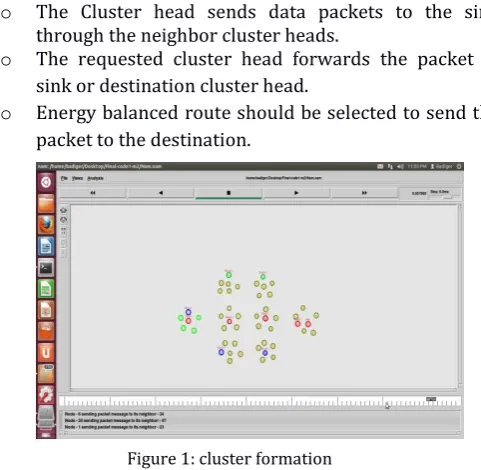
o The Cluster head sends data packets to the sink through the neighbor cluster heads.
o The requested cluster head forwards the packet to sink or destination cluster head.
o Energy balanced route should be selected to send the packet to the destination.
Figure 1: cluster formation
3.4 RSA encryption-decryption technique
This technique provides the secure communication framework between each node. The key to encryption scheme varies as a function of residual energy of the nodes, thus preventing the rekeying requirements. All normal nodes will broadcast a unique value which contains their authentication keys, to the selected set of nodes in first round of data aggregation. When any node within the group needs to transfer the data, it transfers slices of data to the DAG within the cluster and then DAG collects data which is encrypted along with authentication key. Finally encrypted data will be forwarded to the sink node. Now the sink node contains decrypted data. Hence, secure algorithm has been used for the clustering process. This algorithm proves the RSA energy-efficient encryption-decryption technique, to achieve secured data transmission between normal sensed node(CM) to data aggregator(CH) and data aggregator(CH) to a sink(CM).
The RSA encryption-decryption technique steps given in the following.
Begin
o Deploy a node in cluster infrastructure.
o Generate a dynamic key for each sensor node.
o Source node transmits a text file along with its dynamic key to DAG.
o Enter key E for encryption, D for Decryption
o Entered key E will be encrypted, where encrypted data which is in unknown binary format will be saved in DAG.
o DAG will send its data to a sink.
o The data, which is encrypted, need to be decrypted by the sink which is known binary format.
End
4. Simulation Results
4.1 Simulation parameters
We evaluate our SAEECS through ns-2.35 (NS-2).we used Ubuntu in LINUX operating system, front end as Tool Command Language (TCL) .We use a bounded region 1300 Χ 1000 sq. in which we place nodes using a random distribution. The number of nodes is 50. The simulated traffic is Constant Bit Rate (CBR).
4.2 Performance metrics
The performance of SAEECS technique is compared with the LEACH AND M-LEACH. The performance is evaluated mainly, according to the following metrics.
1) Average Packet Delivery Ratio: it is the ratio of the number of packets received successfully and the total number of packets transmitted.
2)Average Energy Consumption: the average energy consumed by the nodes in receiving and sending the packets.
3) Throughput: the number of packets received by the sink successfully.
4) Packet Drop: the number of packets not received by the sink successfully.
The following table summarizes the simulation parameters used.
Table 1: simulation parameters
Number of nodes 50
© 2015, IRJET.NET- All Rights Reserved
Page 2314
Initial energy 100 JTransmission rate 250m Routing protocol DSR
4.3 Results and analysis
In our experiment, four performance metrics are used to compare the performance of our proposed SAEECS approach with LEACH technique.
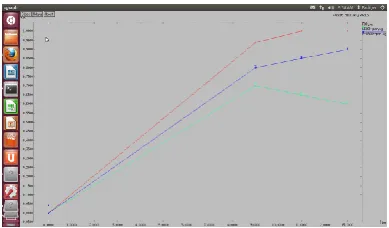
From Figure. 1, we can see that the packet delivery ratio of our proposed SAEECS is higher than the existing LEACH, M-LEACH method with time v/s no. of packets (Kbit/s). From Figure. 2, we can see that the Average Energy Consumption of our proposed SAEECS is higher than existing LEACH, M-LEACH method with time v/s energy in (joules).
From Figure. 3, we can see that the throughput of our proposed SAEECS is more than the existing LEACH, M-LEACH method with time v/s no. of packets (Kbit/s).
Figure 1. Time Vs Packet Delivery Ratio
Figure 2. Time Vs Energy
Figure 3 Time Vs No. of packets
5. ACKNOWLEDGMENTS
Nothing is envisaged without the help and guidance of an experienced person respected in the field of concerned subject. Though the benefits achieved from them can never be adequately valued, I would like to express hearty gratitude towards them. I am grateful to thank my guide Mr. Mohan B A Assistant Professor Dept. of CSE for guiding me throughout the work. I sincerely acknowledge my guide for hearty guidance and constant support.
6. REFERENCES
[1] V. Kumar, S. Jain and S. Tiwari, “Energy Efficient Clustering Algorithms in Wireless Sensor Networks: A Survey”, Journal of Computer Science Issues, vol. 8, no. 2, (2011), pp. 259-268.
[2] M. Arshad, N. Armi, N. Kamel and N. M. Saad, “Mobile data collector based routing protocol for wireless sensor networks”, Scientific Research and Essays, vol. 6, no. 29, (2011), pp. 6162-6175.
[3] X. Liu, “A Survey on Clustering Routing Protocols in Wireless Sensor Networks”, Journal of Sensors, vol. 12, (2012), pp. 11113-11153.
[4] C. -M. Liu, C. -H. Lee and L. -C. Wang, “Distributed Clustering algorithms for data gathering in mobile wireless sensor networks”, Journal of Parallel and Distributed Computing, vol. 67, (2007), pp. 1187-1200. [5] M. Lehsaini1, H. Guyennet and M. Feham, “CES: Cluster-based Energy-efficient Scheme for Mobile Wireless Sensor Networks”, Wireless Sensor and Actor Networks II, the International Federation for Information Processing, vol. 264, (2008), pp. 13-24.
[6] M. Thangaraj and P. P. Ponmalar, “A Survey on data aggregation techniques in wireless sensor networks”, Journal of Research and Reviews in Wireless Sensor Networks, vol. 1, no. 3, (2011), pp. 36-42.
© 2015, IRJET.NET- All Rights Reserved
Page 2315
International Arab Journal of Information Technology, vol.8, no. 3, (2011), pp. 302- 309.
[8] A. Koucheryavy and A. Salim, “Prediction-based Clustering Algorithm for Mobile Wireless International Journal of Control and Automation Vol. 6, No. 1, February, 2013 233 Sensor Networks”, International Conference on Advanced Communication Technology, vol. 2, (2010), pp. 1209-1215.
[9] S. A. B. Awwad, C. K. Ng and N. K. Noordin, “Cluster Based Routing Protocol with Adaptive Scheduling for Mobility and Energy Awareness in Wireless Sensor Network”, Proceedings of the 30th Asia Pacific Advanced Network,(2010).
[10]http://en.wikipedia.org/wiki/Mahalanobis_distance# cite_ref-0.
[11] F. Zhao and L. Guibas, “Wireless Sensor Networks: An Information Processing Approach”, The Morgan Kaufmann Series in Networking, (2004), pp. 317-318.
[12] W. R. Heinzelman, A. Chandrakasan and H. Balakrishnan, “Energy Efficient Communication Protocol for Wireless Microsensor Networks”, Proceedings of the 3rd Annual Hawaii International Conference on System Sciences, (2000), pp. 3005-3014.
[13] G. S. Kumar, M. V. V. Paul, K. P. Jacob, “Mobility metric based leach-mobile protocol”, Proceedings on the 16th International Conference on Advanced Computing and Communications, (2008) , pp. 248-253.
[14] D. S. Kim and Y. J. Chung, “Self-Organization Routing Protocol Supporting Mobile Nodes for Wireless Sensor Network”, Proceedings on the 1st International Multi-Symposiums on Computer and Computational Sciences, (2006), pp. 622-626.
BIOGRAPHIES
Sangeeta Badiger pursing M.Tech final year in Nitte Meenakshi Institute of Technology Bangalore. My area of research is in wireless sensor networks.