R E S E A R C H
Open Access
Performance analysis of wireless communication
system in general fading environment subjected
to shadowing and interference
Goran Stamenovi´c
1†, Stefan R Pani´c
2*†, Dejan Ranˇci´c
1†, ˇCaslav Stefanovi´c
2†and Mihajlo Stefanovi´c
1†Abstract
In this paper, performance analysis of wireless communication overα−η−μfading channels has been investigated. First, analysis has been carried out for the case when communication is subjected to the influence of co-channel interference. Closed-form expressions have been derived for the probability density function and cumulative
distribution function of the received signal-to-interference ratio. Outage probability has been obtained for this case, in the function of various values of system parameters, and also for the case when selection diversity has been presented at the reception. Further, simultaneous multipath fading and shadowing occurrence has been analyzed, through deriving novel composite Gamma long-time fadedα−η−μfading distribution. First-order statistical parameters have been obtained in closed form, for this novel composite distribution, and capitalizing on them, standard performance measures have been efficiently evaluated, graphically presented and discussed in the function of system parameters.
Keywords: α−η−μdistribution; Co-channel interference; Signal-to-interference ratio; Selection combining; Novel fading/shadowing composite model; Average bit error rate
Introduction
Every wireless communication system design must take into account three major channel propagation impair-ments: short-term fading (multipath propagation), long-term fading (shadowing) and the corruptive effect of co-channel interference [1].
The non-linear properties of propagation medium have been considered extensive recently [2,3]. Various short-term fading distributions like Nakagami-m, Ricean and Rayleigh assume a resultant homogenous diffuse scatter-ing field, from randomly distributed scatters. However, surfaces are often spatially correlated and they character-ize non-linear environment. Exploring the fact that the resulting envelope would be a non-linear function of the sum of multipath components, novel generalα−η−μ distribution for short-term fading model was recently pre-sented. Probability density function (PDF) is presented in the form of three parameters α, η and μ, which
*Correspondence: [email protected]
†Equal contributors
2Faculty of Natural Science and Mathematics, University of Priština, Lole Ribara 29, 38320 Kosovska Mitrovica, Serbia
Full list of author information is available at the end of the article
are related to the non-linearity of the environment, the number of multipath clusters in the environment and the scattered wave power ratio between the in-phase and quadrature components of each cluster of multipath, respectively [3].
Since it is a general fading distribution, the α − η−μmodel includes as special cases other short-term fading distributions, like Rayleigh, Nakagami-q (Hoyt), Nakagami-m,η−μ, Weibull and one-side Gaussian dis-tribution. By setting parameter α to value α = 2, it reduces to η − μ distribution. Further, from the η − μ fading distribution, the Nakagami-m model could be obtained in two cases: first, for η −→ 1, with param-eter m being expressed as m = μ/2 and second, for η−→0, with parametermbeing expressed asm= μ. It is well-known thatη−μdistribution reduces to the Hoyt distribution, for the case whenμ = 1, with parameterb
defined asb= (1−η)/(1+η). By equating the in-phase and quadrature component variances, namely by setting η = 1, the Rayleigh distribution is derived from Hoyt. Also the Weibull distribution could be obtained as a
cial case of theα−η−μmodel by setting corresponding values to the parameters η = 1 and μ = 1. Major contribution of this analysis is then the above-mentioned generality.
Here, analytical framework for performance analysis of wireless communication system subjected to co-channel interference (CCI) over α −η− μfading channels will be presented. Signal-to-interference (SIR)-based analysis will be provided and closed-form expressions will be pro-vided for received SIR PDF and cumulative distribution function (CDF). From this statistics, outage probability (OP) values will be obtained in the function of sys-tem parameters. Even OP improvement will be observed through a prism of space diversity reception tech-niques appliance, particularly selection combining (SC) reception.
Number of composite channel models have been used in literature for the wireless communication systems anal-ysis, for the case when multipath fading and shadowing occur simultaneously. Such are theη−μ/gamma [4], the κ−μ/gamma [5], theK[6], and the generalized-K(KG) [7] distribution models. Similar work has been presented in [8,9]. Non-linear, non-homogenous, shadowed propa-gation have been analyzed in [10], but for the case when dominant, line-of-sight (LOS) component is taken into account. Starting from general α − η−μ distribution, closed-form statistics (PDF, CDF andn-th order moments expressions) will be introduced, for novel composite dis-tribution. That is another contribution of this work since this composite distribution has not been reported in lit-erature so far. Obtained mathematical form will allow simple performance analysis of wireless communication systems, operating in composite fading environments. This performance analysis is also accompanied by graph-ically presented numerical results, which show the influ-ence of various communication system parameters (fading and shadowing parameters), on the standard performance criterions.
Transmission subjected to co-channel interference
In modern wireless communication systems, a tendency to preserve the available spectrum is present. Preserv-ing of available spectrum could be obtained by reusPreserv-ing allocated frequency channels in areas, which are as geo-graphically close to each other as possible. However, distance for reusing channels is limited by the level of CCI. CCI is defined as the interfering signal that has the same carrier frequency as the desired information signal, namely two or more channel signals from dif-ferent locations, but operating at the same carrier fre-quency, due to frequency reuse interfere. In this section, we will analyze how CCI as a general distortion affects well-accepted criterions of wireless system performances.
These effects will be observed in the function of instan-taneous and average signal-to-interference ratios (SIRs). SIR-based performance analysis is a very effective perfor-mance criterion since SIR can be measured in real time both in base and mobile stations. An interference-limited system will be discussed, so the effect of noise would be ignored.
Desired information signal with anα−η−μdistributed random amplitude process can be presented by [3]:
fR(R)=α(ηd− tion of the first kind ([11], Eq. (8.406)). As mentioned, parameterμd defines the number of multipath clusters, through which desired signal propagates, while parameter ηddefines the ratio of the in-phase and the in-quadrature component variances in desired signal [3]. Desired sig-nal propagation environment non-linearity is defined with parameterα.
In a similar manner, resultant interfering signal can be presented as Parametersα,ηcandμcare describing CCI signal propa-gation in the same manner as parametersα,ηdandμdare describing propagation of desired signal.
If the instantaneous SIR, λ, is defined asλ = R2/r2, while the average SIR,S, is defined asS=d/c, then by using the relation from [12], the PDF of instantaneous SIR can be determined as
fλ(λ)= 1
solved according to ([11], Eq. (8.310)), so the PDF of instantaneous SIR can be presented in the form
fλ(λ)=
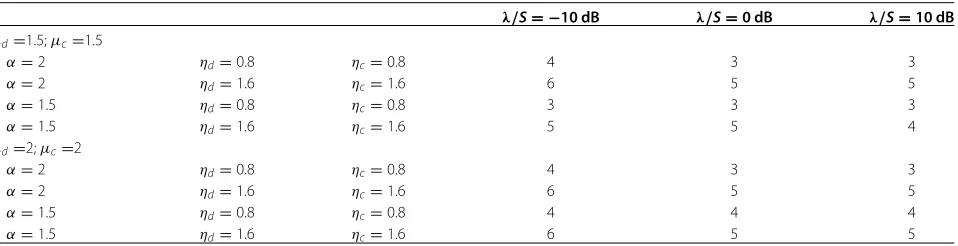
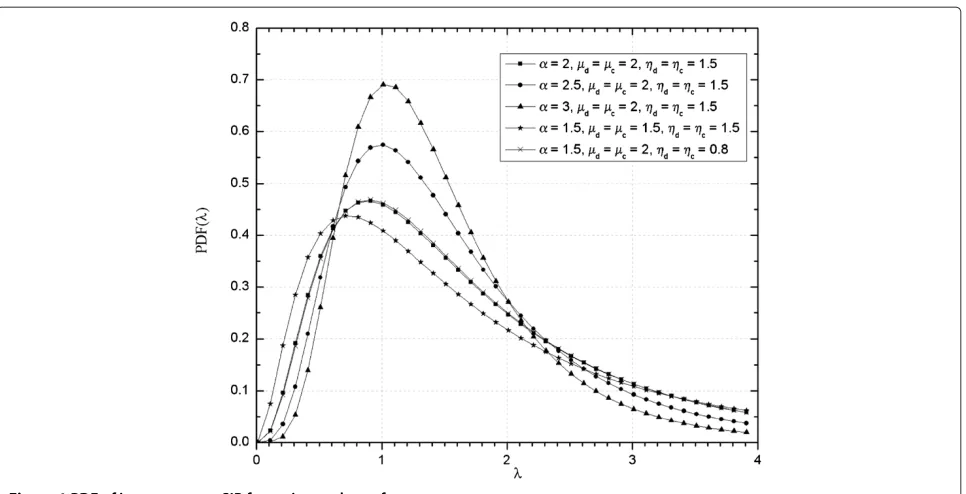
with(.)denoting the well-known Gamma function ([11], Eq. (8.310/1)), while(x)! stands for the factorial operator. The double infinity sum in (4) converge rapidly, as one can see from Table 1, since only few terms should be summed in each sum in order to achieve accuracy at the 6th sig-nificant digit for various values of corresponding system parameters. The PDF of instantaneous SIR for various values of system parameters is presented in Figure 1.
Capitalizing on (4), by using the well-known definition of incomplete Beta function, ([13], Eq. (A.7)), and by fol-lowing same mathematical transformations as in ([13], Appendix), the previous integral can easily be solved. Now, infinite-series expression for the cumulative distri-bution function (CDF) of the instantaneous SIR can be presented as
withB(a,b,z)denoting the well-known incomplete Beta function ([11], Eq. (8.391)). Rapid convergence of this double infinity-series could be seen from Table 2.
System performances
Let us consider some standard wireless transmission per-formance measures for observed scenarios. Considering the interference-limited case, outage probability (OP) could be efficiently evaluated for various values of trans-mission parameters. Namely, OP is standard measure, often used for controlling the CCI level, in order to meet the QoS and grade of service (GoS) demands. If the envi-ronment is interference limited, OP is defined as the probability, that the output SIR of used combiner will fall below defined protection ratio, which depends on applied modulation technique and expected QoS [14,15]
Pout=PR(λ < γth)=
γth
0
fλ(t)dt=Fλ(γth) (6)
Selection combining
Multi-branch diversity reception is an efficient remedy, based on providing the receiver with multiple faded repli-cas of the same desired signal [14]. In that way, transmis-sion reliability is upgraded without transmistransmis-sion power and bandwidth increase. Simplest diversity reception that process only one of the diversity branches is SC reception. It is well-known that SC diversity chooses and outputs the branch with the largest instantaneous SIR (or SNR), namely,λout =max(λ1,λ2,. . .,λN), withλi denoting the instantaneous value of SIR at the i-th received branch. This means that in this case, for calculating OP, we should take into account the CDF of N-branch SIR-based SC output determined from [16]
Fλout(λ)=Fλ1(λ)Fλ2(λ) . . .FλN(λ)=
N
i=1
Fλi(λ) (7)
where corresponding CDF’s for the uncorrelated input branches are defined with (5).
Table 1 Number of terms need to be summed in double-infinite series of Equation 5
λ/S= −10 dB λ/S=0 dB λ/S=10 dB
Figure 1PDF of instantaneous SIR for various values of system parameters.
Numerical results
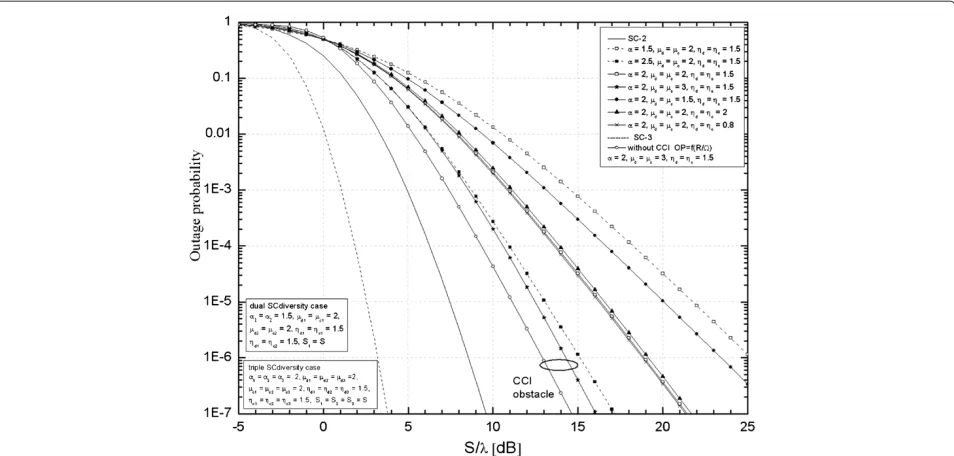
It is visible from Figure 2 how CCI as a major obstacle affects transmission in observed propagation environ-ment. Another conclusion from Figure 2 is that lower OP values are achieved, in the areas where η, α and μ parameters obtain higher values.
Further, performance improvement obtained by the appliance of selection combining (SC) reception tech-nique was presented at this figure. Improvement obtained with the usage of dual-branch SC diversity is visible, since for the same system parameter values, significantly lower OP values are reached.
Based on (4) and (5), other well-known performance criteria, such as, i.e. ABER, and output moments could
be efficiently evaluated and graphically presented for this scenario.
Transmission subjected to shadowing
In order to superimpose the influence of multipath fading, modelled by generalα −η−μdistribution, with shad-owing process modelled with Gamma distribution, for the first time in the literature, we will present in this section novel composite fading distribution. As multipath fading and shadowing simultaneously occur in wireless transmis-sion, there is a need to derive general model which would accurately describe this composite random process.
For the case when composite fading is observed, the average power of the multipath component, = E(Rα),
Table 2 Number of terms need to be summed in infinite series of Equation 11
R/= −10 dB R/=0 dB R/=10 dB
c=1
μ=1.5 η=1.6 6 6 5
μ=1.5 η=0.8 4 3 3
μ=2 η=1.6 7 6 6
μ=2 η=0.8 3 3 3
c=1.5
μ=1.5 η=1.6 6 5 5
μ=1.5 η=0.8 3 3 3
μ=2 η=1.6 9 8 6
μ=2 η=0.8 4 3 3
Figure 2OP for various values of wireless communication parameters in the interference-limited system.
is also randomly varying process, which will be mod-elled in the following analysis with Gamma long-term fading model. Now, novel composite fading distribution can be obtained by averaging the short-term conditional RV process
over slowly varying Gamma process, which has been shown to accurately approximate shadowing phenomena, described with [17,18]:
using the total probability theorem, and after some math-ematical manipulations, the PDF of the novel composite distribution can be expressed in terms of an infinite series as ([11], Eq. (3.471.9))
withKv(.) denoting the modified Bessel function of sec-ond kind and order v([11], Eq. (8.407.1)). The conver-gence of expression (10) is rapid, since few terms should be summed for achieving the 5th significant digit accu-racy for various values of corresponding PDF parameters. Newly derived composite PDF is presented in Figure 3 for various values of corresponding parameters.
Let us now derive other first-order statistical parame-ters for this composite fading distribution, namely CDF and n-th order moments. Capitalizing on (10), and by using the same mathematical transformations as in ([19], Eq. (03.04.26.0006.01)) and ([20], Eq. (26)), expression for CDF of the composite process can be presented in terms of an infinite series as
FR(R)=
stands for Meijer’s G-function ([11], Eq. (9.301)). Rapid convergence of this expression could be seen from Table 2.
Figure 3PDF of novel composite distribution for various values of corresponding parameters.
System performances
For the case when wireless communication is subjected to shadowing, we will consider another important perfor-mance measure, the average bit error probability (ABER). ABER values could be numerically calculated as in [21], by substituting (10) into
Pe=
∞
0
fR(t)Pe(t)dt (13)
wherePe(t)denotes conditional error probability, whose functional dependency is determined by the type of ulation scheme performed. For some non-coherent mod-ulation schemes, it stands Pe(t) = 12exp(−gt), with g denoting modulation constant, (g = 1 for BDPSK and
g=1/2 for NCFSK), while for some coherent modulation schemes, it stands Pe(t) = 21erfc(√gt) with g denoting modulation constant (g = 1 for CPSK andg = 1/2 for
Figure 5ABER over NCFSK modulation scheme for various values of wireless communication parameters in the composite fading/shadowing environment.
CFSK) and erfc(x) being complementary error function ([11], Eq. (8.250.4)).
Assuming that the fading process is ergodic, then ergodic capacity of a communication channel can be determined according to
C=B
∞
0
log21+γthr2 fR(r)dr (14)
whererdenotes random envelope process,γthstands for
the average received signal-to-noise ratio (SNR) and B
stands for the bandwidth of a channel.
Numerical results
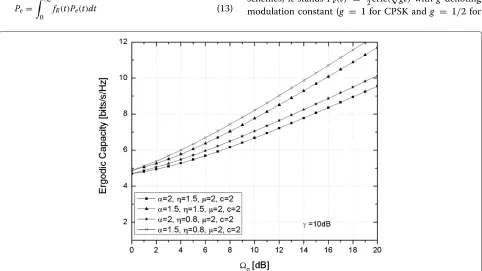
Ergodic capacity of observed communication channel as a function of composite process parameters are presented in Figure 4. It is visible from Figure 4 that when fading
is less severe (parameter α obtains higher values) and when the ratio of in-phase and in-quadrature propagation components is more balanced, higher normalized capacity values are reachable.
In Figure 5, some results are graphically presented in the function of corresponding parameters. It can be seen from Figure 5 that better performances (lower ABER) values are achieved, where parameters candα have higher values. Also as expected, better performances are obtained, for higher values ofη,αandμparameters. Namely, for higher α parameter values, fading is less severe, while a num-ber of multipath propagation components of same phase delay grows with μ parameter growth. Also, c parame-ter growth leads to OP decrease; since then, shadowing is more severe.
Additionally, in Figure 6, a graphical comparison of ABER performances obtained when transmission is observed over non-coherent (NCFSK, BDPSK) and coher-ent (CFSK and CPSK) modulation schemes for the same set of system parameters is shown. A comparison of curves shows better performance of non-coherent mod-ulation formats, while the BDPSK modmod-ulation scheme usage is depicted as an outperforming option.
Conclusion
This paper has considered wireless communication in a general fading environment, which can be reduced to other types of fading environments like Rayleigh, η − μ, Nakagami-q (Hoyt), Nakagami-m, Weibull. Obtained closed-form expressions for PDF and CDF of SIR for the interference-limited system case and closed-form expressions for first-order statistics (PDF, CDF, moments of various order) of newly introduced composite fad-ing/shadowing model allow simple unconstrained analysis and accurate wireless system planning and performance evaluation. Some of the performance measures are evalu-ated and discussed in the paper.
Competing interests
The authors declare that they have no competing interests.
Author details
1Faculty of Electronic Engineering, University of Niš, Aleksandra Medvedeva
14, Niš, Serbia.2Faculty of Natural Science and Mathematics, University of
Priština, Lole Ribara 29, 38320 Kosovska Mitrovica, Serbia.
Received: 30 September 2013 Accepted: 9 July 2014 Published: 8 August 2014
References
1. WCY Lee,Mobile Communications Engineering. (Mc-Graw-Hill, New York, 2001)
2. AK Papazafeiropoulos, SA Kotsopoulos, Second-order statistics for the envelope ofα−κ−μfading channels. IEEE Comm. Lett.14(4), 291–293 (2010)
3. G Fraidenraich, MD Yacoub, Theα−η−μandα−κ−μfading distributions, inProceedings of the IEEE Ninth International Symposium on Spread Spectrum Techniques and Applications(Manaus-Amazon, Brasil, 28–31 Aug. 2006), pp. 16–20
4. PC Sofotasios, S Freear, Theη−μ/gamma composite fading model, inIEEE International Conference in Wireless Information Technology and Systems (ICWITS ‘10)(Honolulu, HI, 28 Aug. 2010-3 Sept. 2010), vol. 2, pp. 872–877 5. PC Sofotasios, S Freear, Theκ−μ/gamma extreme composite
distribution: a physical composite fading model, inIEEE Wireless Communications and Networking Conference (WCNC ‘11)(Cancun, Mexico, 28–31 March. 2011)
6. A Abdi, M Kaveh,Kdistribution: an appropriate substitute for Rayleigh-lognormal distribution in fading-shadowing wireless channels. Electron. Lett.34(9), 851–852 (1998)
7. PS Bithas, NC Sagias, PT Mathiopoulos, GK Karagiannidis, AA Rontogiannis, On the performance analysis of digital communications over
generalized-K fading channels. IEEE Commun. Lett.5(10), 353–355 (2006) 8. S Al-Ahmadi, H Yanikomeroglu, On the approximation of the
generalized-Kdistribution by a gamma distribution for modeling composite fading channels. IEEE Trans. Wireless Commun.9(2), 706–713 (2010) 9. IS Ansari, S AlAhmadi, F Yilmaz, MS Alouini, A new formula for the BER of
the binary modulations with dual-branch selection over generalized-K composite fading channels. IEEE Trans. Commun.59(10),
2654–2658 (2011)
10. PC Sofotasios, S Freear, Theα−κ−μ/gamma composite distribution: a generalized non-linear multipath/shadowing fading model, in Proceedings of the IEEE INDICON ‘11(Hyderabad, India, 16–18 Dec. 2011) 11. IS Gradshteyn, IM Ryzhik,Table of Integrals, Series, and Products, 6th edn.
(Academic Press, New York, 2000)
12. I Trigui, A Laourine, S Affes Stephenne, Performance analysis of mobile radio systems over composite fading/shadowing channels with co-located interferences. IEEE Trans. Wireless Commun.8(7), 3449–3453 (2009)
13. M Stefanovic, S Minic, S Nikolic, S Panic, M Peric, D Radenkovic, M Gligorijevic, The CCI effect on system performance in kappa-mu fading channels. TTEM.7(1), 88–92 (2012)
14. M Stefanovic, D Milovic, A Mitic, M Jakovljevic, Performance analysis of system with selection combining over correlated Weibull fading channels in the presence of cochannel interference. AEU - Int. J. Electron. Commun.
62(Issue 9), 695–700 (2008)
15. A Panajotovic, M Stefanovic, D Draca, Performance analysis of system with selection combining over correlated Rician fading channels in the presence of cochannel interference. AEU - Int. J. Electron. Commun.
63(12), 1061–1066 (2009)
16. I Petrovic, M Stefanovic, P Spalevic, SR Panic, D Stefanovic, Outage analysis of selection diversity over Rayleigh fading channels with multiple co-channel interferers. Telecommun. Syst.52(1), 39–50 (2013). doi:10.1007/s11235-011-9438-z
17. A Abdi, M Kaveh, On the utility of the gamma PDF in modeling shadow fading (slow fading), inProceedings of the IEEE Vehicular Technology Conference (VTC’99)(Houston, 16–20 May 1999), vol. 3, pp. 2308–2312 18. PM Shankar, Analysis of microdiversity and dual channel macrodiversity in
shadowed fading channels using a compound fading model. Int. J. Electron. Commun. (AEU).62, 445–449 (2008)
19. The Wolfram Functions Site [Online]. Available: http://functions.wolfram. com. Accessed 01 Dec 2012
20. VS Adamchik, OI Marichev, The algorithm for calculating integrals of hypergeometric type functions and its realization in REDUCE system, in Proceedings of the International Conference on Symbolic and Algebraic ComputationTokyo, Japan, 20–24 Aug. 1990, pp. 212–224
21. N Sekulovic, M Stefanovic, D Denic, D Aleksic, Performance analysis of SINR-based selection diversity over correlated Rayleigh fading channels. IET Commun.5(2), 127–134 (201)
doi:10.1186/1687-1499-2014-124