Volume 2009, Article ID 571903,8pages doi:10.1155/2009/571903
Research Article
A Real Orthogonal Space-Time Coded UWB Scheme for Wireless
Secure Communications
Yanbing Zhang and Huaiyu Dai
Department of Electrical and Computer Engineering, NC State University, Raleigh, NC 27695, USA
Correspondence should be addressed to Huaiyu Dai,[email protected]
Received 1 December 2008; Revised 5 June 2009; Accepted 21 July 2009
Recommended by Merouane Debbah
Recent research reveals that information security and information-hiding capabilities can be enhanced by proper exploitation of space-time techniques. Meanwhile, intrinsic properties of ultra-wideband (UWB) signals make it an outstanding candidate for secure applications. In this paper, we propose a space-time coding scheme for impulse radio UWB systems. A novel real orthogonal group code is designed for multi-antenna UWB signals to exploit the full spatial diversity gain and achieve the perfect communication secrecy. Its performance in a frequency-selective fading channel is analyzed. The transmission secrecy, including low probability of detection (LPD), low probability of intercept (LPI), and anti-jamming performance, is investigated, and some fundamental tradeoffs between these secrecy metrics are also addressed. A comparison of the proposed scheme with the direct sequence spread spectrum (DSSS) technique is carried out, which demonstrates that proper combination of UWB and space-time coding can provide substantial enhancement to wireless secure communications over other concurrent systems.
Copyright © 2009 Y. Zhang and H. Dai. This is an open access article distributed under the Creative Commons Attribution License, which permits unrestricted use, distribution, and reproduction in any medium, provided the original work is properly cited.
1. Introduction
The rapid expansion and proliferation of the wireless applications, especially in military and commercial use, have been prompting a corresponding increasing demand for transmission security. Currently, chief among the methods of information security is cryptography. Working at the network or higher layers mostly, cryptography aims to deny the unintended attempt on the information content by making various transformations of the original message. Protection against unintended disclosure of the information, however, can also be enhanced at the physical layer. Three features are generally desired for transmission secrecy—low probability of detection (LPD), low probability of intercept (LPI), and anti-jamming protection [1]. LPD, LPI, and anti-jamming properties may be viewed as the counterparts of the three important objectives in cryptography: secrecy, integrity, and availability.
It is well known that code division multiple access (CDMA) systems can provide an inherent physical layer security solution to wireless communications. However, if an eavesdropper can intercept a 2n-bit sequence segment generated from ann-stage linear feedback shift register, the
characteristic polynomial and the entire spreading code can be reconstructed through certain algorithms [2]. This moti-vates researchers to study enhancing the physical layer built-in security of CDMA systems through secure scramblbuilt-ing [2] or random spreading codes [3]. In 1990s, chaos, a very universal phenomenon in many nonlinear systems, has also been found valuable in secure communication systems due to its extreme sensitivity to initial conditions and parameters [4]. As a hybrid approach, it was shown that CDMA systems employing time-varying pseudo-chaotic spread-ing sequences can provide improvements with respect to their conventional CDMA counterparts (employing binary-valued pseudo-noise spreading sequences) [5]. Techniques have also been proposed to use the characteristics of the radio channel itself to provide secure key distribution in a mobile radio environment, where the information bearing signal is modified to precompensate for the phase effects of the channel [6].
[7]. One of the principal conclusions there is that proper exploitation of space-time diversity at the transmitter can enhance information security and information-hiding capa-bilities. Particularly, if a source with constant spatial inner products (seeSection 3.1) is transmitted over an uninformed link, the cutoff rate of the channel will be equal to zero and the minimum probability of decoding error will be forced to one. There are many known signal constellations satisfying this perfect-secrecy property, like double unitary codes, square unitary codes, or space-time QPSK.
Reference [8] is an exemplary work of this principle, where the authors proposed a secure transmission scheme based on random space-time coding. The basic idea is multiplying a random coefficient to the symbol sequence to make the eavesdropper completely blind with the transmit-ted signal. However, this random space-time transmission scheme has some drawbacks as well. One is that since the weight should be randomly selected, it has to trade transmission power for secrecy. The other is that before the data transmission, a secure initialization method has to be adopted to set up the feedback channel.
Research interests in ultra-wideband (UWB) wireless communications have also proliferated in both industry and academia recently [9]. Besides many other advantages, UWB also offers salient features, like ultrashort pulse and noise-like power density, for secure communications [10, 11]. Intent to jointly exploit the advantages of MIMO and UWB has also been initiated. In particular, UWB-MIMO systems which employ space-time block coding have been proposed in [12–14]. More recently, cooperative schemes have also been considered for such systems [15]. These works show performance improvement over the conventional single-input single-output (SISO) UWB systems for commonly adopted modulation and multiple-access techniques, in both single-user and multiuser scenarios. But to the best of our knowledge, there is no formal discussion on security issues when multiple antennas are introduced to UWB systems.
This motivates us to investigate a unitary space-time coding scheme for UWB systems, coined as USTC-UWB, which can simultaneously exploit the information security and information-hiding capabilities of space-time coding and UWB. Compared with general approaches in [7], USTC-UWB employs real space-time codes suitable for USTC-UWB signals and can work at any transmission rate. Based on the performance analysis in a multipath fading channel, we demonstrate that USTC-UWB can achieve superior LPD, LPI, and anti-jamming performances, making it an outstanding candidate for wireless secure communications. In the analysis, some fundamental trade-offs between the secrecy metrics are also explicitly addressed. A comparison of USTC-UWB with the direct sequence spread spectrum (DSSS) technique is also carried out, which further demon-strates its advantages.
The rest of the paper is organized as follows.Section 2
describes the system model and assumptions. The proposed USTC-UWB scheme is presented inSection 3, together with its BER performance analysis. Security metrics for USTC-UWB, including LPD, LPI, and anti-jamming properties, are analyzed inSection 4. The trade-offbetween anti-jamming
and LPD performance is also addressed. InSection 5the sim-ulation results are presented. And finally, some concluding remarks are given inSection 6.
2. System Model
Consider a peer-to-peer UWB communication system equipped withMtransmit antennas andNreceive antennas. The transmitted waveform at theith transmit antenna during Dtime frames can be described as
x(i)(t)=
D−1
d=0
E Mφidp
t−dTf
, (1)
where Tf represents the pulse repetition time (frame)
interval corresponding to one symbol transmission. p(t) is the transmitted monocycle with the pulse durationTp, which
is modulated by the (real) space-time code φid. Typically,
the durationTp is between 0.2–2 nanoseconds, resulting in
a transmitted signal of ultra-wideband, whileTf is hundred
or thousand times longer thanTp[9,13]. The factor
√ E/M ensures that the total transmitted power isE. For simplicity, the random time-hopping (TH) codes for multiple access are omitted ([13]).
A class of unitary space-time signals is proposed in [16] for flat-fading channels where neither the transmitter nor the receiver necessarily knows the fading coefficients. Suppose that signals are transmitted in blocks of T time samples, over which interval the fading coefficients are approximately constant. Then, this space-time coding design admits a constellation ofK=2RT(Ris the data rate in bits per channel
use) signalsSk =
√
TΦk,k = 1,. . .,K, with the property
thatΦ1,. . .,ΦKareT×Mcomplex-valued matrices obeying
ΦH
1Φ1= · · · =ΦHKΦK=I(We use superscriptsTandHin
this paper to respectively denote the transpose and conjugate transpose operations.).
Extending this discussion to UWB systems, and assuming M = T (without loss of generality), the transmit signal matrix can be formed as
S
=
⎡ ⎢ ⎢ ⎢ ⎢ ⎢ ⎢ ⎢ ⎢ ⎣
φ11p(t) φ12p(t) · · · φ1Mp(t)
φ21p
t−Tf
φ22p
t−Tf
· · · φ2Mp
t−Tf
..
. ... . .. ...
φM1p
t−MTf
φM2p
t−MTf
· · · φMMp
t−MTf
⎤ ⎥ ⎥ ⎥ ⎥ ⎥ ⎥ ⎥ ⎥ ⎦
,
(2)
whereΦ= {φi j}is a unitary matrix to be designed.
Due to its large bandwidth, the channel observed by UWB signals is usually subject to frequency selective fading. So an L-path tapped-delay line model is adopted in the discussion, for which the impulse response from the ith transmit antenna to thejth receive antenna can be described as
hi j(t)= L−1
l=0
hl
withτlrepresenting the delay andhli jthe complex amplitude
of the lth path, respectively. At the receiver, we employ anL-finger Rake receiver to exploit the multipath diversity inherent in UWB systems, each adopting the delayed versions of the received monocycle as the reference waveform. It can be shown that ifτl−τl−1 ≥ Tp,l = 1,. . .,L−1, and the
autocorrelation function of the pulseγ(τ)=0 for|τ| ≥Tp,
all Lcorrelators’ outputs at thejth receive antenna can be collected into aT×L(equivalentlyM×L) matrix
Yj=
E
MSHj+Wj, (4)
where Wj is the circularly symmetric complex Gaussian
background noise with spectral heightN0/2, and theM×L
matrixHjcollects the multipath gain as
Hj=
The decision rule for the ML decoder with channel state information (CSI) can be stated as ([17, Chapter 7])
3. Unitary Space-Time Coding for UWB Systems
Conveying information with ultrashort pulses, UWB signals can resolve many paths and thus are rich in multipath diversity. This has motivated research toward using Rake receivers to collect the available diversity and thus enhance the performance of UWB communication systems. On the other hand, multi-antenna-based space-time systems offer an effective means of enabling space diversity, which has the potential to improve not only error performance but also capacity. In this section, we consider the construction of time codes for UWB systems. A novel unitary space-time code is designed, which can exploit the full spatial diversity and fulfill the purpose of secure communications. InSection 3.1, we first elaborate the design of this space-time code, and then its performance is characterized by a union bound on the block error probability inSection 3.2.
3.1. Construction of Unitary Space-Time Codes for UWB. Rank and determinant criteria are proposed in [18] for space-time code design. That is, in order to achieve the maximum diversity, the matrixΦ−Φhas to be full rank for
any different codewordsΦandΦ. It is shown in [19] that all optimal (full-rank) space-time group codes are unitary, which coincide with the secure space-time code structure found in [7].
A family of complex-valued space-time codes is devised in [20] by use of rotated constellation and the Hadamard
transform, which can achieve full-rate and full diversity. However, since UWB systems employ baseband transmis-sion, it is necessary to set{φi j}to be real. In the following,
we propose a class of real orthogonal group codes for UWB signals based on Hadamard transform and rotation matrices, which also admit more general transmit antenna settings. For n=2m, withman integer, a Hadamard matrix is generated
by a simple recursion
Θn=
with the initial rotation matrix given by
Ω2(i)=
code falls into the category of real orthogonal design and admits the perfect-secrecy property (constant spatial inner product) as well (Following the definition in [7], we call
ΩM(i)ΩM(i)T the spatial inner product of ΩM(i) in this
paper.). Also note that the squaredL2norm for every column
and row of the matrices so generated (corresponding to the total transmit power in space and time, resp.) is equal to 1. This design works well for any transmission rateRandM= 2mtransmit antennas. For odd values ofM, a similar design
can be applied for a few special cases with some performance loss. For example, forM=3, a code based on 3-dimensional rotation matrix can be employed:
Ω3(i)=
with the group codes given by
Φ=Ω3(0),Ω3(1),. . .,Ω3
2TR−1. (12)
3.2. Performance of USTC-UWB System. Suppose Φ and Φ are two different transmitted ST codewords, then the
pairwise error probability (PEP) conditioned on the channel matrixHj,j=1,. . .,N, is given by [20]
which is tightly upper bounded as
PΦ−→Φ|H
The square distance betweenΦandΦis defined as
d2Φ,Φ=
eigenvalue decomposition leads to
Φ−ΦTΦ−Φ=VΛVT, (16)
where the columns {v1,. . .,vM}of V are the orthogonal
eigenvectors of (Φ−Φ)T(Φ−Φ), and the diagonal matrix Λcontains its eigenvaluesλm,m=1,. . .,M. Using (16), the
expression (14) can be written as
PΦ−→Φ|H
where in the last line, we use the fact that the moment generation function for an exponential ranodm variable X with meanE(X) isE(esX)=(1−E(X)s)−1
. Therefore, at the
high signal-to-noise ratio (SNR) region, this probability is upper-bounded by
For the group code we design above, it can be shown that ΩM(i)−ΩM(j), ∀i /=j has full rank, that is,r =M(thus
full diversity is achieved). Following the similar approach in [19] we can get that all the eigenvalues are identical, given by
λm=4 sin2
Without loss of generality, we can assume Φ0 is
trans-mitted, therefore the block probability of error could be bounded by
4. Security Performance Analysis
There are a variety of metrics used to describe the secu-rity properties in a wireless communications system from different aspects. The most important of them is LPD, LPI, and anti-jamming capability. LPD is concerned with preventing adversaries from detecting a radio transmission. Low probability of being detected also means low probability of being jammed by hostile transmitters, which is especially preferable for military communications. Even after being detected, a good secure communication system is still expected to have a strong ability to prevent being intercepted and jammed; therefore these properties should be considered equally important. In this section, we analyze the LPD, LPI, and anti-jamming performance of the proposed USTC-UWB scheme.
4.1. Low Probability of Detection (LPD). When the channel is unknown, a common detecting approach for the eavesdrop-per is to use radiometer [10,11], which measures the energy in a bandwidthBover a time intervalTs. The received signal
is fed to a bandpass filter with bandwidthB, followed by the squaring device and theTs-second integrator. The output of
the integrator is sent to a comparator with a fixed threshold level. If the integrator output is higher than the threshold, the presence of a signal is declared.
can be modeled as Gaussian [11]. Assuming that H0 and
H1 are two hypotheses that correspond to the absence and
presence of the signal, respectively, then
fH0
y=√1 2πσn
exp
)
−y−μn
2
2σ2
n *
,
fH1
y=√ 1 2πσsn
exp
)
−y−μsn 2
2σ2
sn *
,
(22)
where the mean and the variance are given byμn = 2TsB,
σ2
n=4TsB,μsn=2TsB+ 2γ,σsn2 =4TsB+ 4γ, andγ=E/N0
denotes the SNR.
To study the asymptotic behavior, we keep the observa-tion interval Ts fixed, and assume that the number of the
observationsNsgoes to infinity as in [7]. The Chernofferror
exponent is defined as the exponentially decreasing rate of the detection error probabilityPdet err:
ρ=lim inf
Ns→ ∞
1
NslnPdet err. (23)
As a negative value,ρis required to be as large as possible (close to 0) for LPD. By the large deviation technique [7]
ρ= inf
α∈[0,1]Nlims→ ∞
inf 1 Ns
ln
+
fH1−α1
y1,. . .,yNs
×fHα0
y1,. . .,yNs
dy1,. . .,dyNs
= min
α∈[0,1]
(1−α) lnσn+αlnσsn−
1 2ln
,
(1−α)σn2+ασsn2
-−(1−α)α
μsn−μn
2
2(1−α)σ2
n+ασsn2
*
.
(24)
In general, it is very difficult to get an explicit expression for ρ from (24). But in secure communication scenarios, we can assume TsB γ(which generally holds for UWB
signals). This assumption impliesσ2
n≈σsn2, andρis obtained
forα=1/2 in (24) as
ρ≈ − γ2 4TsB.
(25)
This nice and simple relationship coincides with the intuition that a system with larger time-bandwidth product owns better secure properties.
In a secure communications system, the intended communicators (transmitter/receiver) should avoid signal detection/interception, which implies that the minimum transmit power should be used at the transmitter end and the highest sensitive receiver employed at the receiver end. But the communications should also prevent signal jamming, in this regard the transmitter should use the maximum transmit power and employ the least sensitive receiver (see
Section 4.3). Therefore, certain trade-offexists between these objectives. Equation (25) also explicitly illuminates the trade-offbetween anti-jamming and LPD performance: while the performance of the desired user in the presence of jamming will certainly benefit from a larger transmit power, such an SNR increase inevitably leads to a higher probability of being detected by the eavesdropper.
4.2. Low Probability of Intercept (LPI). As we discussed in
Section 3.1, the group code we design has constant spatial inner product. When the channel is unknown to the receiver, the maximum-likelihood (ML) decoding is given by [16]
ΦML,NCSI=arg max
Φ∈{Φ1,...,Φ2TR}
N
j=1
YHjΦ2
=arg max Φ
N
j=1
trYHjΦΦHYj
,
(26)
where tr{A}denotes the trace of matrixA. When the channel is known to the receiver, the ML decision rule is given by (6). So if we can keep the desired user informed, but the eavesdropper uninformed, the later will be absolutely blind to the transmitted information (see (26)). Thus a perfect secrecy can be achieved.
To reach this objective, we can use a reverse-channel estimation method motivated by [6]. That is, let the desired receiver transmit pilot signals periodically, by which the transmitter can estimate the channel state information. Once the transmitter gets the CSI, it can precode the transmit signal to compensate for the effect of the forward channel and make the composite channel effectively constant. Thus, the desired user can be regarded as equivalently informed, while the eavesdropper is still kept uninformed, assuming the independence of the channels between the transmitter and the desired user, and the eavesdropper. This approach is valid when channel reciprocity holds. Otherwise, some secured feedback can be adopted for this purpose [8].
Denote the received signals for the desired user and the eavesdropper byYandZ, respectively, givenΦtransmitted. Since the conditional probability densityP(Z |Φ) depends onΦonly through the matrixΦΦH, with the constant spatial inner product property ofΦ(i.e.,P(Z |Φ) is independent withΦ), we have
P(Z)= ΦP
(Z|Φ)p(Φ)=P(Z|Φ) Φp
(Φ)=P(Z|Φ).
(27)
So the mutual information is
I(Z;Φ)=E
logP(Z|Φ) P(Z)
=0. (28)
That is, the received signal of the eavesdropperZ does not contain any information of the transmitted signalΦ.
The secrecy capacity defined in [21] is then given by
Cs≥I(Y;Φ)−I(Z;Φ)=log2det
IMN+ E
MN0HΣΣ
HHH,
(29)
where Σ is the precoding weight matrix andH represents the channel between the transmitter and the desired receiver, which is anMN ×LN block diagonal matrix withHj (see
(5)) as the block diagonal elements. It is easy to see that the secrecy capacity is maximized by choosing Σ = HH/H
4.3. Anti-Jamming Performance. Consider a passband jam-ming signal J(t) with central frequency fJ, modeled as a
continuous-time wide-sense stationary zero-mean random process with bandwidthBJand the power spectral density
SJ
It follows that the autocorrelation ofJ(t) is
RJ(τ)=J0
Then the received signal at receive antenna j can be modeled as
fromith transmit antenna atkth time interval as defined in (2).
The jamming signal appears at the output of a single correlator as
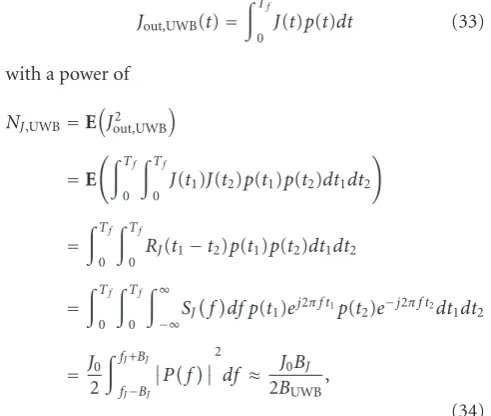
Jout,UWB(t)=
+Tf
0 J
(t)p(t)dt (33)
with a power of
NJ,UWB=E
the bandwidth of UWB pulse. Note that in the last line, we use the fact that the pulse has unit energy. We also assume thatP(f) remains constant in the range of [fJ−BJ,fJ +BJ]
and approximately takes the average value of 1/02BUWB.
Consider allL correlators, the block error rate is bounded by (cf., (21))
Direct-sequence spread spectrum signals are also widely used as a secure communications technique. With much larger bandwidth, UWB is expected to outperform DSSS for transmission secrecy [22]. An immediate conclusion from (25) is that UWB has a better asymptotic LPD performance than DSSS due to larger bandwidth and lower SNR, given the same observation interval Ts. This conforms to earlier
observations in [10,11]. In the following, we further examine the anti-jamming performance.
Let {cn} denote the pseudo-random code sequence of
the DSSS scheme (independent and identically distributed Bernoulli), pc(t) the chip waveform,Tb the bit interval,Tc
the chip interval, andLc = Tb/Tcthe spreading ratio [22].
Then the jamming signal at the output of the DSSS receiver is
For fair comparison with UWB, we assume thatpc(t) also
takes the same form as the UWB pulse and has the energy of 1/Lc. Then, following a similar procedure as in the UWB
case, it is not difficult to get the power of the jamming signal in DSSS systems as
NJ,DSSS=E
the bandwidth of the DSSS signal.
Comparing (34) and (37), it is observed that the output jamming power for DSSS is larger than that for UWB as long asBUWB > BDSSS, which means that UWB provides a better
anti-jamming protection than DSSS.
5. Numerical Results
In this section, some numerical examples are provided to better illustrate our main results in the previous sec-tions. We employ UWB signals with frame interval Tf =
25 nanoseconds and pulse duration Tp = 0.2 nanoseconds
The second derivative of a Gaussian pulse is adopted as the transmit pulse
withAcchosen such that the pulse has unit energy.
First, the simulation BER and upper bound (21) for our proposed USTC-UWB scheme is presented inFigure 1. We can see that employing multiple antennas for UWB signals dramatically improves the BER performance and analytical bounds match the exact BER at the high SNR region, which testifies the validity of our analysis.
−10 −8 −6 −4 −2 0 2 4 6 8 SNR (dB)
M = T = 2
N = 1 simulation N = 2 simulation N = 4 simulation
N = 1 upper bound N = 2 upper bound N = 4 upper bound
BER
10−6 10−5 10−4 10−3 10−2 10−1 100
Figure1: BER performance of USTC-UWB and its upper bound.
−0.7 −0.6 −0.5 −0.4 −0.3 −0.2
ρ −0.1
0
UWB M = N = 1 UWB M = 2, N = 1 UWB M = 2, N = 2
10−5 10−4 10−3 10−2 10−1 100
Pe
Figure2: Tradeoffbetween LPD and anti-jamming.
increase of SNR corresponds a lower BER, it also inevitably leads to a higher probability of being detected. However, a MIMO system can significantly reduce this probability compared with multiple-input single-output (MISO) or SISO systems.
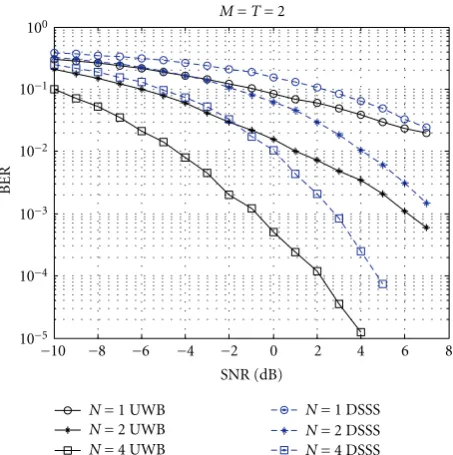
Figure 3. compares the performance of unitary space-time coding for UWB and DSSS signals. The simulation parameters are set asBDSSS=5 MHz andLc=16 as in [23].
We can see that UWB and DSSS systems possess the same diversity gain at high SNR. But UWB steadily outperforms
M = T = 2
N = 1 UWB N = 2 UWB N = 4 UWB
N = 1 DSSS N = 2 DSSS N = 4 DSSS
−10 −8 −6 −4 −2 0 2 4 6 8 SNR (dB)
BER
10−5 10−4 10−3 10−2 10−1 100
Figure 3: Anti-jamming performance comparison of UWB and CDMA.
0 5 10 15 20 25 30 35 40
Distance (m)
M = 2 N = 2 M = 2 N = 1 M = 1 N = 1
BER
10−5 10−4 10−3 10−2 10−1 100
Figure4: BER performance versus coverage range of SISO, MISO, and MIMO UWB system.
DSSS due to better interference suppression (anti-jamming) capability.
Finally, the coverage range extension advantage of employing multiple antennas in UWB transmission is exam-ined in Figure 4. A path link model in [24] is used in the simulation. We can see that compared to conventional SISO, MISO and MIMO schemes significantly increase the transmission distance of UWB system. For instance, at the target BER of 10−4, SISO is able to cover a range of 1 m,
By using 2 antennas also at receiver end, the range can be extended to almost 12 m. It is also observed that since the path loss increases dramatically with the distance, the BER of all three schemes becomes very large after a certain distance. Note that this comparison assumes that the same power is used at transmit side; that is, for a certain transmission distance, multiple antennas result in a lower transmit power, thus reducing the probability of detection.
6. Conclusions
Motivated by some recent research progress on applying MIMO technique in UWB and secure communications, we propose a new unitary space-time coding scheme for impulse radio UWB systems. Its error rate and various transmission secrecy metrics are analyzed. The tradeoff between low probability of detection and anti-jamming is revealed, which indicates that any of these security features could not be solely enhanced without sacrificing another. Our work demonstrates that introducing properly designed space-time codes into UWB systems not only improves the performance of conventional single-antenna schemes but also offers prominent benefits on physical-layer transmission covertness, making it a strong candidate for wireless secure communications, especially for short-distance applications.
Acknowledgment
This work was supported in part by the US National Science Foundation under Grant CCF-0515164, CNS-0721815 and CCF-0830462. Part of the results in this work appeared in [23].
References
[1] M.-K. Tsay, C.-H. Liao, C.-S. Shyn, and T.-Y. Yang, “Simul-taneous AJ and LPD evaluations for secure communication,” inProceedings of IEEE Military Communications Conference (MILCOM ’07), Orlando, Fla, USA, October 2007.
[2] Q. Ling, T. Li, and J. Ren, “Physical layer built-in security enhancement of DS-CDMA systems using secure block inter-leaving,” in Proceedings of the 38th Asilomar Conference on Signals, Systems and Computers, Pricenton, NJ, USA, March 2004.
[3] L. Nguyen, “Self-encoded spread spectrum communications,” inProceedings of IEEE Military Communications Conference (MILCOM ’99), vol. 1, pp. 182–186, Atlantic City, NJ, USA, October 1999.
[4] T. Yang and L. O. Chua, “Secure communication via chaotic parameter modulation,” IEEE Transactions on Circuits and Systems I, vol. 43, no. 9, pp. 817–819, 1996.
[5] Y. Hwang and H. C. Papadopoulos, “Physical-layer secrecy in AWGN via a class of chaotic DS/SS systems: analysis and design,”IEEE Transactions on Signal Processing, vol. 52, no. 9, pp. 2637–2649, 2004.
[6] H. Koorapaty, A. A. Hassan, and S. Chennakeshu, “Secure information transmission for mobile radio,”IEEE Communi-cations Letters, vol. 4, no. 2, pp. 52–55, 2000.
[7] A. O. Hero III, “Secure space-time communication,” IEEE Transactions on Information Theory, vol. 49, no. 12, pp. 3235– 3249, 2003.
[8] X. Li, M. Chen, and E. P. Ratazzi, “A randomized space-time transmission scheme for secret-key agreement,” inProceedings of the 39th Annual Conference on Information Sciences and Systems (CISS ’05), Baltimore, Md, USA, March 2005. [9] L. Yang and G. B. Giannakis, “Ultra-wideband
communica-tions: an idea whose time has come,”IEEE Signal Processing Magazine, vol. 21, no. 6, pp. 26–54, 2004.
[10] A. Bharadwaj and J. K. Townsend, “Evaluation of the covertness of time-hopping impulse radio using a multi-radiometer detection system,” inProceedings of IEEE Military Communications Conference (MILCOM ’01), vol. 1, pp. 128– 134, Washington, DC, USA, November 2001.
[11] D. R. McKinstry and R. M. Buehrer, “Issues in the perfor-mance and covertness of UWB communications systems,” inProceedings of IEEE Midwest Symposium on Circuits and Systems, vol. 3, pp. 601–604, Tulsa, Okla, USA, August 2002. [12] L. Yang and G. B. Giannakis, “Analog space-time coding for
multi-antenna ultra-wideband transmissions,”IEEE Transac-tions on CommunicaTransac-tions, vol. 52, no. 3, pp. 507–517, 2004. [13] W. P. Siriwongpairat, M. Olfat, and K. J. R. Liu, “Performance
analysis and comparison of time-hopping and direct-sequence UWB-MIMO systems,”EURASIP Journal on Applied Signal Processing, vol. 2005, no. 3, pp. 328–345, 2005.
[14] A. Tyago and R. Bose, “M-PAM space-time trellis codes for ultra-wideband multi-input multi-output communications,” IET Communications, vol. 2, no. 4, pp. 514–522, 2008. [15] C. Abou-Rjeily, N. Daniele, and J.-C. Belfiore, “On the
amplify-and-forward cooperative diversity with time-hopping ultra-wideband communications,”IEEE Transactions on Com-munications, vol. 56, no. 4, pp. 630–641, 2008.
[16] B. M. Hochwald and T. L. Marzetta, “Unitary space-time mod-ulation for multiple-antenna communications in Rayleigh flat fading,”IEEE Transactions on Information Theory, vol. 46, no. 2, pp. 543–564, 2000.
[17] A. J. Paulraj, R. Nabar, and D. Gore,Introduction to Space-Time Wireless Communications, Cambridge University Press, Cambridge, UK, 2003.
[18] V. Tarokh, N. Seshadri, and A. R. Calderbank, “Space-time codes for high data rate wireless communication: performance criterion and code construction,”IEEE Transactions on Infor-mation Theory, vol. 44, no. 2, pp. 744–765, 1998.
[19] B. L. Hughes, “Optimal space-time constellations from groups,”IEEE Transactions on Information Theory, vol. 49, no. 2, pp. 401–410, 2003.
[20] M. O. Damen, K. Abed-Meraim, and J.-C. Belfiore, “Diagonal algebraic space-time block codes,”IEEE Transactions on Infor-mation Theory, vol. 48, no. 3, pp. 628–636, 2002.
[21] I. Csiszar and J. K¨orner, “Broadcast channels with confidential messages,”IEEE Transactions on Information Theory, vol. 24, no. 3, pp. 339–348, 1978.
[22] B. M. Sadler and A. Swami, “On the performance of episodic UWB and direct-sequence communication systems,” IEEE Transactions on Wireless Communications, vol. 3, no. 6, pp. 2246–2255, 2004.
[23] Y. Zhang and H. Dai, “A unitary space-time coding scheme for UWB systems and its application in wireless secure commu-nications,” inProceedings of IEEE International Conference on Acoustics, Speech and Signal Processing (ICASSP ’06), vol. 4, pp. 485–488, Toulouse, France, May 2006.