Automatic Target Detection Using Wavelet Transform
S. Arivazhagan
Department of Electronics and Communication Engineering, Mepco Schlenk Engineering College, Sivakasi 626 005, India Email:s [email protected]
L. Ganesan
Department of Computer Science and Engineering, Government College of Engineering, Tirunelveli 627 007, India Email:[email protected]
Received 17 September 2003; Revised 14 July 2004; Recommended for Publication by Kyoung Mu Lee
Automatic target recognition (ATR) involves processing images for detecting, classifying, and tracking targets embedded in a background scene. This paper presents an algorithm for detecting a specified set of target objects embedded in visual images for an ATR application. The developed algorithm employs a novel technique for automatically detecting man-made and non-man-made single, two, and multitargets from nontarget objects, located within a cluttered environment by evaluating nonoverlapping image blocks, where block-by-block comparison of wavelet cooccurrence feature is done. The results of the proposed algorithm are found to be satisfactory.
Keywords and phrases:discrete wavelet transform, target detection, texture, wavelet cooccurrence features.
1. INTRODUCTION
The last three decades have seen rapid development in elec-tronic automation, though mechanical automation was there for the past 200 years. Computer vision researchers have for many years attempted to model the basic components of the human visual system to capture our visual abilities. The steps required for successful implementation of an automatic target recognition (ATR) task involves automatic detection, classification, and tracking of a target located in an image scene.
The wavelet transform is a multiresolution technique, which can be implemented as a pyramid or tree structure and is similar to subband decomposition. The discrete wavelet transform (DWT) has properties that make it an ideal trans-form for the processing of images encountered in target recognition applications, including rapid processing, a nat-ural ability to adapt to changing local image statistics, effi -cient representation of abrupt changes and precise position information, ability to adapt to high background noise and uncertainty about target properties, and a relative indepen-dence to target-to-sensor distance.
In this paper, target detection is achieved by calculating cooccurrence matrix features from detail subbands of dis-crete wavelet transformed, nonoverlapping but adjacent sub-blocks of different sizes, depending upon the target image. From these calculations, the subblock with the maximum of combined wavelet cooccurrence feature values (WCFs) is identified as a seed window. Then, by applying a region
growing algorithm, the subblock or regions are grouped into a larger block or region based on some predefined criteria. Then, the target is identified by a bounded rectangle. The proposed algorithm is applied on both man-made and non-man made single-, two-, and multitarget images.
This paper is organized as follows. InSection 2, the de-tailed literature survey about the texture analysis and target detection are given. In Section 3, the theory of DWT and wavelet filter bank for image decomposition are presented. A brief discussion about gray-level cooccurrence matrix is given inSection 4. The target detection system is explained in Section 5. In Section 6, experimental results for various target images are discussed in detail. Finally, concluding re-marks are given inSection 7.
2. BACKGROUND
2.1. Texture analysis
Analysis of textures requires the identification of proper attributes or features that differentiate the textures in the image for segmentation, classification, and recognition. The features are assumed to be uniform within the regions containing the same textures. Initially, texture analysis was based on the first-order or second-order statistics of tex-tures [3, 4, 5, 6, 7, 8]. Then, Gaussian Markov random field (GMRF) and Gibbs random field models were pro-posed to characterize textures [9, 10, 11, 12, 13, 14]. An adaptive anisotropic parameter estimation in a weak mem-brane model which uses the MRF and an adaptive pat-tern recognition system for scene segmentation are pro-posed in [15,16]. Later, local linear transformations were used to compute texture features [17,18]. Then, a texture spectrum technique was proposed for texture analysis [19]. The above traditional statistical approaches to texture anal-ysis, such as cooccurrence matrices, second-order statistics, GMRF, local linear transforms, and texture spectrum, are re-stricted to the analysis of spatial interactions over relatively small neighborhoods on a single scale. As a consequence, their performance is best for the analysis of microtextures only [20].
More recently, methods based on multiresolution or multichannel analysis, such as Gabor filters and wavelet transform, have received a lot of attention [20, 21, 22, 23, 24, 25, 26, 27, 28, 29, 30]. But, the outputs of Ga-bor filter banks are not mutually orthogonal, which may result in a significant correlation between texture features. Finally, these transformations are usually not reversible, which limits their applicability for texture synthesis. Most of these problems can be avoided if one uses the wavelet transform, which provides a precise and unifying frame-work for the analysis and characterization of a signal at different scales [20]. Another advantage of wavelet trans-form over Gabor filters is that the lowpass and highpass filters used in the wavelet transform remain the same be-tween two consecutive scales while the Gabor approach re-quires filters of different parameters [23]. In other words, Gabor filters require proper tuning of filter parameters at different scales. Later, Kaplan proposed extended frac-tal analysis for texture classification and segmentation and Wang and Liu proposed multiresolution MRF (MRMRF) parameters for texture classification [31, 32]. Wavelet sta-tistical features (WSF) and WCF were proposed and ef-fectively used for texture characterization and classifica-tion [33].
2.2. Target detection
Kubota et al. proposed a vision system with real-time fea-ture extractor and relaxation network using a multiresolu-tion technique [34]. An algorithm for boundary detecmultiresolu-tion using edge dipole and edge field is presented in [35]. An adaptive pixel-based data fusion is proposed for boundary detection [36]. Huntsberger and Jawerth proposed wavelet-based techniques for automatic target detection and recogni-tion and for acoustic and nonacoustic antisubmarine war-fare [37, 38]. Espinal et al. proposed wavelet-based
frac-LL1 HL1
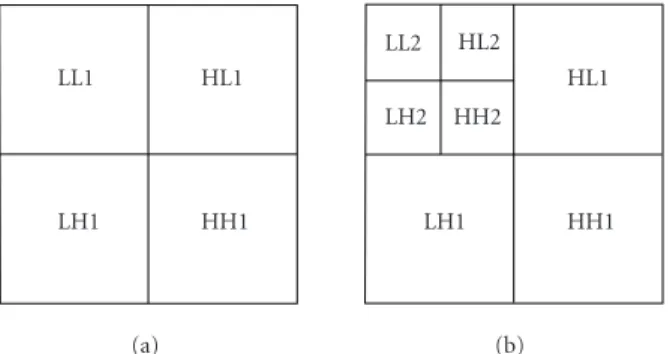
Figure1: Image decomposition. (a) One level. (b) Two levels.
tal dimension for ATR [1]. Chernoffbounds was proposed for ATR from compressed data [39]. Regularized complex DWT (CDWT) optical flow algorithm was used for mov-ing target detection in infrared imagery [40]. Then, Tian and Qi used spectral analysis statistics and wavelet coeffi -cient characterization (SSWCC) for target detection and clas-sification [41]. Later, Renyi’s information and wavelets were used for target detection [42]. Howard et al. proposed di-rected principal component analysis followed by clustering for real-time intelligent target detection [43]. Then, a preat-tentive selection mechanism based on the architecture of the primate visual system was implemented for target de-tection in cluttered natural scenes [44]. Kubota et al. pro-posed edge-based probabilistic relaxation for subpixel con-tour extraction, a useful subtechnique for target detection [45].
Although there have been previous efforts involved in texture analysis and target detection, limitations still exist in their applicability in detecting man-made and non-man-made, two and multitargets. Our approach effectively ex-ploits the cooccurrence features, derived from detail sub-bands of discrete wavelet transformed images for the detec-tion of man-made and non-man-made two and more targets, in both cluttered and noncluttered environments.
3. DISCRETE WAVELET TRANSFORM
Wavelets are functions generated from one single functionψ by dilations and translations. The basic idea of the wavelet transform is to represent any arbitrary function as a super-position of wavelets. Any such supersuper-position decomposes the given function into different scale levels where each level is further decomposed with a resolution adapted to that level [46].
h 2
g LPF
HPF 2
h
g
h
g
2
2
2
2 Image
LPF
HPF
LPF
HPF
LL1
LH1
HL1
HH1 x Convolve with filter x 2 Down sampling by 2
Rows
Columns
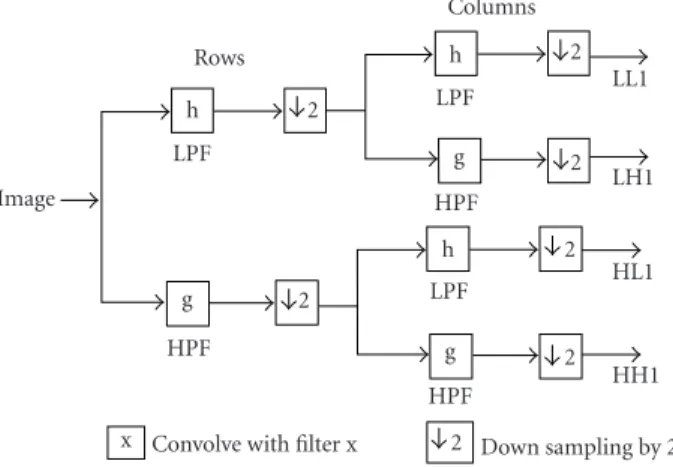
Figure2: Wavelet filter bank for one-level image decomposition.
i
j
(a)
i
j
(b)
i j
(c)
i
j
(d)
Figure3: Cooccurrence matrix-orientations. (a)d=(1, 1)−135◦. (b)d=(1,−1)−45◦. (c)d=(0, 1)−0◦. (d)d=(1, 0)−90◦.
The filters h and g shown inFigure 2are one-dimensional lowpass filter (LPF) and highpass filter (HPF), respectively. Thus, decomposition provides subbands corresponding to different resolution levels and orientations. These subbands labeled LH1, HL1, and HH1 represent the finest scale wavelet coefficients, that is, detail images, while the subband LL1 cor-responds to coarse-level coefficients, that is, approximation image. To obtain the next coarse level of wavelet coefficients, the subband LL1 alone is further decomposed and critically sampled using a similar filter bank shown inFigure 2. This results in a two-level wavelet decomposition as shown in Figure 1b. Similarly, to obtain further decomposition, LL2 will be used. This process continues until some final scale is reached.
The values or transformed coefficients in approxima-tion and detail images (subband images) are the essen-tial features, which are as useful for texture discrimination and segmentation. Since textures, either micro or macro, have nonuniform gray-level variations, they are statisti-cally characterized by the values in the DWT transformed subband images or the features derived from these sub-band images or their combinations. In other words, the features derived from these approximation and detail sub-band images uniquely characterize a texture. The features obtained from these DWT transformed images are shown here as useful for target detection and are discussed in the Section 5.
4. GRAY-LEVEL COOCCURRENCE MATRIX
The cooccurrence method of texture description is based on the repeated occurrence of some gray-level configuration in the texture and this configuration varies rapidly with dis-tance in fine textures and slowly in coarse textures [3]. Con-sider the part of textured image to be analyzed is of size M×N. In the cooccurrence matrix, an occurrence of some gray-level configuration is described by a matrix of relative frequencies Cθ,d(i,j) describing how frequently two pixels with gray levelsi,jappear in the window separated by a dis-placement vector din directionθ. For example, if the dis-placement vector is specified as (1, 1), it has the interpreta-tion of one pixel below and one pixel to the right, in the direction of 45◦ as shown inFigure 3aand if it is specified as (1,−1), it has the interpretation of one pixel below and one pixel to the left, in the direction of 135◦ as shown in Figure 3b. Similarly, the displacement vector (0, 1) has the interpretation of zero pixel below and one pixel to the right, that is, in the direction of 0◦ as shown inFigure 3cand the displacement vector (1, 0) has the interpretation of one pixel below and zero pixel to the left, that is, in the direction of 90◦ as shown inFigure 3d.
Input image
highlighting Region growing Seed blockselection Target detected
image
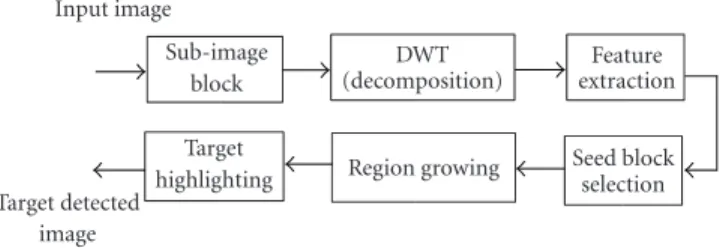
Figure4: Target detection system.
cooccurrence as functions of angle and distance can be represented as
The gray-level cooccurrence matrix C(i,j) can be ob-tained by counting all pairs of pixels having gray levelsiand j, separated by a given displacement vectordin the given di-rection.
5. TARGET DETECTION SYSTEM
The steps involved in the target detection process is shown in Figure 4.
Here, the input images of sizeN×Nare considered. The target detection is carried out by considering nonoverlapping sub-images (i.e., blocks) of different sizes, depending upon the target images. Each distinct sub-image block, taken from the top-left corner of the original image, is decomposed us-ing one- or two-level DWT and wavelet cooccurrence matri-ces (C) are derived forθ=135◦andd=(1, 1) (i.e., one pixel below and one pixel to the right) for detail subbands (i.e., LH1, HL1, HH1, LH2, HL2, and HH2). Here, it is impor-tant to note that the required level of DWT decomposition depends on the window size used, that is, for larger window size, the image can be decomposed into more levels of DWT,
while for smaller window size, a smaller level of DWT de-composition is used. In turn, the window size depends on the size of the target and the image.
Contrast=
Then, from these cooccurrence matrices (C), significant WCFs such as contrast, cluster shade, and cluster promi-nence are computed using the formulae given in (2) to (4). These feature values are subjected to either linear or loga-rithmic normalization, depending on their dynamic ranges. The contrast features have moderate values and hence they are subjected to linear normalization, while cluster shade and cluster prominence are subjected to logarithmic nor-malization, since they have very large dynamic range of val-ues. Selecting the seed block often can be based on the nature of the problem. When a priori information is not available, the procedure is to compute at every pixel or subregion the same set of properties that ultimately will be used for the selection of seed and also for the grow-ing process. In our implementation, the sub-image block, with the maximum of combined normalized feature values of contrast, cluster shade, and cluster prominence (Shigh) is identified as seed block or seed window. The concept of wavelet and cooccurrence features show that the feature val-ues are high for a window that is surely a part of the tar-get.
Input: Target image of sizeN×N Output: Target detected image
(1) Read the target image.
(2) Obtain32×32or16×16sub-image blocks, starting from the top-left corner.
(3) Decompose sub-image blocks using 2D-DWT.
(4) Derive cooccurrence matrices for detail subbands of DWT decomposed sub-image blocks.
(5) Calculate WCFs, such as contrast, cluster shade, and cluster prominence, from cooccurrence matrices.
(6) Repeat Steps 2 to 5 for all sub-image blocks.
(7) Sort the sum of feature values of all windows in ascending order and choose the window, having the maximum combined feature values(Shigh)as the seed window. (8) Obtain the threshold, that is, the average of feature sums of
the firstn%windows.
(9) Apply the region growing algorithm using the mean distance method by merging windows based on the threshold and adjacency.
(10) Highlight the target by a bounded rectangle.
Algorithm1
In our implementation, the region growing algorithm is based on mean distance method. In this method, the first step is to sort the feature values of all the windows, that is, sub-image blocks in ascending order so that the window whose value is the largest would be the seed window. The threshold is determined by finding the average (A) of the first n% of the windows, which are adaptively chosen de-pending upon the target image. Now, the feature values of all the 8-adjacent blocks are compared with the average value, A, and theShighvalue. The window whose value is closer to Shigh value will be merged with the seed window. This pro-cess is repeated for all 8 adjacent blocks. If no window is merged from the 8 adjacent blocks, then the algorithm ter-minates. If at least one window is merged from the 8 adja-cent blocks, then the above procedure will be repeated with the 16 adjacencies and so on. At the end, a rectangle, bound-ing all the merged windows, is drawn to highlight the tar-get detected. The tartar-get detection algorithm is given as in Algorithm 1.
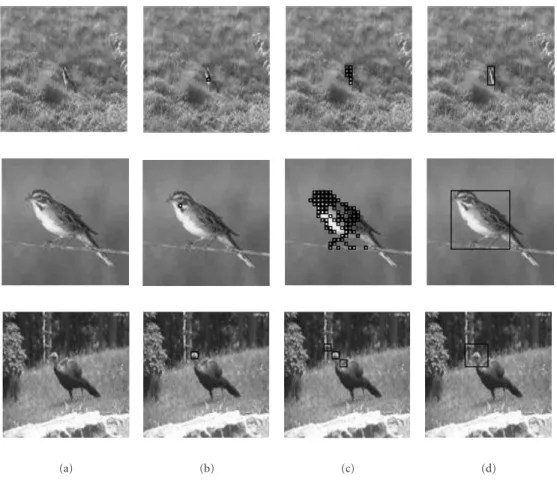
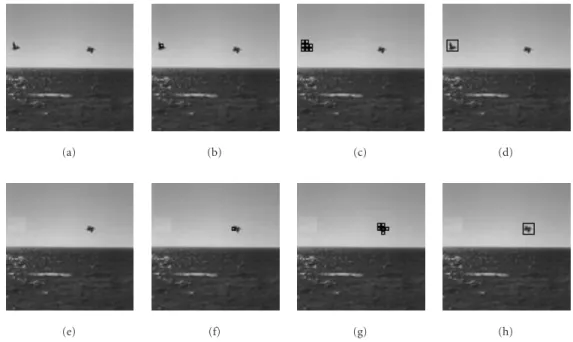
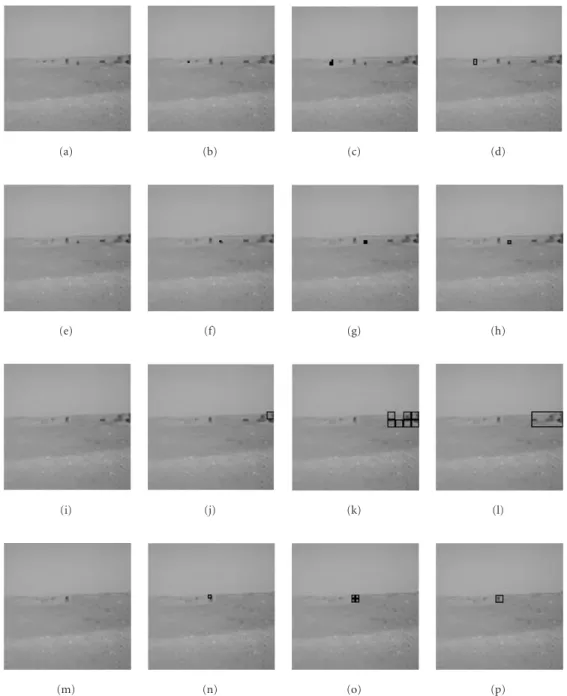
6. EXPERIMENTAL RESULTS AND DISCUSSION The target detection algorithm discussed in the previous sec-tion is applied on twelve different man-made single-target images of sizes either 512×512 or 256×256, three non-man-made or natural single-target images, a non-man-made two-target fused image, two non-man-made two-two-target images (i.e., images with two birds), and a non-man-made mul-titarget image (i.e., image with animals). These images are chosen in such a way that some images are with a clear natural background while other images are in cluttered en-vironment. Also, the images of different sizes are chosen to prove the effectiveness of the proposed target detection
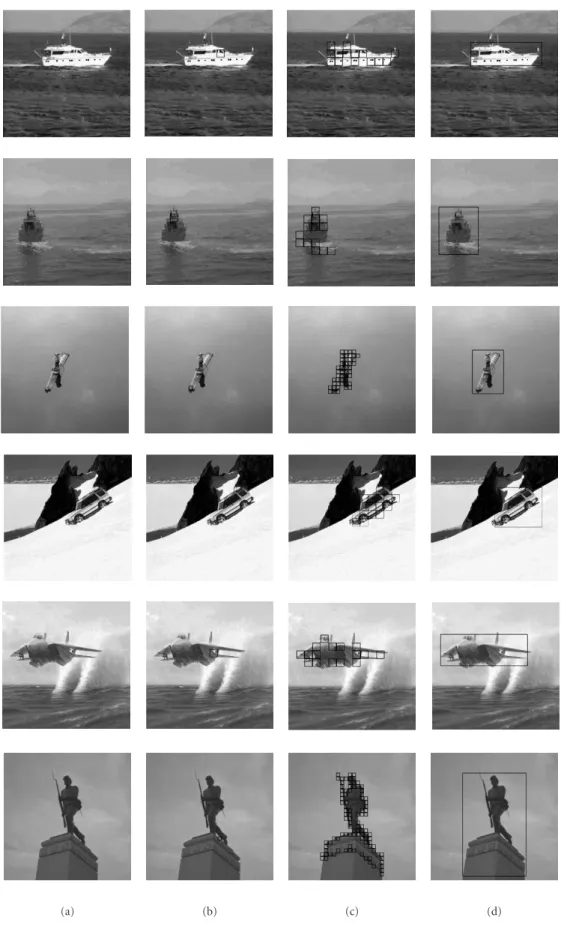
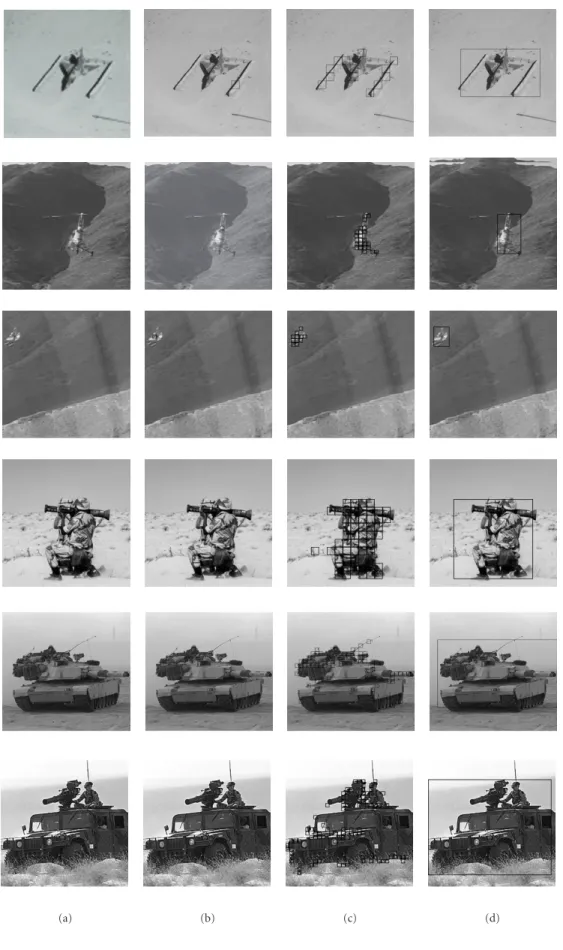
algorithm. Though the number of levels of DWT decompo-sition depends on the window size used, all the target im-ages are subjected to two levels of wavelet decomposition using Daubechies fourth-order filter. For the region grow-ing process, the mean distance method provides better re-sults compared with the Euclidean distance method. The tar-get detection results obtained for the first twelve man-made single-target images are shown in Figures 5 and 6, where column (a) shows original images, while columns (b), (c), and (d) show images with seed window, images after re-gion growing process, and target detected images, respec-tively. From the figures, it is observed that for all the twelve images, the proposed algorithm results in a better detection process.
(a) (b) (c) (d)
(a) (b) (c) (d)
(a) (b) (c) (d)
Figure7: Non-man-made single-target detection results (columnwise). (a) Original images. (b) Images with seed window. (c) Images after region growing. (d) Target detected images.
(a) (b) (c) (d)
(e) (f) (g) (h)
(a) (b) (c) (d)
(e) (f) (g) (h)
Figure9: Non-man-made two-target detection results. (a) Original image having two birds. (b)–(d) Results of the first target. (e) Image after suppressing the first detected target. (f)–(h) Results of the second target.
(a) (b) (c) (d)
(e) (f) (g) (h)
Figure10: Non-man-made two-target detection results. (a) Original image having two birds. (b)–(d) Results of the first target. (e) Image after suppressing the first detected target. (f)–(h) Results of the second target.
single-, two- and multitarget images are found to be satis-factory.
7. CONCLUSION
Considering the role of technology in contemporary defense systems, automating of target detection is very important. The metric wavelet cooccurrence features used in our
(a) (b) (c) (d)
(e) (f) (g) (h)
(i) (j) (k) (l)
(m) (n) (o) (p)
Figure11: Non-man-made multitarget detection results. (a) Original image having more animals. (b)–(d) Results of the first target. (e) Image after suppressing the first detected target. (f)–(h) Results of the second target. (i) Image after suppressing the second detected target. (j)–(l) Results of the third target. (m) Image after suppressing the third detected target. (n)–(p) Results of the fourth target.
ACKNOWLEDGMENTS
The authors are grateful to the Management and Principal of our colleges for their constant support and encouragement. The authors wish to thank the anonymous reviewers for their constructive suggestions to mold this paper better.
REFERENCES
[1] F. Espinal, T. L. Huntsberger, B. D. Jawerth, and T. Kubota, “Wavelet-based fractal signature analysis for automatic target recognition,”Optical Engineering, vol. 37, no. 1, pp. 166–174, 1998.
[2] P. P. Raghu and B. Yegnanarayana, “Segmentation of Gabor-filtered textures using deterministic relaxation,” IEEE Trans. Image Processing, vol. 5, no. 12, pp. 1625–1636, 1996. [3] R. M. Haralick, K. Shanmugam, and I. Dinstein, “Textural
features for image classification,” IEEE Trans. Systems, Man, and Cybernetics, vol. 3, no. 6, pp. 610–621, 1973.
[4] J. S. Weszka, C. R. Dyer, and A. Rosenfeld, “A comparative study of texture measures for terrain classification,” IEEE Trans. Systems, Man, and Cybernetics, vol. 6, no. 4, pp. 269– 285, 1976.
[6] L. S. Davis, S. A. Johns, and J. K. Aggarwal, “Texture analy-sis using generalized co-occurrence matrices,”IEEE Trans. on Pattern Analysis and Machine Intelligence, vol. 1, no. 3, pp. 251–259, 1979.
[7] O. D. Faugeras and W. K. Pratt, “Decorrelation methods of texture feature extraction,” IEEE Trans. on Pattern Analysis and Machine Intelligence, vol. 2, no. 4, pp. 323–332, 1980. [8] P. C. Chen and T. Pavlidis, “Segmentation by texture using
correlation,”IEEE Trans. on Pattern Analysis and Machine In-telligence, vol. 5, no. 1, pp. 64–69, 1983.
[9] G. R. Cross and A. K. Jain, “Markov random field texture models,”IEEE Trans. on Pattern Analysis and Machine Intelli-gence, vol. 5, no. 1, pp. 25–39, 1983.
[10] R. Chellappa and S. Chatterjee, “Classification of textures using Gaussian Markov random fields,” IEEE Trans. Acous-tics, Speech, and Signal Processing, vol. 33, no. 4, pp. 959–963, 1985.
[11] R. L. Kashyap and A. Khotanzad, “A model-based method for rotation invariant texture classification,” IEEE Trans. on Pat-tern Analysis and Machine Intelligence, vol. 8, no. 4, pp. 472– 481, 1986.
[12] H. Derin and H. Elliott, “Modeling and segmentation of noisy and textured images using Gibbs random fields,” IEEE Trans. on Pattern Analysis and Machine Intelligence, vol. 9, no. 1, pp. 39–55, 1987.
[13] F. S. Cohen, Z. Fan, and M. A. Patel, “Classification of rotated and scaled textured images using Gaussian Markov random field models,” IEEE Trans. on Pattern Analysis and Machine Intelligence, vol. 13, no. 2, pp. 192–202, 1991.
[14] B. S. Manjunath and R. Chellappa, “Unsupervised texture segmentation using Markov random field models,” IEEE Trans. on Pattern Analysis and Machine Intelligence, vol. 13, no. 5, pp. 478–482, 1991.
[15] T. Kubota and T. L. Huntsberger, “Adaptive anisotropic pa-rameter estimation in the weak membrane model,” inProc. 1st International Workshop on Energy Minimization Methods in Computer Vision and Pattern Recognition (EMMCVPR ’97), vol. 1223, pp. 179–194, Venice, Italy, May 1997.
[16] T. Kubota and T. L. Huntsberger, “Adaptive pattern recogni-tion system for scene segmentarecogni-tion,”Optical Engineering, vol. 37, no. 3, pp. 829–835, 1998, Special section on advances in pattern recognition.
[17] K. I. Laws, “Rapid texture identification,” inImage Processing for Missile Guidance, vol. 238 ofProceedings of SPIE, pp. 376– 380, San Diego, Calif, USA, July–August 1980.
[18] M. Unser, “Local linear transforms for texture measure-ments,”Signal Processing, vol. 11, no. 1, pp. 61–79, 1986. [19] D.-C. He and L. Wang, “Texture unit, texture spectrum, and
texture analysis,”IEEE Transactions on Geoscience and Remote Sensing, vol. 28, no. 4, pp. 509–512, 1990.
[20] M. Unser, “Texture classification and segmentation using wavelet frames,” IEEE Trans. Image Processing, vol. 4, no. 11, pp. 1549–1560, 1995.
[21] M. Unser and M. Eden, “Multiresolution feature extraction and selection for texture segmentation,” IEEE Trans. on Pat-tern Analysis and Machine Intelligence, vol. 11, no. 7, pp. 717– 728, 1989.
[22] A. Bovik, M. Clark, and W. S. Geisler, “Multichannel texture analysis using localized spatial filters,”IEEE Trans. on Pattern Analysis and Machine Intelligence, vol. 12, no. 1, pp. 55–73, 1990.
[23] T. Chang and C.-C. J. Kuo, “Texture analysis and classification with tree-structured wavelet transform,” IEEE Trans. Image Processing, vol. 2, no. 4, pp. 429–441, 1993.
[24] A. Teuner, O. Pichler, and B. J. Hosticka, “Unsupervised tex-ture segmentation of images using tuned matched Gabor fil-ters,”IEEE Trans. Image Processing, vol. 4, no. 6, pp. 863–870, 1995.
[25] G. M. Haley and B. S. Manjunath, “Rotation-invariant tex-ture classification using modified Gabor filters,” inProc. IEEE International Conference on Image Processing (ICIP ’95), pp. 262–265, Washington, DC, USA, October 1995.
[26] B. S. Manjunath and W. Y. Ma, “Texture features for brows-ing and retrieval of image data,” IEEE Trans. on Pattern Analysis and Machine Intelligence, vol. 18, no. 8, pp. 837–842, 1996.
[27] W.-R. Wu and S.-C. Wei, “Rotation and gray-scale transform-invariant texture classification using spiral resampling, sub-band decomposition, and hidden Markov model,” IEEE Trans. Image Processing, vol. 5, no. 10, pp. 1423–1434, 1996. [28] E. P. Simoncelli and J. Portilla, “Texture characterization via
joint statistics of wavelet coefficient magnitudes,” in Proc. IEEE International Conference on Image Processing (ICIP ’98), vol. 1, pp. 62–66, Chicago, Ill, USA, October 1998.
[29] E. P. Simoncelli, “Modeling the joint statistics of images in the wavelet domain,” inWavelet Applications in Signal and Image Processing VII, vol. 3813 ofProceedings of SPIE, pp. 188–195, Denver, Colo, USA, July 1999.
[30] G. Van de Wouwer, P. Scheunders, and D. Van Dyck, “Statisti-cal texture characterization from discrete wavelet representa-tions,”IEEE Trans. Image Processing, vol. 8, no. 4, pp. 592–598, 1999.
[31] L. M. Kaplan, “Extended fractal analysis for texture classifica-tion and segmentaclassifica-tion,”IEEE Trans. Image Processing, vol. 8, no. 11, pp. 1572–1585, 1999.
[32] L. Wang and J. Liu, “Texture classification using multires-olution Markov random field models,” Pattern Recognition Letters, vol. 20, no. 2, pp. 171–182, 1999.
[33] S. Arivazhagan and L. Ganesan, “Texture classification using wavelet transform,” Pattern Recognition Letters, vol. 24, no. 9-10, pp. 1513–1521, 2003.
[34] T. Kubota, T. L. Huntsberger, and C. O. Alford, “A vision sys-tem with real-time feature extractor and relaxation network,” International Journal of Pattern Recognition and Artificial In-telligence, vol. 12, no. 3, pp. 335–354, 1998.
[35] T. Kubota and T. L. Huntsberger, “Edge dipole and edge field for boundary detection,” inHybrid Image and Signal Process-ing VI, vol. 3389 ofProceedings of SPIE, pp. 179–189, Orlando, Fla, USA, April 1998.
[36] T. Kubota, “Adaptive pixel-based data fusion for bound-ary detection,” in Proc. Energy Minimization Methods in Computer Vision and Pattern Recognition (EMMCVPR ’99), Lecture Notes in Computer Science, pp. 173–188, Springer-Verlag, York, UK, July 1999.
[37] T. L. Huntsberger and B. D. Jawerth, “Wavelet based auto-matic target detection and recognition,” Annual Tech. Rep., University Research Initiative Program for Combat Readiness, University of South Carolina, Columbia, SC, USA, 1998. [38] T. L. Huntsberger and B. D. Jawerth, “Wavelet based
algo-rithms for acoustic and non-acoustic antisubmarine warfare,” Annual Tech. Rep., University Research Initiative Program for Combat Readiness, University of South Carolina, Columbia, SC, USA, 1998.
[40] G. Castellano, J. Boyce, and M. Sandler, “Moving target de-tection in infrared imagery using a regularized CDWT optical flow,” inProc. IEEE Workshop on Computer Vision Beyond the Visible Spectrum: Methods and Applications (CVBVS ’99), pp. 13–22, Fort Collins, Colo, USA, June 1999.
[41] Y. Tian, H. Qi, and X. Wang, “Target detection and classifi-cation using seismic signal processing in unattended ground sensor systems,” inProc. IEEE Int. Conf. Acoustics, Speech, Sig-nal Processing (ICASSP ’02), vol. 4, p. 4172, Orlando, Fla, USA, May 2002.
[42] G. Boccignone, A. Chianese, and A. Picariello, “Using Renyi’s information and wavelets for target detection: an application to mammograms,” Pattern Analysis and Applications, vol. 3, no. 4, pp. 303–313, 2000.
[43] A. Howard, C. Padgett, and K. Brown, “Real time intelligent target detection and analysis with machine vision,” inProc. 3rd International Symposium on Intelligent Automation and Control, World Automation Congress (ISIAC-WAC ’00), Maui, Hawaii, June 2000.
[44] L. Itti, C. Gold, and C. Koch, “Visual attention and target de-tection in cluttered natural scenes,” Optical Engineering, vol. 40, no. 9, pp. 1784–1793, 2001.
[45] T. Kubota, T. L. Huntsberger, and J. T. Martin, “Edge based probabilistic relaxation for sub-pixel contour extrac-tion,” inProc. 3rd International Workshop on Energy Min-imization Methods in Computer Vision and Pattern Recogni-tion (EMMCVPR ’01), pp. 328–343, INRIA, Sophia Antipolis, France, September 2001.
[46] M. Antonini, M. Barlaud, P. Mathieu, and I. Daubechies, “Im-age coding using wavelet transform,” IEEE Trans. Image Pro-cessing, vol. 1, no. 2, pp. 205–220, 1992.
[47] L. Bin and J. Peng, “Image fusion method based on short sup-port symmetric non-separable wavelet,”International Journal of Wavelets, Multiresolution and Information Processing, vol. 2, no. 1, pp. 87–98, 2004.
S. Arivazhagan was born in 1965, in Sivakasi, Tamil Nadu. He received his B.E. degree in electronics and communi-cation engineering from Alagappa Chet-tiar College of Engineering and Technol-ogy, Karaikudi, in 1986, and his M.E. degree in applied electronics from College of En-gineering, Guindy, Anna University, Chen-nai, in 1992. He has submitted his Ph.D. thesis in the area of texture image
analy-sis using wavelet transform to Manonmaniam Sundaranar Uni-versity, Tirunelveli. Presently, he is working as an Associate Pro-fessor in the Department of Electronics and Communication En-gineering, Mepco Schlenk Engineering College, Sivakasi. He has eighteen years of teaching and research experience. He has been awarded the Young Scientist Fellowship by Tamil Nadu State Coun-cil for Science and Technology in the year 1999. His areas of in-terest include image processing and computer communication. He has published/presented 31 technical papers in the interna-tional/national journals and conferences. He has also coauthored a book entitledDigital Circuits and Design. He is the Principal Inves-tigator of a Research and Development Project sanctioned by De-fense Research and Development Laboratory (DRDL), Hyderabad, and Indian Space Research Organization (ISRO), Trivandrum. He is a Life Member in the Indian Society for Technical Education (ISTE) and Institute of Electronics and Telecommunication Engi-neers (IETE).
L. Ganesanborn in Ettayapuram (south-most part of India) in 1961. He received his B.E. degree from Thiagarajar College of Engineering, Madurai Kamaraj Univer-sity Madurai, and obtained his M.E. de-gree from Government College of Technol-ogy, Bharathiar University Coimbatore. He completed his Ph.D. in Indian Institute of Technology, Kharagpur, West Bengal. He started his career as an Associate Lecturer