R E S E A R C H
Open Access
Authentication of satellite navigation
signals by wiretap coding and artificial noise
Francesco Formaggio
*and Stefano Tomasin
Abstract
In order to combat the spoofing of global navigation satellite system (GNSS) signals, we propose a novel signal authentication method based on information-theoretic security. In particular, the satellite superimposes to the navigation signal an authentication signal containing a secret authentication message corrupted by artificial noise (AN). We impose the following properties:
a) Authentication and navigation signals are synchronous, b) Authentication and navigation signals are orthogonal and
c) The secret message is undecodable by the attacker due to the AN.
The legitimate receiver synchronizes with the navigation signal and stores the samples of the authentication signal with the same synchronization. After the transmission of the authentication signal, through a separate public asynchronous ground channel (e.g., a secure Internet connection) additional information is made public allowing the receiver to
a) Decode the authentication message, thus overcoming the effects of AN, and b) Verify the authentication message.
We assess the performance of the proposed scheme by the analysis of both the secrecy capacity of the authentication message and the attack success probability under various attack scenarios.
Keywords: Artificial noise, Authentication, Global navigation satellite system, Physical layer security, Wiretap coding
1 Introduction
Global navigation satellite systems (GNSS) offer posi-tioning and timing services for an increasing variety of applications (e.g., car and ship navigation, but also syn-chronization of electrical grid stations). GNSS signals are subject to various security attacks, aiming ultimately at disrupting or altering these applications [1]. In this paper, we focus on thespoofing attack, where an attacker (AT) transmits a signal with the purpose of inducing a false spe-cific location estimate to the victim receiver (VR). This attack isactiveas it requires a transmission by the spoofer. Positioning is typically obtained by measuring the time of arrival of pilot signals known at the receiver. The AT generates and transmits the pilots with proper delays
*Correspondence:[email protected]
Department of Information Engineering, University of Padova, via Gradenigo 6/A, Padova, Italy
(with respect to other original or spoofed satellite sig-nals) in order to induce the desired position estimation. Moreover, the spoofer can also transmit an additional sig-nal that destructively interferes with the origisig-nal satellite signal at the VR.
A first defense against spoofing is its detection at the VR. Examples include the detection of either the resid-ual power (on top of the legitimate signal) [2], or pre-[3] or post-correlation [4] power. Other approaches check the consistency of the arrival directions of satellite sig-nals through multiple antennas [5–7]. Another defense strategy is the modification of current GNSS signal to both ease spoofing detection and make the attack more difficult. An interesting opportunity is the transmission of (partially) unpredictable signals, in what is usually denoted as navigation message authentication (NMA). Implementations of NMA include cryptographic schemes
based on either symmetric-key [8,9] or asymmetric-key [10,11] encryption. The partial unpredictability of the sig-nal makes the spoofing attack more difficult as the AT cannot simply transmit a delayed version of the legitimate signal. In a more sophisticated attack, the AT eavesdrops the original satellite signal and then retransmits it (includ-ing both pilots and authentication data) in the so-called meaconing attack. Variations of this attack include the partial observation of the satellite signal and the recon-struction of the missing part, exploiting the redundancy provided by either forward error correction (FEC) (for-ward estimation attack, FEA) [12,13] or spread spectrum techniques typical of GNSS, thus alternating (within the symbol duration) detection and retransmission (security code estimation and replay, SCER) [14].
In this paper, we propose a solution to make the GNSS system more robust to spoofing by operating at the phys-ical layer and exploiting information theory (IT) results (see [15] for a survey on IT authentication solutions). The idea is that the satellite transmits an unpredictable
authentication message synchronously with the
naviga-tion message. In order to prevent meaconing attacks, the satellite also transmits artificial noise (AN) superim-posed to the authentication message, to be removed at the receiver before authentication verification. Then, after its transmission over the satellite channel, the authenti-cation message and the AN are separately and securely re-broadcast so that the VR can check the presence and correctness of the authentication message in the earlier received signal. This eases thedetection of the spoofing attack. The information dissemination can also occur on a separate delay-tolerant but authenticated channel, e.g., over the Internet with cryptographic authentication pro-tocols. In summary, our solution, denoted physical layer authentication (PLA), includes (a) a novel communication architecture to securely share the authentication mes-sage and AN with a loose random delay and (b) coding
and decoding algorithms for theauthentication message, together with a technique to decide about its authenticity. About related literature, in [16] AN is also used on top of an authentication tag, however without synchronization requirements and without an architecture for the dissem-ination of AN signal and authentication tags. In [17], we proposed to superimpose an AN-corrupted authentica-tion message to the navigaauthentica-tion signal, and PLA extends it by including advanced coding and signaling, and analyz-ing the solution within the framework of wiretap codanalyz-ing.
We show that as the length of the authentication mes-sage goes to infinity, we obtain a vanishing probability of success for the spoofing attack. We compute the rate at which the success probability vanishes, under perfect cod-ing and Gaussian signalcod-ing. Then, we derive bounds on the success probability when finite-length messages and binary signaling are used. The impact of synchronization errors (due to an ongoing spoofing attack) on the success probability is also considered. For finite-length coding and binary signaling, a predictive attack (similar to meacon-ing FEA) is analyzed in terms of the probability of passmeacon-ing undetected. By numerical results, we show the effec-tiveness of the proposed PLA technique against various attacks.
The rest of the paper is organized as follows. Section2
introduces both the system model and the reference attack strategy. In Section3, we propose the novel PLA solution, whose correctness and security are analyzed in Section4. In Section 5, we consider prediction attacks specifically targeting our PLA. The optimization of the transmit power is addressed in Section 6. Numerical results are presented is Section 7 before conclusions are driven in Section8.
2 System model
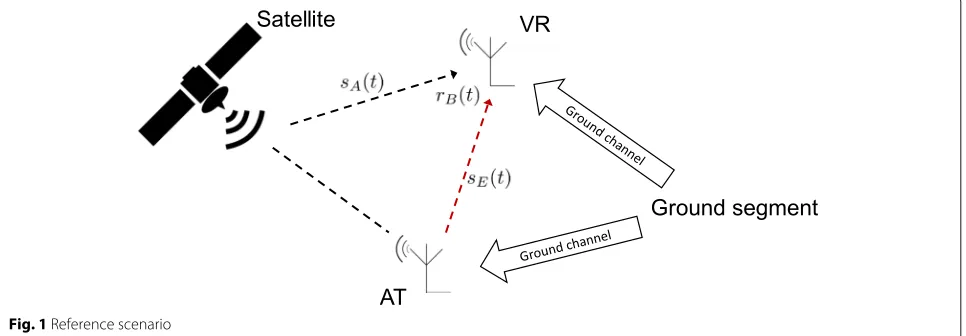
Figure1shows our reference scenario with a satellite, and two earth devices, i.e., a VR and an AT.
Satellite communication channel: In the basic existing configuration, the satellite generates a unitary-power real binary pilot signaldiwith symbol periodTsand spreads it with the real unitary-power spreading pulse
sp(t)
In the current GNNS,p(t)is also the baseband-equivalent (pilot component) signal transmitted by the satellite, which we will denote as
sA(t)=p(t). (3)
In the absence of attacks and considering additive white Gaussian noise (AWGN) channels between all devices, as typically considered in satellite navigation systems, the signal received by the VR is
rB(t)=GBsA(t)+wB(t), (4)
whereGBis the channel gain, andwB(t)is the zero-mean AWGN signal with power spectral densityσw2B.
Ground channel: In order to implement our PLA
scheme, we need aground channel, i.e., public authenti-cated channel over which signals are transmitted by the ground segment, i.e., the navigation control center on the earth that is controlling GNSS. This channel is not nec-essarily a satellite link, and it is assumed to be of large bandwidth provided for example through an Internet con-nection. The authentication is ensured by higher layer authentication protocols [18] (such as https). We assume the AT has no control over the information traveling on the ground channel and, thus, it can not modify it. More-over, as no fine time synchronization is available on the ground channel, it is not useful for ranging purposes.
2.1 Land satellite model
Channel gain GB can be described by the land mobile satellite link (LMS) according to [19]. A three-state Markov chain (MC) is used to model the slow variations of the line of sight (LOS) due to shadowing and block-age effects while the Loo [20] distribution is used forGB within each state and models shadowing and multipath effects. Therefore, we have
GBejθ=lejφ0+gejφ, (5)
whereGB≥0,lis log-normally distributed,gis Rayleigh distributed, φ0 and φ are uniformly distributed in the
interval [ 0, 2π]. In particular, ferent scenarios and for each Markov state. Note that we assume that the channel phase is always compensated at the receiver, thus we obtain the real signal model (4).
2.2 Reference attack
The AT’s objective is to forge a navigation signal, send it to the VR, and let it believe it was transmitted by the satellite. We consider in particular here asreference attacka strat-egy wherein AT transmits an amplified (by factorζ) and delayed (by delayE) version ofp(t), i.e.,
sE(t)=ζp(t−E), (9)
where the delay is chosen by AT to induce a desired posi-tioning at the VR. Correspondingly, the signal received by the VR is
rB(t)=GBsA(t)+GE−AsE(t)+wB(t), (10) whereGE−Ais the gain of the AT-VR channel. The result-ing gainGE−Aζ of the pilot signal must be big enough to ensure that the received signal from the AT is stronger than that from the satellite, thus forcing the VR to get synchronous to sE(t). An enhancement of this attack is achieved by transmitting a signal that destructively inter-feres withsA(t)at the VR, i.e.,
sE(t)= − GB
GE−AsA(t)+ζp(t−E), (11)
where the first term nulls outGBsA(t) in (10), while the second term induces the desired delayed signal. Moreover, the AT can receive the signal from the satellite as
rE(t)=GEsA(t)+wE(t), (12)
whereGEis the channel gain, andwE(t)is the zero-mean AWGN signal with powerσw2E.
We will assume that the AT knows all channel gains, and we will also assume that in case of attack the VR gets syn-chronous with the AT signal and perfectly estimates the GE−Aζgain. Therefore, for a simpler notation, we drop the channel gains in the following, assumingGE−Aζ =GB= GE=1, except when we focus on the LMS channel.
3 Methods
AN, while in the second phase the ground segment broad-casts both the uncoded authentication message and the AN over the ground channel. During the first phase, the VR stores the received authentication signal sampled with the timing and synchronism obtained by the pilot signal. In the second phase, the VR removes the AN, decodes the authentication message, and checks if it corresponds to the authentication message broadcast over the ground channel.
We now detail the operations carried out in both phases.
3.1 First phase
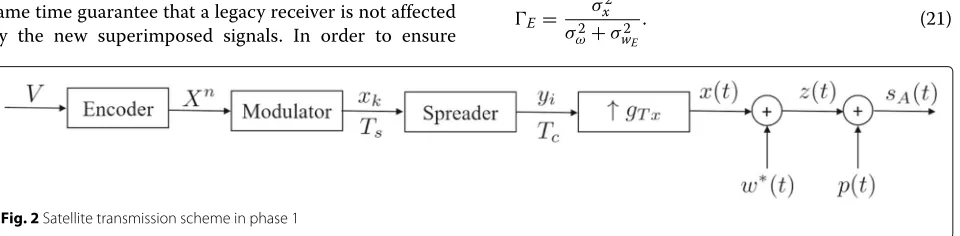
In the first phase, the satellite transmits the authentica-tion signal generated as described in Fig.2. In particular, the satellite encodes the authentication messageV in the codewordXn. The codeword enters the modulator, which outputs real symbolsxkwith powerσx2at symbol timeTs.
Finally, the chip pulseu(t)is used to obtain the contin-uous time real signal
x(t)= i
yiu(t−iTc). (14)
The authentication messageVmust be undecodable to the AT in the first phase, in order to prevent prediction attacks, as detailed in Section 5. Therefore, the satellite also transmits an AN signal ω(t) superimposed tox(t). The resulting signal
z(t)=x(t)+ω(t) (15)
is superimposed to the ranging signal p(t), and the baseband-equivalent signal transmitted by the satellite becomes
sA(t)=z(t)+p(t), (16)
which replaces (3).
We design the superimposed signal (including AN)z(t) to beorthogonalto the pilot spreading pulsesp(t)in each pilot symbol, in order to avoid interference with the syn-chronization process (operating with p(t)), and at the same time guarantee that a legacy receiver is not affected by the new superimposed signals. In order to ensure
orthogonality, the spreading codecA,iis orthogonal toci, the spreading code of the pilot signal. About the AN, for each symbol of durationTs, we first generate a stationary Gaussian processw(t), 0≤t≤Ts, and then project it on
Note that the Gaussian AN generation may be performed by a physical device providing electrical noise which may be further elaborated numerically. Although generating truly random variables is a challenging task [21–23], we observe that the satellite has typically enough process-ing power and cannot be physically tampered; therefore, it is reasonable to assume that it can generate random variables with fairly good randomness.
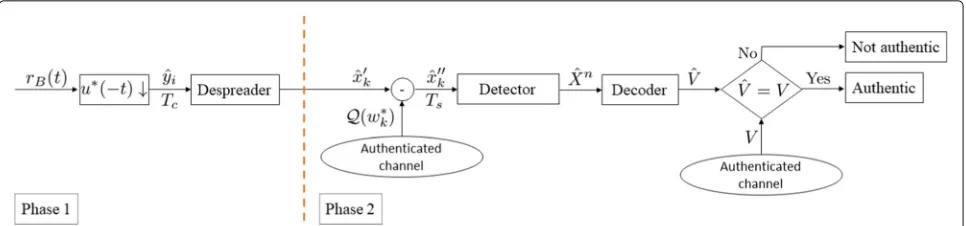
The signals received by both VR and AT on the AWGN channels are still given by (10) and (12), with the new transmitted signalsA(t)given by (16). The operations at the VR in the first phase are shown in Fig.3 on the left of the dashed line separating the two phases. In particular, the VR acquires the synchronization on signalp(t), filters the received signalrB(t)byu(−t), and samples the output before despreading with sequencecA,i. In the absence of attack, the resulting discrete-time despread signal can be written as
ˆ
xk=zk+wB,k, (19)
where zk = xk +ωk andωk is the AN term. The noise sampleswB,k andωkare still independent and identically distributed (iid) with zero mean and powers σw2B andσω2 respectively.
Note that we have omitted the pilot signal in (19) as its symbols are orthogonal to zn andωk. Similarly, the AT receives in phase 1 the signal
ˆ
xE,k=zk+wE,k. (20)
Since in the first phase AT does not know the AN, the resulting signal to noise ratio (SNR) at the AT is
E = σ
Fig. 3VR signal processing. Dashed line separates operations occurring in the first phase by those occurring in the second phase
Therefore, we already observe that even with a noiseless receiver, by properly choosingσω2we can severely degrade the SNR at the AT, thus preventing meaconing attacks. Further details will be provided in Section4.2.
3.2 Second phase
In the second phase, the ground segment broadcasts both V and a quantized version Q(ωk) of the AN samples
ωk on the ground channel using bbits per sample1. In the absence of attack and perfect synchronization, the quantization error is
wq,kωk−Q(ωk), (22)
with zero mean and powerσ2
wq. Note that bis a design parameter which trades off the quantization noise power with the transmission bandwidth of the ground channel.
On its side, the VR receives the signals over the ground channel and elaborates the signal received from the satel-lite in the first phase according to the scheme of Fig.3
(at the right of the dashed line). In particular, the VR subtracts fromxkthe quantized AN obtaining
ˆ
xk =xk−Q(ωk)=xk+wB,k+wq,k. (23) Detection and decoding follow to obtain the decoded messageVˆ. IfVˆ = V, the VR declares that the authen-tication signal comes from the satellite and the pilot signal is also authentic. Otherwise the VR declares both the authentication message and the pilot as not authen-tic. Since the synchronization is obtained fromp(t), we design the authentication signal such that misalignments betweenp(t) andx(t) result in an error of the decoded messageV, thus revealing the attack. Note also that the AT has no advantage in partially modifying the authentica-tion message, since, once decoded at the VR, it would not match with the messageV provided by the ground seg-ment, thus again revealing the attack. In Section5, we will consider an intermediate situation in which the AT par-tially observes the signal and attempts to predict the rest ofV in the prediction attack.
4 Correctness and security analysis
We now examine thecorrectnessandsecurityof the pro-posed PLA solution. Thecorrectnessof the protocol is its ability to accept as authentic a signal coming from the satellite that corresponds to the conditionVˆ = V. The security of the protocol is its ability to detect the refer-ence attackdescribed in Section4.2. We will obtain rules for the design of PLA parameters (such as the rate of the authentication messageRx and the power of the AN) in order to guarantee correctness and security. Since we are dealing with authentication, which is basically a testing problem between the hypotheses of receiving correct or fake messages, its performance is assessed by the proba-bilities of attack success and authentic message rejection. Therefore, in our framework, the error probability
PBe P[Vˆ =V|no attack]≈0, (24)
where P[·] denotes the probability operator, is used as correctness metric, while the success probability of the reference attack is used as security metric, see Section4.2. In the next section, we will also analyze the security of PLA with respect to prediction (meaconing) attacks on the authentication message.
We consider four communication scenarios, combining finite/infinite codeword lengths with Gaussian/binary sig-naling. In the following, we will introduce a more efficient feedback where instead ofVa smaller-size message can be fed back.
4.1 Correctness analysis
Infinite-length codewords and Gaussian signaling: In this case, it is well known that we can ensure a vanishing decoding error probability as long as the message rate is below the channel capacity, i.e.,
Rx ≤CB, (25)
and CB is the satellite-VR channel capacity after AN removal. Note that with perfect AN cancelation the result-ing SNR of the signal at the input of the VR detector in the absence of attack is
In case of attenuation introduced by the LMS, the VR SNR becomes
and it may occur that the channel is not good enough for the decoding of the authentication message at the VR, generating an outage event with outage probability
Pout=P[CB<Rx]=
where in the second equation, we conditioned on the LMS stateS. For a given state, we also have from (28)
Infinite-length codewords and binary signaling: In this case, we can still provide a vanishing error probability, given that the rate is below the constellation-constrained capacity. In particular, the constrained capacity of a binary AWGN channel with SNRis
C=H(y)−1
is the entropy of the received signal with probability den-sity function (PDF)
In order to compute the capacity, we must resort to the numerical integration of (32).
Finite-length codewords and Gaussian signaling: For
codewords of lengthn¯and Gaussian signaling, we cannot anymore ensure vanishing error probability. In order to compute the (non-zero) probability that the VR does not decode V, denotedPe(B,Rx,n¯), we resort to literature results on finite-length codewords regime [24,25]. In par-ticular, we lower-bound the codeword error probability Pe(,R,n¯)on AWGN channel with SNR, transmission
and Q(·) is the complementary cumulative distribution function (CDF) of a continuous normal variable.
Finite-length codewords and binary signaling: For this case, (34) and (35) still hold with [24,25]
The probability of rejecting an authentic message is still lower-bounded by (34), with the new H and G in the definition of the functionq(·)given still by (35).
4.2 Security analysis against the reference attack
Considering now the reference attack, assuming that the VR acquires the synchronization on the spoofed signal, i.e., the attack on the pilot signal is successful, we aim at assessing the probability that the VR also demodulatesV from the asynchronous authentication signal, thus failing to reveal the attack.
First note that ifEis larger thanTc, the despreading of the authentication message with an asynchronous spread-ing signal yields a very low output, thus we can assume that the attack is always detected. Therefore, we focus on the case wherein 0 ≤ E < Tc. After despreading and AN removal,xˆk in (23) is affected by the previously transmitted symbolxk−1, i.e.,
ˆ
whereα andβare non-negative interference coefficients andw(q)k,
E is the residual quantization error with power
σ2
E, decreases the VR’s SNR and mines his capabil-ity to decodeVˆ, resulting in the attack being uncovered. Closed-form expressions forα,β, andσw2q,are derived in AppendixA.
Now, we examine PLA security, i.e., its ability to detect the attack in various transmission configurations. We indicate withPsucc(E)the probability of an attack pass-ing undetected (thus full success of the AT), as a function of the induced positioning signal delay.
Infinite-length codewords and Gaussian signaling:Let
CB(E)= 1 2log2
1+B(E) (44)
be the channel capacity induced to the VR by the reference attack. Given a chosen working point of the authentication message rateRx, the probability of successful attack, con-sidering infinite codeword length and Gaussian signaling, is
since, from the converse theorem on capacity, the word error probability of the VR tends to 1 as the code-word length tends to infinity. We observe that we can reduce the feedback and provide only the secret bits. As soon as these coincide with the one decoded at the receiver, we can ensure authenticity.
Infinite-length codewords and binary signaling: For
binary signaling, (45) still holds, but the capacity is com-puted through (31) by replacingwithB(E).
Finite-length codewords and Gaussian signaling:Given the codeword length n¯ and the authentication message rateRx in this case the reference attack is successful with probability
Finite-length codewords and binary signaling:The anal-ysis is the same as for the previous paragraph, but using (38)–(41) instead of (36)–(37).
Remark on the replay attack.In the replay attack, the AT retransmits the received signal to the VR right after recep-tion, with arbitrary power. Therefore, the replayed signal contains also the non-predictable component z(t) and differs from the legitimate signal only by the additional noise introduced by the AT front-end. Clearly, in absence of AT noise, no defense is possible against this attack, whereas the AT operates simply as an ideal amplifier, and the malicious received signal is indistinguishable from the legitimate one. We then do not consider it specifically in this paper, while it has been considered for example in [17]. In [17], we addressed the case wherein the AT intro-duces noise by assessing the authentication performance under various SNR regimes.
5 Security against prediction attacks
As we have just seen, the proposed protocol is secure against the reference attack; however, we can consider a more general attack wherein AT partially observes the sig-nal transmitted by the satellite in phase 1, predicts the whole signal and transmits it to the VR. This attack is simi-lar to FEA considered in the literature, where however our authentication protocol was not present.
This attack is based on the possibility of predictingsA(t) (including the authentication part), which is now investi-gated. While the authentication message is encoded with FEC and therefore the codeword has a specific structure that actually eases prediction, the AN samples are inde-pendent and unpredictable. Therefore, the AT will only predict and transmit the authentication message without AN. Under this attack, the VR will then suffer from the cancelation of an AN that is not present, thus actually introducing noise on the signal at the input of the detector. The best thing the AT can do is to align his prediction ofx(t), that we denotexˆ(t), with the forged positioning signal. Following (11), the attack signal becomes
sE(t)= −[xˆ(t)+p(t)]+ˆx(t−E)+p(t−E), (48) such that, if xˆ(t) = x(t) and following (10), the signal received in phase one by the VR is
rB(t)= ˆx(t−E)+p(t−E)+ω(t)+wB(t). (49) In phase two, we have
ˆ
xk =xk+wB,k+w(q)k,
E, (50)
which is similar to (42) except that now there is no symbol interference in the authentication message. The VR’s SNR becomes
condition to the event of correct prediction, which hap-pens with probability
PpredP[xˆ(t)=x(t)] , (52)
then the success probability of the prediction attacks becomesPsucc(E)of Section4.2withB(E)in place of
B(E).
In the following, we will consider two specific prediction attacks, namely, the blind prediction and the codeword prediction attack. For each attack, we evaluatePpred, as a metric of success of the attack in our authentication context.
Blind prediction attack:In this case, the AT does not use the signal received from the satellite but directly attempts to guess the authentication message. For a finite number of possible codewords, there is a non-zero probability that the guess is correct. The AT generates and transmitssA(t) according to the guessed authentication codeword, with the desired delayE.
Codeword prediction attack: In this case, the AT
receives a fraction of the signal transmitted by the satellite (corrupted by AN) and attempts to decode the authentica-tion message. Then, it transmits the decoded codeword as its own authentication message with the desired delayE. This attack exploits the structure of the codeword intro-duced by FEC and is equivalent to the FEA attack present in the literature (not with our authentication scheme).
We now analyze each of these attacks against PLA.
5.1 Blind prediction attack
With ideal transmission, i.e., when codewords with infi-nite lengths are used forxk, the probability that the VR guesses the correct messageV is vanishing. For a finite lengthn¯, the prediction probability is instead associated with the probability of correctly guessing the codeword into a codebook ofRxn¯entries; therefore,
Ppred=2−Rxn¯. (53)
5.2 Codeword prediction attack
In order to avoid the codeword prediction attack, we must reduce the probability of correct decoding of the code-word by the AT for a partial observation of the received signal in the first phase. This feature is provided by the AN that affects the decoding capabilities of the AT.
Infinite-length codewords and Gaussian signaling: For perfect coding and Gaussian signaling, we can avoid the codeword prediction attack by ensuring that no informa-tion is obtained on the secret message by the observainforma-tion ofrE(t)in the first phase, i.e.,
I(V;rE(t))=0, (54)
where I(·;·) denotes the mutual information function. This condition will also ensure that no information is obtained on V by a partial observation of rE(t). From
results on wiretap-coding, the secrecy condition (54) is satisfied as long as ([26], Chaper 5)
Rx ≥CE= 1
2log2(1+E), (55)
whereCEis the capacity of the satellite-AT channel. Note that in our authentication framework, mutual informa-tion matters only for predicinforma-tion attacks, because in the reference attack the AT does not attempt to constructV by eavesdroppingz(t). Therefore, assuming as worst case that the AT has a noiseless receiver (σw2E = 0), from (21)
Still by the wiretap coding theory, there exist suitable wiretap codes for the satellite such that the part of the authentication message that remains secret to the AT has a secrecy rate
RA=Rx−CE, (57)
and the probability of guessing the correct codeword is vanishing with the codeword length as
Ppred=2−RAn¯. (58)
Note that with respect to the blind prediction attack,Rxis now replaced byRA<Rx. In turns,RAis maximized when Rx=CB, and we obtain the secrecy capacity [26]
CACB−CE, (59)
while the design constraint (56), assuming negligible quantization noise, becomes
σ2
ω > σw2B. (60) Note that in our context, the secrecy of messageV is only instrumental to the authentication of the navigation message. Therefore, with a small abuse of notation, we will denote asauthentication capacitythe secrecy capac-ity CA, as the secret bits are those that prevent the AT from guessing the authentication message. For a prac-tical implementation of this approach, existing wiretap codes can be used (see for example the survey papers [27] and [28]), with a variety of trade-offs between wiretap performance, code length, and decoding complexity. Fur-ther investigation is also needed, though outside of the scope of this paper, on specific requirements of the wire-tap codes for our scheme. Here, indeed, confidentiality is only instrumental to preventing prediction attack and the security metric is the success probability of the spoofing attack.
Infinite-length codewords and binary signaling: The
Finite-length codewords and Gaussian signaling: We still first assume Gaussian signaling. Due to the finite-length regime, (54) does not hold anymore. Considering a codeword prediction attack performed by the AT at symbol n < n¯, the probability of successful attack is upper-bounded as
where the second inequality comes from two facts:
a) q(,Rx,n)is a lower bound on the codeword error probability and
b) the bound (34) is based on the fact that the code is optimized for lengthn¯, while the AT attempts decoding after receivingn symbols, thus we have a further source of error by this mismatch.
The maximum comes from the fact that the success prob-ability cannot be lower than 2−Rxn, which corresponds to the complete random choice of the attack codeword.
Finite-length codewords and binary signaling: In this case, (61) still holds using (38)–(41).
6 Power optimization
We now aim at optimizingσx2, given a fixed power budget, i.e.,
A=σx2+σω2. (62)
This corresponds to choosing the trade-off between the power assigned to the authentication message and the AN, for a total additional power (with respect to the non-authenticated system)A. We consider two design criteria which lead to different optimization problems, aiming at increasing security against reference and prediction attacks, respectively.
6.1 Optimization against the reference attack
In this case, we want to maximize the protection against the reference attack, while also achieving a desired value forRx, under power constraint (62). To this end, we choose an operating pointE = , corresponding to the maxi-mum tolerable synchronization error in standard operat-ing conditions. Performance is then dictated by how fast
B(E)decreases, whenE≥, due to an ongoing attack that introduces an asynchronism larger than the expected maximum.
First, observe that when u(t) has a rectangular shape
B(E) is a monotonically decreasing function for 0 ≤
E ≤ Tc, as shown in the Appendix A. Then, we aim at minimizing the derivative ofB around, so that the system is as sensitive as possible to unexpected synchro-nization errors. With a slight abuse of notation, we define
the derivative ofB(E)computed atas f(σx2) ∂B(E)
∂E
E= , (63)
where we highlight the derivative dependency onσx2that we want to optimize. The problem then can be written as
min
where the second constraint ensures correctness atE =
(still tolerable delay) for the case with infinite codeword length and Gaussian signaling.
We now solve the optimization problem. For ease of notation, let us rename the optimization variable aso
σ2
x. With algebraic computations, we have
f(o)= N2o didate solutions of the optimization problem. We have
f(o)= (2N2D0−N1D1)o+N1D0
(D1o+D0)3 =
0 (66)
and the only candidate point is
o∗= N1D0
N1D1−2N2D0
. (67)
We now consider the constraints in (64). The power constraint has been eliminated by substitutingσω2= A−
σ2
6.2 Authentication capacity maximization
In this case, we want to maximize the protection against prediction attacks, that as we have seen, can be achieved by maximizing the secrecy rate given the power budget (62), i.e.,
where again with a slight abuse of notation, we have high-lightedCAdependency onσx2. Note thatCA wherein VR and AT SNRs are
B= σ
Exploiting the concavity of the logarithm, (69) is equiva-lent to
The objective function is now a down-facing parable; hence, the solution of (71) is
We consider the transmission scenario of Fig.1with a sin-gle satellite. The ground channel is assumed error-free and with a large band. As for the Galileo signal, we assume Nc = 4, 092 and Tc = 10−6/1.023 s [29]. The VR’s noise power is σw2B = 0,−5, or−10 dB, that are typi-cal values for GNSS receivers [30]. For the AT, we assume
σ2
wE = 0, i.e., a noiseless receiver, as a worst case for the authentication problem.
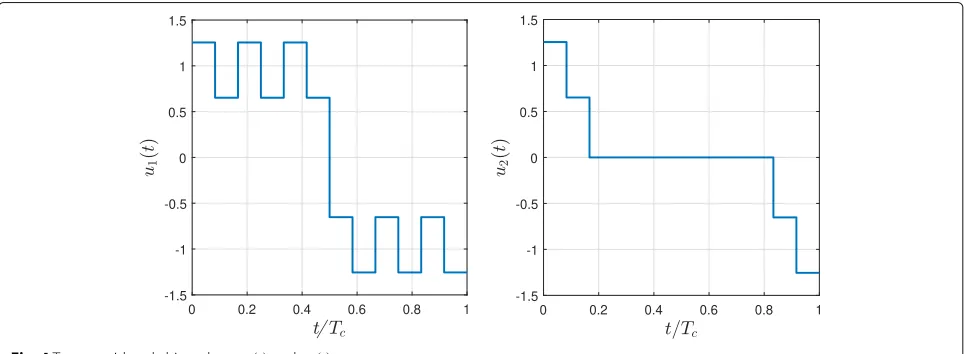
About the transmission chip u(t), we consider two options, shown in Fig. 4. In particular, u1(t) is the chip pulse used in the Galileo E1b system [29], while u2(t) is a chip pulse characterized by a smaller sup-port designed in order to make the authentication sig-nal more fragile to synchronization errors, as discussed in Section 4.2. The design of u(t) can be further improved for a practical implementation, but this is left for future works.
As an example of various issues that must be addressed in the design of the chip pulse beyond its sensitivity to syn-chronization errors, we consider here its occupied band, by showing in Fig.5the power spectral density (PSD) of x(t)modulated by the two chip pulses. We note that the new pulse has a similar PSD to the standard one, thus makingu2(t)a good candidate (at least about band occu-pation) for future GNSS systems. In the following, we will show the merits ofu2(t)for authentication purposes.
With reference to Sections4,5, and6, we now provide various performance results.
7.1 Correctness analysis
About correctness, we have shown that it is related to the capability of the VR to correctly decode the authentication message sent by the satellite.
Infinite-length codewords: In this case, correctness is ensured as long as the rate of the authentication mes-sage Rx is below the capacity of the satellite-VR chan-nel. Thus, we show the outage probability (29) for three propagation scenarios [19], namely, (1) urban area, vehi-cle mounted antenna, elevation 30circ; (2) suburban area, vehicle mounted antenna, elevation 60circ; and (3) inter-mediate tree shadowed area, elevation 80circ.
Figure6showsPoutfor the three scenarios in the case of Gaussian signaling, as a function ofRx. Note that a lower elevation (scenario 1) has more impact on the outage
Fig. 5PSD ofx(t)modulated by the chip pulses of Fig.4
probability rather than differences in user motion settings as the curves of scenarios 2 and 3 are closer to each other. Similar results (omitted here for the sake of conciseness) are obtained for the case of binary signaling.
Finite-length codewords: For finite-length codewords, we have seen that there is a non-zero probability that the VR does not recognize as authentic the signal coming from the satellite, due to decoding errors in the authenti-cation message.
Figure7shows the lower bound to the codeword error probability,q(B,Rx,n¯), as a function ofn¯for both Gaus-sian and binary signaling andB=1 dB. We observe that for a higher rate, the error probability increases, e.g., for ¯
n = 300 (for Gaussian signaling) the probability of error goes from 2·10−3to 2·10−2by increasing the rate of 0.05 b/s/Hz.
Moreover, we observe that for Gaussian signaling, the codeword error rate decreases faster with n¯ rather than with binary signaling. Note however that the func-tions q(·) are approximations of bounds for codeword error probability [25]; therefore, the distance between the binary and the Gaussian case we read in the plots might not be exact.
7.2 Reference attack
As discussed Section 4.2, the success of the reference attack depends on the delay between the authentication
and the navigation message, as well as the operating con-ditions of the VR. We now consider the various signaling and coding configurations with AN powerσω2 = 0 dB and VR’s noise powerσw2B = − 5 dB.
Infinite-length codewords:Figures8 and9 showCB vs the attack delayEfor both Gaussian and binary signal-ing, and for chip pulseu1(t)andu2(t). We observe that withu1(t)(Galileo system), the capacity drops to zero for
E > 0.2Tc, while withu2(t)(proposed pulse) having a more compact support, the capacity drops to zero already forE = 0.15 Tc. Therefore, with the proposed chip, we can detect a reference attack inducing even smaller delays. Moreover, as observed earlier, binary and Gaussian signaling provides similar performance.
Note that by setting the coding rate Rx below CA(∗E) = 0, we have that an attack with delayE> ∗E is detected as, from the converse theorem on capacity, the codeword error probability of the VR tends to 1 asn¯tends to infinity. Note however, that the choice ofRx must also take into account the sensitivity of VR to synchronization errors in normal operation (i.e., when the received signal is coming from the satellite), in order to avoid false alarms. Finite-length codewords: For finite-length codewords, Gaussian signaling, and σ2
wB = − 5 dB, the reference attack is successful with non-zero probability. Figures10
Fig. 6Poutfor three different propagation scenarios as a function ofRx
Fig. 8Degradation of VR’s capacity versus the delayE, using the
transmission chip pulseu1(t), withσ2
wB = −5 dB andσ
2 ω=0 dB
of the attack delay E on the error probability Pe. The two symmetric lobes are due to the particular structure of pulsesu1(t) andu2(t)that exhibit positive values in the first half chip and negative values in the second half. Also in this case ,u2(t)is more robust thanu1(t)against the ref-erence attack, yielding an attack success probability lower than 10−10for 0.3< E/Tc<0.8. Similar considerations
Fig. 9Degradation of VR’s capacity versus the delayE, using the
transmission chip pulseu2(t), withσ2
wB = −5 dB andσ
2 ω=0 dB
Fig. 101−q(B(E),Rx,n¯)(Gaussian case) as a function of the
attack delayEfor three values ofRxand using pulseu1(t)of Fig.4, σ2
wB= −5 dB
hold for the binary signaling case, omitted here for sake of conciseness.
7.3 Prediction attacks
We have seen that the prediction attacks are more pow-erful than the reference attack, given a successful x(t) prediction. In this section , we evaluatePpred, as defined
Fig. 111−q(B(E),Rx,n¯)(Gaussian case) as a function of the
attack delayEfor three values ofRxand using pulseu2(t)of Fig.4, σ2
in (52), for various system configurations. In particular, for the blind prediction attack,Ppredis a simple exponen-tial function ofn¯andRx, thus we omit showing it, and we focus on the codeword prediction attack that also depends on the device operating conditions.
Figure12showsPpredas function ofσω2andn¯ = 250 for the codeword prediction attack. We considerRA= CB− CE with capacities given by Gaussian (marked lines) and binary (without markers) signaling, for three values ofσw2B. In general, we observe that the Gaussian signaling offers more protection against the codeword prediction attack than binary signaling. However, the difference with the binary signaling becomes less relevant asσw2Bincreases.
We now asses the impact of the number of quantization bitsbonPpred, see (58), for the PLA scheme withRA=CA andCBgiven by (27). Figure13showsPpredas a function ofσω2for different values ofb, withb= ∞corresponding to no quantization of the AN. We can see that a lowerb
requires the system to work with a higherσω2in order to keep a desired level ofPpred. However, note how perfor-mance rapidly approachesb = ∞, as soon asbincreases, suggesting that implementations with a reasonably lowb
are close to optimal.
7.4 Power optimization
In this section, we consider the power optimizations of Section6.
Reference attack: For the optimization against the refer-ence attack, Fig.14showsfσopt2 , (see (63)) as a function ofAfor three values ofσw2B. We note that for an increasing
Fig. 12Ppredfor the codeword prediction attack as a function ofσω2. Binary (no markers) and Gaussian (markers) signaling, withB=5 dB
and three different values ofσ2
wB
Fig. 13Ppredfor the codeword prediction attack as a function ofσω2 for different values ofb. Gaussian signaling, withσ2
wB = −5
power budgetA, we can make the system more sensitive to synchronization errors, which corresponds to having a smallerfσopt2 .
Figure15showsσopt2 as a function ofAand three values ofσ2
wB. In general, we need to spend more power on the authentication message rather than on AN. For a smallA,
Fig. 14f(σopt)2 as a function ofAfor three values ofσ2
Fig. 15σ2
optas function ofAfor three values ofσw2B
we actually do not need AN (thusσopt2 = A). This corre-sponds to the candidate pointo∗in (67) being outside the feasible setE.
Prediction attacks: Figure16shows the authentication capacity (59) as a function of the power constraintAfor different values ofσw2B. The power of the AN is chosen according to (72) and Gaussian signaling is assumed (see Section6.2). We recall that in our model, the navigation signal has unitary power, i.e.,A = 0 dB implies that we
Fig. 16Authentication capacity under power constraintAfor three values ofσ2
wB
are using the same amount of power for both the navi-gation and authentication components. Note that a 0 dB thermal noise power yields zero authentication capacity forA = 0 dB, and we thus needA > 2.2 dB to obtain a positiveCA.
8 Conclusions
In this work, we proposed a novel authentication pro-tocol, and we showed that the proposed solution effec-tively authenticates a navigation message. We analyzed the protocol performance under various transmission constraints, such as finite-length codewords, binary sig-naling and power constraints. We conclude that the proposed strategy is effective in providing authentication of the Galileo signal, preventing the reference attack for Gaussian signaling and significantly lowering the success of attacks for finite-length codeword and finite signaling. We also considered prediction attacks specifically target-ing the PLA, showtarget-ing how the unpredictability of the AN further increases its security.
Appendix A: Derivation of interference coefficients for the reference attack
The interference coefficients in (43) are given by
α= Ts
sT(τ−)sR(τ)dτ, (73)
β =
0
sT(τ+Ts−)sR(τ)dτ, (74)
sT(t)= Nc−1
i=0
cA,igTx(t−iTc). (75)
For the residual quantization errorw(q)k,, we have
ωk, =
(k+1)Ts
kTs
ω(τ−)sR(τ−kTs)dτ, (76)
and thus
w(q)k,=ωk,−Q(ωk). (77)
The power ofw(q)k,is
σ2
wq,()=E
|w(q)k,|2
, (78)
whereE[·] is the expectation operator. Considering per-fect quantization, i.e.,ωk = Q(ωk),ωk, andωk are two correlated Gaussian random variables. Note that
σ2 wq, =E
w(q)k,
2
+E(ωk)2
−2E
w(q)k,ωk
Now we have
where the second line comes from (77), the third line comes from the linearity of the expectation, and we con-sidered k = 0 in the integral limits for the noise stationarity. Since ω(t) is a white Gaussian process, by definition the inner expected value becomes
Eω(τ)ω(τ−)=δ(τ−τ+)σ2
ω, (81)
whereδ(·)is the continuous time impulsive function. Due to the integral properties ofδ(·), (80) becomes where the result of the integralνonly depends onand the transmitter and receiver pulses. Note that if = 0, thenωk = ωk,andwqk, = 0. Moreover, for a high, the correlation betweenωkandωk,decreases; ifexceeds Ts, the two variables become uncorrelated (ν = 0), since they insist on disjoint intervals ofω(t). Under these conditions,σw2q,=2σω2(1−ν).
We now show that B is a monotonically decreasing function for 0 ≤ E ≤ Tc, whenu(t)has a rectangular metry of the rectangular shape we are considering yields the same expression for the correlation integral. Similarly, from (74) we get
β=c1cNcE=BE, (85) whereβis an increasing function ofE. By definition of
B, we have
where the numerator is a decreasing function ofEand the denominator is an increasing function ofE. It follows thatB(E)is a monotonically decreasing function ofE.
Endnote
1Note that indeed the AN signal ω(t) can be directly generated at the satellite. Note also that the satellite must transmit the quantized AN samples to the ground seg-ment.
Abbreviations
AN: Artificial noise; AT: Attacker; AWGN: Additive white Gaussian noise; BPSK: Binary phase shift keying; CDF: Cumulative distribution function; FEA: Forward estimation attack; FEC: Forward error correction; iid: Independent and identically distributed; IT: Information theory; LMS: Land mobile satellite link; LOS: Line of sight; NMA: Navigation message authentication; MC: Markov chain; PDF: Probability density function; PLA: Physical layer authentication; PSD: Power spectral density; PSK: Phase shift keying; SCER: Security code estimation and replay; SNR: Signal to noise ratio; VR: Victim receiver
Acknowledgements No acknowledgements.
Funding No Specific funding.
Availability of data and materials No data is available.
Authors’ contributions
The contribution of this paper consists in the proposal and analysis of a novel authentication scheme for the authentication of GNSS signals. Both authors contributed significantly in writing the manuscript and they read and approved the final version.
Competing interests
The authors declare that they have no competing interests.
Publisher’s Note
Springer Nature remains neutral with regard to jurisdictional claims in published maps and institutional affiliations.
Received: 21 September 2018 Accepted: 21 March 2019
References
1. D. P. Shepard, T. E. Humphreys, A. A. Fansler, Evaluation of the vulnerability of phasor measurement units to GPS spoofing attacks. Int. J. Crit. Infrastruct. Prot.5(3-4), 146–153 (2012)
2. K. D. Wesson, D. P. Shepard, J. A. Bhatti, Humphreys T.E., inRadionavigation Laboratory Conference Proceedings. An evaluation of the vestigial signal defense for civil GPS anti-spoofing (University of Texas, Austin, 2011) 3. D. M. Akos, Who’s afraid of the spoofer? GPS/GNSS spoofing detection via
automatic gain control (agc). Navig. J. Inst. Navig.59(4), 281–290 (2012) 4. A. Cavaleri, B. Motella, M. Pini, Fantino M., inSatellite Navigation
Technologies and European Workshop on GNSS Signals and Signal Processing (NAVITEC) 2010 5th ESA Workshop on. Detection of spoofed GPS signals at code and carrier tracking level (IEEE, Noordwijk, 2010), pp. 1–6 5. M. Cuntz, A. Konovaltsev, M. Heckler, A. Hornbostel, L. Kurz, G. Kappen,
Noll T., inProc. ION GNSS, vol 2010. Lessons learnt: The development of a robust multi-antenna GNSS receiver (Oregon Convention Center, Portland, 2010), pp. 21–24
6. E. Axell, M. Alexandersson, Lindgren T., inLocalization and GNSS (ICL-GNSS), 2015 International Conference on. Results on GNSS meaconing detection with multiple cots receivers (IEEE, Gothenburg, 2015), pp. 1–6 7. E. Axell, E. G. Larsson, Persson D., inAcoustics, Speech and Signal Processing
(ICASSP), 2015 IEEE International Conference on. GNSS spoofing detection using multiple mobile cots receivers (IEEE, Brisbane, 2015), pp. 3192–3196 8. P. Levin, D. S. De Lorenzo, P. K. Enge, S. C. Lo, Authenticating a signal based on an unknown component thereof, June 28 2011. US Patent 7,969,354 9. B. W. O’Hanlon, M. L. Psiaki, J. A. Bhatti, D. P. Shepard, T. E. Humphreys,
10. A. J. Kerns, K. D. Wesson, Humphreys T.E., inPosition, Location and Navigation Symposium-PLANS 2014, 2014 IEEE/ION. A blueprint for civil GPS navigation message authentication (IEEE, Monterey, 2014), pp. 262–269 11. L. Scott, inProceedings of the 16th International Technical Meeting of the
Satellite Division of The Institute of Navigation (ION GPS/GNSS 2003). Anti-spoofing & authenticated signal architectures for civil navigation systems (Oregon Convention Center, Portland, 2001), pp. 1543–1552 12. J. T. Curran, C. O’Driscoll, Message authentication as an anti-spoofing mechanism (2017). Technical report, Working Paper.researchgate.net
13. G. Caparra, S. Ceccato, N. Laurenti, J. Cramer, inProc. of the 30th International Technical Meeting of The Satellite Division of the Institute of Navigation (ION GNSS+ 2017), Portland, OR. Feasibility and limitations of self-spoofing attacks on GNSS signals with message authentication, (2017), pp. 3968–3984
14. T. E. Humphreys, Detection strategy for cryptographic GNSS
anti-spoofing. IEEE Trans. Aerosp. Electron. Syst.49(2), 1073–1090 (2013) 15. E. Jorswieck, S. Tomasin, A. Sezgin, Broadcasting into the uncertainty:
Authentication and confidentiality by physical-layer processing. Proc. IEEE.103(10), 1702–1724 (2015)
16. X. Wu, Z. Yang, C. Ling, X. G. Xia, Artificial-noise-aided message authentication codes with information-theoretic security. IEEE Trans. Inf. Forensics Secur.11(6), 1278–1290 (2016)
17. F. Formaggio, S. Tomasin, G. Caparra, S. Ceccato, N. Laurenti, inProc. IEEE 2018 26th European Signal Processing Conference (EUSIPCO). Authentication of Galileo GNSS signal by superimposed signature with artificial noise, (Rome, 2018), pp. 2573–2577
18. W. Stallings,Cryptography and network security: Principles and practice. (Pearson, Upper Saddle River, 2017)
19. F. P. Fontan, M. Vázquez-Castro, C. E. Cabado, J. P. Garcia, E. Kubista, Statistical modeling of the LMS channel. IEEE Trans. Veh. Technol.50(6), 1549–1567 (2001)
20. C. Loo, A statistical model for a land mobile satellite link. IEEE Trans. Veh. Technol.34(3), 122–127 (1985)
21. J. E. Gentle,Random number generation and Monte Carlo methods. (Springer Science & Business Media, New York, 2006)
22. H. Niederreiter,Random number generation and quasi-Monte Carlo methods, vol. 63. (Society for Industrial & Applied Mathematics, US, 1992) 23. P. L’Ecuyer,Handbook of Computational Statistics. (Springer, Berlin, 2012) 24. T. Erseghe, On the evaluation of the Polyanskiy-Poor–Verdú converse
bound for finite block-length coding in AWGN. IEEE Trans. Inf. Theory. 61(12), 6578–6590 (2015)
25. T. Erseghe, Coding in the finite-blocklength regime: Bounds based on Laplace integrals and their asymptotic approximations. IEEE Trans. Inf. Theory.62(12), 6854–6883 (2016)
26. M. Bloch, J. Barros,Physical-layer security: from information theory to security engineering. (Cambridge University Press, 2011)
27. M. Hayashi, R. Matsumoto, Construction of wiretap codes from ordinary channel codes (2010). arXiv preprint arXiv:1001.1197
28. W. K. Harrison, J. Almeida, M. R. Bloch, S. W. McLaughlin, J. Barros, Coding for secrecy: An overview of error-control coding techniques for physical-layer security. IEEE Signal Proc. Mag.30(5), 41–50 (2013) 29. I. Galileo, Galileo open service, signal in space interface control document
(OS SIS ICD) (2008). European space agency/European GNSS supervisory authority
30. A. Joseph, GNSS solutions: Measuring signal strength (2010). GNSS