A Complementary Code-CDMA-Based MAC
Protocol for UWB WPAN System
Jiang Zhu
Department of Electrical and Computer Engineering, University of Calgary, Calgary, AB, Canada T2N 1N4 Email:[email protected]
School of Electronic Science and Engineering, National University of Defense Technology, Changsha, Hunan 410073, China
Abraham O. Fapojuwo
Department of Electrical and Computer Engineering, University of Calgary, Calgary, AB, Canada T2N 1N4 Email:[email protected]
Received 26 October 2004; Revised 24 January 2005; Recommended for Publication by David I. Laurenson
We propose a new multiple access control (MAC) protocol based on complementary code-code division multiple access (CC-CDMA) technology to resolve collisions among access-request packets in an ultra-wideband wireless personal area network (UWB WPAN) system. We design a new access-request packet to gain higher bandwidth utilization and ease the requirement on system timing. The new MAC protocol is energy efficient and fully utilizes the specific features of a UWB WPAN system, thus the issue of complexity caused by the adoption of CDMA technology is resolved. The performance is analyzed with the consideration of signal detection error. Analytical and simulation results show that the proposed CC-CDMA-based MAC protocol exhibits higher throughput and lower average packet delay than those displayed by carrier sense multiple access with collision avoidance (CSMA/CA) protocol.
Keywords and phrases:UWB, MAC, CC-CDMA, WPAN.
1. INTRODUCTION
Ultra-wideband (UWB) is the radio technology that can use very narrow impulse-based waveforms to exchange data. The Federal Communications Commission (FCC) requires the impulse waveforms to occupy minimum of 500 MHz of spec-trum or a band of specspec-trum that is broader than 1/4 of the band’s center frequency [1]. UWB can provide much higher spatial capacity (bits/s/m2) than any other technology, and
the technology is typically used for transmitting high-speed, short-range (less than 10 meters) digital signals over a wide range of frequencies. This makes UWB attractive as a high data rate physical layer for wireless personal area network (WPAN) standards.
UWB-based physical (PHY) layer radio technology can be divided into two groups: single band and multiband [1]. Two commonly used single-band impulse radio sys-tems are time-hopping spread-spectrum impulse radio (TH-UWB) and direct-sequence spread-spectrum impulse radio
This is an open access article distributed under the Creative Commons Attribution License, which permits unrestricted use, distribution, and reproduction in any medium, provided the original work is properly cited.
(DS-UWB). Multiband UWB (MB-UWB) divides the whole spectrum into several bands that are at least 500 MHz, it gives low interpulse interference but high data rates by using or-thogonal frequency division multiplexing (OFDM) technol-ogy. MB-OFDM and DS-UWB were proposed for the physi-cal layer for IEEE 802.15.3 Task Group 3a [2,3].
The main objective of the medium access control (MAC) layer in UWB system is to perform the coordination function for the multiple-channel access. In recent years, more and more research in UWB has focused on MAC protocol design to fully exploit the flexibility offered by the UWB. Initially the IEEE 802.15.3 MAC protocol [4], which is designed to support additional physical layers such as UWB, is to be ap-plied. Several industries and companies have decided to map their UWB technology onto IEEE 802.15.3 MAC protocol. However, it is found that IEEE 802.15.3 MAC protocol is not ideal when applied to UWB WPAN, due to the use of carrier sense multiple access with collision avoidance (CSMA/CA) as the channel access mechanism. CSMA/CA is not efficient in UWB WPAN because of the following reasons [5,6,7,8]:
(i) the power consumed in idle listening is significant, (ii) voice and video cannot cope with too large
(iii) using ready-to-send/clear-to-send (RTS/CTS) hand-shakes and the possibility of collisions drastically affect the performance in ad hoc environments.
Aloha-based channel access protocol is proposed in [1], but the contention problem during the channel access period cannot be resolved. System performance is still degraded by packet collisions, and quality of service (QoS) support be-comes difficult.
In this paper, we propose a complementary code-code division multiple access (CC-CDMA)-based MAC protocol for UWB WPAN system. The protocol is similar to the IEEE 802.15.3 MAC protocol, but using CC-CDMA as the channel access protocol to completely avoid packet collisions. Conse-quently, traffic scheduling becomes an easy task and QoS can be conveniently managed.
Recently, Li [9] presented a method based on CC-CDMA to design access-request packets. Our channel access-request packet is similar to the work in [9], but differs by how users are identified and when they can begin transmission. In [9], users are identified by different delays, which demands that each user is assigned a special time to send authentication re-quest during the access period. In the protocol proposed in this paper, users are identified by different phase offsets of the complementary code (CC), and all users can send authenti-cation request at the beginning of the access period instead of assigning a special beginning time to each user. Thus, the timing control mechanism in our protocol is much simpler compared to that in [9]. Theoretical analysis and simulation results show that our protocol can gain higher bandwidth utilization and higher spreading gain than those of [9].
The paper is organized as follows. Section 2 gives an overview of IEEE 802.15.3, and presents the MAC basic prin-ciples for an UWB WPAN.Section 3introduces the proposed CC-CDMA-based MAC protocol, which is then analyzed in Section 4. Simulation results are shown inSection 5to vali-date the results of theoretical analysis. Finally,Section 6 con-cludes the paper.
2. BACKGROUND
2.1. IEEE 802.15.3 MAC protocol
The 802.15.3 MAC mainly works within a piconet. A piconet is defined as a small network, which allows a small number of independent data devices (DEV) to communicate with each other in short range. One DEV is required to be the piconet coordinator (PNC). The PNC provides the basic timing and information for a piconet. The 802.15.3 timing within a pi-conet is based on the superframe. The time-slotted super-frame includes three parts: a beacon, a contention access pe-riod (CAP) and a channel time allocation pepe-riod (CTAP), which are illustrated inFigure 1.
The beacon frame is sent by the PNC at the beginning of a superframe, and contains the system timing and other control information. During a CAP, the DEVs access the channel using CSMA/CA to send commands and nonstream asynchronous data. Channel access in the CTAP is based on TDMA. The CTAP is divided into channel time allocation
Superframem−1 Superframem Superframem+ 1
Beacon m from PNC
CAP
CTAP
MCTA1· · · GTS1 · · · GTSn−1 GTSn
Figure1: 802.15.3 superframe format.
(CTA) slots, and CTAs are allocated to DEVs by the PNC. CTAs used for asynchronous and isochronous data streams are called guaranteed time slots (GTSs). CTAs used for com-munication between DEVs and the PNC are called manage-ment channel time allocation (MCTAs). MCTAs can be di-vided into three types: association MCTAs, open MCTAs, and regular MCTAs. Open MCTAs and regular MCTAs are used by the DEVs associated to the piconet to exchange con-trol messages with the PNC. Open MCTAs enable the PNC to service a large number of DEVs by using a minimum number of MCTAs. When there are few DEVs in a piconet it might be more efficient to use MCTAs assigned to a DEV, called reg-ular MCTAs. Association MCTAs are used by unassociated DEVs to send the request to associate to the piconet. Slotted Aloha is used to access open and association MCTAs. The ac-cess mechanism for regular MCTAs is TDMA [1,4].
2.2. MAC principles for UWB WPAN
A WPAN is distinguished from other types of wireless data networks in that communications are normally confined to a person or object that typically covers about 10 meters. In this network, the role of the MAC protocol is to coordinate transmission access to the channel, which is shared among all nodes. General requirements that apply to the MAC protocol in WPAN are [10,11]:
(i) energy constrained operation is of the utmost impor-tance in WPAN,
(ii) simple control mechanism is needed to increase effi -ciency and save power,
(iii) flexibility, fast changing topologies, caused by new nodes arriving and others leaving the network, (iv) limiting the interference between links so that the
spectrum can be used efficiently.
Therefore, power conservation is one of the most impor-tant design considerations for MAC protocol in WPAN, and the major energy waste comes from idle listening, retrans-mission, overhearing, and protocol overhead. Thus, to make MAC protocol energy efficient, the following design guide-lines must be obeyed [12]:
(i) minimize random access collision and the consequent retransmission,
(ii) minimize idle listening (the energy spent by idle listen-ing is 50%–100% of that spent while receivlisten-ing), (iii) minimize overhearing,
(iv) minimize control overhead,
Superframem−1 Superframem Superframem+ 1
Beacon m from PNC
CDMA-based access period
CTAP
GTS1 GTS2 · · · GTSn−1 GTSn
Figure2: Proposed superframe format for CC-CDMA protocol.
The proposed CC-CDMA-based MAC protocol satisfies most of the above guidelines. Packet collision is completely avoided. Idle listening and overhearing are not needed. Us-ing CDMA technology can fully utilize the bandwidth of a UWB system to save energy. Finally, the control mechanism is simple compared to that in traditional CDMA cellular sys-tem.
3. THE NEW CC-CDMA MAC PROTOCOL
3.1. Protocol description
Similar to IEEE 802.15.3, our MAC protocol timing within a piconet is based on the superframe divided into three zones, which is illustrated inFigure 2:
(i) beacon frame, emitted by the PNC to synchronize DEVs and broadcast information about the piconet characteristics and the resource attribution,
(ii) unlike the 802.15.3, we change the CAP to a CC-CDMA-based contention free access period. Acknowl-edgement for this phase is done in the beacon of the next superframe,
(iii) a period during which DEVs are allocated CTAs by the PNC to transmit data frames.
Each associated DEV is assigned a spreading code by the PNC. In the access period, DEVs can send their chan-nel time requirements and other messages to the PNC based on CDMA technology. Another special spreading code is as-signed for unassociated DEVs to send to the PNC the request to associate to the piconet. Thus the MCTAs in 802.15.3 are not needed.
The use of a CC-CDMA contention free access period requires the design of access-request packets that are com-pletely orthogonal at the receiver, thus eliminating mutual interference. In our proposed protocol, all DEVs in a piconet are using a single spreading code. As such, DEVs are distin-guished only by the relative phase shift of the code. Thus, the receiver circuitry is relatively simple.
3.2. Access-request packet design
Complementary codes are characterized by the property that their periodic autocorrelative vector sum is zero everywhere except at the zero shift. We define N as the spreading fac-tor, which is equal to the length of the code. Given a pair of complementary sequences withA=[a0a1· · ·aN−1] and
User 1
User 2 · · ·
Useri · · ·
1 2 · · · G−1 G G+ 1 · · · N 1 · · · G
G+ 1G+ 2· · ·2G−1 2G 2G+ 1 · · · G G+ 1 · · · 2G · · ·
iG+ 1iG+ 2 · · · iG iG+ 1· · ·iG+G · · ·
Figure3: Code assignment.
B=[b0b1· · ·bN−1], the respective autocorrelative series are
given by [13]
cj= N−1
i=0
ai·ai+j,
dj= N−1
i=0
bi·bi+j.
(1)
Ideally, the two sequences are complementary if
cj+dj=
2N, j=0,
0, j=0. (2)
Consider a piconet, where the number of active users is
K. Assume that the transmission is asynchronous, near-far with frequency selective fading. Channels are assumed time invariant within each access-request slot. Assume that the maximum channel propagation delay of useriisLi, and user
ibegins transmission after a delayDi. We define an integerG satisfying
G·Tc>max
Li
+ maxDi
, (3)
whereTcis the chip period of the complementary code. We call Gthe guard length. Hence, the spreading code of each user is designed as inFigure 3.
The number in each box ofFigure 3denotes the corre-sponding chip of the CC, and the spreading factor in our system isN+G. Thus, ifGsatisfies (3), we can assure that the relative phase shift of the received CC of any two diff er-ent DEVs at the PNC is nonzero. By defining these code as-signments, each DEV can send authentication request at the beginning of the access period. In [9], DEVs are identified by different delays, which demands that each DEV must obtain the beginning of the access period and calculate the special time assigned to it to send authentication request. Thus, our timing mechanism is much simpler than that in [9].
User 1
User 2
Useri
A data symbol period Next symbol · · ·
Figure4: The correlative zone at the receiver. (To simplify the anal-ysis, we assume the total delay of user 1 is zero.)
one data symbol period is (N+G)Tc, and the propagation delay of each user is less thanGTc. Thus, the firstGTcperiod of each symbol may interfere with the previous symbols of other users, but the last NTc period of each symbol is free of intersymbol interference, and the relative chip shift of any two users’ complementary codes is nonzero. Since the correl-ative zone includes an entire CC period, all users’ signals in the correlative zone are orthogonal, and the processing gain in our system is stillN.
3.3. Length of the access-request packet
High spreading factor means high processing gain, but less efficiency and more complication. The main purpose of us-ing CDMA technology here is to provide many orthogo-nal channels. Also, reducing access-request packet length achieves energy savings, hence the shortest length of the access-request packet is desired.
Define LRP as the length of access-request packet. From Section 3.2, the LRP of our protocol is
LRP=N+G. (4)
In order to provideKorthogonal channels,Nmust satisfy
N≥K·G. (5)
Thus LRP≥K·G+G. From [9], the length of access packet is LRP=(K−1)·G+N, whereNis the length of the com-plementary code, which must satisfyN > G, otherwise the system becomes a TDMA system. AssumingG=2, the LRP of CC-CDMA protocol and the protocol in [9] are shown in Figure 5. It is seen fromFigure 5that the CC-CDMA proto-col is more efficient whenN>4.
As seen from (5), the length of access-request packet for the CC-CDMA protocol is directly related to the number of users (K), which is dynamic in a piconet. Thus, it is impor-tant for the PNC to assign complementary code of diff er-ent lengths according to the number of users. One simple way to realize a variable length complementary code is using zero insertion technology [14]. As illustration, given a pair of
14
Number of DEVs,K 0
Figure5: LRP of CC-CDMA protocol and protocol in [9].
complementary codes
A=[−1,−1,−1, +1, +1, +1,−1, +1],
B=[−1,−1,−1, +1,−1,−1, +1,−1], (6) we can insert zeros periodically inAandBto make a new pair of codes. For example, with one zero insertion, the new codes are
A=[−1, 0,−1, 0,−1, 0, +1, 0, +1, 0, +1, 0,−1, 0, +1, 0],
B=[−1, 0,−1, 0,−1, 0, +1, 0,−1, 0,−1, 0, +1, 0,−1, 0].
(7)
It is easy to prove that the new codes still satisfy the autocor-relative property of CC.
Proof. Assume a codec=[c0c1· · ·cN−1], and the
autocorre-lation of the code satisfies
N−1 thus the elements incsatisfy
p(LM+ 1/0) p(LM/0)
p(LM+ 1/1) p(L M/LM) p(0/0)
p(1/1)
p(1/0) p(LM/1)
p(LM+ 1/LM)
(0, 0) p(0/1) (1, 0) · · · p(1/LM)
(LM, 0) (LM, 1) · · ·
p(0/LM)
p(LM/LM)
p(LM−1/LM)
p(0/LM)
Figure6: Markov chain for the system without detection error.
nonzero only if j = m·(k+ 1) andi =n·(k+ 1), where
n=0,. . .,N−1. Thus,
(k+1)·N−1
i=0
ci·ci+j
=
0, j=m·(k+ 1), N−1
n=0
ci·ci+m, j=m·(k+ 1),
m=0,. . .,N−1,
(10)
the autocorrelation of codecsatisfies
(k+1)·N−1
i=0
ci·ci+j=
0, j=0,
N, j=0. (11)
Although using zero insertion technology is a simple way to realize a variable length complementary code, the draw-back is that the processing gain does not increase as the length of the code increases.
4. PERFORMANCE ANALYSIS
This section presents performance analysis of the proposed CC-CDMA-based MAC protocol. The objective of analysis is to derive expressions for system throughput, average packet delay, and duration of access period. Our analysis approach follows that used in [9]. Note that the analysis presented in [9] assumes unlimited frame length. In contrast, the analysis presented in this paper assumes limited frame length, which is a more realistic and practical assumption.
4.1. System throughput
System throughput is defined as the fraction of the channel capacity used for data transmission. Let the length of data
packet slots and access-request slots be Ld andLa, respec-tively, and we assumeLd =Lato simplify the analysis. The traffic load is Poisson-distributed with averageλupackets per slot per user. Then, the overall average traffic load isλ=K·λu packets per slot, whereK is the number of active users. We denote the maximum length of data packet slots in a super-frame byLM, and the buffer size is infinite.
We first consider the case without detection error. As-sume that there are j data packet slots in framen, and 0 ≤
j≤LM. Then the probability that there areinewly generated data packets is [9]
p(i|j)=
(j+ 1)λ i i! e
−(j+1)λ. (12)
In order to analyze the system behavior, we construct a Markov chain with a state pair (S,R), whereS denotes the number of data packets sent in current frame, andRdenotes the number of surplus data packets in the buffer at the time of sending a frame. Therefore, the state transition probability from state (S1,R1) to state (S2,R2) can be expressed as
Tp
S2,R2S1,R1
=
pS2+R2−R1|S1, R1≤S2+R2,
0, R1> S2+R2,
(13)
where p(i|j) is calculated by (12). The Markov chain is shown inFigure 6.
Since the proposed protocol is collision free, and without detection error, the average throughput of the system is
R=
LM−1
j=0 jLdPj,0+LMLdPLM
LM−1
j=0
jLd+La
Pj,0+
LMLd+La
PLM
, (14)
wherePLM=
∞
p(LM+ 1/0) p(LM/0)
p(LM+ 1/1)
p(LM/LM) p(1/1)
p(0/0) p
(1/0) p(L M/1)
p(LM+ 1/LM)
(0, 0) p(0/1) (1,ξ) · · · p(1/LM)
(LM,LMξ) (LM,LMξ+ 1) · · ·
p(0/LM)
p(LM/LM)
p(LM−1/LM)
p(0/LM)
Figure7: Markov chain for the system with detection error.
Next, we consider the case with detection error. We as-sumePe1 is the detection error rate (DTR) of failed
detec-tion,Pe2is the DTR of false alarm, and they are independent
of each other. Thus, the state transition probability can be approximated as [9]
p(i|j)=p i−j·Pe1
1−Pe2
1−Pe1
j
, (15)
and p(i|j) = 0 when (i−j·Pe1) < 0. The Markov chain
inFigure 6must be modified to calculatePj,kwith detection error. If we define ξ =Pe1(1−Pe2)/(1−Pe1), the modified
Markov chain is shown inFigure 7.
Thus, the modified state probabilitiesPj,kare calculated from the modified Markov chain, and the expression for throughput becomes
R=
LM−1
j=0 jLdPj,0+LMLdPLM
·1−Pe2 LM−1
j=0
jLd+La
Pj,0+
LMLd+La
PLM
, (16)
wherePLM=
∞
k=0PL M,k,k
=L
M·Pe1·(1−Pe2)/(1−Pe1)+k. 4.2. Average packet delay
Medium access delay is defined as average time spent by a packet in the MAC queue. It is a function of access proto-col and traffic characteristics. In general, the total delay for a message can be broken down into four terms [15]: the service time of the enable transmission interval (ETI), the total delay due to collision resolution, the total delay associated with ac-tual data transmission, and the delay caused by the collision of a data packet in a data slot. The latter term appears when more than one DEV transmit their packets using free access rule in the same slot.
In the proposed CC-CDMA protocol, collisions among data packets are avoided when there is no detection error. Thus, the delay due to collision resolution and the delay caused by the collision of a data packet are zero. Conse-quently, we only need to analyze the delay associated with actual data transmission and ETI service time.
We first consider the case without detection error. The total delay of data packet transmission equals 0 + 1 +· · ·+ (j−1)=j·(j−1)/2 data slots [9], wherejis the number of data packet slots in a frame. Due to the finite length of data slots in a frame, there arekdata packets that will be transmit-ted in the following frames, thus the analysis becomes more involved. The ETI service time represents the time each data packet has to wait from when it arrives in the system until it is transmitted, which is determined by the current state and the number of newly generated packets. The average packet de-lay equals the average number of waiting slots plus two (the access-request slot and the transmission slot in the frame it is transmitted). The average delay is obtained as
T=LMT Delay
j=0 ∞
k=0j·Pj,k
+ 2, (17)
whereT Delay is the average number of waiting slots. The al-gorithm for calculatingT Delay is described in the appendix. Now consider the case with detection error. We can use the same algorithm shown in the appendix to calculate the average number of waiting slots, with changes made to some parameters as follows:
(i) the state transition probability and the state probabil-ity need to be recalculated as described inSection 4.1; (ii) the number of surplus data packets in the buffer at
the time of sending a frame is changed from k to
k=j·Pe1·(1−Pe2)/(1−Pe1) +k;
(iii) the number of successfully transmitted data packets re-duces toj·(1−Pe2);
(iv) the number of newly generated packets is changed fromitoi=i·(1−Pe2)/(1−Pe1)−k. Wheni > LM,
i=LM·(1−Pe2)/(1−Pe1) + (i−LM)−k. Thus, the average delay can be obtained as
T=LM T Delay
j=0 ∞
k=0j·
1−Pe2
·Pj,k
1.2
CC-CDMA protocol withN=32 Protocol in [9] withN=32
Figure8: Throughput performance comparison.
whereT Delayis calculated by using the new parameters as mentioned above.
In order to compare the throughput performance of CC-CDMA protocol and the protocol in [9], we assume the total number of states is 128,G=2,N =32, and the number of DEVs is 10. We defineβ = LRP/LRP, so thatβ = 1.5625 whenN = 32. If we assumeLd = La in our protocol, the length of access-request slots in [9] must satisfyLd=β·La. The comparison between the throughput performance of the CC-CDMA protocol and the protocol in [9] with infinite frame length is shown inFigure 8, where it is seen that the CC-CDMA protocol is more efficient than that of [9] when
N=N.
Numerical results of throughput and delay of CC-CDMA protocol with detection error and limited frame length are shown in Figures 9 and 10, respectively. The results are compared with the corresponding numerical results of the CC-CDMA protocol with infinite frame length. The results shown in Figures 9 and 10 assume Ld = La = 128, and the maximum number of data slots in a superframe is 63. It is concluded that the limited frame length has little effect on system throughput at low loads, which can also be de-duced from equation (14). Data packets transmitted in the next frame will add only one slot to the packet delay, hence the increase in delay caused by limited frame length is small. It is also concluded thatPe1does not reduce system
through-put but causes only a small increase in delay because of the assumption that all affected users transmit again in the fol-lowing superframes.Pe2reduces system throughput and
in-creases the delay obviously, because j·Pe2data packets are
wasted in every jdata packet.
4.3. Duration of access period
The main difference between the proposed CC-CDMA pro-tocol and IEEE 802.15.3 lies in the channel access
mecha-1.2
Figure9: Effect of detection error rate on throughput performance.
1
Figure10: Effect of detection error rate on average delay perfor-mance.
Table1: IEEE 802.15.3 parameters.
Parameters Values
aSlotTime 10µs
τ 1µs
ACK 532.7µs
RIFS 27.3µs
SIFS 10µs
CSMA/CA, and compare it with that of the proposed CC-CDMA protocol.
Using CSMA/CA as channel access protocol, the proba-bility that a DEV amongKactive DEVs can complete a trans-mission successfully is calculated by [16,17]
PK
ts=j
=
[E(Nj)]+1
i=1
Idle Time/aSlotTime
k=0
P(Idle=k)
, (19)
wheretsis the duration of access period,E(Nj) is the average number of collisions,P(Idle=k) is the distribution function of idle period, and Idle Time is calculated by
Idle Time= j−
Lc+τ+ RIFS
·ENj
−Ls
ENj
+ 1 , (20)
where Lc is the length of collision period (a constant), Ls is the length of transmitting a packet successfully without any collision,τis propagation delay, and RIFS is retransmis-sion interframe space.Table 1 lists the required parameters of 802.15.3 and the values assumed in the calculations.
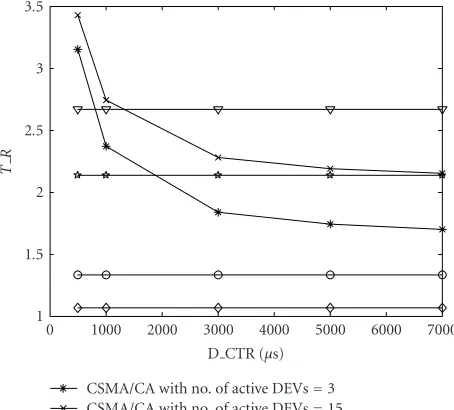
We define D CTR as the duration of channel time request packet and T Rdenotes the ratio of the duration of chan-nel time required to complete a transmission successfully and D CTR. In CC-CDMA protocol,T Ris calculated by
T R=K·G+G
K . (21)
When the probability of successful access is near 1 (i.e., (1−Pk) < 0.0001), the relationship between D CTR and
T R of CSMA CA and CC-CDMA protocol is shown in Figure 11.
To obtain these results, we assume that the chip rate of CC-CDMA is equal to the data rate of CSMA/CA. We con-clude fromFigure 11that the CC-CDMA protocol is more efficient than CSMA/CA when D CTR is short, the guard length is small, and the number of active DEVs is large.
5. SIMULATION RESULTS
In this section, we first present simulation results to validate the theoretical results of Sections4.1and4.2. Second, we pro-vide simulation results for the probability of successful chan-nel access when the CSMA/CA protocol is used. Finally, we present simulated throughput and packet delay performance for both CC-CDMA and 802.15.3 access protocols.
7000 6000 5000 4000 3000 2000 1000 0
D CTR (µs) 1
1.5 2 2.5 3 3.5
T
R
CSMA/CA with no. of active DEVs=3 CSMA/CA with no. of active DEVs=15
CC-CDMA with no. of active DEVs=3 andG=1 CC-CDMA with no. of active DEVs=15 andG=1 CC-CDMA with no. of active DEVs=3 andG=2 CC-CDMA with no. of active DEVs=15 andG=2
Figure11: Relationship ofT Rand D CTR.
The following system parameter values are assumed:Ld=
La =128, the number of DEVs is 10, each DEV has unlim-ited buffer size, the maximum number of data slots in a su-perframe is 63, and the detection error rate is zero. The sim-ulation results for average throughput and average delay are shown in Figures12and13, respectively, which display very good match with the analytical results.
The simulation results for probability of successful chan-nel access for the CSMA/CA protocol are shown inFigure 14. The assumptions made in the calculations are (i) every DEV in the system always has packets for transmission, (ii) D CTR
= 1500 microseconds,Lc = Ls = 2000 microseconds, and (iii) the duration of access periodts=D CTR×LRP, where LRP is given by (4). Now, considering the case without detec-tion error when the number of active DEVs is no more than the maximum number calculated using (5), the probabil-ity of successful channel access for the proposed CC-CDMA protocol is 100%.
1.2
Figure12: Comparison of throughput: analysis versus simulation.
1
Figure13: Comparison of packet delay: analysis versus simulation.
6. CONCLUSIONS
In this paper, we propose a new MAC protocol for a UWB WPAN system. The basic idea is using a CC-CDMA-based channel access protocol to resolve collisions among request packets. We design a new access-request packet to gain higher bandwidth utilization and ease the requirement on system timing. Theoretical anal-ysis shows that our access request packet can gain higher bandwidth utilization and higher spreading gain at the same time.
Figure14: The probability of successful access of CSMA/CA.
0.99
Figure15: Performance of packet delay.
80 70 60 50 40 30 20
Offered traffic load 0.9
0.91 0.92 0.93 0.94 0.95 0.96 0.97 0.98 0.99
A
ver
age
thr
oug
h
put
CC-CDMA
CSMA/CA withN=32, DEVs=10 CSMA/CA withN=32, DEVs=20 CSMA/CA withN=16, DEVs=10
Figure16: Performance of throughput.
is short and the propagation delay is small, which are gen-eral requirements in a WPAN system. Analytical and simu-lation results show that the CC-CDMA protocol has higher throughput and lower average delay than those obtained for the CSMA/CA protocol. Based on these findings, it is con-cluded that the proposed CC-CDMA protocol is suitable for UWB WPAN system.
APPENDIX
ALGORITHM FOR CALCULATING THE AVERAGE NUMBER OF WAITING SLOTS
To derive the algorithm for calculating the average number of waiting slots, we assume that the newly generated pack-ets are uniformly distributed among slots, the current state satisfies(S=j,R=k), where S denotes the length of data packet slots of current frame, andRdenotes the number of surplus data packets in the buffer at the time of sending a frame, and the number of newly generated packets isi. Thus, the algorithm for calculating the average number of waiting slots can be described as inAlgorithm 1.
To obtain these results, we assume that the packets erated in an earlier frame are sent first, and the packets gen-erated in the same frame are sent randomly.m1andm2are defined as follows:
m1=modk,LM
, n1=k−m1·LM,
m2=modn1+i,LM
, n2=n1+i−m2·LM, (A.1)
where mod (x, y) equals the largest integer less than x/y.
T Delay=0;
for(j,k)=(0, 0) : (LM,∞)
fori=0 :∞
EDelay=(i+n1)·m1·(LM+ 1) +i·j/2 +k·j+n2·m2·LM
if (m1>0)
form=1 :m1
EDelay=EDelay + (LM+ 1)·(m−1)·LM+ (LM−1)·LM/2;
end end if (m2>0)
form=1 :m2−1
EDelay=EDelay + (LM+ 1)·m·LM;
end
EDelay=EDelay +n1·(LM−1)/2;
else
EDelay=EDelay +n1·(n1+i−1)/2;
end
T Delay=T Delay +Pj,K·p(i/ j)·(EDelay +j·(j−1)/2);
end end
Algorithm 1: Algorithm for calculating the average number of waiting slots.
ACKNOWLEDGMENTS
The first author thanks the National University of Defense Technology for a study leave award. The research of the sec-ond author is supported by a grant from the Natural Sciences and Engineering Research Council (NSERC) of Canada.
REFERENCES
[1] L. Blazevic, I. Bucaille, L. De Nardis, et al., “U.C.A.N.’s ultra wide band system: MAC and routing protocols,” inProc. In-ternational Workshop on Ultra Wideband Systems (IWUWBS ’03), Oulu, Finland, June 2003.
[2] “Multi-band OFDM physical layer proposal update,” IEEE 802.15-04/0122r4. Available at: http://www.ieee802. org/15/pub/TG3a.html.
[3] “DS-UWB physical layer submission to 802.15 task group 3a,” IEEE P802.15-04/0137r00137r00137r0, http://www.ieee802. org/15/pub/TG3a.html.
[4] “Wireless medium access control (MAC) and physical layer (PHY) specifications for high rate wireless personal area net-works (WPANs),” IEEE Std 802.15.3TM-2003.
[5] J. Ding, L. Zhao, S. R. Medidi, and K. M. Sivalingam, “MAC protocols for ultra-wide-band (UWB) wireless networks: im-pact of channel acquisition time,” inEmerging Technologies for Future Generation Wireless Communications, vol. 4869 of Pro-ceedings of SPIE, pp. 97–106, Boston, Mass, USA, November 2002.
[6] Y.-H. Tseng, “The MAC Issue for UWB,”http://inrg.csie.ntu. edu.tw/2002/The%20MAC%20Issue%20for%20UWB.ppt. [7] F. Cuomo and C. Martello, “MAC Principles for an Ultra
Wide Band Wireless Access,” Available at:http://www.whyless. org/files/public/WP4 globecom01.pdf.
[9] X. Li, “Contention resolution in random-access wireless net-works based on orthogonal complementary codes,” IEEE Trans. Commun., vol. 52, no. 1, pp. 82–89, 2004.
[10] PACWOMAN Consortium, “Medium Access Control for Wireless Personal Area Networks,” Deliverable 4.3.2, PAC-WOMAN IST-2001-34157, October, 2003.
[11] P. Kamath, “Issues in Wireless MAC Protocols,” Available at: http://www.isi.edu/∼pkamath/personal/coursework/mac. pdf.
[12] F. Liu, K. Xing, X. Cheng, and S. Rotenstreich, “Energy-Efficient MAC layer protocols in ad hoc networks,” Available at: http://www.seas.gwu.edu/∼cheng/Publication/ PowerMACSurvey.pdf.
[13] B. Pearson, “Complementary code keying made simple,” Available at: http://www.intersil.com/data/an/an9/an9850/ AN9850.pdf.
[14] M. Gen, “Design a new address code for CDMA system,” Master thesis of engineering, University of Air Force, China, 2003.
[15] L. Alonso, R. Agust´ı, and O. Sallent, “A near-optimum MAC protocol based on the distributed queueing random access protocol (DQRAP) for a CDMA mobile communication sys-tem,”IEEE J. Select. Areas Commun., vol. 18, no. 9, pp. 1701– 1718, 2000.
[16] Y.-H. Tseng, E. H.-k. Wu, and G.-H. Chen, “Maximum traffic scheduling and capacity analysis for IEEE 802.15.3 high data rate MAC protocol,” inIEEE 58th Vehicular Technology Con-ference (VTC ’03), vol. 3, pp. 1678–1682, Orlando, Fla, USA, October 2003.
[17] F. Cali, M. Conti, and E. Gregori, “Dynamic tuning of the IEEE 802.11 protocol to achieve a theoretical throughput limit,” IEEE/ACM Transactions on Networks, vol. 8, no. 6, pp. 785–799, 2000.
Jiang Zhu received the B.Eng., the M.S., and the Ph.D. degrees in electrical engineer-ing from the National University of Defense Technology, Changsha, Hunan, China, in 1994, 1997, and 2000, respectively. Since 2001, he has been with the National Uni-versity of Defense Technology as an Assis-tant Professor at the School of Electronic Science and engineering. He is now a Visit-ing Scholar at the University of Calgary, AB,
Canada. His current research interests include QoS mechanisms for multimedia over wireless network.
Abraham O. Fapojuworeceived the B.Eng. degree (first-class honors) from the Univer-sity of Nigeria, Nsukka, in 1980, and the M.S. and Ph.D. degrees in electrical engi-neering from the University of Calgary, Cal-gary, AB, Canada, in 1986 and 1989, re-spectively. From 1990 to 1992, he was a Re-search Engineer with NovAtel Communica-tions Ltd., where he performed numerous exploratory studies on the architectural
def-inition and performance modeling of digital cellular systems and personal communications systems. From 1992 to 2001, he was with Nortel Networks, where he conducted, led, and directed system-level performance modeling and analysis of wireless communica-tion networks and systems. In January 2002, he joined the De-partment of Electrical and Computer Engineering, University of Calgary, as an Associate Professor. He is also an Adjunct Scientist
![Figure 5: LRP of CC-CDMA protocol and protocol in [9].](https://thumb-us.123doks.com/thumbv2/123dok_us/914548.1110625/4.600.314.541.68.300/figure-lrp-cc-cdma-protocol-protocol.webp)