Munich Personal RePEc Archive
On the Implications of Contract Farming
on Agricultural and Rural Development
in India : With Special Reference to
Karanataka, India
Motkuri, Venkatanarayana and Veslawatha, Suresh Naik
Centre for Development Studies, Thiruvananthapuram (Kerala)
August 2005
Online at
https://mpra.ub.uni-muenchen.de/48443/
On the Implications of Contract Farming on Agricultural
and Rural Development in India
: With Special Reference to Karanataka, India
Motkuri Venkatanarayana and Suresh V. Naik
Centre for Development Studies
Abstract
In the Gandhian perspective the real India lives in villages. Taking this perspective into account there had been efforts for rural development since independence. As a matter of fact rural development is intertwined with the development of agrarian economy as majority of the population depends on agriculture activities for their livelihood. In the early stages of first plan, Community Development Programme (CDP) is designed for the rural and agricultural development but the realisation of expected outcome was disappointing. In the 1960’s and 1970’s the green revolution package was seen as another chance to materialise the agricultural and thereby rural development given its advantages in terms of new technology, hybrid seeds, and externalities like commercialisation and linkages between industry and agriculture. It too gave us disappointing results, as it is concentrated in specific areas and benefited the particular sections of farming community. One of the problems found with the agricultural development in Indian context is that lack of infrastructure and credit facilities, absence of frontier technology and technical education and proper monitoring mechanism. In the globalisation and liberalization era a new device for agricultural development brought out in the form of contract farming. It is argued that the new concept of contract farming might address these problems. However, it is open to debate whether the initiatives of contract farming help in rural and agricultural development especially whether it provides any beneficial outcome for the marginal and small farmers in terms of their living standards.
In this context the present paper examines the rationale for the introduction of contract farming in Indian context and advantages and disadvantages it draws with reference to rural and agricultural development where particular emphasis is given to marginal and small farmers. It is also looking into what are the ideal market conditions necessary for the contract farming to be encouraged and to what extent state can have its regulatory mechanism to monitor and control the contract farming to the extent it benefits the farmers along with sponsoring companies. The study is narrowed down to a case study of Karnataka, which already launched the initiatives towards the contract farming.
***
On the Implications of Contract Farming on Agricultural and
Rural Development in India: With Special Reference to
Karanataka, India
Motkuri Venkatanarayana
and
Suresh V Naik
####Centre for Development Studies, Trivandrum (Kerala)
I. Introduction
In the Gandhian perspective the real India lives in villages. Taking this perspective into
account there had been efforts for rural development since independence. As a matter of fact
rural development is intertwined with the development of agrarian economy as majority of
the population depends on agriculture activities for their livelihood. In the early stages of first
plan, Community Development Programme (CDP) is designed for the rural and agricultural
development but the realisation of expected outcome was disappointing. In the 1960’s and
1970’s the green revolution package was seen as another chance to materialise the
agricultural and thereby rural development given its advantages in terms of new technology,
hybrid seeds, and externalities like commercialisation and linkages between industry and
agriculture. It too gave us disappointing results, as it is concentrated in specific areas and
benefited the particular sections of farming community. One of the problems found with the
agricultural development in Indian context is that lack of infrastructure and credit facilities,
absence of frontier technology and technical education and proper monitoring mechanism. In
the globalisation and liberalization era a new device for agricultural development brought out
in the form of contract farming. It is argued that the new concept of contract farming might
address these problems. However, it is open to debate whether the initiatives of contract
farming help in rural and agricultural development especially whether it provides any
beneficial outcome for the marginal and small farmers in terms of their living standards.
In this context the present paper examines the rationale for the introduction of contract
farming in Indian context and advantages and disadvantages it draws with reference to rural
# Both are Research Scholars at Centre for Development Studies, Trivandrum (Kerala), 695 011.
and agricultural development where particular emphasis is given to marginal and small
farmers. It is also looking into what are the ideal market conditions necessary for the contract
farming to be encouraged and to what extent state can have its regulatory mechanism to
monitor and control the contract farming to the extent it benefits the farmers along with
sponsoring companies. The study is narrowed down to a case study of Karnataka, which
already launched the initiatives towards the contract farming.
Having said, the paper is organised in the following. While second section discusses the
relationship between the agrarian economy and the well-being of the people; the third section
is about how important is the infrastructure facilities development agriculture growth. The
factors determining the agriculture growth are discussed in the fourth section. The account of
process and evolution of contract farming system is given in the fifth section. It is followed
by an evaluation of the contract farming system in terms its benefits especially to small and
marginal farmers, based on the available literature survey in the sixth section. We felt it
necessary examine what are theoretical market condition that suitable to work out the
contract farming, hence the seventh section elaborates it. Finally the case study of Karnataka
is presented in the eighth section, then it is followed by discussion and conclusion in the final
section.
II. Agrarian Economy
Agrarian Economy and Well-being
Agriculture is the main source of livelihood for the majority especially in the developing
countries such as India. Hence, the increase in the standard of living is associated with the
growth and development of agriculture. In an agrarian economy, the growth in agricultural
output is essential to the overall economic growth thereby its development process (Mellor,
1969; Hayami and Rutton, 1971). Historical experience of developed countries indicates us
the agriculture revolution (in terms of commercialisation, new technologies, marketing)
preceded the industrial revolution. Similarly, the case of Japan where the developed
agriculture had a positive impact on both non-agriculture and overall development (see
Ishikawa, 1967). In the contemporary developing countries their backwardness coincides
with the under development in agriculture. The contribution of agricultural growth to
development process is positively related to the rate of productivity growth in the agricultural
growth of agriculture: availability of required inputs, technology, production techniques,
infrastructure like irrigation, structure and relations in agrarian economy (see Boyce, 1987).
Infrastructure and Agricultural Development
For any society and economy the development process involves with the expansion of
infrastructure (both social and economic infrastructure). In fact, the development theories of
Rosenstenan Rodan, Lewis and Hirschman had already emphasised the crucial role
infrastructure (i.e. referred as the social overhead capital) thereby investment in it (see
Hirschman, 1956). Prior to these development theoreticians, classical economist Adam Smith
in his book Wealth of Nations already emphasised the importance of infrastructure in
economic development. Social infrastructure facilities like health and education would
improve the human capital and thereby the productivity of the human labour. Likewise
economic infrastructure especially communication facilities first of all removes the
information asymmetries and helps in capitalising internal economies of scale. Energy and
financial market infrastructure paves the way for industrialisation process. For an agrarian
economy irrigation infrastructure stabilises the fluctuation in agricultural output, facilitates
use other inputs like HYV seeds, fertilisers and thereby increases the productivity.
Factors Determining Agricultural Growth
There are multiple factors, which are involved with the growth of agriculture: availability of
required inputs, technology, production techniques, infrastructure like irrigation, structure
and relations in agrarian economy (see Boyce, 1987). Hayami and Rutton (1971) emphasized
the crucial role of technology and the institutional factors while Schultz (1964) argued that
availability of economic information with respect to technology and production techniques
are important for the growth agriculture. According to Hayami and Rutton (1971) the growth
in agriculture depends upon the productivity with respect to factors involved in the
agriculture where technology and institution govern the application of the available
technology. Schultz (1964) in his Transforming Traditional Agriculture emphasised the role
of economic information at the disposal of the farmers. The niggardness (i.e. backwardness)
agriculture kept intact because farmers do not have the knowledge of update technology
related agriculture and its application. He emphasises the given the information whatever the
technology and the production techniques they are using is an efficient one. Another factor
that was unravelled is the structure of the agrarian economy where the semi-feudal nature of
investment required and involves with the asymmetry of information related to production
and production techniques. All these do not show any incentive to further development of
agricultural.
In the Indian context, there was great deal of debate on size of the farm and its productivity. It
was argued that smaller the size of the farm higher its returns and noticed that it is because of
the efficiency of the family labour involved with the small farm whereas the larger farms had
to depend upon the hired labourers (see Sen 1962 & 1964; Mazumdar, 1963). However, the
emergence of new technology negated the efficiency of small firms in terms of their intensive
manual family labour, which reduces the monitoring costs. The production techniques
undergone sea change where larger farm size produces better outcomes rather than the
smaller farm size. In this new emerging scenario there should be measures to under take the
welfare of the small and marginal farmers.
III. The Evolution of Contract Farming
The contract farming evolved as a solution for the difficulties observed in terms of natural
vagaries, price fluctuations, input procurement, and access to credit in agriculture particularly
cultivation practices of small and marginal farmers (Eaton and Shepherd, 2001). Indian
agricultural scenario has given birth to the concept of Contract Farming, which promises to
provide a proper linkage between the ‘farm and market.’ Recognising the need for and merits
of such a linkage with the farming/producing community, several corporate involved in
agro-commodity trading, processing, exports, etc. have attempted to establish convenient
systems/models that ensure timely and consistent supply of raw material of the desired
quality and low cost. This article discusses a few successful cases of contract farming and a
brief note on the bottlenecks and criticisms leveled against this emerging alternative farm
business model. Contract farming may be defined as an agreement between farmers and
processing and/or marketing firms for the production and supply of agricultural products
under forward agreements, frequently at predetermined prices (Singh, 2000a). One of the
benefits it accrues is that it reduces the production risk to the processors and price risk to the
farmers.
Contract farming, in fact, is not a modern process, rather it has its own variants existed for a
long time. Sharecropping is a traditional variant of modern contract farming. It is contract
to share cropping in the context of India as well as other developing countries. On the other
the contract farming in Indian can be traced back to the 19th century where the farmers under
East India Company’s command cultivated crops like cotton, indigo, tobacco etc to serve the
Company’s input requirements at its native place. In the contemporary India, the seed
production especially in the case of cotton, the seed companies have carried out it through
contract farming quite successfully. Another variant of contract farming that existed since
independence is co-operatives in sugarcane cultivation especially in Maharashtra.
The current situation and direction of contract farming in India is interesting to examine. The
entry of Multinational Corporations (MNCs) and foreign direct investment (FDI) is one of the
recent attractions in the system of contract farming. The increasing demand for processed and
packaged food and the availability of technology that enhances the durability of food
products led to establishment of agro-processing industry, which in turn attracted global
Giant Corporations into the field, given its profitability. As mentioned earlier, one of the
problems that related to crop cultivation is fluctuation in output and price. Another constraint
is lack of information on proper techniques to be used in the cultivation and harvesting. To
ensure the continuous supply of crop products to agro-processsing industry, it needs
continuous monitoring from sowing to harvesting. Also given the agrarian structure that
involving large chunk of marginal and small farmers, they may not be able to take timely care
of the crop.
Under these circumstances of unstable product supply, the firms involving agro-processing
industry came forward to provide all the assistance ranging from supplying seeds and other
inputs (like fertiliser and pesticides), credit and economic information related to cultivation
and harvesting. One of their main objectives is to ensure the supply of the raw material for
their agro-processing industry. It needs a joint work of the producer (i.e. the farmer) and
buyer/processor (i.e. the firm). There emerges the need for contract between the farmers and
the processing firm. Here each agent has their own motive in terms of maximising their
benefits. In the process, since there is a possibility of violating the contract, there needs an
institutional mechanism that ensures the contract kept it up. One of those institutional
mechanisms is the intervention of the government/state in the process of the contract farming.
On the one hand, in the welfare state context, the state intervention in the process of contract
farming sees it that farmers especially marginal and small ones benefit out of the process. On
investment while giving concession and providing incentives to the private entrepreneurs.
The complexity of the process always gives the space for different value judgements for and
against the contract farming.
Having said above, the government of India adapted a policy that encouraging the contract
farming while introducing New Agricultural Policy. The Government of India’s National
Agriculture Policy envisages that “Private sector participation will be promoted through
contract farming and land leasing arrangements to allow accelerated technology transfer,
capital inflow and assured market for crop production, especially of oilseeds, cotton and
horticultural crops”. Under these policy initiatives, there are private enterprenurship within
India and abroad (MNCs) coming forward to take up the contract farming. Nevertheless the
question to be answered is that whether this policy initiative is really serving its purpose in
FARMERS
SPONSORS
THE CONTRACT MANAGEMENT AND ADMINISTRATION THE PROJECT PRODUCTION PERFORMANCE MONITORING
Feedback to farmers and sponsors Price adjustments and contract amendments
Innovations and adaptations Quota allocation and distribution Preconditions
Market Environment Physical and Social
Land tenure Financing Infrastructure Materials Communications Project components Crop schedules Pricing policies Extension services Contract formulas Contract formats Farmer selection Technical Inputs Farmer advances Research and trials Staff/farming training Farmer forums Government support Political stability General legislation Industry regulation Public utilities Community services Quarantine controls Plant pathology Environment Land tenure
Chart I : Framework of Contract Farming
terms of increasing the value addition to the crop output and thereby growth of agriculture by
involving as many people as they depend upon cultivation and benefiting them. There is
emerging literature on this part of assessing the impact of contract farming on agricultural
growth and thereby rural development.
An Evaluation of Contract Farming in Practice
Farming is an age-old means of livelihood for millions of Indians as well as people in the rest
of the world. There has been a transition from subsistence farming to commercial farming
(i.e. production for market). In the commercialisation process there have been few
systems/models in which farmers are assured of a market for their produce, leave alone a
remunerative price. One on hand farmers have on occasion had to throw their produce away
for want of buyers. On the other is the agri-based and food industry, which requires timely
and adequate inputs of good quality agricultural produce. This underlying paradox of the
Indian agricultural scenario has given birth to the concept of Contract Farming, which promises
to provide a proper linkage between the farm and market. However, contract-farming practices
are so diverse in different countries that no generalisation can be made on positive or
negative effects (Eaton and Shepherd, 2001; Singh, 2000a).
It is observed that the impact of contract farming depends on the social, economic and
political environments of the country in which it is practised. In the individual farmers
perspective, it is not contract per se that is important, rather how it is practised in a given
socio-economic and political background (Singh, 2000a). The available evidence shows that
the processing companies are favouring large farmers mainly for undertaking contract
farming (Singh 2000a; Dileep et al, 2002). It indicates that the process of contract farming is
unable to serve its purpose of benefiting the marginal and small farmers. Also, there are
evidences that firms violating contracts in terms of devaluing the predetermined price of the
product and able to procure all the crop produce that a farmer produced under the contract.
There arises the case for whether to continue the contract farming, if at all under what
conditions. Whether there is a need for change in institutional mechanism to monitor it
properly and to see it that it benefits small and marginal farmers.
Suitable Market Conditions
In this section we make an attempt to examine what are the suitable theoretical market
to land, credit facility and incentives (above mentioned). In this kind of structure what kind
of market structure should exist. Whether monopoly market, oligopoly market, perfect market
structure. This is one of the major debated issues in an agrarian economy when we related to
contract farming. The monopoly market in contract farming is not a new concept rather it
existed during the colonial regime of British India, where the farmers are forced to produce
those agriculture crops that are in demand at predetermined prices by the East India
Company. In the contemporary India if such market conditions prevails in contract farming it
exactly resembles our old experience, just like “new wine in a old bottle”.
As our historical experience informs us the monopoly market conditions do not the serve the
purpose of contract farming in farmers perspective. But the alternative perfect market
conditions are imaginary ones, no way they are really existed. Particularly the assumption
that there is perfect information between buyers and sellers (in our case between the farmers
and firm). Information asymmetry is found to be one of the major problems in economic
decision making (see Akerlof, 1982). The other alternative important market structures are
Duopoly and Oligopoly. As we have studied in the economics text books of market structures
and their functioning, these two market structure have there own defaults especially when one
views in the marginal and small farmers perspective. Any form of market system as such is
not helpful for farmers. Therefore the institutional mechanism of the state and its intervention
is needed. However, the political economy of the state and the corporate influence over the
state decides the welfare of the farmers1.
IV. Contract Farming in Karnataka: A Case Study
Karanataka is one among the Indian states, which are undergoing through the modern
corporate contract farming in different crops, which are grown especially for exports.
Profile of the State
The State of Karnataka is one of the Major States in India and located in southern part with a
population size of 52.7 million (Census, 2001). The state covers – per cent of geographical
area and 5 per cent of population in Indian Territory. Within the State about 34 per cent of the
population live in urban localities and the rest 66 per cent of population live in countryside.
The total work participation rate (TWPR), which includes main and marginal workers, is
about 38 per cent of the population. In the rural areas the WPR is little bit higher than the
still agricultural activities especially in rural areas. On an average (both rural and urban areas
combined) there are about 56 per cent of total workers engaged in agricultural related
(particularly cultivation and agricultural labour) activities and the rest 44 per cent of total
workers involved with non-agricultural activities. But in rural areas the intensity of
dependency on agriculture as source of livelihood increases, where 73.5 per cent of the total
workers in rural areas depend on agricultural activities. In the total workforce about 39 per
cent are cultivators and about 34 per cent are agricultural labourers. If one see among the
agricultural labour force about 53 per cent cultivators and the rest 47 per cent are agricultural
labourers. As a matter of fact, the phenomenon of landlessness is higher in south Indian
States than the north Indian States, where Karnataka is one among the south Indian State
which has high incidence of landlessness (see Chadha, 1994).
In the total geographical area of 19050 thousand hectares about 10489 thousand hectares
comprising 55 per cent of geographical area is the net sown area (NSA) and about 17.5 per
cent of NSA is available for double cropping hence the gross cropped area (GCA) is 64.6 per
cent of the geographical area2.
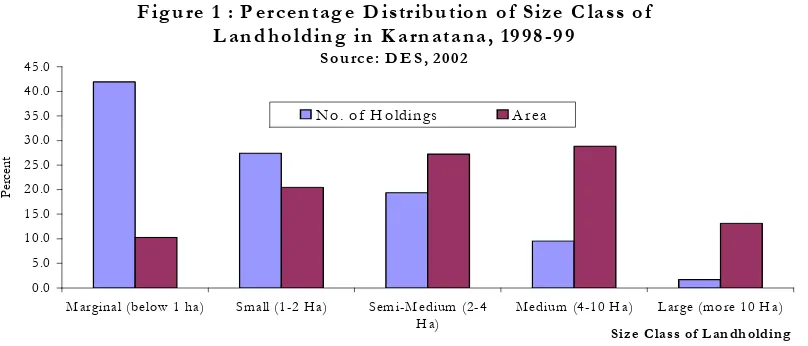
There are about 6221 thousands total number of landholdings covering about 12109 thousand
hectares of land cultivated. The percentage distribution of landholdings in number and area
according to the size class of the landholding indicates that there is unequal distribution of
land. In other words, in terms of the number of holding, marginal and small farmer covers
about 2/3rd of total number of holding. In case of area they cover it is merely 1/3rd of the total
area under cultivation.
F ig u re 1 : P e rc en ta g e D istrib u tio n o f S iz e C la ss o f L a n d h o ld in g in K a rn a ta n a , 19 9 8 -9 9
S o u rc e: D E S , 20 02
0.0 5.0 10.0 15.0 20.0 25.0 30.0 35.0 40.0 45.0
M arg in al (b elo w 1 h a) S m all (1-2 H a) S em i-M ed ium (2-4 H a)
M ed ium (4-10 H a) L arge (m o re 10 H a)
S iz e C la s s o f L a n d h o ld in g
P
er
ce
nt
[image:11.612.117.521.312.485.2]Table 1 : Percentage of Estimated Number of Household and Population Reportedly Possessed, Owned and Having Cultivated Land in Karanataka by
Location : NSSO
Land Details Rural and Urban Rural Urban
1 2 3 4
Estd. No. of HH 10.1 M 7.1 M 3.0 M
Estd. Pop 48.5 M 35.1 M 13.4 M
Average HH Size 4.8 5.0 4.4
H
H
s.
Possessed 92.2 96.4 82.2
Owned 80.5 90.9 56.2
Cultivated 43.1 57.8 8.6
P
o
p
. Possessed Owned 93.3 84.3 96.8 92.7 84.0 62.4
Cultivated 48.6 63.1 10.4
Note: M – Millions; HHs - Households; Pop – Population; Estd. – Estimated.
Source: Estimated using NSSO 55th (1999-2000) Round unit level record data.
As regards the land ownership of the households, there are about 10 million total households
estimated in the state and these households consist about 48.5 million population; on an
average 4.8 person per household (i.e. Household Size). Within the rural area there are about
7 million households comprising 35 million population (Average household size is 5 persons
per household). Among the estimated rural households (population) about 96.4 (96.8) per
cent of them reported that they have possessed some land. And about 91 (93) per cent of the
households (population) reportedly owned the land. When it comes to households having
cultivated land, about 58 (63) per cent of the rural households (population) reported that they
have it.
Table 2 : Percentage Distribution of Households and Population by Size Class of the Land holding in Rural Karnataka: NSSO
Size Class of Landholding Households Population
In Total Within the Landed In Total Within the Landed
1 2 3 4 5
Marginal 25.1 44.9 25.2 40.7
Small 17.4 31.1 19.0 30.7
Semi-Medium 9.0 16.1 11.4 18.4
Medium 3.6 6.4 5.2 8.4
Large 0.8 1.4 1.2 1.9
Tot Landed 55.9 100 61.9 100
Landless 44.1 - 38.1 -
Total 100.0 - 100.0 -
Note: 1. In Total - Among the Total Rural Households; Within the Landed - Among those who reported the cultivated land.
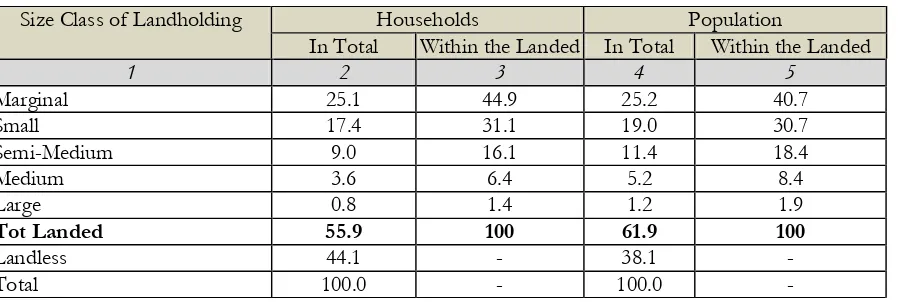
[image:12.612.87.536.561.712.2]When we examine the percentage distribution of households and population by size class of
the landholding among the landed (i.e. cultivated land), about 75 (70) per cent of households
(population) are in the class of marginal and small-scale landholding class. And the rest of the
households and population in the size class brackets of semi-medium, medium and
large-scale landholdings. It is obvious that among the cultivating class, lion's share holds the
marginal and small farmers. Given this agrarian structure, any development effort especially
the policy related to cultivators should aim at this large chunk of marginal and small farmers.
The State Policy
To establish idle market condition for the farmers and sponsors is one of the major issues in a
globalisation era. The government and policy makers are coming up with new policy
initiative to attract the MNCs (food processing industry). The government of Karnataka is
providing major incentives to food processing industries like.
• Agro Food Processing Industries will be declared as "Seasonal Industry" for the purpose of Labour Act. These industries will also be exempt from payment of minimum demand charges to the KP. TCL, during closure period of more than 90 days at a time.
• 100% exemption from payment of Electricity Tax and levy of concessional Sales Tax on 4% on liquid fuel used for Captive Power Generation, without any time limit, except for the units located in Bangalore urban and Bangalore Rural Districts.
• All Agro Food Processing Industries which purchase fruits and vegetables directly from the farmers on contract farming basis would be exempt from payment of Market Fees/Cess under the APMC Act.
• All Agro Food Processing Industries will be exempt from payment of Conversion Fee when they purchase agricultural lands for establishing the industry / Food Park. This benefit will be available in all Agro-Food Technology Parks without any restrictions on the extent of land; however for industries to be set up outside the Parks, the benefit will be available only for a maximum of 100 acres of land in each case;
• Agro Food Processing Industries will be encouraged to participate in national and international exhibitors and seminars for which purpose an appropriate incentives scheme will be formulated separately
• The incentives available under the New Industrial Policy for obtaining ISO and other international certification will be extended for Agro Food Processing Industries in respect of HACCP and other similar safety related regulations and processes.
ceiling of Rs.25.000/- or 25% of technology fee whichever is lower from the Technology Up-gradation Fund.
Initiative in Contract Farming in the State
Given the above policy with lot of concessions and incentives, there are few number of firms
especially those of MNCs came forward to set up their firms in various parts of Karnataka for
different types of crops. Sami Labs Limited, a Bangalore-India based firm undertaking
contract farming of medicinal plants in the state. And the Unicorn Pickles Limited
(Bangalore, India) has been in the business of gherkins (pickled cucumbers) for over 10
years, exporting products3 to USA, Canada, Chile, Spain, France, Germany, Italy,
Netherlands, Belgium, UK, Sweden, Greece, Thailand, S.Africa, Australia, Japan, Russia,
Korea, Brazil, and Switzerland.
About the farms where the gherkins grow UNICORN PICKLES has a team of agro experts
(Agri extension team) lead by a senior manager who holds over 22 years of experience. Its
Agri extension offices / Agri exports are very closely located to farmers at multi-locational
points. The teams execute their expertise in (a). Selecting the farm / farmer where the farm is
identified on conforming the aspects of Fertility of the soil, Availability of water and
Proximity to the plant; b). Supplying quality seeds c). Disease control. Unicorn Pickles has
Research and Development centre at Hyderabad, which supplies seeds that is tried and tested
for a healthy crop. The Agri team suggests and supplies pesticides to farmers as required. The
list of permitted chemicals / pesticides are continuously updated based on USFDA and
French regulations. The Agri team closely monitors the crop by regular field visits and
meetings with farmers to advise them on package of practices and update their cultivation
skills. Planting takes place according to the Agri Team Standards. The produce is picked up
on a daily basis from the farm and it reaches the plant on the same day ensuring the crispiness
of the processed Gherkin.
Another global giant entered into contract farming in the state is GLOBAL GREEN. The
given the India's advantage in the wide agro-climatic diversity of India allows cultivation of
certain temperate and tropical fruits and vegetables round the year. GLOBAL GREEN has
proven capabilities of using these unique country advantages to supply world-class fruits &
Baby corn, Papaya, Pickling cucumbers, and Peppers (coloured bell peppers, jalapenos,
paprika, sweet banana peppers)4.
The contract farming takes in the following way. It procures crops through a successful and
established model of contract farming. Global Green enters into written contracts with
farmers, chosen on the basis of the suitability of their land for growing cucumbers, as well as
their capability to work with us. The key features of contract farming are a). All farmer
contracts are bi-lateral and written contracts. The farmers are assured of buy-back of crop at
pre-agreed prices b). Farmers are provided with 'passbooks' in which records of crop
purchase and use of plant protection chemicals by the farmer are entered; c). Depending upon
the concentration of sowing, harvested produce is collected from one or more buying points.
At each such buying point, GLOBAL GREEN's buyers, check farmers' crop, grade and
quantity. Grading is done with mechanical devices. Farmers are paid on basis of grades and
weights recorded at the buying point d). By a simple system of 'tagging the crop' at the time
of purchase it is possible to trace any product made in the processing plants, upto the buying
point. This trace ability also allows for checking customer complaints, if any; and e). A
computerized MIS (Management information system) enable recording of farmer contracts
and forecasting of expected crop arrival. This allows for planning of sowings to meet
customer orders. Through the same system purchase of crop and issues of seeds and
chemicals are recorded.
For the farmer's training, the GLOBAL GREEN has crop extension teams in each growing
region. These teams consist of Senior Managers, Area Managers, Area Extension Officers, &
Village Level Workers, who maintain continuous contact with the farmers and provide
necessary advice and guidance on crop management, pest and disease control, harvesting,
post-harvest handling etc. Each extension team also has plant protection personnel
(entomologists & plant pathologists) who assess all crops on the farms regularly and advise
and assist the farmers in pest control. In addition, frequent F2F (Farmer to Farmer) programs
are conducted, where specific training is given on how to ensure Freshness and quality.
There is a Plant protection protocol. The company issues farmers with all the seeds, fertilizers
and plant protection chemicals that they require for cultivation. Only those chemicals
permitted in the importing country are used. For each plant, a standard plant protection
There are Research and Development (R & D) efforts from the company. At GLOBAL
GREEN, we recognize that R&D is the key to future growth. Hence, we have set up two
experimental stations for systematic evaluation of crops. The key research areas include: a).
New crop evaluation and development; b). Variety evaluation; c). Adaptability studies; d).
Productivity trials; e). Pest & disease tolerance studies; and d). Standardization of cultural
practices.
As a result of the research done over the last few years, varieties suited for every growing
season have been identified. In addition, promising hybrids are tested in farmer fields to
replicate the best results obtained under controlled conditions. This ensures smooth and ready
acceptance by farmers. GLOBAL GREEN has successfully introduced several new crops to
farmers. Currently, several new hybrids of pickling cucumbers & Jalapenos of different
pungency levels are under introduction.
It seems that the Global Green maintain farmers relations and takes care of the environment.
Contract farming by GLOBAL GREEN ensures guaranteed and satisfactory returns to
farmers. It thereby eliminates marketing risk & payment uncertainties. Multiple crop
requirements by GLOBAL GREEN also allow for crop rotation and a virtually
round-the-year contract farming opportunity. Such stability of incomes in rural areas is a boon, as a
result of which GLOBAL GREEN farmers have greatly benefited over the years. GLOBAL
GREEN ensures use of only legally permitted pesticides and that too in permitted quantities.
Cultural practices followed by GLOBAL GREEN allow conservation of limited resources of
water and electricity.
Having said above, if one looks into how the MNCs playing role in contract farming, one
finds a grim situation. In an interview (September 29, 2000) for the News and Information,
Dick Levins, an economist with the University of Minnesota Extension Service, said in the
following way about the contract farming in a developed country like USA5:
poultry production 'models the type of business organisation that may characterise much of U.S. farming in the future.'" There's a high social cost for contract farming. "Control of our food system could be taken over by a few multinational corporations. And that means we would lose the Jeffersonian ideal of a democracy built on millions of independent farms".
Above view of Levin pressurises us think twice about introducing the contract farming in
India especially given its agrarian structure of large chunk of small and marginal farmers.
However, rather than abandoning the new farm of corporate farming i.e. contract farming, it
is better to invent new devices and methods by which one can make it beneficial to the
producers i.e. farmers.
IX. Discussion and Conclusions
Since the independence rural development that is associated with agriculture has been
prioritised in economic planning. In the early stages Community Development Programme
(CDP) was designed and in the 1960’s and 1970’s the green revolution package was
introduced to materialise the agricultural and thereby rural development. Nevertheless they
give us disappointing results, as it is concentrated in specific areas and benefited the
particular sections of farming community.
One of the problems found with the agricultural development in Indian context is that lack
infrastructure and credit facilities, absence of the frontier technology and technical education
and proper monitoring mechanism. In the globalisation and liberalization era a new device for
agricultural development brought out in the form of contract farming. The concept of contract
farming is seen as if it addresses those problems. However, there is great deal of open debate
on whether the initiatives of contract farming help in rural and agricultural development
especially whether it provides any beneficial outcome for the marginal and small farmers in
terms of their living standards. The existing literature while assessing the beneficial outcomes
of contract farming is so diverse. It is observed that negative impact is outweighed by its
positive impact in the perspectives of small and marginal farmers. It does not mean one has
argue against the contract farming rather it is better to device new methods by which the
concept of contract farming can be beneficial to the targeted population i.e. farmers. Here
requires the proper institutional mechanism to control and monitor the process of contract
farming where the 'welfare state' has an obligation.
References
Allen, Douglas and Lueck, Dean (1992) “Contract Choice in Modern Agriculture: Cash Rent versus Crop share”, Journal of Law and Economics, Vol. 35 (2), Oct., pp. 397-426.
Bhaduri, Amit (1973) “Agricultural Backwardness under Semi-feudalism”, Economic Journal, Vol. 83 (1).
Boyce, James K (1987) Agrarian Impasse in Bengal: Institutional Constraints to Technological Change, O U P, Oxford.
Dev. S Mahendra and Chandrasekhararao, N (2005) “Food Processing and Contract Farming in Andhra Pradesh: A Small Farmer Perspective”, Economic and Political Weekly, June 25.
Dileep, B K; R K Grrover and K N Rai (2002) “Contract Farming in Tomato: An Economic Analysis”, The Indian Journal of Agricultural Economics, Vol. 57 (2), April-June, pp. 197-210.
Eaton, Charles and Andrew W Shepherd (2001) “Contract Farming: Partnerships for Growth, A Guide”, F A O Agricultural Services Bulletin 145, Food and Agriculture Organisation, Rome.
Grossman, Lawrence (1995) “Living under Contract: Contract Farming and Agrarian Transformation in Sub-Saharan Africa”, Annals of the Association of American Geographers, Vol. 85 (1), March, pp. 204-206.
Hayami, Yujiro and Rutton Vernon (1971) Agricultural Development: An International Perspective, John Hopkins, London.
Ishikawa, Shigeru (1967) Economic Development in Asian Perspective, Kinokuniya, Tokyo.
Ludden, David (1984) “Productive Power in Agriculture: A Survey of Work on the Local History of British India”, in Desai, Rudra and Rudolph (eds.) Agrarian Power and Agricultural Productivity in South Asia, University of California Press, London.
Mellor, John W (1969) The Economics of Agricultural Development, Vora and Company, Bombay.
Rao, V M (1994) “Farmers in Market Economy: Would Farmers Gain Through Liberalisation?”, The
Indian Journal of Agricultural Economics, Vol. 49 (3), July-Sept., pp. 393-402.
Revathi (1998) “Farmers’ Suicide: Missing Issues”, Economic and Political Weekly, 33 (20): 1207.
Schultz (1964) Transforming Traditional Agriculture, Yale University Press, New York.
Singh, Sukhpal (2000a) “Contract Farming for Agricultural Diversification in the Indian Punjab: A Study of Performance and Problems”, The Indian Journal of Agricultural Economics, Vol. 55 (3), July-Sept, pp. 283-94.
Singh, Sukhpal (2000b) “Theory and Practice of Contract Farming: A Review”, Journal of Social and
Economic Development, Vol. 3 (2), July-Dec., pp. 228-46.
End Notes
1 Major issues should be incorporated in market structure like: farmers should have bargaining power,
institutional support at the time market failure, guaranty to purchase corps.
2 The figures are obtained from State Statistical Abstract (Karnataka) for the year 1998-99.: Directorate of
Economics and Statistics, Banglore.
3 The company has track record for consistently delivering high quality products on time. The product
in new food grade HDPE drums. The net drained weight for salted vinegar/acid products is 160 kilos per drum and for brine products - 180 kilos per drum. 80 such drums are stuffed in a 20' container (Source: http://www.unicornagro.com/).
4 Growing season is: the ideal conditions established for growing pickles in India are a maximum
temperature of 35° C (95° F) and a minimum temperature of 15° C (59° F). These conditions are available in our growing areas virtually round the year. Additionally, this also lets us plan for compensatory sowings to allow for adverse weather conditions, thereby ensuring freshly packed products throughout the year.
5 The quotes obtained from the following website.