REFRACTIVE: An Open Source Tool to Extract Knowledge from Syntactic and
Semantic Relations
Peter Exner, Pierre Nugues
Lund University, Department of Computer science, Lund, Sweden [email protected],[email protected]
Abstract
The extraction of semantic propositions has proven instrumental in applications like IBM Watson (Ferrucci, 2012) and in Google’s knowledge graph (Singhal, 2012). One of the core components of IBM Watson is the PRISMATIC knowledge base consisting of one billion propositions extracted from the English version of Wikipedia and theNew York Times(Fan et al., 2010). However, extracting the propositions from the English version of Wikipedia is a time-consuming process. In practice, this task requires multiple machines and a computation distribution involving a good deal of system technicalities. In this paper, we describe REFRACTIVE, an open-source tool to extract propositions from a parsed corpus based on the Hadoop variant of MapReduce. While the complete process consists of a parsing part and an extraction part, we focus here on the extraction from the parsed corpus and we hope this tool will help computational linguists speed up the development of applications.
Keywords:semantic parsing, relation extraction, proposition database.
1.
Introduction
IBM Watson (Ferrucci, 2012) and Google’s knowledge graph (Singhal, 2012) are recent and spectacular achieve-ments that show the significance of large scale seman-tic processing. Systems like IBM Watson and OLLIE (Mausam et al., 2012) have carried out a systematic ex-traction of semantic frames on very large corpora. Both systems used a syntactically parsed corpus as input, gram-matical relations and rules to derive the predicate-argument structures as it is fast and easier to apply to large cor-pora. A complete semantic role labeling, using the Prop-Bank (Palmer et al., 2005) or Framenet (Ruppenhofer et al., 2010) lexicons, is slower, but usually more accurate. Nonetheless, it is possible to combine both techniques to get higher performances. See Mausam et al. (2012) for a discussion.
While distributing the extraction manually on two or more computers seems an intuitive solution, it is difficult to im-plement in practice. Applying a semantic parser to corpora of more than 1 billion words is a daunting task that requires a computer cluster to be tractable in practice. On average, the end-to-end Mate semantic pipeline (Björkelund et al., 2010) takes 190 milliseconds to parse a sentence with a high-end single CPU. Given that the English version has 62 million sentences, the corpus parsing would be completed in ideal conditions in little less than five months. Such a duration does not fit the interactive, try-and-fail nature of many experiments in natural language processing.
In this paper, we introduce REFRACTIVE, a streamlined, large-scale extraction tool based on MapReduce that runs on a computer cluster of arbitrary size. Using it, we ex-tracted propositions from a parsed version of the entire En-glish Wikipedia and we created a knowledge base from it. The complete processing, parsing and extraction, takes less than 20 days on a cluster of ten processors, where we rep-resent the extracted propositions as frames and slots. In the rest of the paper, we describe the extraction part of the pro-cess.
2.
Related Work
Lexical databases or networks representing structured gen-eral knowledge have a long history in natural language pro-cessing. Examples resorting to an intensive manual labor include WordNet (Miller and Fellbaum, 1998), FrameNet, and Cyc (Lenat, 1995). With the advent of Wikipedia, automatic techniques to extract knowledge from semi-structured text have successfully been applied by YAGO (Suchanek et al., 2007) and DBpedia (Auer et al., 2007).
Agichtein and Gravano (2000), Etzioni et al. (2004), and Carlson et al. (2010) employed semi-supervised methods using bootstrapping techniques together with initial seed relations in order to extract relations from unstructured text. Banko and Etzioni (2007) and Fader et al. (2011) refined them further using unsupervised approaches. To-gether, these approaches have successfully handled scala-bility and precision factors, when applied to unstructured text in web-scale corpora. Although syntactic and semantic parsers reach higher recalls and precisions (Christensen et al., 2010), their use in knowledge extraction has been rela-tively limited as they require more computing capabilities.
The identification of name mentions that are part of seman-tic propositions and their disambiguation is essential to link the resulting relations to external knowledge graphs. Exam-ples of such an identification include Cattoni et al. (2012) that applied a named entity tagger and a coreference solver to systematically extract entities across a set of newspaper articles and LODifier (Augenstein et al., 2012) that com-bined a named entity disambiguator and a semantic parser to generate linked data. Prismatic (Fan et al., 2012) used a slot-grammar-based parser together with a named entity recognizer and a coreference solver to create a large-scale knowledge base.
3.
Terminology
Following the terminology found in Fan et al. (2012), RE
-FRACTIVEuses the definitions and extensions below:
Frames: We consider a frame as a representation of a se-manticn-ary relation. Like Prismatic, we define its contents as a set of slot and value pairs. Frames in REFRACTIVEare instantiated by the syntactic and se-mantic representations of a sentence obtained from de-pendency parsing.
Slots: Slots represent binary relations. These are most commonly syntactic and semantic dependency rela-tions.
Slot values: Prismatic defines a slot value as either the lemma form of a term from a sentence or a named en-tity type. We extend this definition by allowing values obtained from a coreference resolver, term yields, and semantic roles.
Frame projections: A frame projection is a subset of a frame. It is generated by specifying an ordered list of slots, such as SBJ-VERB-OBJ.
4.
System Architecture
4.1.
Overview
REFRACTIVEconsists of a pipeline that takes Wikipedia ar-ticles as input and produces frame projections in the form of RDF triples and queryable Lucene indices. We first parse the Wikipedia articles using KOSHIK(Exner and Nugues, 2014), a MapReduce-based, open-source framework that includes an ensemble of natural language processing tools. We then extract the frames from the syntactic and seman-tic dependency representations of the arseman-ticle sentences. We finally generate frame projections or subsets using a prede-fined list of slots.
The instances of the frame projections can then be queried using an interface to a Lucene-based index. For each in-stance, we compute aggregate statistics based on frequency or conditional probability. As an alternative to Lucene in-dices, REFRACTIVE can also export data as RDF triples. For scalability, we run both frame extraction and projection as Map jobs in Hadoop.
Figure 1 shows an overview of the system architecture. In the following sections, we describe the modules that are part of the system in more detail.
4.2.
Corpus Processing
We process and annotate the articles using KOSHIK1. KOSHIK combines tools for syntactic parsing (Bohnet, 2010), semantic parsing (Björkelund et al., 2009), named entity recognition, and coreference resolution (Raghu-nathan et al., 2010; Lee et al., 2011) within the Hadoop framework for distributed computing. This allows for the possibility to scale the NLP tasks with varying sizes of cor-pora by running atop of a cluster of commodity hardware.
1Available at:
https://github.com/peterexner/KOSHIK/
In addition, Hadoop comes with a rich set of exiting tools that KOSHIKcan integrate and utilize.
KOSHIK annotates the documents using an extended ver-sion of the CoNLL 2008 format, where we added columns to support named entities and coreference chains. This en-ables the system to gather results with varying output for-mats into one single structure.
Using tools like Hive (Thusoo et al., 2009), the annotated corpus can then be queried using an interactive language. Hive offers an SQL-like language, called HiveQL, to ex-press queries that are transformed into MapReduce jobs. Hive simplifies the analysis phase by offering a simplified querying language familiar to RDBMS analysts.
4.3.
Frame Extraction
We extract frames from syntactic trees by projecting sub-trees of fixed height. Slots are formed from each binary syntactic relation. We only consider frames having a noun or a verb as root. Following Prismatic, we limit the height of frames to a depth of two levels. This allows us to fo-cus on the immediate participants in a frame. Furthermore, given that all dependency parsers make mistakes, this lim-itation decreases the probability that a participant has been incorrectly attached.
We attach a set of slot values to each slot. At a minimum, REFRACTIVEneeds only the syntactic annotation of a doc-ument to extract frames. Optionally, the values of slots may be extended by annotating the document with seman-tic roles, coreference chains, and named entity tags. The lemma and yield of the term, restricted to the words in-side the frame, are always attached together with a flag indicating if the term is a proper noun. Given a corefer-ence chain, we resolve terms that constitute an anaphoric mention to their corresponding antecedent mention and at-tach this mention to the slot. When given, we also atat-tach a named entity type as a slot value. Similarly to syntactic relations, semantic roles from sentences annotated with the semantic parser are transformed into slots.
Figures 2 and 3 show the syntactic and semantic outputs of the parser for the sentence:
Wilhelm Conrad Röntgen won the first Nobel Prize in Physics in 1901 for his discovery of X-Rays,
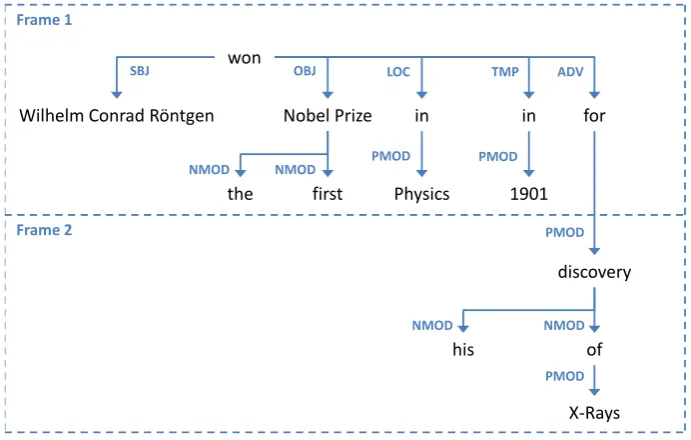
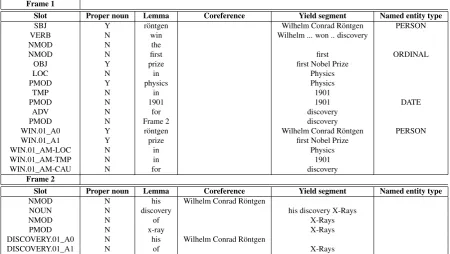
while Figure 4 shows of how the syntactically annotated sentence is divided into frames. Table 1 shows the resulting frames extracted from the sentence.
4.4.
Frame Projection
We create frame projections or subsets of frames by spec-ifying an ordered list of slots, where each slot consists of a name and a value. The slot name is made of a de-pendency label, either syntactic likeSBJ, or semantic like WIN.01_A0, and an optional modifier specifying its con-tent. The modifier can either be: yield (-Y), type (-T), or coreference (-C).
A
Wikipedia Article Text Corpus Processing
Frame Extraction
Frame Projection
Statistics Calculation
Lucene
RDF Triples
[image:3.595.104.489.67.238.2]Figure 1: Overview of the REFRACTIVEknowledge extraction architecture.
Figure 2: Dependency graph of the sentenceWilhelm Conrad Röntgen won the first Nobel Prize in Physics in 1901 for his discovery of X-Rays.
• the type indicates that the value must belong to a specific category, where the categories can be either: PERSON, LOCATION, ORGANIZATION, DATE, MONEY, NUMBER, ORDINAL, DURATION, or MISC.
• the coreference modifier specifies that the slot value must be a member of the coreference chain; the coref-erence chain is defined by the set of all its mentions.
For instance, the projection specification “SBJ-Y:Y, VERB, OBJ-Y:Y” describes frames with three slots: the yield seg-ment of a subject slot, the lemma of a verb slot, and the yield segment of an object slot. The optional suffix:Y in-dicates that both the subject and the object slots are con-strained to contain only proper nouns. REFRACTIVE in-stantiates this projected frame with slot values from frames that contain a matching set of slots.
4.5.
Frame Statistics
REFRACTIVE supports the calculation of two types of frame statistics: frequency and conditional probability. All the statistics are calculated from the resulting frame in-stances generated by the frame projections.
The frame frequency module calculates the number of times an occurrence of a specific set of slot values has been found in the corpus. For instance, it might be of interest to find out how many times a “SBJ, VERB, OBJ” projection with the values “Yankees,win,cup” occurs in a text. The conditional probability is calculated by specifying two frame projections: a target projection and a conditional pro-jection. For instance, given a conditional projection, “SBJ,
VERB”, and a target projection, “SBJ, VERB, OBJ”, RE
-FRACTIVEcalculates the conditional probability that a cer-tain object value occurs given cercer-tain values of subject and verb. Table 2 shows an example of a conditional projec-tion and how condiprojec-tional probabilities are useful in finding the countries that the United States most probably annexed. Similarly, conditional probabilities may be used to generate probable answers to other questions.
Subject Verb Object Probability
United States annex Texas 0.3
United States annex Puerto Rico 0.1
United States annex Hawaii 0.07
Table 2: An example of a “SBJ-Y:Y, VERB, OBJ-Y:Y” projection with the values SBJ:United States and VERB:annex. Conditional probability statistics based on the conditional frame projection, “SBJ-Y:Y, VERB”, have been calculated for each frame instance.
4.6.
Export and Querying
REFRACTIVE supports the export of frame projections to Lucene indices and RDF triples. Each frame projection in-stance is stored as a document in Lucene with fields set by the slot values from the projection. This enables REFRAC
[image:3.595.81.513.280.363.2]Figure 3: Semantic propositions extracted from the sentenceWilhelm Conrad Röntgen won the first Nobel Prize in Physics in 1901 for his discovery of X-Rays“Wilhelm Conrad Röntgen won the first Nobel Prize in Physics in 1901 for his discovery of X-Rays. .”
won
Wilhelm Conrad Röntgen Nobel Prize
the first
in
Physics
in
1901 for
discovery
his of
X-Rays
SBJ OBJ LOC ADV
NMOD NMOD PMOD PMOD
PMOD
NMOD NMOD
PMOD TMP Frame 1
[image:4.595.123.469.173.393.2]Frame 2
Figure 4: Frames extracted from the sentenceWilhelm Conrad Röntgen won the first Nobel Prize in Physics in 1901 for his discovery of X-Rays.
5.
Experimental Results
We processed over 4 million articles from the English edi-tion of Wikipedia and we extracted more than 260 million frames. On average, this amounts to 4.3 frames per sen-tence. To carry out the syntactic and semantic analyses, KOSHIK uses a high precision, graph-based dependency parser (Bohnet, 2010). This parser achieved an F1-score of 90.33 on the CoNLL 2009 shared task corpus at the ex-pense of a relatively slow speed. Using a 60-core cluster, corpus processing and frame extraction took 463 hours. We counted the number of predicates covered by our ex-tracted frames and we found that the frames include 95.5% of the extracted predicates. Similarly, we compared the coverage of named entity tags by the extracted frames and found that 94.9% of the named entities are included in some frames. Table 3 summarizes the statistics we extracted from Wikipedia.
Property Value
Corpus size 7.6 GB
Sentences 61,265,766
Frames extracted 263,586,849
Frames per sentence 4.3
Predicate coverage 95.5%
Named entity coverage 94.9%
Table 3: Statistics extracted from Wikipedia.
6.
Conclusions and Future Work
In this paper, we described REFRACTIVE – a tool for ex-tracting knowledge from unstructured text. We represent the extracted knowledge as semantic n-ary relations, de-scribed by a frame with a set of slot and slot values. We implemented a scalable framework for processing articles using tools that can extract, project, and query frames. By running REFRACTIVEon the English edition of Wikipedia, we have extracted over 260 million frames, covering more than 94% of the named entities and predicates present in the articles.
In the future, we plan to use REFRACTIVEfor distant su-pervision of semantic role labeling. While many languages have corpora for training syntactic parsers, fewer have cor-pora of sufficient size annotated with semantic roles. We believe that by generating frames for parallel corpora in two different languages and matching entities in parallel frames, semantic roles can be transferred from one language to an-other. Figure 5 shows an example of such a situation. The source code for REFRACTIVE is available for download at https://github.com/peterexner/ REFRACTIVE/.
7.
Acknowledgments
[image:4.595.85.254.662.750.2]Frame 1
Slot Proper noun Lemma Coreference Yield segment Named entity type
SBJ Y röntgen Wilhelm Conrad Röntgen PERSON
VERB N win Wilhelm ... won .. discovery
NMOD N the
NMOD N first first ORDINAL
OBJ Y prize first Nobel Prize
LOC N in Physics
PMOD Y physics Physics
TMP N in 1901
PMOD N 1901 1901 DATE
ADV N for discovery
PMOD N Frame 2 discovery
WIN.01_A0 Y röntgen Wilhelm Conrad Röntgen PERSON
WIN.01_A1 Y prize first Nobel Prize
WIN.01_AM-LOC N in Physics
WIN.01_AM-TMP N in 1901
WIN.01_AM-CAU N for discovery
Frame 2
Slot Proper noun Lemma Coreference Yield segment Named entity type
NMOD N his Wilhelm Conrad Röntgen
NOUN N discovery his discovery X-Rays
NMOD N of X-Rays
PMOD N x-ray X-Rays
DISCOVERY.01_A0 N his Wilhelm Conrad Röntgen
[image:5.595.71.522.70.324.2]DISCOVERY.01_A1 N of X-Rays
Table 1: The two frames extracted from the sentence: Wilhelm Conrad Röntgen won the first Nobel Prize in Physics in 1901 for his discovery of X-Rays.
English frame
SBJ Einstein A0
VERB received receive.01
NMOD the
NMOD 1921
OBJ Nobel Prize A1
TMP in
PMOD Physics
Swedish frame
SS Einstein A0
VERB fick få.01
DT 1921
DT års
OO Nobelpris A1
ET i
HD fysik
Figure 5: Using frames to create a training corpus for se-mantic role labeling.
8.
References
Agichtein, E. and Gravano, L. (2000). Snowball: extract-ing relations from large plain-text collections. In Pro-ceedings of DL ’00, pages 85–94, New York. ACM. Auer, S., Bizer, C., Kobilarov, G., Lehmann, J., Cyganiak,
R., and Ives, Z. (2007). DBpedia: A nucleus for a web of open data. InThe Semantic Web, volume 4825 ofLNCS, pages 722–735. Springer Berlin.
Augenstein, I., Padó, S., and Rudolph, S. (2012). LODi-fier: Generating linked data from unstructured text. In The Semantic Web: Research and Applications, volume 7295 ofLNCS, pages 210–224. Springer Berlin.
Banko, M. and Etzioni, O. (2007). Strategies for lifelong knowledge extraction from the web. In Proceedings of K-CAP ’07, pages 95–102, New York. ACM.
Björkelund, A., Hafdell, L., and Nugues, P. (2009). Mul-tilingual semantic role labeling. InProceedings of The Thirteenth Conference on Computational Natural Lan-guage Learning (CoNLL-2009), pages 43–48, Boulder,
June 4-5.
Björkelund, A., Bohnet, B., Hafdell, L., and Nugues, P. (2010). A high-performance syntactic and semantic de-pendency parser. In Coling 2010: Demonstration Vol-ume, pages 33–36, Beijing, August 23-27. Coling 2010 Organizing Committee.
Bohnet, B. (2010). Top accuracy and fast dependency pars-ing is not a contradiction. In Huang, C.-R. and Jurafsky, D., editors,COLING, pages 89–97. Tsinghua University Press.
Carlson, A., Betteridge, J., Kisiel, B., Settles, B., Hruschka, E. R., and Mitchell, T. M. (2010). Toward an architec-ture for never-ending language learning. InProceedings of AAAI-10, pages 1306–1313.
Cattoni, R., Corcoglioniti, F., Girardi, C., Magnini, B., Ser-afini, L., and Zanoli, R. (2012). The KnowledgeStore: an entity-based storage system. InProceedings of LREC 2012, Istanbul, may.
Christensen, J., Mausam, Soderland, S., and Etzioni, O. (2010). Semantic role labeling for open information ex-traction. InProceedings of the NAACL HLT 2010 First International Workshop on Formalisms and Methodol-ogy for Learning by Reading, FAM-LbR ’10, pages 52– 60.
Etzioni, O., Cafarella, M., Downey, D., Kok, S., Popescu, A.-M., Shaked, T., Soderland, S., Weld, D. S., and Yates, A. (2004). Web-scale information extraction in know-itall. InProceedings of WWW ’04, pages 100–110, New York. ACM.
[image:5.595.54.287.375.501.2]Fader, A., Soderland, S., and Etzioni, O. (2011). Identify-ing relations for open information extraction. InProc. of EMNLP ’11, pages 1535–1545.
Fan, J., Ferrucci, D., Gondek, D., and Kalyanpur, A. (2010). Prismatic: Inducing knowledge from a large scale lexicalized relation resource. In Proceedings of the NAACL HLT 2010 First International Workshop on Formalisms and Methodology for Learning by Reading, pages 122–127.
Fan, J., Kalyanpur, A., Gondek, D. C., and Ferrucci, D. (2012). Automatic knowledge extraction from doc-uments. IBM Journal of Research and Development, 56(3.4):5:1–5:10.
Ferrucci, D. A. (2012). Introduction to “This is Watson”. IBM Journal of Research and Development, 56(3.4):1:1 –1:15, may-june.
Lee, H., Peirsman, Y., Chang, A., Chambers, N., Sur-deanu, M., and Jurafsky, D. (2011). Stanford’s multi-pass sieve coreference resolution system at the CoNLL-2011 shared task. In Proceedings of the CoNLL-2011 Shared Task, pages 28–34, Boulder.
Lenat, D. B. (1995). Cyc: A large-scale investment in knowledge infrastructure. Communications of the ACM, 38(11):33–38.
Mausam, Schmitz, M., Soderland, S., Bart, R., and Etzioni, O. (2012). Open language learning for information ex-traction. InProceedings of the 2012 Joint Conference on EMNLP and CoNLL, pages 523–534, Jeju Island, July. Miller, G. and Fellbaum, C. (1998). Wordnet: An
elec-tronic lexical database. MIT Press Cambridge.
Palmer, M., Gildea, D., and Kingsbury, P. (2005). The Proposition Bank: an annotated corpus of semantic roles. Computational Linguistics, 31(1):71–105.
Raghunathan, K., Lee, H., Rangarajan, S., Chambers, N., Surdeanu, M., Jurafsky, D., and Manning, C. (2010). A multi-pass sieve for coreference resolution. In Proc. of EMNLP-2010, pages 492–501, Boston.
Ruppenhofer, J., Ellsworth, M., Petruck, M. R. L., John-son, C. R., and Scheffczyk, J. (2010). Framenet ii: Extended theory and practice. http://framenet. icsi.berkeley.edu/, September.
Singhal, A. (2012). Introducing the knowledge graph: things, not strings. Official Google Blog, May.
Suchanek, F. M., Kasneci, G., and Weikum, G. (2007). Yago: A Core of Semantic Knowledge. In16th interna-tional World Wide Web conference (WWW 2007), New York, NY, USA. ACM Press.