Proceedings of the 55th Annual Meeting of the Association for Computational Linguistics-System Demonstrations, pages 79–84 Vancouver, Canada, July 30 - August 4, 2017. c2017 Association for Computational Linguistics
Proceedings of the 55th Annual Meeting of the Association for Computational Linguistics-System Demonstrations, pages 79–84 Vancouver, Canada, July 30 - August 4, 2017. c2017 Association for Computational Linguistics
RelTextRank: An Open Source Framework for Building Relational
Syntactic-Semantic Text Pair Representations
Kateryna Tymoshenko† and Alessandro Moschitti and Massimo Nicosia† and Aliaksei Severyn† †DISI, University of Trento, 38123 Povo (TN), Italy
Qatar Computing Research Institute, HBKU, 34110, Doha, Qatar
{kateryna.tymoshenko,massimo.nicosia}@unitn.it {amoschitti,aseveryn}@gmail.com
Abstract
We present a highly-flexible UIMA-based pipeline for developing structural kernel-based systems for relational learning from text, i.e., for generating training and test data for ranking, classifying short text pairs or measuring similarity between pieces of text. For example, the proposed pipeline can represent an input question and answer sentence pairs as syntactic-semantic structures, enriching them with relational information, e.g., links between question class, focus and named entities, and serializes them as training and test files for the tree kernel-based reranking framework. The pipeline generates a num-ber of dependency and shallow chunk-based representations shown to achieve competitive results in previous work. It also enables easy evaluation of the models thanks to cross-validation facilities.
1 Introduction
A number of recent works (Severyn et al.,
2013; Tymoshenko et al., 2016b,a; Tymoshenko and Moschitti,2015) show that tree kernel meth-ods produce state-of-the-art results in many dif-ferent relational tasks, e.g., Textual Entailment Recognition, Paraphrasing, question, answer and comment ranking, when applied to syntactico-semantic representations of the text pairs.
In this paper, we describeRelTextRank, a flex-ible Java pipeline for converting pairs of raw texts into structured representations and enriching them with semantic information about the relations be-tween the two pieces of text (e.g., lexical exact match). The pipeline is based on the Apache UIMA technology1, which allows for the creation
1https://uima.apache.org/
of highly modular applications and analysis of large volumes of unstructured information.
RelTextRank is an open-source tool avail-able at https://github.com/iKernels/ RelTextRank. It contains a number of generators for shallow and dependency-based structural representations, UIMA wrappers for multi-purpose linguistic annotators, e.g., Stanford CoreNLP (Manning et al.,2014), question classi-fication and question focus detection modules, and a number of similarity feature vector extractors. It allows for: (i) setting experiments with the new structures, also introducing new types of relational links; (ii) generating training and test data both for kernel-based classification and reranking, also in a cross-validation setting; and (iii) generating pre-dictions using a pre-trained classifier.
In the remainder of the paper, we describe the structures that can be generated by the sys-tem (Sec2), the overall RelTextRank architecture (Sec3) and the specific implementation of its com-ponents (Sec4). Then, we provide some examples of how to run the pipeline from the command line (Sec5)2. Finally, in Sec6, we report some results
using earlier versions of RelTextRank.
2 Background
Recent work in text pair reranking and classi-fication, e.g., answer sentence selection (AS) and community question answering (cQA), has stud-ied a number of structures for representing text pairs along with their relational links, which pro-vide competitive results when used in a standalone system and the state of the art when combined with feature vectors (Severyn et al., 2013; Ty-moshenko et al., 2016b; Tymoshenko and Mos-chitti,2015) and embeddings learned by the neural networks (Tymoshenko et al.,2016a). In this
sec-2The detailed documentation is available on the related
GitHub project.
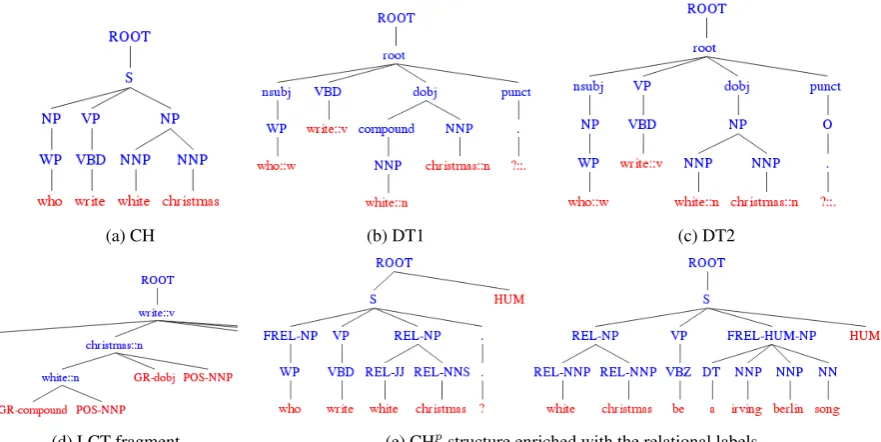
(a) CH (b) DT1 (c) DT2
[image:2.595.78.519.66.287.2](d) LCT fragment (e) CHpstructure enriched with the relational labels
Figure 1: Structures generated byRelTextRank
tion, we provide an overview of the structures and relational links that can be generated by RelTex-tRank (specific details are in the above papers).
2.1 RelTextRank Structures
RelTextRank can generate the following struc-tural representations for a text pair hT1, T2i,
where, e.g., T1 can be a question and T2 a
can-didate answer passage for an AS task.
Shallow pos-chunk tree representation (CH and CHp). Here,T
1 andT2 are both represented
as shallow tree structures with lemmas as leaves, their tags as their parent nodes. The POS-tag nodes are further grouped under chunk and sentence nodes. We provide two versions of this structure: CHp (Fig. 1e), which keeps all
infor-mation while CH (Fig. 1a) excludes punctuation marks and words outside of any chunk.
Constituency tree representation (CONST).
Standard constituency tree representation.
Dependency tree representations. We pro-vide three dependency-based relational structures: DT1, DT2 and LCT. DT1 (Fig. 1b) is a depen-dency tree in which grammatical relations become nodes and lemmas are located at the leaf level. DT2 (Fig. 1c) is DT1 modified to include the chunking information, and lemmas in the same chunk are grouped under the same chunk node. Finally, LCT (Fig. 1d) is a lexical-centered de-pendency tree (Croce et al.,2011) with the gram-matical relationREL(head, child)represented as
(head (childGR-RELPOS-pos(head)). Here REL
is a grammatical relation,head andchild are the head and child lemmas in the relation, respec-tively, andpos (head)is the POS-tag of the head lemma. GR- andPOS- tags in the node name in-dicate that the node is a grammar relation or part-of-speech node, respectively.
2.2 RelTextRank relational links
Experimental results on multiple datasets ( Sev-eryn et al., 2013; Severyn and Moschitti, 2012) show that encoding information about the relations betweenT1andT2is crucial for obtaining the state
of the art in text pair ranking and classification. RelTextRank provides two kinds of links: hard string match,REL, and semantic match,FREL.
REL. If some lemma occurs both inT1 and T2,
we mark the respective POS-tag nodes and their parents in the structural representations ofT1 and T2 with REL labels for all the structures, except for LCT. In LCT, we mark with REL- the POS (POS-) and grammar relation (GR-) nodes.
FREL. When working in the question answering setting, i.e., whenT1is a question andT2is a
can-didate answer passage, we encode the question fo-cus and question class information into the struc-tural representations. We useFREL-<QC>tag to mark question focus inT1. Then, inT2, we mark
all the named entitiesT2 of type compatible with
the question class3. Here, <QC> is substituted
3We use the following mappings to check for compatibility(Stanford
System Experiment Projector
OutputWriter Ti1
VectorFeatureExtractor Ti
Tin
…. UIMA pipeline
4. Submit (CASi, CASij)
5. Return (R(Ti,Tij), R(Tij,Ti))
6. Submit (CASi, CASij, R(Ti,Tij), R(Tij,Ti))
7. Similarity feature vector
FVi,ij 9. Submit
(R(Ti,Tij), R(Tij,Ti), FVi,ij) Input
MLExamplei,i1 Output
MLExamplei,in
…
1. Su bmit
(Ti,T ij)
2. Get (CAS
i , CAS
ij)
3. Submit (CASi, CASij)
[image:3.595.129.470.62.223.2]8. Return (R(Ti,Tij), R(Tij,Ti), FVi,ij)
Figure 2: Overall framework
with an actual question class. For all structures in Sec. 2.1, except LCT, we prepend the
FREL-<QC>tag to the grand-parents of the lemma nodes.
In case of LCT, we mark the child grammatical (GR-) and POS-tag (POS-) nodes of the lemma nodes. Finally, only in case of CHp structure we
also add<QC>to theROOTtree node as its right-most child, and mark the question focus node sim-ply asFREL. Fig.1eshows an example of a CHp
enriched withRELandFRELlinks.4
3 System Architecture
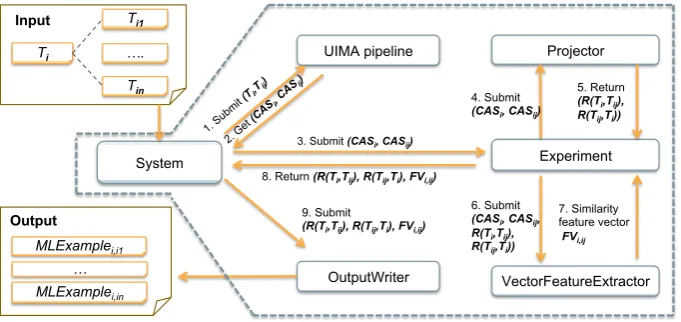
RelTextRankhas a modular architecture easy to adjust towards new structures, features and rela-tional links (see Fig.2). The basic input of RelTex-tRankis a textTi, and a list ofntexts,Ti1, ..., Tin
to be classified or reranked as relevant or not for
Ti. For example, in the QA setting,Ti would be
a question andTij,j = 1, ..., nwould be a list of
n candidate answer passages. The output of the
system is a file in the SVMLight-TK5format
con-taining the relational structures and feature vectors generated from thehTi,(Ti1, ..., Tin)ituples.
When launched, theRelTextRankSystem mod-ule first initializes the other modmod-ules, such as the
UIMA text analysis pipeline responsible for lin-guistic annotation of input texts, theExperiment
module responsible for generating the structural representations enriched with the relational labels, and, finally, the OutputWriter module, which generates the output in the SVMLight-TK format. At runtime, given an input hTi,(Ti1, ..., Tin)i
tuple,RelTextRank generates(Ti, Tij) pairs (j =
1, ..., n), and performs the following steps:
4Note that the structures in Fig.1a-1dhere are depicted withoutRELand
FRELlinks, however, at runtime the classes described in Sec.4do enrich them with the links
5http://disi.unitn.it/moschitti/Tree-Kernel.htm
Step 1. Linguistic annotation. It runs a pipeline of UIMA Analysis Engines (AEs), which wrap linguistic annotators, e.g., Sentence Splitters, To-kenizers, Syntactic parsers, to convert the input text pairs(Ti, Tij)into the UIMA Common
Anal-ysis Structures (CASes), i.e.,(CASiandCASij).
CASes contain the original texts and all the lin-guistic annotations produced by AEs. These pro-duce linguistic annotations defined by a UIMA Type System. In addition, there is an option to per-sist the produced CASes, and not to rerun the an-notators when re-processing a specific document.
Step 2. Generation of structural representa-tions and feature vectors.TheExperiment mod-ule is the core architectural component of the sys-tem, which takes CASes as input and generates the relational structures forTiandTij along with their
feature vector representation,F Vi,ij.R(Ti, Tij)is
the relational structure for Tienriched with the
re-lational links towardsTij, whileR(Tij, Ti)is the
opposite, i.e., the relational structure forTij with
respect to Ti. Here, the Projector module
gen-erates(R(Ti, Tij), R(Tij, Ti))and the VectorFea-tureExtractormodule generatesF Vi,ij. In Sec.4,
we provide a list of Experiment modules that im-plement the representations described in Sec.2.1, and a list of feature extractors to generateF Vi,ij. Step 3. Generation of the output files. Once, all the pairs generated from thehTi,(Ti1, ..., Tin)i
tu-ple have been processed, theOutputWriter mod-ule writes them into training/test files. We provide several output strategies described in Sec.4.
4 Architecture Components
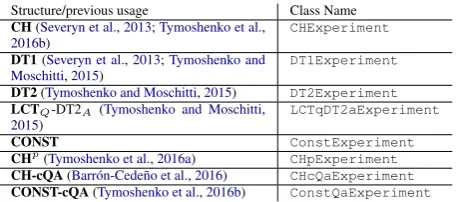
In order to generate the particular configuration of train/test data, one must specify whichSystem,
Structure/previous usage Class Name
CH(Severyn et al.,2013;Tymoshenko et al.,
2016b) CHExperiment
DT1(Severyn et al.,2013;Tymoshenko and
Moschitti,2015) DT1Experiment
DT2(Tymoshenko and Moschitti,2015) DT2Experiment
LCTQ-DT2A (Tymoshenko and Moschitti,
2015) LCTqDT2aExperiment
CONST ConstExperiment
CHp(Tymoshenko et al.,2016a) CHpExperiment
CH-cQA(Barr´on-Cede˜no et al.,2016) CHcQaExperiment
[image:4.595.62.292.61.162.2]CONST-cQA(Tymoshenko et al.,2016b) ConstQaExperiment
Table 1: List of experimental configurations
to be used. In this section, we describe the imple-mentations of the architectural modules currently available within RelTextRank.
System modules. These are the entry point to the pipeline, they initialize the specific structure and feature vector generation strategies ( Exper-iment and VectorFeatureExtractor) and define the type (classification or reranking) and the format of the output file. Currently, we provide the system modules for generating classification
(ClassTextPairConversion) and
rerank-ing trainrerank-ing (RERTextPairConversion) files. Then, we provide a method to gen-erate the cross-validation experimental data
(ClassCVTextPairConversion and
CVR-ERTextPairConversion). Additionally,
we provide a method for generating training/test data for the answer comment reranking in cQA,
CQASemevalTaskA. Finally, we provide a
prediction module for classifying and rerank-ing new text pairs with a pre-trained classifier
(TextPairPrediction).
Every System module uses a single Out-putWriter module, whose type of Experiment and FeatureVectorExtractor to be used are specified with command line parameters (see Sec.5.)
UIMA pipeline. We provide the UIMA AEs (see
it.unitn.nlpir.annotators), wrapping
the components of the Stanford pipeline (Manning et al., 2014) and Illinois Chunker (Punyakanok and Roth,2001). The UIMA pipeline takes a pair of texts, (Ti, Tij) as input, and outputs their
re-spective CASes,(CASi, CASij).
RelTextRank also includes AEs for question classification (QuestionClassifier) and question focus detection (
QuestionFocus-Annotator). Focus classification module
employs a model pre-trained as in (Severyn et al.,
2013).QuestionClassifiercan be run with
coarse- and fine-grained question classification models trained on the UIUC corpus by (Li and
Algorithm 1Generating training data for reranking Require:Sq+,Sq−-(Ti, Tij)pairs with positive and negative labels,
re-spectively
1: E+← ∅,E−← ∅,f lip←true
2: for alls+∈Sq+do 3: for alls−∈Sq−do
4: iff lip==true then 5: E+←E+∪(s+, s−)
6: f lip←false
7: else
8: E−←E−∪(s−, s+)
9: f lip←true
10:returnE+,E−
Roth,2002) as described in (Severyn et al.,2013). The coarse-grained classier uses the following categories, HUMan, ENTitY, LOCation, ABBR, DESCription, NUMber classes, whereas the fine-grained classifier splits the NUM class into DATE, CURRENCY and QUANTITY.
Currently, we use a custom UIMA type system defined for our pipeline, however, in future we plan to use the type systems used in other widely used UIMA pipelines, e.g., DKPro (de Castilho and Gurevych,2014).
Experiment modules. All the Experiment mod-ule implementations are available as classes in the
it.unitn.nlpir.experiment.*package.
Tab.1provides an overview of the structures cur-rently available within the system. Here LCTQ
-DT2A represents Ti and Tij as LCT and DT2
structures, respectively. CH-cQA and CONST-cQA are the CH and CONST structures adjusted for cQA (see (Tymoshenko et al.,2016b)).
OutputWriter modules. In the it.unitn.
nlpir.system.datagen package, we
pro-vide the OutputWriters, which output the data in the SVMLight-TK format in the classifica-tion (ClassifierDataGen) and the reranking
(RerankingDataGenTrain and
Rerank-ingDataGenTest) modes. Currently, the type
of the OutputWriter can only be specified in the code of the System module. It is possible to create a new System module starting from the existing one and code a different OutputWriter.
In the classification mode, one OutputWriter generates one example for each text pair(Ti, Tij).
Another OutputWriter implementation generates input data for kernel-based reranking (Shen et al.,
2003) using the strategy described in Alg.1.
VectorFeatureExtractors.RelTextRank contains feature extractors to compute: (i) cosine similar-ityover the text pair: simCOS(T1, T2), where the
rep-Command 1. Generate training data
java -Xmx5G -Xss512m it.unitn.nlpir.system.core.RERTextPairConversion -questionsPathdata/wikiQA/WikiQA-train.questions.txt
-answersPathdata/wikiQA/WikiQA-train.tsv.resultset-outputDirdata/examples/wikiqa-filePersistenceCASes/wikiQA
-candidatesToKeep10-modetrain-expClassNameit.unitn.nlpir.experiment.fqa.CHExperiment
-featureExtractorClassit.unitn.nlpir.features.presets.BaselineFeatures
Command 2. Use pre-trained model to do classification
java -Xmx5G -Xss512m it.unitn.nlpir.system.core.TextPairPrediction -svmModeldata/wikiQA/wikiqa-ch-rer-baselinefeats.model
-featureExtractorClassit.unitn.nlpir.features.presets.BaselineFeatures-questionsPathdata/wikiQA/WikiQA-test.questions.txt
-answersPathdata/wikiQA/WikiQA-test.tsv.resultset-outputFiledata/examples/wikiqa/wikiqa-ch-rer-baselinefeats.pred
-expClassNameit.unitn.nlpir.experiment.fqa.CHExperiment-modereranking-filePersistenceCASes/wikiQA/test
Table 2: Example commands to launch the pipeline
resentations of T1 and T2: simP T K (T1, T2) = P T K(T1, T2), where the input trees can both be
the dependency trees and/or the shallow chunk trees; (ii) IR score, which is a normalized score assigned to the answer passage by an IR engine, if available; (iii)question classas a binary feature.
Then, RelTextRank includes feature extractors based on the DKPro Similarity tool (B¨ar et al.,
2013) for extracting (iv) longest common sub-string/subsequence measure; (v)Jaccard similar-itycoefficient on 1,2,3,4-grams; (vi)word contain-ment measure(Broder, 1997); (vii) greedy string tiling(Wise,1996); and (viii)ESA similaritybased on Explicit Semantic Analysis (ESA) (Gabrilovich and Markovitch,2007),
We provide several predefined VectorFeature-Extractors: BaselineFeatures,
AllFea-tures and NoESAAllFeatures6, which
in-corporate feature groups: (i)-(iii), (i)-(viii) and (i)-(vii), respectively. Finally, we provide a ture extractor that reads the pre-extracted fea-tures from file, FromFileVectorFeature. The full list of features can be found by ex-ploring the contents and documentation of the
it.unitn.nlpir.featurespackage.
5 Running the pipeline
Documentation on the RelTextRank GitHub ex-plains how to install and run the pipeline with the various reranking and classification configu-rations. Due to the space limitations, here we only provide the sample commands for running the training file generation for the reranking mode (Tab.2, Command 1) and using a pretrained model to rank the produced data (Tab.2, Command 2).
Command 1 runs the RERTextPairConversion system (see Sec. 4), using the files specified as
-questionsPath and -answersPath parameters to read the questions (Ti in Fig 2) and their
corre-6The motivation behind this feature extractor is that ESA feature extrac-tion process is time-consuming
sponding candidate answers (Tij, in Fig 2 with
j = 1, ..., n;-candidatesToKeep parameter
spec-ifies the value of n), respectively. -outputDir is
a path to the folder that will contain the resulting training file, while-filePersistenceindicates where to persist the UIMA CASes containing the linguis-tic annotations produced by the UIMA pipeline (this is optional). -mode train indicates that we are generating the training file. -expClassName
is a mandatory parameter, which indicates the Experiment module (Fig. 2) we want to invoke, i.e., which structure we wish to generate. In this specific example, we build a CH structure (see Tab.1). Finally, -featureExtractorClass specifies which features to include into the feature vector.
Command 2 runs a pipeline that uses a pre-trained SVMLight-TK model (-svmModel
parameter) to rerank the candidate an-swers (-answerPath) for the input questions (-questionsPath), and stores them into a pre-diction file (-outputFile). Here, we also in-dicate which structure generator and feature extractors to be used (-expClassName and -featureExtractorClass). Note that-expClassName
and -featureExtractorClass must be exactly the same as the ones used when generating the data for training the model specified bysvmModel.
6 Previous uses of RelTextRank
Tab.3 reports the results of some of the state-of-the-art AS and cQA systems that employ
Rel-TextRank as a component and combine the
structures produced by it with the feature vectors of different nature, V. Here feature vectors are
either manually handcrafted thread-level features,
Vt, or word and phrase vector features, Vb, for
cQA; or embeddings ofTi,Tij learned by
Convo-lutional Neural Networks,VCN N, for the AS task.
Corpus Reference paper Struct. Feat. MRRVMAP MRR+ Rel.StructuresMAP WikiQA (Tymoshenko et al.,2016a)∗ CHp V
CN N 67.49 66.41 73.88 71.99
TREC13 (Tymoshenko et al.,2016a) CH VCN N 79.32 73.37 85.53* 75.18*
SemEval-2016, 3.A, English (Tymoshenko et al.,2016b) CONST Vt 82.98 73.50 86.26 78.78
[image:6.595.76.522.64.125.2]SemEval-2016, 3.D, Arabic (Barr´on-Cede˜no et al.,2016) CONST Vb 43.75 38.33 52.55 45.50
Table 3: Previous uses of RelTextRank
mention which of the structures described in Sec.2
they employ. (Tymoshenko et al.,2016a)∗is a new
structure and embedding combination approach. We show the results on two AS corpora, Wik-iQA (Yang et al., 2015) and TREC13 (Wang et al., 2007). Then, we report the results ob-tained when usingRelTextRankin a cQA sys-tem for English and Arabic comment selection tasks in the SemEval-2016 competition, Tasks 3.A and 3.D (Nakov et al.,2016).
V column reports the performance of the
sys-tems that employ feature vectors only, while +Rel.Structurescorresponds to the systems
us-ing a combination of relational structures gener-ated by the earlier versions ofRelTextRankand feature vectors. The numbers marked by * were obtained using relational structures only, since combining features and trees decreased the overall performance in that specific case. Rel.Structures
always improves the performance.
7 Conclusions
In this demonstration paper we have provided an overview of the architecture and the particu-lar components of the RelTextRank pipeline for generating structural relational representations of text pairs. In previous work, these representa-tions have shown to achieve the state of the art for factoid QA and cQA. In the future, we plan to further evolve the pipeline, improving its code and usability. Moreover, we plan to expand the publicly available code to include more relational links, e.g., Linked Open Data-based relations de-scribed in (Tymoshenko et al.,2014). Finally, in order to enable better compatibility with publicly available tools, we plan to adopt the DKPro type system (de Castilho and Gurevych,2014).
Acknowledgments
This work has been partially supported by the EC project CogNet, 671625 (H2020-ICT-2014-2, Research and Innovation action).
References
D. B¨ar, T. Zesch, and I. Gurevych. 2013. Dkpro similarity: An open source framework for text similarity. In ACL: System Demonstrations.
A. Barr´on-Cede˜no, G. Da San Martino, S. Joty, A. Moschitti, F. Al-Obaidli, S. Romeo, K. Tymoshenko, and A. Uva. 2016. Convkn at semeval-2016 task 3: Answer and ques-tion selecques-tion for quesques-tion answering on arabic and english fora. InSemEval-2016.
A. Z Broder. 1997. On the resemblance and containment of documents. InSEQUENCES.
D. Croce, A. Moschitti, and R. Basili. 2011.Structured lexi-cal similarity via convolution kernels on dependency trees. InEMNLP.
R. Eckart de Castilho and I. Gurevych. 2014. A broad-coverage collection of portable NLP components for building shareable analysis pipelines. In OIAF4HLT Workshop (COLING).
E. Gabrilovich and S. Markovitch. 2007. Computing se-mantic relatedness using wikipedia-based explicit seman-tic analysis. InIJCAI.
X. Li and D. Roth. 2002. Learning question classifiers. In
COLING.
C. D. Manning, M. Surdeanu, J. Bauer, J. Finkel, S. J. Bethard, and D. McClosky. 2014.The Stanford CoreNLP natural language processing toolkit. InACL.
P. Nakov, L. M`arquez, A. Moschitti, W. Magdy, H. Mubarak, A. Freihat, J. Glass, and B. Randeree. 2016. Semeval-2016 task 3: Community question answering. InSemEval. V. Punyakanok and D. Roth. 2001. The use of classifiers in
sequential inference. InNIPS.
A. Severyn and A. Moschitti. 2012. Structural relationships for large-scale learning of answer re-ranking. InSIGIR. A. Severyn, M. Nicosia, and A. Moschitti. 2013. Learning
adaptable patterns for passage reranking. InCoNLL. L. Shen, A. Sarkar, and A. Joshi. 2003. Using LTAG Based
Features in Parse Reranking. InEMNLP.
K. Tymoshenko, D. Bonadiman, and A. Moschitti. 2016a.
Convolutional neural networks vs. convolution kernels: Feature engineering for answer sentence reranking. In
NAACL-HLT.
K. Tymoshenko, D. Bonadiman, and A. Moschitti. 2016b.
Learning to rank non-factoid answers: Comment selection in web forums. InCIKM.
K. Tymoshenko and A. Moschitti. 2015. Assessing the im-pact of syntactic and semantic structures for answer pas-sages reranking. InCIKM.
K. Tymoshenko, A. Moschitti, and A. Severyn. 2014. Encod-ing semantic resources in syntactic structures for passage reranking. InEACL.
Mengqiu Wang, Noah A. Smith, and Teruko Mitaura. 2007. What is the Jeopardy model? A quasi-synchronous gram-mar for QA. InEMNLP-CoNLL.
Michael J. Wise. 1996.Yap3: improved detection of similari-ties in computer program and other texts. InACM SIGCSE Bulletin.