The Scielo Corpus:
a Parallel Corpus of Scientific Publications for Biomedicine
Mariana Neves
∗, Antonio Jimeno Yepes
†, Aur´elie N´ev´eol
‡ ∗Hasso-Plattner InstituteAugust-Bebel-Str. 88 14482 Potsdam - Germany [email protected]
†IBM Research Australia, Carlton 3053 VIC - Australia,
University of Melbourne, Parkville 3010 VIC - Australia [email protected]
‡LIMSI, CNRS, UPR 3251 Universit´e Paris-Saclay F-91405 Orsay - France
Abstract
The biomedical scientific literature is a rich source of information not only in the English language, for which it is more abundant, but also in other languages, such as Portuguese, Spanish and French. We present the first freely available parallel corpus of scientific publications for the biomedical domain. Documents from the ”Biological Sciences” and ”Health Sciences” categories were retrieved from the Scielo database and parallel titles and abstracts are available for the following language pairs: Portuguese/English (about 86,000 documents in total), Spanish/English (about 95,000 documents) and French/English (about 2,000 documents). Additionally, monolingual data was also collected for all four languages. Sentences in the parallel corpus were automatically aligned and a manual analysis of 200 documents by native experts found that a minimum of 79% of sentences were correctly aligned in all language pairs. We demonstrate the utility of the corpus by running baseline machine translation experiments. We show that for all language pairs, a statistical machine translation system trained on the parallel corpora achieves performance that rivals or exceeds the state of the art in the biomedical domain. Furthermore, the corpora are currently being used in the biomedical task in the First Conference on Machine Translation (WMT’16).
Keywords:parallel corpus, machine translation, biomedicine
1.
Introduction
Researchers make available new findings and knowledge in biology and medicine through the publication of research articles. However, the volume of the biomedical literature grows at a large rate, which poses a challenge to keep up with new discoveries. Even though a large volume of pa-pers are published in English, there are also many publica-tions written in languages other than English.
Access to the biomedical literature is available on-line via systems such as PubMed®1, that allow researchers to browse and search for publications of their interest. Even though English is thede factoofficial language in the scien-tific community, many researchers have limited proficiency in English and feel more comfortable with reading scien-tific prose written in their native language. The same goes for patients who might find it difficult to understand medi-cal records when they are written in a language other than their native language. Furthermore, articles published in lo-cal research journals are accessible only for researchers flu-ent in the original language of the article. This is typically the case for articles available in databases such as Scielo2, which has a focus on Latin American publications. Machine translation (MT) can provide a solution to in-crease the access to the biomedical literature (Pecina et al., 2014) and to health information in general (Kirchhoff et al., 2011). For instance, it was successfully used as the
ba-1
http://www.ncbi.nlm.nih.gov/pubmed
2http://www.scielo.org/
sis for query translation in cross-language information re-trieval (Pecina et al., 2014). Although there has been much work in this field (Bojar et al., 2014), the automatic transla-tion of scientific publicatransla-tions has not received much atten-tion of the community, in part because of the difficulty of getting parallel collections of documents.
PubMed is the largest database for scientific publications in biomedicine, and has been extensively used in many biomedical natural language processing applications. How-ever, only titles are available in more than one language in PubMed (Wu et al., 2011). Previous work (Jimeno Yepes et al., 2013) relied on titles extracted from PubMed and ab-stract texts extracted from various journals’ web sites for experiments on MT, but licenses issues limited the distribu-tion of the corpora used in the work.
Herein, we describe the construction of the first freely avail-able parallel collection of scientific publications for the biomedical domain. The documents were derived from Sci-elo3, a database of open access scientific publications with a focus on developing and emerging countries, and especially on Latin America. Scielo currently includes publications in a variety of domains, such as agriculture, engineering, bi-ological and health sciences. It includes abstracts and full texts for publications, mainly in Portuguese and Spanish, but also in English, French and German.
The intended purpose of this parallel corpus is to train and evaluate MT systems. To this end, we created parallel corpora for three pairs of languages: Spanish-English
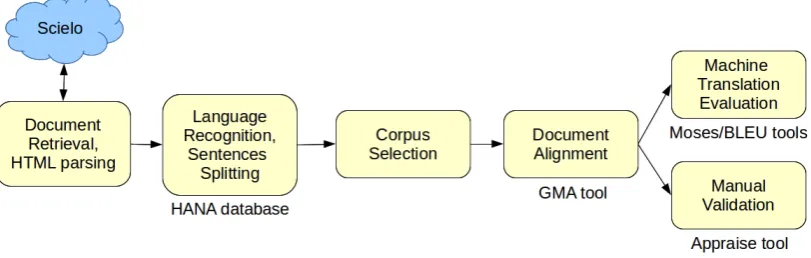
Figure 1: Work-flow of the construction of the parallel collection of biomedical publications.
(ES/EN), French-English (FR/EN) and Portuguese-English (PT/EN). These collections are used as training data for the biomedical shared task4 in the First Conference on Machine Translation (WMT16). In this paper, we describe the set of documents which was collected, though we have currently only released the training dataset, while the test dataset is being kept for future release during the shared task. Examples of the sentences for all language pairs, i.e., ES/EN, FR/EN and PT/EN, are shown below:
La especie m´as frecuente aislada de pacientes de ambas regiones fue L. paracasei ssp paracasei 1.
Lactobacillus paracasei ssp paracasei 1 was the most frequently isolated species in both regions.
Le seul traitement valid´e pour soigner cet ´etat est l’immunoth´erapie passive avec des s´erums antivenimeux d’origine animale sˆurs et efficaces.
The only validated treatment for this condition is passive immunotherapy with safe and effective animal-derived antivenoms.
Avaliac¸˜ao da forc¸a muscular perif´erica de pacientes sub-metidos `a cirurgia card´ıaca eletiva: estudo longitudinal. Evaluation of peripheral muscle strength of patients under-going elective cardiac surgery: a longitudinal study.
2.
Related Work
The development of parallel corpora as translation mem-ories and use for training MT systems has been an active area of research. Previous work has addressed various types of documents, domains and language pairs. Popular paral-lel corpora in specialized domains include the News Com-mentary corpus5, composed of news related documents and commonly used in the WMT challenges, the EuroParl cor-pus (Koehn, 2005), derived from the European Parliament proceedings, and the Acquis corpus (Steinberger et al., 2006), which contains legal documents for more than 20 European languages.
4
http://www.statmt.org/wmt16/ biomedical-translation-task.html
5http://www.statmt.org/wmt16/
translation-task.html
The OPUS corpus (Tiedemann, 2012) contains some sub-domain data covering the biomedical sub-domain with EMEA (European Medicines Agency) documents, which were later used, along with MEDLINE®titles, to produce paral-lel annotated data following the CLEF-ER 2013 challenge (Kors et al., 2015) and for named-entity recognition and normalization for French in the QUAERO corpus (N´ev´eol et al., 2014). Previous attempts to train statistical MT sys-tems for biomedicine include the pioneer work using a corpus of MEDLINE titles (Wu et al., 2011), use of the Cochrane Systematic Reviews for the FR/EN language pair (N´ev´eol et al., 2013), use of publication titles and abstracts for both ES/EN and FR/EN language pairs (Jimeno Yepes et al., 2013) and building an application to produce public health information (Kirchhoff et al., 2011). In summary, currently, there are limited resources for training and eval-uating MT systems for the biomedical domain as previous work is limited to either document titles or one particular language pair, e.g., FR/EN.
3.
Methods
In this section we present our methodology for constructing parallel corpus of scientific publication for biomedicine derived from the Scielo database. The work-flow is illustrated in Figure 1 and each phase is described in details below.
3.1.
Document retrieval and HTML parsing
each publication. Titles and abstracts were subsequently stored and indexed in the SAP HANA database6.
All translations of the abstracts in Scielo are the original texts provided by the authors of the publications, who are presumably not professional translators, and who may not have native proficiency in both languages. All publi-cations are available under either the Creative Commons Attribution-Noncommercial 3.0 Unported (cc-by-nc) or Attribution 3.0 Unported (cc-by) licenses, which makes all documents suitable for redistribution and research purposes.
3.2.
Language recognition and Sentence
Splitting
We used the HANA database to perform language recogni-tion in the texts and their segmentarecogni-tion into sentences. Al-though the language of the publication is usually identified in the Scielo URL, we noticed that there are many situations in which the abstract is in one language and the title in an-other, making the language recognition step necessary. For instance, the document S0874-489020100003000067 con-tains the abstracts available in French, Spanish and English, four different HTML pages, but the title is always in Por-tuguese in all of them.
We decided to use the HANA database tool for sentence splitting after finding that it compared favorably to the OpenNLP library8 on a sample of documents. Further, as stated above, HANA could also be used for language recognition and provides support of various languages, including the ones we focus on in this work.
Corpus Selection
For both “Biological Sciences” and “Health Sciences” cate-gories, we retrieved from the database pairs of titles and ab-stracts available in both English and one of the other three languages we consider, i.e., French, Portuguese or Span-ish. These constitute our whole collection of parallel doc-uments, which was subsequently split in training and test datasets.
We built the test datasets by retrieving 1,000 complete doc-uments, i.e., containing both title and abstract, from our database, 500 for each of the translation directions, e.g., English to Spanish and Spanish to English. The only ex-ception is the FR/EN language pair for Biological Sci-ences for which very few parallel documents are avail-able. When selecting the documents of the test dataset, we checked that none of them is included in the training or test dataset of the other language pairs, categories (Biological and Health) and language directions. Once the test datasets were selected, the rest of the parallel documents, i.e., com-plete documents, abstracts or titles, constitutes the training datasets.
Scielo contains many entries only available in one of the languages or in languages other than English, e.g., in both Portuguese and Spanish, given that the focus of the database is in the Latin American journals. These documents constitute our monolingual corpus, given that in-domain monolingual corpora are also a valuable re-source for training and evaluation of language models, one of the components of statistical MT systems (Koehn, 2010).
3.3.
Document alignment
We automatically aligned sentences from titles and ab-stracts for the language pairs using the Geometric Mapping and Alignment (GMA) tool9. No language-specific re-sources were provided while using the GMA tool, such as bilingual dictionaries. As discussed above, many articles in Scielo do not have both title and abstract available for a particular language, but just one of them. For this reason, we decided to align titles and abstracts separately.
3.4.
Manual validation
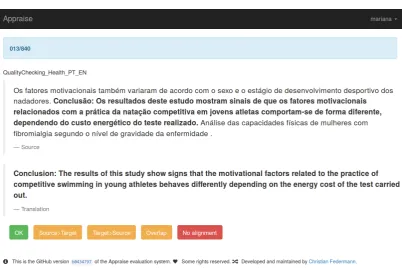
We manually checked the automatic alignment generated by the GMA tool to ensure the quality of the corpora. Sta-tistical MT tools need to rely not only on parallel col-lections of documents, but also on parallel colcol-lections of aligned sentences. We randomly selected 100 publications (titles and abstracts) for each category, i.e., Biological Sci-ences and Health SciSci-ences, and for each of the three pairs of languages, i.e., PT/EN, ES/EN and FR/EN. The sentences were converted into the XML format of the Appraise tool10 and loaded into the tool. Each of the authors validated the documents pair for his or her native language, i.e., MN for Portuguese, AJY for Spanish and AN for French. The sen-tences were validated using the ”Quality Checking” task (cf. Figure 2) available in Appraise to check the degree of alignment between each pair of sentences. We defined five categories to classify the alignment: (a) “OK”, when the alignment is correct and both sentences contains the same information; (b) “Source>Target”, when the alignment is correct but the source contains more information than the target; (c) “Target>Source”, when the alignment is correct but the target contains more information than the source; (d) “Overlap”, when there is an overlap in the information content of both sentences but they cannot be considered aligned; (e) “No alignment”, when the sentences are un-related and there is no alignment.
3.5.
Machine Translation Evaluation
We trained a statistical MT system on the parallel corpora to demonstrate the capabilities of the proposed corpus, For this purpose, we used Moses11(Koehn et al., 2007) as the statistical MT tool. The BLEU score (Papineni et al., 2002) has been used as the translation evaluation measure.
9
http://nlp.cs.nyu.edu/GMA/
10
https://github.com/cfedermann/Appraise
Figure 2: Screen-shot of the Appraise tool during the validation of the alignment of a EN/PT pair of sentences.
4.
Results and Evaluation
In this section, we present the statistics on our corpus and its evaluation regarding two aspects: the quality of sentence alignment and the corpus suitability for training and evalu-ation of MT algorithms.
4.1.
Corpus Statistics
Table 1 presents statistics of the training data, including the proportion of titles and abstracts and the total num-ber of documents, sentences and tokens. The corpus is currently available for download12 in the BioC XML for-mat (Comeau et al., 2013), a forfor-mat which is becoming a standard in the biomedical natural language processing (BioNLP) community. Using this format also ensures the integration of our corpus with tools and other corpora as well as making use of any of the available BioC implemen-tations (e.g. Java, Python or C++). The following metadata are available for each document in the corpus: subject (Bi-ological Sciences or Health Sciences), language (EN, FR, PT, ES), and zone in the document (title or abstract). The documents are split by sentences according to the analysis we obtained using the HANA database.
As discussed above, the training data is currently being used in the scope of the biomedical task in the WMT16 challenge. Besides the training data, we also released a par-allel corpus of MEDLINE titles, similar to the dataset used in our previous work (Jimeno Yepes et al., 2013), the mono-lingual documents obtained from Scielo and all alignment output on the sentence and word level that we obtained from the GMA tool.
12https://drive.google.com/folderview?id=
0B3UxRWA52hBja0t2azlkN3d2elk&usp=drive_web
As observed in table 1, and due to the focus of the Sci-elo database on journals from Latin America, the number of documents is much larger for Portuguese and Spanish compared to French, for both categories and for both the parallel and monoligual datasets. Indeed, the number of parallel documents for FR/EN and the Biological Sciences category was so low that we do no provide any training and test datasets for it. Alternatively, it is possible to train a MT system for the Biological Sciences using documents from the Health Sciences, or even completely ignore categories and use a single system trained on the whole dataset for a given language pair.
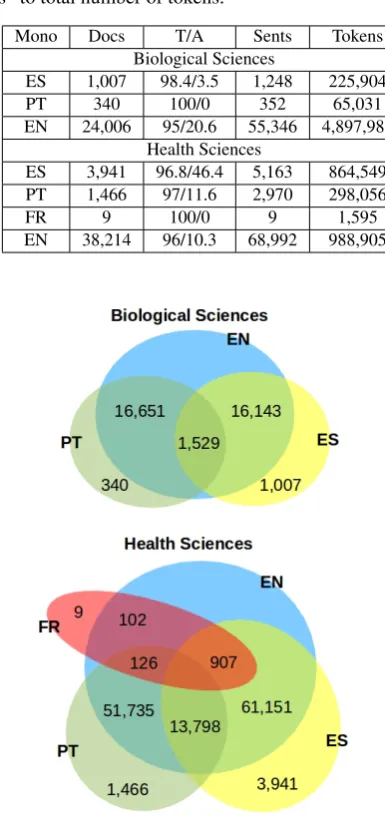
Regarding percentages of titles and documents in the train-ing data, table 1 shows that more abstracts are available in comparison to titles. This aspect is due to the high number of documents in Scielo that have their abstract translated to other language but not their titles, such as document S0874-48902010000300006 cited above. This is certainly a good feature of our corpus, given that previous parallel corpora of biomedical publication were restricted to MEDLINE ti-tles (Kors et al., 2015; Jimeno Yepes et al., 2013). On the other hand, the monolingual datasets are mainly composed of titles, due to the same reason stated above, i.e., the exis-tence of many articles whose titles were been translated to other languages. Finally, we officially released only parallel datasets that include English in the language pair. However, there are some documents which are available for other lan-guage pairs, such as ES/PT, ES/FR and FR/PT, as illustrated in Figure 3.
4.2.
Alignment Quality
Table 1: Statistics on the parallel training and test col-lections according to the categories and the available lan-guages. “T” corresponds to percentage of titles and “A” to percentage of abstracts, separated by a slash. “Docs” to total number of documents, “Lang” identifies the lan-guage,“Sents” to total number of sentences and “Tokens” to total number of tokens.
Train Docs T/A Lang Sents Tokens Biological Sciences
EN/ES 17,672 49.4/97.7 EN 138,073 3,819,190 ES 128,894 3,887,818 EN/PT 18,180 31.1/96.1 EN 128,357 3,807,296 PT 125,717 3,598,618 Health Sciences
EN/ES 75,856 55.6/99.5 EN 628,966 15,978,198 ES 606,231 17,168,994 EN/PT 65,659 74.0/92.8 EN 541,272 14,457,939 PT 525,721 14,447,017 EN/FR 1,135 64.5/99.7 EN 9,393 250,907
FR 9,501 320,132
Test Docs T/A Lang Sents Tokens Biological Sciences
EN2ES 500 100/100 EN 4,344 116,388 ES 4,070 125,491 ES2EN 500 100/100 ES 4,113 124,343 EN 4,405 115,045 EN2PT 500 100/100 EN 4,333 114,705 PT 4,205 120,591 PT2EN 500 100/100 PT 4,029 114,970 EN 4,164 108,120 Health Sciences
EN2FR 500 100/100 EN 5,093 137,321 FR 5,782 208,795 FR2EN 500 100/100 FR 5,784 206,559 EN 5,178 137,638 EN2ES 500 100/100 EN 5,111 127,112 ES 5,027 141,473 ES2EN 500 100/100 ES 5,198 144,666 EN 5,276 128,742 EN2PT 500 100/100 EN 3,858 99,001
PT 3,776 101,991 PT2EN 500 100/100 PT 3,826 106,735 EN 3,930 102,813
(ES/EN, PT/EN, FR/EN) for Biological Sciences and 844, 840, 977 (ES/EN, PT/EN, FR/EN) for Health Sciences. The rate of aligned sentences (i.e., “OK”) varies from 79% to 85% while the rate of sentences that were not aligned (i.e., “No alignment”) is less that 3%. The rate of sentences with overlap of information is also very low, up to 3.5%, while the proportion of sentences in which either the source or the target contains more information than the other lan-guage varies across the lanlan-guages and subjects, but usually ranges from 5% to 10% (cf. Figure 4).
Differences between the parallel sentences occur for a va-riety of reasons. When the source text contains more infor-mation than the target text, or vice-versa, it is usually due to the authors failing to include some content during the
trans-Table 2: Statistics on the monolingual collections accord-ing to the categories and the available languages. “T” cor-responds to percentage of titles and “A” to percentage of abstracts, separated by a slash. “Docs” to total number of documents, “Sents” to total number of sentences and “To-kens” to total number of tokens.
Mono Docs T/A Sents Tokens Biological Sciences
ES 1,007 98.4/3.5 1,248 225,904 PT 340 100/0 352 65,031 EN 24,006 95/20.6 55,346 4,897,988
Health Sciences
ES 3,941 96.8/46.4 5,163 864,549 PT 1,466 97/11.6 2,970 298,056
FR 9 100/0 9 1,595
EN 38,214 96/10.3 68,992 988,905
Figure 3: Size of the training datasets for each category, language pair, across language pairs and monolingual cor-pora. (The figure is not in scale.)
lation, or adding more content instead. For instance in the English sentence “Analysis of the composition of Brazil-ian propolis extracts by chromatography and evaluation of their in vitro activity against gram-positive bacteria.” con-tains only one word more (“gram-positive”) than its par-allel sentence in Portuguese. Other examples exhibit more significant content difference, such as in the sentence “Sal-icylic acid degradation from aqueous solutions using Pseu-domonas fluorescens HK44: parameters studies and appli-cation tools.”, where all the text after the colon is missing in the Portuguese sentence.
tool has a high quality, there are still some cases in which two unrelated sentences were aligned. This is the case of the English sentence “This richness was similar to that previously reported for the Tucum´an Province, although species occurring in both provinces were mostly different.”
which was aligned to the Spanish sentence “Los mayores valores de riqueza espec´ıfica se encontraron en el extremo norte de la provincia (R=32), donde a su vez se registra la mayor cantidad de muestreos.”. Nevertheless, both sen-tences share some words in common, such as the words
“province/provincia”and“richness/riqueza”.
Figure 4: Percentage of the errors in the quality assessment of the corpus.
4.3.
Machine Translation Experiments
The data sets developed for each language pair and science field are split to train and tune the Moses MT tool. From the whole set of aligned sentences, 10,000 sentences were kept for tuning while most of the aligned sentences were used for training. The EN/FR Health Sciences Scielo set has less than 10,000 aligned sentences, so all the sentences from this set were used for both training and tuning steps. For training Moses, we enhanced the Scielo sentences using bilingual article titles from PubMed, which helps increas-ing the lexical coverage of the Scielo corpus.
We followed the training example from Moses web site13 and the results are presented in Table 3. Compared to pre-vious work (Jimeno Yepes et al., 2013), the BLEU score of EN/ES is higher compared to a corpus using aligned bilingual abstracts. BLEU score for EN/FR is lower com-pared to previous work, however, the Scielo set for EN/FR is much smaller. No previous results for a similar work are available for EN/PT, but results are similar to the ones ob-tained for EN/ES. Our results indicate that the Scielo corpus can be effectively used to train a statistical MT system for EN/ES and EN/PT language sets.
4.4.
Corpus quality
It can be argued that the evaluation of sentence alignment and the BLEU scores obtained in the machine translation
13http://www.statmt.org/moses/?n=Moses.
Baseline
Table 3: Baseline results for MT based on the Scielo corpus
Datasets BLEU
Biological Health
ES-EN ES2EN 30.53 28.66 EN2ES 32.75 31.11
PT-EN PT2EN 29.40 31.78 EN2PT 31.98 33.37
FR-EN FR2EN - 13.52
EN2FR - 15.34
experiments provide a positive evaluation of the corpus quality as a whole. However, in our manual review of sen-tence alignment, we found some examples where the lan-guage quality of the corpus was lacking. Minor issues in-clude consistency in the encoding so that special charters such as apostrophes or accented letcharters need to be ac-counted for carefully. More severe issues were found with the fluency and correctness of one or both of the languages of the document perused. We believe this to be a direct re-sult of the training of the article authors who are not profes-sional translators, and who may have limited proficiency in one or more of the languages they need to use when writing articles. Below is a description of the error types commonly found:
• mistranslation conveying erroneous meaning: the sen-tence“Certains patients ont affirm´e qu’ils n’avaient aucune raison de demander des explications.” was translated by“Some inpatients stated that they had no reason for not seeking clarity.”instead of“...for seek-ing clarity.”.
• grammatical error: “une consommation nocif ” in-stead of“une consommation nocive”(erroneous gen-der agreement between adjective and noun).
• lexical error: “success in attaining vaginal delivery”
was translated by“la r´eussite d’un accouchement par voie vaginale”instead of“la r´ealisation...”.
• A combination of error types: “All this resulted in laws favouring parents interests over embryo’s rights.” was translated into French as “Tout c¸ela est traduit en l´egislations qu’ont superpos´es l’int´erˆet des parents sur les droits de l’embryon.”, a sentence that conveys a different meaning from the original sen-tence and exhibits grammatical errors (“traduit en”
instead of “traduit par”, “qu’ont” instead of “qui ont”) and erroneous lexical choices (“superpos´e” in-stead of“privil´egi´e”). A better translation would have been: “Tout c¸ela s’est traduit par des l´egislations qui ont privil´egi´e l’int´erˆet des parents plutˆot que les droits de l’embryon.”
5.
Conclusions and Future Work
We presented the development of the first parallel corpus of biomedical titles and abstracts freely available in three lan-guage pairs: EN/ES, EN/FR and EN/PT. We describe the crawling of the documents from Scielo, language recogni-tion, sentence splitting and sentence alignment using state-of-the-art tools. For quality assurance, sentence alignment were manually validated, and found to be correct for around 80% of sentence pairs in ES/EN and PT/EN in the Biologi-cal Sciences set and around 87% in FR/EN. This percentage is higher, around 85%, in the Health Sciences for ES/EN and PT/EN. Baseline machine translation experiments were performed and achieved a BLEU score higher compared to previous work for well covered language pairs.As further work, we could evaluate the contribution of ad-ditional, in and out of domain, available corpora to improve MT results. We plan to make the training set available in community challenges (e.g. ACL WMT’16) so the re-search community can experiment with additional transla-tion methods. Finally, it would be interesting to use this corpus in a task that could be used in a practical context.
6.
Acknowledgments
MN acknowledges computing resources from the HPI Fu-ture SOC Lab. AN was supported by the French National Research Agency under grant CABerNeT ANR-13-JS02-0009-01.
7.
Bibliographical References
Bojar, O., Buck, C., Federmann, C., Haddow, B., Koehn, P., Leveling, J., Monz, C., Pecina, P., Post, M., Saint-Amand, H., Soricut, R., Specia, L., and Tamchyna, A. (2014). Findings of the 2014 workshop on statistical ma-chine translation. InProceedings of the Ninth Workshop on Statistical Machine Translation, pages 12–58, Balti-more, Maryland, USA, June. Association for Computa-tional Linguistics.
Comeau, D. C., Islamaj Do˘gan, R., Ciccarese, P., Cohen, K. B., Krallinger, M., Leitner, F., Lu, Z., Peng, Y., Ri-naldi, F., Torii, M., Valencia, A., Verspoor, K., Wiegers, T. C., Wu, C. H., and Wilbur, W. J. (2013). Bioc: a min-imalist approach to interoperability for biomedical text processing.Database, 2013.
Jimeno Yepes, A., Prieur-Gaston, E., and Neveol, A. (2013). Combining medline and publisher data to create parallel corpora for the automatic translation of biomed-ical text. BMC Bioinformatics, 14(1):146.
Kirchhoff, K., Turner, A. M., Axelrod, A., and Saavedra, F. (2011). Application of statistical machine translation to public health information: a feasibility study. Jour-nal of the American Medical Informatics Association, 18(4):473–478.
Koehn, P., Hoang, H., Birch, A., Callison-Burch, C., Fed-erico, M., Bertoldi, N., Cowan, B., Shen, W., Moran, C., Zens, R., et al. (2007). Moses: Open source toolkit for statistical machine translation. InProceedings of the 45th Annual Meeting of the ACL on Interactive Poster and Demonstration Sessions, pages 177–180. Associa-tion for ComputaAssocia-tional Linguistics.
Koehn, P. (2005). Europarl: A Parallel Corpus for Sta-tistical Machine Translation. In Conference Proceed-ings: the tenth Machine Translation Summit, pages 79– 86, Phuket, Thailand. AAMT, AAMT.
Koehn, P. (2010). Statistical Machine Translation. Cam-bridge University Press, New York, NY, USA, 1st edi-tion.
Kors, J. A., Clematide, S., Akhondi, S. A., van Mulligen, E. M., and Rebholz-Schuhmann, D. (2015). A multilin-gual gold-standard corpus for biomedical concept recog-nition: the mantra gsc. Journal of the American Medical Informatics Association, 22(5):948–956.
N´ev´eol, A., Max, A., Ivanishcheva, Y., Ravaud, P., Zweigenbaum, P., and Yvon, F. (2013). Statistical ma-chine translation of systematic reviews into French. In Rita Temmerman et al., editors,Proceedings of the TIA Workshop on ”Optimizing understanding in multilingual hospital encounters”, page 4p, October 30th, 2013. N´ev´eol, A., Grouin, C., Leixa, J., Rosset, S., and
Zweigen-baum, P. (2014). The QUAERO French medical corpus: A ressource for medical entity recognition and normal-ization. InProc of BioTextMining Work, pages 24–30. Papineni, K., Roukos, S., Ward, T., and Zhu, W.-J. (2002).
Bleu: A method for automatic evaluation of machine translation. InProceedings of the 40th Annual Meeting on Association for Computational Linguistics, ACL ’02, pages 311–318, Stroudsburg, PA, USA. Association for Computational Linguistics.
Pecina, P., Duˇsek, O., Goeuriot, L., Hajiˇc, J., Hlav´aˇcov´a, J., Jones, G., Kelly, L., Leveling, J., Mareˇcek, D., Nov´ak, M., Popel, M., Rosa, R., Tamchyna, A., and Ureˇsov´a, Z. (2014). Adaptation of machine translation for multilin-gual information retrieval in the medical domain. Artif Intell Med, 61(3):165–85, Jul.
Steinberger, R., Pouliquen, B., Widiger, A., Ignat, C., Erjavec, T., Tufis, D., and Varga, D. (2006). The jrc-acquis: A multilingual aligned parallel corpus with 20+ languages. In Proceedings of the 5th Interna-tional Conference on Language Resources and Evalua-tion (LREC’2006), Genoa, Italy.
Tiedemann, J. (2012). Parallel data, tools and interfaces in opus. In Nicoletta Calzolari, et al., editors,LREC, pages 2214–2218. European Language Resources Association (ELRA).
Wu, C., Xia, F., Deleger, L., and Solti, I. (2011). Statis-tical machine translation for biomedical text: Are we there yet? AMIA Annual Symposium Proceedings, pages 1290–1299.
8.
Language Resource References
(2010).Appraise.(2010).GMA (Geometric Mapping and Alignment). (2010). Moses Phrase-based Statistical Machine
Transla-tion system.